What is a Jefimok?
A Jefimok—plural: Jefimiki—is a coin weighing one taler that has been made legal tender by the Russian authorities through the application of a countermark or counterstamps for circulation in Russia.
Where does the term “Jefimok” come from?
The Russian term is a phonetic adaptation of the Czech name of one of the most important centers of taler production. Jáchymov (short for Joachimsthal) became Jefimok. As travel accounts attest, this term dates back to the 17th century.
What does “Jefimok” mean?
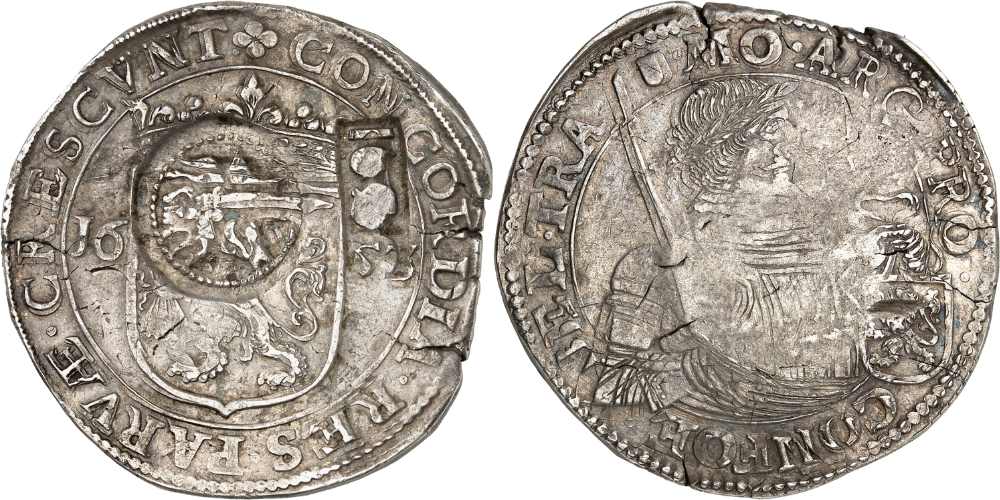
While in Russia, the term “Jefimok” was once used to refer to any Western European coin that matched the taler in weight and fineness, numismatists now use the term exclusively for the talers that were overstamped with two countermarks under Tsar Alexei Mikhailovich in the years 1754 and 1755. Thanks to these two countermarks or counterstamps, foreign talers could circulate quite widely throughout the country at a value of 64 kopecks.
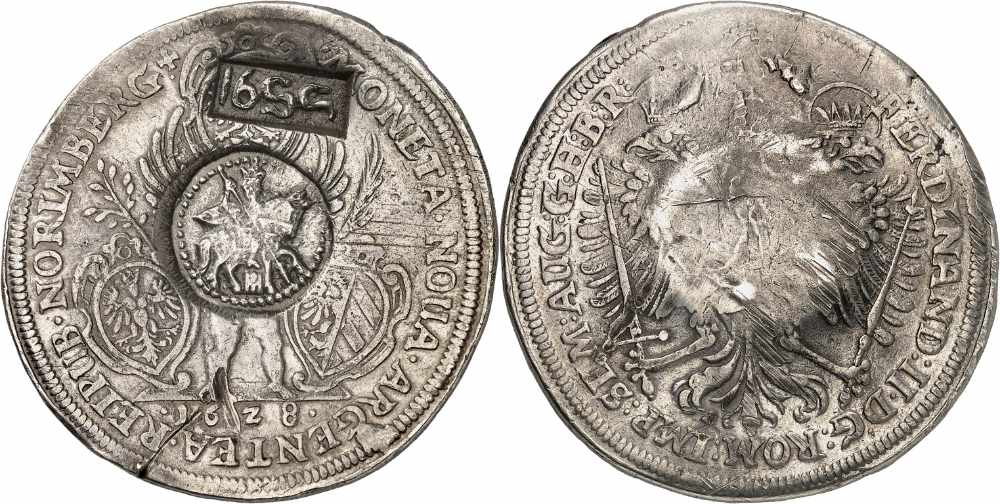
The design of the round countermark corresponds to the one used for kopecks. It depicts a horseman with a spear slaying a dragon. Whether this horseman represents St. George or the tsar is a moot point. For the close association between the Russian ruler and the country’s patron saint was precisely the intention. Above the horseman’s head, there is usually a rectangular die with the cipher of year 1655.
The Historical Background of the Jefimki
Today, Russia is the world’s seventh-largest producer of Silver thanks to its Siberian mineral resources. Things were different under Alexius Mikhailovich. It was Peter the Great who first began systematically searching for Silver in the Donetsk and Altai Mountains. Before him, the country relied on silver imports from Western Europe. These entered the country primarily in the form of thalers as payment for furs, wax, and wood. A foreigner received the equivalent of 36 to 36.5 silver kopecks for his thaler.
In 1654, the Russo-Polish War broke out and drained the already depleted state treasury at a breathtaking pace. Creative measures for money creation were called for. Initially, it was decided to mint the kopecks in copper instead of silver. Theoretically, copper and silver kopecks had the same value. However, the state paid in copper and collected taxes in silver.
The yefimkas emerged as a new large coin. Initially, the Russian authorities attempted to over-stamp the thalers with their own dies. When this proved too costly and time-consuming, they switched in 1655 to simply applying two countermarks or counterstamps, which suddenly gave a thaler a denomination of 64 kopecks. A good deal for the state treasury!
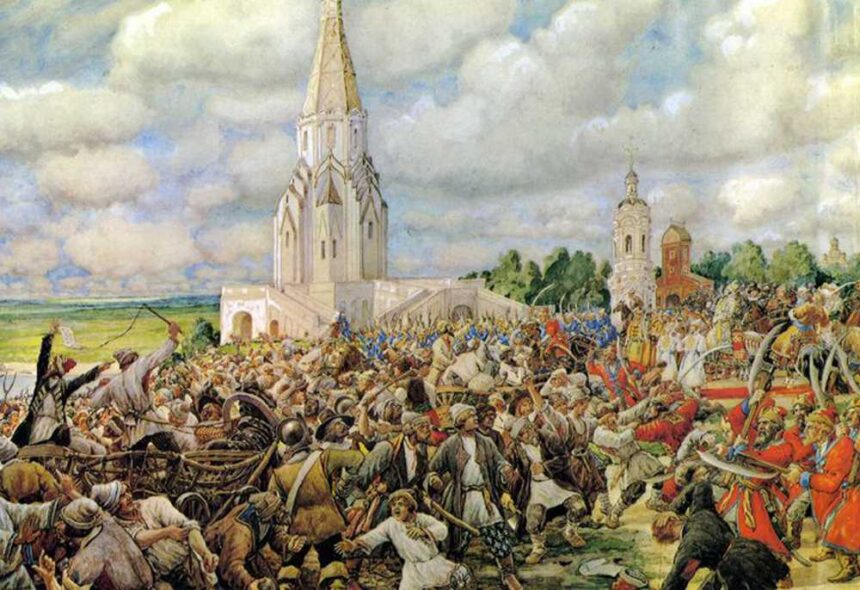
The jefimki were taken out of circulation as early as 1659. By that time, the new copper kopecks had already lost a dramatic amount of value. Money changers were charging 6 to 8 copper kopecks for a single silver kopeck. By 1662, inflation had risen to such an extent and caused so much hunger and misery among the urban population that an insurrection broke out. Leaflets attest that the citizens clearly understood that it was the state, through its currency manipulations, that had caused their misery. In them, high-ranking and top politicians are accused of counterfeiting.
Later historians named the insurrection the Copper Uprising—медный бунт. This term has become a catchphrase in Russia, used to describe any currency crisis, inflation, or devaluation, quite regardless of whether copper coins are involved or not.
What is the value of a Jefimok today?
Of course, there’s no one-size-fits-all answer to such a broad question. So let’s take a look at two specific examples. Our cover image is taken from the upcoming auction by Heidelberger Münzhandlung. It will take place on May 12 and 13, 2026, and features a lovely series of Russian rarities, including two Jefimoks.
The Jefimok shown above on a Nuremberg taler from the year 1628 is estimated at 3,500 euros. The Jefimok shown here on a Utrecht taler starts at 2,200 euros. We’ll have to wait and see what the market is willing to pay for these two pieces.
Text by Ursula Kampmann