King Kroisus and his significance for the monetary system
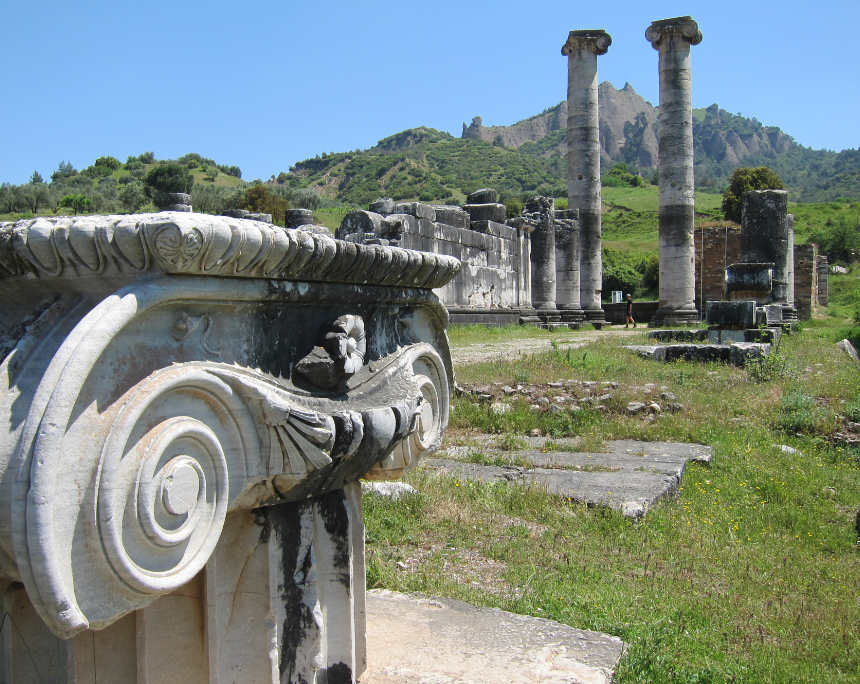
Let us go back to the beginnings of Western coinage and travel to Sardis, in the economically powerful kingdom of Lydia, which lay between the Greek cities on the Turkish west coast and the Persian Empire. As always in regions with strong cultural exchange, new things emerged here. These included a medium for economic life that was destined for a great future: the coin. Initially, these were “only” small bars of electrum with a standardized weight. This made them simply another medium of exchange, like cattle or tripods, which were used instead in the Iliad.
These electrum bars were only used in trade in exceptional cases. They were much more useful for saving. Or when a large sum had to be distributed evenly among many people, for example to mercenaries during a campaign. If these small bars were then used again, their value had to be determined before each transaction. This was because the alloy fluctuated. And since the gold and silver cast together in the electrum represented different values, the exact ratio had to be measured each time. There was a simple method for this, which, incidentally, was used until modern times. A small amount was rubbed on a touchstone and the color was compared with known alloys.
The coin reform of Kroisus
This complex process may have given a ruler of the Lydian Empire the idea of specifying not only the weight of these coins, but also their alloy. From then on, coins were made of either gold or silver. Even in ancient times, this coin reform was linked to the legendary Kroisus, whose fate was described in detail by Herodotus. The first coins of Kroisus – known in ancient times as Κροίσειοι στατῆρες, Kroisus staters – are therefore among the central milestones in the history of coinage.
In this article, we present two of the earliest known pieces in the series. They will be auctioned on January 12, 2026, at an auction held by the American auction house Heritage.

What can be seen on the front of the coins of Kroisus?
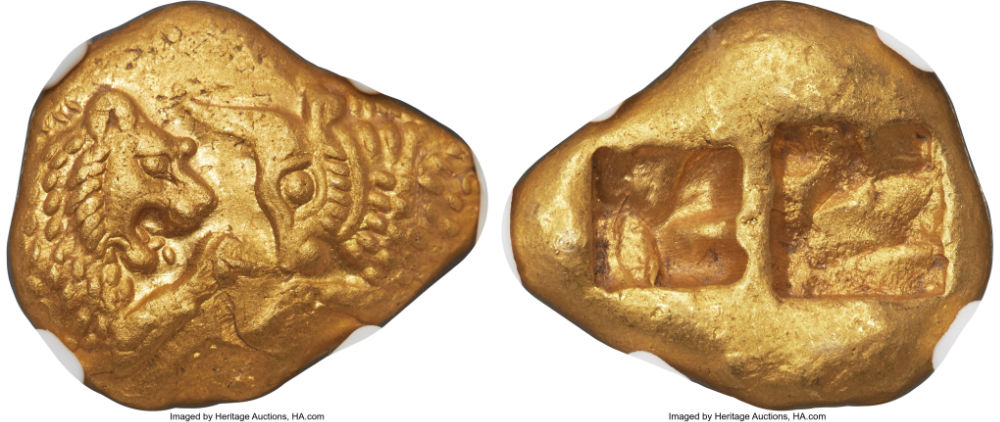
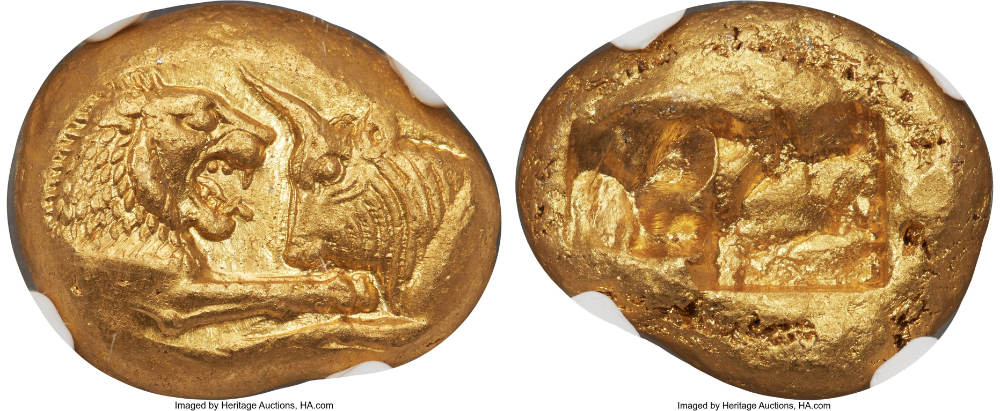
The front of all coins of Kroisus shows a very simple design, namely the protomes of a lion and a bull facing each other. Perhaps precisely because this motif is so simple, there is heated debate about what the lion and bull might represent. The various theories that have been put forward can be reduced to six different approaches, which have one thing in common: they can neither be proven nor disproven.
- Metallurgical: The lion with its golden yellow coat represents gold, while the bull represents silver.
- Cosmic: Here, the lion symbolizes the golden sun and the bull the silver moon.
- Dynastic-political: The previous Lydian coins already featured a lion; could this mean that the bull stands for Kroisus himself and the lion for the dynasty? However, this raises the question of why the Persians adopted the motif.
- Symbolic: Harlan Berk refers to the well-known characteristics of the animals, with which a ruler would certainly have liked to identify: the powerful lion, the fertile (and thus prosperity-bringing) bull.
- Religious: The lion and bull as symbols of popular deities such as Zeus or the Assyrian Lamanassu.
- Artistic: Perhaps the seal carver adopted a motif commonly used in royal representations, namely the battle between the lion and the bull. This cannot be ruled out, as this motif is often found in reliefs, on jewelry, and many other objects.
Which of these theories should be given preference? No idea. Take your pick!
How do you date the first Kroisus legends?
Many catalogs adhere to Herodotus’ dating of King Kroisus’ life as 561-546. This is practical, but it may not be accurate. Today, there is lively debate as to whether Herodotus may have used symbolic figures. Like the seven good and seven bad years in the Bible, he divides the 14 years of Kroisus’ reign into seven good and seven bad years.
Many scholars today follow Robert W. Wallace, who assumes a much earlier beginning to Kroisus’ reign. He assumes that he took over the rule of Lydia in the 580s. This would place Kroisus’ coinage reform in the 570s, not around 550 as previously thought.
How do we know which coins of Kroisus are the first?
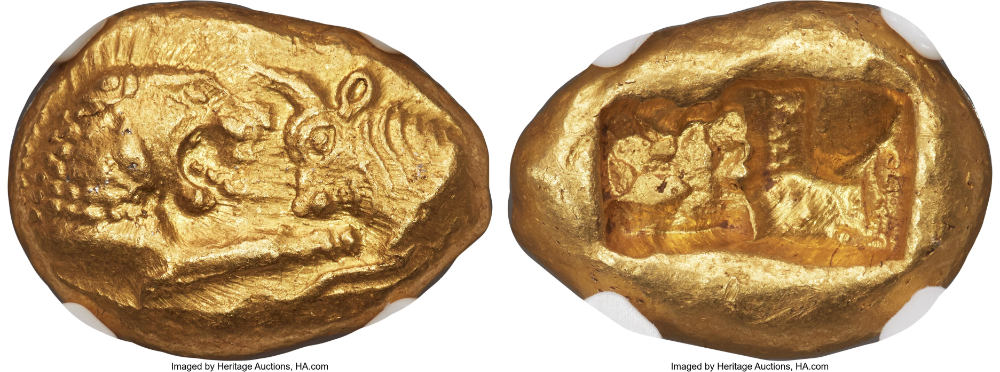
Let’s briefly summarize how the Kroisus series is structured. First, there is a division into heavy and light staters. In the heavy series, gold and silver staters weigh the same, namely 10.6 to 10.7 g. In the light series, the weight of the gold staters is reduced to 8.17 g. Apparently, both series circulated side by side, but the heavy series was only used for a very short period of time, while the light series continued to be minted after the conquest of Lydia by the Persians.
In addition to weight, style is also important for chronological classification. A distinction is made between “realistic” and “stylized” depictions. Based on hoard finds, we know that the ‘realistic’ pieces predate the “stylized” ones.
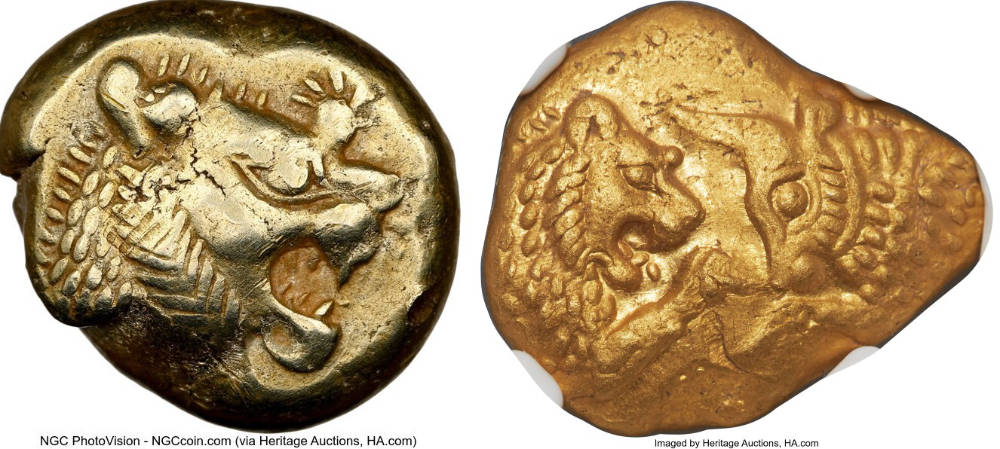
Some extremely rare pieces stand out from the rest, as Paolo Naster first recognized in 1964. Their style is described as “archaic” and their appearance is associated with the early Lydian electrum coins, which are often attributed to Alyattes, the predecessor of Kroisus. Particularly important in this regard is the small round wart above the nose, which is no longer visible on later issues. For this reason, these pieces are considered to be the first of the coins of Kroisus and are referred to as prototypes.
The missing link between prototype and series minting
The coin offered by Heritage in its NYINC auction is now a particularly interesting “missing link,” a coin that connects early archaic minting with realistic minting of heavy staters—namely through one of the two reverse dies. The exact same die was used for three of the archaic coins of Kroisus.
The coins of Kroisus
This marked the beginning of the minting of heavy staters, followed by light staters, which continued to be minted by the Persians for a long time. As late as the 5th century BC, they appear in the treasurer’s accounts of Athens, specifically in a settlement for the gold and ivory statue of Athena Parthenos, which is said to have been created by Phidias.
What is the prototype of the Kroisus worth? What about the Missing Link?
The last prototype sold at Heritage 2022 was estimated at $30,000–50,000 and sold for $90,000. This piece appears to be in slightly better condition, so it could fetch more.
There is no precedent price for the so-called Missing Link. It will be interesting to see whether buyers are willing to pay the same price for its extraordinary monetary historical significance as they would for one of the prototypes.
The auction results
The final prices for the two coins have now been announced. The results are impressive: a collector was willing to pay $320,000 for the prototype of the Krösus coin. Including the buyer’s premium, this amounts to a total of $390,400. The Missing Link fetched even more. The hammer price was $440,000, including the buyer’s premium of $536,800. By way of comparison, a perfect stater of Croesus from the usual light series fetched a hammer price of $50,000.
The complete catalog of the Heritage auction can be found here.
Text by Ursula Kampmann