Saudi Arabia's First Islamic Coin

Islamic coins are actually easy to identify, as their inscriptions provide information about the year they were minted and the place where they were made. However, this information is hidden in Arabic script. For this reason, Islamic coins are treated somewhat disparagingly in the Western world as a field of collecting that is of interest only to specialists. It is only in Dubai or Riyadh that one realizes how many enthusiastic collectors of Islamic coins there actually are. This could have been known beforehand. After all, US coins have to share the ranks of the top ten most expensive coins in the world with some Islamic pieces. We present one of these coins in this article. The coin, which looks relatively unspectacular to the layman, has the potential to fetch USD 6 million or more.
What can be seen on the dinar?
Anyone who has seen one Umayyad dinar and does not speak Arabic believes they have seen them all. This is because the design is always similar. On the front and back, there is an inscription and a few lines filling the space. This is also the case with this coin.
On the front, along the edge, we read the translation: Muhammad is the messenger of Allah. He sent him with guidance and the true religion to make it prevail over all other religions. In the field we find the Kalima, the beginning of the Islamic creed: There is no god but Allah alone, who has no partner.
On the reverse side, the inscription indicates the date of minting: In the name of Allah. This dinar was minted in the year one hundred and five.
The first lines of the central inscription are also no surprise at first. As usual, they contain an excerpt from the 112th surah: Allah is the One. Allah is the Eternal, Independent. He begets not, nor was He begotten. But then come the last three lines, and they make all the difference. They read: Ma’din / amir al-mu’minin / bi’l-Hijaz, translated as: Mine of the Commander of the Faithful, in the Hijaz.
The Caliph’s Mine and Its Connection to the Prophet
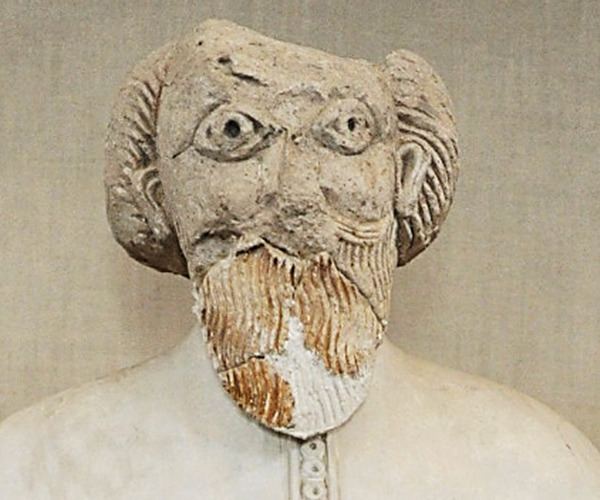
So we are talking about a mine owned by the Caliph in the Hejaz. In the Hejaz! This place name is likely to electrify every devout Muslim. For the Hejaz includes Mecca and Medina, the cities between which the life of the Prophet once unfolded. In fact, thanks to the 9th-century historian al-Balādhurī, we know that the Umayyad caliphs did indeed own a mine in the Hejaz. And this could also be linked to the Prophet Muhammad. Al-Balādhurī reports: ‘The Prophet granted certain mines in the vicinity of al-Furu‘ to Bilal b. al-Harith al-Muzani. Authorities relate that the Prophet had in fact granted Bilal a piece of land where there were both a mountain and a mine. The caliph ‘Umar b. ‘Abd al-‘Aziz later bought part of this land from the sons of Bilal, on which another mine was then discovered. At this, the sellers said, “What we sold you was agricultural land, not a mine,” and they duly presented him with a statement written by the Prophet himself on a palm-leaf. ‘Umar kissed it, and rubbed the Prophet’s writing over his eyes. Then he said to his steward, “Find out what the income and expenses relating to that property are, charge them the expenses and give them the surplus.”’
Why was 105 minted in the Hejaz?
So much for the indisputable facts. And now we could enter into a scholarly discussion about the exact meaning of the inscription on the coin. I will spare you that. If you wish, you can read about it in detail in the Triton catalog of the Classical Numismatic Group. Instead, I will limit myself to repeating what Islam specialist Stephen Lloyd considers likely. One source reports that Caliph Hisham ibn Abd al-Malik ibn Marwan was in the Hejaz in the year he ascended the throne, i.e., 105 AH. This source mentions that he gave a funeral speech in a cemetery near Medina. So what could be more natural than for Hisham to stop by the gold mine he had inherited from his predecessors on his way to Medina? And why not mint a few coins on site with the gold mined there? Incidentally, the obverse die used for this comes from the mint in Damascus, from which we know of coins with the same die. However, the Umayyads often transferred dies from one mint to another.
What is the value of a dinar from the mine of the Commander of the Faithful in the Hejaz?
We know of ten coins that bear this inscription on the reverse and can therefore be linked to the mine of the Commander of the Faithful in the Hejaz. Only two of these have come onto the market so far, and only once each. Both were immediately purchased by institutions which, unlike a private collector, are unlikely to put them back on the market.
The piece offered in Triton Auction XXIX is the third known specimen on the market. It is currently estimated at one million dollars, but everyone knows that this price has nothing to do with the value of the pieces.
The other two coins – both offered by Morton & Eden in London, one in 2011 and the other in 2019 – fetched far more, each selling for exactly £3.1 million. Including the buyer’s premium, this corresponded to USD 6 million in 2011 and USD 4.78 million in 2019.
So there is currently only one example of this coin available for sale. It comes from the private collection of Yahya Jafar / Dubai. Mr. Jafar is a well-known collector and specialist in Islamic coins. He has written several important books and regularly publishes articles in numismatic journals.
We can look forward to seeing what price this remarkable coin will fetch. Perhaps it will set a new record.
What did the dinar from the mine of the Commander of the Faithful in the Hejaz fetch?
The dinar was estimated to be worth $1 million. It was auctioned for $600,000. The hammer price was $1.1 million, which was well below the £3.1 million that the piece fetched in a year earlier. This rare dinar is an excellent example of how coins, just like stocks, can not only rise in price but also fall. The reason for this is often that the group of people interested in a particular coin has shrunk, or that they either already have it or cannot/will not afford it.
The buyer of the dinar made an excellent purchase, as the piece naturally retains its rarity and historical significance. In other words, at another point in time, this coin can and will be worth significantly more. The art of investing lies in buying when prices are low and selling when they are high – and, above all, in having the time to wait for the right moment. This applies not only to stocks, but also to coins!
The complete catalog for the Triton XXIX auction can be found on the Classical Numismatic Group website.
Text and Images by Ursula Kampmann