750,000 CHF for the First Sovereign
Few medieval denominations enjoyed a career comparable to that of the sovereign. The modern sovereign, produced from 1817 onwards as the principal British gold coin, spread throughout their colonial empire and beyond. It was minted on five continents, at the British mints of Melbourne, Sydney, Perth, Ottawa, Bombay, Pretoria, and, of course, London.
Many collectors have specialized in this denomination. Only very few own not only the 19th-century sovereigns but also their medieval predecessors, as these early sovereigns are extremely rare. Scholars estimate that only 20 to 30 exist in total. The finest known example was auctioned at Numismatica Genevensis SA on November 24, 2025. The starting bid was CHF 500,000. The hammer fell at CHF 750,000. Including the buyer’s premium, this sum amounts to approximately €970,000 or almost USD 1.2 million.
What Can Be Seen on the First Sovereign?
The obverse adopts the design of a coin that the future Emperor Maximilian I had created for the Burgundian Netherlands by decree of April 20, 1487. The English ruler ordered it to be adapted to his own needs, while imitating it as closely as possible. Perhaps he even included a lead cast of the original coin with the edict for this purpose. Thus, the English king is depicted wearing a closed crown, which was not customary in England. He also holds the orb.
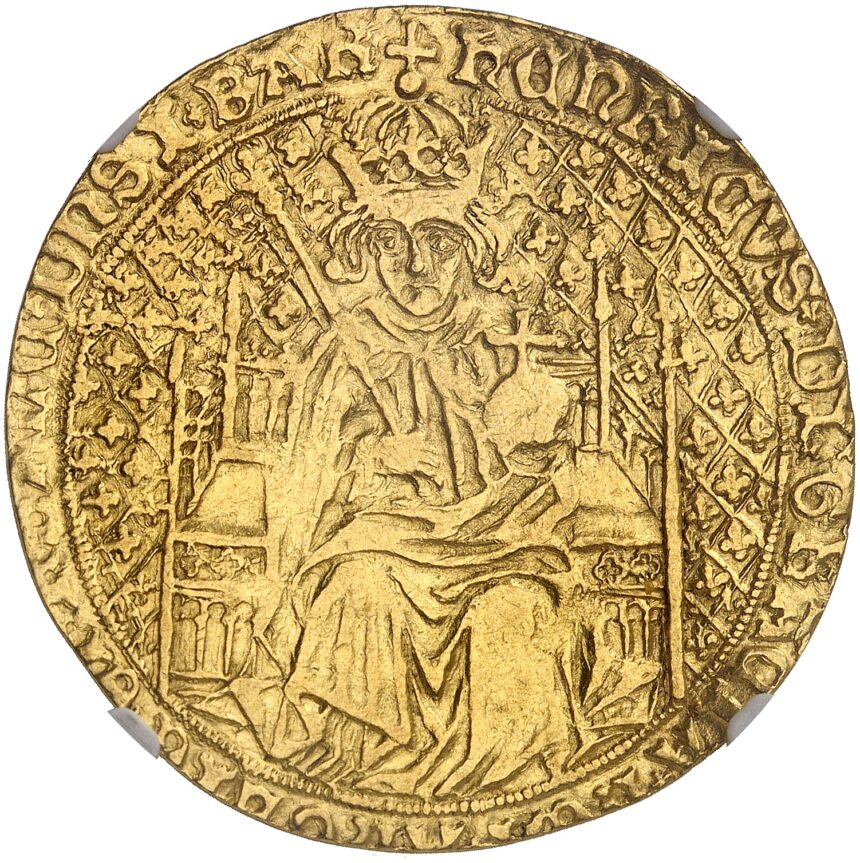
The depiction of the enthroned ruler became so iconic for the self-representation of English kings that Henry VIII had to commission an orb for his coronation. Since the orb had previously played no role in the coronation ritual, this royal prop had not existed before.
The reverse side features the so-called Tudor Rose in the center. It is considered an invention of Henry VII. It dominated his propaganda to such an extent that the term “Wars of the Roses” became established for the English Civil War in the 19th century. The first to use the term was the Scottish historian David Hume. He coined it for the second volume of his ” History of England” published in 1762. Walter Scott, whose popular novels are often set in this era, popularized it.
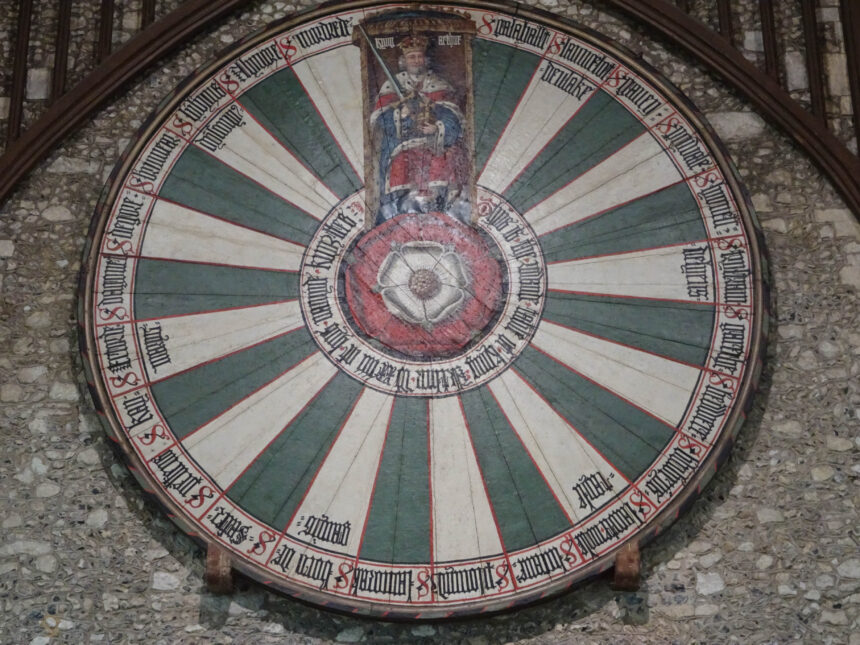
The Tudor rose of the Sovereign is a prime example of how propaganda distorts the perception of history by subsequent generations. In reality, roses were just one of many symbols used as emblems by the noble houses of York and Lancaster. Edward IV preferred the sun, Richard III a white boar or antelope, while the House of Lancaster was identified by the swan. Nevertheless, Henry VII succeeded in establishing the myth that the Tudor rose represented the union of the red rose of the House of Lancaster with the white rose of the House of York, and therefore symbolized his marriage to Elizabeth of York. We still believe him to this day.
What Purpose did the First Sovereigns Serve?
The English sovereigns were minted according to the edict of October 28, 1489, weighing 240 grains (15.55 g) from 23-karat gold and equivalent to 20 shillings or one pound sterling in silver. This marked the first time an English coin was minted that corresponded to the Carolingian unit of account, the “pound.” The sovereign was the most valuable coin minted in England up to that point.
Nobody used them in everyday life. Their value was far too high for that. The annual income of an average worker was about 4 pounds. Daily household expenses for a family amounted to roughly 5 pence.
Sovereigns were therefore primarily used as diplomatic gifts. Indeed, we know of two well-documented examples: Sixteen sovereigns were presented to the Hungarian ambassador during a reception on May 1, 1502. In April 1506, members of the Castilian court received 40 sovereigns.
Where did the Gold for the First Sovereigns Come From?
The Islamic conquest of North Africa cut Europe off from its gold supply via Byzantine solidi. This is evident in the decline of gold coins and the rise of silver in coinage. However, from the 1480s onward, increasing numbers of Portuguese merchant ships sailed to Guinea to acquire the coveted precious metal. From Portugal, the African gold flowed to Europe. Flanders likely played a central role in English gold imports. The wealthy cloth producers in the metropolises of Bruges, Ghent, and Antwerp were the main consumers of Britain’s most important export: wool.

What Message did the Sovereigns Convey to Those who Received Them?
Although Henry VII defeated his rival Richard III at the Battle of Boswell, this did not automatically end the English Civil War. According to medieval inheritance law, Henry had considerably less of a claim to the English throne than, for example, his rival Edward Plantagenet. His only advantage was his marriage to Elizabeth of York, a direct descendant of Edward IV. Their son, Arthur, born on September 20, 1486, was therefore the legal heir to the English crown.
Henry had to convince the world that his rule was legitimate. He achieved this through a finely tuned propagandistic self-representation in which his new gold coins played a crucial role.
Text by Ursula Kampmann