Asklepios plays soccer
Did you enjoy the movie Gladiator II? Great story? Well, it’s all lies and fabrications. It was completely different with Emperor Caracalla and his brother. But the screenwriters are following a long tradition: many historians have already made up lies about Caracalla.
Fratricide vs. raison d’état
Caracalla gave them a perfect excuse by ordering the murder of his brother Geta. He probably had little choice if he wanted to prevent a civil war, as his father had not made the succession clear enough. Geta gathered his supporters to stage a coup and seize power for himself. Ultimately, it would have come down to a military showdown that would have cost thousands of lives if Caracalla had not pulled the plug and had his brother killed. Even their mother subsequently sided with Caracalla.
Cassius Dio, to whom we owe the hateful account of the events, did not. We can only speculate about his reasons. Perhaps he did not like the fact that all inhabitants of the empire now had Roman citizenship. Perhaps he thought the taxes were too high and the priorities wrong. A coin gives us a clue that Caracalla was by no means the ruthless sadist he is often portrayed as.
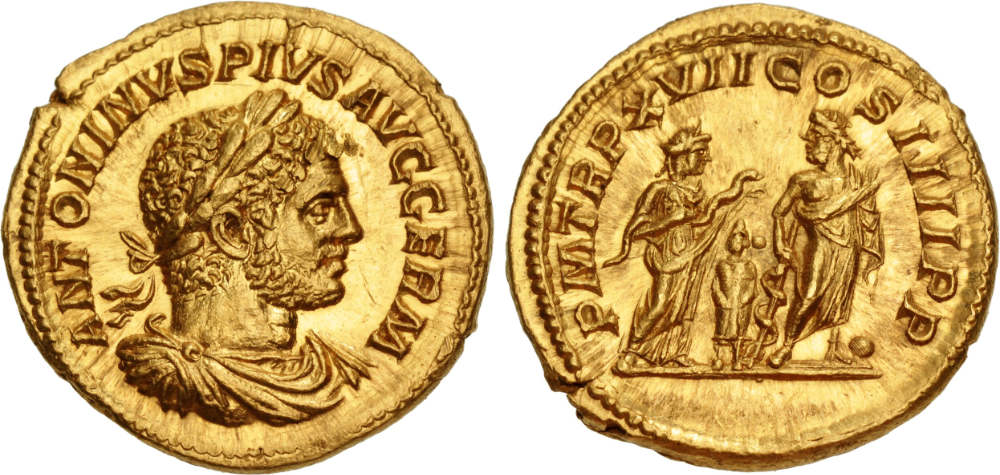
Does Asclepius play soccer?
An aureus of Caracalla from 214 AD depicts three deities. All of them are associated with healing. On the left is Salus, feeding a snake from a bowl; in the middle is Telesphorus in a hooded cloak. His name, “he who brings the end,” describes what he did: he announced the divine decision to the sick person in a dream: healing or death.
To his right, we see Asclepius with his snake staff. But what is that on his foot? Is it a ball? Did Asclepius play soccer?
Of course not. The small ball identified the Asclepius whom Caracalla wanted to honor. For in ancient times, not all gods were equal. There was the Asclepius of Epidaurus, the Asclepius of Kos, the Aesculapius of Tiber Island, and, of course, the Asclepius of Pergamon. It is he who is meant here.
The ball is actually a somewhat unsuccessful representation of an omphalos. Omphalos? The navel of the world? Well, initially, the omphalos was just the burial mound of a hero, and Asclepius – like Heracles – was transformed from a human being into a god, which is what the small omphalos commemorates.
The emperor at the psychotherapist’s?
But why did Caracalla honor Asclepius of Pergamon to such an extent? Well, Cassius Dio, who was so hostile to Caracalla, reports with relish that the emperor was particularly fond of visiting the temples of healing gods because of health problems. He also suffered from horrible dreams in which his brother and father attacked him with drawn swords. Who wouldn’t have done the same in this situation? Today, we would refer to this as psychosomatic. The priests in Pergamon specialized in this field. We do not know what they did, but Caracalla subsequently showed deep gratitude to Asclepius of Pergamon, including by adopting his image for the imperial coinage. Perhaps he felt a little better after the treatment.
Asclepius would appear again and again on the reverse side of Roman coins, usually with the small ball. This was because the Roman die cutters did not understand that it was actually an omphalos. They simply copied their template.

Text by Ursula Kampmann