A reflection of our times
It is an unfounded claim when academics assert that contemporary numismatics has no significance. Such a statement really only shows that, amidst all the hoarded coins and archaeology, many academics have forgotten what a coin is at its best: it is a mirror of our thinking and our culture. It makes quite a difference whether the coins are issued by the state or by private mints. On the contrary: private mints, which are hardly bound by political directives and whose output is geared solely towards sales, do not reflect what a handful of elitist politicians consider to be in the national interest, but rather what we refer to as popular culture – and which has thus become deeply ingrained in our collective memory.
Scottish Highlands
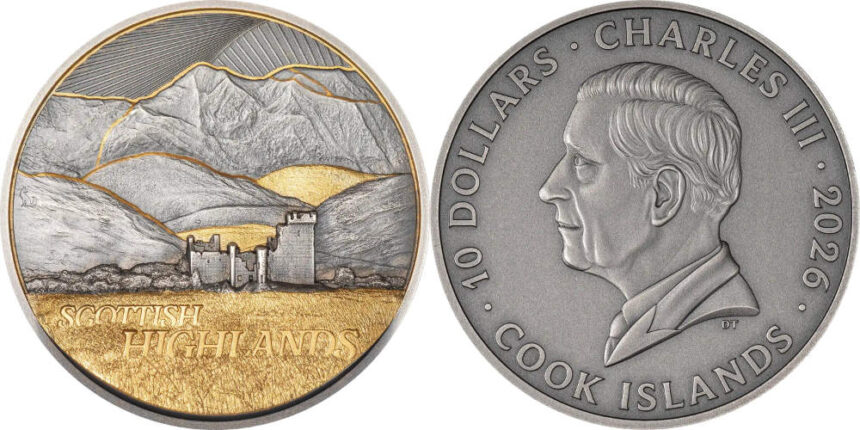
Let’s look at a specific example. In the spring, CIT issued a coin called “Scottish Highlands”. To my knowledge, there are no precedents for this theme. In 2018/9, the Royal British Mint struck a 10-pence coin featuring the Loch Ness Monster. It was part of the very amusing and successful A–Z series and represented the letter L(och). Apart from that, I’m only aware of coins that were struck with Highland cattle or Scottish castles – notably Edinburgh Castle – and that’s about it.
Walter Scott invents the Scottish Highlands
After all, the concept of the Scottish Highlands is hard to pin down. No wonder, as it is a literary fiction. It was invented by the writer Walter Scott (1771–1832). Walter Scott was born in urban Edinburgh into a middle-class family. He lived in one of the country’s most industrialised cities, yet when he visited his cousin in London, people at his club would mock the backward Scots.
Was that what prompted Walter Scott to write his world-famous novels about the heroic chieftains of the Scottish clans? Was that why he contrasted the elegant gentlemen of the City of London with the unpolished powerhouses who, despite lacking any civilised refinement, possessed an unerring sense of right and justice? His novel *Waverley* was a resounding success. With it, Walter Scott single-handedly invented and established the genre of the historical novel. *Waverley* is set during the Second Jacobite Rising, when the Scots fought alongside Bonnie Prince Charles against the English. His novel *Rob Roy*, published shortly afterwards and set at the time of the First Jacobite Rising (yes, in that one too the Scots are fighting the English), sold out within two weeks. That was extremely unusual for that era.
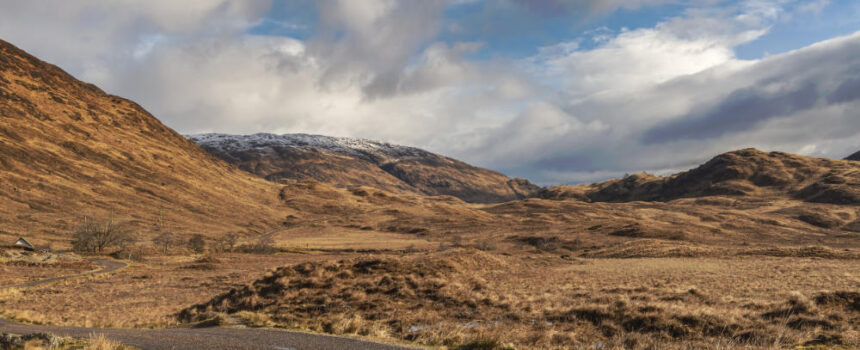
Walter Scott had a marvellous way of imbuing the landscape in which he set his thrilling plots with meaning. He romanticised nature, turning it into a mirror of his protagonists’ souls, and told his readers exactly what they should feel when gazing upon mountains and lochs. Even back then, English ladies and gentlemen enjoyed travelling to the Scottish Highlands to experience the same intense emotions as the protagonists of their favourite stories.
The highlight of Scott’s marketing campaign was a royal visit by George IV in August 1822. Walter Scott took care of every little detail of the staging, creating a Highland symbolism that we still regard as authentic today. The ‘ancient’ tartans worn by the various clans, for example, date back to this celebration.
And with that, Scotland finally became modern. Right up to the present day. In 1848, for instance, the young Queen Victoria leased the Balmoral estate. In the year 1852, she had a new building erected there in a style that many today regard as authentically medieval. In Britain, it is known as ‘Scotch Baronial’ and is the Scottish variant of the historicist style that was quite widespread throughout Europe at the time.
There can only be one!
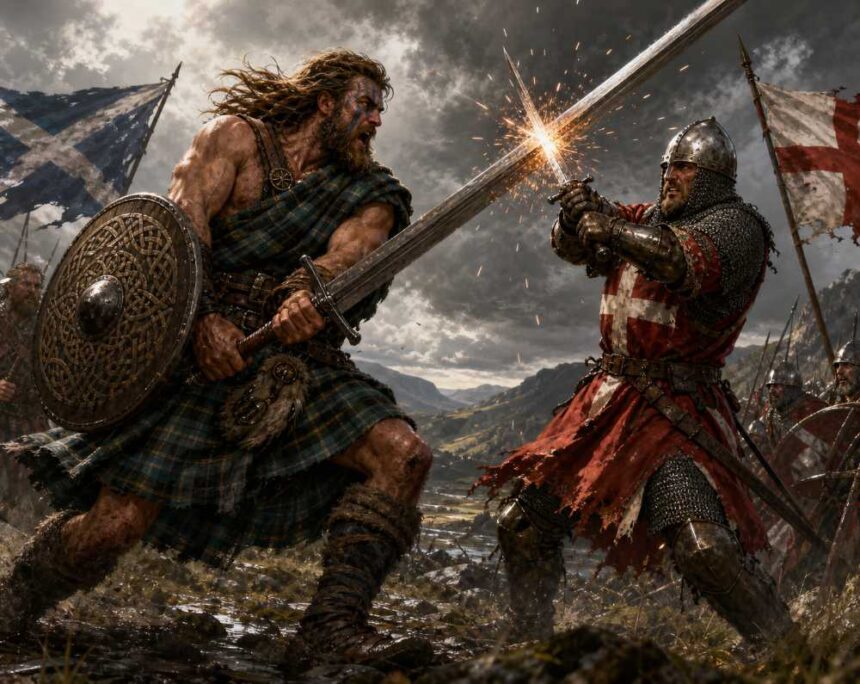
Well, Walter Scott has long since passed away, but his fictional characters live on. And let’s face it: a young, well-built man looks really good in a kilt. And that makes Scots virtually ideal for film and television. Perhaps that’s what the screenwriters were thinking when they created the setting for the film *Highlander*. Because, in principle, it doesn’t actually have much to do with Scotland. It merely uses the Scottish background to give its immortal heroes a heroic past.
The film was a massive success. There were sequels and a TV series, an animated version, a game, a rock band – and they all tell tales of heroic Highlanders and treacherous Englishmen. This inspired countless films. So, in 1995, Mel Gibson donned a kilt to present *Braveheart*, a highly liberalised biography of William Wallace, on which our perceived knowledge of the Scots’ eternal struggle against the British is based.
A younger generation discovered this myth through the TV series *Outlander*, based on Diana Gabaldon’s bestsellers. And once again we see fluttering kilts, brave men, treacherous Britons, magnificent, unspoilt mountains and valleys, where quite a small castle ruin in the far distance adds to the scenery.
This image naturally has its consequences. The Scots like it. Although Scotland has little sunshine, hardly any sandy beaches, no warm water and food that takes some getting used to, 6.45 million overnight stays per year (2024) now generate an income of 756 million pounds. Incidentally, more than half of the visitors come from foreign countries. This creates around 200,000 jobs and generates an annual turnover of 4 billion pounds.
A testament to ‘felt history’
And that brings us back to our historical source: the coin issued by CIT in 2026 featuring the Scottish Highlands. It encapsulates everything a tourist to Scotland hopes to find on their journey. There are the mountains and valleys, bathed in golden light. In the foreground, the glistening barley sways in the wind, from which Scottish malt whisky is distilled somewhere in an unnamed distillery. It is famous for bestowing strength and courage upon true heroes. But those days are long gone, and the lonely castle ruin stands as a testament to a grand past that, in truth, never existed.
This brings us to a fact that no one with an interest in history can deny: this coin superbly encapsulates the popular longings evoked by the term ‘Scottish Highlands’. It is thus a high-calibre testament to our popular culture, to our thoughts, feelings and ‘knowledge’ (or rather, to what we believe we know).
Anyone who is fascinated by Baroque medals and their subtle historical and cultural allusions should not look down on their contemporary successors. Even today, coins bear witness to their era. They artfully distil people’s thinking onto a piece of metal with a minuscule coin diameter. The ideas behind the designs are sometimes more, sometimes less original – just as they were in the Baroque period.
CIT is one of those coin issuers that has its finger on the pulse of the times and their pop culture. I believe that products such as ‘Scottish Highlands’ belong in a museum just as much as the medals of a Sebastian Dadler. And just as Sebastian Dadler’s medals can only be unravelled by those who know their background, it also takes a connoisseur to interpret the allusions to contemporary pop culture in a CIT coin.
Perhaps the disdain with which some numismatists treat modern numismatics stems from the fact that they haven’t been to the cinema often enough.
Text and images: Ursula Kampmann