Etruscan Vetulonia and its coins
Etruscan cities are located on hills. Anyone who has ever taken the grand Etruscan tour knows this rule. Vetulonia is no exception. Located between the small holiday resort of Castiglione della Pescaia and the regional centre of Grosseto, this village is one of those archaeological sites that tourists tend to stumble upon by chance when looking for a change from the beach and sun.
An industrial centre of the Etruscans
Vetulonia (Etruscan: Vatluna or Vetluna) was once an important centre. This can be seen from the fact that, like Cerveteri, Tarquinia and Populonia, it belonged to the Etruscan League.
Vetulonia controlled a vast territory that offered rich deposits of copper, lead, silver and, above all, iron. Vetulonia smelted the material and transported it by sea to Egypt, Phoenicia, Greece and south-eastern France on its own merchant ships. It is hard to imagine today – after all, it takes about half an hour to drive from the coast to the interior – but Vetulonia had a harbour. It was located directly on a lagoon, through which merchant ships reached the open sea.
Today, important tombs outside the city serve as reminders of this period. If you want to visit them, you need an off-road vehicle and/or the courage to take risks. The narrow, unpaved track requires strong nerves, which we (no longer) had. I therefore cannot tell you whether the Etruscan tombs are accessible. Probably not.

Like us, you’d be better off contenting yourself with the Etruscan city wall. It is located in the middle of the town, is well signposted, therefore impossible to miss, and completely unspectacular.
The end of independent Vetulonia
Vetulonia was also part of the Etruscan coalition that stood in the way of Rome’s expansion, or rather, its efforts to secure its borders against its evil and aggressive Etruscan neighbours. Like the other cities, it was punished after its defeat at Lake Vadimone in 283 BC. Vetulonia lost its independence. From then on, a Roman praetor decided what was to happen. Vetulonia’s citizens were granted Roman citizenship, but without the privilege of voting. They paid taxes and provided soldiers, but were not allowed to vote in the popular assembly.
The situation improved in 280 BC when a new treaty was signed. It granted Vetulonia additional privileges, unknown to us, which restored its former prosperity.
Republican Vetulonia
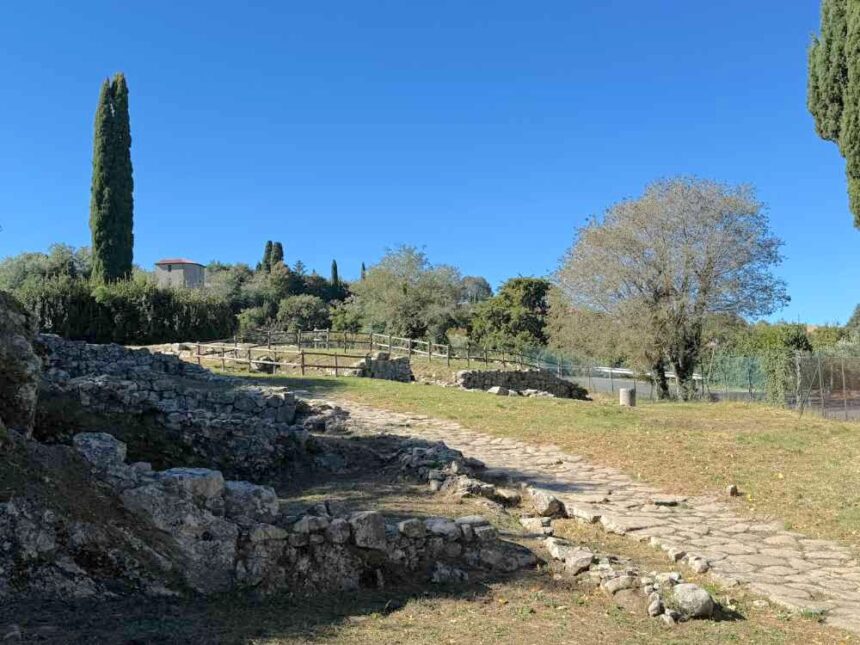
The new wealth is easy to verify on site, as there is a small excavation right at the entrance to the town. There are not many parking spaces there. This is not necessary, as visitor numbers are limited. Nevertheless, the excavation is well maintained, free of charge, open – even during our visit in October – and has information sheets in German and English.
It offers a walk along a typical Via Decumana, as we know it from throughout the Roman world: a wide, stone-paved street lined with small shops. The neighbourhood to which they belong was built after 280. Two large villa complexes illustrate how wealthy the local upper class was during this era. Admittedly, the ruins are not particularly impressive, but the finds are on display in the local museum and bear witness to taste and wealth.
The decline of Vetulonia
Sometime during the Roman Empire, an ecological disaster struck: the lagoon became swampland. This not only meant the loss of the harbour, but also millions of malaria-carrying mosquitoes. They made the area practically uninhabitable. Vetulonia fell into oblivion, even though a few farmers remained in the area. Around a thousand years later, sources mention a small village called Colonna di Buriano, located high above the malaria swamps.
Thanks to the coins, Vetulonia is rediscovered
And it was in this very village that the doctor Isidoro Falchi went for a walk on Corpus Christi Day in 1880. Falchi was not only a doctor, but also an amateur archaeologist. While walking, he looked down and discovered three coins on the ground, whose legend he interpreted as ‘vatl’.
Falchi translated this as Vetulonia. To prove his theory that Colonna was ancient Vetulonia, he began digging on site, and his finds were spectacular. He discovered not only the Republican quarter, but also numerous graves that yielded impressive gold jewellery.
The scientific world took notice of Vetulonia when Falchi claimed to have found the oldest fasces in history in a tomb – the tomb of the lictor. Today, it is highly controversial whether
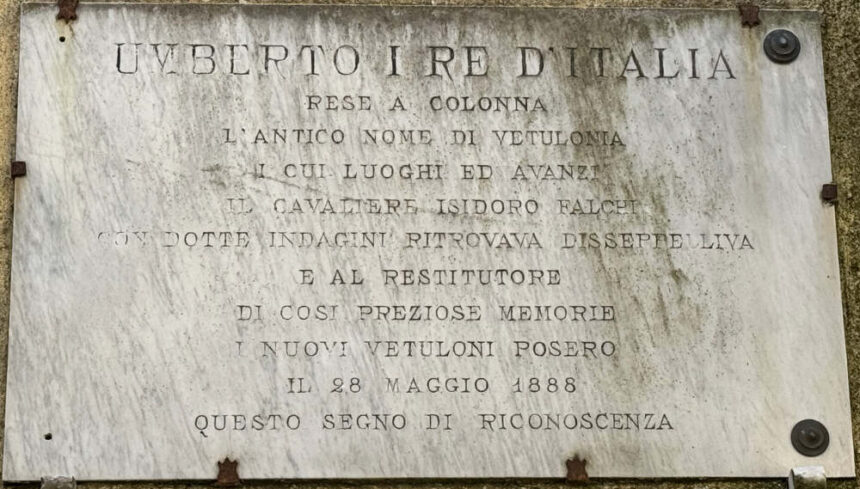
this is not something else entirely. At the time, people were fascinated when, shortly afterwards, a tomb stele was discovered showing a man with a double axe. This fitted in perfectly with the literary sources. For it was clear from Silius Italicus’ Punica that Rome owed its symbols of power – the sella curulis and fasces – to Vetulonia. Just how impressed even the Italian authorities were is shown by the fact that King Umberto I personally issued an edict giving the village of Colonna back its name of Vetulonia. A marble plaque commemorates this event.
The coinage of Vetulonia under the sign of Rome
Isidoro Falchi carried out a total of 34(!) excavation campaigns between 1884 and 1913. Among other things, he found a Republican part of the city where even more coins with the inscription ‘vatl’ were lying. Most of them are on display in the local museum (albeit, as usual, rather poorly lit).
Coins from the city of Vetulonia are also occasionally found at auctions. The most common type shows a male head on the front, whose headdress consists of a sea monster known to the Greeks as Ketos. This head is therefore thought to represent the Etruscan god Nethuns. We can imagine Nethuns’ sphere of influence to be similar to that of the Roman god Neptune. This would make sense, as Vetulonia owed its prosperity to trade across the Mediterranean.
In any case, the image on the reverse side fits into this context: it shows a trident for Nethuns/Neptune’s power to stir up the sea, and two dolphins as an indication that the sea god could grant safe passage.
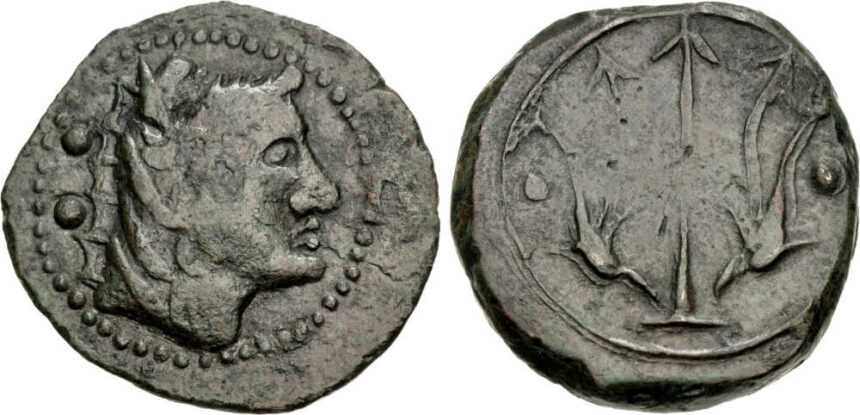
Only a few examples remain of the type showing a god wearing a pileus on the obverse. This is probably the Etruscan god Sethlans, who is considered the Etruscan counterpart to Vulcanus, or the Greek Hephaistos. This would also make sense: after all, the metal found on his territory and its processing were the basis of Vethulonia’s prosperity.
In contrast, the reverse side shows an oar, bringing us back to a maritime symbol that tells us that the iron was brought across the sea on ships.
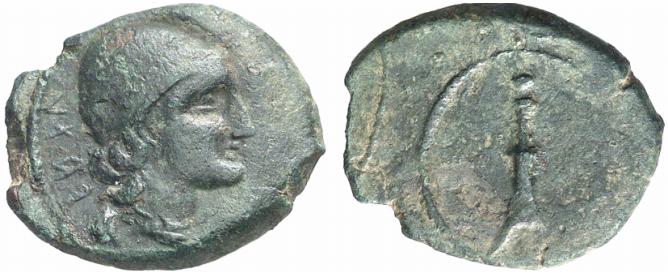
The female figure wearing a diadem on the obverse of this type of coin from Vetulonia has not yet been identified. Her image is combined with a blank reverse or with a reverse showing a caduceus.
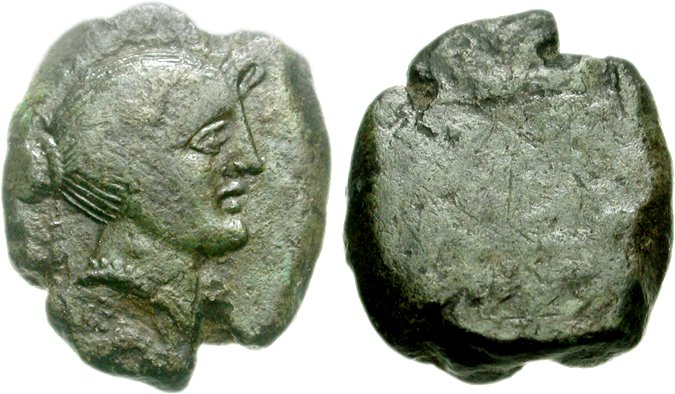
We do not know with absolute certainty where this type was minted. It has been tentatively attributed to Vetulonia or Populonia. The ketos and dolphins on the obverse suggest Vetulonia. They would fit in well with the city’s motifs. However, the coin bears no legend, so the place of minting is unclear. Coin finds have led to it being attributed to Lucca today.
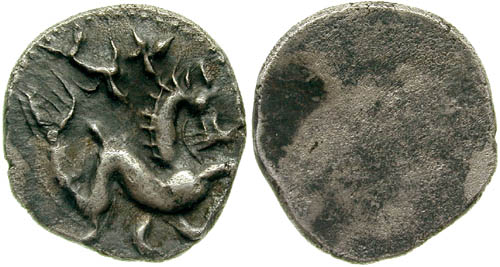
In contrast, we know with relative certainty that this coin was not minted in Etruscan Vetulonia. It is the product of an enterprising 19th-century goldsmith who wanted to fill a gap in the market: museum curators and collectors were eager to purchase impressive gold coins from Vetulonia. Unfortunately, none existed. Vetulonia minted coins in bronze, perhaps in silver. At least, that was Falchi’s reasoning for not being willing to pay a high price for the rare gold coin he was offered. The goldsmith who wanted to sell it was left holding the bag. How did it end up in the museum anyway? No idea.

Museo Civico Archeologico ‘Isidoro Falchi’
Like many other exciting (and, of course, genuine!) finds from the region, this fake has been on display in the local museum since 2000. It is named after the discoverer of Vetulonia, Museo Civico Archeologico Isidoro Falchi. It is definitely worth a visit. Although the museum may not be able to compete with the large Etruscan museums in Florence or Rome in terms of quantity and quality, it does exhibit numerous high-quality objects. It is a welcome development that more and more local museums are providing an overall picture of the place, so that ruins and finds can be seen together.
Allow at least one to two hours for a visit. And if you are lucky, the museum will also be offering one of its annual special exhibitions.
You can find the museum in our numismatic travel guide, of course.
Click here to visit the museum’s website.
Text and images: Ursula Kampmann