Fountain competition in Braunschweig
Can a power struggle be resolved by building the best fountain? That is what happened in Braunschweig. A medal from 1691 commemorates the fact that the rulers of Braunschweig-Wolfenbüttel and Braunschweig-Lüneburg fought for supremacy. It shows the waterworks that powered the fountain in Herrenhausen.
Some people are just lucky. At least, that’s what they called it in the Baroque era when older brothers died before you and you inherited the throne. That’s how Ernst August came to power in Brunswick-Lüneburg in 1679, even though he was only the fourth of five sons and was actually intended to be Prince-Bishop of Osnabrück.
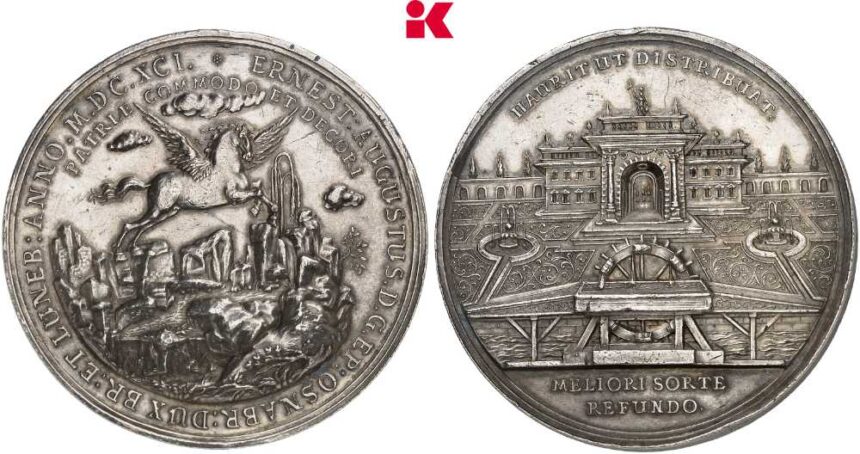
One might have thought that the now 49-year-old ‘lucky devil’ would have been content with the title of duke. But Ernst August was much more ambitious. He aspired to the title of elector in order to outdo the rival line in Brunswick-Wolfenbüttel. A medal from 1691, which will be auctioned by Künker in Berlin on 28 January 2026, commemorates the moves with which Ernst August won the power struggle: he displayed princely power on a grand scale, including a magnificent Baroque garden with elaborate water features, modelled on those at Versailles. But it also included costly gifts to leading officials and opinion makers in the empire. This medal combines both. It shows the gardens of Herrenhausen near Hanover with a water feature and, weighing over 116 g, was intended as a diplomatic gift.
What can be seen on the Braunschweig medal from 1691?
One side shows the winged Pegasus striking water from Helicon with his hoof. Helicon is a mountain range in Boeotia, and according to ancient poets, the Muses lived there at the Hippocrene Spring. That is why its water was considered artistically inspiring. The inscription lists the titles of Ernst August of Brunswick. Above Pegasus there is also a Latin motto: For the benefit and adornment of the fatherland. These were terms often used by Cicero in De Officiis to describe the most important goals of political action.
The other side shows the Herrenhausen Gardens, with the palace in the background. Prominently depicted in the foreground is a water feature: a scoop wheel equipped with buckets that transports water from a basin upwards to drive the fountains with the help of the water pressure generated by the fall. What this water feature achieves is described by a Latin couplet: It scoops so that it can distribute // With improved fortune, I give back.
This motto is ingenious and innovative. It compares the performance of the water wheel with that of a prince. While the water wheel ‘only’ scoops to distribute, a good ruler – according to the prince’s praise – makes more of the resources that his country provides him with. The idea for this theme probably came from one of the greatest polymaths of his time: we know that Gottfried Wilhelm Leibniz repeatedly advised his patron Ernst August on matters of self-presentation. In the second half of 1690, for example, he provided him with written suggestions for medals.
The fountain competition
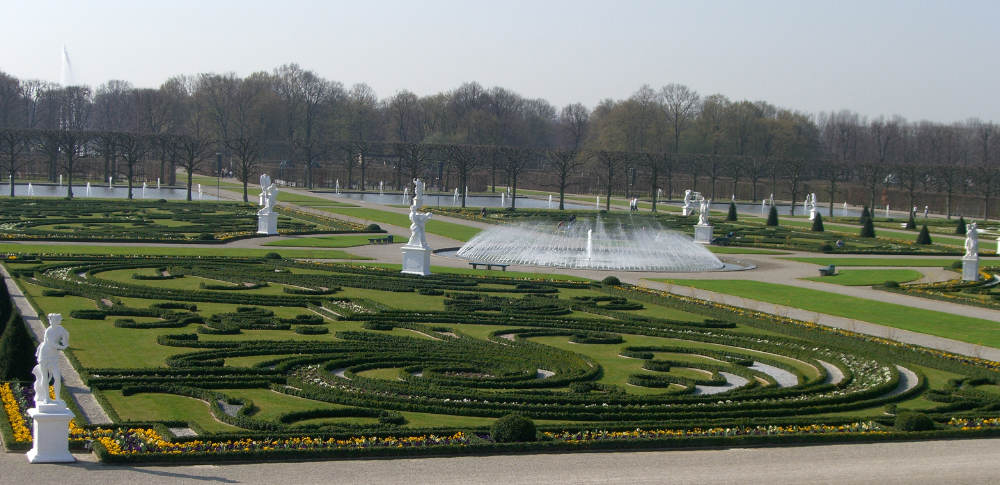
Was this water wheel just a well-chosen coin motif? Certainly not. Its depiction was also intended to highlight the Herrenhausen Gardens. After all, the building activities of a Baroque ruler illustrated the vast resources at his country’s disposal. Herrenhausen was a prestige project, and its splendour emphasised that the Duchy of Brunswick-Lüneburg was long overdue for the elevation in status it sought!
Today, we know how difficult it was to build impressive water features in Herrenhausen. The flat terrain made it impossible to drop water from great heights in order to generate the water pressure needed for the fountains. The water reservoir built by the princely fountain master – yes, such a position existed at the court of Ernst August – was not large enough for the princely ambitions.
And then his arch-rival, Duke Anton Ulrich of Brunswick-Wolfenbüttel, built his own palace complex in front of his pleasure palace in Salzdahlum. Its sole purpose was to surpass the palace, gardens and water features of Herrenhausen. Salzdahlum in particular shows why magnificent buildings were an indicator of a country’s importance: Anton Ulrich did not have sufficient funds to realise his gigantic plans. So instead of a stone palace, he built a wooden one, which has now disappeared along with the gardens.
Fighting for power by any means necessary: the princes’ conspiracy
Fountains were, of course, only one means of competing with each other. The two dukes also fought each other with intrigues in the political arena. Anton Ulrich played a key role in the princes’ conspiracy of 1691, the year in which this medal promoted Ernst August’s ambitions among many high-ranking nobles.
The background to this was that Ernst August had introduced primogeniture in order to maintain the power of his duchy after his death. Whereas previously all sons of the Guelphs had been entitled to a share of the rule, it now passed undivided to the eldest. When this was introduced, Ernst August’s sons were too young to protest. Now the second-eldest son (17 years old) rebelled with his brothers (14 and 12 years old) and the support of Anton Ulrich. Father Ernst August reacted with full severity. He brought his sons to trial for high treason. They were only mildly punished. They were not executed, but were allowed to join the imperial army on the intercession of a relative.
In 1792, it became clear that Ernst August had defeated his rival Anton Ulrich. The Brunswick-Lüneburg or Brunswick-Hanover line, as it was now called, received the title of elector, and Ernst August’s eldest son inherited not only the undivided electorate, but also the crown of Great Britain.
What is the value of the Braunschweig medal from 1691?
The large silver medal from 1691, weighing over 116 g, is estimated to be worth 4,000 euros. It is difficult to say how much it will fetch, as it has not been seen in this weight and condition for many years. In 2016, a perfect specimen weighing 88 g already fetched €9,000. How much will the heavier version in this magnificent condition fetch? We will only know when the hammer falls on 28 January 2026.
Hammer price for the Braunschweig medal from 1691
On January 28, 2026, the medal was sold by Künker at the Berlin auction. The buyer can be delighted. He has acquired a great rarity for a bid of “only” 6,000 euros! Such are the uncertainties of auctions. Despite periods of high prices and increased interest in numismatics, it is still possible to buy great pieces for a very reasonable price from time to time.
The complete catalog for Auction 437 can be found on the Künker website.
Text by Ursula Kampmann