French Reparations, the Imperial War Treasury, and the July Uprising
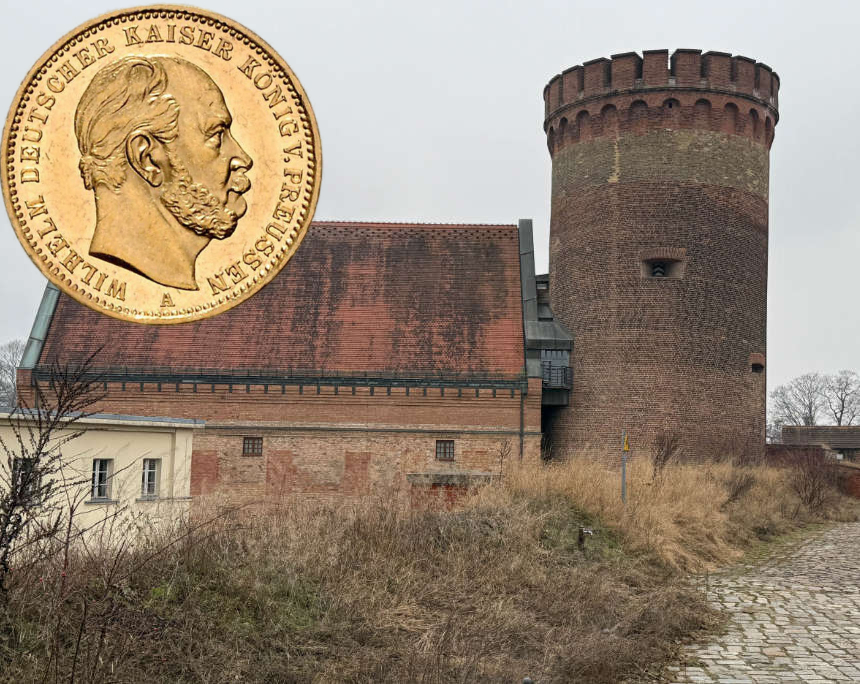
Spandau is just under a quarter of an hour from Berlin Central Station, and yet it feels like a different world. For centuries, the military dominated the townscape here. That’s because Spandau was home to the great citadel, the centerpiece of which was the Juliusturm. Built around 1200 as a keep, the approximately 30-meter-high building still played a decisive role in the 19th century, as it housed the German Imperial War Treasury—according to modern calculations, some 48,000 kilograms of gold. And that wasn’t all. It also held the imperial funds for the care of disabled veterans, for fortress construction, and for the erection of the Reichstag building. However, these sums were not held in gold but invested in securities. But let’s start at the beginning. Let’s go back to May 10, 1871, when the Preliminary Peace of Versailles was cast into a legally binding document in Frankfurt.
Reparations
The French government was to pay 5 billion francs—or, expressed in fine gold, 1,450 tons of fine gold—in reparations to the newly founded German Empire. At the contractually fixed exchange rate of one Prussian taler to 3.75 gold francs, and including 3 million francs in interest for the three-year deferment, this amounted to a total of 1,413,651,189 Prussian talers
—a virtually unimaginably high sum that far exceeded Germany’s war costs. The 6th edition of Meyer’s Great Conversational Lexicon from the year 1907 put this figure at 1.024 billion marks. Since three marks were equivalent to one Prussian thaler, the war costs amounted to 341,333,333 Prussian thalers, or about a quarter of the reparations.
Incidentally, the 5 billion was already a compromise: originally, German diplomats had demanded 6 billion, but agreed to a lower figure. As collateral, German troops occupied four departments and the city walls of Paris until the debt was paid in full.
To everyone’s great surprise, France raised the sum in a very short time. The country was, in fact, still creditworthy. The first public bond issue, announced on June 20, 1871, for 2 billion francs at 5% was oversubscribed by two and a half times within seven days; a second bond issue for 3 billion pounds at 5% was oversubscribed by as much as 14.5 times (!). In other words: France raised the reparations payments—around 25% of its gross domestic product at the time—with the help of the free money market. It was the first time the international business community had financed such a large government loan. The punctuality with which France serviced its debts gave the nation immense economic credibility despite having lost the war.
A New Monetary System for Germany
Under heavy military guard, the 1,450 tons of gold arrived in Berlin by rail. The transaction was handled on order of both governments by the Paris-based Rothschild banking house and the Berlin-based Bleichröder banking house. By 1871, an average railroad car could carry up to 10 tons. So let’s calculate—just to visualize it and without any claim to accuracy—that seven locomotives pulled the 145 gold-filled cars.
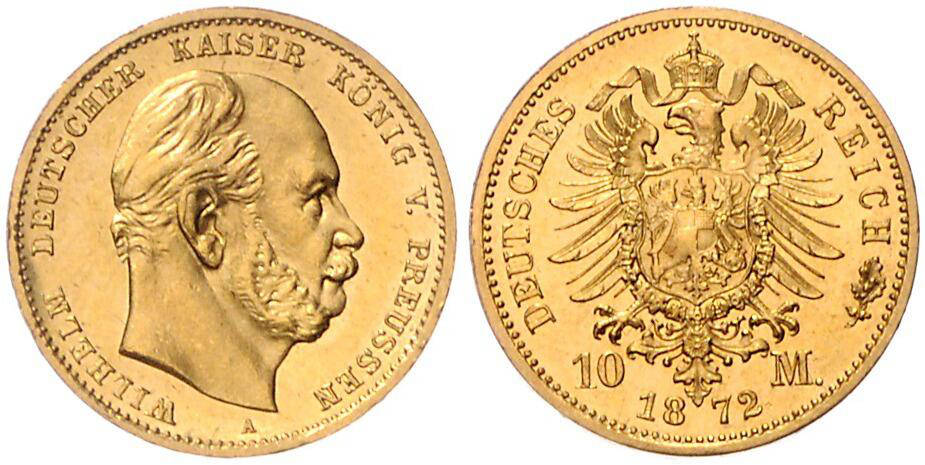
The gold arrived just in time to be used to mint the new imperial coins. For on December 4, 1871, the Reichstag passed the “Law Concerning the Mintag of Imperial Gold Coins.” With this, the German government opted for a gold standard. In the preceding decades, gold had proven to be significantly more stable in value than silver, primarily due to the rich silver deposits in Nevada. Thus, Section 1 of the new law stipulated that 139 1/2 pieces of the new imperial coin were to be minted from one pound of fine gold; one-tenth of this—according to Section 2—was to be called a mark and divided into 100 pfennigs. In other words: The law first established the 10-mark coin before addressing the 20-mark coin.
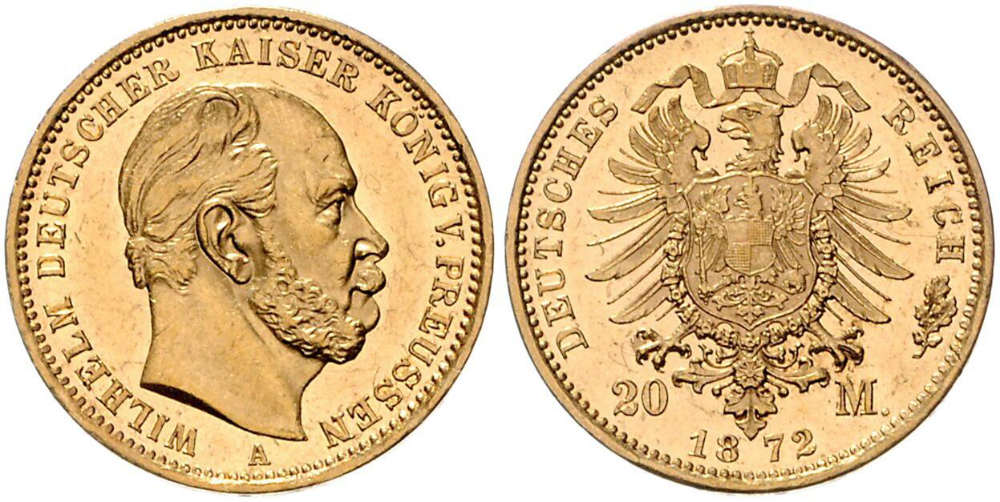
Section 3 stipulated that 69 3/4 pieces of the 20-mark imperial gold coins were to be minted from one pound of fine gold. In the very first year, the Berlin mint alone produced 7,717,323 20-mark pieces and 3,922,722 10-mark pieces. In other words, anyone wishing to buy a coin like those once stored in the Juliusturm can do so for relatively little money.
What did Germany do with the French reparations?
Most of the French reparations were not stored in the July Storm, but were issued. As a result, the immense influx of bullion into Germany and Austria triggered what we now know as the Gründerboom—the economic bubble that formed on the stock market because, for a brief moment, anything seemed possible. Statistics exist showing where the funds were allocated.
Let’s take a look at just a few of the most notable expenditure items. For example, part of the more than 5 billion gold francs went toward expanding the navy (31,949,890 talers), fortification construction (72,000,000 talers in Germany, 43,280,950 talers in Alsace-Lorraine), and the Imperial Invalids’ Fund (187,000,000 talers).
Eight million were spent on the Reichstag building, and two million were given to Germans expelled from France as compensation. Particularly controversial were the four million thalers intended as a stipend for German generals. The press pointed out how anachronistic it was to squander such sums on a military elite. And it was precisely this elite that behaved extremely unwisely. Thus, War Minister Albrecht von Roon defended the gifts by claiming that the common soldier had already gained honor simply by being allowed to sacrifice his limbs for the fatherland, which triggered an outcry of indignation in the German press. Despite this tactlessness, the Emperor insisted that “his” military leaders receive the 4 million thalers.
Large sums also went to the individual states. Bavaria was awarded 90,200,411 talers, Württemberg 28,500,870 talers, and the North German Confederation, Baden, and South Hesse together received 668,179,719 talers.
The 40,000,000 talers—equivalent to 120 million gold marks under the new monetary system—that had been stored in the Juliusturm thus represented only a relatively small portion of the reparations.
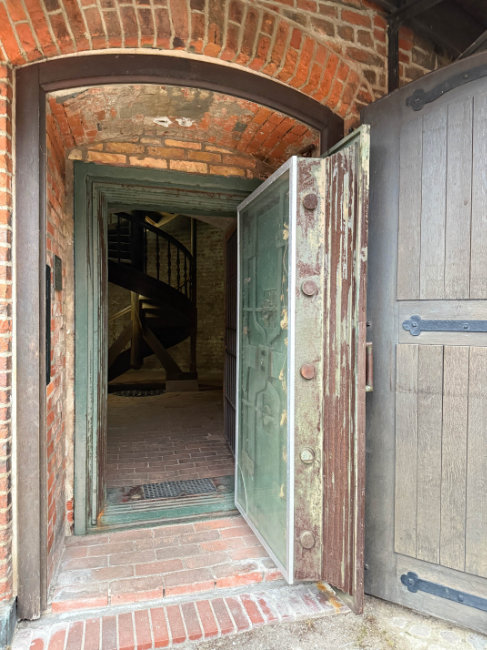
120 Million Goldmarks in the Juliusturm
The 120 million goldmarks stored in the Juliusturm were expressly earmarked for future mobilizations. For example, they were used to finance the Empire’s intervention in the Boxer Rebellion. Interestingly, there was no order to draw on the treasure during World War I, so the gold flowed back to France as part of the reparations after the war ended.
Once a year, a representative of the Reichstag inspected the treasure to ensure it was complete. Thanks to the 1910 issue of *Gartenlaube*, the procedure has been preserved for us. The Spandau local historian Karl-Heinz Bannasch stumbled upon this gem, which was published by the TAZ as part of an interview about the Imperial War Treasury.
Deputy Dr. Hermann Pachnicke describes the prevailing general perception of the Imperial Treasury as follows: “The ceiling, walls, and floor of the hall were made of gold. The tables and other furnishings that filled the room were made of gold, and everywhere lay piles of shiny gold coins!”
In reality, the scene was far more sober. After the door had been opened with six keys brought by various officials, the first thing Pachnicke saw were ladybugs: “The first iron door opens. A still life from the animal kingdom presents itself to the surprised eye. Quite a few swarms of ladybugs nest there in a crevice and, suddenly startled by the glaring daylight, scatter in confusion to seek a new, protective nook. Now the second door swings on its hinges. It is not made of iron plates, but of iron bars, which, while the inspection is underway, allow light and air to enter. Finally, the third door creaks, and we are inside the tower. There they stand, the plain wooden boxes with their golden contents, stacked side by side and on top of one another. Fifteen stacks of thirty boxes each on the lower level, twenty-two stacks of thirty each, and six stacks of fifteen each on the upper floor, to which a wooden spiral staircase leads.
The boxes have a length of about one foot and a width of half a foot. Each has a weight of about 87 pounds. Each of these boxes contains 100,000 marks, partly in ten-mark and partly in twenty-mark coins, which are evenly distributed among ten linen pouches. 1,200 containers, each containing 100,000 marks—this amounts to a total of 120 million, which was set aside by the law of November 11, 1871, from the French war reparations for the purposes of a future mobilization.”
The boxes are counted, then the seals are examined, checked, and inspected. Next, the deputy marks certain boxes for a thorough inspection: “A subordinate official and a worker bring the marked [boxes] over and place them on a decimal scale. The actual weight still matches the target weight noted on a slip of paper on the outside. … Now they proceed to open one of the weighed crates. The iron sheets enclosing it are loosened with a pry bar. The nails—which are by no means thin or short—are omitted or removed with pliers. The lid opens, and the heavy linen bags are in our hands. We place them on a second scale…. Here, too, there is no difference. Nevertheless, we are not yet satisfied with this sample, but break the seal on another randomly selected bag and pour the contents onto the scale pan. There they lie, the gleaming metal discs with their seductive allure, smiling at the onlookers as if to say: Go ahead, help yourselves! The onlookers laugh too and jokingly calculate how far the 10,000 would go.”
After the inspection, the crates are nailed shut again, resealed, and placed exactly where they stood before. Once the three iron doors have been closed again, the final check is made to ensure that no one is attempting to dig into the Juliusturm.
A New Understanding of Money
The reflections that politician Pachnicke offers following his account are interesting. They reflect a new understanding of money and the state economy. A shift from tangible assets to investment: “Is it prudent to leave 120 million idle and lose 4.5 million annually in interest? The present, with its fully developed credit system, will view this differently than the past did. In any case, Germany is the only major power that possesses such a sum of treasure. In the event of a large-scale mobilization, it will be exhausted in a few days, for the costs, which in the year 1870 amounted to 6 million marks daily for Prussia alone, have since grown quite considerably with the increase in the strength of the army and the number of warships. How much would we have today if, over the course of 30 years, interest had compounded on this 120 million?”
A good question, one that the politician would surely have asked himself differently 25 years later. For after the hyperinflation of the year 1923, gold once again assumed a quite different role in public finances.
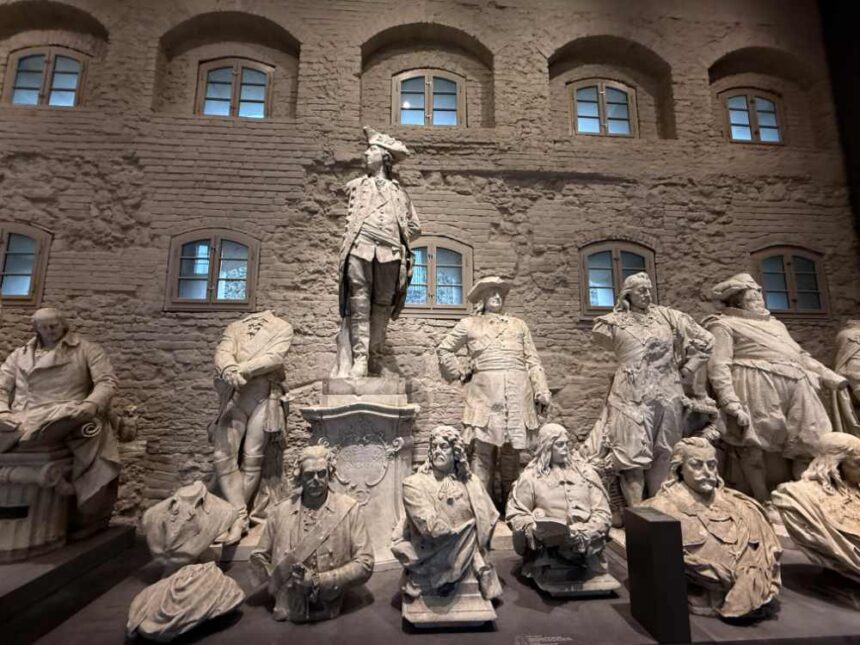
A Visit to Spandau Citadel
So if you ever visit the capital, Berlin, don’t miss a visit to Spandau Citadel. It’s well worth it—and not just to see the place where the Imperial War Treasury once rested. In addition to historical exhibitions about the fortress and local Potsdam history, the citadel also features the permanent exhibition “Revealed. Berlin and Its Monuments.” It brings together all the statues that once glorified the House of Hohenzollern along the Siegesallee, conceived by Wilhelm II, in the heart of Berlin. A wonderful glimpse into a now-outdated conception of history.
Oh, and nature lovers will adore the bat cellar! Every winter, the citadel’s vaults provide shelter for around 10,000 bats, allowing them to get through the cold season undisturbed.
Text by Ursula Kampmann