What exactly is a patina?
I remember it as if it were yesterday: I was sitting through one of those countless lectures held at mint gatherings. A representative from the Royal Australian Mint described customers’ frustration with discolouration on silver coins. He proudly explained that they had finally discovered a marvellous technique to prevent this discolouration. I felt as though I’d walked into the wrong film! For me, with my background in traditional coin dealing, there was nothing better than a coin with patina! Grey, blue, red, brown: I love them all! And there stood a man who seemed proud to be preventing such wonderful patinas! How did that add up?
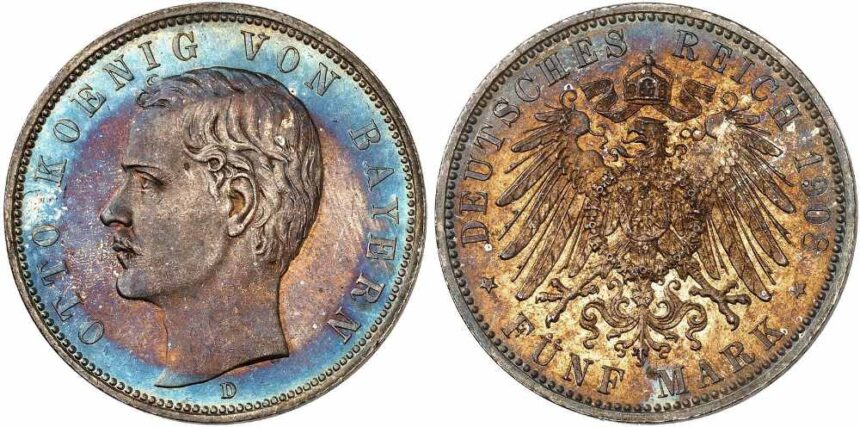
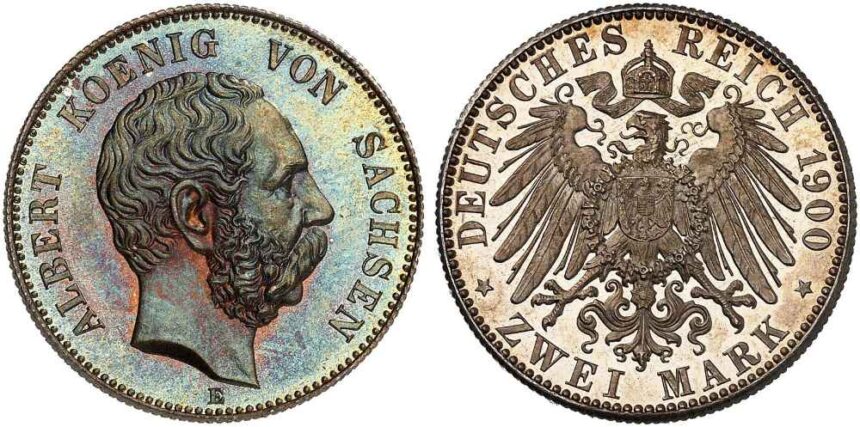
In this article, we aim to reconcile these differing perspectives. Why do some collectors love patinas and toning, whilst others regard them as flaws? Does the field of collecting play a role here? (To come straight to the point, yes, it does.) What exactly is a patina? We shall illustrate this article with coins from the German Empire that display patinas and toning in every color. In Auction 94, running from 10 to 12 November 2026, Heidelberger Münzhandlung is selling a dealer’s stock that has remained untouched for many years. This has allowed the magnificent patinas to develop, which will undoubtedly demonstrate to you why such colouring has drastically increased a coin’s value for centuries.
Is there a difference between patina and toning?
But let’s first clarify the terms. Is there actually a difference between patina and toning? Both terms are used interchangeably in auction catalogs. Well, I would say: in principle, yes, but in reality the terms have now become synonymous. Personally, when it comes to bronze coins whose patina is a thick layer that has become deeply ingrained in the coin through mineralisation, I tend to prefer the term ‘patina’, whilst for silver coins that bear only a slight hint of color, I refer to it as ‘toning’. But that is a matter of personal preference.
How does a patina or toning actually develop?
When a patina or toning develops, it is always due to environmental influences. Sesterces, for example, which have lain in the ground for a long time, were exposed to trace elements and mineral substances which, depending on their exact composition, either caused them to disintegrate (we refer to this as corrosion) or led to the mineralisation of their surface (which we refer to as a patina).
Even coins that are placed in a coin cabinet immediately after being struck are exposed to environmental influences. The wood of the coin cabinets emits vapours, and the air carries minute particles as aerosols that react with the metal surface.
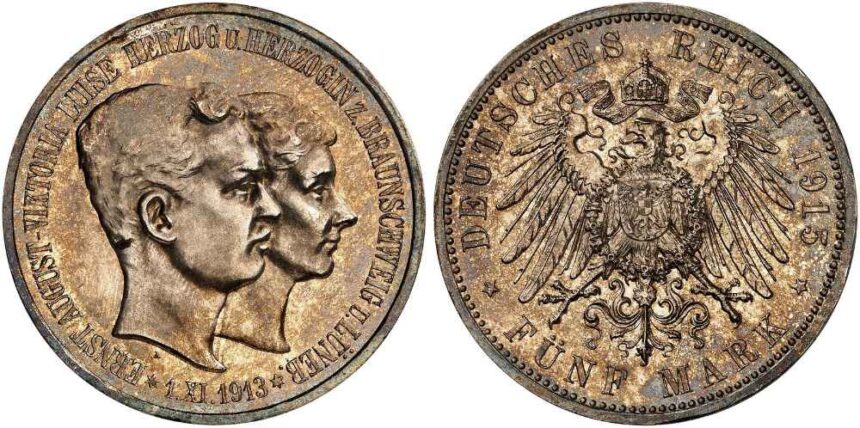
Whilst copper coins take on only a subtle patina and coins made of a copper-nickel or cupro-nickel alloy change colour barely at all, whilst gold coins do not discolour at all, these influences often produce a magnificent play of colours in silver coins, at least if they have been left in one place for long enough. We then refer to such a coin as a ‘cabinet piece’ – and that is the long-forgotten origin of this term, which is now used to excess in auction catalogues. A genuine ‘cabinet piece’ therefore always has a patina that has had time to ‘develop’ over the many decades that the coin has lain in a traditional wooden cabinet.
Ironically, many of these ‘cabinet pieces’ did not develop whilst the coins were lying in a cabinet, but whilst they were stored in the small coin pouches of the turn of the 19th to the 20th century. These pouches were still glued by hand using glue, and the combination of glue, paper and Silver fostered a magnificently iridescent rainbow patina.
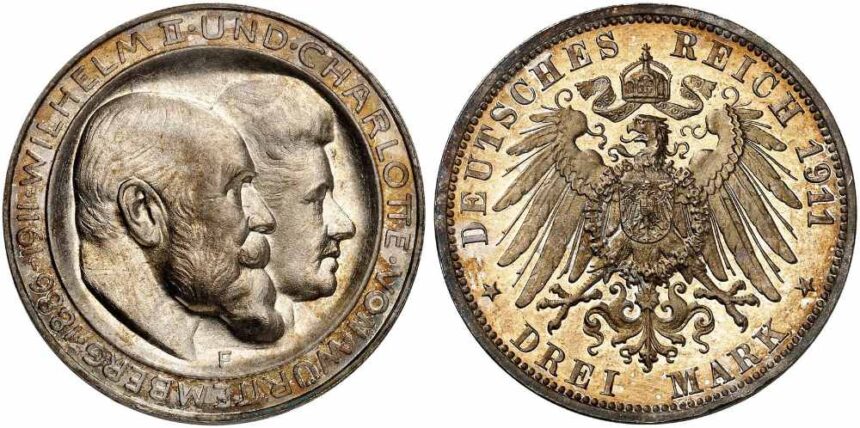
The patina ‘grows’ from the outside in. It begins as a ring around the letters of the legend, then gradually spreads inwards, eventually filling the entire design.
Various factors can accelerate its formation. For instance, I recall a coin collector who owned a small coin box which, with all his Roman denarii inside, produced a marvellous rainbow patina within a few months.
Normally, proximity to the sea and salty air, combined with dry air, promote the formation of a rainbow patina. This is why the Royal Australian Mint suffered so much from this phenomenon. Many coin collectors live in areas where this climate prevails.
Does a patina increase a coin’s value? Or does it reduce it?
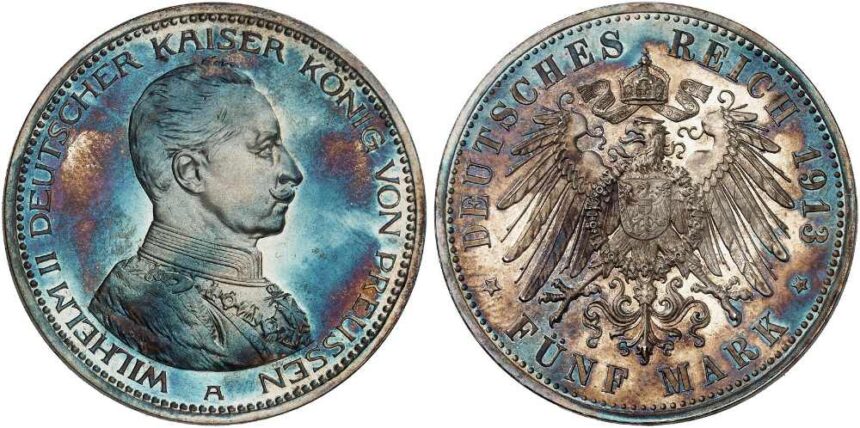
There’s no question about it: in classical numismatics, a patina increases a coin’s value – and significantly so! That is why, in the 1990s, so many coin collectors with a sound grounding in chemistry created a patina on their coins using artificial means. Distinguishing this artificial patina from a genuine one is difficult and requires many years of experience. As a rule of thumb, you can bear in mind that anything that looks too uniform often has an artificial origin.
Why are there collectors who don’t like patina?
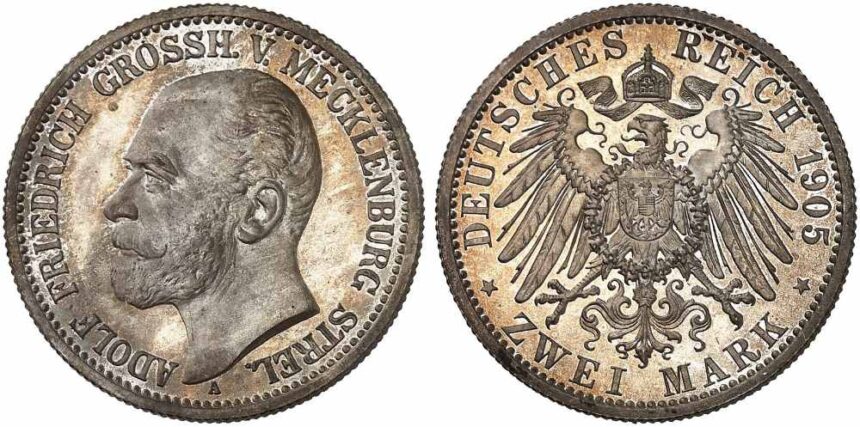
In recent years, the value of a coin with patina has not risen to the same extent as that of a coin in a high grade of preservation. This is because almost no one buys coins anymore. Yes, you read that correctly. Very few people have actually held the coin they are buying in their hands before purchasing it. What we are buying are photographs. And in photographs, the iridescent beauty of a coin’s patina is extremely difficult to capture. Indeed, patina often even gives a coin a slightly spotted appearance in a photograph.
And this is where the investor market comes into play, which is teeming with people who have hardly any experience with coins and no longer even buy a photograph, but a grade. They do not know what a patina is and mistake it for a flaw.
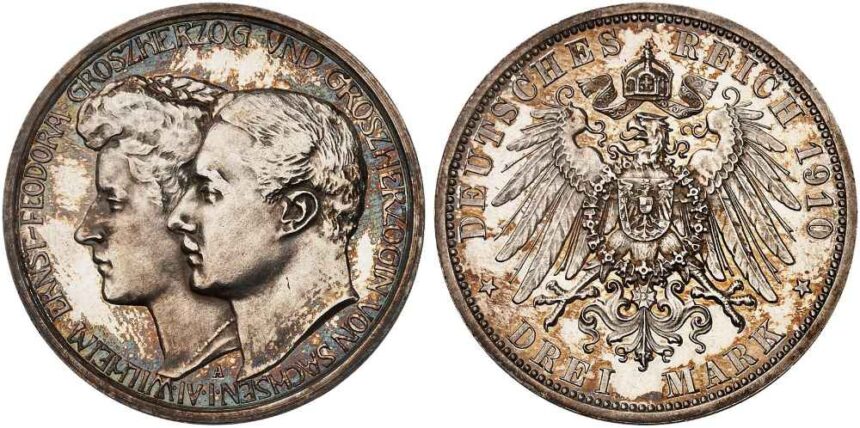
This brings us back to the Royal Australian Mint, whose collectors failed to appreciate the patina that was in the process of forming. To prevent complaints, mints now use techniques to prevent patina from forming later on. This makes sense for a large proportion of their products. Contemporary commemorative coins no longer feature a uniform metal surface that gains beauty through patina; instead, they anticipate this colouring through sophisticated techniques. These include colour application, rainbow effects, plating, artificial patination and much more. Genuine – that is, unpredictable – patination could well detract from the visual appeal of a contemporary coin.
So let me answer the question of whether a patina increases or decreases a coin’s value in a slightly more nuanced way:
Traditional numismatics: A patina always means an increase in value.
Contemporary numismatics: If the patina detracts from the visual effects, this results in a decrease in value. However, it can also lead to an increase in value if the coins in question do not require artificial colour effects and rely purely on their design. In that case, a patina should increase the coin’s price, at least if you are selling to a connoisseur.
How can you prevent a patina from forming?
There is one tried-and-tested method: simply do not let any air come into contact with a coin; in other words, store it in a neutral material wherever possible. Neutral materials include hard plastic, such as the well-known BeBa cases or the slabs from American grading firms, or metal.
How do you remove a patina?
NOT AT ALL!!!!!!
No, seriously. Any form of cleaning has a detrimental effect on the coin’s preservation and value. So enjoy the fact that your coin’s beauty unfolds naturally and don’t fight it!
Where is this trend heading?
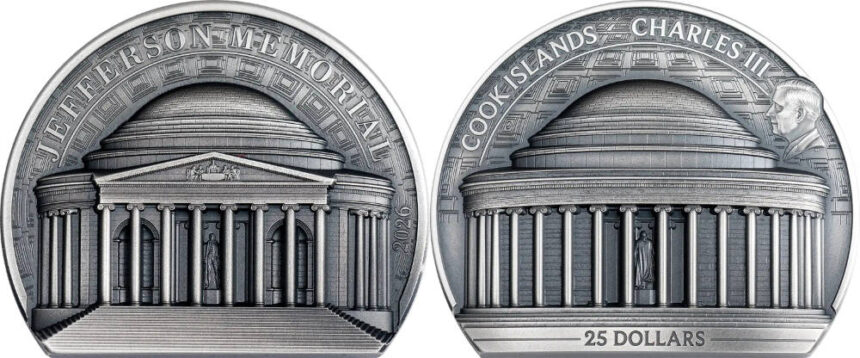
As already mentioned, the coin industry has, in recent years, begun to use patinas as a design element. The so-called ‘antique finish’ is a dark patina that was already being applied by the Monnaie de Paris as early as the late 19th century. Many mints have rediscovered this surface treatment because it allows coin owners to handle their coins whenever, however often and wherever they wish.
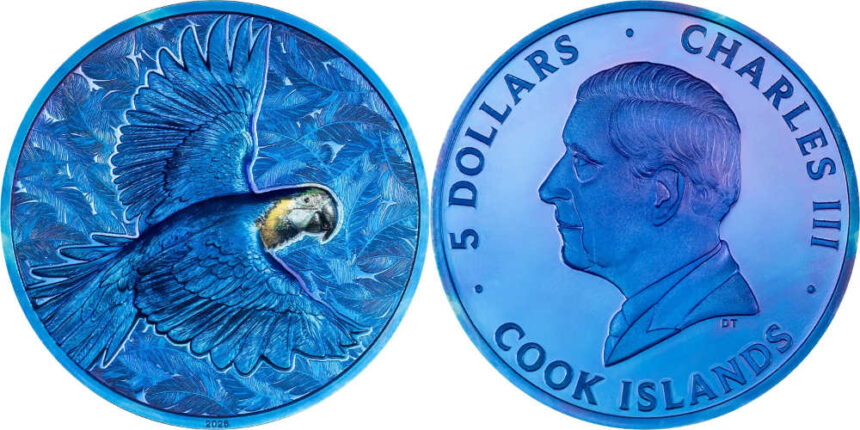
An enhancement of this process is the controlled fake of the incomparable rainbow patina in a toning chosen by designers and coin technicians. CIT has launched a new series under the name ‘Spektrum’, which brings this beauty into contemporary numismatics.
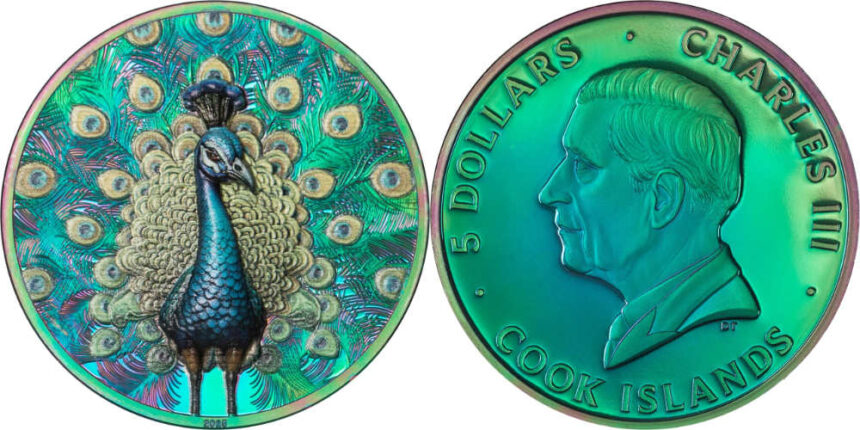
There, they refer to a newly developed coating technique called ‘Prisma Plating’. Unlike the Antique Finish, Prisma Plating can be applied without restriction to a coin struck using the proof process. This does not diminish the lustre of the surface.
So the patina is back, and here to stay. Nothing is more fine for the true connoisseur than turning a coin over and over between their fingers to enjoy the iridescent patina in all its colour.
This article owes much to a piece published by Marcel Häberling in the Swiss Numispost in February 2026. The subsequent conversation at the Basel Coin Fair inspired me to take up this topic in CoinsWeekly as well. As is often the case, it only came back to mind when I saw the beautiful patina on the coins in Auction 94 at the Heidelberger Münzhandlung… Thank you, Marcel, for the inspiration, and thank you to the Heidelberger Münzhandlung and its photographer Benjamin Seifert / Lübke & Wiedemann for the photos.
Text and images: Ursula Kampmann