Kumaragupta and the Rhinoceros
When the Kushan Empire collapsed sometime in the 3rd century AD, other peoples filled the void. Among them was the Gupta ruling dynasty, which ruled over quite a bit of northern India between the 3rd and 6th centuries AD.
The Gupta rule is considered the golden age of classical India. This era saw the emergence of the great epics of the Ramayana and the Mahabharata, not to mention the Kama Sutra, which so fascinated the hippies of the 1970s. Science flourished under the Guptas, especially mathematics and astronomy. The economy prospered. Payments were made with gold coins, most of which featured the ruler on one side and a deity on the other.
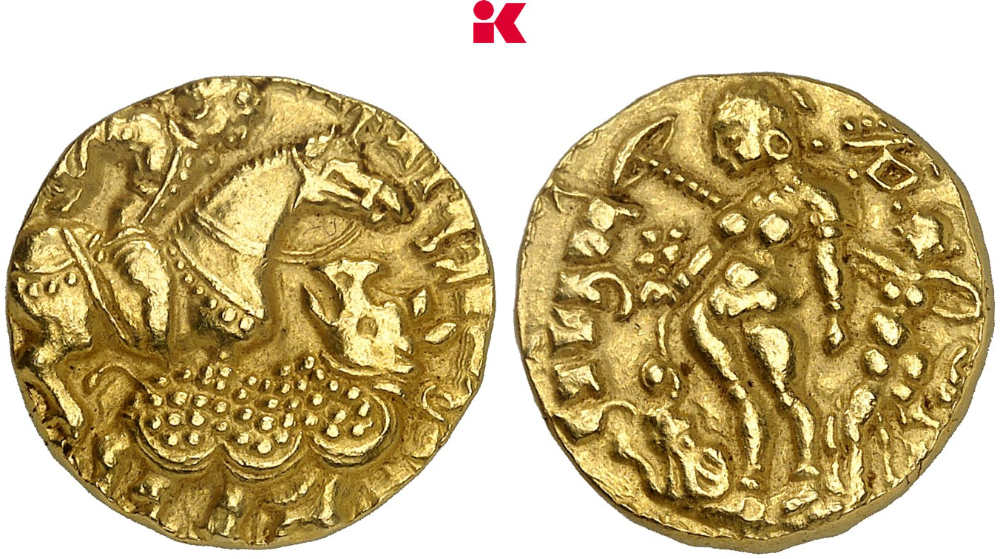
In its upcoming auction, the Osnabrück-based auction house Künker will be offering an extremely rare gold coin of Kumaragupta, referred to in specialist literature as the “Rhinoceros Slayer Type.”
What can be seen on Kumaragupta’s gold coin?
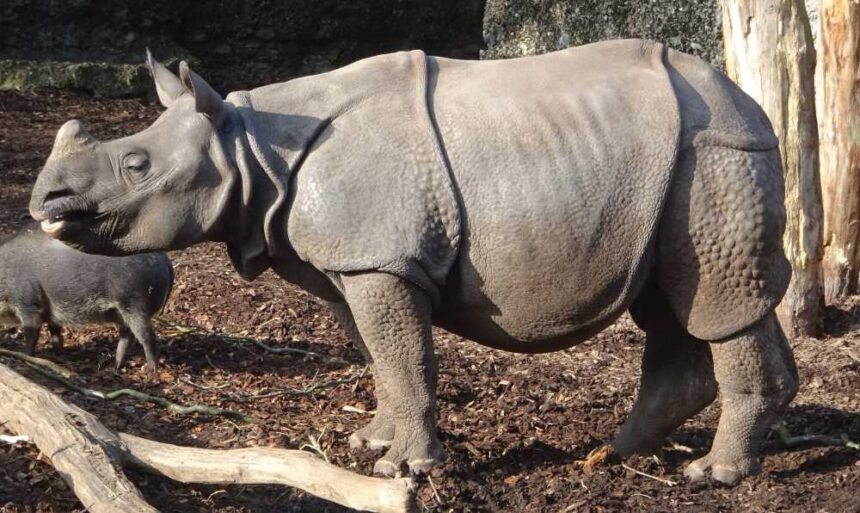
The obvers of the coin shows the Gupta ruler, Kumaragupta. We see him on horseback, sword in his right hand, in front of him an Indian rhinoceros, whose characteristic skin folds and wart-like knobs are stylized. The mighty animal turns toward the attacker. The legend, which is not completely visible on the planchet, can be translated as follows: Eternally victorious is the ruler Kumaragupta, who is defended by the sword against the rhinoceros.
On the revers, we see the goddess Ganga, daughter of Himavat and sister of Parvati. Once upon a time, she flowed with her rich waters as the Milky Way across the canopy of the sky. But Bhagiratha, with Shiva’s help, brought her down to earth, where she flowed into seven sacred rivers. The holiest of these is the Ganges, which is still revered by many Indians today as the incarnation of the goddess.
The goddess Ganges stands on a makara, a mythical water creature whose appearance is a mixture of elephant, turtle, fish, and crocodile. She holds a lotus flower in her right hand. Behind her stands a small servant holding an umbrella over Ganga. To her right, we see an inscription that reflects the king’s title. This can best be translated as “raised [king] with the great sword.”
Who was Kumaragupta?
Kumaragupta was the son of Chandragupta II. He took power shortly before 415 BC and ruled until 455 AD.
He is considered a prince of peace under whom the Gupta culture was able to flourish. Today, he is particularly praised for his religious tolerance, as Kumaragupta promoted both Buddhism and Jainism as well as the various cults for different deities that we now subsumed under the term Hinduism.
Kumaragupta is considered the great organizer who divided his empire into provinces, each administered by a governor appointed by him. The provinces were in turn divided into districts. The lowest administrative units were widely autonomous villages or towns, a system very similar to that we know from the heyday of the Roman Empire.
Towards the end of his reign, the Pushyamitra tribe rose up, but was defeated by Kumaragupta’s son Skandragupta. He was not actually intended to be the heir to the throne, but used his military success to oust his brother.
Does the design of the rhinoceros have any historical significance?
We have no information about any military exploits that Kumaragupta is said to have accomplished. Nevertheless, attempts have been made to explain the unusual coin type of the rhino slayer with a campaign by Kumaragupta to Assam. The Indian rhinoceros is said to be particularly common there. Similarly, another numismatist explained the coin type of the tiger slayer with a (otherwise unproven) campaign to the Narmada Valley, because a particularly large number of tigers are said to have lived there.
This overlooks the fact that ancient coin depictions often have no concrete reference, but rather seek to express the victorious nature of the ruler in general. Kumaragupta had numerous coin types minted.
Among other things, he had himself designed as an archer, a swordsman, and a horseman—on horseback and elephant. But he also showed himself killing tigers and lions. Killing a rhinoceros, which is at least as dangerous as the big cats, fits perfectly into this program. Even though his ancestors did not use this type of coin, it seems more than questionable whether Kumaragupta really wanted to commemorate a specific military campaign with his coin types.
What is a Kumaragupta gold coin worth?
Kumaragupta ruled for around four decades. Many coins were minted during his reign, and many coins have been preserved. That is why Kumaragupta’s common gold coins can already be purchased for between 800 and 2000 euros.
The situation is different for rare coin types. The most expensive pieces fetch high five-figure sums. Now, if we consult the Coin Archive, it appears that not a single coin of the Rhinoceros Slayer type has been offered at auction in recent decades. The result cited by Mike Markowitz in his article on the Gupta cannot be verified, as the piece he mentions does not exist. The example he shows is also not from an auction, but from the website The Coin Galleries.
In other words, we do not know what this coin will fetch. It is currently estimated at €25,000, but it could easily fetch twice that amount or even more.
Text by Ursula Kampmann