CIT Winter Launch 2026
Let us remember what national commemorative coins looked like just a decade or two ago: flat, silver, and engraved with some building, anniversary, or date of birth or death that no one really cared about. The fact that this is no longer the case today is mainly thanks to private mints such as CIT, which have shown state mints what contemporary coins need to look like in order to appeal to a wide audience.
Unusual motifs take center stage
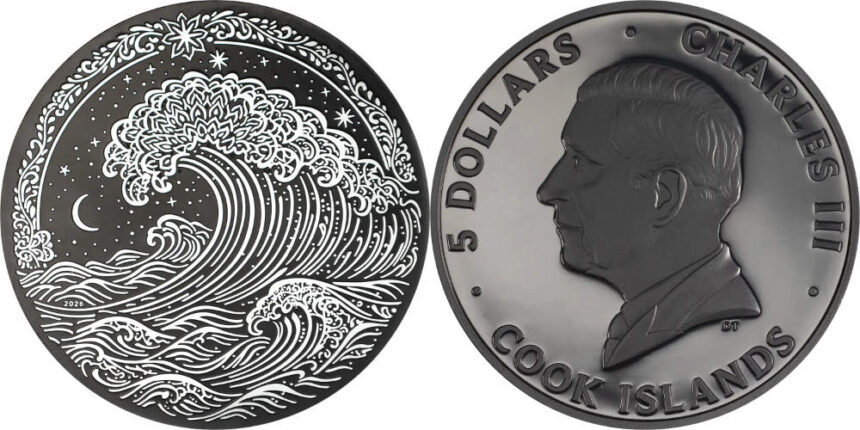
And so historical figures play only a minor role in CIT’s Winter Launch 2026. Instead, aesthetic motifs shape the action. They all aim to evoke strong emotions. What I mean by this is illustrated by a coin from the Cook Islands with the striking name “Wave.” Like the Japanese artist Hokusai before him, CIT focuses on the indescribable: the destructive power of nature symbolized in the all-consuming wave.
Only at second glance does the connoisseur recognize the high level of technical mastery that CIT’s long-standing partner, B. H. Mayers Kunstprägeanstalt, has poured into this coin. The artwork was minted using the proof process and then patinated with obsidian black. The shiny areas of the coin are not painted on, but shine through from the surface. Technically and artistically, it is a masterpiece. The technology behind it is called Nanoshine – and it is being used for only the second time on this edition.
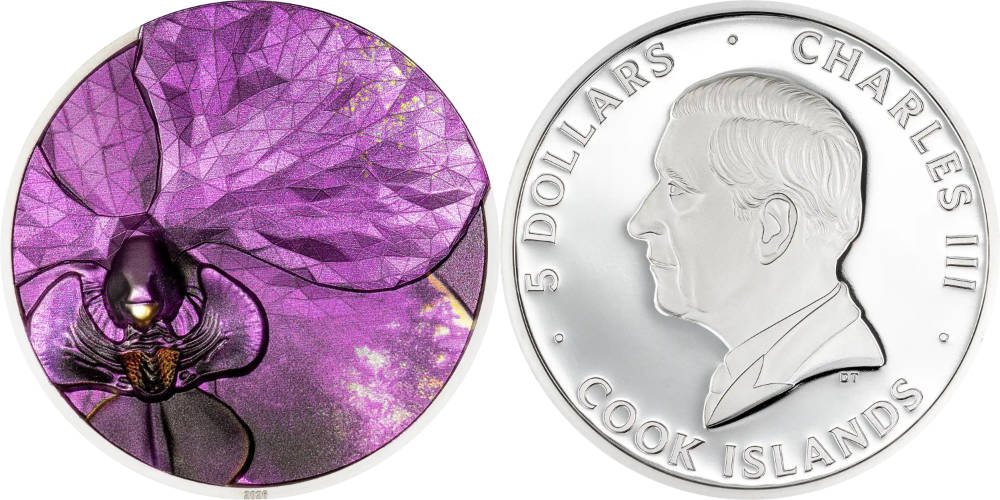
Another example of this unusual perspective is the first coin in a new series entitled “Bionics.” Bionics refers to state-of-the-art technology inspired by nature—such as our Velcro fastener. It mimics the technique that certain plants have used to spread their seeds for thousands of years. Bionics can also be found in orchids. With their complex three-dimensional structures, they have influenced our architecture. Their flowers consist of elements with double curvature, ribs, and joints, as used today in construction to combine maximum stability with minimum weight.
To do justice to the subject, CIT has greatly enlarged the orchid flower and highlighted its structures. This provides an unusual, captivating view of this plant, which has been given its impressive relief using state-of-the-art Smartminting® technology.
Fears and feelings in coin designs
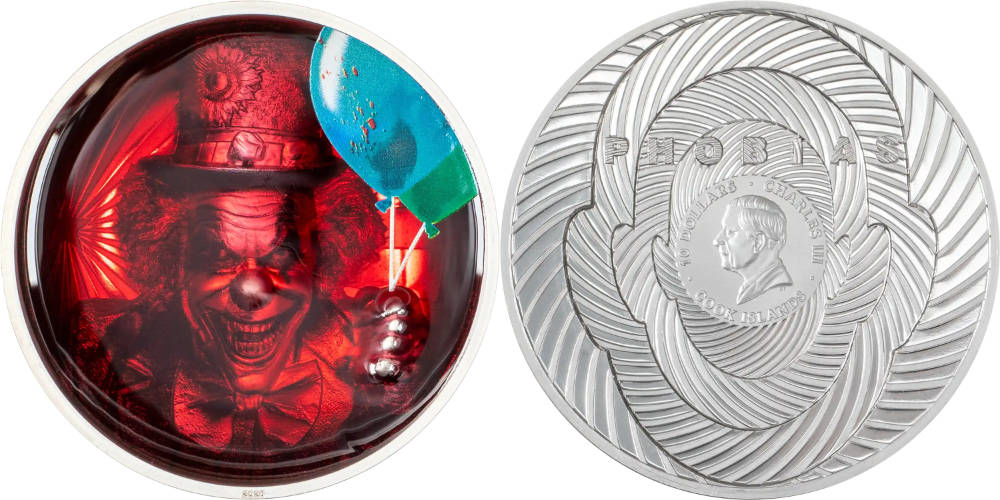
When a human head appears on a CIT coin, it transcends itself and reaches the level of emotions. Phobias is the name of the series, the third edition of which has just been released. It focuses on a clown, because coulrophobia is the name given to an excessive fear of clowns. Unlike claustrophobia and agoraphobia, coulrophobia is relatively new. It has spread since the 1990s and has been fueled by numerous films. It is by no means a marginal phenomenon. As a study from 2023 noted, 5% of respondents suffered from coulrophobia.
With motifs such as this, CIT is continuing a numismatic phenomenon that began in 2019 with “Trapped.” At that time, a coin was used for the first time to convey nothing other than a feeling. Today, the first edition of “Trapped” is one of the icons of contemporary numismatics.
It goes without saying that “Coulrophobia” also features superb craftsmanship. The combination of high relief in a concave round blank, filled with enamel and additionally colored, is something that no one can easily replicate.
The ancient guilloche process modernized for numismatics
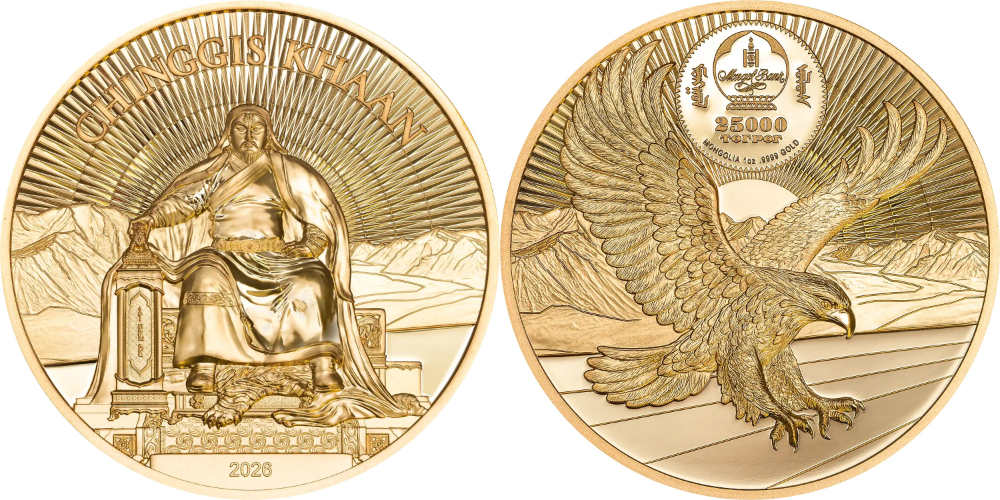
CIT has created a coin for Mongolia that, at first glance, takes up a common theme in a classic form. Genghis Khan is enthroned on the face of the coin. The depiction refers to a statue that was unveiled in Ulaanbaatar on March 1, 2025. His museum now houses a 7-meter-high, 13-ton statue of Genghis Khan, completely covered in Mongolian gold, whose image can be found on a CIT silver, gold, and small gold coin.
Of course, CIT could have designed a normal, representational coin image for this purpose. But if you take a closer look at this coin, you will see something completely different. CIT translates the reverence shown to the great Khan in Mongolia into the ancient process of guilloché engraving. The medieval ruler appears almost godlike thanks to the fine rays surrounding him.
They are the result of a technique that dates back to the 17th century and became famous through its use on watch cases and banknotes. While the lines were applied semi-automatically and semi-manually at that time, CIT and B. H. Mayer have adapted the ancient technique for numismatics.
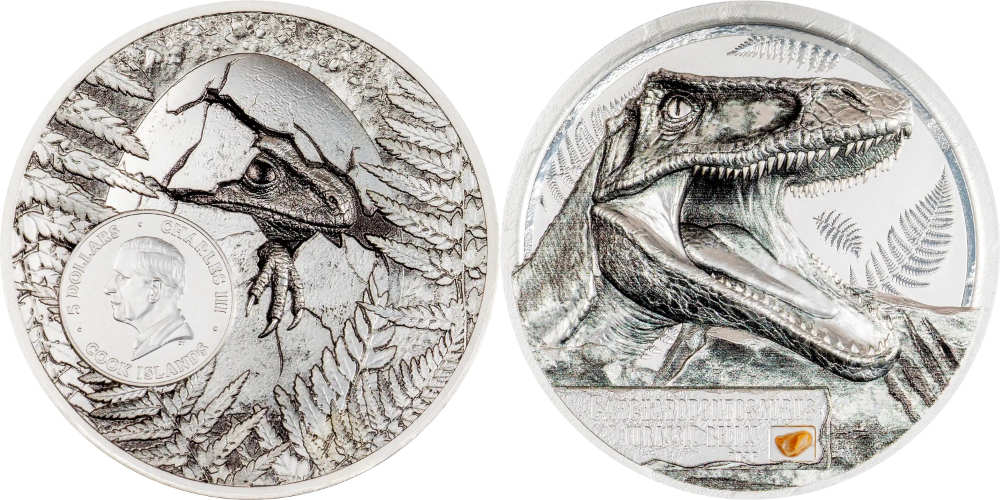
Let’s end this brief insight into the CIT winter launch with an evergreen. Dinosaurs are still a popular collector’s item. And when an attractive coin with a dinosaur motif also contains a tiny piece of a precious fossil, we have the perfect object for cross-marketing. The Carcharodontosaurus on the Cook Islands’ $5 coin will not only interest coin collectors, but also all fossil collectors who will never be able to afford a complete Carcharodontosaurus tooth. The fact that the designers at CIT also managed to incorporate what we now refer to as the “cute factor” into the design is a stroke of genius. The reverse design also appeals to young women.
All coins from the CIT Winter Launch 2026 can be found on the CIT website.
CIT has uploaded an impressive film about its Winter Launch on YouTube.
Text by Ursula Kampmann