How do I get the most for my coins?
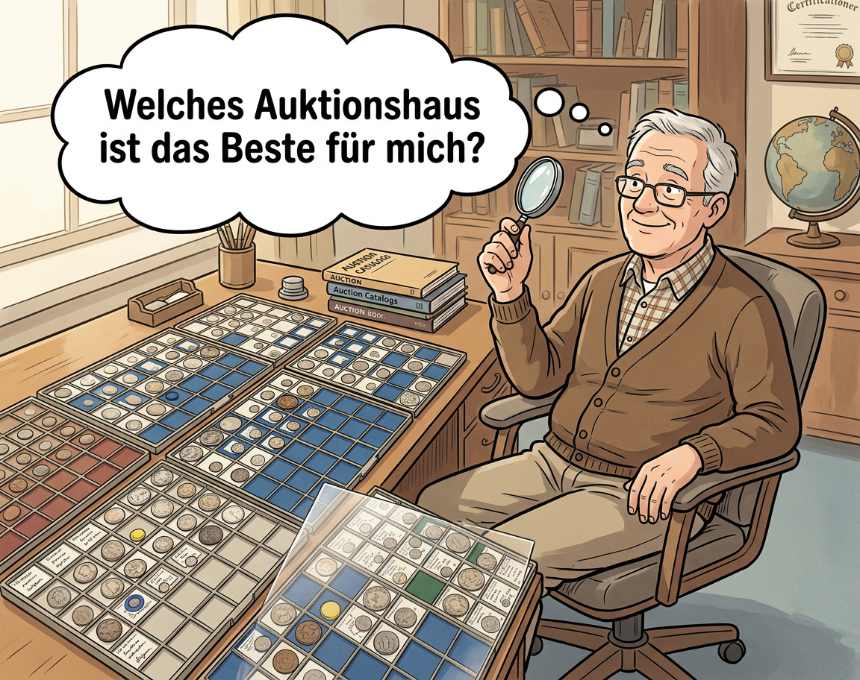
There’s that famous story about the woman who consigned a rug to her local auction house and was delighted when its estimate climbed from 900 euros to an impressive 19,700 euros. Her joy faded when the buyer consigned that very same rug to Christie’s, where it achieved the highest price ever paid for a rug: 7.2 million euros. The woman held her local auction house responsible and sued. In fact, she should have been more annoyed at her own foolishness, because it is the consignor’s responsibility to make the selection of the right auction house for their treasures. This article is intended to help you find the right one for your coin collection. It is intended for advanced collectors. For heirs who have no idea what they have inherited, we will occasionally publish a separate article.
1. Be realistic!
First and foremost, it’s important to be brutally honest with yourself. It’s clear that all auction houses are scrambling for coins in perfect condition with a long and distinguished provenance that haven’t been on the market for a long time. But who actually has those? Most of us have built the collection we could afford with our often limited resources. There are better
and worse pieces in the collection. First, get an overview, and then compare which auction house offers items similar to what you have. An auction house that frequently offers coins like yours is most likely to have exactly the clientele that can appreciate the quality of your coins and honor them with the highest possible bids.
2. Find the expert in your specific field
Quality isn’t the only factor in identifying the ideal customer base. Your area of collecting is just as important. Once you’ve specialized in a particular field, it makes sense to find the dealer who knows that field best. The “Islam” collecting field is a prime example. Of course, you can have Islamic coins auctioned at any auction house, but very few auction houses have such strong connections in the Islamic world that collectors from Saudi Arabia and the United Arab Emirates bid directly through that auction house.
To a lesser extent, this also applies to other fields: U.S. coins simply sell best in the U.S.—or at an auction house that is just as well-connected in the U.S. as a U.S. firm. You should offer French coins at an auction house where French collectors can bid in their native language. Ancient coins should only be auctioned by specialists in ancient coins, and so on. Check whether your prospective auction house has already conducted auctions in this field and what prices were achieved. This will give you an idea of whether it has the right clientele for your specialty.
3. Squaring the Circle: Collaboration
Let’s say—just to give an example—you collect French coins, have been doing so your whole life through your local dealer, and are now beginning to wonder whether this particular dealer might be the right choice for selling them? You don’t want to hurt his feelings because a friendly bond has developed over the years? Then ask him if he could envision collaborating with a suitable auction house. In such a case, your local dealer can help you find the best auction house—perhaps in France or elsewhere; he will negotiate the terms and handle the shipping. Of course, he will receive a few percent of the profit in return, but you’ll easily recoup that by tapping into his expertise to find the best auction house.
4. See what a dealer does to promote a collection
Another crucial question is what a dealer does to promote your collection. Which auction platforms does he use? Does he use all the market leaders, or just a budget option? Does he advertise in the most important numismatic publications? Does he send newsletters to his customers? If so, how many, and what do they contain? What other promotional tools are at their disposal? Podcasts, blog posts, auction previews? Do they attend coin fairs both domestically and in foreign countries? How active are they in the numismatic market? Quite active, as this means the greater the chance that as many people as possible will see your coins.
5. And what role do the commission rates play?
Let me tell you what I quite believe: The commission a dealer takes from your consignment is actually a minor detail. I’m sure the woman who sold her rug at a local auctioneer’s office for a five-figure sum would have gladly paid double the commission if it had netted her a seven-figure sum. Commissions always add up to the final result, and the result is more important than whether you pay 10, 15, or 20%.
6. Reserves: If you want to be on the safe side
Competition among auction houses is fierce. This means that many auction houses entice consignors with extremely favorable terms. They simply cannot afford to have coins remain unsold because they were estimated to be worth more than they actually were. The result: Estimates today are a joke. They do not correspond to an “estimate,” but rather to an extremely low starting price at which the auction house itself would buy the piece in a pinch. This usually works out well, since bidders are now accustomed to having to bid several times the estimate if they want a truly interesting piece.
Nevertheless, unfortunate coincidences do occur. To prevent your most valuable piece, of all things, from being sold off at a cheap, inexpencive hammer price, you should have the auctioneer guarantee that the lot list with the estimates reaches you in time so that, if necessary, you can set a reserve price on the pieces that seem drastically undervalued to you. This may involve costs, but they are worth it—if only for your peace of mind.
7. A contract is a given
Oh, and by the way—it goes without saying: Of course, you should insist on having a copy of the auction contract in your possession BEFORE you hand over the items for consignment. Trust is good, but a contract is better. Every reputable auctioneer has standard contracts that they adapt to your specific situation. These contracts cover everything, such as when the proceeds will be paid out, what percentage will be deducted, what happens to unsold lots, and so on.
8. Consider all possibilities
The key thing to consider before the consignment of your items is what really matters to you. Do you want your specialized collection to be auctioned as a whole to create a numismatic legacy? Or does the financial return occupy the centre of your priorities? Depending on your answer, you will choose a different auction house.
Because if you’ve read this article carefully so far, then you know: There isn’t THE BEST auctioneer, but there is the best auction house FOR YOU and YOUR COLLECTION.
Text by Ursula Kampmann