More than 50,000 counterfeits exposed on eBay
I love flea markets. It’s just wonderful to stroll along the stalls and pick up a bargain or two. I never spend a lot of money, because what I think is a precious antique at first glance can quickly turn out to be a cheap imitation from the Far East when I examine it more closely at home in good light. (This happened with an engraved walrus tooth from the 1920s, which—as I discovered at home—was made of hard plastic.) Ultimately, eBay is nothing more than the modern version of a flea market. So the same rule applies on eBay: keep your eyes open before you buy!
The most common problems
First of all, let’s note that most sellers on eBay are completely honest individuals or companies who have been using this channel for decades to connect with potential customers. There is hardly a German coin dealer that has not bought or sold on eBay. However, there are also many dubious sellers who set out to defraud customers. Separating the wheat from the chaff is not so easy for beginners.
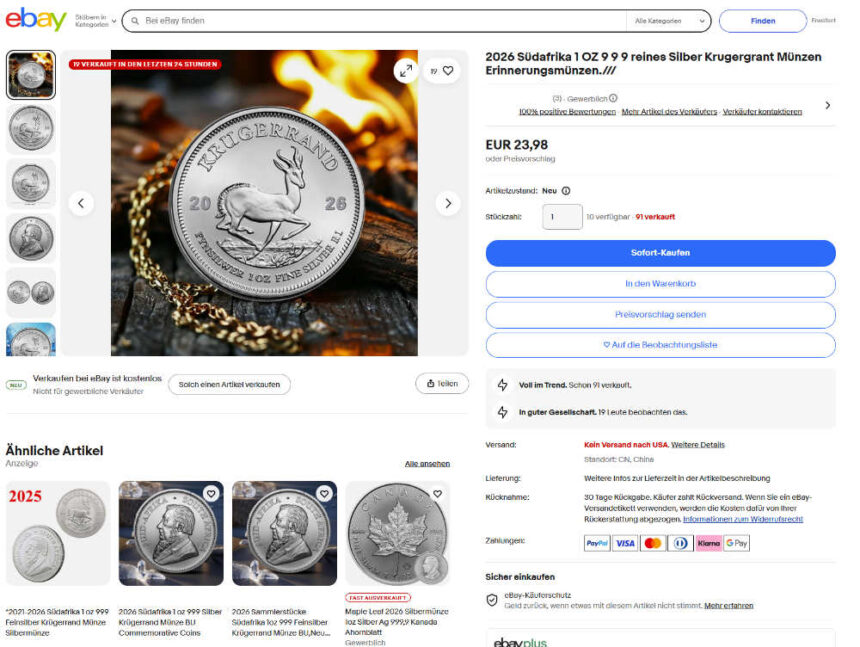
The biggest problem at present is likely to be the large number of counterfeit investment coins flooding the market. They are not good enough to fool the expert, but anyone who is just starting to collect coins can easily be taken in by them.
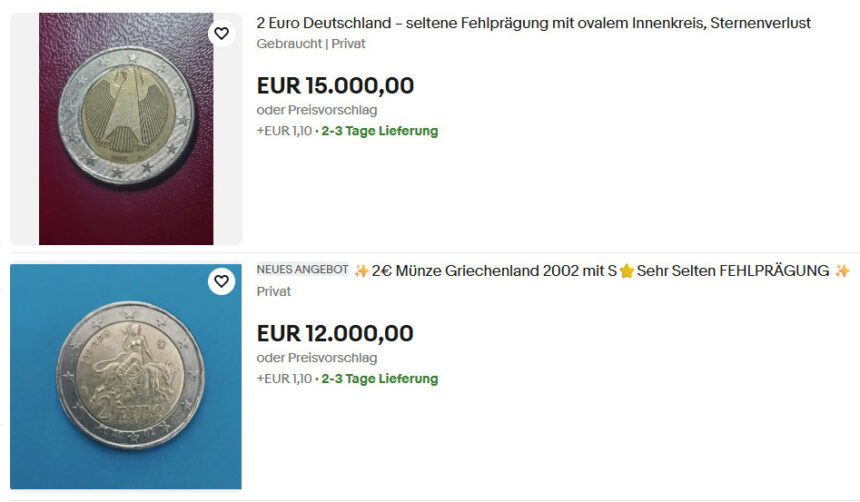
Another problem is genuine euro coins being offered at completely inflated prices. Offering common 2 euro coins as “misminted coins” for a five-figure sum constitutes usury under the law!
eBay’s watchdogs
This problem does not only affect coins. There are dubious offers in all areas of collecting. For many years, eBay relied on so-called “watchdogs” to remove them. eBay still gives every user the option of reporting an item via a button. Users who are particularly active and achieve a high success rate in reporting dubious offers are rewarded with extended reporting rights. They are the real watchdogs and work voluntarily in their spare time. That is commendable. However, these helpers are far from being able to keep the various marketplaces around the world clean.
The VeRo program
This problem became acute when major luxury goods companies sued eBay because the marketplace did not prevent counterfeit versions of their exclusive products from being sold on eBay. To cite just one example, in 2008 a French court ordered eBay to pay €38.6 million to the LVMH Group, which owns brands such as Dior, Guerlain, Givenchy, and Kenzo.
The many lengthy lawsuits that the company had to fight at the time were tedious, costly, and risky. For this reason, eBay launched the VeRO program. VeRO stands for Verified Rights Owners. The program gives representatives of licensed products the opportunity to file complaints with eBay immediately and preferentially in the event of infringements of their rights. Currently, 72,000 active rights holders are reported to be registered under this program. As soon as they file a complaint, the item is removed “promptly”—whatever that means. eBay reviews the seller and then decides what further action to take. This can range from suspending the account to filing a complaint.
Disastrous cooperation with the FOC
Authorities are being given even more power. eBay occasionally grants authorities the right to remove items themselves and immediately. This usually concerns product and environmental safety.
In this context, older coin dealers will shudder when they think of the cooperation that eBay agreed with the Swiss Federal Office of Culture in 2009. Background: On June 1, 2005, the new Cultural Property Protection Act came into force, which some Swiss archaeologists believed needed to be enforced more rigorously. They therefore pushed to ensure that eBay did not trade in “freshly excavated” coins. A pilot project was launched with which eBay wanted to preempt criminal prosecution.
Now, no reputable collector wants to buy coins from recent excavations. So the idea is actually a good one. However, the archaeologists tasked with reviewing the coins acted arbitrarily and without concrete evidence. Their suspicions were enough. This led to a large number of mistakes. Several coin dealers complained that their goods were affected, even though they could prove that the deleted coins came from old collections. The problem was that no one was interested! There was no authority to which a dealer could present his arguments. Coin dealers who had been trading successfully on eBay for years had their accounts blocked virtually overnight and without any possibility of appeal.
After the Swiss Professional Numismatists Association complained to the Federal Office of Culture on the initiative of MünzenWoche, the pilot project was not followed up with any further cooperation.
Cooperation between the BdDM and eBay
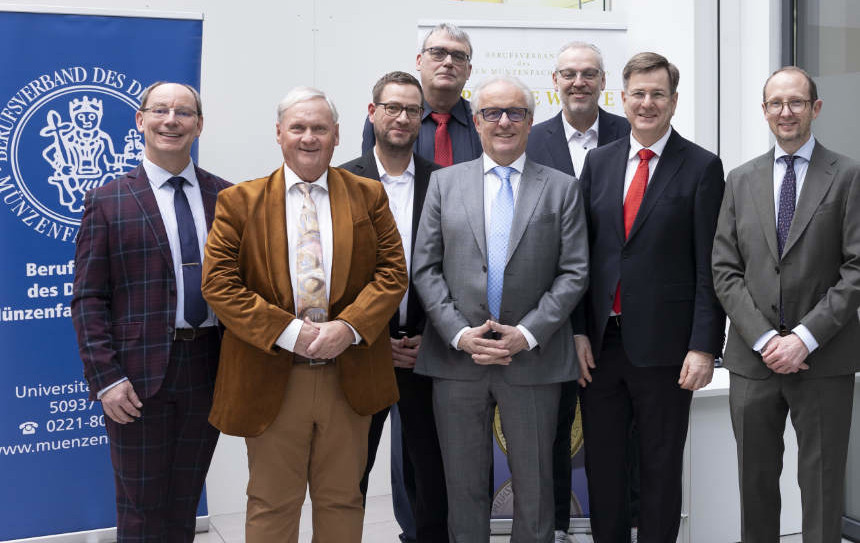
The collaboration between BdDM and eBay is quite different. It cannot be emphasized enough how much credit the Professional Association of German Coin Dealers deserves for taking on this task. Michael Becker summarizes the reasons for this: “Beginners in particular are deterred by bad experiences when buying coins. That’s why we joined forces with eBay’s watchdogs.”
According to managing director Stefan Lutter, the BdDM watchdogs have succeeded in removing more than 50,000 items from the platform over the past two years. A great achievement in the interests of collectors!
However, collectors should not feel too secure, as Michael Becker clearly states: “We are aware that even for us as experts, the possibilities for verification on the Internet are limited. We can only judge on the basis of a picture.” That is why the BdDM recommends that newcomers in particular search eBay specifically for recognized specialist dealers. They can be identified as “Verified Coin Dealers” and/or by the logo of the professional association and guarantee the authenticity of the coins purchased from them for an unlimited period of time. Advice is provided free of charge. “This is invaluable for beginners. A well-advised collector avoids costly mispurchases,” emphasizes Michael Becker.
A cheap solution
eBay can be pleased to have found such a competent partner for the coin sector, one that on the one hand has the expertise to recognize counterfeits and on the other hand costs as little as possible. It is remarkable how much the publicly traded company (net profit of $2.85 billion in 2024) relies on the work of volunteers when it comes to buyer protection.
Experts as “watchdogs”?
To be honest, I personally also have problems with the term “watchdog.” In my opinion, the word in no way reflects the appreciation that should be shown to an expert who, on top of that, offers their expertise out of altruism. “Watchdog” verbally downplays the fact that eBay itself does not want to raise the funds to build the wall that protects its marketplace – to stay with the metaphor. I can just picture eBay’s management patting their loyal watchdogs on the head, just like the old landowners used to do.
Long story short, I think it’s great that the BdDM—just like NGC and PMG, by the way—supports eBay in keeping the marketplace clean. And I find it embarrassing for eBay that the company doesn’t consider it necessary to hire its own experts—and then pay them appropriately.
Text by Ursula Kampmann