The Coin and Stamp Market on Plaza Mayor
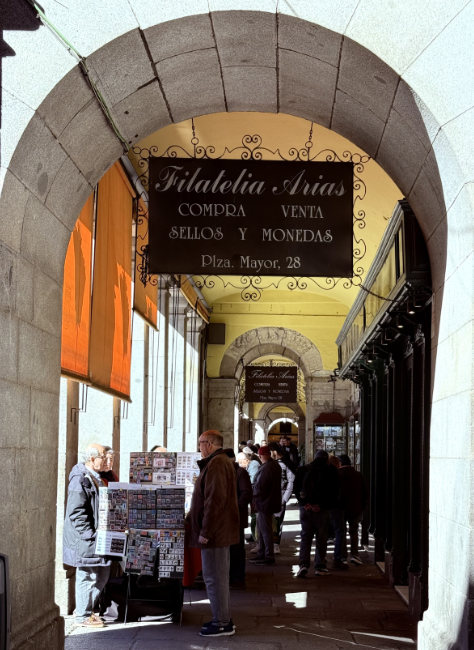
Madrid has a lot to offer coin enthusiasts—more than any other city I’ve visited so far. And I’m not talking about the many museums that host coin and medal exhibitions. Nor am I referring to the numerous coin shops clustered around the Plaza Mayor. I’m talking about the Mercado de Monedas y Sellos, a kind of coin market that takes place every Sunday throughout the year under the arcades of the Plaza Mayor! To my knowledge, this is unique worldwide: the dealers don’t set up their stalls in some cheap, inexpencive hall on the edge of the city, but right where thousands of tourists gather. It doesn’t get any more central than that. Anyone taking a stroll through Madrid’s Old Town on a Sunday will inevitably pass through the Plaza Mayor and be confronted with the fact that you can buy coins there—even on a tight budget.
An Experience
I’d known about this event for many years, but until now I’d never gotten around to visiting it. That’s because I make a point of avoiding Madrid on weekends. This city, which is already overrun with visitors, is never more crowded than on weekends.
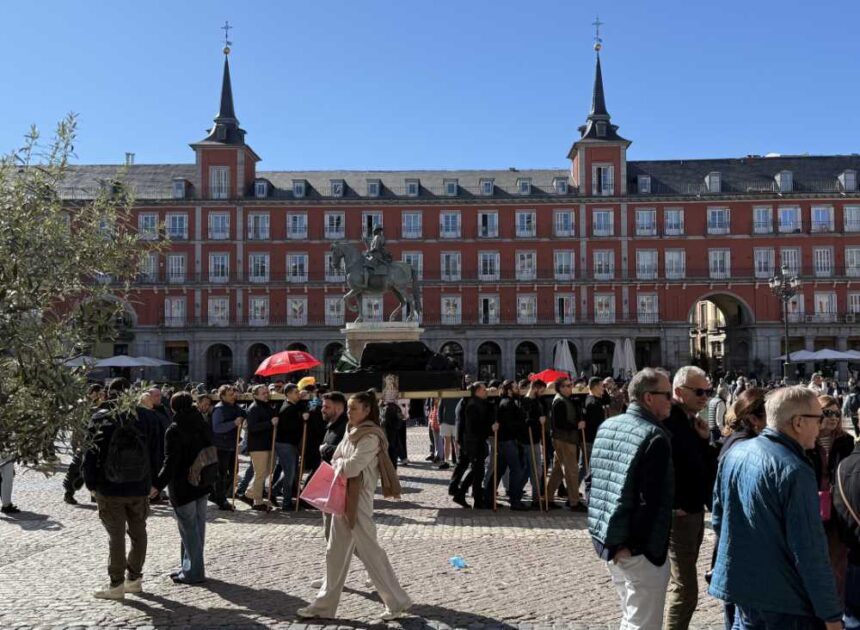
If I’d known what a unique atmosphere there is at the Mercado de Monedas y Sellos, I would have come much sooner. It was incredible. The vendors actually set up their stalls as early as 9:00 a.m.—a rather unusually early time for Spain. So on Sunday, we strolled through the relatively quiet streets and alleys. All we could hear was a steady thudding, as if many people were striking the ground at the same time. The mystery was quickly solved. Large groups of men dressed in black were carrying massive wooden platforms on their backs. They moved in unison, keeping time with their sticks. These were brotherhoods practicing for Semana Santa. They participate in the traditional processions during Holy Week, when scenes from the biblical narrative are reenacted on the platforms, which are still empty at this point.
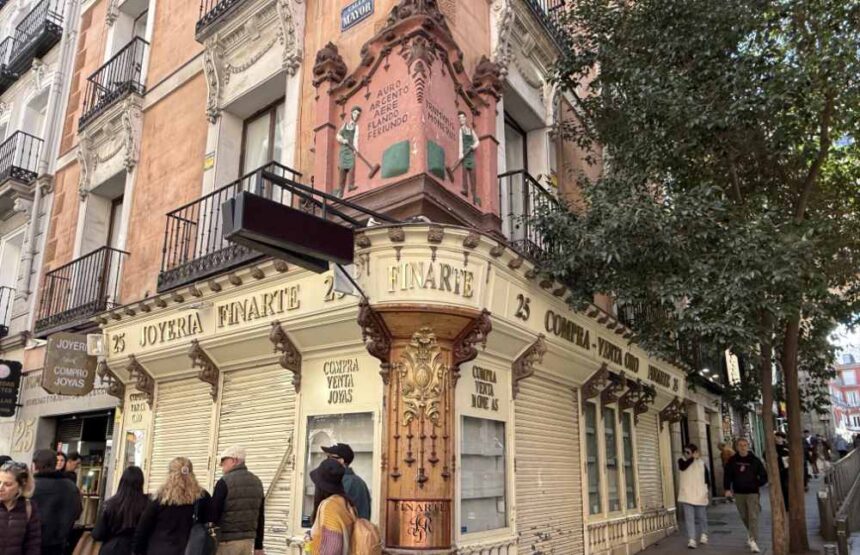
But back to numismatics and the attractions for coin collectors. They can look forward to finding plenty of evidence near the Plaza Mayor of the great interest Spaniards have in their coins and stamps. Numerous coin dealers have set up shop here and have been displaying their wares in large shop windows for many decades. This is evidenced by a striking facade decoration dating from the early 20th century at one of the entrances to the Plaza Mayor: There, the Latin name of the triumvirate responsible for coin production during the Republic is prominently displayed: AURO ARGENTO AERE FLANDO FERIUNDO TRIUMVIRIS MONETALIS—the triumvirate for the smelting and minting of gold, silver, and bronze.
The Location: The Plaza Mayor
First, a few words about the significance of the venue. Madrid’s Plaza Mayor is not just any ordinary location, even though there are Plaza Mayores quite everywhere in Spain. The name simply means “main square.” The market was held in a Plaza Mayor; meat and bread were sold there, processions took place, death sentences were carried out, heretics were pardoned or burned, and whatever else people wanted to do in public.
There had been a Plaza Mayor in Madrid long before the settlement became the capital of the Spanish Empire. Back then, it was still called Plaza del Arrabal and was anything but the impressive ensemble that the Spanish rulers left us. The most significant renovations can be traced back to Philip III, who commissioned an architect in the early 17th century to create a representative square. He did so between 1617 and 1619. The construction costs amounted to around 900,000 ducats. More or less, we are still conducting viewing sessions of this architectural highlight today.
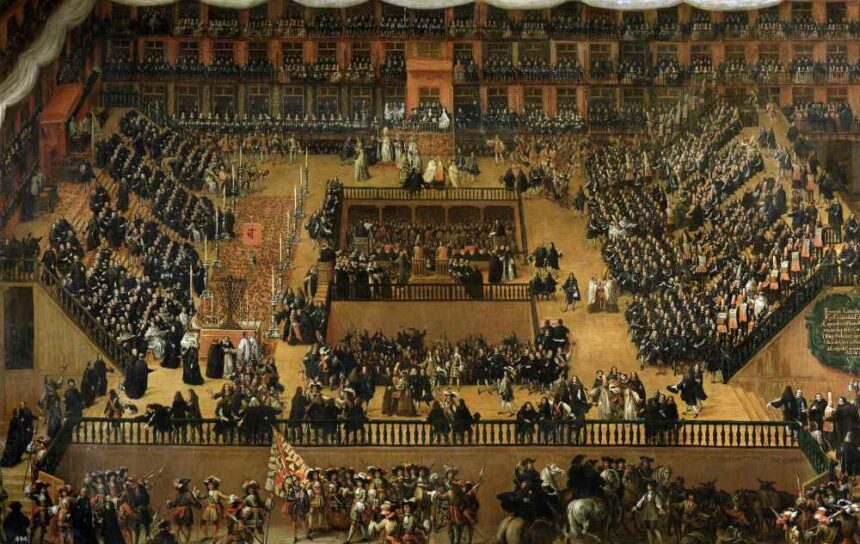
More or less because fires broke out repeatedly, and the square was therefore redesigned several times. Thus, at the beginning of the 20th century, it evolved from a simple market for daily necessities into a sort of elegant shopping mall with upscale stores for high society. And since collecting coins and stamps was a widespread hobby among the educated classes at the beginning of the 20th century, a Sunday Mercado de Monedas y Sellos fit perfectly into the weekly schedule.
This numismatic event has actually been around since the 1920s. Simply incredible!
Since 1927: The Mercado de Monedas y Sellos
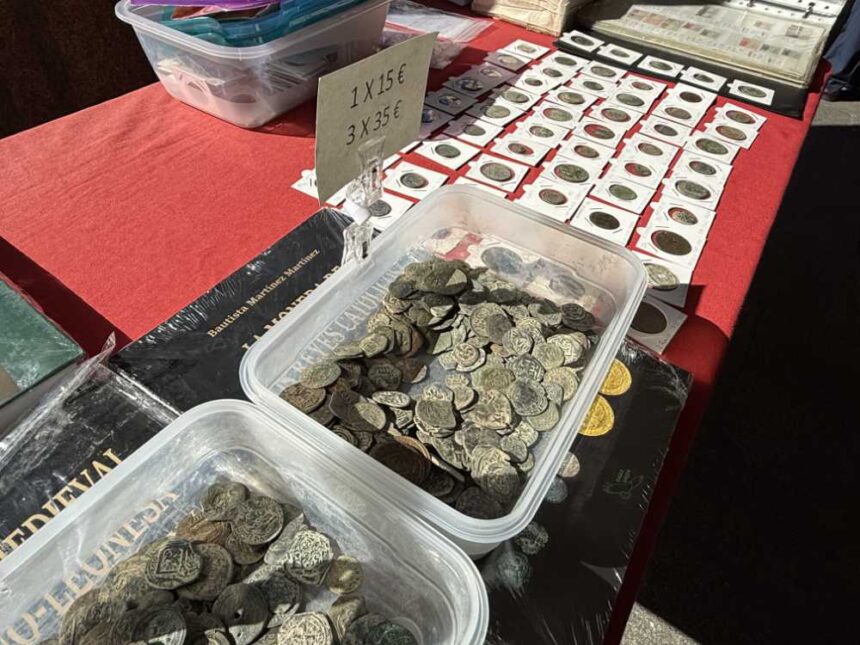
Records show that this coin market has existed since 1927, which is why a Spanish stamp was issued to mark its 50th anniversary in the year 1977. Today, the event is as vibrant as ever. I found around 100 tables, staffed by Spanish coin and stamp dealers. They all had a rich selection to offer. As expected, the focus is more on coins than on stamps. Several dealers specializing in banknotes also had a table. A few stands offer other collectibles such as stocks, postcards, and more.
The quite rare and high-priced coins are, of course, not there; in Spain, those go to auctions held by the well-known houses, which, incidentally, are not represented at the Plaza Mayor. Here, you’re more likely to meet all the dealers who don’t yet sell their wares online.
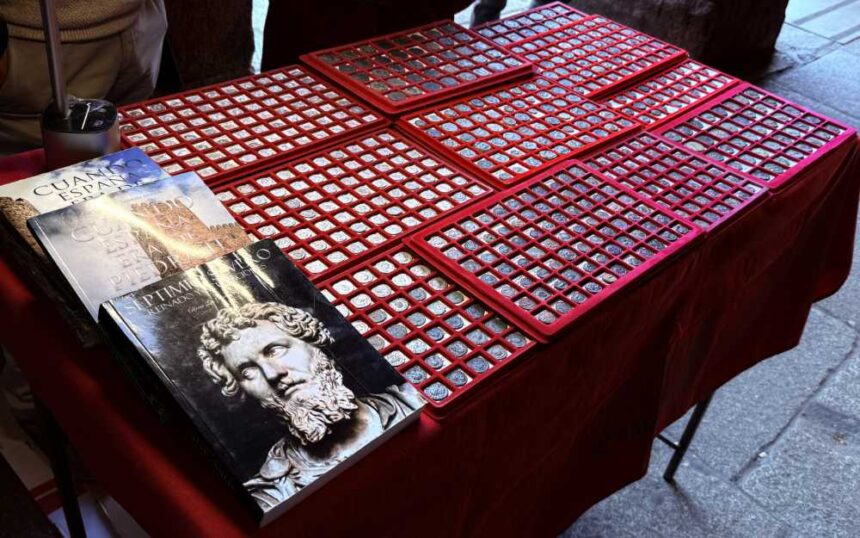
Of course, the focus is on Spanish coins—after all, the Spanish Middle Ages and modern era offer a rich selection of mintings. In antiquity, the so-called Celtiberians produced a diverse and interesting range of coins.
However, international coins are also available. There is a particularly rich selection of Roman coins. Please keep your country’s cultural property protection laws in mind when making purchases! For some pieces, it may make sense to ask the dealer to ship your purchases to you rather than risking disputes (and legal complications) at the border.
There is an active secondary market for modern coins here
Two things particularly impressed me at the Mercado de Monedas y Sellos. First, there’s the issue of modern commemorative coins. Many collectors complain that even for modern rarities, it’s only possible to a limited extent to sell them at a fair price. Common commemorative coins from recent decades usually end up in the melting pot. Not so in Spain. All dealers on the Plaza Mayor actively buy—including modern commemorative coins. This is extremely important, because only this way do these pieces retain a collector’s value, quite high or quite low.
The dealers buy because they know they can resell the pieces. The national FNMT—the Fábrica Nacional de Moneda y Timbre—has been systematically promoting interest in its older commemorative coins for years. For instance, a friendly dealer gave me—just like that—a current catalog of all Spanish euro coins, which the FNMT distributes for free. There’s no better way to encourage collectors to seek out pieces no longer available from the mint on the open collector’s market!
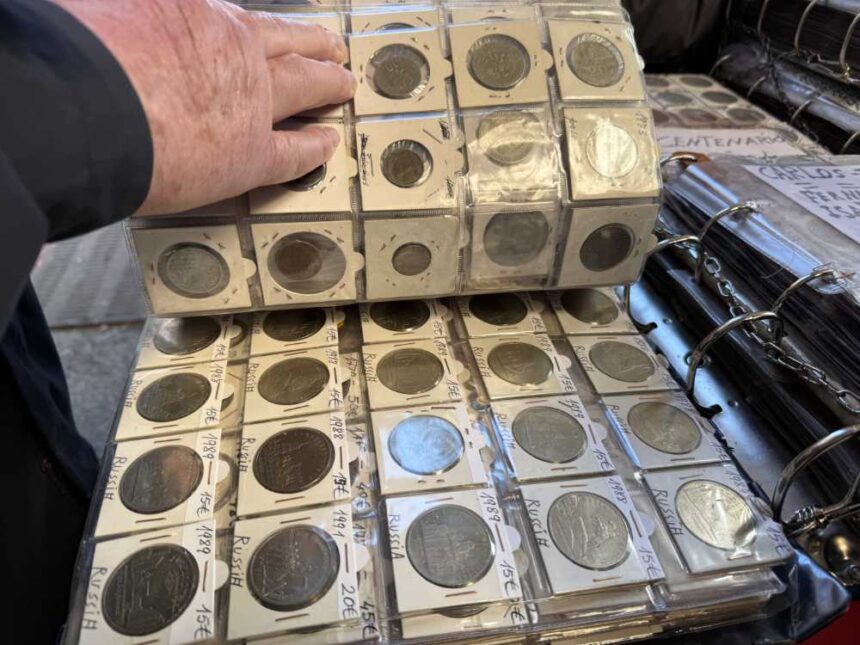
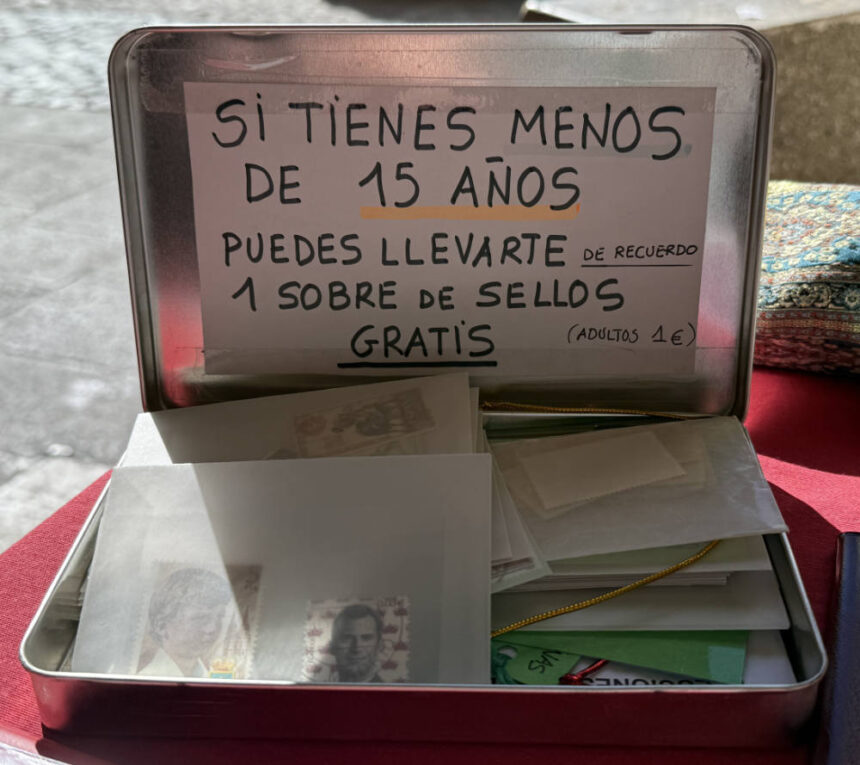
Supporting the next generation par excellence
What I find even more important is the low-barrier access people here at the Mercado de Monedas y Sellos have to the coin trade. After all, what ordinary person knows about the fascination of numismatics unless they happen to stumble upon it somehow? Here, many dealers are delighted when fathers show up with their children—and at quite a few booths, there’s something free for the kids. The fact that the numerous tourists wandering around the Plaza Mayor on Sundays also realize that one could collect coins is a positive side effect.
2027: The 100th Year Anniversary of the Mercado de Monedas y Sellos
If my math is correct, the Mercado de Monedas y Sellos will celebrate its 100th year anniversary next year. They did issue a commemorative stamp for its 50th year anniversary. I wonder if the FNMT will dedicate a commemorative coin to it for its 100th anniversary. Honestly, it deserves it, and I’d buy one right away. I’m simply fascinated by this vibrant numismatics scene for everyone! I highly recommend a visit to the Mercado de Monedas y Sellos to all coin enthusiasts.
There would be a good reason for a numismatic trip to Madrid anyway with the Evento Numismático, which will take place in Madrid on July 3 and 4, 2026.
Text by Ursula Kampmann