The end for Berlin's Institute of Archaeology?
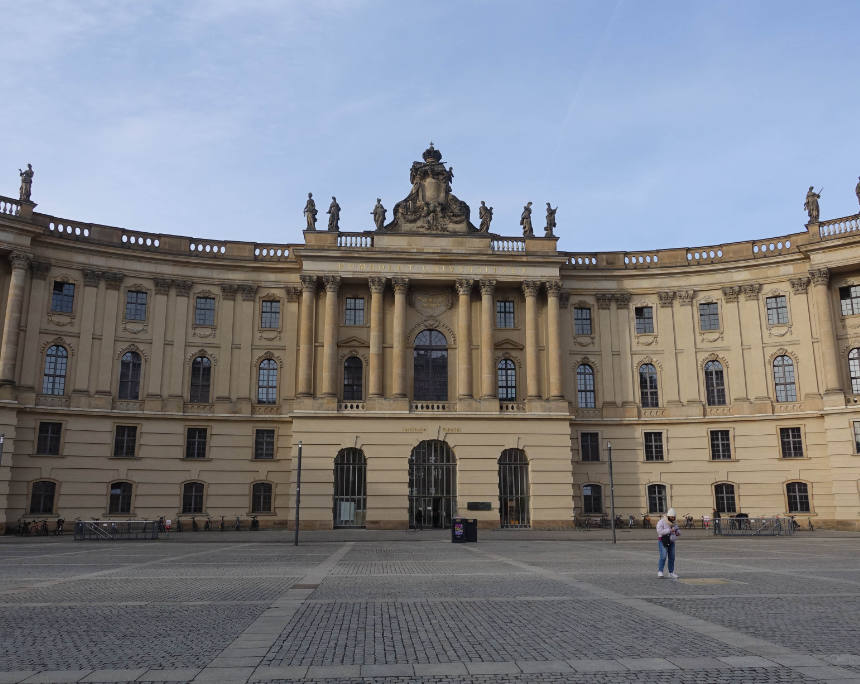
Spending money is fun. Saving money is not. No one can deny that saving is sometimes necessary. But while we can decide in our own lives whether we would rather buy a book or lunch, the same does not apply to government funds. The rule is: whoever has the smallest lobby gets the least money. And apparently, the Humboldt University’s executive committee assumes that it can convince the general public that the Institute of Archaeology will no longer continue in its current form.
There are plans to “restructure” the ancient sciences, whatever that may mean. They refer to the Berlin Antike-Kolleg, which promotes “classical studies research in Berlin and Brandenburg” as a network. Under this name, Berlin’s universities are linked with the German Archaeological Institute, the Prussian Cultural Heritage Foundation, and the Berlin-Brandenburg Academy of Sciences and Humanities.
“Every child has a right to Latin”
Of course, those affected disagree with this cost-cutting measure. And it is interesting to see how they argue their case: Gabriel Zuchtriegel, one of the signatories of the petition to preserve the institute, gave a detailed interview to the FAZ newspaper. In it, he complains that “neoliberal politics disguised as woke” are cutting Europe off from its roots. At the same time, he refers to the queer Winckelmann, after whom the institute threatened with closure is named, and serves feminist ideals by emphasizing that it was Humboldt University that appointed the first woman as professor of archaeology in Germany. Little is said about why society should afford such an institute; even the demand that children should continue to have the opportunity to learn Latin in regular classes remains just that—a demand—without describing the advantages of this language.
The same picture emerges when reading through the petition to preserve the Archaeological Institute, which of course also exists. The arguments are alarmingly thin. The most important of these is that 200 years of scientific tradition would come to an end. The others come from an internal perspective: researchers would be deprived of planning security and students would be deterred.
Does Berlin need TWO institutes for classical archaeology?
Currently, every person living in Berlin is statistically already 18,000 euros in debt, and spending remains high; the debt is increasing daily.
Savings must be made. The question now is: where?
Classical archaeology seems to have offered itself up. And will the arguments that have been put forward so far convince the people of Berlin that Humboldt University needs an institute for archaeology? What am I saying? Berlin needs to afford TWO institutes for classical archaeology, one at Humboldt University and one at Freie Universität Berlin. And the one at Freie Universität is not affected by the closure.
How many classical archaeologists does Germany need?
To be quite clear: I am an ancient historian. I have a soft spot for classical archaeology and am familiar with the important excavations around the Mediterranean. I am enthusiastic about the subject. But I am also a realist. And as a realist, I have to say that more and more Mediterranean countries are training their own archaeologists, who are doing very good work in their home countries.
Then we should also not forget that, even without counting Humboldt University, it is currently still possible to study classical archaeology at more than 20 universities throughout Germany. The training of future generations of classical archaeologists is therefore certainly not (yet) under threat.
I know I’m not making any friends with my thoughts. But I do occasionally ask myself where all the classical archaeologists from Germany are supposed to work after their studies. The DAI can only guarantee a secure livelihood for a tiny fraction of them. Then there are the museums and, oh yes, the universities, which in turn are constantly producing new graduates who need to be accommodated after graduation. It’s an expensive vicious circle that makes you wonder why we spend so much money on educating people when most of them have no chance of earning a living with their education. How do you explain to a potential medical student who fails the numerus clausus, even though Germany is suffering from a drastic shortage of doctors, that there is no numerus clausus for classical archaeology?
Today, there is a lack of a broad base of collectors.
Of course, one could argue that Humboldt University can afford to have an institute for gender studies that is well-staffed with teachers and students. Why them and not us? Well, money is always available for topics that society considers important. When Wilhelm II was in power, that was classical archaeology. When I started studying, it was trendy to do research on women or witches. Then funding flowed when an application prominently mentioned the word “gender.” Today, “provenance research” is booming, and no one knows what will be on the agenda tomorrow.
What I do know, however, is that archaeology has alienated its broad, financially strong, and helpful base in recent decades through its clear rejection of trade and collectors. This is a shame, because collectors are the very people who would enthusiastically champion the necessity of the classical disciplines. But for this to happen, all the prejudices and entrenched opinions would finally have to be overcome. And that means on both sides.
Let’s stand united for the ancient sciences!
I can only repeat it over and over again: whether archaeology or numismatics, if these sciences want to occupy a broad space in the public sphere, then they have no choice but to cooperate with collectors and dealers. Only in this way can they secure the broad base and approval needed to lead the subjects into a secure future – especially in times of lacking government funding.
And those who dare to cooperate may be surprised to find that views on cultural property protection are no longer as far apart as they were in the 1980s.
Text by Ursula Kampmann