What is a coin worth?
Coin dealer Erich Cahn coined a famous saying in the 1950s. He said: “A coin has value equal to whatever a fool is willing to pay for it.” Now, those who bought (exceptionally good) coins in the 1950s were certainly no fools. On the contrary. They wisely invested their money for the enjoyment of their descendants. Erich Cahn had no intention whatsoever of discouraging them from buying coins. On the contrary. His statement simply means that coins do not actually have a value that can be quantified. Every price reflects current preferences, expectations, and desires. The higher the price, the clearer this becomes. I would like to illustrate what I mean by this in this article.
Spectacular Rarities, Varying Prices
On June 23, 2026, Künker held its 442nd auction in Osnabrück. It was a massive spectacle with a hall full of collectors—some of whom had traveled from far away; a quite large phalanx of telephones through which dozens of bidders competed; and, of course, the internet with its international clientele. The great interest stemmed from the fact that Künker was auctioning the collections of King Frederick William IV of Prussia and Emperor Wilhelm I. Top-notch provenance combined with exceptional grade! After all, most of the medals were not purchased in the trade but came directly from the royal mint to the imperial coin collection.
The collection included not only German but also Russian rarities, as the Prussians had a direct connection to the Tsar’s court through a sister married to Tsar Nicholas I. They received many coins as gifts for their own collection directly from the mint via special courier.

Künker had put in a great deal of effort in the run-up to the auction. Some pieces had already made their way to the U.S. and Japan. The collection’s catalog became a history book worthy of a place on any bookshelf.
Around the same time, Heritage held a World & Ancient Coins Platinum Session and Signature Auction in Hong Kong. The Peh family’s collection was offered there. The catalog and advertising—well, as good as always. Who is the Peh family? No idea. I only know that they collected beautiful and interesting coins.
So, now let’s compare a few prices.
Alexander von Humboldt and the Cosmos
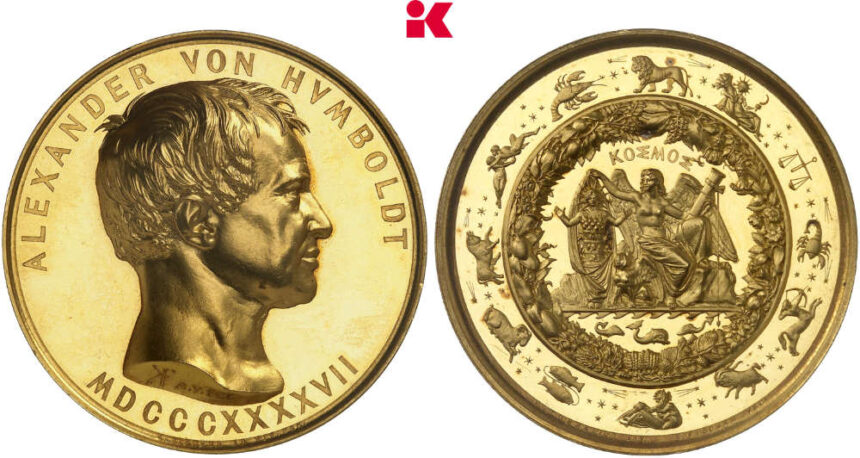
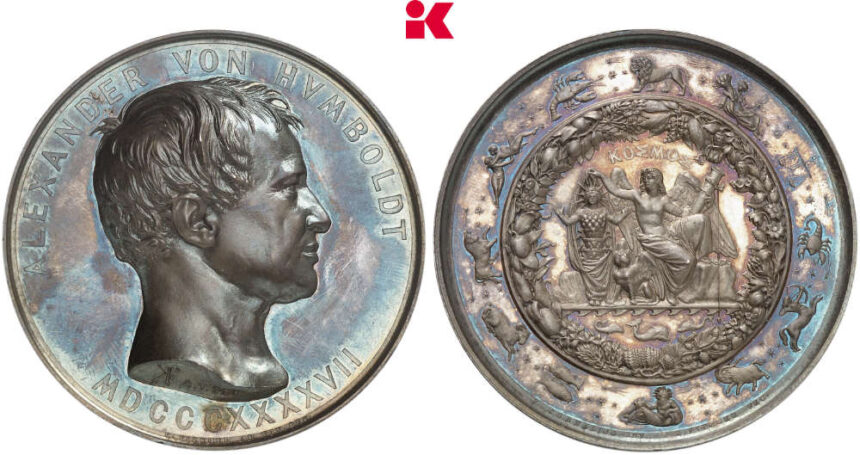
Let’s start with a medal of the utmost importance to the history of science. King Frederick William IV personally issued an order for the creation of an 80-ducat gold medal for his aging court naturalist, the famous Alexander von Humboldt, to commemorate the publication of the second volume of his comprehensive work *Kosmos*.
To briefly put this into the context of the history of science. (You can find a longer commentary here.) The *Kosmos* volumes represent the first conceptualization of the world as an ecosystem in which everything is interconnected: flora, fauna, climate—micro and macro, water bodies, geology, and, of course, all expressions of human culture. This publication by Humboldt is one of the central roots of our modern worldview.
The medal is also extremely rare! There are likely no more than a handful of them in gold—probably even fewer. The last time a piece came on the market was in the year 1860; that was Humboldt’s personal specimen. This time, it was Emperor Wilhelm I’s specimen, and for that, a price of 70,000 euros is quite nice, but certainly not spectacular—especially when compared to the silver medal. That one fetched 18,000 euros, and that is truly impressive!
For while very few gold medals were produced in 19th-century Germany, silver medals—though not commonplace—were by no means an uncommon sight. The rarity of gold specimens stems from the fact that even during the heyday of coin collecting, only a very small number of citizens could (or would) afford gold medals. They were incredibly expensive at the time of their production!
Issue Price and Rarity
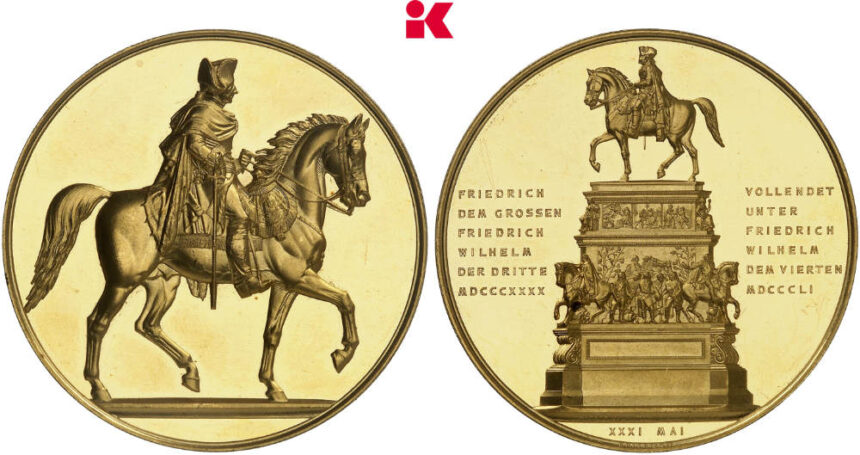
For another medal, we have the original prices at which it could be purchased at the Prussian mint at the time it was struck. The bronze version of the medal commemorating the inauguration of the monument to Frederick II of Prussia cost two talers, while the silver version cost twelve talers. The magnificent gold piece, with a weight of 50 ducats, cost 40 Friedrichsd’or, or 200 talers. A likely private (or perhaps smaller-scale) emission commemorating the same occasion cost one taler in bronze, 2 1/2 talers in Silver, and 50 talers in gold.
By way of comparison: On page 6 of a Prussian official gazette from the year 1847, there are records of official distress sales of Berlin properties. From these, we learn that entire townhouses served as collateral for a loan of around 700 talers, while large orchard meadows served as collateral for 150 to 200 talers.
A horse-drawn carriage ride for three people cost one-third of a taler in the same year; and in 1847, a Berlin community purchased three magnificent textiles—hand-embroidered with Silver thread and Silver tassels—for 41 talers to adorn the altar, the baptismal font, and the pulpit.
So who could afford to purchase a gold medal for 50 or 200 talers in the year 1847? And how many wealthy families have preserved their wealth through all the crises and periods of inflation to this day, so that they were not forced to have their gold medals melted down at some point?
The Ratio of Silver to Gold
In other words: In 1847, a gold medal cost eighty times as much as a silver medal. Today, the price difference between a German gold and silver medal—as seen in the extreme case of “Kosmos”—may be less than 1:4.
The reason is likely that the number of collectors who can spend between a high four-digit and a low five-digit amount on a silver medal is significantly greater than the number of those willing to offer a high five-digit or low six-digit amount for a collectible. Consequently, far more collectors compete for silver medals than for gold medals.
Icons of History and Numismatics
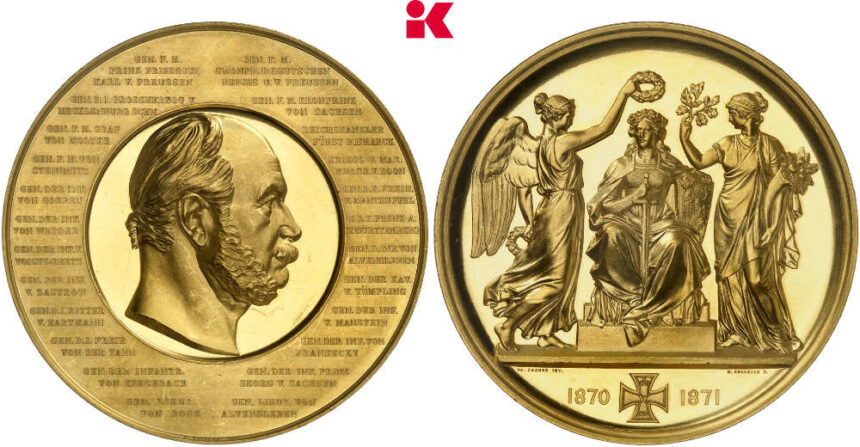
Let’s look at two more examples, both icons of history and numismatics. First, we have the famous Generals’ Medal, a testament to the grand victory celebration following the Franco-Prussian War, which also served as the founding celebration of modern Germany. It doesn’t get any more historic than this. The piece marks the dawn of modern Germany and comes from the collection of the very person who created it. We’ve already told this story.
160,000 euros is a hefty price for this medal, but a drop in the bucket when compared to another coin in the auction.
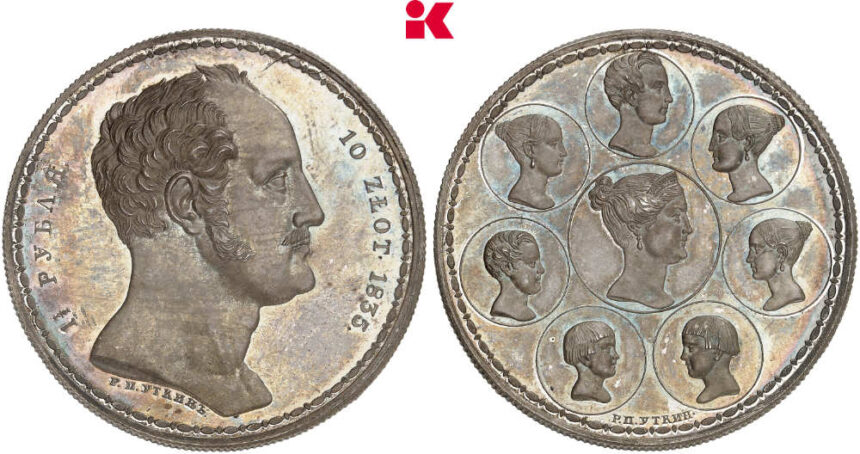
What the General’s Medal is to German history, the Family Ruble is to Russian numismatics. It features the Tsar’s portrait, which does not appear on standard coinage. Nevertheless: 36 (not 25) Family Rubles were struck; it is made of Silver (not gold); however, it is a coin—albeit a pattern that never entered circulation—and not a medal.
Nevertheless, the Family Ruble fetched 700,000 euros—more than four times the price of the Generals’ Medal.
The Short-Whiskered Dragon
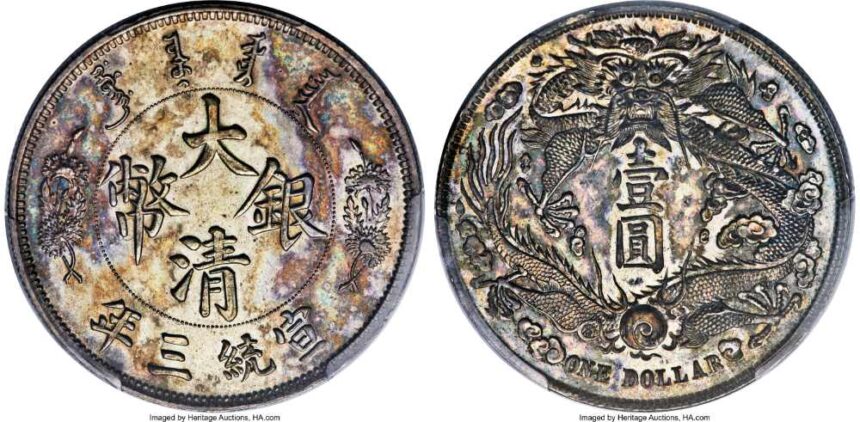
The famous Short-Whiskered Dragon dollar is also a very rare pattern. It, too, is of not only numismatic but also the utmost historical significance. We summarized this recently. The hammer fell for this piece in Hong Kong at $4,000,000—equivalent to around 3.5 million euros.
So has the Chinese Short-Whiskered Dragon Dollar a value of five times that of a Russian Family Ruble and 25 times that of a General’s Medal?
Different Buyer Demographics
No, it’s simply that different, financially more powerful buyer groups have been scrambling for these coins.
Russia has followed its own logic for several decades. After the fall of the Iron Curtain, prices for Russian coins skyrocketed; although they have since fallen slightly, they still operate in a quite different league than the rest of European coins.
The situation is similar with regard to China. Here, many investors anticipate significant price increases because they are banking on the size of the Chinese population, which is only slowly discovering the joy of coin collecting.
In the past, Heritage has succeeded in convincing its financially well-off collectors that coins have potential as an investment, that a coin is far rarer and historically more significant than any gemstone or Pokémon card, and that they are, of course, easier to store than Oriental rugs and oil paintings.
And so it’s not just Chinese coins from which investors expect impressive appreciation. Since U.S. coins cost so much that only a small clientele can afford the highest grades—known to be good investments—many are turning to other areas.
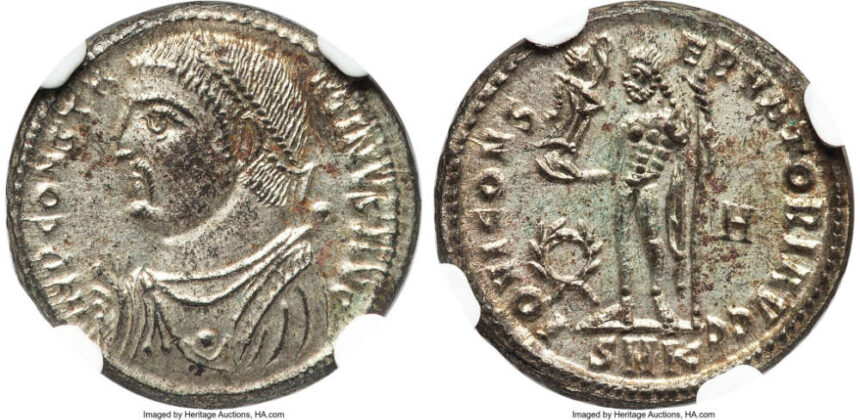
A good example of this is Heritage Auction 61,626 (yes, that’s the right number!). It took place on June 7, 2026, and featured ancient coins in attractive conditions. All had a starting price of one dollar. So Heritage certainly didn’t influence its customers’ bids!
Now, someone bid $5,612 (= 4,927 euros) for a coin of Constantine the Great—which, after all, was in perfect condition with its full silver edge! An unbelievable price! But there must have been a second-highest bidder. So at least two people wanted to buy this beautiful piece and were willing to spend more than 5,000 euros, including the buyer’s premium, for it. And that for a coin for which, back in the 1990s on the German market, you might have gotten 400 marks—if you were very lucky.
This result is neither an outlier nor an isolated case. A common Constantine of the Beata Tranquillitas type fetched $2,074 (= 1,820 euros) in the same auction, while a Trier Constantine II with VOT X sold for $2,928 (= 2,570 euros). Is this perhaps the new normal?
What is the value of a coin?
And that brings us to our central question: What is the right price? The 400 marks I would have received in Germany in 1990 for a perfect Constantine with a silver patina? Or the 5,000 euros that an American customer is willing to pay for it today?
What is the value of a numismatic object that can be understood as a central historical artifact of a proud nation? 160,000 euros? 400,000 euros? 3.5 million euros?
I think I agree with Erich Cahn, even if I’ll, of course, phrase it a bit more politely: The value of a coin is whatever the market is willing to pay for it today.
Or as another coin dealer named Bernhard Schulte used to say: “Valuations are nonsense!”
Text and images: Ursula Kampmann