Where Coinage Began
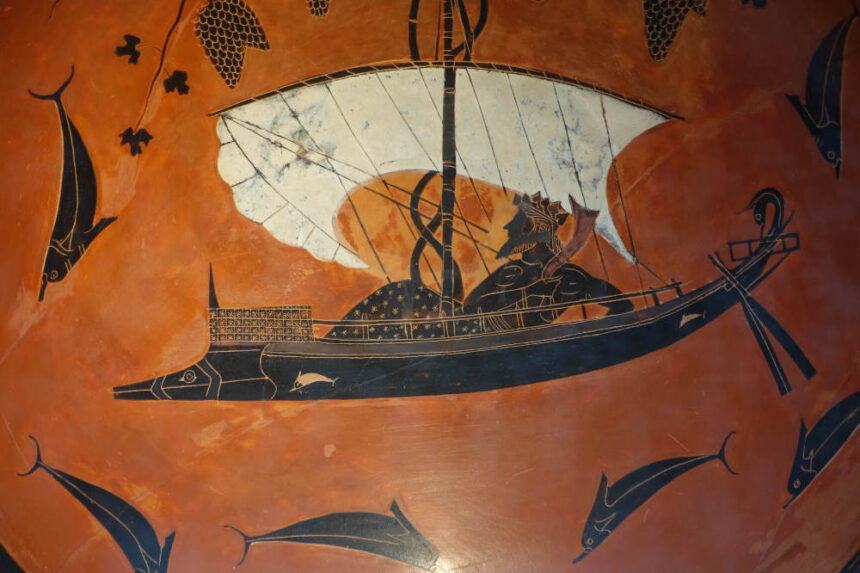
It was a turbulent time when the world of the Greeks underwent fundamental change. Myths like the Odyssey depict a society in which a prince’s greatness was measured by the number of sheep, goats, pigs, and horses he owned; indeed, by the number of men and ships he could spare to gain rich spoils in war. But this was changing even as Homer was composing his epic. He likely lived in a time when city-like settlements were emerging, competing with the princes. In these centers, crafts and trade flourished. Their citizens possessed a completely different self-image; they saw themselves as an egalitarian community whose members were bound together by their own rules, which everyone had to abide by. This was appealing.
The coin as a consequence of a culture clash
More and more people moved into these centers, and space became scarce. Local food supplies were no longer sufficient for everyone. Unrest arose; the elders had to take action. They expelled the troublemakers. Young, now homeless men founded new Greek settlements in far-flung regions. We know this process as the Greek colonization.
They spread Greek culture around the Mediterranean. The settlers built houses, imported their gods, their knowledge, and their values. They wooed (or abducted) local women, and in their young families, Greek and local cultures mingled.
Where cultures interact and knowledge is exchanged, the ideal place for innovation is. The Greeks learned from friend and foe alike, adapting foreign knowledge to their own needs.
Rarely in history have promising ideas developed and spread so quickly.
Writing is just one of many examples. We will not discuss it, nor the military, crafts, or laws. Suffice it to say that these innovations transformed the loose associations of farmers, artisans, and merchants into what we know and celebrate today as the Greek polis—the Greek city-state.
Let us instead turn our attention to their money, or rather to the coin, which also originated during this period of upheaval and, at the beginning of its career, was nothing more than standardized merchandise, a small bar of precious metal with an image that points us to its creator(s)…
Where the first electrum coins come from
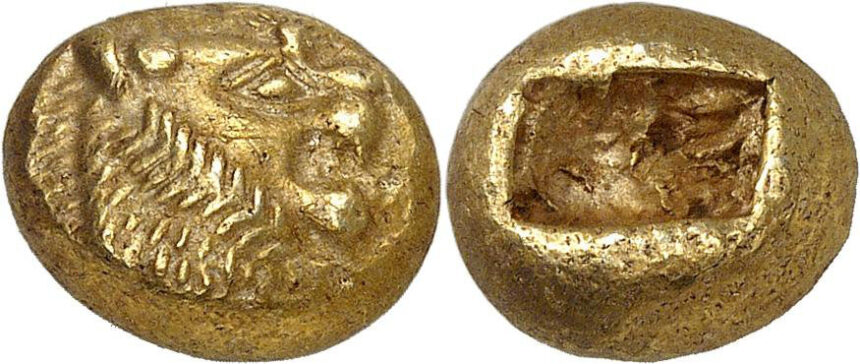
This innovation originated in the border region between the Greek cities of Ionia and the Lydian kingdom. If we are to believe Herodotus, it was the latter who minted the first coins. That is quite possible. What is impossible is that they used electrum for this purpose, which they found in the Pactolus, a river that flows past their capital, Sardis. For the Pactolus does not contain electrum, as long believed, but gold. Recent studies have shown this.

What is electrum?
We must therefore assume that the men who created these early electrum coins were masters of metalworking. They were skilled at producing artificial alloys with a consistent metal content. The electrum of the Lydian coins contains a fairly consistent 55% gold, 44% silver, and a small amount of copper.
The craftsmen responsible for these coins managed to weigh even the smallest fragments of a stater so precisely that their accuracy holds up even on electronic scales. We know not only the stater, the trite (1/3), and the hecte (1/6), but also 1/12, 1/24, 1/48, 1/96, and even 1/192 of the stater! The latter weighs a mere 0.04 grams of electrum!
And yet, each of these tiny coins bears a coin image of archaic beauty!
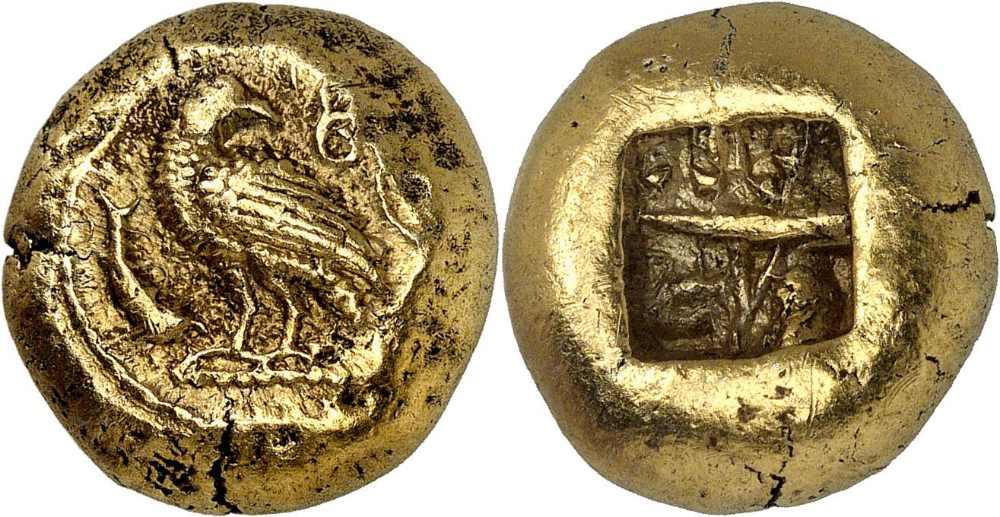
A rooster on a tiny electrum coin
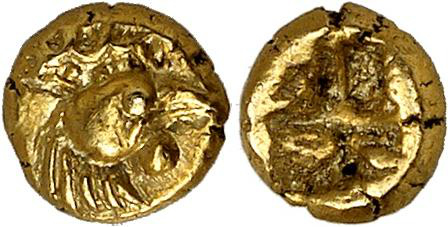
The skill with which the engravers created their images is truly admirable. This 1/24 stater coin, weighing just 0.62 g, measures a mere 6 mm in diameter, yet it depicts all the details of a rooster’s head, including its impressive comb, beak, wattles, and neck feathers. The artist must have observed many roosters to capture the anatomy of the head so precisely!
Today we no longer fully understand the significance of the rooster in the Greek world; we only know that it frequently appears in connection with the Greek gods. Why, we can only speculate. Perhaps because roosters are so magnificent – and yet so superfluous? One rooster is sufficient for a henhouse. Yet, just as many roosters as hens hatch from an egg. Perhaps that is why the rooster was so wonderfully suited as a sacrificial animal? In any case, shortly before his death, Socrates asked Crito to sacrifice a rooster to Asclepius in his name.
Lydia and Ionia
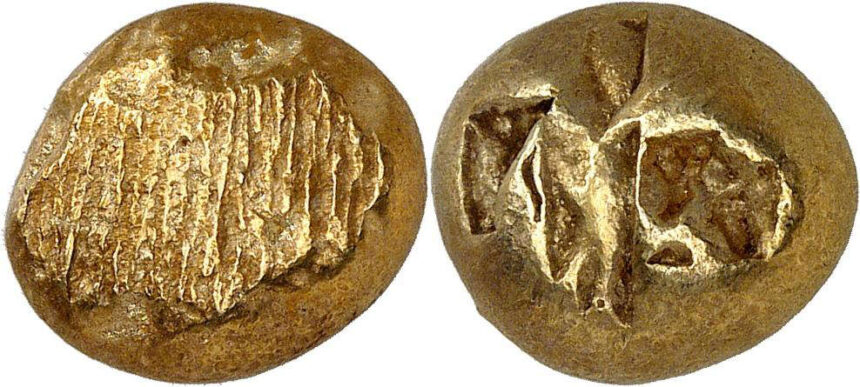
The Lydian kingdom also underwent a major transformation in the 7th century BC. Around 680 BC, Gyges came to power there, and we associate him with Lydian expansion. His mercenaries brought the burgeoning Greek cities of Ionia under their control. We do not know how the Lydians exercised their rule over Magnesia, Smyrna, Ephesus, and indeed almost the entire west coast of Asia Minor. Did they collaborate with local elites? Or did the Lydians appoint governors who commanded garrisons? Is this why the lion or a body part of the lion appears so frequently on Ionic electrum coins? Not on this one, we are presenting here, but on many, many others. Our sources fail us. Thus, it must also remain questionable whether Lydian coins were used to pay mercenaries.
The oldest depiction of a donkey on a coin
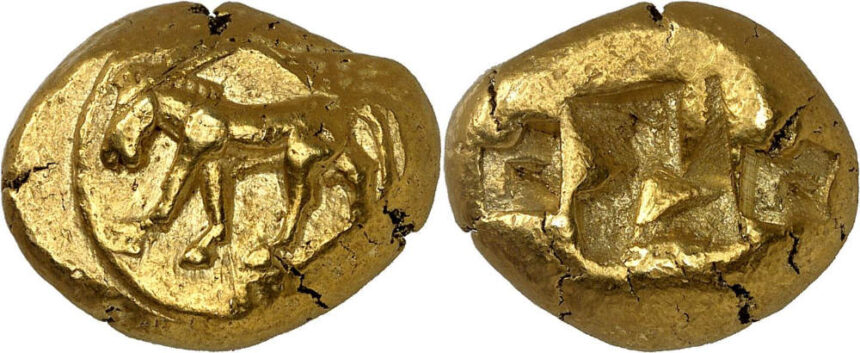
In any case, the coin spread throughout Ionia as a means of payment. The motifs are incredibly diverse, and the old hypothesis – from simple to complex representation – cannot be maintained. A precise chronology of the depictions is simply not possible.
Nevertheless, this donkey to be seen on a coin minted between 600 and 550 BC is likely the first donkey in numismatics. Many more would follow. After all, the animal, with its gigantic phallus, was often associated with the bacchanalian aspects of the Dionysian cult.
What were the first coins minted for?
Few things in numismatics are as controversial as the question of why the first coins were created. No Greek needed coins as a means of exchange. Merchants from Athens, Syracuse, Carthage, and Gades had managed for centuries without coins! Or were the coins initially minted for religious reasons? Did pious donors want to make their offerings unique and distinctive? This theory is now considered outdated. Indeed, no one would likely have entertained this idea had the first major hoard of electrum coins not been discovered beneath the foundation of a predecessor to the Temple of Artemis at Ephesus. Perhaps the matter is much simpler. Perhaps it all had a pragmatic cause. The gold content of natural electrum, after all, fluctuates between 65 and 85% and can only be determined with elaborate methods. Perhaps the new electrum bars, where an image verified the purity, facilitated trade. Perhaps they transformed from a commodity into a medium of exchange. Many means of payment have taken this step: glass beads and cigarettes, tea bricks and iron skewers. For at some point, the electrum bars crossed the threshold from a helpful medium of exchange to genuine money.
Silver coins as the logical next step
When coinage spread throughout the Mediterranean world, the coin was used as a means of payment. But by then, it was no longer made of electrum, but of silver. This, too, had pragmatic reasons: there were far more silver than gold mines under the control of Greek city-states. It was therefore simpler to mint coins from pure silver. Coinage then developed into a true unit of measurement, with which all products and services of an urban society could be valued. It is no coincidence that the word nomismata, which the Greeks used to refer to their money, is related to the word nomos (= law). Literally, nomisma (= coin) means: that which is accepted by law [as a token of value].
The survival of the electrum in the Black Sea trade
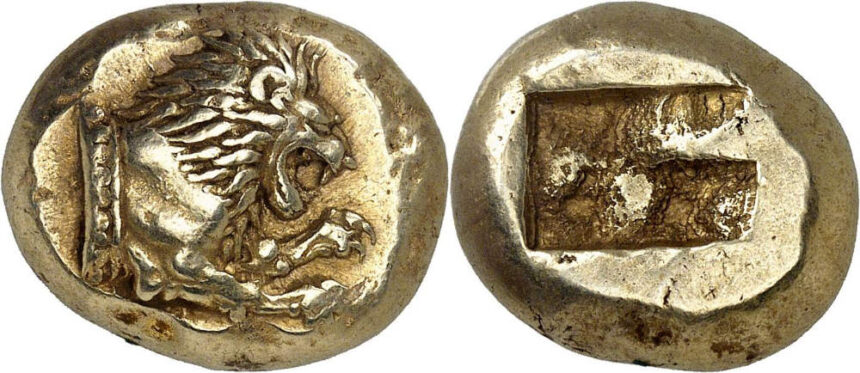
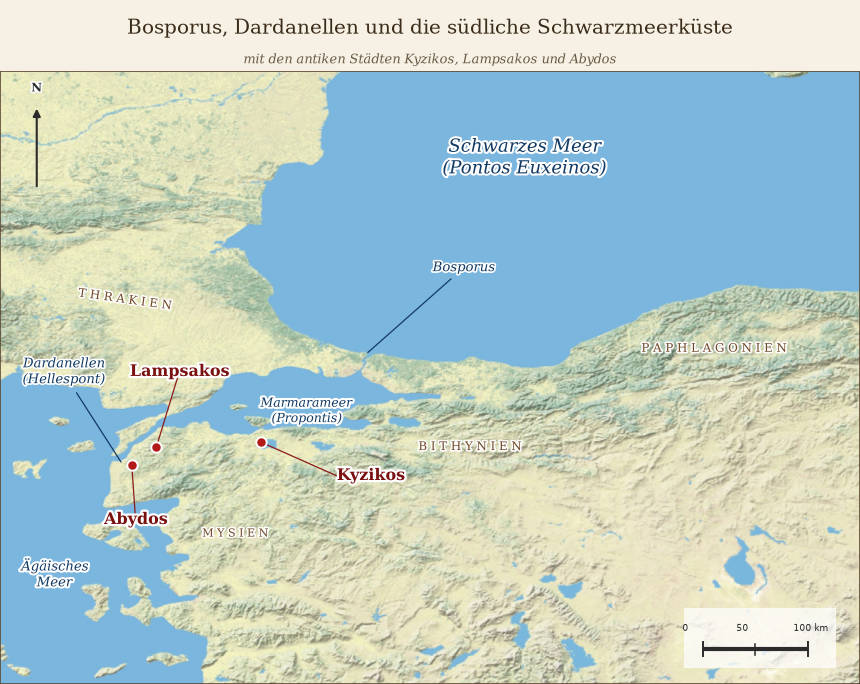
Why did some cities retain their currency of electrum? Good question, we don’t know. What we do know is that all these cities engaged in some form of grain trade with the Black Sea region.
Abydos, Lampsakos, and Kyzikos lay directly on the route there. Merchants from Mytilene brought grain from Pontus to the south, as we have literary and inscriptional sources to support this. We do not know what connected Phocaea and Mytilene. However, we do know of the only treaty concerning a monetary union between these two cities in antiquity. From this, we learn that Phocaea and Mytilene minted electrum hectes according to a precisely agreed-upon weight and fineness, alternating between the two cities one year and the next. Each issue had a different coin design.
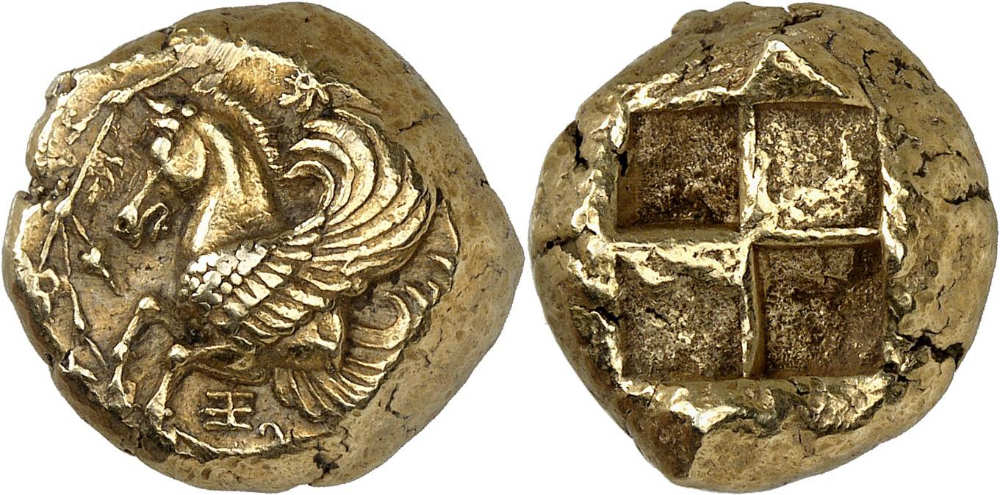
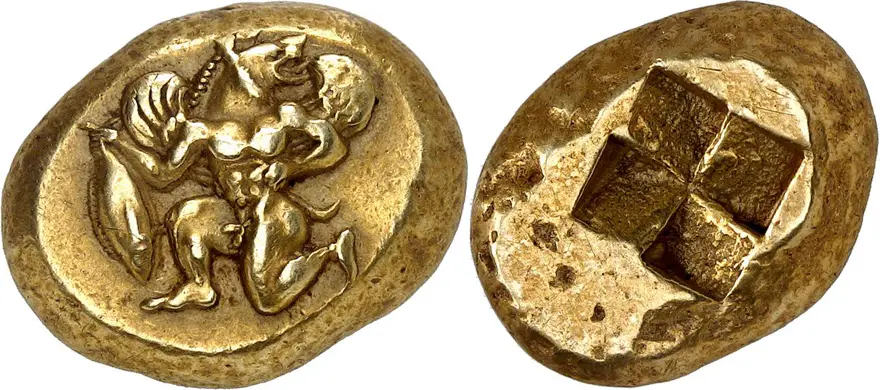
The many coin designs that resulted from this process remind us of the variety of motifs we also know from Kyzikos. Perhaps a similar approach was behind the constantly changing images there.
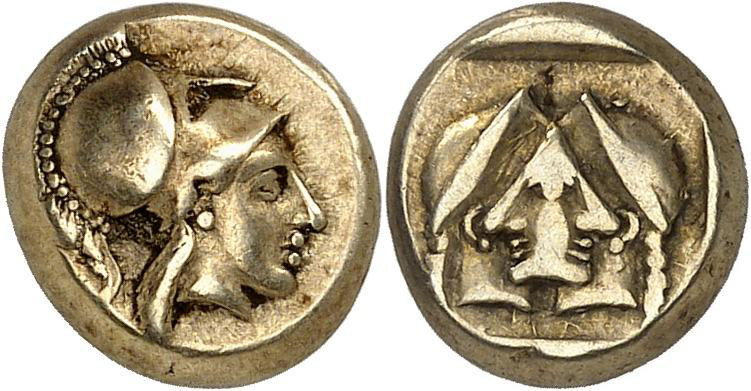
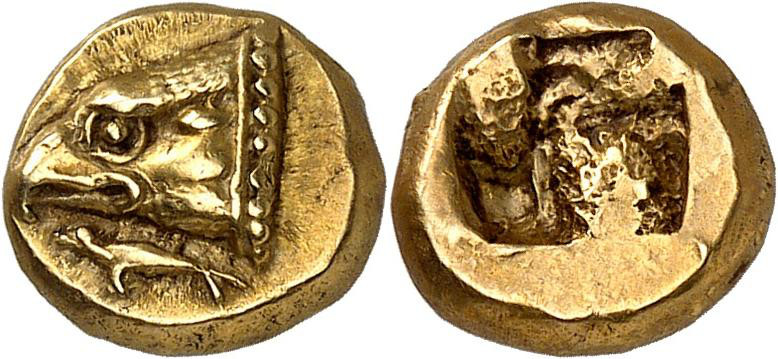
Electrum coins are truly special, as they take us back to the time, when money began. If you’d like to see more coins from this fascinating era, take a look at the catalogue of Numismatica Genevensis SA. There you will find those 49 lots from the Baron Lorne Thyssen-Bornemisza Collection and various other owners, all united by one thing: the exceptional beauty of the pieces. If you would like to learn more about the history of money BEFORE first coins, you can watch a short film about it at the MoneyMuseum. By the way, there is also a film about the exhibition “White Gold”, in which some of the coins offered in this auction were featured.
Text and images: Ursula Kampmann