The Most Expensive European Coin
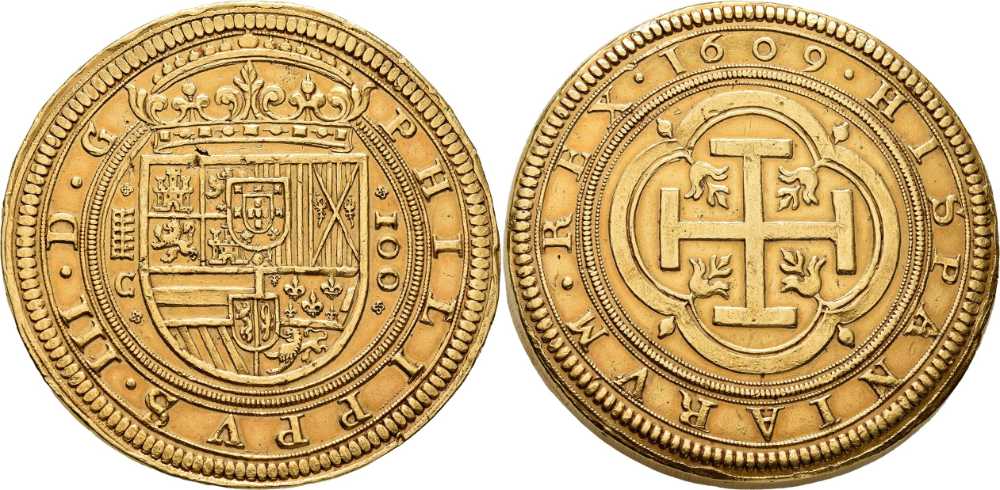
In 1609, Philip III ordered his mint in Segovia to strike a new coin the likes of which the world had never seen before: the centén. It was to weigh 340 grams of gold. Its minting was only made possible by the modern technology of roller minting, which Segovia had mastered. Philip III commissioned 100 of these giant coins as diplomatic gifts. Only one of them has survived to this day. On November 24, 2025, it was auctioned in Geneva by the numismatic auction house Numismatica Genevensis SA. The starting price was CHF 2 million. The final bid amounted to CHF 2.3 million. This corresponds to approximately EUR 3 million or almost US$3.5 million including buyer’s premium. This makes it the most expensive European coin of modern times. At least if we don’t consider Russia part of Europe, which makes sense for many historical and numismatic reasons.
What Can Be Seen on the Centén from 1609?
The obverse depicts a coat of arms. For us today, a rather mundane representation, but for contemporaries, pure self-promotion. Anyone who knew how to read a coat of arms immediately recognized which territories its bearer laid claim to and how much power he wielded. In the case of the centén, or rather Philip III, these territories were: Castile, León, Aragon, and the two Sicilies; Austria, Burgundy, France, Brabant, Portugal, and Granada; as well as Flanders and Tyrol. Of course, Philip III did not control all of these territories, but as a member of the Habsburg dynasty, he was closely connected to them. The coat of arms was a statement, a signal that every recipient of the coin understood.
On its reverse side is a very special cross, which we know today as the Jerusalem Cross. It was associated with the Spanish Order of the Holy Sepulchre of Jerusalem. Philip III acted as its protector and, precisely at the time when the centén was minted in Segovia, commissioned the construction of a magnificent new church for the order in Calatayud. Thus, the cross reminded those to whom Philip III presented a centén that the Spanish king had a particularly close relationship with Christ and therefore enjoyed God’s favor. To us, this may seem a strange argument for a politician. For his contemporaries, however, it was of paramount importance. Those who enjoyed God’s favor could not only hope for salvation, but also for rescue even in seemingly hopeless situations.
Why Does the Centén of 1609 not Show the Portrait of Philip III?
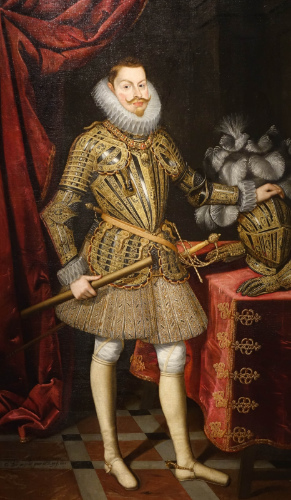
Like many of his contemporaries, Philip III could have chosen to place his own portrait on the obverse of his coin. He did not, instead adhering to long-established motifs already used by his ancestors. In doing so, Philip harks back to medieval thinking: as an individual, he faded into the background behind his office. This is programmatic. The centén speaks of the power of the Spanish king, not of the power of Philip III, who just happened to be ruling Spain.
Why Did Philip III Have the Largest Coins in Spanish History Minted in 1609?
Even though the centén doesn’t reveal it, Spain was at a historic low point in 1609. The economic situation forced the king to conclude an armistice with the United Provinces of the Netherlands on April 9, 1609. This was epochal. For the first time, a Spanish ruler had to officially recognize that the rebellious Dutch provinces constituted a new state with which treaties could be concluded. In doing so, Philip III relinquished what his father, Philip II, had more or less ruined his country for. What a humiliation!
Philip III attempted to overshadow this by taking powerful actions elsewhere. For example, on the day of the peace treaty, he signed an edict expelling the Moriscos. This measure, however, does not demonstrate a particularly strong understanding of economics on the part of the king. The plague had already drastically reduced the population. Depriving the country of further manpower through expulsion was simply foolish.
The golden centén of 1609 was not an economic measure, but merely a symbolic gesture. A truly powerful country does not need to assert its importance through such conspicuous symbols. The princes, nobles, and diplomats who received such a centén as a gift from Philip III likely praised his power. And afterwards they aligned their politics with what the new power dynamics made possible.
Text by Ursula Kampmann