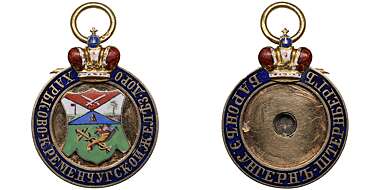
Los 3676. Russia (Related to Estonia, Latvia & Ukraine) Gold and Enamel Jeton ND (1868-1871) - Kharkov-Kremenchug Railway - Baron E. Ungern-Sternberg 12.44g. Gold "56 zolotnik" / 0.583 / 14K). 25mm. The original applied central element on the reverse is missing. Gold and polychrome enamel. Surmounted by an enamelled Imperial crown and suspension ring. Unreadable hallmark on the connecting ring. Extremely rare. Obv.: Enamelled heraldic shield beneath the Imperial crown, surrounded by a dark blue enamel border bearing the inscription: ХАРЬКОВО-КРЕМЕНЧУГСКОЙ ЖЕЛЕЗ. ДОРОГИ (Kharkov-Kremenchug Railway). Rev.: Plain central gold field surrounded by a dark blue enamel border bearing the inscription: БАРОНЪ Э. УНГЕРНЪ-ШТЕРНБЕРГЪ (Baron E. Ungern-Sternberg). The name most probably refers to Baron Ewald Konstantinovich von Ungern-Sternberg (1824-1899), younger brother of Baron Peter Andreas Konstantin von Ungern-Sternberg (1815-1872), one of the principal concessionaires of the Kharkov-Kremenchug Railway. The Kharkov-Kremenchug Railway was one of the important private railway projects developed in the southern part of the Russian Empire during the rapid expansion of the railway network in the late 1860s and early 1870s. A new joint-stock company was organized in 1868 to construct a line connecting Kharkov with Kremenchug through Poltava. The principal concessionaires were Alexander Abaza and Baron Peter Andreas Konstantin von Ungern-Sternberg (1815-1872). The concession was approved on 24 August 1868, construction began soon afterwards, the Kremenchug-Poltava section opened in 1870, and the line reached Kharkov in 1871. On 26 November 1871 the company was reorganized as the Kharkov-Nikolaev Railway Company. Peter Andreas Konstantin von Ungern-Sternberg (1815-1872), known in Russian sources as Konstantin Konstantinovich Ungern-Sternberg, was a Baltic German baron and an important railway entrepreneur. He was born on 4 November 1815 at Wenden in the Wiek district of Estonia and died on 20 July 1872 at Vöslau in Lower Austria. He was closely involved in the development of railway communications in the southern Russian Empire and became one of the principal concessionaires of the Kharkov-Kremenchug Railway. His younger brother, Ewald Alexander Andreas von Ungern-Sternberg (1824-1899), known in Russian as Ewald Konstantinovich Ungern-Sternberg, was born on 27 January 1824 at the same family estate at Wenden in Estonia. He died on 2 June 1899 at Ellistfer in the Dorpat district of Livonia, also in present-day Estonia. Ewald and Konstantin belonged to the same entrepreneurial branch of the family and are documented together in major financial and commercial enterprises of the period. The Baron E. Ungern-Sternberg associated with the Kharkov-Kremenchug Railway is most probably Ewald Konstantinovich, the younger brother of its principal concessionaire Konstantin Konstantinovich. The Ungern-Sternbergs were an old Baltic German noble family whose history was closely connected with the territories of present-day Estonia and Latvia. Various branches of the family possessed estates and held military, administrative, diplomatic and economic positions throughout the Baltic provinces of the Russian Empire. Both Konstantin and Ewald were born in Estonia, and Ewald also died there, making the Estonian connection particularly strong. Their careers illustrate the role played by Baltic German noble families not only in the administration and military service of the Russian Empire, but also in banking, industry and the development of major infrastructure projects during the 19th century.
Startpreis:
2'500 EUR
2'084 GBP
2'286 CHF
2'791 USD
Nur ungefähre, gerundete WerteDatum:
06.11.2026
 consentmanager.net