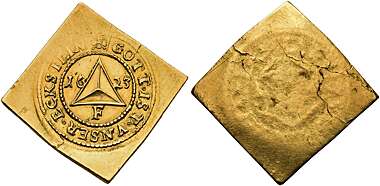
Los 1221. City of Frankenthal. Ducat 1623, square flan, AV 24x25 mm, 3.12 g. GOTT IST VNSER ECKSTEIN A three-sided pyramid, the Frankenthal arms, to either side the year 16-23, F below. Uniface. F. 935c ('very rare'); Brause-Mansfeld pl. 10,8; Mailliet pl. XXXIX, 1 and p. 154,1 (without description); Ehrend 1 (2,5 g). Of the highest rarity, only 3 specimens known. Extremely fine Ex Jacques Schulman, Den Haag sale 18.1.1938, 528 ('extrêmement rare'). Ex Eugen Merzbacher Nachf., München sale 5.4.1910, 669 (sold for 380.- Mark). Apart from this piece, only two other specimens of this extremely rare Klippe have been offered in auctions: the one from the Hermann Vogel collection (Leo Hamburger, Frankfurt sale, 11 November 1924, lot 156), which was subsequently sold at Münzen und Medaillen AG, Basel sale 81, 1995, lot 1388, for CHF 24,000, and the one from the collection of Baron von Claer, which was sold at the Leo Hamburger auction in Frankfurt on 1 June 1920, lot 532, for 3,100 marks. Frankenthal was the strongest Electoral Palatinate fortress on the left bank of the Rhine. In 1622, the town was besieged by Catholic troops and completely cut off from the outside world. After some time, money ran short. Consequently, silver tableware and gold from private households and churches was used to produce emergency currency so that soldiers could continue to be paid their wages. At the end of March 1623, the town was captured by the Spanish, who were fighting on the side of the Emperor and the Catholics, and for the next decade, like the whole of the Palatinate on the left bank of the Rhine, it was placed under Spanish sequestration. Whilst silver emergency coins from Frankenthal occasionally appear on the market, the gold examples are among the greatest rarities amongst emergency and siege coins. Please find here the video of the coin
Startpreis:
8'000 CHF
8'740 EUR
7'286 GBP
9'824 USD
Nur ungefähre, gerundete WerteDatum:
05.11.2026
 consentmanager.net