The Large Salvator Mundi Medal worth 24 ducats
The large golden Salvator Mundi medal of the City of Vienna is one of the most important awards of the Habsburg era. The extremely rare 24-ducat version from the era of Emperor Franz Joseph I (1848–1916) is particularly sought after. It combines the highest artistry in medal making with the representative symbolism of the imperial capital – a highlight of any specialised Habsburg or Vienna collection.
Historical background: The Vienna Salvator Medal since 1575
The tradition of this municipal medal of honour began in 1575, when the Vienna City Council decided to recognise special services with a non-wearable gold medal. These so-called Rats- or Verehrpfennige (council or honour pennies) have always depicted Christ as Salvator Mundi and were considered the highest civil honour of the city of Vienna.
Over the centuries, different weights and diameters were minted – but the most prestigious always remained the heaviest gold version.
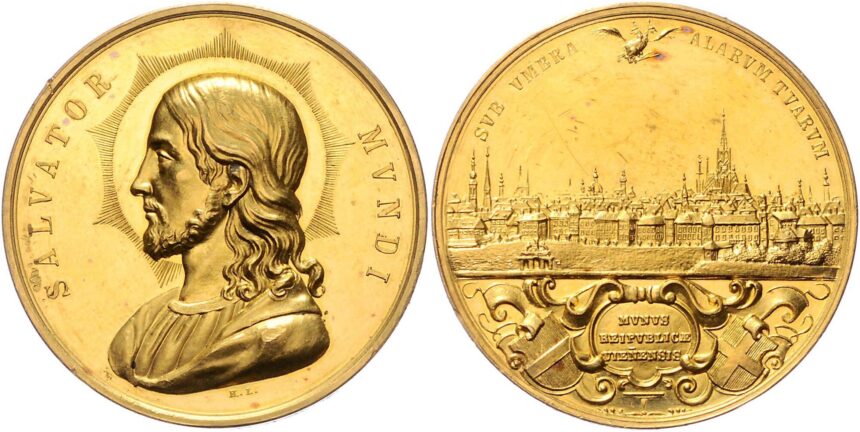
The die cutter Konrad Lange and the new type from 1846
When the old dies from the 18th century became unusable, the medallist Karl Konrad Lange (1806–1856) was commissioned to redesign them in 1846. His design was used from 1846 to 1919 – spanning seven decades and three emperors.
The obverse shows Christ with a halo and the inscription SALVATOR•MVNDI.
The reverse combines religious symbolism with political representation:
- Inscription: SVB VMBRA ALARVM TVARVM (‘Under the shadow of your wings’)
- Crowned double-headed eagle of the Habsburg Monarchy
- View of Vienna with St. Stephen’s Cathedral
- Cartouche MANVS REIPVBLICAE VIENNENSIS – ‘Gift of the City of Vienna’
The medal thus embodies city pride, faith and imperial authority.
The 24-ducat coin: dimensions, characteristics and rarity
The double-sized Salvator medal – the 24-ducat version – is considered the highlight of the entire series and is also the most prestigious version of this municipal honorary award:
- Diameter: approx. 42 mm
- Weight: approx. 83.8 g fine gold
- Edge mark: ‘A in a circle’ of the Vienna Mint
- Minting period: 1846–1919
This large-format gold medal was minted exclusively for specific occasions and was never produced for stock. The awards were therefore extremely rare from the outset. It has been verified that only around 130 copies of this weight class were awarded during the entire period – some of which were melted down over the decades. Accordingly, well-preserved pieces with their original award box are still a rare sight on the collectors’ market today.
Original ceremonial box: a work of art in itself
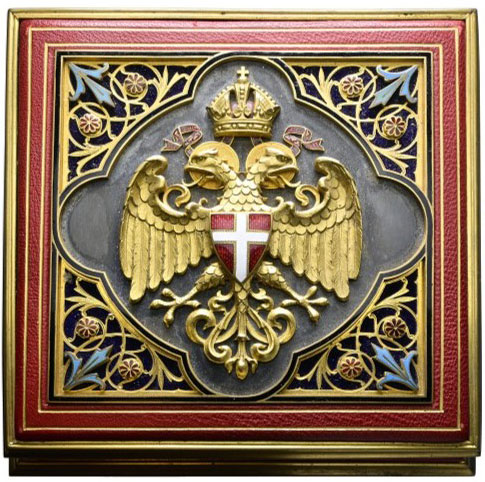
The medal was presented in a richly decorated, leather-covered wooden box with gold-embossed edges. The lid features an octagonal medallion with a crowned double-headed eagle and an enamelled coat of arms of Vienna. The interior is lined with silk and blue velvet, and the lid closes with a screw cap – a particularly high-quality detail.
Characteristic ‘hairline cracks’ – a sign of authenticity, not a defect
Many examples show fine lines in the field. These are not signs of wear or later damage, but result from brushing and cleaning the embossing dies before the actual embossing process. This removed the smallest impurities, resulting in these typical hairline marks. They run exclusively in the smooth areas, never over raised sections or the lettering – an important technical identification feature of genuine Salvator medals based on the dies by Konrad Lange.
Significance & market position
The combination of exceptional rarity, high gold weight, artistically sophisticated design and deep historical context makes the 24-ducat Salvator medal one of the most important and prestigious collector’s items in Viennese numismatics. It combines urban representation, Habsburg symbolism and the highest art of medal making in an object of museum quality. These large gold medals appear on the international auction market only at long intervals and regularly fetch high five-figure sums, depending on their condition, provenance and whether they come with their original case. Particularly well-preserved specimens are considered to be top lots within Habsburg and Vienna collections.
Availability: Currently at Sixbid.com
This exceptional specimen is currently up for auction at Sixbid.com. It is being offered by the auction house Auktionen Münzhandlung Sonntag in Auction 45, which will take place on 3 December. Pre bids can be submitted until 2 December at 4 p.m.
Sources
- J. C. Steiner: Die Auszeichnungen der Stadt Wien (The Awards of the City of Vienna), Vienna 2000, p. 51 ff.
- Unger / Schalk: Zur Geschichte der Wiener Rats- und Salvatorpfennige (On the History of the Vienna Council and Salvator Pennies), Vienna 1896.
- Various auction and archive data (Dorotheum, Frühwald, Heritage, CoinArchives).