Duke Albrecht V, Emperor Ludwig the Bavarian and the Habsburgs
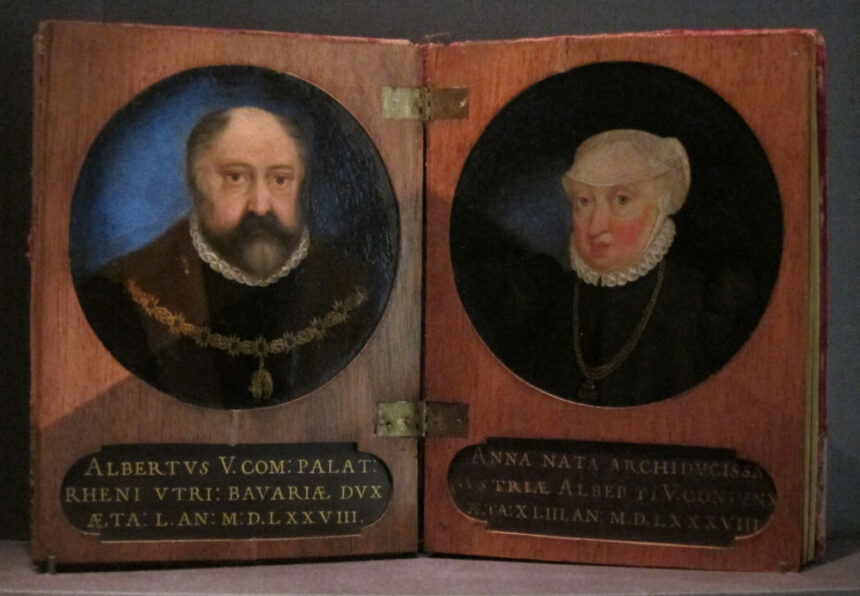
On 4 July 1546, Albrecht V of Bavaria, a member of the House of Wittelsbach, married Anna of Austria, the second eldest daughter of Ferdinand I, who at that time was ruler of the Habsburg hereditary lands and King of the Holy Roman Empire. This temporarily settled a latent dispute between the Wittelsbachs and the Habsburgs. Whilst the Wittelsbachs sought to expand their power without offending the Habsburgs, the Habsburgs found themselves increasingly dependent on the Wittelsbachs: on the very same day that Albrecht V and Anna were married, the leaders of the Schmalkaldic League resolved to go to war against the Emperor.
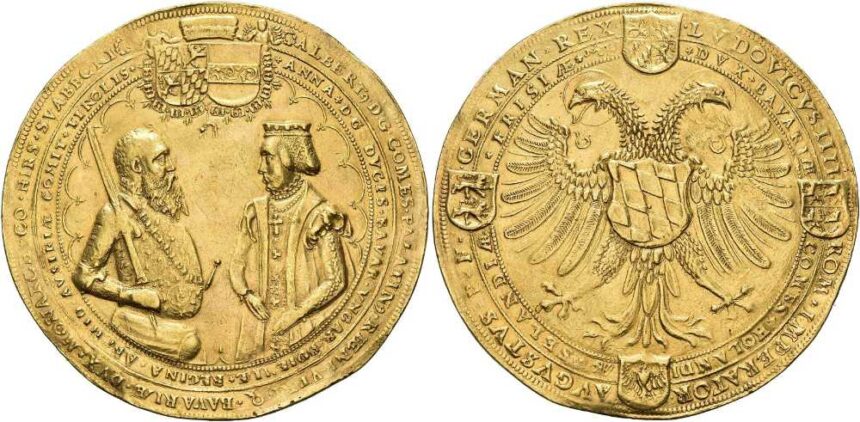
The donative, which is on offer at Numismatica Ars Classica in the Traveller Collection with an estimate of 150,000 euros, was not minted to mark this wedding, but several decades later. We explain what purpose it served.
What can be seen on Albrecht V’s donative?
The obvers shows a half-length portrait of the Bavarian Duke facing right. He is bareheaded, wearing richly decorated ceremonial armour, over which hangs the chain of the Order of the Golden Fleece. In his right hand he holds a raised sword. Opposite him we see a half-length portrait of Anna in sumptuous court dress. She wears a bonnet on her head, her hair held in place by a hairnet.
Above them, on the left, we see Albrecht’s coat of arms: the quartered shield bearing the Bavarian lozenges and the Palatinate lion; above Anna is the banded shield representing the Austrian Hereditary Lands. Two cherubs ostentatiously hold the ducal hat above the coats of arms of both duchies.
The inscription lists the names and titles of those depicted. Albrecht is presented as Count Palatine of the Rhine, Duke of the Two Bavarias, Count of Hirschberg and Schwabegg; Anna is introduced as Duchess of Bavaria; furthermore, she is honoured as Queen of Hungary and Bohemia, Archduchess of Austria and Countess of Tyrol.
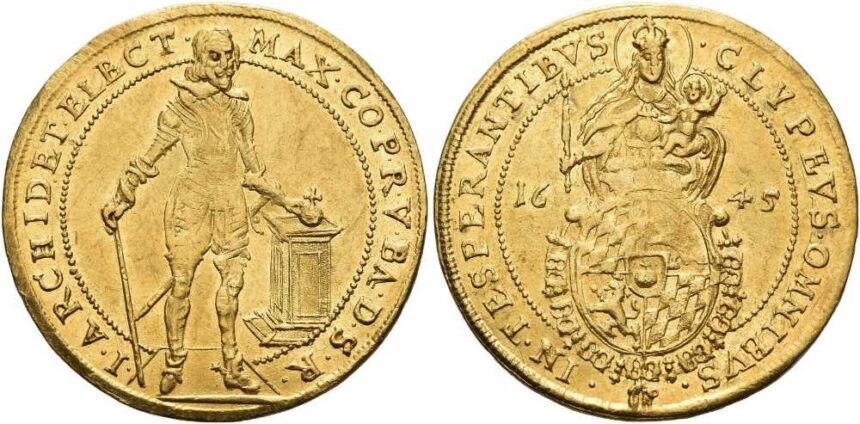
This array of impressive titles is topped on the revers by the Imperial Eagle, which provocatively bears the Bavarian diamond-shaped shield on its breast. The legend lists the name and titles of the sole Wittelsbach emperor to date: Louis IV, Holy Roman Emperor and Augustus, the Pious, the Fortunate, King of the Germans, Duke of Bavaria, Count of Holland, Zeeland and Friesland. Four coats of arms representing the aforementioned dominions punctuate the legend
Why the imperial double-headed eagle is a shock on a Bavarian donative!
Donatives were gifts used in the context of diplomacy. The rule was: the heavier and more precious a donative was, the higher the rank of the recipient. A gold donative with a weight of 25 ducats was extremely valuable and reserved for the highest-ranking nobles. The recipients were aware of the significance of the double-headed eagle. They understood the claim that lay behind it. But how did the Bavarian Duke come to design the imperial double-headed eagle on his donative?
Albrecht explains this himself through the legend. He refers to his ancestor, Louis IV. In doing so, Albrecht reminds us that the Wittelsbachs had produced an emperor and were thus on a par with the Habsburgs.
We must not forget that the Habsburgs’ monopoly on the imperial title had only just begun to take shape: Charles V was only the third Habsburg emperor. Rudolf I and Albrecht I did not count. They were ‘merely’ kings.
Was Albrecht V. seeking to lay claim to the office of Emperor with this?
Albrecht V. certainly did not wish to challenge Ferdinand I’s claim to the imperial throne. But he wanted to remind people that the Wittelsbachs, too, had much to their credit. Through Anna’s titles, he also subtly alludes to the marriage contract that Ferdinand I had signed in 1546. In it, the Wittelsbachs had only partially renounced their claim to Anna’s inheritance. Should the male line of the descendants of Charles V and Ferdinand I die out, the Wittelsbachs would have been able to perform the registration of their inheritance claims.
Albrecht was unaware that, just one year after the wedding, Ferdinand I had already safeguarded himself against such claims by means of a secret addendum to his will. This only came to light in 1740, when the male line did indeed die out with Charles VI and the Wittelsbachs laid claim to the imperial title.
At the time this donative was struck, Albrecht V was less concerned with the Empire than with the office of Elector. He attempted, by every means at his disposal, to have the office of Elector transferred from the Palatinate line to the Bavarian line.
Culture in the service of claims to rank
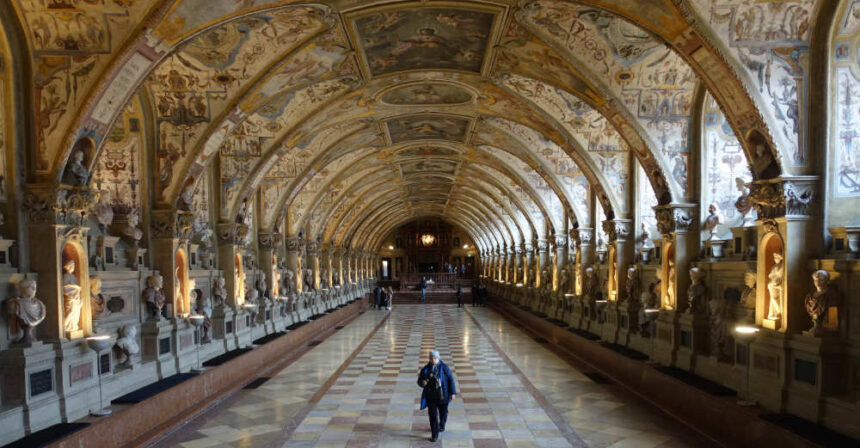
Albrecht V underpinned his claims with a magnificent public image that continues to have an impact to this day. In the early modern period, a ruler’s importance was, after all, associated above all with his public image. Magnificent buildings such as the Marstall or the Antiquarium, an impressive collection and library, plus a widely renowned court chapel – all of this is not merely a sign of the private interests of a ‘passionate collector’. This is how historians like to describe Albrecht. Yet this obscures the extent to which an impressive collection of coins, antiquities, paintings and books emphasised a prince’s status.
Furthermore, during this era, Munich developed into an important stop on the Grand Tour. Young aristocrats from across Europe visited the city of Munich as part of their multi-year journey to the most important courts of Europe. They marvelled at the magnificent court of the Bavarian duke and spoke of his famous court chapel and his antiquarian treasures.
Munich can still take pride in this legacy today. It lives on, for example, in the State Coin Collection and the State Library.
Gifts as a sign of economic and political power
The gift offered by NAC in its auction fits into this context. When a gift was presented as part of diplomatic manoeuvring, it was an unwritten rule that the person of higher rank would present the more valuable gift. A gift of this value, 25 ducats, was not easily outdone! Combined with all the references to the high rank of the Wittelsbachs and their equality with the Habsburgs, this piece was a political statement.
A heavy legacy
Albrecht V died on 24 October 1579. Upon his death, his son Wilhelm V inherited a debt burden of nearly 2.5 million guilders. Not one to save, he increased this debt during his reign until he voluntarily handed over the rule (and the crushing financial worries) to his son on 15 October 1597.
Maximilian I was to be the one who not only got the debts under control but also finally secured the office of Elector for the Bavarian House of Wittelsbach. He, too, relied on Ludwig of Bavaria, whose magnificent cenotaph – ordered by Maximilian – is still marvelled at by tourists in Munich’s Liebfrauendom today.
What is Albrecht V’s donative worth?
NAC has estimated the donative, which we have presented to you in this article, at 150,000 CHF. That equates to more than 160,000 euros or 180,000 dollars. The price is purely an estimate, as numismatists are aware of only a single specimen of this impressive gold donative, namely the one shown here. There are three further specimens in Silver, but these are all held in public collections, namely in Munich, Vienna and Berlin.
The last time our donative was sold at public auction was in 1924 at Leo Hamburger’s auction of the collection of the former Kings of Bavaria on 7 April 1924. This was shortly after the introduction of the Rentenmark. The coin fetched an incredible 7,150 Rentenmark. Just to give you an idea of what this figure means: The Reich Statistical Office calculated the average hourly wage of a worker for April 1924 at 56.2 pfennigs.* Based on a (then standard) 48-hour working week, this amounts to a weekly wage of around 27 Rentenmarks. A skilled worker would therefore have had to work for more than 5 years(!) to buy this coin!
Based on the current average gross income of a German skilled worker of 50,604 euros, a comparable figure in the year 2026 would be around 250,000 euros. As far more people today have sufficient wealth to afford to invest that much money in a single coin, the figure could be considerably higher. We will keep you informed.
*Economy and Statistics, Volume 4, Issue 11 (June issue) from the year 1924, page 348
Text and images: Ursula Kampmann