Numismatic encyclopaedia of medallists and mint masters is available in full on Numista
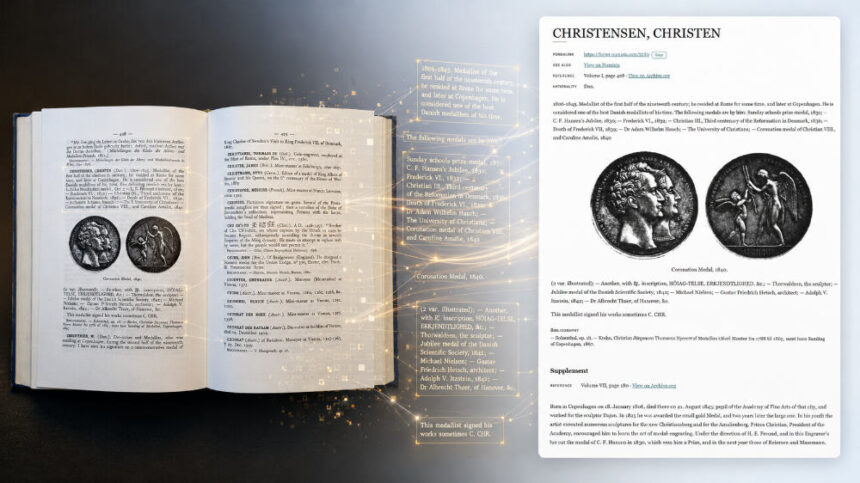
Biographical Dictionary of Medallists: Coin-, Gem-, and Seal-Engravers, Mint-Masters, &c., Ancient and Modern, with References to Their Works, B.C. 500–A.D. 1900, was the title Leonard Forrer gave to his seminal work, which remains an indispensable source to this day for anyone wishing to learn about ephemeral medallists and mint masters. Numista has digitised this book and made its contents available to the numismatic community.
Who was the author, Leonard Forrer?
The Biographical Dictionary of Medallists was written by Leonard Forrer, a coin dealer who, in the pre-war period, was the rule rather than the exception. Forrer not only sold coins and medals, but was also interested in their history.
Leonard Forrer was born in Winterthur on 7 November 1869. Many members of his extensive family were in the same line of work. The best known is probably Robert Forrer, who was about the same age, a collector, art dealer, publisher of a collectors’ journal and museum director in Strasbourg.
Unlike Robert Forrer, Leonard chose to study in England. He fell in love with the country and, after graduating, began working for Spink. At that time, the firm was primarily known for the sale of art and valuable works of arts and crafts. Numismatics was a purely peripheral field, a situation that Forrer changed for the better. Under his leadership, Spink gained an international reputation as one of the world’s leading coin dealers. The fact that the firm simultaneously developed into one of – perhaps the most significant – numismatic publishing houses in the history of scholarship was merely a by-product.
Forrer became a prominent and frequently seen figure in the coin trade. Throughout his life, he took pride in the fact that – following the sale of the Montagu collection – he had never missed a single major auction. He made a deep impression on the schoolboy Herbert Cahn. Cahn described Forrer in his obituary as follows: “He was common, regular, and ordinary: he sat at the auction table in the front corner, his spectacles perched on the tip of his nose; his attention was deepened by his catalogue. … One must consider what a vast amount of material passed through his hands during his 60 years in the coin trade, what an inestimable wealth of experience he had accumulated! A keen, critical eye, profound numismatic knowledge, a memory that remained unfailing well into old age and, above all, a genuine passion for the subject – it was these qualities, combined with his vast experience, that made him one of the greatest connoisseurs the numismatic world has ever known.”
Leonard Forrer was thus predestined to undertake such a monumental project as the Biographical Dictionary of Medallists. He had the connections to involve researchers, coin dealers and collectors worldwide.
This dictionary remains his enduring legacy, whilst everything Leonard Forrer achieved as a coin dealer has long since been forgotten. He died on 17 November 1953. Unsurprisingly, his two sons also became coin dealers.
Why is Forrer’s dictionary so important?
The Biographical Dictionary of Medallists is unique in terms of its conception and comprehensiveness. Forrer worked on it between the years 1902 and 1930. He had excellent contacts with numismatists around the globe, who were far more adept at archival research than most numismatists are today. His contemporaries were able to read Latin fluently and thus quickly analyse complex documents.
As a result, the lexicon preserves information about the lives of medallists which, following the loss of so many libraries and archives during the two world wars, may no longer be available today. Furthermore, Forrer interviewed contemporary medallists about their older colleagues and their own careers.
Thus, Forrer’s work has itself become a primary source.
His approach is remarkable: he did not make the distinction between numismatics and glyptics that is common today, but rather combined both in a single work. This reflects the reality of their training: many die-cutters also worked as gem-cutters when required.
The Biographical Dictionary of Medallists remains a standard reference work. It is available as a reprint and online as a PDF. Numista now makes searching easier thanks to a well-organised search engine. As a result, the information that Forrer once painstakingly compiled has been processed in such a way that it is more easily accessible not only to human users but also to AI search engines. The quality of information we can expect from Google and ChatGPT regarding medallists and die cutters will improve radically thanks to Numista.
Was ist Numista?
Numista hat sich zu einer der wichtigsten Plattformen für Münzsammler aus aller Welt entwickelt. Sie bestimmen ihre Münzen im Numista-Katalog, tauschen über Numista mit Gleichgesinnten Münzen, finden hier wichtige Literatur und Informationen zu aktuellen Events. Numista vereint eine Community im besten numismatischen Sinne: Das Numista-Team arbeitet zusammen, um den Zugang zur Numismatik für die Community zu erleichtern.
Numismata-Gründer Xavier Rogé ist es gelungen, eine beeindruckende Zahl von Münzbegeisterten in seinem Projekt zusammenzubringen. Sie erstellen gemeinsam einen sorgfältig kuratierten Typenkatalog von Münzen und machen numismatische Literatur zugänglich.
Numista hat heute rund 1,9 Millionen Besucher pro Monat mit 11,9 Millionen Page Views. Damit dürfte Numista zu einer der am meisten besuchten numismatischen Seiten gehören.
An alternative to Forrer in English
Incidentally, as part of its projects relating to standardised data, LMU Munich has already created an important supplementary source which records not only medallists and mint masters, but also all mint wardens – extending beyond the period covered by Forrer. The Biographical Encyclopaedia of Mint Masters and Mint Wardens, Die-Cutters and Medallists from the Renaissance to the Present Day is, however, in German and is, in any case, more of a portal. Nevertheless, it indexes all sources currently available on the internet. Dr Gerhard Schön is listed as the project leader; many long-standing collectors will still recognise him from his world coin catalogues.
Text: Ursula Kampmann
The images were kindly provided by Numista.