Lucerne, Leodegar and the largest Swiss gold coin of the 16th century
In the year 1524, the Grand Council of Zurich resolved to expropriate church property and abolished the Mass in April 1525. In 1527, the Abbot of St Gallen fled the city, as the people of St Gallen had joined the Protestants. In January 1528, Bern enforced the Reformation within its city walls and urged other towns to follow suit. Basel and Schaffhausen followed in 1529, Neuchâtel in 1530, and Geneva and Vaud in 1536.
Not all opened their doors to the Reformation. Many a city government shied away from the expropriation of church property and remained true to the old faith. Lucerne was the most powerful and influential among them. It emerged as the leader of the Catholic faction within the Diet. In the numerous disputes between the traditionalist and Reformed cantons, Lucerne frequently spoke on behalf of the entire Catholic party.
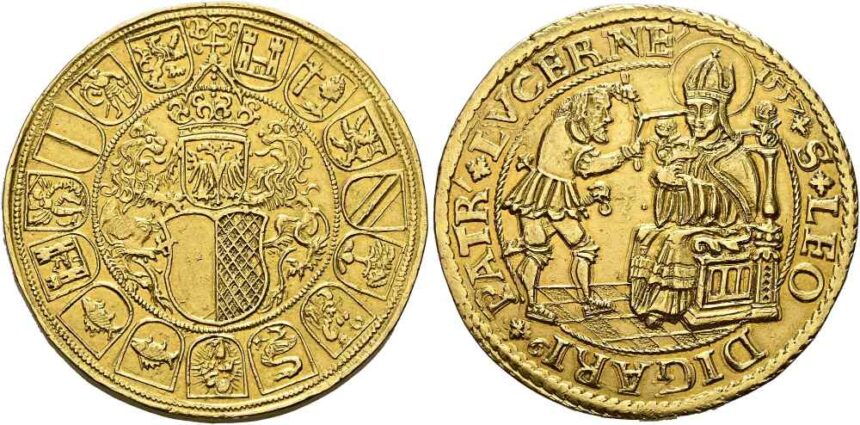
Lucerne’s commitment to Catholicism is illustrated by a Lucerne donative from the year 1557 with a value of 20 gold guilders. It was struck with the dies for the Lucerne taler. SINCONA is offering this coin as part of the Lake View Collection.
What can be seen on the Lucerne donative coin of 1557?
The obverse depicts the coat of arms of Lucerne flanked by two lions. Above them, the lions hold a crowned coat of arms of the Holy Roman Empire, signifying imperial immediacy. In this way, the Lucerne Council emphasises that it is answerable only to the Emperor and that no one – not even the Diet – can issue it with instructions.
The arrangement of 15 bailiwick coats of arms is within a circle around the design. A bailiwick is a dependent territory administered (and taxed) by a bailiff on behalf of the sovereign. With these coats of arms, Lucerne thus showcases the size and wealth of its territories. These include (starting at the 1 o’clock position): Rothenburg, Entlebuch, Sempach, Triengen, Malters, Kriens, Merenschwand, Ebikon, Weggis, Horw, Habsburg, Münster, Sursee, Ruswil and Willisau.
The reverse side bears a Latin inscription, which translates as: ‘To St Leodegar, the patron saint of Lucerne’. The dating of 1557 can be seen in the upper panel.
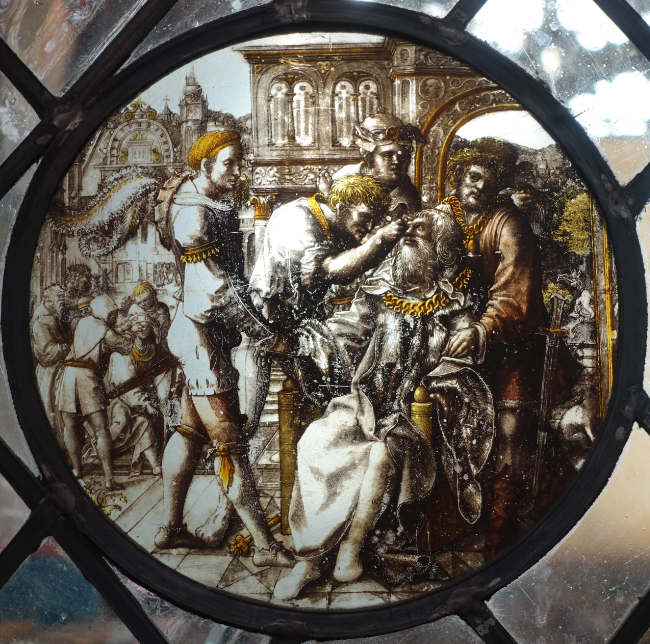
The scene depicted portrays the martyrdom of St Leodegar. The bishop, dressed in liturgical vestments and wearing a mitre, sits on a high throne on the right. An armed knight approaches from the left. He uses a large drill to gouge out St Leodegar’s eyes.
Who was St Leodegar?
St Leodegar, whose feast day is celebrated by the Catholic Church on 2 October, is a historical figure whose life is well documented. He was born in 616 in the Merovingian Kingdom. As his uncle already held a high ecclesiastical office, Leodegar too rose high in the ecclesiastical hierarchy. In 659, the queen appointed him bishop of Autun. In this role, he used a council to ensure that the Irish monastic rule was abolished in favour of the Benedictine Rule. This was not an ecclesiastical but a political decision; indeed, we should regard Leodegar more as a power-seeking politician than as a champion of Christianity. Whilst the Benedictine Rule granted the bishop supreme authority over a monastery, under the Irish Rule a monastery was subject exclusively to its own abbot. Through this and many other measures, Leodegar emerged as a champion of the local nobility, who in his day held a monopoly on high ecclesiastical offices.
Leodegar’s opponent was Ebroin. As mayor of the palace of Neustria, he sought to increase the influence of the nobility in favour of central authority. A battle ensued between the troops of Ebroin and Leodegar. Leodegar was defeated, and Ebroin, in accordance with the customs of the time, first had him mutilated and then put to death on 2 October 679.
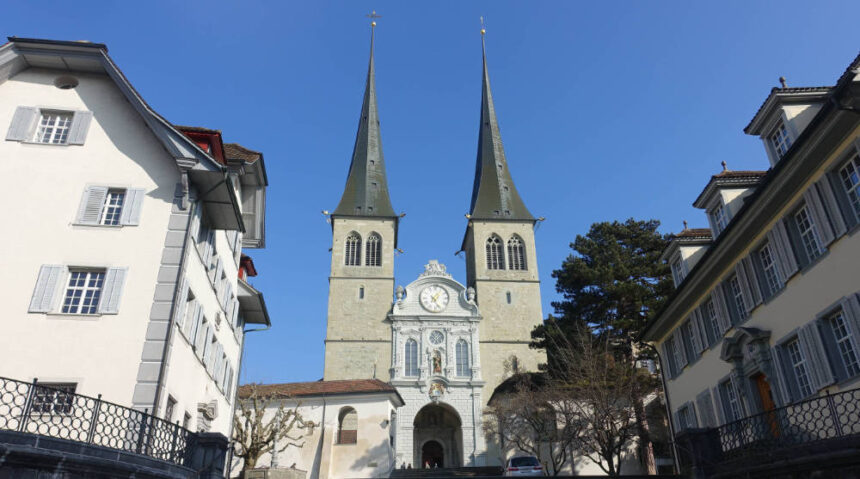
After his death, Leodegar was venerated primarily in Benedictine monasteries. The Benedictine monastery of Murbach in Alsace brought his veneration to Lucerne. It owned extensive estates in the Lucerne area, which it administered through a provostry. St Leodegar im Hof, now a Lucerne landmark, emerged as the spiritual centre of this provostry.
Why does Lucerne feature St Leodegar on its coins?
Having a saint as a patron was a decisive factor in the early modern period. Believers expected ‘their’ saint to intervene in political and military affairs on their behalf. By showcasing its wealth through the magnificent Donativ, its power through the bailiwick coats of arms depicted on it, and its heavenly protection through the image of St Leonard, Lucerne conveyed a message to those viewing this Donativ: thanks to St Leodegar, Lucerne possesses wealth and power.
And thanks to St Leodegar, Lucerne will retain this wealth and power in the future too – in spite of all its enemies.
What is the Lucerne Donative of 1557 worth?
SINCONA values the Lucerne Donative, with a weight of 20 guilders or 65.39 g, at 250,000 Swiss francs. This is a relatively low price given its rarity and significance, and one that could easily be exceeded. This is because large gold coins from the 16th century are extremely rare. Central Europe possessed very little gold prior to the conquest of the New World. Consequently, few heavy gold coins were minted, and even fewer have survived. Of all the surviving 16th-century Swiss large gold coins, this coin – of which only a single specimen is known to exist and which is offered by SINCONA – is the heaviest. If one were to compile a list of the heaviest gold coins of the Old Swiss Confederacy, this coin would probably rank sixth.
For the period in which it was minted, this donative has exceptional mintag and is in good condition. However, as was customary at the time of its production, the fields have been slightly leveled to enhance its appeal. This contemporary reworking is not adequately reflected in the grade awarded by NGC. It is not so straightforward to apply a grading system developed for machine-struck coins of the 19th and 20th centuries to a hand-struck coin from the 16th century. This grade, which does not do justice to the coin’s beauty, could be detrimental to its appeal amongst investors. Collectors, on the other hand, will appreciate the unique beauty of this piece.
It remains to be seen whether collectors are prepared to pay similar prices to those paid by investors who rely solely on the coin’s grade.
We will keep you updated on the outcome!
Text and images: Ursula Kampmann