Nero wants to perform
In the late summer of the year 66 AD, Nero boarded a ship that took him to Greece. This was something out of the ordinary. No emperor had travelled to Greece since the civil war over Caesar’s legacy. What did Nero intend with his trip? Well, scholars still debate this today. Did he wish to take part in the great Panhellenic Games whilst playing the kithara, thereby stroking his ego as an artist? Did he intend to use these performances to bind the Greek world more closely to Rome? How did Nero himself view his actions? And do the Alexandrian coins shed any light on this?
We answer these questions with the help of a number of billon tetradrachms, which will be auctioned at Emporium Hamburg from 23 to 26 November 2026. They form part of an extensive collection of coins from Alexandria – dating from both the Greek and Roman periods.
The Departure on the Sebastophoros
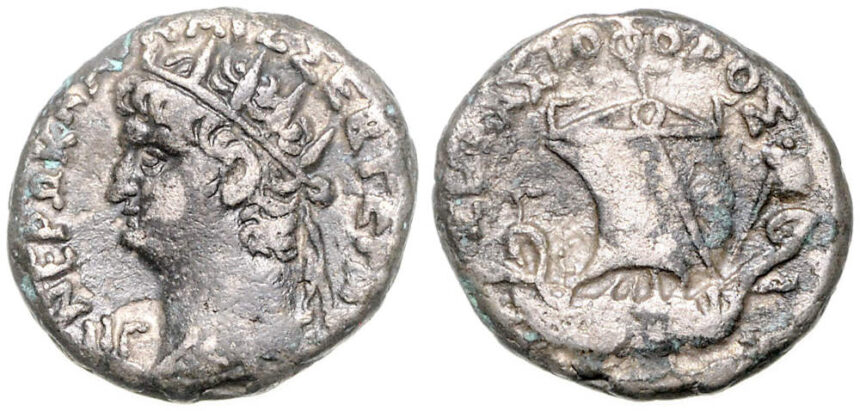
The designs on the billon tetradrachms from Alexandria always follow a similar layout: on the obvers, we see a portrait of the emperor. The legend states his title in Greek. This is modelled on the Roman system of titles. Thus, on this piece, Nero refers to himself (in translation) as Nero Claudius Caesar Augustus Germanicus Imperator.
Alexandrian billon tetradrachms are dated according to the start of the respective emperor’s reign. In our example, the dating appears in front of the emperor’s neck and denotes the 13th year of Nero’s reign, i.e. 66/7 AD. The revers depicts a ship sailing to the right with its sails fully billowing. The legend explains who it is carrying; it reads Sebastophoros, meaning ‘Emperor-bearer’. The mint at Alexandria thus issued this coin to mark the Emperor’s visit to Greece, which suggests that he was exceptionally well received by the Greek-speaking provincial population.
Participation in the Pythian Games
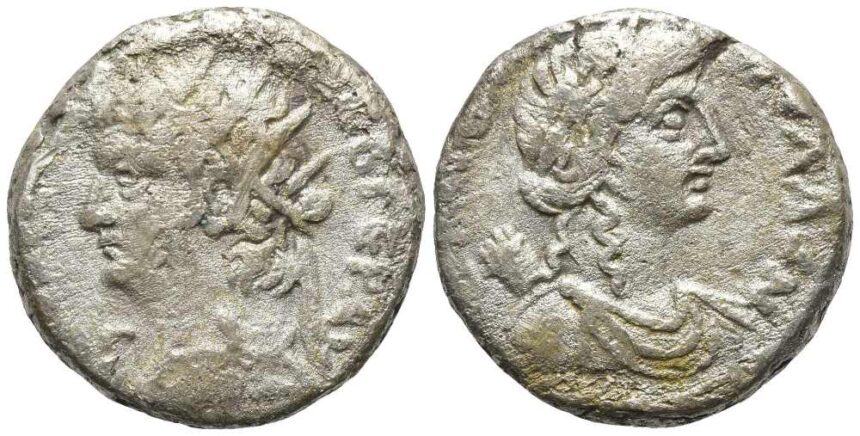
This is also evidenced by another tetradrachm from the same year. It depicts Apollo – and not, as the legend indicates, just any Apollo, but the Pythian Apollo, that is, the Apollo worshipped at Delphi. The Pythian Games were dedicated to him. They took place as part of a Panhellenic festival which, in antiquity, was at least as well-known and significant as that held in honour of Zeus at Olympia.
Such a Panhellenic festival regularly brought together delegations from across the Greek world at the site of the sanctuary. There they performed sacrifices and offered prayers. These festive delegations also included musicians and athletes from the finest families in Greece. They competed in various disciplines; in Delphi, this was primarily singing, accompanied by the kithara. After all, Apollo himself was regarded as a great kithara player. It was only later that athletic competitions and horse races were added to the programme in Delphi.
No matter which category a competitor won in, their victory was regarded as an unmistakable sign that Apollo Pythios had bestowed his favour upon the winner’s homeland. One must bear this in mind to understand why it was virtually impossible for anyone other than Nero to win such a competition! His victory signified, so to speak, a bow by the Greek gods to the Roman emperor. Any other result would have been impossible given Rome’s political and military dominance; it would have amounted to a declaration of war.
Did Nero fall out of his chariot at Olympia?
In Rome, the view was quite different. The conservative senators, in particular, were appalled by the imperial kithara player. No member of a respectable family would have dared to perform in public before the rabble! The Greek idea of a contest between the best to test upon whom the gods bestowed their favour was alien to Roman thinking.
In Rome, the ‘Games’ had quite different roots. Gladiatorial combats were originally part of funeral rites and may, in the distant past, have replaced human sacrifice. Gladiatorial combat or chariot racing was something for slaves and certainly not something a free Roman would want to be seen doing.
Thus, in the eyes of the senator Suetonius, an imperial charioteer could only make a fool of himself, even if he won the Olympic Games with flying colours. He incorporated his contempt into his biography of Nero, which, incidentally, Suetonius did not write until around half a century after Nero’s death. We should therefore not take it at face value when Suetonius finds it amusing that Nero fell out of his chariot during the race and yet still received the victor’s wreath! For his Greek contemporaries, Nero’s participation in the Olympic Games was certainly remarkable – so remarkable, in fact, that an Alexandrian tetradrachm commemorates it.
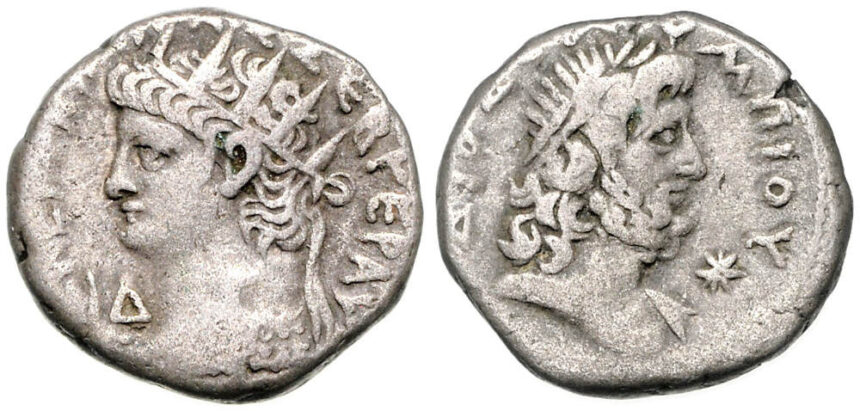
At the Isthmus of Corinth
This tetradrachm commemorates Nero’s victory at the Isthmian Games, which were held near Corinth. They attracted a large audience comprising the most important political figures of the Greek world. Titus Quinctius Flamininus had already proclaimed Greek freedom here in a manner designed to impress the public. Nero used his appearance to similarly present himself, to great public effect, as a benefactor of the Greeks. He initiated a major infrastructure project. With a small gilded spade, he broke ground for a canal intended to cross the Isthmus of Corinth. Whereas Greek ships had previously had to be laboriously hauled overland by hand to avoid the treacherous coasts of the Peloponnese, a canal would have made navigation considerably easier. Unfortunately, this project came to an end with Nero’s death. Galba had other priorities.
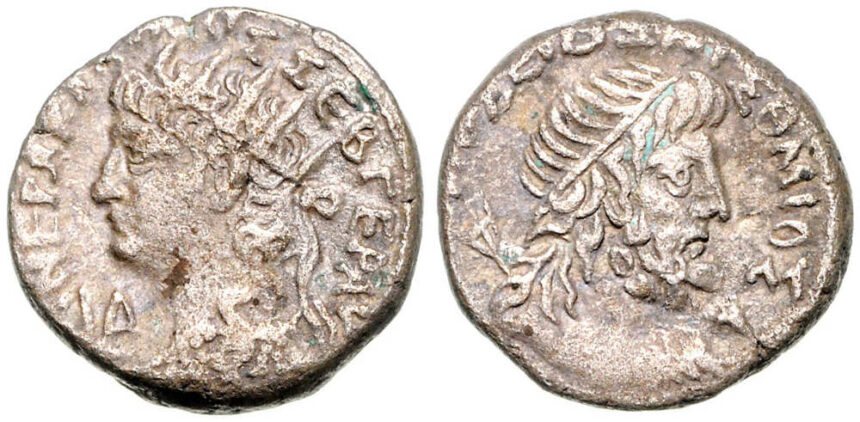
The Heraia in honour of Hera, the Nemean Games in honour of Zeus
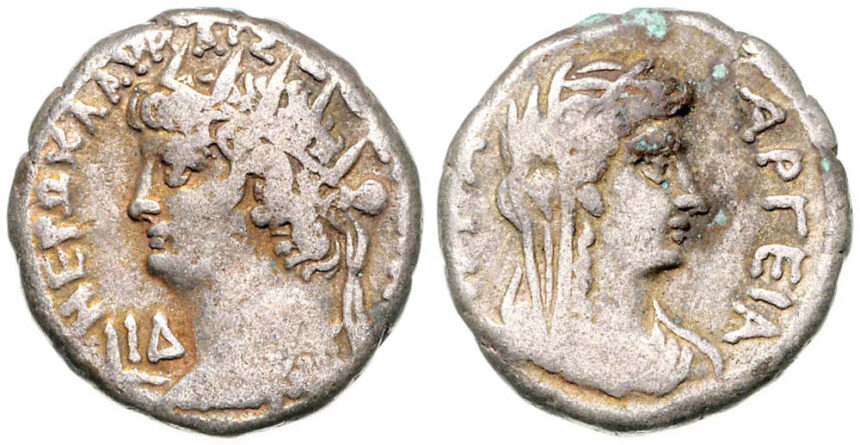
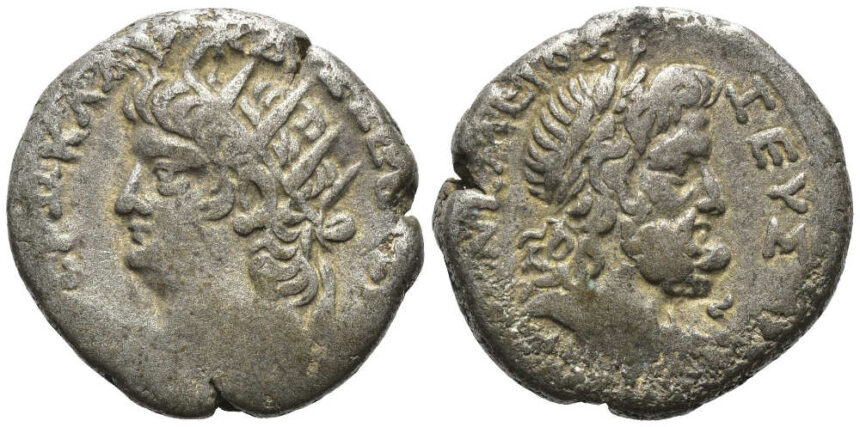
In Argos, Nero was a participant in two Panhellenic events held in quick succession: the Heraia in honour of Hera Argeia and the Nemean Games in honour of Zeus. Indeed, the Alexandrian coins also make a careful distinction between the two festivals and do not lump them together simply because they were held in the same place.
Originally, the Heraia originated from a small, rural sanctuary of the goddess near Argos, whilst the Nemean Games were formerly held in the town of Kleonai, which is largely unknown today. However, thanks to a loose alliance with Philip II of Macedonia, Argos gained greater influence over its surrounding region and – as a sign of its power – brought both of these important games to its own city.
Between the Greeks and Rome: the Actian Games
Whilst most Panhellenic Games were of Greek origin, there was one supra-regional festival in Greece that had been founded by a Roman emperor: the Actian Games. They date back to Augustus, who established this festival in honour of Apollo of Actium in Nicopolis (= the City of Victory) as a lasting testament to his victory over Mark Antony.
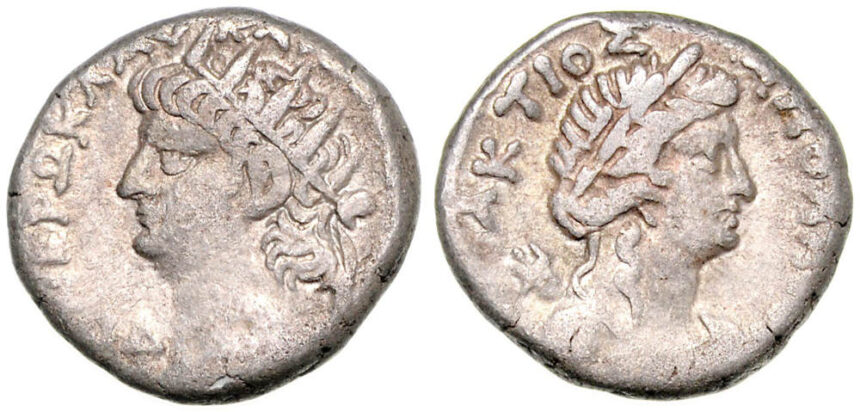
Naturally, as a descendant of Augustus, Nero had to be a participant in these games! And naturally, there is also an Alexandrian tetradrachm bearing the image of Apollo of Actium to commemorate his participation in the Actian Games.
The three false Neros
The fact that Nero had won over the East with his journey to Greece is evidenced not only by the coins, but also by the numerous impostors who, following his assassination, gathered followers in his name throughout the Greek-speaking East.
All this could call into question the image of the mad Nero that Roman senators have handed down to us in their historical works. The Roman Empire was by no means limited to a handful of senators, even if they would have preferred to think so. Through their historiography, they shaped our view of history for centuries. And so the emperor who played the kithara and was a participant in Greece’s most important competitions did not become a bridge-builder between Rome and the Greek world, but rather a ridiculous figure.
What is the value of Alexandrian tetradrachms?
Those not necessarily looking for coins in good condition can discover a wealth of historically fascinating motifs amongst Alexandrian tetradrachms, which are available for relatively little money. The coins we are showing you here all fall within the upper double-digit and lower triple-digit price ranges. Their prices may well rise slightly still. But even then, they remain a relatively affordable testament to Rome’s past! After all, coin collecting doesn’t have to be expensive.
by Ursula Kampmann / MünzenWoche