New findings regarding the issue of the “Raxalpe” commemorative thaler
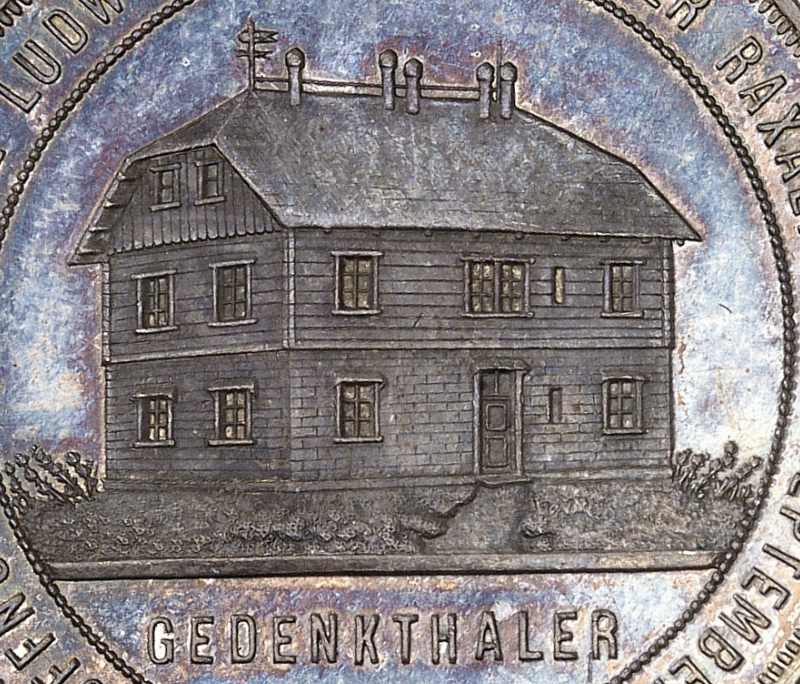
On 22 September 2026, Künker auctioned a coin of high grade, which was struck in 1877 to mark the opening of the mountain refuge on the Raxalpe. The piece, from the collection of Kommerzialrat Dr Herbert Wenzel, impressed with its iridescent rainbow patina and its immaculate surface. The lot fetched 13,000 euros against an estimate of 10,000 euros.
We had previously featured this coin and its history in an earlier emission. The text at the time stated: “The silver Raxalpe – relative to its tiny issue – appears relatively frequently on the auction market.” We now know why this is the case, as we have received a letter from the original client. Ludwig Fischhuber is the archivist of the Austrian Tourist Club (ÖTK) in Vienna and has corrected the issue of the medal based on documents from the association’s archives.
The letter to the editor with the correct figures
Ludwig Fischhuber writes: “Due to a lack of knowledge, publications (catalogues) and various auctions state a much lower issue, thereby significantly inflating the actual value of the medal. Three hundred specimens were struck, along with two experimental pieces, one on the obverse and one on the reverse (hollow-embossed in copper, silvered). For a long time, it appeared as though this were a commemorative coin, i.e. official coinage, comparable in size, shape and weight to club coins. The designation ‘Gedenkthaler’ further reinforced this impression.”
However, the club’s records contradict this. They clearly indicate a private-sector background: “To commemorate the ceremonial laying of the keystone of the ‘Archduke Carl Ludwig House’ on the Raxalpe on 16 September 1877, the ÖTK’s building committee commissioned the striking of 300 commemorative medals. The order was placed via the numismatist Franz Josef Wesener, a member of this ÖTK committee. To ensure that the club did not suffer any financial loss, Mr Wesener undertook to buy any unsold commemorative thalers at cost price.
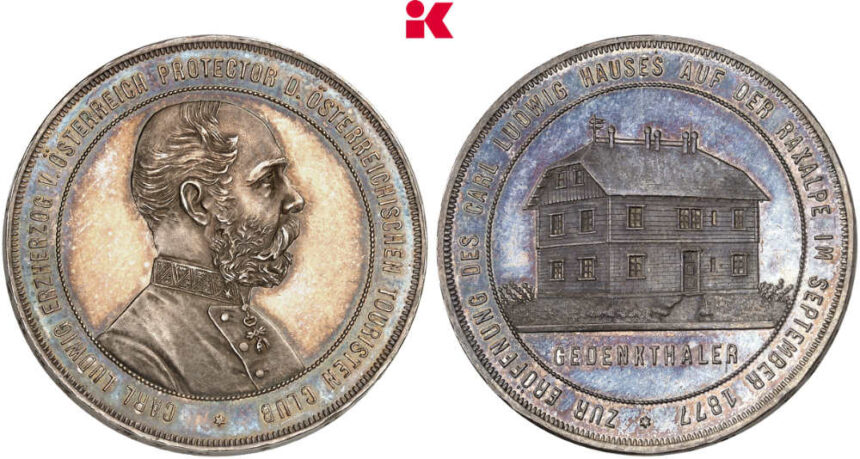
The medal (Silver, fineness 900/1000, diameter 33 mm) was designed by the Imperial and Royal Court Medallist Joseph Tautenhayn the Elder (*5 May 1837, †1 April 1911) and produced at the Imperial and Royal Main Mint in Vienna. According to the ÖTK’s financial report, the total cost for the 300 pieces amounted to 876 gulden and 22 kreuzer. The sale of 286 medals (206 pieces for 1877 and 80 pieces for 1878) raised 858 gulden (3 gulden per piece). Two specimens were presented as gifts to the club’s patron, Archduke Carl Ludwig (*30 July 1833, †19 May 1896).”
In other words: it is now established that the ‘Raxalpe’ is not a commemorative coin, but a medal struck solely at the Vienna Mint on planchets of the same type used in the striking of official commemorative coins. This makes the already fascinating history of this striking even more intriguing.
The organiser of the striking: Franz Joseph Wesener
The mention of Franz Josef Wesener is also of interest to the history of the coin trade. He is not unknown to numismatics, as we know thanks to Hadrian Rambach: Wesener (1822–1893) initially ran a shop in Berlin; whether he actually traded in tobacco, as Hermann Dannenberg writes in his Berlin memoirs, remains an open question. In any case, the coin dealer, based at 63 Elisabethstraße, worked as an expert appraiser of coins and medals on behalf of the Prussian court. He organised auctions such as that of Prince Pless’s collection. In 1874, Wesener moved to Vienna, where he catalogued collections for auction on behalf of the Egger brothers. From Vienna, he moved to Munich, specifically to Promenadeplatz 6. He organised several auctions under his own name and had a branch in Berlin at Hackescher Markt 1. In the year 1893, he died in Überlingen on Lake Constance.
We can assume that Wesener played a key role in the design and production of the commemorative issue. Thus, the ‘Raxalpe’ offers us an intimate insight into the processes behind 19th-century medal production.
Medals are more than just their motifs!
This example illustrates that medals are far more than just the event depicted on them. They were part of the everyday culture of their era, just as commemorative coins today are not merely pretty objects, but play a (albeit small) role in our economic life.
We would like to extend our sincere thanks to Mr Fischhuber for sharing the Austrian Tourist Club’s insights with us.
Text and images: Ursula Kampmann