Traitor or Failed Savior of the Republic?
We know little about Quintus Labienus, even though his life should have captured the imagination of many authors. He was the son of one of Caesar’s most important associates, and thus the son of a man who consciously sided with the Republic in the civil war; he himself was a close confidant of Brutus and Cassius, who sent him as an envoy to the Parthians to mobilize aid; then left alone in the Parthian Empire after their deaths, two years later back at the head of an army in Asia Minor: Who was this Quintus Labienus? What did he want? To conquer the Parthian Empire? To establish a client kingdom in Asia Minor? To save the Roman Republic? And what do his coins tell us?
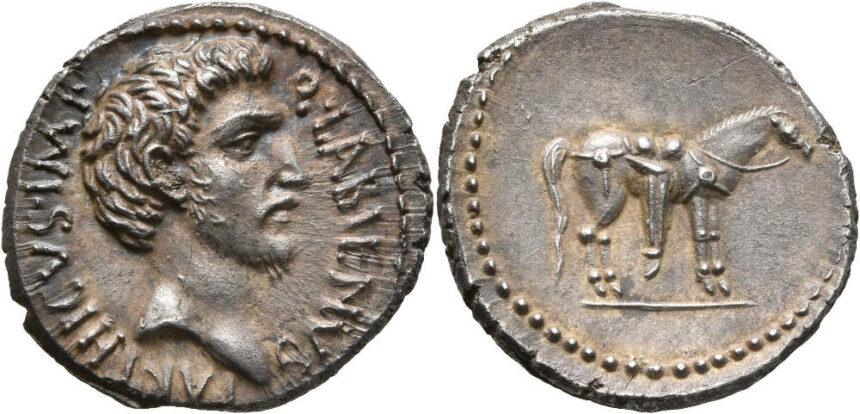
In this article, we present an extremely rare aureus of Labienus, of which only five pieces exist. It will be auctioned by Numismatica Genevensis SA on November 16, 2026. Its comes from the Baron Lorne Thyssen-Bornemisza collection, and its provenance dates back to 1970, when it was sold by Münzen & Medaillen AG. At that time, Pierre Strauss wrote: “This aureus, the best known example, is one of the rarest from the time of the Roman Republic; this type has never before been publicly auctioned.”
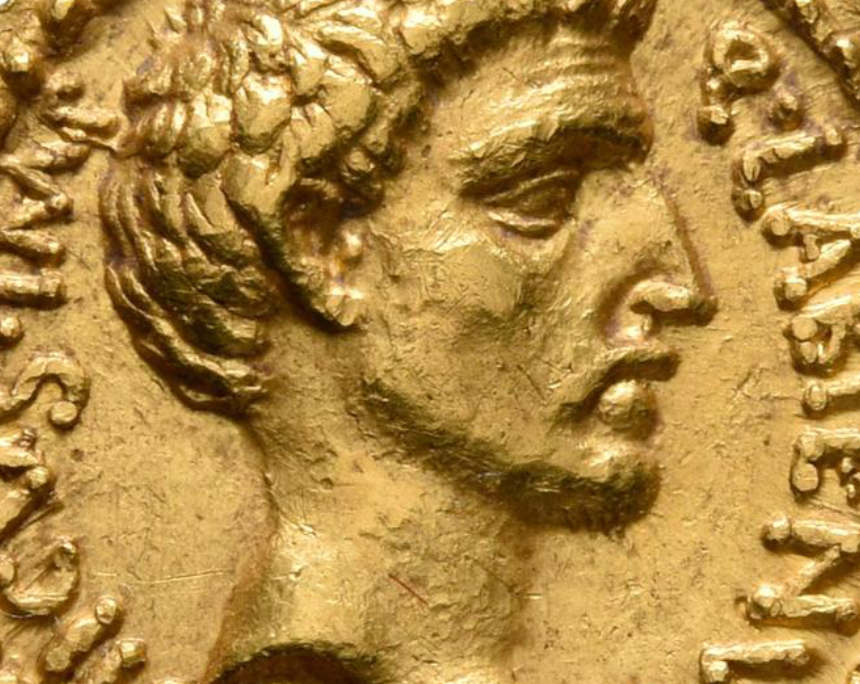
What can be seen on the aureus of Quintus Labienus?
The obverse of the aureus features a realistic portrait of the youthful Quintus Labienus facing right. The inscription reads Q LABIENVS PARTHICVS IMP. This is ambiguous. Quintus Labienus and Imperator is clear, but what does “PARTHICVS” mean? There are three possible translations:
- Labienus calls himself “victor over the Parthians”, although he did not achieve a victory over them.
- Labienus refers to himself as “the Parthian”, which is hardly conceivable given the Roman self-perception.
- Labienus wants to express that he is a friend and ally of the Parthians; however, the grammar is awkwardly worded.
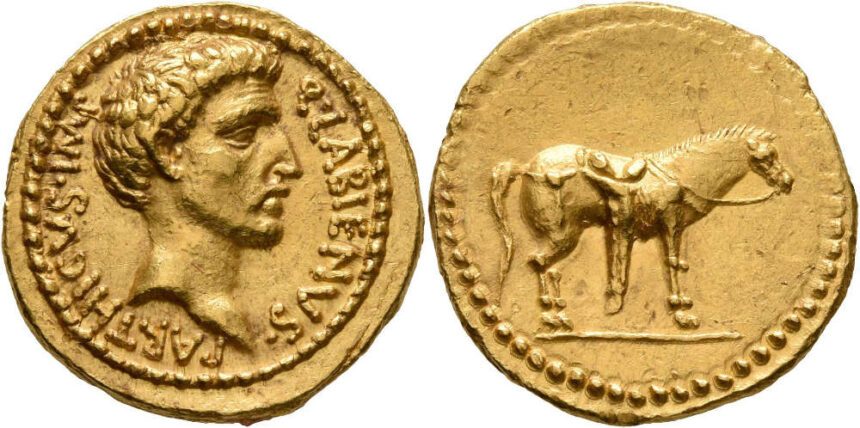
The reverse side shows a horse saddled in the Parthian style. Particularly striking is the long gorythos dangling from the saddle. The gorythos, a container for bows and arrows, was part of the typical weaponry of Parthian horsemen.
Who was Quintus Labienus?
Quintus Labienus was born at an unknown date as the son of Titus Labienus, whose birth is estimated to be around 100 BC. Assuming that Roman men typically married in their late twenties, Quintus Labienus could have been born from around 70 BC onwards. However, this date is based on several hypotheses and is therefore not reliable.
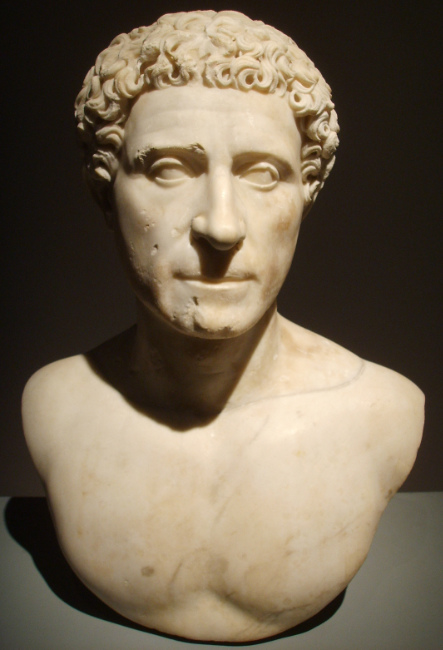
Quintus Labienus’ father is mentioned in many ancient sources. He was a very important staff member of Caesar, responsible for, among other things, the victory over the Treveri and a campaign against Lutetia modern Paris. However, after Caesar’s decision to begin the civil war by crossing the Rubicon in 49 BC, Labienus sided with the supporters of the old Republic. He sacrificed his life in the Battle of Munda in 45 BC.
Quintus’s life was sealed by his father’s decision. He, too, sided with Brutus and Cassius, the assassins of Caesar. They sent him to King Orodes II, who had ruled the Parthians since 58/7 BC, at the end of 43 / beginning of 42 BC. Quintus’s task was to persuade Orodes to form an alliance and thereby mobilize fresh resources. Labienus must have been a young but enterprising man at this time, already possessing some military experience. For when he learned of his commanders’ defeat at Philippi, he decided to act independently. He himself then concluded the alliance with Orodes. To what end? We will probably never know.
Why did Labienus mint coins?
In late 41 / early 40 BC, a Parthian army crossed the Euphrates. It was led by a Parthian-Roman dual command: the Parthian Crown Prince Pacorus worked together with the Roman Quintus Labienus. They marched into a country utterly ruined by civil war. Marcus Antonius, who commanded the province, was in winter quarters in Egypt with his troops. The garrison of the province of Asia Minor consisted largely of former supporters of Brutus and Cassius. Winning them over to the Parthian side may have been Quintus Labienus’s task. For this, he needed coins, since it was customary to pay newly enlisted soldiers a signing bonus.
We should understand the coins minted by Quintus Labienus in this context. They were aimed at a Roman audience consisting primarily of soldiers. Therefore, the obverse of the coin depicts Labienus as legionaries had become accustomed to seeing him: with a realistic portrait and the title of Imperator. The reverse points to his allies, the Parthians. In this context, the inscription “Parthicus” can also be understood. It characterizes him not as a victor over the Parthians, but as their ally. This interpretation was not as odd to his contemporaries as it is to us. While there were already occasional victor’s names in the Roman Republic – for example, Scipio called himself Scipio Africanus after his victory over Hannibal – they were by no means as standardized as they would later become in the imperial period.
How did Quintus Labienus’ campaign end?
Pacorus and Labienus agreed to separate campaigns. Pacorus headed east, while Labienus marched to Cilicia. At first, he made good progress there. Numerous cities submitted to him, and many soldiers defected. However, in 39 BC, an army of Mark Antony arrived and annihilated Labienus’s troops that same year. The young Roman died while fleeing. Pacorus held out a little longer. He fell in 38 BC at the Battle of Mount Gindarus. The relationship between the murder of his father, Orodes II, and the failure of the campaign is unknown.
What is the value of the aureus of Labienus?
When Münzen und Medaillen auctioned the Aureus of Labienus in November 1970, it fetched the then-unbelievable price of 75,000 Swiss francs. For comparison, a mint-state Aureus of Pertinax cost 22,000 Swiss francs at the same auction, and a mint-condition Aureus of Faustina the Elder 4,650 Swiss francs. And let’s not forget: residential property in Zurich at that time cost between 1,500 and 3,500 francs per square meter. Today, you’d pay between 18,000 and 20,000 francs per square meter for the same property. And this calculation doesn’t even take into account the sharply increased exchange rate of the Swiss franc. In 1970, one dollar was worth approximately 4.3 Swiss francs!
Let’s take also a look at the results in the Coin Archive: The last Labienus Aureus was offered in January 2023. It came from the Tareq Hani Collection and was graded by NGC Choice AU* 5/5 2/5 graffiti, grinding mark. The coin fetched an impressive $775,000. The Aureus, which Numismatica Genevensis SA is offering, should fetch more money, after all, it is better preserved and has a better provenance.
The coin presented here was last sold by NAC in 2013, when it realized CHF 800,000. We can be very curious to see what it will fetch some 13 years later, given its exquisite provenance.
We’ll keep you updated!
Text and images: Ursula Kampmann