Sikh temple tokens
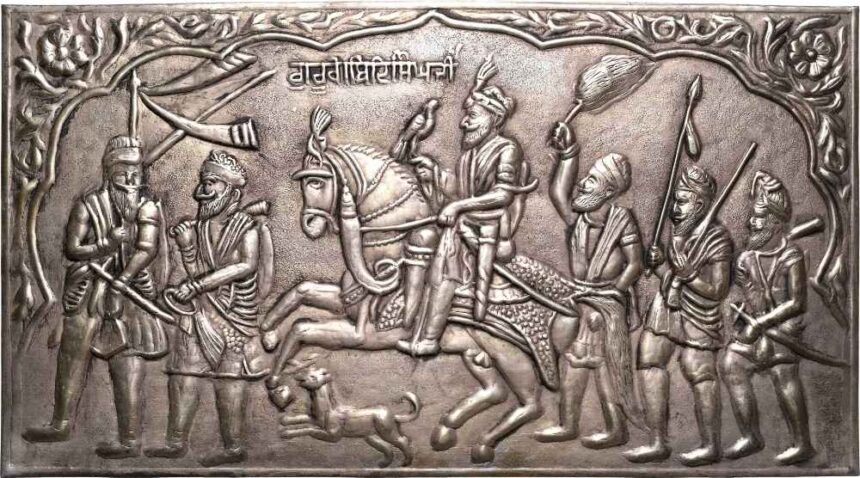
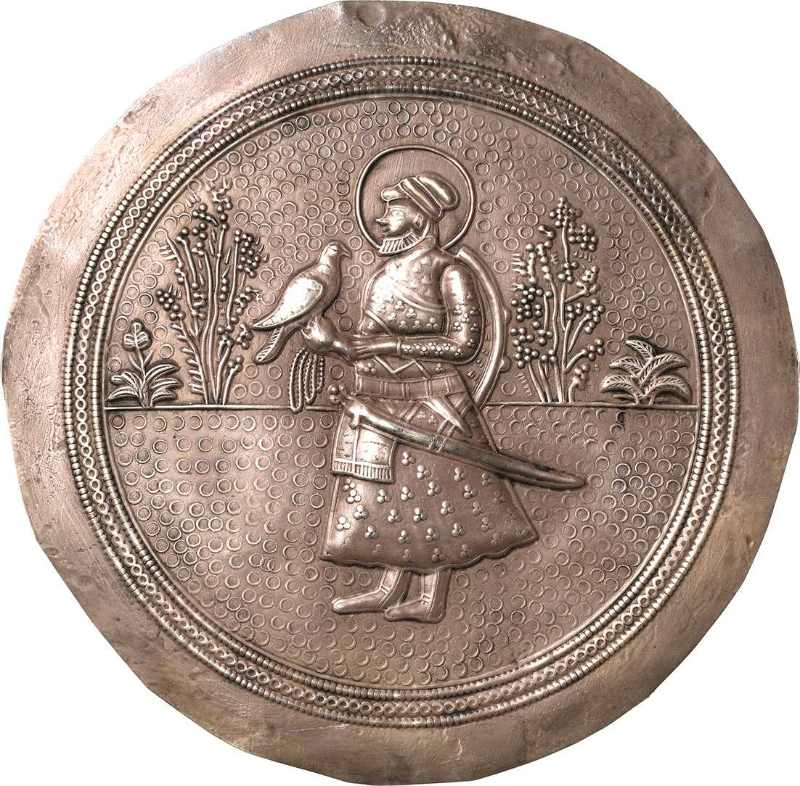
For Christians it is the cross, for Muslims the Hand of Fatima, and for Sikhs it is the Gurus who accompany and protect them in their daily lives. Their depictions are frequently found on so-called ‘temple tokens’, whose appearance is reminiscent of medieval bracteates. They are regularly offered at numismatic auctions, such as the upcoming auction by the Leipzig coin dealer and auction house Heidrun Höhn, which takes place from 27 to 31 May. It includes, amongst other things, an extensive collection of numismatic items from India. Our two examples of Sikh temple tokens come from this auction.
What can be seen on the Temple Token?
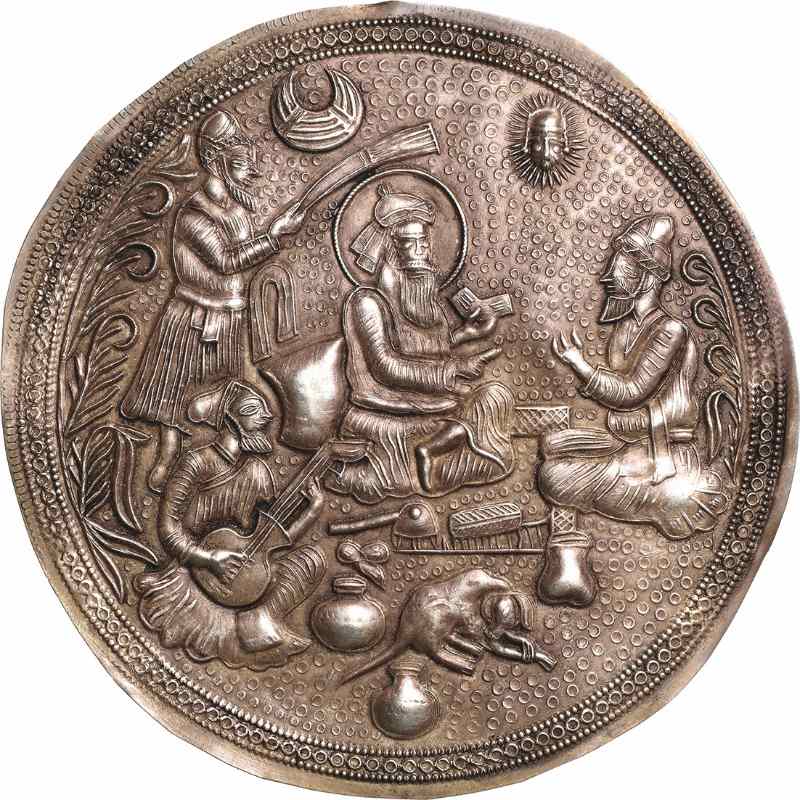
The Temple Token is dedicated to the first Sikh Guru, Nanak. In the literature, we often find the full name Guru Nanak Dev. Here, ‘Guru’ refers to the role of teacher, whilst the epithet ‘Dev’ belongs to the religious sphere and is used for people of great holiness and spiritual authority. Guru Nanak Dev lived from 1469 to 1539. He stands at the centre of a scene that we encounter time and again in Sikh imagery. It shows Nanak receiving holy men.
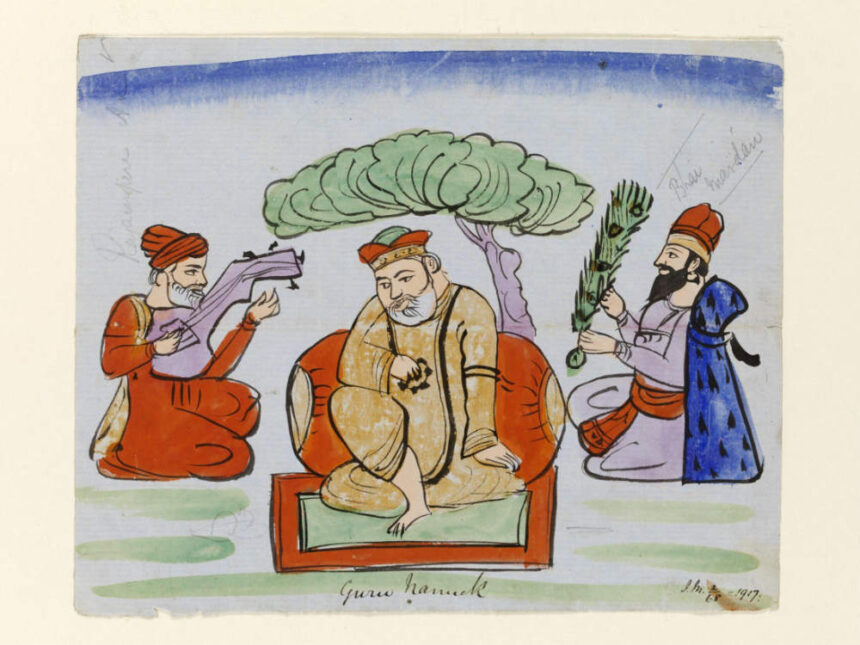
In the centre, Nanak sits on the ground. As a sign of his holiness, he wears a nimbus and is accompanied by the sun and moon. He has raised his right hand in a gesture of teaching. The object in his left hand is not explained. Behind Nanak stands his disciple Bhai Bala, who is swatting away vermin with a flywhisk. At the saint’s feet sits his disciple Bhai Mardana, playing the rabab. Opposite this trio sits a seeker of wisdom. The depiction of the dog in this context is highly unusual. Perhaps it refers to the comparison of the believer with a dog, formulated by a later Sikh guru: wild dogs live without masters or rules, and are therefore filthy and anarchic. Quite different is the loyal domestic dog, which is a source of enrichment. The difference between a believer who follows a master and an unbeliever is exactly the same.
Who was Nanak?
Nanak was born in 1469 AD to a family of merchants living in what is now the Pakistani Punjab. His parents practised the Hindu faith, but Nanak rejected the idea of multiple gods – perhaps due to Muslim influence. Divine voices are said to have commanded him to believe in the one God, to practise mercy and purity, to learn to serve, and to maintain devotion. Nanak saw himself as a kind of prophet of his God, learning not from others but directly from the divine power. Nanak travelled throughout India and the Muslim world, and is even said to have reached as far as Mecca. His most famous quote emphasises the unifying elements of faith: “There are no Hindus, there are no Muslims, there are only creatures of God.”
Nanak is credited with writing 974 hymns, which became the religious foundation of Sikhism.
At the age of 55, he is said to have settled in Kartapur, where he lived until his death. He appointed a successor before he died in 1539 at the age of 70.
What is a temple token?
Temple tokens are not found only in Sikh shrines. They are widespread throughout India, where they were being produced as early as the beginning of the 14th century. As they often depicted the god Rama, they are also known as Ramatankas.
The function of Temple Tokens is multifaceted. They served – particularly when made of precious metal – as a combination of currency issued by a temple in the name of its god, an offering coin and an amulet. A worshipper could purchase such a token at the temple, and was free to use it as they wished. Perhaps they used it in the temple for offerings, took it home as an amulet, where they wore it themselves or gave it away. If it was made of precious metal, it could of course also serve as a medium of exchange outside the temple. The sharp distinctions we draw today between coins and non-coins are, in any case, a modern construct and not applicable to earlier eras.
Even today, pilgrims can purchase temple tokens. They serve as souvenirs or gifts for Diwali. Many Indian traders also offer replicas of ancient Ramatankas to tourists.
What is a temple token worth?
Despite their interesting designs, temple tokens are relatively inexpensive. Even such rare and beautifully crafted items as those offered by the Leipzig coin dealer are priced in the lower three-figure range. The price depends heavily on the age and material of the tokens. Condition, of course, also plays a role. Brass tokens can be purchased from as little as 50 euros. Rare gold tokens can fetch up to a mid-four-figure sum at auction.
Temple tokens are an affordable, versatile and exciting entry point for collectors interested in Indian culture.
Text and images: Ursula Kampmann
1 June 2026
The result
The Temple Token from the Leipzig Coin Dealers, Auction 110, Lot 1051, shown here, sold for more than ten times its estimate. It was sold for 1,300 euros. Lot 1056, which we also show here, fetched 1,000 euros.
The most expensive Temple Token in this series changed hands for €1,800. It depicts a hunting scene featuring numerous figures, with Guru Gobind Singh at the centre of the action.