Swiss marksmen in the U.S.
Swiss shooting medals are an extremely popular collecting field worldwide. Collectors appreciate the fact that these pieces are visually appealing and, at the same time, relatively affordable given their rarity. Shooting medals made of bronze or tin in good grade can be purchased for as little as a few hundred dollars. Rarer gold examples are, of course, more expensive.
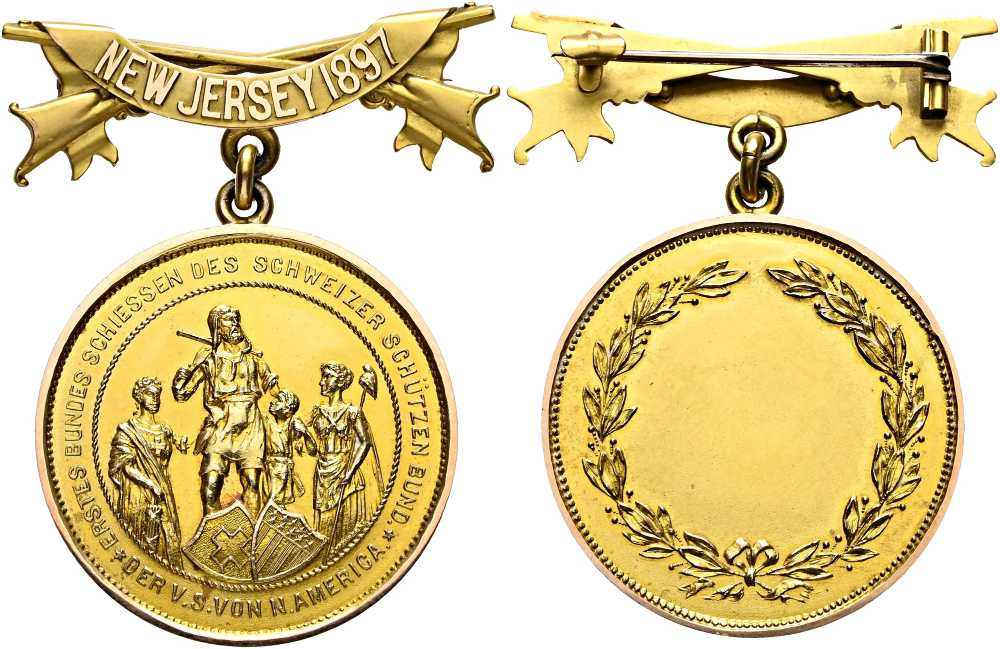
A good example of this is a gold medal from 1897, which was produced on the occasion of the First Federal Shooting Competition of the Swiss Shooting Federation for Veteran Shooters of North America in New Jersey. It will be auctioned on May 19, 2026, by the SINCONA auction house.
What is depicted on the 1897 gold medal?
The obvers features an allegory combining elements of Swiss and American symbols of liberty. In the center stands William Tell facing forward, his crossbow slung over his shoulder, with his young son to his left. The design is reminiscent of the Tell monument unveiled in Altdorf in 1895. The 142,000 francs required for the approximately 4-meter-tall bronze statue were raised through a fundraising campaign. To this end, Swiss citizens living abroad were also contacted, which is why they were informed about the appearance of the planned statue, as this medal attests.
To the right of William Tell stands Helvetia, crowned with a laurel wreath. She wears the Swiss cross on her chest and leans on a lictor’s bundle. The lictor’s bundle is a symbol of unity widely used in Switzerland: while the individual rods can be bent easily with little force, it is impossible to break them when the bundle is tightly bound.
To the left stands Lady Liberty in a striped robe. In her left hand, she holds the cap of liberty on a long staff. This symbol is based on two different traditions. It recalls the coins of Brutus, which were minted after the assassination of Julius Caesar. On them, the pileus—the headdress of a freed slave—can be seen between two daggers. This round felt cap evolved into a widely recognized symbol of freedom during the Eighty Years’ War between the Netherlands and Spain. The fact that the cap is carried on a pole is connected to the legend of William Tell. The proud peasant is said to have refused to salute the hat of the Habsburg administrator, which the latter had placed on a pole.
The design is framed by the escutcheons of Switzerland and the United States of America.
The inscription around the edge, reads: FIRST FEDERAL SHOOTING OF THE SWISS SHOOTERS’ ASSOCIATION / THE VETERANS’ SHOOTERS OF NORTH AMERICA.
The revers features a laurel wreath. The blank surface was intended for engraving the winner’s name.
The medal is already with a loop, with mounting, and was intended to be worn as a clasp on the garment by one of the competition’s winners. This is the purpose of the fastener, which bears the inscription NEW JERSEY 1897.
The Significance of Swiss Shooting
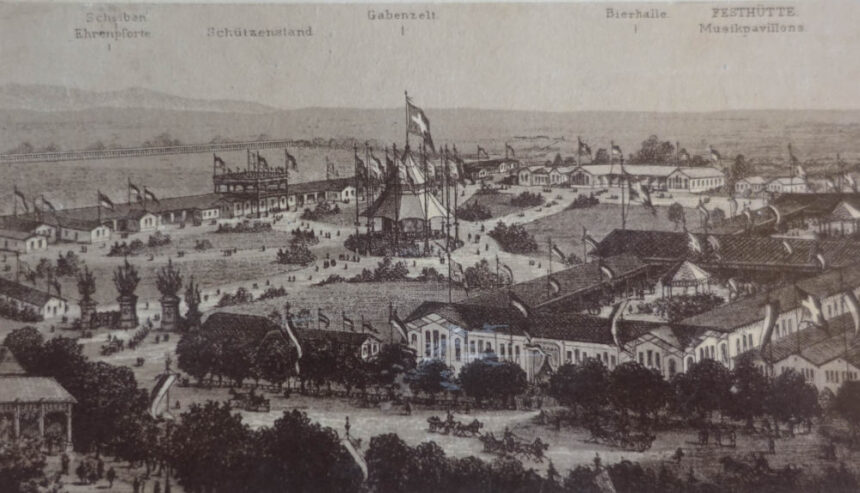
The first Swiss Federal Shooting Festival took place in Aarau in 1824. It brought together two key objectives of the time: first, to strengthen the country’s defense capabilities following the defeat by Napoleon, and second, to bridge the deep religious, regional, and political divides among the citizens of Switzerland. The unifying element was the sport of shooting. Soon, more and more marksmen began to gather to compete in peaceful target shooting at the Swiss National Shooting Festivals.
The marksmen came not only from all over Switzerland but also from foreign countries. In the year 1859, the Swiss Shooting Association even had to amend its bylaws to accommodate the many foreign participants. It was agreed that they could participate in all competitions, with the exception of the so-called “Federal Main Target.”
As a result, the Swiss Shooting Festivals—long before the Olympic Games!—became an international meeting point for sport shooters. In addition to individual participants, several national shooting clubs from foreign countries sent delegations. For example, the German, French, Belgian, English, Italian, and American umbrella organizations each sent a delegation of their best shooters to the Swiss Shooting Festival in La Chaux-de-Fonds. The international significance of these festivals is demonstrated, among other things, by the fact that a government from a foreign country donated a prize for the winner of a Swiss Shooting Festival.
How did a Swiss shooting festival end up in the U.S.?
Unfortunately, we know nothing about a shooting festival held in New Jersey in 1897. What we do know, however, is that Swiss marksmen have enjoyed an excellent reputation in the United States ever since their service in the American Civil War. Company A of the famous Berdan’s Sharpshooters consisted mainly of men of Swiss descent. Several American shooting clubs bore the name “Swiss” in their titles, such as the organizations documented in the 1860s: the Swiss Society of Sharpshooters (New York City), the Sacramento Swiss Rifle Club (Sacramento, CA), and the Swiss Guards (San Francisco).
However, the medal itself tells us quite a bit about the event. Medals like this gold medal were made for the winners of the competition. The fact that the name and year of the competition do not appear on the medal as part of the legend suggests that it was intended to serve as a decoration for multiple competitions. The absence of a winner’s name engraved on the revers indicates that it was never awarded. Did the Association of Swiss Veteran Shooters perhaps plan a regular event that never materialized due to lack of interest? We do not know.
What is the value of a marksman’s medal?
The term “marksman’s medal” encompasses many objects with very different characteristics. The value of a marksman’s medal depends on the material from which it was made, its grade, its rarity, and the appeal of its design. Prices therefore range from the double-digit to the five-digit range.
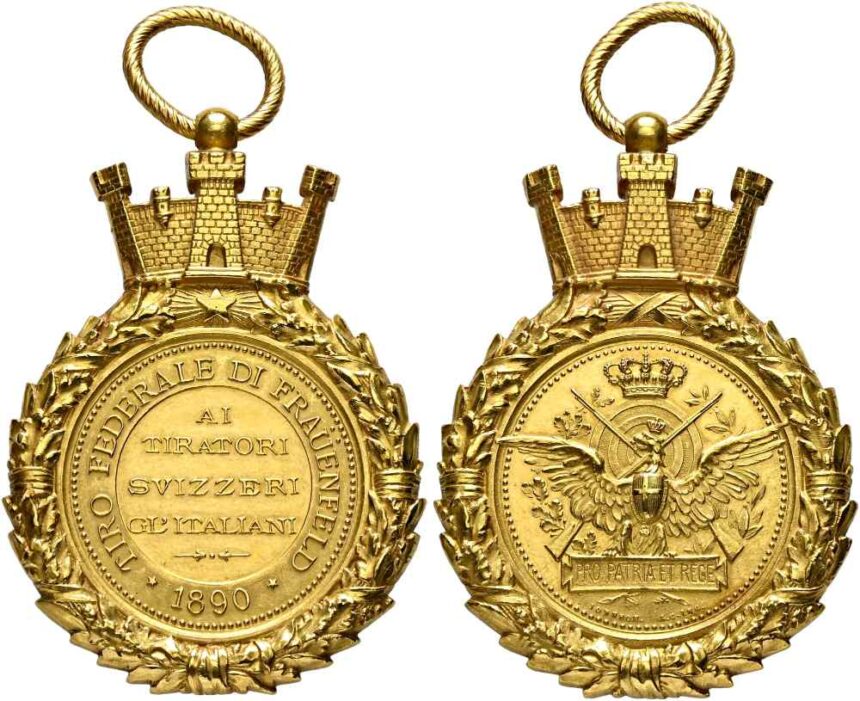
The shooting medal we have presented here is extremely rare, though we do not know how many gold specimens were actually produced. We do know this for other pieces. For instance, SINCONA estimates a shooting medal—produced only once in gold in 1890 on the occasion of the Cantonal Shooting Festival in Solothurn—at 7,500 CHF. The historically significant gold medal from the Italian government, also produced in a single specimen, is estimated at 10,000 CHF.
The estimate for the piece we’ve presented here is 3,000 CHF, though we can view this more as a starting price. We won’t know how high the hammer price will be until after the auction.
Text by Ursula Kampmann