The finest specimen of the rarest gold coin from the German Empire
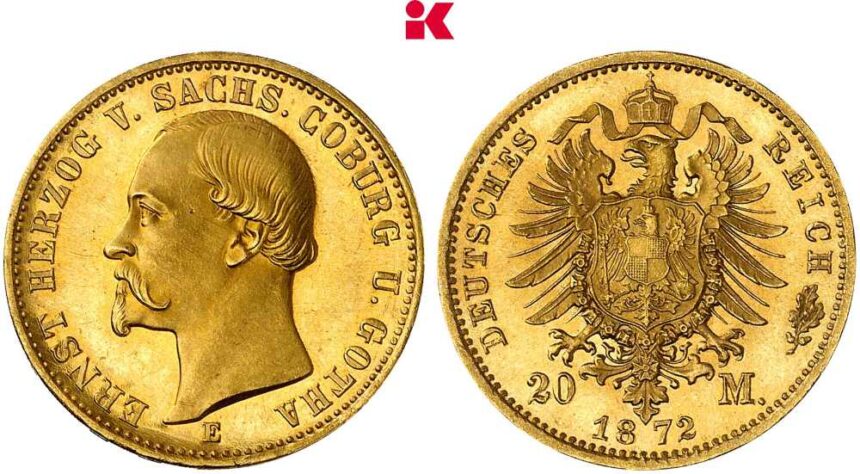
‘A collector’s prize’ – this is the Jaeger’s cautious appraisal of lot number 270, under which the 20-mark piece from the year 1872 issued by Ernest II of Saxe-Coburg and Gotha is catalogued. 1,000 of these pieces were struck. We do not know how many of these were not melted down but have survived to this day. Künker conservatively values a single specimen of this rarest coin of the German Empire at 100,000 euros. We’ll tell you everything you need to know about this piece.
What can be seen on the 1872 20-mark piece of Ernst II of Saxe-Coburg and Gotha?
The obvers of the piece depicts the head of Ernst II of Saxe-Coburg and Gotha facing left. Around it runs the legend ERNST DUKE V [on] SACHS[en] COBURG U[nd] GOTHA, with the mint mark ‘E’ for Dresden below.
The revers of the coin is common to all coins of the German Empire. Bearing the inscription ‘DEUTSCHES – REICH’, it depicts an imperial eagle modelled on the coat of arms of the Holy Roman Empire of the German Nation, which existed until 1806. A key difference from the old coat of arms is the breast shield, which depicts the crowned Prussian eagle with the Hohenzollern coat of arms, divided into squares of silver and black. This breast shield is surrounded by the chain of the Order of the Black Eagle. In the lower field, the face value is stated as 20 M[ark], with the cipher of year 1872 below it.
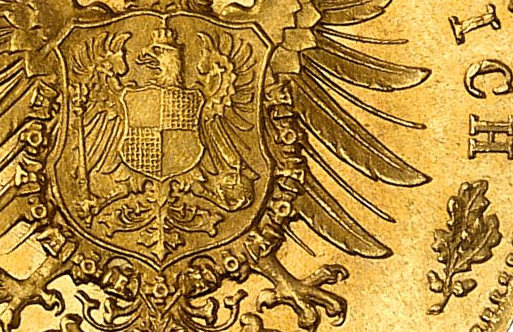
One notable detail has not yet been described in the literature. On the revers, there is a small oak branch with two leaves and two acorns. This oak branch also appears on the gold coins of other constituent states, exclusively in the years 1872–73.
We see it on coins
- of Frederick I of Baden, minted in Karlsruhe
- of Ludwig II of Bavaria, minted in Munich
- of the City of Hamburg, minted in Hanover
- of Ludwig III of Hesse-Darmstadt, minted in Darmstadt
- of Franz II of Mecklenburg-Schwerin, minted in Berlin
- of Frederick William of Mecklenburg-Strelitz, minted in Berlin
- of William I of Prussia, minted in Berlin, Hanover and Frankfurt
- of John of Saxony, minted in Dresden
- of George II of Saxe-Meiningen, minted in Munich
- of Charles of Württemberg, minted in Stuttgart
The oak is the tree most closely associated with the German nation. Perhaps the oak branch was intended as a memento of the unification of the German Empire.
Why is the title ‘Duke of Saxe-Coburg and Gotha’ used?
Normally, the names of the territories under a ruler’s control are joined by a hyphen. So we speak of Brunswick-Wolfenbüttel, Hesse-Darmstadt and Schwarzburg-Rudolstadt. Why, then, is such great value placed on ‘and’ in the title ‘Saxe-Coburg and Gotha’?
There are political reasons for this. Saxe-Coburg and Gotha were originally independent duchies that were closely linked through a personal union. Even as the administration gradually merged, the territories retained separate state parliaments and separate departments within the Ministry of State. Although Gotha was officially the seat of government, the court regularly alternated between Gotha and Coburg.
Who was Ernest II of Saxe-Coburg and Gotha?
Ernst II of Saxe-Coburg and Gotha, born in the year 1818, was already an experienced ruler at the time of the founding of the German Empire, having held office since 1844. In Germany, he was regarded as a national hero because, in 1849, as the highest-ranking commander at the Battle of Eckernförde, he had secured the decisive victory over Denmark.
Despite his tiny territory – the two duchies of Saxe-Coburg and Gotha had a combined population of just 174,339 in 1871 and covered an area of 1,977 km²—Ernst II played a central role in German politics because his brother Albert was the consort of Queen Victoria of England.
In 1861, Ernst II concluded a military convention with Prussia. He enjoyed a close and trusting relationship with Wilhelm of Prussia, the future Emperor. In 1866, the duchy of Saxe-Coburg and Gotha fought alongside Prussia against Austria and its allies, just as it would later do against France in the Franco-Prussian War of 1870–71. From 1870 onwards, Ernst II was a staunch advocate of German unification under Prussian leadership.
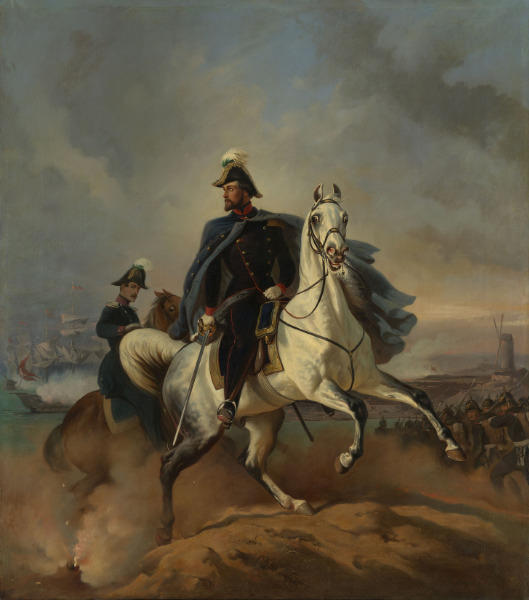
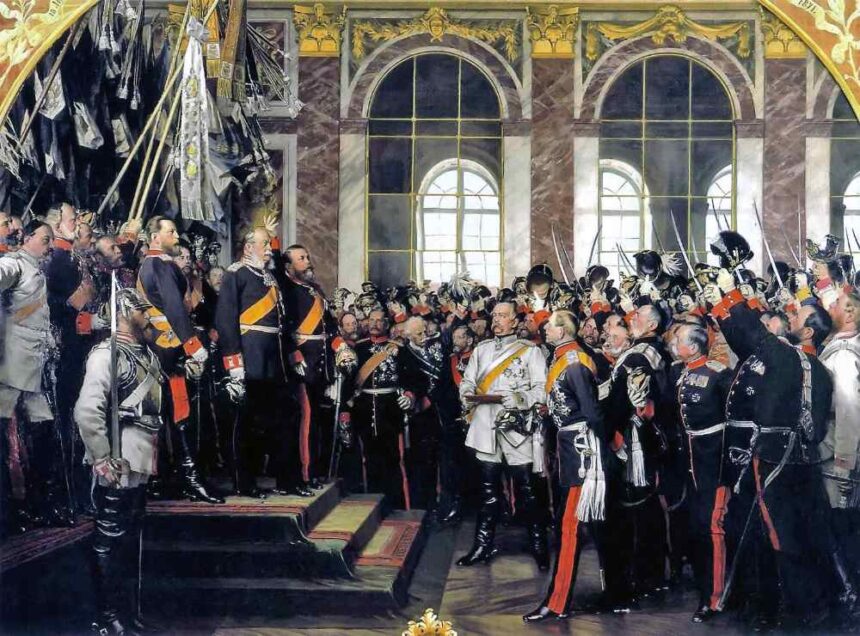
For this reason, the newly proclaimed Emperor Wilhelm I is said to have publicly acknowledged Ernst in his speech of thanks with the following words: “I do not forget that I owe the main achievement of this day in part to your efforts.”
Ernst II as a composer
Less well known than his support for Wilhelm I is the fact that Ernst II of Saxe-Coburg and Gotha was a composer to be taken seriously, who created numerous works. His best-known work was his opera *Santa Chiara*, the overture to which you can listen to on YouTube. His *Austrian Hunting Music No. 14* for a wind ensemble combined his enthusiasm for hunting with his musical creativity.
Death and Succession
Ernst II died on 22 August 1893. Emperor Wilhelm II, who was present at his funeral, is said to have knelt by his great-uncle’s coffin and wept. The duke, who died childless, was succeeded by his British nephew Alfred, the second son of Prince Albert and Queen Victoria.
What is the 1872 20-Mark piece of Ernest II of Saxe-Coburg and Gotha worth?
When the exact piece that Künker is now offering – valued at 100,000 euros – was last sold via the Heidelberg coin dealership in the year 2018, it fetched 135,000 euros. That was the highest price ever achieved for such a piece. All other comparable pieces have topped out at 130,000 euros. However, none of them had been graded until now. The piece on offer at Künker therefore meets, for the first time, the criteria of an increasingly international investment market. This market is currently seeking alternatives to US coins, whose high prices many investors consider to be overheated.
We can therefore look forward to seeing whether, at the end of September, a German collector will secure this piece at the usual hammer price, or whether they will have to compete for it with international investors who have recognised the potential of coins from the German Empire.
Text and images: Ursula Kampmann