The Imperial Collection
On 23 June 2026, the first part of the Hohenzollern coin collection will go under the hammer. The Osnabrück-based auction house Künker will be auctioning coins and medals formerly owned by the Kings of Prussia and the Emperor of Germany. We present a selection of particularly special items and explain what the coins in the collection reveal about the character of Emperor Wilhelm I.
Coin collecting is a hobby fit for kings. That is a standard phrase I often use when I tell people how coin collecting came to become so widespread across the globe. Rulers began collecting when humanists presented their patrons with coins of Roman emperors to teach them how a true prince ought to conduct himself.
The logical consequence was that the princes, having been instructed by Roman coins, in turn considered how to shape their own image so that they would be perceived by their contemporaries and posterity in the way they wished to be perceived. The medal thus became the medium of choice.
I never would have thought that I would actually one day see the collection of kings and an emperor in an auction catalogue! Yet that is precisely what is happening right now with the Imperial Collection, which is to be auctioned at Künker on 23 June 2026. I can now look in an auction catalogue to see, for example, what Emperor Wilhelm I collected, and whether his collecting interests were linked to the medals on which he bequeathed his own image to contemporaries and future generations. By the way, if you’re interested in German history, I’d strongly recommend that you don’t just look at the coins on online portals. Künker has produced an auction catalogue that contains far more background information on the collection and the individual items than one would normally expect from auction catalogues.
Life-changing experiences
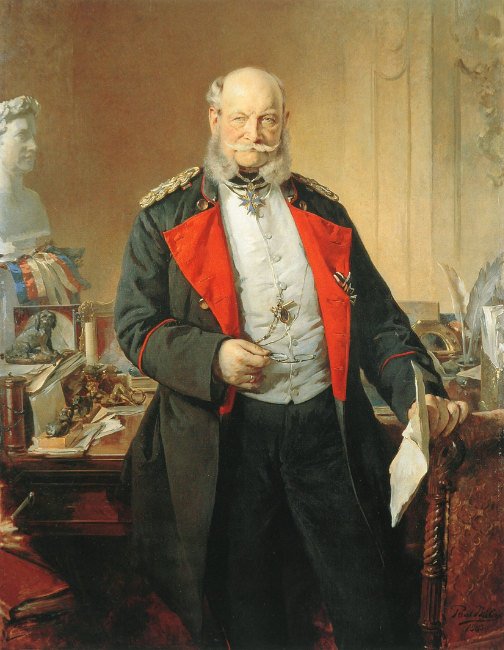
So we will be seeing medals from the collection of Emperor Wilhelm I. Wilhelm I? Who was this Wilhelm I? And how did he become the man he was?
To answer that, we must go back to the night of 18–19 October 1806, when the nine-year-old boy was hurriedly shoved into a carriage along with his siblings to travel from his native Berlin into the unknown. His tutors thus prevented his capture by French troops. Napoleon marched into the Prussian capital just a few days later. Hounded by their pursuers, the children fled eastwards in the freezing late autumn, together with their mother, who was seriously ill with typhus.
Admittedly, Wilhelm I was neither the first nor the last refugee in world history. Compared to many other escapes, his flight was even relatively comfortable. Nevertheless: the nine-year-old was torn from his surroundings overnight. He was afraid; less than four years later, he lost his mother, who had been weakened by illness, a fact he would always hold against the French. And Wilhelm held a position that enabled him to protect Prussia from ever again being overrun by the French and the Revolution.
The fact that every Prussian prince had to join the military was therefore not a duty for Wilhelm, but a passion. The military made Prussia capable of defence and ready to fight. Wilhelm identified with ‘his’ soldiers, who, like him, were protecting their shared fatherland. He shared their daily lives, their worries, their hopes. Together, they would ensure that Germany would never again be on the losing side.
Coin collecting as a form of self-affirmation
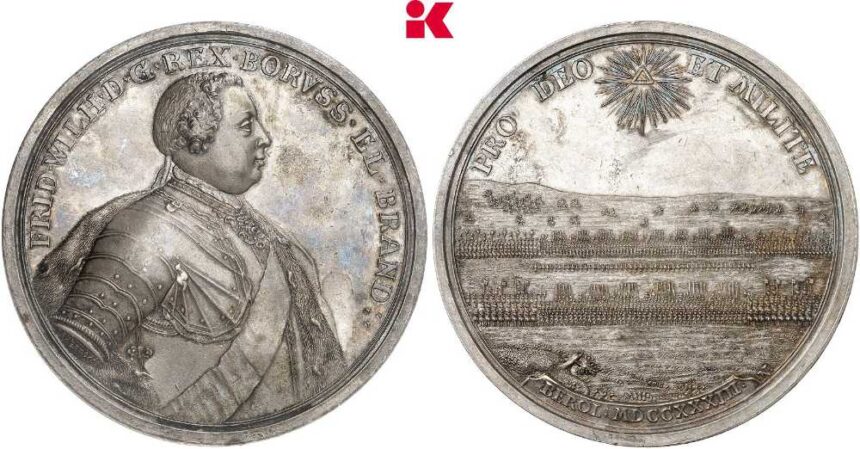
What did Wilhelm collect? Do you really need to ask? He collected medals that evoked Prussia’s glorious military past. Such as, for example, the magnificently preserved silver medal bearing the portrait of Frederick William I, the ‘Soldier King’, and dated 1733. He may well have admired the troops marching in an eternal parade on the reverse. Wilhelm could certainly identify with the motto on the reverse – ‘For God and Army’ (in translation).
Do you really need to think about which monarch Wilhelm had the most medals of in his cabinet? Frederick II, of course, under whom Prussia rose to join the ranks of the great powers. Frederick II became the figure with whom the Hohenzollerns most identified. His fate gave Wilhelm the certainty that the humiliation at the hands of Napoleon had been merely an interlude, a temporary setback just as Frederick had had to endure. After all, Berlin had even been occupied in October 1760 under the greatest of all Prussian commanders.
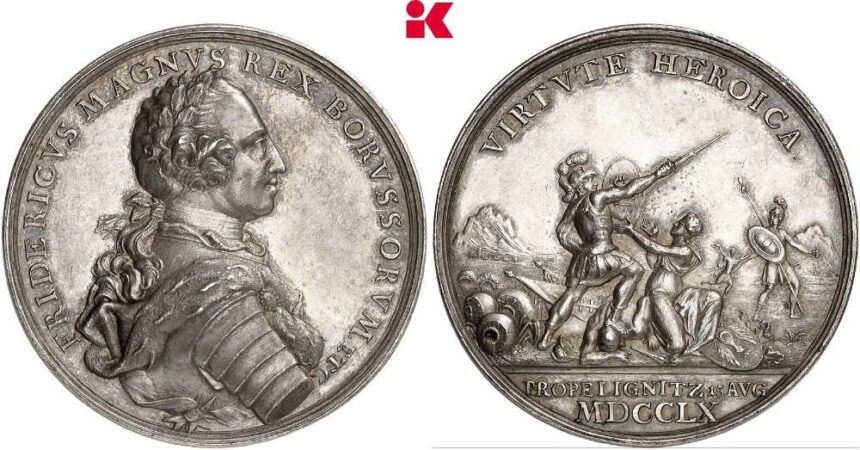
Yet for Frederick, the loss of the capital did not mean the loss of the empire. He held on to Silesia at the head of his army through the victory at Liegnitz on 15 August 1760, to which this medal is dedicated. He held on to wealthy Saxony with the victory at Torgau, which is also well documented by medals in William I’s collection. Frederick II held his ground until fate turned with Peter III of Russia’s change of allegiance. When Frederick II concluded the Peace of Hubertusburg on 15 February 1763 – this peace is also documented by many items in William’s collection – he could be proud that his assembled enemies had not brought him to his knees. Prussia had won Silesia!
This was an example that every Prussian soldier could follow.
Royal coins to mark a major event
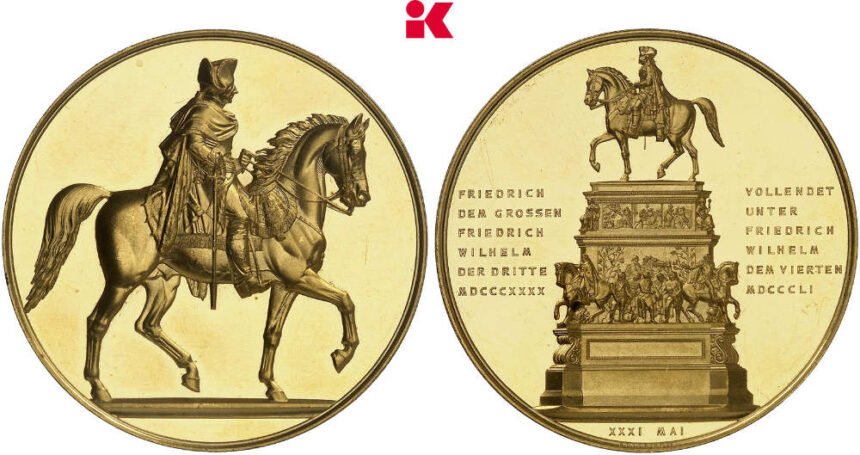
It should therefore come as no surprise that, following their victory in the Wars of Liberation, the Hohenzollerns planned a monument to Frederick the Great. Frederick William III had already commissioned a monumental statue in 1836. It was to cost the state treasury 200,000 talers. The Prussian Crown Prince Frederick William laid the foundation stone on 31 May 1840 to mark the 100th anniversary of Frederick II’s accession to the throne. The event was overshadowed by the king’s serious illness; he watched the ceremony from his study. It was to be the last time his subjects saw him: he died just one week later.
This was followed by the Revolution of 1848, Frederick William IV’s rejection of the German crown offered by the Paulskirche, the military crackdown on the radicals, and the victory of the conservative forces. It was only then – 11, not 10, years after the laying of the foundation stone – that the childless King Frederick William IV and his brother William, the new Crown Prince, organised the inauguration ceremony for the monument in honour of Frederick the Great.
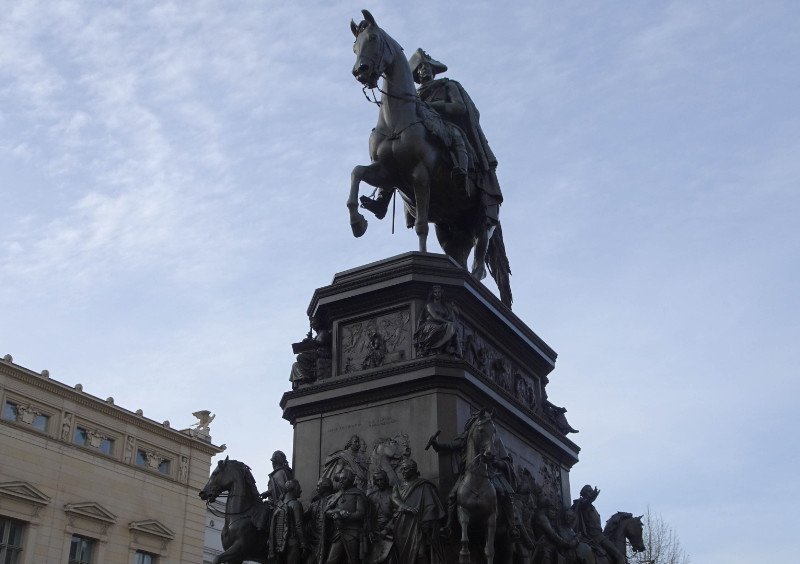
The statue can be seen today on the grand boulevard ‘Unter den Linden’, opposite Humboldt University.
Its unveiling was a celebration for the military, from which the general public was, as a precaution, excluded. The memory of the barricade fighting during the Revolution of 1848 was still too fresh. Instead, 80 veterans of Frederick II’s wars who were still alive had been tracked down. They were now invited as guests of honour. The future Wilhelm I made his grand entrance as he marched in at the head of more than 30,000 soldiers. He strode forward – as a contemporary source wrote – “tall and stately like the god of war himself”.
The citizens of Berlin, who had not been welcome at the unveiling, came later and marvelled. The monument sparked a Frederick boom that continues unabated to this day. Despite all his wars of aggression, we regard Frederick as the perfect philosopher on the throne. This stems from the image of him established in the second half of the 19th century. Theatres staged plays about Frederick; bookshops did a roaring trade in old and new works by him and about him; Adolph Menzel painted his iconic pictures of his court; and even military marches sold twice as well if people believed that Frederick II had composed them.
The fact that ‘Old Fritz’ is still so popular today and has become ‘the’ Prussian king par excellence can be traced back to this era.
Wilhelm’s Self-Perception – The Guardian Angel in the Face of Revolution
But how – and this question remains open – did Wilhelm I see himself? How did he wish to be remembered by his contemporaries and future generations? This is illustrated by two medals dating from completely different phases of Wilhelm’s life. The first was created in 1849 and offers us a very unusual perspective on the events of 1848–49.
We have come to a social consensus that the March Revolution was the spark that ignited German democracy. It is a pity that it failed. The blame, of course, lay with the reactionary forces that conspired to prevent the well-meaning democrats from introducing a modern system of government.
Many contemporaries would have been surprised by our interpretation. At that time, democracy was still considered radical. Well, everyone at least agreed that something had to be done, that the worst social injustices of industrialisation should be mitigated in some way.
But how? That was the subject of dispute between the Radicals, the Liberals and the Conservatives – the contemporary terminology for democrats, supporters of a constitutional monarchy and supporters of the ruling system. Whilst the Democrats sought to overturn the existing order, the Liberals wanted to modernise the state and the Conservatives to preserve it.
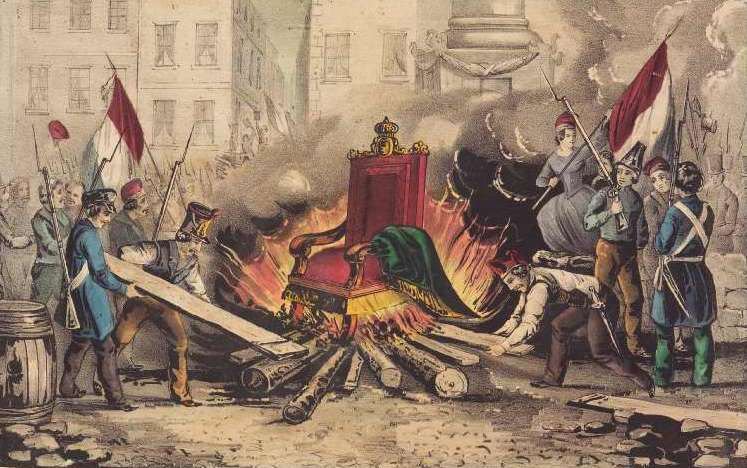
When revolutions broke out across Europe following the February Revolution in Paris in 1848, the people of Berlin also attempted an uprising. Radicals fought on the barricades and, with their enthusiasm, swept many of the undecided along with them. In the short term, they gained the upper hand. King Frederick William IV felt compelled to accede to the rebels’ demands in order to prevent the bloodshed that military intervention would have caused. But soon the liberal and conservative citizens had had enough of the riots, in which not only people but also their property had been damaged. They rallied behind the state authorities and sought a political solution. Although Wilhelm I had to flee to London under cover of darkness at the height of the March Revolution, he returned as early as June of the same (!) year as the Conservatives’ hope.
And this brings us to Wilhelm’s role in the suppression of the Baden uprising in 1849. To clarify the facts beyond what is found in our school textbooks: on 14 May 1849, Grand Duke Leopold of Baden fled across the border to neighbouring Koblenz to escape the insurgents. From there, in accordance with the statutes of the German Confederation, he asked the other states for military support in suppressing the revolution. At that point, the Paulskirche was in disarray. The major German states had withdrawn their delegates’ mandates. Most liberal and conservative delegates subsequently left the assembly, whilst the radical forces, with the so-called ‘rump parliament’, moved to Stuttgart on 31 May 1849.
In this situation, the German Confederation decided to dispatch a joint army to support Leopold of Baden. The Prussians provided the bulk of the troops. Wilhelm I was appointed by his brother Friedrich Wilhelm IV as commander of the Prussian operational army in Baden and the Palatinate. On 20 June 1849, the Prussian soldiers crossed the Rhine. On 21 June, they defeated the Baden revolutionary army at Waghäusel. The subsequent purge was carried out in a very short space of time. The 27 insurgents who were executed are still revered in Baden today as martyrs of democracy.
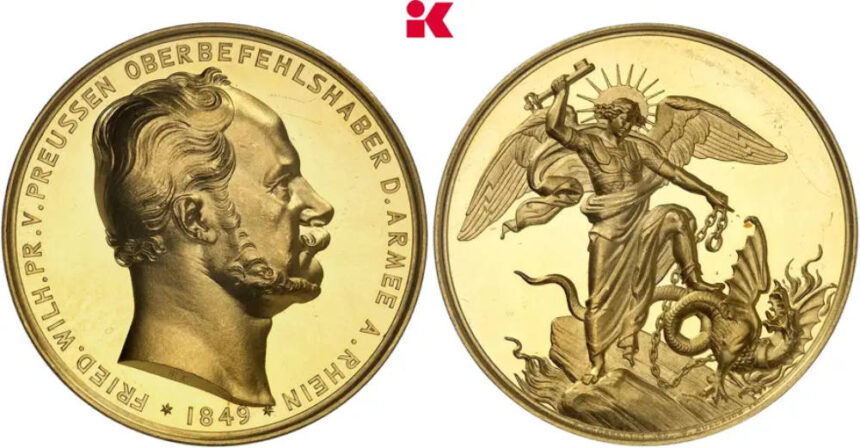
The conservative forces saw things differently. On 14 June 1849, Frederick William IV wrote to his brother: “We are, after all, dealing with devils. That is why your mission can be called an angelic one.” This is precisely what this medal captures. It identifies Wilhelm with the Archangel Michael, who protects Paradise from evil. Michael, patron saint of all soldiers, appears before us as a powerful, winged figure, brandishing the key to the gates of Paradise in his left hand, whilst holding a long chain in his right, with which the forces of evil – depicted as a dragon – are bound.
This identification with Michael was taken even further. For a monument in Karlsruhe, erected by the Prussian Field Army in honour of their fallen comrades, Frederick William IV donated an image of the Archangel. This image then also adorned the Michael Monument, which Frederick William had erected in Potsdam in 1853 as a gift for his brother.
Wilhelm and many of his contemporaries would have found today’s enthusiasm for democratic revolutionaries just as baffling as today’s artists and writers find the conservative forces of the second half of the 19th century. They often refer to them collectively as ‘the reaction’ and are keen to portray their representatives as dehumanised militarists.
Wilhelm’s Self-Perception – The First Soldier of His State
In Germany, following the defeat in the Second World War and during the long period of peace that followed, many people forgot that a strong military offers more options for action. Wilhelm I was always aware of this, thanks to his childhood experiences. With these thoughts in mind, let us take a look at another medal that shows us how Wilhelm I wished to be perceived. It is ‘the’ central numismatic icon of German history: the gold medal that Wilhelm I presented to the 45 commanding generals on the occasion of the grand victory celebration in Berlin on 16 June 1871.
Its design alone is remarkable: on the obverse we see the names of the 24 honourees. They are listed in the ceremonial order in which they rode into the victory parade. Wilhelm I, having only just been crowned German Emperor, is represented simply by his portrait. Without a laurel wreath. Without a title. Without a commemorative inscription. A prime example of imperial restraint. We know how averse Wilhelm I was to the cult of his personality. Perhaps one reason why Bismarck succeeded in attributing all the credit for the unification of Germany to himself.
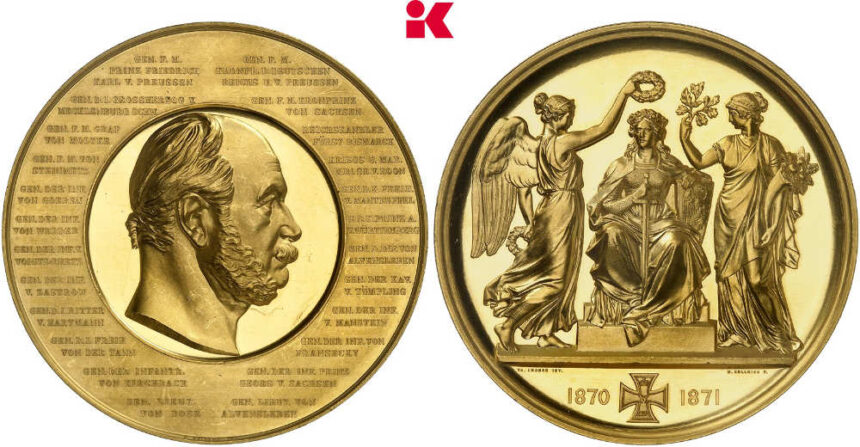
We also search in vain for Wilhelm I on the reverse. Instead, it shows Germania seated, having settled down peacefully once more following her victory over France. We should not forget that it was France that declared war on Prussia on 19 July 1870 – Ems Dispatch or not. This is also reflected in her image. She sits there in chain mail, shield and spear in hand, ready at any moment to repel an attack. Victoria crowns her with a wreath of laurel; to the right stands an ambiguous figure – Pax? Fortuna? – with a cornucopia and an oak branch, a motif often used to symbolise the bourgeoisie. In the section, we see a cross whose shape refers to one of the most famous Prussian orders, the Iron Cross.
By featuring this Iron Cross, the medal links the victory of 1871 with the Wars of Liberation against Napoleonic France, during which this decoration was created. It reminded the 74-year-old of his experiences as a young boy on that long-ago night in 1806.
With the victory over France, Wilhelm had overcome his trauma. German unity made his empire so strong that it no longer needed to fear France.
That this very victory would cause the French to develop a trauma of their own, one that would have terrible consequences for the German Empire after the First World War, was something Wilhelm I certainly could not have imagined at the time.
Update from July 1, 2026:
On June 23, 2026, Künker Auction 442 took place amid great interest from the collecting community, during which the Imperial Collection was sold. Finally, the auction hall was full once again, so much so that additional chairs had to be brought in for more bidders. A large proportion of interested parties participated by phone or online. Overall, interest was so high that the auction of the 337 lots lasted from 2:00 p.m. to 9:00 p.m.! The total proceeds quadrupled! They climbed from a total estimate of one million to an impressive 4 million euros.
We analyze the results in detail in a separate article and place the prices currently being achieved for German medals in an international context.
Here are the results for the medals mentioned in this article:
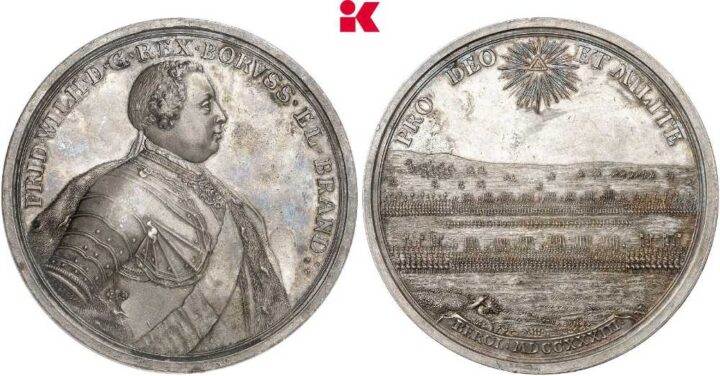
Frederick William I, known as the Soldier King. Silver medal by P. P. Werner, dated 1733. Very rare. From the stock of the Hohenzollern Museum, from the estate of Emperor Wilhelm I. Extremely fine condition. Estimate: 7,500 euros. From Künker Auction 442 (June 23, 2026), Lot 32.
Starting price: 6,000 euros. Hammer price: 50,000 euros
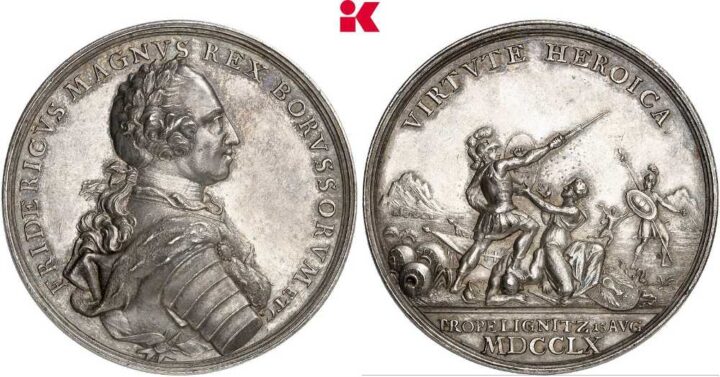
Frederick II, known as “the Great.” Silver medal by J. G. Holtzhey, commemorating the victory at the Battle of Liegnitz on August 15, 1760. Very rare. From the stock of the Hohenzollern Museum, from the estate of Emperor Wilhelm I. Extremely fine condition. Estimate: 2,500 euros. From Künker Auction 442 (June 23, 2026), Lot 53.
Starting price: 2,000 euros. Hammer price: 4,400 euros
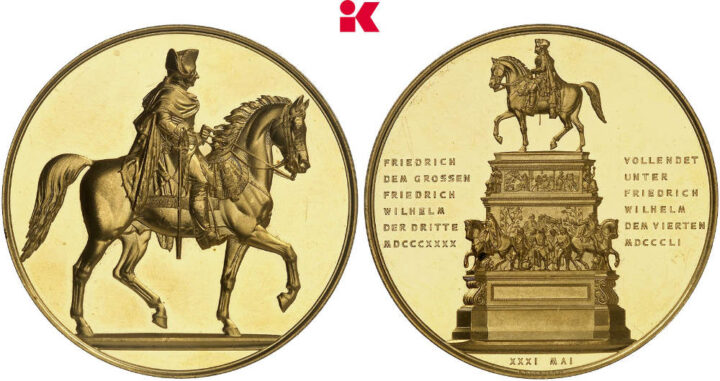
50-ducat gold medal commemorating the unveiling of the statue of Frederick II on May 31, 1851, by F. W. Kullrich. From the stock of the Hohenzollern Museum, from the estate of Emperor Wilhelm I. Almost in mint state (uncirculated). NGC MS63 PL. Estimate: 25,000 euros. From Künker Auction 442 (June 23, 2026), Lot 166.
Starting price: 20,000 euros. Hammer price: 70,000 euros
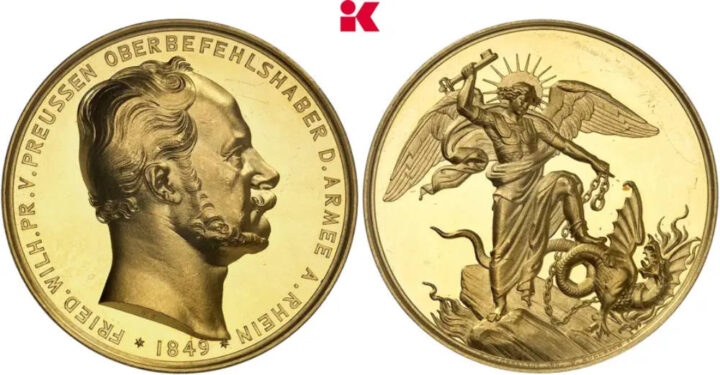
25-ducat gold medal by F. W. Kullrich commemorating the suppression of the Baden Revolution by Crown Prince Friedrich Wilhelm, later Wilhelm I, in the year 1849.
From the Hohenzollern Museum stock, from the estate of Emperor Wilhelm I. NGC MS64 DPL. Almost in mint state (uncirculated). Estimate: 12,500 euros. From Künker auction 442 (June 23, 2026), Lot 158.
Starting price: 10,000 euros. Hammer price: 30,000 euros
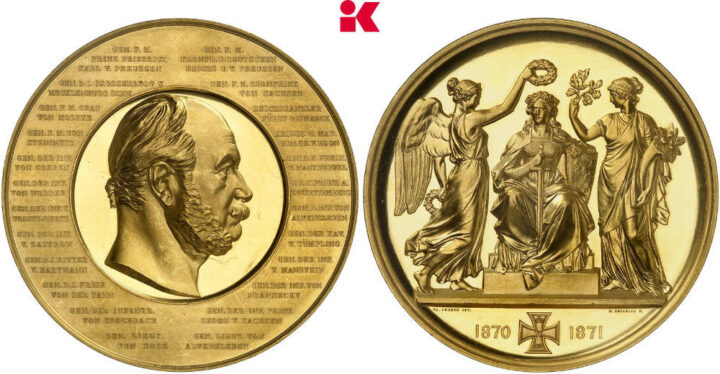
Gold General’s Medal worth 120 ducats by E. Weigand and F. W. Kullrich, distributed on the occasion of the Berlin Victory Parade on June 16, 1817. Only 25 specimens minted. From the stock of the Hohenzollern Museum, from the estate of Emperor Wilhelm I. Almost in mint state (uncirculated). Estimate: 75,000 euros. From Künker Auction 442 (June 23, 2026), Lot 191.
Starting price: 60,000 euros. Hammer price: 160,000 euros
Text and images: Ursula Kampmann