Building Russia's First Modern Mint.
The piece we are presenting today is not just another coin. Gadoury, where this object will be auctioned on October 17, 2026, refers to it as an “essay”. But it is more than that. It is a pattern, a sample, a prototype, intended to demonstrate to Russian mint technicians the minting quality achievable with the new machines from Birmingham. At the time this essay was created, Russia’s first modern mint was being built in the Peter and Paul Fortress. Thus, this piece plunges us into the heart of an adventure that could provide enough material for a novel of many hundreds of pages. It tells the story of an inventor, four mint technicians, and a born diplomat who together revolutionized Russian coinage.
What can be seen on the Soho Mint’s essay for the St. Petersburg Mint?
The front of the essay shows the bust of Alexander I of Russia. His hair is long, styled in a fashionable braid of the time. He is dressed in armor, over which falls a general’s cloak, fastened at his left shoulder with a clasp. The Latin (not Russian!) inscription reads ALEXANDER I D[eo] G[ratia] IMP[erator] AVTOCR[rator] RVSSOR[um], which translates as: Alexander I, by the Grace of God, Emperor and Ruler of all Russians.
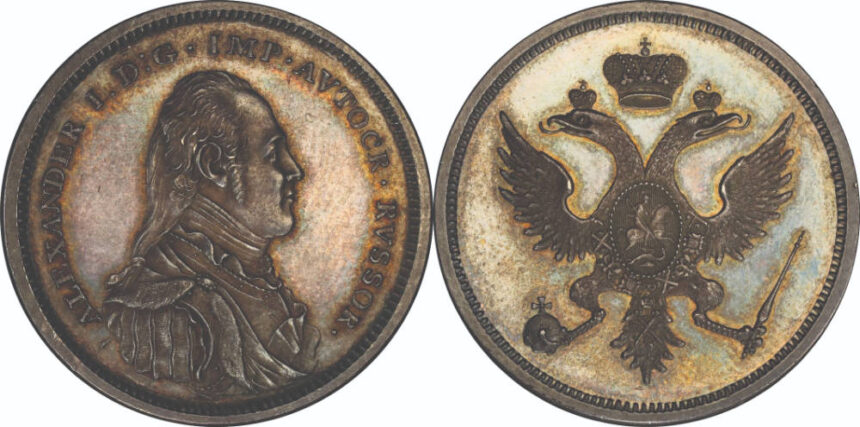
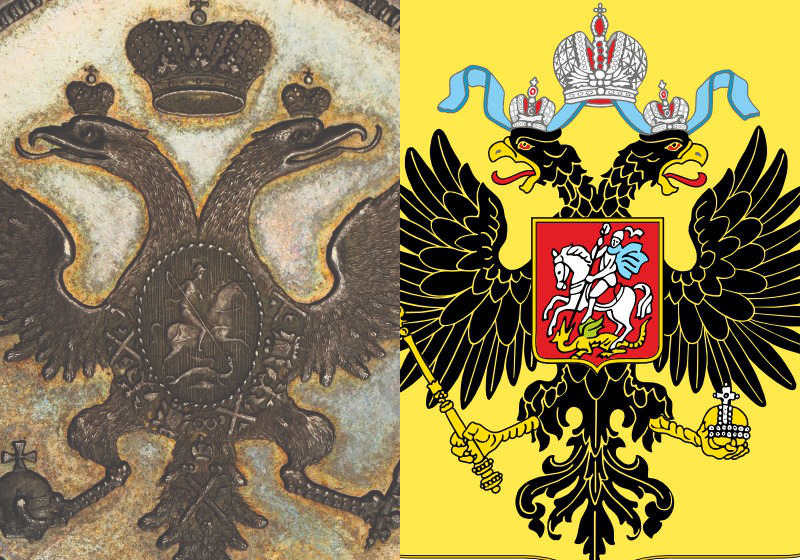
The reverse of the essay depicts the central element of the coat of arms of the Russian Empire, which also appears on many Russian rubles, albeit mirror-inverted and with slightly different details. The central motif is the triple-crowned double-headed eagle with orb and scepter. The escutcheon incorporates the Moscow coat of arms with St. George slaying the dragon. While the Order of St. Andrew the First-Called is reduced to a blue ribbon in the state coat of arms, on the essay it is clearly visible – easy to recognize due to the St. Andrew’s crosses – wrapped around the escutcheon. This was the common way it was represented on many 19th-century Western and Central European coins.
What’s missing are the mint mark and year of issue. However, we have written sources that tell us this essay was minted in 1804 at the Soho Mint.
Who or what is the Soho Mint?
The Soho Mint was founded in Birmingham in 1788 and is the result of a collaboration between entrepreneur and inventor Matthew Boulton and James Watt, the inventor of the steam engine. In the last quarter of the 18th century, Boulton & Watt sold hundreds of steam engines. Around 1790, Boulton secured a patent for steam-powered minting presses, thus developing the core component of the modern mint. The Soho Mint marks the beginning of machine-based coin production.
What does the Soho Mint have to do with Russia?
When Catherine, who so loved to be called the Great, considered modernizing her completely outdated mint in St. Petersburg, she instructed her Consul General in London to write to Boulton. The letter survives: “As the Empress of Russia is very desireous to make some necessary Improvements in Her Imperial Mint at St. Petersburg – by procuring some masterly hands, to engrave Dies for Gold, Silver & Copper Coins & to purchase the whole apparatus & machinery, that is necessary for Striking them. And as all the World knows that no person is better qualifyed to execute such a Commission Then Mr. Boulton – May I request the favor of you Sir! to inform me in return whether you chuse to make any proposal respecting the whole of this business?”
Boulton intended to do this. His cost estimate survived. He calculated an immense 6,520 pounds for eight minting presses, eight cutting out presses, three edge marking machines, a steam engine, and other smaller pieces of equipment such as a mint needed. Just to put this sum into perspective: in the same year, the construction of one of the most innovative warships of the time, HMS Triton, including her 32 canons, cost 20,722 pounds sterling. Dozens of specialists had built the 43-meter-long frigate with its 11-meter-high mainmast. What were a few minting presses in comparison, however well-constructed they may have been? The entire workforce of the Soho Mint at that time consisted of 164 people, many of whom were working on other projects.
Despite the high price, Boulton received the commission on October 10, 1796. However, his client died on November 17, 1796. Boulton learned on February 7, 1797, that the new Tsar had cancelled the order.
Obstacles upon obstacles in the construction of the Russian mint
Paul I commissioned a local engineer to build a modern mint. It was a fiasco! Less than five months later, Boulton learned that he would now be delivering his mint after all – along with a rolling mill and an additional steam engine. Boulton designed, his men built, and the first shipment left the port of Hull on May 9, 1800 – despite a militant strike and the anxiety surrounding the missing export license. A second shipment followed on September 6, 1800. It likely reached Russia shortly before the assassination of Paul I. So, renewed anxiety and doubt arose as to whether the next Tsar would cancel the order for the mint. Then, a sigh of relief: Tsar Alexander I confirmed that he wished to receive the ordered mint.
An adventurous journey
To assemble and set up the machines, Boulton sent four of his best craftsmen to St. Petersburg. The conditions seemed lucrative. James Duncan, for example, the head of the small team, received 3 guineas per week. For this, he worked 12 hours a day, 6 days a week (including breaks for meals). In case of illness, his wages continued to be paid. Overtime was paid extra.
Problems without end
The crossing from Scotland to Russia was already an adventure. It turned into a nightmare because the craftsmen couldn’t stand each other. When they arrived in St. Petersburg, they discovered to their dismay that they wouldn’t be able to assemble the mint immediately. The building designated for it was far too small to house all the modern machinery, including the steam engine.
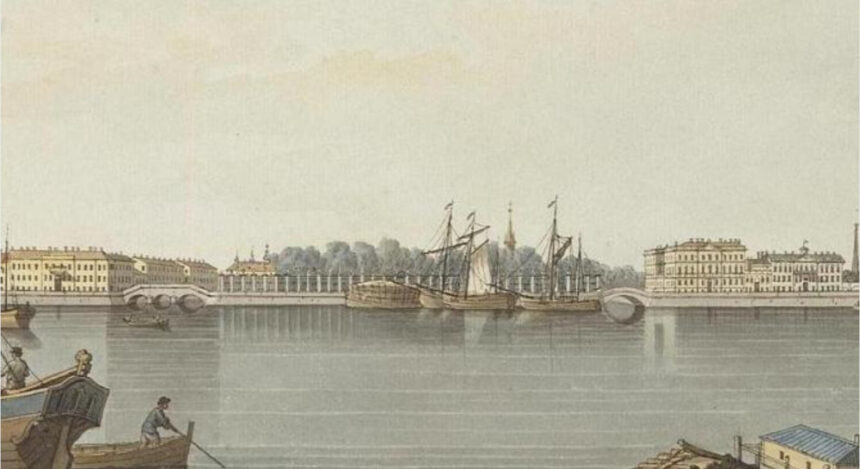
The Tsar approved the new building, and the craftsmen had no choice but to twiddle their thumbs and squabble until its completion. On top of that, there were practical problems: the craftsmen’s wages, paid on-site by the Russian crown, had been agreed upon in British currency, and the Russian officials intended to profit handsomely from the exchange rate. The quarters were unfurnished, so beds and wardrobes had to be purchased. In general, the cost of living in St. Petersburg was much higher than expected! And then there were the Russian and French spies trying to copy Mr. Boulton’s steam-powered stamping press designs. The machines had to be guarded constantly. In short, it was a nightmare!
5 years in Russia
To save the project, Boulton sent his nephew, Zacchaeus Walker, to Russia. Walker wasn’t an engineer, but a gifted diplomat who kept everything running smoothly and patiently pushed the project forward. Boulton was in the process of selling two more mints, one to Copenhagen and one to London, and therefore needed his craftsmen. They shouldn’t be stuck in Russia, but rather working on new projects. Our essay belongs in this context.
A package containing stamps and essays
Boulton considered how he could pragmatically impart to Russian craftsmen and engineers the knowledge they needed to operate his machines. To this end, he had dies made in Russia that demonstrated all stages of die production. These were supplemented by strikings – including probably our essay – with which Boulton demonstrated the minting quality achievable with the new machines. The package of “teaching materials” was sent in the autumn of 1804.
The last few years
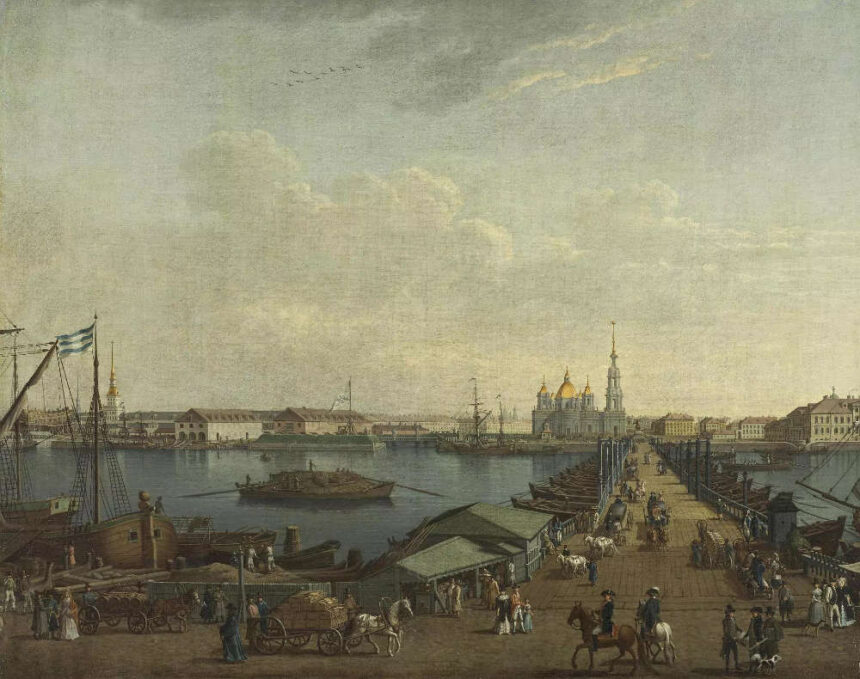
Unfortunately, at that time the building wasn’t even finished, let alone the machinery installed. It wasn’t until the beginning of 1806 that the project began to near completion. In mid-1806, the new machines were adjusted, without much public attention, perhaps using the dies supplied by Boulton in 1804. At the ceremonial inauguration on June 20, 1807, rubles were produced using dies that – according to Walker’s records – had been cut by the Russian engraver Carl Leberecht.
Initially, only two minting presses were in operation, producing 67 to 70 rubles per hour. By August 9, 1807, all presses were running. The mint was fully operational. Now, Walker, acting on Boulton’s behalf, was finally to collect the full purchase price. Until then, the Soho Mint had paid everything upfront, with the exception of the wages for the four craftsmen.
The payment
Zacchaeus Walker spoke with the Minister of Finance. The minister assured him that he would present the payment order to the Tsar at his next audience. Then he died – this time not the Tsar, but the Minister of Finance. Walker left us with a poignant letter expressing his feelings: “I began to revive again, enlivened by a ray of hope that the business would at last terminate to the satisfaction of all parties … when, on the 15th the golden dream vanished by intelligence that the Minister died very suddenly on the preceding night. – On reviewing the principal occurrences of my life, insignificant as it has been, I can scarcely avoid yielding up my reason & common-sense to the false & pernicious doctrine of an evil Genius or unfortunate fatality, hovering over all the actions which some men are either directly or indirectly concerned with, & that I belong to the ominous Class of whom it may be truly said “Lo! whatsoever those men do it shall not prosper” – The Count’s Papers are all sealed up & no new Minister yet appointed, every thing material to the Mint Department may therefore be considered as at a stand until a nomination takes place.”
So the payment was delayed once again. It was not made until December 1807.
James Duncan is staying in St. Petersburg
What you have read here is the short version of the story. I have omitted not only many setbacks and arguments, but also a love story. For the confirmed bachelor Walker returned to Birmingham with his wife. (The perilous journey home, threatened by the forces of nature and Napoleon’s army, would be worthy of an article of its own!)
It only remains to add that James Duncan decided to stay on as technical director of the St. Petersburg mint with his entire family. In 1814, he proudly wrote to his former boss’s son that “his” mint was now producing more than 10 million silver rubles a year, in addition to silver 5, 10, and 20 kopek pieces with a face value of another million rubles.
What is this Russian essay worth?
Honestly? I have no idea. Gadoury estimates this piece at €10,000 . But that’s likely just a symbolic starting price. After all, this essay is considerably rarer than any family ruble.
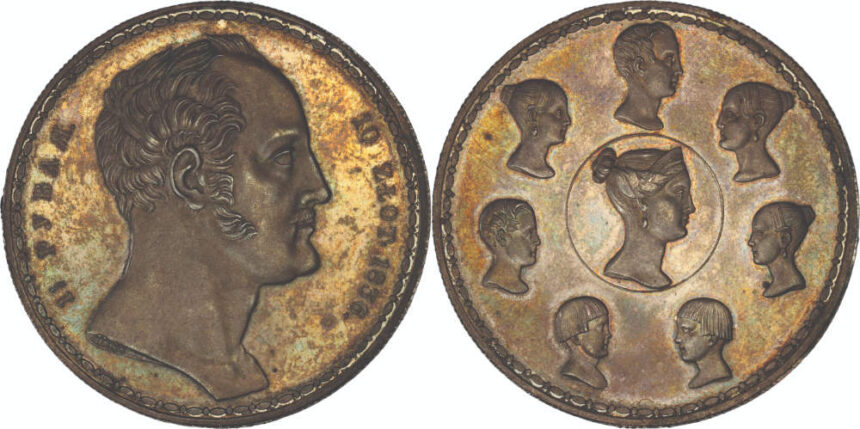
Gadoury is offering a specimen from the second issue – the die in which the Tsarina’s unsightly double chin was erased on the Tsar’s personal orders – with a starting price of €100,000. It will fetch more than that, as every collector worldwide knows the family ruble and its history. Hardly anyone, however, is aware of the essays with which Boulton supplied Russia’s first modern mint. These pieces are simply too rare!
CoinsWeekly will definitely publish an update on the price as soon as this essay has been sold.
Literature:
Richard Doty, The Soho Mint & the Industrialization of Money. Washington – Cambridge (1998)
Text and images: Ursula Kampmann