What is a Kontorniat?
Numismatists define a ‘kontorniat’ as an object that resembles a bronze coin but has no monetary value. It is slightly larger than a standard sesterce and has a hammered or crimped rim, which is consequently significantly raised. This is what gave the object its (modern) name. The word ‘kontorniat’ comes from the Italian ‘contorno’. Italians use this term not only to refer to a side dish served with meat and fish, but also to the outline of a geometric shape – in other words, the rim.
Kontorniats originated in late Christian antiquity, but do not feature the coin designs of that period; instead, they refer to a glorified past.
What was the purpose of the Kontorniaten?
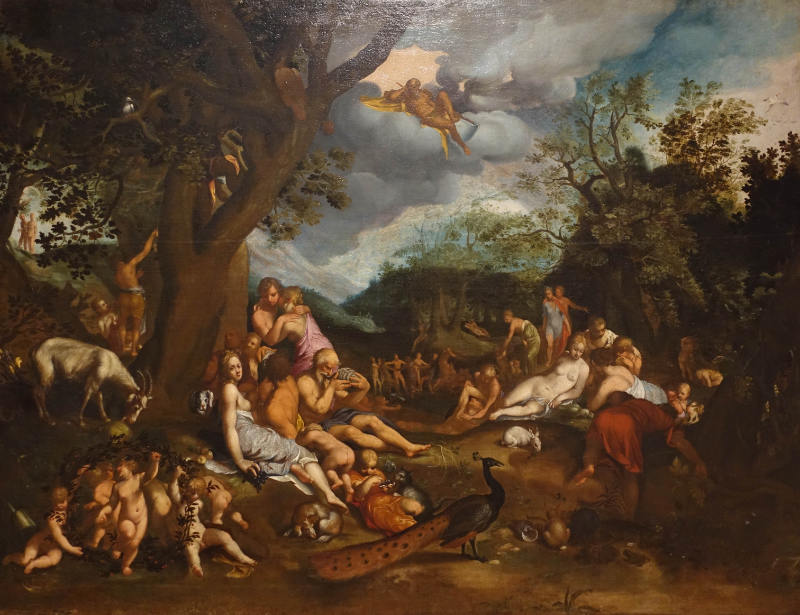
The Kontorniaten are associated with literary sources from the 1st century AD. Ovid, for instance, describes the custom of giving each other old, Republican coins at the start of the year. Suetonius confirms this tradition by writing that Augustus enjoyed giving away old coins during the Saturnalia.
The Saturnalia and the start of the new year were closely linked in time. The Saturnalia were originally celebrated on 17 December; later, the festivities were extended to the period from 17 to 23 December, and subsequently to 30 December. Thus, in late antiquity, the Saturnalia led directly into the start of the Roman year, which had begun on 1 January since 153 BC.
The Saturnalia are named after the god Saturn, who was regarded as the ruler of the Golden Age. The Romans used this term to describe a kind of paradisiacal state in which humanity lived together at the dawn of time, free from suffering and worry, social distinctions and war. They were the occasion for an exuberant festival during which much drinking took place, social distinctions seemed to be set aside, people attended chariot races and gladiatorial games, and exchanged gifts.
We can trace the custom of using old coins for this purpose back to the reign of Gratian (367–383) through written sources. Ausonius reports that Macedonian gold coins were used as New Year’s gifts at Gratian’s court.
Incidentally, the timing of this exchange of gifts persisted well into the modern era. It was not until the 19th century that Christmas replaced the New Year as the festival of gift-giving.
Proto-contorniates or the origin of the contorniates
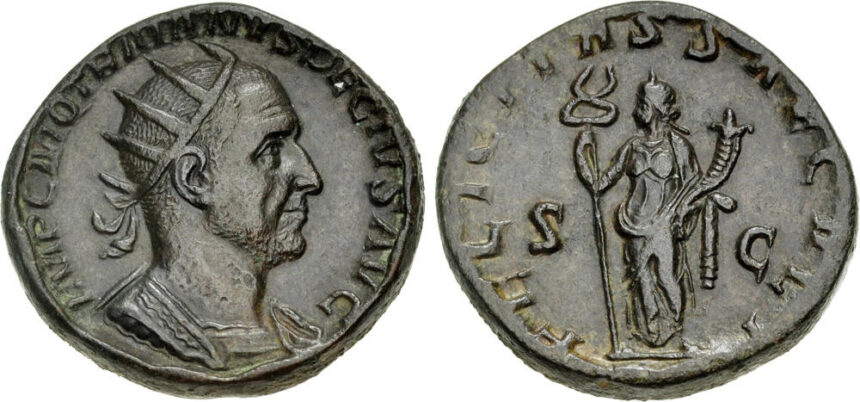
Numismatists seek to link the so-called proto-contorniates to this custom, which has been handed down through literary sources. This term refers to regular bronze coins from the Roman Imperial period whose edges, like those of the contorniates, were hammered out at a later date in order to remove the coins from circulation. The Romans had certain preferences regarding which rulers’ coins they used for the production of contourniates: they most frequently chose sesterces of Nero (14 per cent), Hadrian (9 per cent), Caracalla and Antoninus Pius (7 per cent) as well as – as in our case – double sesterces of Traianus Decius (6 per cent). These rulers have nothing in common in terms of their reigns, leading to the suggestion that it was the shape of their coins that made them particularly suitable for this purpose from a technical standpoint.
When and where did the Kontorniats originate?
We have no evidence as to when the first proto-contorniates appeared. They are merely taken as an indication that the custom of giving away coins with hammered rims was already established by the time the first ‘genuine’ contorniates were produced. These were minted in Rome from around the middle of the 4th century until the second third of the 5th century AD.
Private or state-run?
We do not know who produced the kontorniates. There are only a number of more or less well-founded conjectures on this matter. Private production, as was the case with the spintriae, is a possibility. However, state-run production by the Roman mint is also a possibility. In recent years, there has also been discussion as to whether these possibilities necessarily exclude one another. Peter Franz Mittag posits that some of the kontorniats were produced by private entrepreneurs, whilst the Roman mint produced a group of kontorniats, linked by their motifs, on behalf of the emperor. They played a role in the ritualised demonstration of imperial generosity.
For whom were the Kontorniates produced?
This brings us straight to the next question: for which target audience were the Kontorniates made? The idea that they might have been gaming tokens, tesserae or admission tickets – as is occasionally suggested in very old publications – is now considered outdated. The interpretation that they were gifts is generally accepted. This leaves open the question of what messages the pieces conveyed.
Andreas Alföldi, who compiled an extensive catalogue of the stamps found on the Kontorniates, viewed them as a propaganda tool of a pagan senatorial class. This view has since been put into perspective. Chariot races, gladiators, musicians and the classical heritage of ancient literature also played a decisive role in Rome as it gradually became Christianised. At most, one might associate the motifs with a nostalgia for the ‘good old days’ and link them to the Golden Age. However, we must not forget the magical connotations either. The protagonists of the chariot races, in particular, were known for frequently using curses and spells to ensure their victory. We know from the sources of several trials in which charioteers were accused of casting harmful spells. However, most of the motifs could also quite simply be explained by what the Romans were interested in during late antiquity, or rather, how they passed the time during the festival at which these pieces were given as gifts.
The motifs
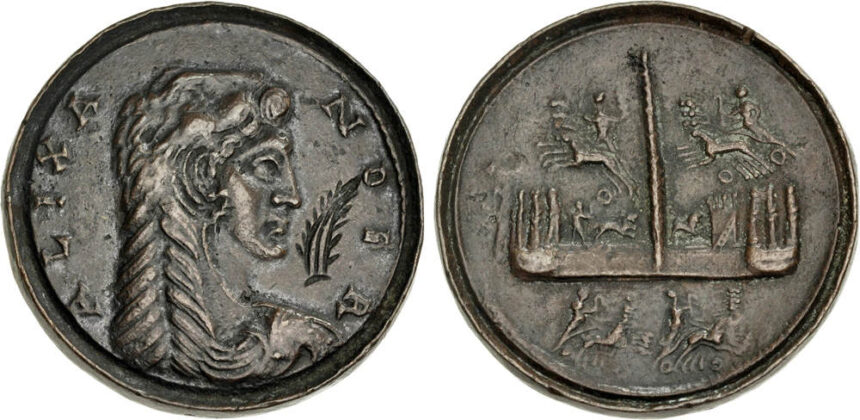
Among the most common motifs found on the Kontorniates are Alexander the Great and his mother, Olympias. Perhaps this is linked to the fascination that this Greek hero held for the people of late antiquity. To them, he was not only a historical figure, but also the protagonist of tales of miracles and fairy tales, which found their literary expression in the Romance of Alexander. This book is one of the most popular works of the Middle Ages and is said to have been – after the Bible – the most widely circulated manuscript of its time.
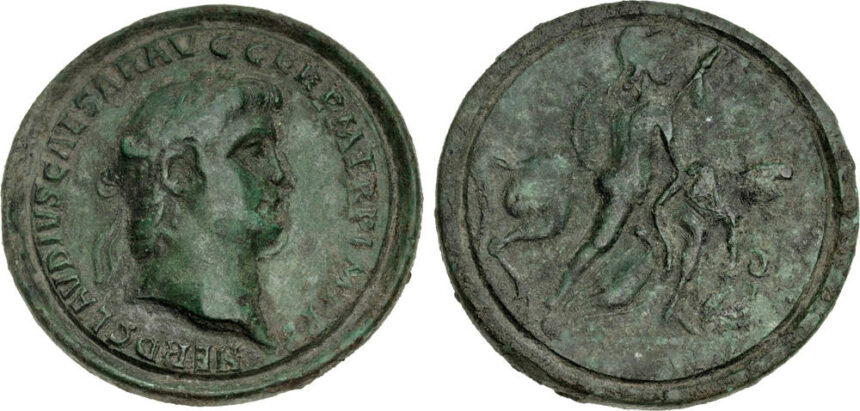
Whilst for many centuries we regarded Nero as one of the ‘bad’ emperors, thanks to Suetonius, Tacitus and, not least, Peter Ustinov, his reputation amongst the Roman people was considerably better, due to his generosity and closeness to the people, as historians have recently discovered. Nevertheless, we do not know whether the decision to feature his head so frequently on kontorniats was a deliberate one. The private entrepreneurs who began producing contorniates may also have drawn inspiration from the most widely circulated proto-contorniates.
It is certainly no coincidence that the motifs frequently allude to popular myths and plays. We know the story of Achilles and Penthesilea, for example, from a successful epic written by Quintus of Smyrna in the 3rd century AD. His *Posthomerica* describe, amongst other things, the death of Penthesilea, who is killed by Achilles in battle. As she slips from her horse, the hero removes her helmet. Aphrodite ensures that Achilles falls in love with the woman and regrets having killed her. Now he weeps because he cannot take her home as his wife.
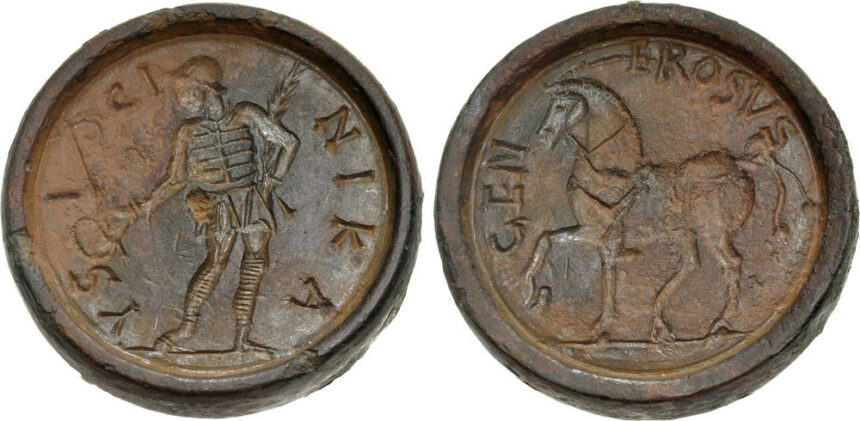
We know neither the charioteer Eusiches nor the horse Generosus from literary or epigraphic sources, but we may assume that their names were just as familiar to their contemporaries as the names of popular footballers are to us. We have already pointed out the magical connotations of these depictions. However, they could also be explained by the fact that a particularly large number of chariot races took place around the turn of the year. Anyone who wished to could watch them at the Circus Maximus on 25 December, 7 January and 13 January.
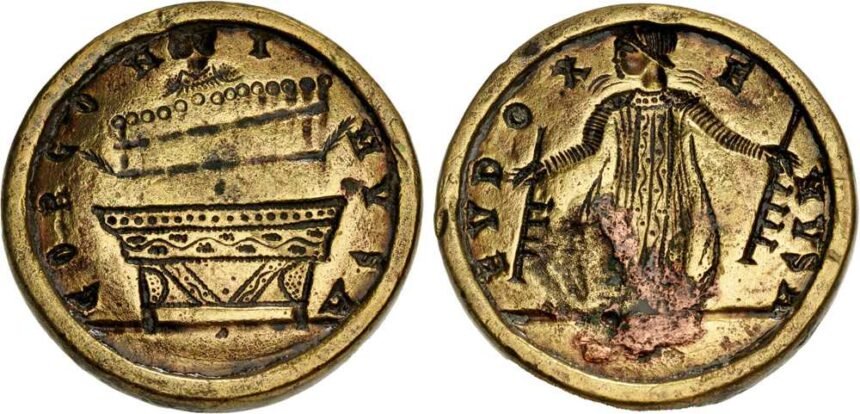
Musical performances in Rome took place primarily as part of the gladiatorial games. The fame of great artists such as Gorgonius or Eudoxius has not survived to the present day. They are likely to have fulfilled a similar role at the gladiatorial games to that of Shakira, Madonna, Justin Bieber and the like at the 2026 World Cup final. Incidentally, December was the time of year when the ‘Munera’ – as the Romans called what we refer to as ‘games’ – were particularly frequent. They were held on 19, 20, 21, 23 and 24 December as part of the Saturnalia.
What are Kontorniats worth today?
Kontorniats are significantly undervalued in relation to their rarity. This is primarily because they do not fit into any category on the Sheldon scale. They therefore play no role in the investment sector. In this article, we present some results from an auction held by the Classical Numismatic Group in July 2026, at which an impressive collection of Kontorniats from the estate of W. Toliver Besson was sold. The hammer prices range from 225 to 7,500 British pounds, i.e. from 262 euros or 303 US dollars up to 8,753 euros or 10,117 US dollars. Prices for individual examples can be found in the captions. All results from this series are included in the Sixbid archive of completed auctions.
Text and Images: Ursula Kampmann