What is a Novodel? What is a Novodel?
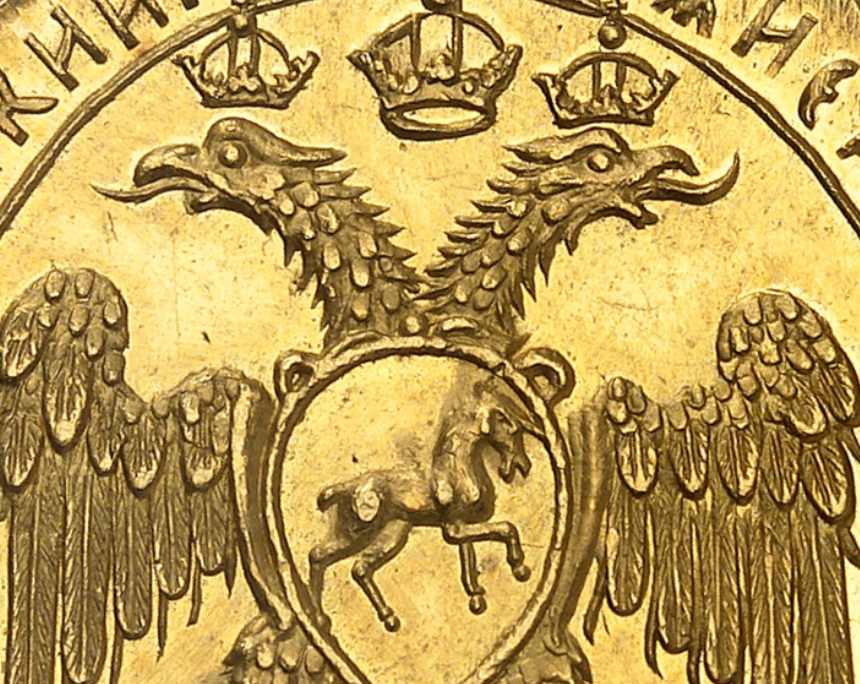
To be quite clear: A novodel has nothing to do with the cheap, inexpencive restrikes that were commonly produced in the 1970s. Novodels are something entirely different. They were minted in the 19th century at an official Russian mint using (mostly) original dies and have been popular, high-value collector’s items since the time of their creation. Today, the value of rare Novodels can easily reach the five- and six-figure range.
What is a Novodel?
We don’t have to come up with a new definition here. Fortunately, Russian numismatists have already done that for us. For example, A. K. Markov, former curator of the Hermitage, defined a Novodel as a coin “minted for collectors using the old dies that served to produce coins in past centuries.” A later curator took a more critical view: I. G. Spassky considered novodels to be “shadow images born of a passion for collecting.” However, he fails to mention that there are Russian coins so rare that a collector has no opportunity whatsoever to acquire a contemporary piece. Indeed, in some cases, we only know of a rare coin type because a novodel was produced of it.
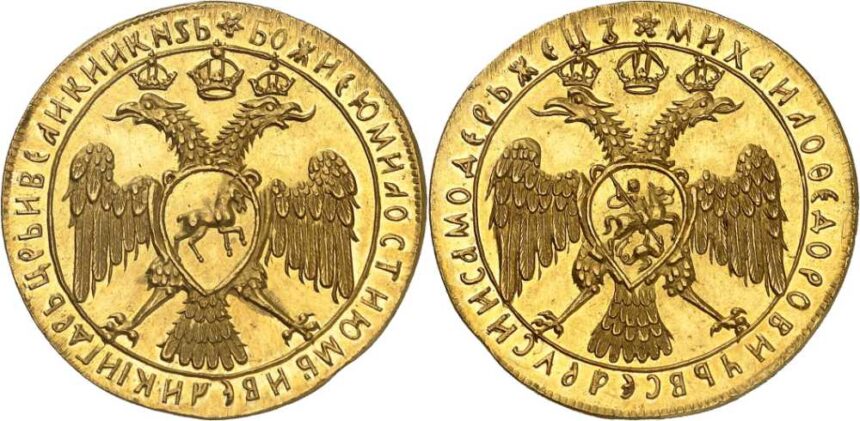
A good example of this is the novodel currently being offered in Auction 92 by Heidelberger Münzhandlung. It was struck using the dies from the undated 4-dukat coin of Michael Feodorovich (1613–1645). This extremely rare coin type is practically only available on the market as a novodel. So anyone who wants a representative large gold coin from the first Romanov on the tsar’s throne must rely on a Novodel.
Let us therefore take from the two definitions that Novodels did not circulate as currency, but were struck from the original dies for collectors. They are therefore generally of impeccable grade.
How did the production of Novodels come about?
To understand why Novodels were minted in the first place, we must go back to the 18th century, when coin collecting was widespread among the rich and fine people, and veneration of Peter the Great was practically a national duty. Every coin collector wanted to have as many coins of this ruler as possible. But there weren’t enough of them. How could supply and demand be balanced?
Well, this problem did not exist with Peter’s medals. Their dies—just like those of the coins—were stored at the St. Petersburg Mint. Anyone who wanted a medal ordered it from the mint at cost, covering only the material and production expenses, and then proudly added it to their collection. This practice was common, and not just in the Russian Empire.
Numerous medals were minted and sold in private and state mints worldwide long after an event had passed. That is why it is nothing more than a pragmatic approach when medals are listed in catalogs today under the date of the event for which they were minted. This date says nothing at all about the time of their production. They may in fact have been produced much later—years, decades, or even centuries later. The Monnaie de Paris, for example, was still selling medals in the second half of the 20th century for which Napoleon had commissioned the dies for design. As long as a later struck piece is indistinguishable from earlier ones, the date of manufacture has no bearing on the value. However, in 1832, the Monnaie de Paris introduced a rim mark that reveals approximately when the restrike took place. A year mark has only appeared on Napoleonic medals since the 1950s and 1960s.
How did the production of Novodels come about?
To understand why Novodels were minted in the first place, we must go back to the 18th century, when coin collecting was widespread among the rich and fine people, and veneration of Peter the Great was practically a national duty. Every coin collector wanted to own as many coins of this ruler as possible. But there weren’t enough of them. How could supply and demand be balanced?
Well, this problem did not exist with Peter’s medals. Their dies—just like those of the coins—were stored at the St. Petersburg Mint. Anyone who wanted a medal ordered it from the mint at cost for materials and production, and then proudly added it to their collection. This practice was common, and not just in the Russian Empire.
Numerous medals were minted and sold in private and state mints worldwide long after an event had passed. That is why it is nothing more than a pragmatic approach when medals are listed in catalogs today under the date of the event for which they were minted. This date says nothing at all about the time of their production. They may in fact have been produced much later—years, decades, or even centuries later. The Monnaie de Paris, for example, was still selling medals in the second half of the 20th century for which Napoleon had commissioned the dies for their design. As long as a later striking is indistinguishable from earlier ones, the date of manufacture has no bearing on the value. However, in 1832, the Monnaie de Paris introduced a rim mark that reveals approximately when the restrike took place. A year mark has only appeared on Napoleonic medals since the 1950s and 1960s.
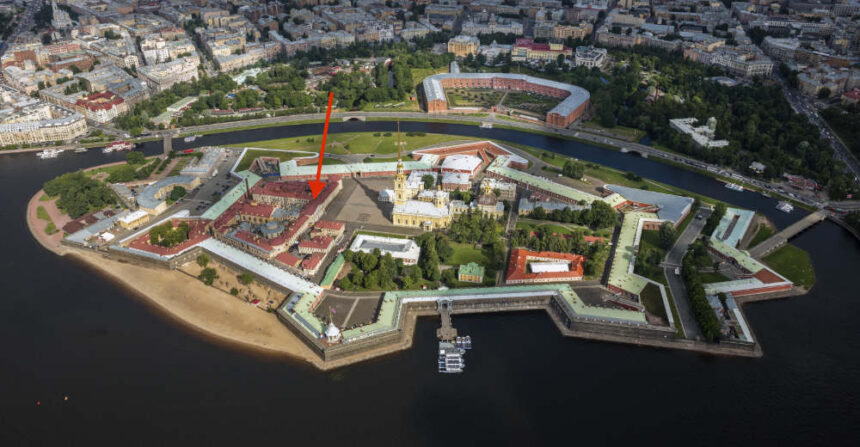
But let’s return to Russia, right in the middle of Catherine II’s reign. Imagine, for a moment, that you are the director of the St. Petersburg Mint. Collectors are flocking to your facility to buy medals of Peter the Great. You have this enormous collection of old dies in the basement—not just for medals, but for coins as well. You know you could make a fortune with them. The state is suffering from chronic financial distress anyway. What would you do? Exactly. In 1789, the first printed price list for ordering restrikes of old Russian coins appeared.
Why did the Novodel striking end?
It was an excellent business. Quite a few Russian coins were thus assembled as Novodels. But over the course of the 19th century, attitudes toward Novodels changed. Historicism brought an inflation of superb imitations. Talented craftsmen mass-produced furniture, weapons, vessels, textiles, and much more based on old models in the style their clients desired. The abundance of fakes heightened the need for a distinction between “genuine” and “fake,” which had not existed before. This was true in Russia as well.
For this reason, Tsar Nicholas I (1825–1855) had some of the old dies destroyed and restricted the practice of Novodel production. Alexander III banned them quite completely in the year 1890. His cousin, the coin-collecting Grand Duke Michael Nikolaevich, is said to have brought this problem to his attention. Did the production of Novodels continue occasionally even after the year 1890? Well, the sky is high and the Tsar is far away, as they say in Russia.
Novodels of a Different Kind
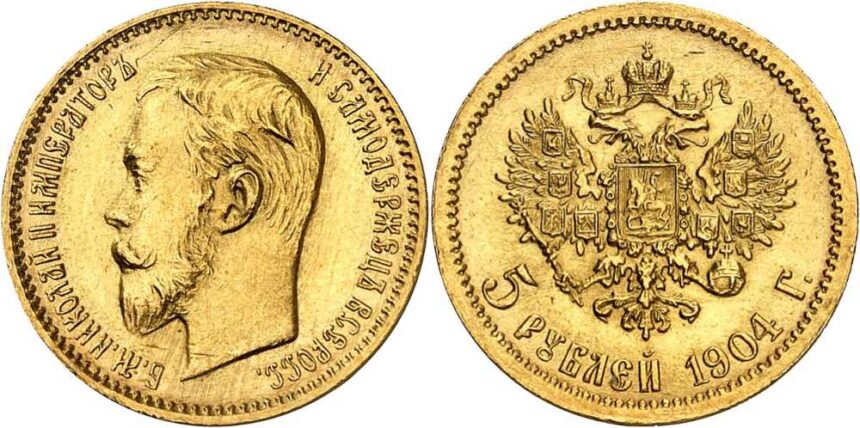
An interesting side note, which has nothing to do with the classic Novodels, is the restrike of gold coins of Tsar Nicholas II by the Soviet government in the years 1925 and 1926. Western governments refused to accept payments in gold coins bearing communist motifs. Therefore, the St. Petersburg—pardon me, the Leningrad—Mint produced gold coins featuring Nicholas II in denominations of 10 and 5 rubles. In doing so, it took great care to imitate the years in which the most coins had been minted anyway.
Please note that our image from the upcoming auction at the Heidelberg Coin Dealers does not show a Soviet restrike, but rather the tsarist original. The 5-ruble pieces from 1904 were far too rare to be issued as restrikes. We know this because in their 2014 article “Soviet Striking of ‘Tsarist’ Gold,” I. I. Rylov & A. I. Fedorin listed precisely which years and mint-marks were imitated.
Novodels on Diplomatic Missions
Here’s another fun fact: In Russia, it’s said that Khrushchev gave away his own Novodels at official events. He is said to have presented restrikes of rare Soviet circulation coins from the years 1931 to 1952, packaged in attractive boxes, as diplomatic gifts.
Classification of Novodels
Now you have to be careful, because of course it wasn’t just the “classic” Novodels—restrikes struck with original dies at the state mint—that were produced. Since it was a lucrative business, producers sometimes got a little too creative.
For this reason, I. G. Spassky divided the Novodels into six different classes:
1.) The classic Novodel produced using original dies at the state mint
2.) Pieces produced using new dies at the state mint; this occurred when the original die was lost or damaged.
3.) Impossible combinations, e.g., of date and face value
4.) Restrikes from other mints
5.) Hybrid strikes using dies that did not originally belong together
6.) Invented coins with no historical precedent
Why do collectors pay such high sums for novodels?
Collecting novodels is not only accepted but considered a matter of course among collectors of Russian coins. This is because many numismatic rarities exist only as novodels. Furthermore, novodels are usually in excellent condition, far surpassing the appeal of their long-circulated “original” counterparts.
What is the value of a Novodel today?
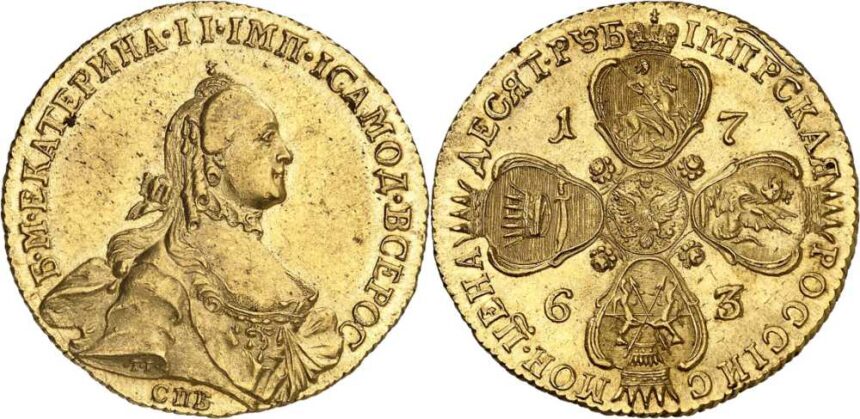
It is impossible to make a general statement about the value of a Novodel today. It depends on the specific item. Our cover image is from the upcoming auction by Heidelberger Münzhandlung, which will take place on May 12–13, 2026, and features a quite wide range of rare Russian coins that have been struck.
At 10,000 euros, not only is the novodel of Michael Feodorovich’s four-ducat coin estimated to be in extremely fine to mint state (uncirculated) condition, but so is a 10-ruble coin of Catherine II minted in 1763 and in extremely fine condition. We can look forward to seeing what prices these two pieces will fetch. Will the novodel or the contemporary coin fetch a higher price?
Text by Ursula Kampmann