What’s going wrong with the COTY?
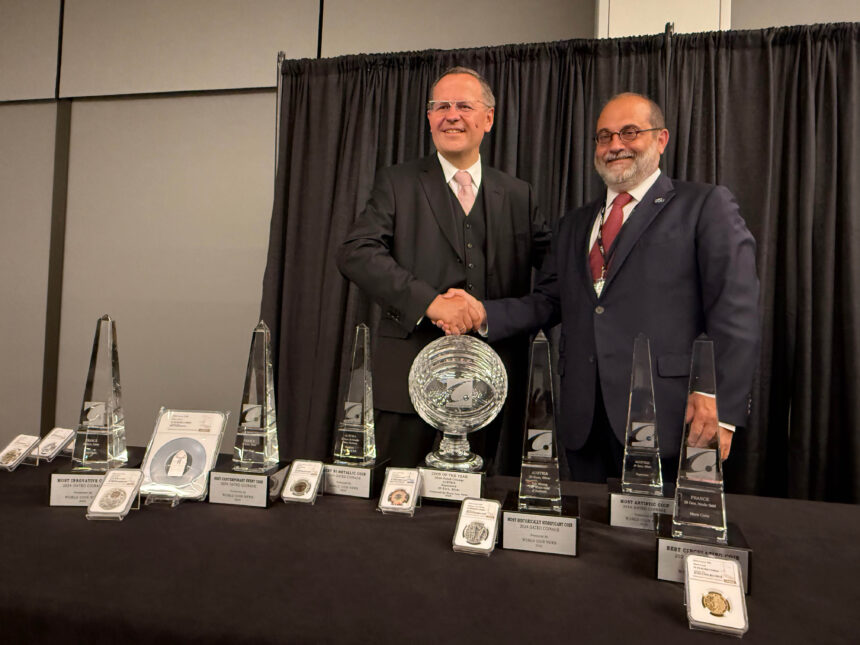
Have you ever understood what the various COTY categories actually mean? I can just about imagine what ‘innovative’ means, but isn’t every good coin artistic? And what on earth does ‘inspiring’ mean? In fact, who can explain to me the difference between the best silver coin and the best Crown? Why can coins from the same series win in one category one time and in another the next? Who selects the coins that the jury assesses? Who allocates them to the categories? And what is the composition of the jury that judges the coins?
In other words: how is it possible that the same mints win in seven COTY categories two years running?
The categories are nonsense!
To start with the main criticism straight away: the categories are historically ingrained nonsense, which certainly made sense when they were first introduced. When most of the categories were defined, commemorative coins were minted using the same technique as circulation coins. That’s why the design and the material were at the centre of attention. Not to mention the size – for it is this that defines the ‘Best Crown’.
Today, however, it is the technique that counts. How can you compare a coin produced with great effort and a wide variety of technical processes to a coin of which tens of thousands have been minted?
So we need a truly fundamental reform of the categories. Simply adding one category or removing another is of no use. We must shift our focus away from the motif and towards the minting technique. The minting relief, for example, makes all the difference! Is it a high-relief strike or a circulation-quality strike with a relief of around 0.5 mm? Has color been applied or not?
Or one could distinguish by function: circulation coins, bullion coins and collector’s coins. Although, in the case of collector’s coins, it would still make sense to create different categories based on the mintage. Up to 1,000 pieces, up to 10,000 specimens, over 10,000 specimens. Or would you prefer a classification based on state-run and private mints?
A restriction on entries
The Austrian Coin Mint and the Monnaie de Paris are regularly among the mints that dominate the COTY. There are quite different reasons for this. In the case of the Monnaie de Paris – just as, incidentally, with the Royal Canadian Mint, a regular award winner which, strangely enough, has come away empty-handed for the last two years – this could be linked to the fact that each of these two mints, on its own, mints as many types and variants of collector coins in a single quarter as 10 average European mints combined do in a year. Okay, I haven’t actually counted them. This was a rough (and probably exaggerated) value. But still: those who mint a lot automatically have a greater chance of winning the COTY.
You might want that. In which case, it’s fine. Or you might prefer greater diversity amongst the winners. In that case, the number of entries per mint should be limited.
The law of the series
At the Austrian Coin Mint, the situation is slightly different. It isn’t down to their high output. In Vienna, a conscious decision was made, in the interests of collectors, to issue ‘only’ 20 emissions per year. But some series are simply so fantastically well-executed that their emissions bag a COTY year after year.
Can this really be called a problem? I think it can. Because an (excessively) high number of decorations cancels out every prize.
The best example of this is the Austrian Coin Mint’s Niob series, which alone has won more decorations than other mints have in their entire history. Niob coins have been named the world’s best bi-metal coin eleven times! In fact, seven times in a row between 2020 and 2026. Nobody at the award ceremony is surprised or delighted anymore when yet another of the truly outstanding Niob coins wins. It has become a matter of course – and that is a shame.
The Niob coins are the best example, but not the only one. Something similar is currently happening with the coins in the ‘Fascination of the Universe’ series and its successor, the ‘Beauty of the Universe’ series. Honestly, I find the combination of ‘Special Shape’ and ‘Curved’ with brilliant colour application incredibly successful too. But the fact that five out of six coins in this series won a COTY – sometimes in the category for the most innovative coin, sometimes for the best silver coin, sometimes for the most artistic coin – I find that counterproductive. Oh yes, I forgot to mention that two emissions in the series took the overall prize.
You think I’ve jumped on the exception? But no, this happens time and again, even with ‘quite ordinary’ coins without any technical bells and whistles. For instance, two out of three emissions in the ‘The White Gold of the Salzkammergut’ series won a COTY in the ‘historically significant’ category. The fact that not all three were awarded is likely down to two emissions being released in the same year…
Now, of course, it makes sense to recognise the painstaking development and the superb die-cutters who have shaped such series. That is why I propose amending the COTY rules as follows: coins from a series may only be submitted to the COTY as individual issues until they have won an award. To compensate, there will be a new prize awarded exclusively to series (from the third emission onwards). As far as I’m concerned, a series can then be awarded prizes several times in succession – or simply until it has won a COTY.
It is the photos that are judged, not the coins!
You may have already noticed. I, too, am a member of the COTY jury, and I am constantly surprised by which coin is awarded the prize for the most innovative design. There may be two reasons for this: either I do not understand why the winning coin is so innovative, or the others do not understand why the coin I prefer would have been far more innovative. It’s probably both, because to understand an innovation, you need not just a photo without commentary, but an explanation and a different design – coins are no longer the one-dimensional objects that a photo of the obverse and one of the revers can realistically depict.
The traditional format in which the material is presented to the jury is completely unsuitable for the ‘innovative’ category.
No wonder that the two coins which completely revolutionised our commemorative coin minting – I’m talking about the first coin with color and the first high-relief coin – didn’t win any prizes.
How do you actually submit coins?
For this article, I wanted to do a quick bit of research online to find out how the COTY submission process works and how much effort it takes to submit a coin. The result: I failed miserably. I couldn’t find any information. Only that the organisers have a mailing list through which they contact their contacts to report interesting emissions.
This shortcoming could probably be remedied most quickly: regardless of which decoration is involved, there needs to be a website that clearly explains the submission process – and showcases previous winners. Naturally, the process for the selection of the winner should also be described in detail there.
Quality over quantity!
And that brings us to the jury. Quite apart from the fact that, in my view, the names and expertise of those making the shortlist should be disclosed. It is certainly not the largest possible quantity of jury members that ensures a fair result, but rather their knowledge and integrity.
I have a problem with the fact that a prize for the best coin in the quite world is awarded by a jury dominated by three nations: the USA (24 members), Germany (15 members) and China (13 members). This means that these three nations alone account for 48 per cent of all decision-makers!
The world is a bit bigger than that. Just look at the magnificent coins produced in Asia, for example! Apart from China, of course, only four of the jury members come from there. South America? As far as I know, it has a quite active numismatic scene. Number of jury members? Quite a few: two.
A reform for credibility
And that brings us to my main point: we need a reform of the COTY – and not just the COTY. There are many awards that are now being handed out at an almost inflationary rate in the world of coins. They’re all nice, good for a press release and social media, but otherwise play no decisive role.
The question now, in my view, is which award-granting institution will be the first to succeed in reforming its decoration. And then to convince the public of the decoration’s credibility.
Once that has happened, we will once again have an award that plays an important, trend-setting role in the numismatic world.
Text and images: Ursula Kampmann