Registrarse para pujas en directo
Heritage Auctions, Inc. Logo
Lote
Lote 23101. Commodus, as Augustus (AD 177-192). AR denarius (19mm, 2.71 gm, 5h). NGC Choice XF 5/5 - 2/5, marks. Rome, AD 191-192. L AEL AVREL C-OMM AVG P FEL, head of Commodus right, wearing lion's skin headdress / HERCVLI-ROMANO AVG, bow, downward club, and quiver. RIC III 253. Commodus' megalomania entered its terminal phase in AD 192. Divested of his powerful chamberlain Cleander, he gave full vent to his obsession with Hercules and pretensions to godhead. This coin of 192 depicts Commodus in the guide of Hercules, wearing the skin of the Nemean lion; the reverse legend translates as "To the Roman Hercules." A famous marble portrait busts depicts him in the same guise, and he portrayed the demigod during a series of spectacles in the Colosseum, where he dispatched hundreds of animals in imitation of Hercules' Twelve Labors. He demanded that the senate rename the city of Rome as Colonia Commodiana, and ordered that all the months of the year be renamed in his honor as well. While the populace seems to have enjoyed these antics, the Roman aristocracy was horrified and a conspiracy took root over the course of the year that culminated in the emperor's assassination on New Year's Eve, AD 192. HID05401242017 © 2026 Heritage Auctions | All Rights Reserved www.HA.com/TexasAuctioneerLicenseNotice
  • Precio de salida:
    1 USD
    0 EUR
    0 GBP
    0 CHF

    Importes redondeados, solo aproximadosFecha: 05/11/2026
Lote
Lote 23102. Commodus, as Augustus (AD 177-192). AR denarius (18mm, 3.06 gm, 7h). NGC Choice XF 4/5 - 3/5, light scratches. Rome, AD 180. M COMMODVS A-NTONINVS AVG, laureate head of Commodus right / TR P V IMP IIII-COS II P P, trophy of arms; two captives seated, flanking the base of trophy, in the attitude of mourning. RIC III 9. The sole reign of Commodus, AD 180-192, is often viewed as the tipping point where the Roman Empire's long decline began. Commodus has thus been featured in novels, plays, and feature films as a villain, most recently in the cinema epics "Fall of the Roman Empire" (1964) and "Gladiator" (2001). Son of the greatly revered "Philosopher Emperor" Marcus Aurelius (AD 161-180), Commodus was the first emperor born "in the purple" in AD 161. Marcus made him co-Augustus in AD 177. He accompanied Marcus on a military campaign against the Germans in AD 178; worn out by his exertions, Marcus died on 17 March AD 180. Freed of his dutiful father's control, Commodus immediately cut a deal with the Germans and abandoned all further plans of military conquest. Returning to Rome, he plunged into sensual pursuits and left governing to a succession of favorites who plundered the public purse and aggrandized themselves. While Commodus continued and worsened the debasement of Roman silver coinage begun by his father, the gold coinage remained of high purity, weight, and artistry. This beautiful aureus, struck early in his sole reign, depicts him as a young man very much in the image of his father. The historians Dio and Herodian both describe him as exceptionally handsome, a picture borne out by his coin portraits and sculpture. The reverse evokes the "Security of the Public" in an uncertain age. HID05401242017 © 2026 Heritage Auctions | All Rights Reserved www.HA.com/TexasAuctioneerLicenseNotice
  • Precio de salida:
    1 USD
    0 EUR
    0 GBP
    0 CHF

    Importes redondeados, solo aproximadosFecha: 05/11/2026
Lote
Lote 23103. Pertinax (1 January-28 March AD 193). AR denarius (18mm, 2.66 gm, 7h). NGC XF 4/5 - 3/5. Alexandria. IMP CAES P HELV-PERTIN AVG, laureate head of Pertinax right / OPI•DIVIN-TR P COS II, Ops, draped and diademed, enthroned left, two grain ears in outstretched right hand. RIC IV.I 8a (Rome). The brief, tragic reign of Helvius Pertinax stands as evidence of how far talent and hard work could take an individual in the Roman world, as well as the dangers of high office. Pertinax began life as the son of a freed slave. Given a good education, he first became a school teacher, then began a career with the Roman Legions and rose quickly. He won the confidence of the Emperor Marcus Aurelius during the Marcommanic War, when he took charge of a legion and intercepted a barbarian horde invading Italy. He was made a senator and heaped with honors, including the governorships of Moesia, Dacia, and Syria. With Commodus descending into megalomania, a conspiracy formed, and the plotters saw the elderly, widely respected Pertinax as the ideal candidate to replace him. Whether he was privy to the plot is uncertain, but immediately after the murder of Commodus on 31 December AD 192, Pertinax went to the Praetorian camp, promised the guard a bonus, and was proclaimed emperor. The Senate enthusiastically ratified his elevation and he initiated a number of popular reforms against the excesses of Commodus, including a crackdown on military indiscipline. This, along with his failure to pay the promised donative, alienated the Praetorians, who held true power in Rome. Although one plot against him was thwarted, Pertinax made the mistake of trying to quell another mutiny by addressing the guard in person. In the middle of the address, a soldier hurled his spear and transfixed him. Pertinax had ruled all of 86 days. Due to the brevity of his reign, the coinage of Pertinax is quite rare, but of unusually high artistic quality. HID05401242017 © 2026 Heritage Auctions | All Rights Reserved www.HA.com/TexasAuctioneerLicenseNotice
  • Precio de salida:
    1 USD
    0 EUR
    0 GBP
    0 CHF

    Importes redondeados, solo aproximadosFecha: 05/11/2026
Lote
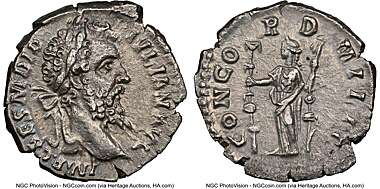
Lote 23104. Didius Julianus (AD 193). AR denarius (19mm, 2.86 gm, 7h). NGC AU 5/5 - 3/5. Rome, March-May AD 193. IMP CAES M DID-IVLIAN AVG, laureate head of Didius Julianus right / CONCO-RD-MILIT, Concordia standing facing, head left, grounded legionary eagle in right hand, grounded standard in left hand. RIC IV.I 1. Didius Julianus was born to a wealthy family in AD 137, probably in Milan. He had a prominent government career, including several provincial governorships in the reigns of Marcus Aurelius and Commodus. Though successful, he did not earn the respect of his fellow senators, who regarded him as a sensualist and a spendthrift. When the Emperor Pertinax was killed by the Praetorians after only a three-month reign, no ready successor was at hand. Pertinax's father-in-law, Flavius Sulpicianus, entered the Praetorian camp on 28 March and tried to get the troops to proclaim him emperor, but he was met with little enthusiasm. Sensing an opportunity, Didius Julianus rushed to the camp and began to make cash promises to the soldiers from outside the wall. Soon the scene became an auction, with Sulpicianus and Julianus striving to outbid each other for the favor of the troops. When Sulpicianus reached 20,000 sesterces per soldier, Didius Julianus upped the bid by a whopping 5,000 sesterces. Sold! Julianus was allowed into the camp and proclaimed emperor. Confronted by the swords of the Praetorians, the Senate approved his elevation, but could not hide its disgust. Disturbances broke out throughout the city, and a crowd at the Colosseum loudly called for Pescennius Niger, governor of Syria, to march on Rome. However, Niger was not the only alternative - two other provincial governors also declared themselves emperor: Clodius Albinus in Britain, and Septimius Severus in Pannonia. Severus, closest to Rome, immediately marshaled his troops and invaded Italy. Julianus at first tried negotiations, then sent assassins to kill Severus, to no avail. Julianus next tried to fortify Rome but the results were ineffective and ludicrous. With Julianus' authority in Rome rapidly deteriorating, Severus was able to send messages to the Praetorians, who renounced their allegiance to Julianus. Seeing their cue, the Senators proclaimed Severus emperor and passed a death sentence on Julianus. On 1 June AD 193, a Praetorian officer found the cringing Julianus hiding in the palace and dispatched him, ending his 66-day reign. HID05401242017 © 2026 Heritage Auctions | All Rights Reserved www.HA.com/TexasAuctioneerLicenseNotice
  • Precio de salida:
    1 USD
    0 EUR
    0 GBP
    0 CHF

    Importes redondeados, solo aproximadosFecha: 05/11/2026
Lote
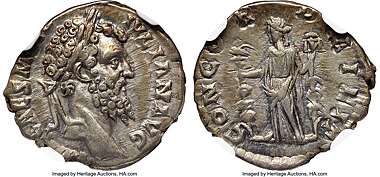
Lote 23105. Didius Julianus (AD 193). AR denarius (18mm, 2.72 gm, 12h). NGC XF 4/5 - 5/5. Rome, March-May AD 193. IMP CAES M DID-IVLIAN AVG, laureate head of Didius Julianus right / CONCO-R-D MILIT, Concordia standing facing, head left, grounded legionary eagle in right hand, grounded standard in left hand. RIC IV.I 1. Didius Julianus was born to a wealthy family in AD 137, probably in Milan. He had a prominent government career, including several provincial governorships in the reigns of Marcus Aurelius and Commodus. Though successful, he did not earn the respect of his fellow senators, who regarded him as a sensualist and a spendthrift. When the Emperor Pertinax was killed by the Praetorians after only a three-month reign, no ready successor was at hand. Pertinax's father-in-law, Flavius Sulpicianus, entered the Praetorian camp on 28 March and tried to get the troops to proclaim him emperor, but he was met with little enthusiasm. Sensing an opportunity, Didius Julianus rushed to the camp and began to make cash promises to the soldiers from outside the wall. Soon the scene became an auction, with Sulpicianus and Julianus striving to outbid each other for the favor of the troops. When Sulpicianus reached 20,000 sesterces per soldier, Didius Julianus upped the bid by a whopping 5,000 sesterces. Sold! Julianus was allowed into the camp and proclaimed emperor. Confronted by the swords of the Praetorians, the Senate approved his elevation, but could not hide its disgust. Disturbances broke out throughout the city, and a crowd at the Colosseum loudly called for Pescennius Niger, governor of Syria, to march on Rome. However, Niger was not the only alternative - two other provincial governors also declared themselves emperor: Clodius Albinus in Britain, and Septimius Severus in Pannonia. Severus, closest to Rome, immediately marshaled his troops and invaded Italy. Julianus at first tried negotiations, then sent assassins to kill Severus, to no avail. Julianus next tried to fortify Rome but the results were ineffective and ludicrous. With Julianus' authority in Rome rapidly deteriorating, Severus was able to send messages to the Praetorians, who renounced their allegiance to Julianus. Seeing their cue, the Senators proclaimed Severus emperor and passed a death sentence on Julianus. On 1 June AD 193, a Praetorian officer found the cringing Julianus hiding in the palace and dispatched him, ending his 66-day reign. HID05401242017 © 2026 Heritage Auctions | All Rights Reserved www.HA.com/TexasAuctioneerLicenseNotice
  • Precio de salida:
    1 USD
    0 EUR
    0 GBP
    0 CHF

    Importes redondeados, solo aproximadosFecha: 05/11/2026
Lote
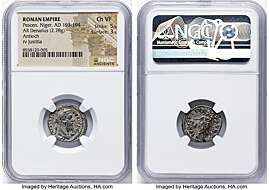
Lote 23106. Pescennius Niger (AD 193-194). AR denarius (18mm, 2.78 gm, 1h). NGC Choice VF 5/5 - 3/5. Antioch. IMP CAES C PESC NI-GER IVST AVG, laureate head of Pescennius Niger right / IVSTITITA-AVGVSTI, Justitia standing facing, head left, scales in outstretched right hand, cornucopia cradled in left arm. RIC IV.I 47c. In AD 193, the Year of the Five Emperors, Pescennius Niger declared himself emperor while he was governor of Syria. He fought in a civil war against Septimius Severus but ultimately lost. While trying to flee to Parthia, Niger was apprehended and beheaded. HID05401242017 © 2026 Heritage Auctions | All Rights Reserved www.HA.com/TexasAuctioneerLicenseNotice
  • Precio de salida:
    1 USD
    0 EUR
    0 GBP
    0 CHF

    Importes redondeados, solo aproximadosFecha: 05/11/2026
Lote
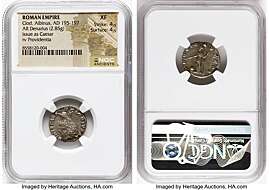
Lote 23107. Clodius Albinus, as Caesar (AD 193-195). AR denarius (17mm, 2.85 gm, 12h). NGC XF 4/5 - 4/5. Rome, AD 193. D CLODIVS AL-BINVS CAES, bare head of Clodius Albinus right / PROVID-A-VG COS, Providentia standing facing, head left, grounded scepter in left hand, wand in outstretched right hand over globe at feet before. RIC IV.I 491. In the Year of the Five Emperors, AD 193, Clodius Albinus initially backed Septimius Severus. Severus appointed him co-Caesar so that Albinus could handle state matters while Severus fought against Pescennius Niger in a civil war, but after Niger was defeated, Severus and Albinus turned on each other. They engaged in another civil war resulting in Albinus's death in battle in AD 197. HID05401242017 © 2026 Heritage Auctions | All Rights Reserved www.HA.com/TexasAuctioneerLicenseNotice
  • Precio de salida:
    1 USD
    0 EUR
    0 GBP
    0 CHF

    Importes redondeados, solo aproximadosFecha: 05/11/2026
Lote
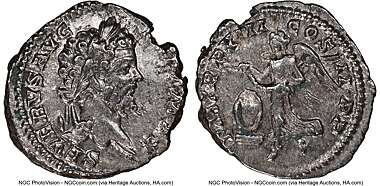
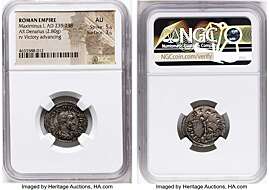
Lote 23108. Septimius Severus (AD 193-211). AR denarius (19mm, 11h). NGC AU. Rome, AD 200. SEVERVS AVG-PART MAX, laureate head of Septimius Severus right / P M TR-P VIII-COS II-PP, Victory advancing left, holding open wreath in both hands over shield set on low base. RIC IV.I 150. Ex Heritage Auctions, Auction 232246 (16 November 2022), lot 63311. The first Roman emperor of African descent, Lucius Septimius Severus was born on 11 April AD 145 in the North African city of Leptis Magna. He entered the Senate during the reign of Marcus Aurelius and also served as an officer in the army under the general Pertinax, finding the soldier's life much to his liking. Talented and hardworking, Severus rose rapidly in the Senate hierarchy, becoming consul in AD 190 and proconsul of Pannonia Superior the following year. The assassination of Commodus on 1 January AD 193 brought his patron Pertinax to the throne, but within three months, Pertinax had been murdered by the Praetorians, who sold the throne to Didius Julianus. An outraged populace demanded that Pescennius Niger, governor of Syria, or Clodius Albinus, proconsul of Britain, depose Julianus. But Severus was much closer, in Pannonia, and he struck first. Placating Albinus with the junior title of Caesar, Severus marched on Rome and easily disposed of Julianus. He next marched against Niger and crushed his rebel regime in a brutally efficient campaign. Returning to Rome in AD 195, he raised his elder son Caracalla to the rank of Caesar, thus severing his pact with Clodius Albinus and igniting another civil war, which ended with Severus's victory in AD 197. A bloody purge of Albinus's supporters led many to call him "the Punic Sulla," but with his position secure, he ruled with moderation. Julia Domna's patronage stimulated Rome's arts and intellectual life, but the mutual hatred of their sons, Caracalla and Geta, caused the imperial couple no end of grief. Like Hadrian, Severus traveled incessantly, but his policy was expansion through conquest, and in AD 208, he launched an invasion of Scotland. But what was supposed to be a quick conquest turned into a long, bitter slog, which took its toll on the emperor's health. On his deathbed in York, Severus begged his sons to "be good to each other, pay the soldiers well, and the rest can to go to hell." He died on 4 February AD 211 at the age of 65. HID05401242017 © 2026 Heritage Auctions | All Rights Reserved www.HA.com/TexasAuctioneerLicenseNotice
  • Precio de salida:
    1 USD
    0 EUR
    0 GBP
    0 CHF

    Importes redondeados, solo aproximadosFecha: 05/11/2026
Lote
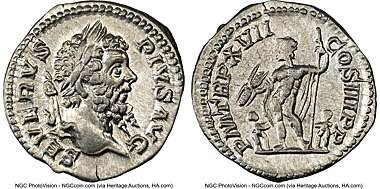
Lote 23109. Septimius Severus (AD 193-211). AR denarius (19mm, 3.40 gm, 7h). NGC Choice XF 5/5 - 4/5. Rome, AD 210. SEVERVS-PIVS AVG, laureate head of Septimius Severus right / P M TR P XVII-COS III P P, Jupiter standing facing, head left, thunderbolt in outstretched right hand, grounded scepter in left, flanked by children on either side. RIC IV.I 226. The first Roman emperor of African descent, Lucius Septimius Severus was born on 11 April AD 145 in the North African city of Leptis Magna. He entered the Senate during the reign of Marcus Aurelius and also served as an officer in the army under the general Pertinax, finding the soldier's life much to his liking. Talented and hardworking, Severus rose rapidly in the Senate hierarchy, becoming consul in AD 190 and proconsul of Pannonia Superior the following year. The assassination of Commodus on 1 January AD 193 brought his patron Pertinax to the throne, but within three months, Pertinax had been murdered by the Praetorians, who sold the throne to Didius Julianus. An outraged populace demanded that Pescennius Niger, governor of Syria, or Clodius Albinus, proconsul of Britain, depose Julianus. But Severus was much closer, in Pannonia, and he struck first. Placating Albinus with the junior title of Caesar, Severus marched on Rome and easily disposed of Julianus. He next marched against Niger and crushed his rebel regime in a brutally efficient campaign. Returning to Rome in AD 195, he raised his elder son Caracalla to the rank of Caesar, thus severing his pact with Clodius Albinus and igniting another civil war, which ended with Severus's victory in AD 197. A bloody purge of Albinus's supporters led many to call him "the Punic Sulla," but with his position secure, he ruled with moderation. Julia Domna's patronage stimulated Rome's arts and intellectual life, but the mutual hatred of their sons, Caracalla and Geta, caused the imperial couple no end of grief. Like Hadrian, Severus traveled incessantly, but his policy was expansion through conquest, and in AD 208, he launched an invasion of Scotland. But what was supposed to be a quick conquest turned into a long, bitter slog, which took its toll on the emperor's health. On his deathbed in York, Severus begged his sons to "be good to each other, pay the soldiers well, and the rest can to go to hell." He died on 4 February AD 211 at the age of 65. HID05401242017 © 2026 Heritage Auctions | All Rights Reserved www.HA.com/TexasAuctioneerLicenseNotice
  • Precio de salida:
    1 USD
    0 EUR
    0 GBP
    0 CHF

    Importes redondeados, solo aproximadosFecha: 05/11/2026
Lote
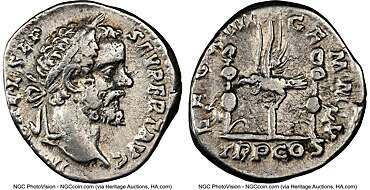
Lote 23110. Septimius Severus (AD 193-211). AR denarius (18mm, 3.84 gm, 6h). NGC Choice VF 4/5 - 4/5, brushed. Emesa, AD 193. IMP CAE L SEP-SEV PERT AVG, laureate head of Septimius Severus right / LEG XIIII-GE-M M-V, legionary eagle left between two standards; TR P COS in exergue. RIC IV.I 358. The first Roman emperor of African descent, Lucius Septimius Severus was born on 11 April AD 145 in the North African city of Leptis Magna. He entered the Senate during the reign of Marcus Aurelius and also served as an officer in the army under the general Pertinax, finding the soldier's life much to his liking. Talented and hardworking, Severus rose rapidly in the Senate hierarchy, becoming consul in AD 190 and proconsul of Pannonia Superior the following year. The assassination of Commodus on 1 January AD 193 brought his patron Pertinax to the throne, but within three months, Pertinax had been murdered by the Praetorians, who sold the throne to Didius Julianus. An outraged populace demanded that Pescennius Niger, governor of Syria, or Clodius Albinus, proconsul of Britain, depose Julianus. But Severus was much closer, in Pannonia, and he struck first. Placating Albinus with the junior title of Caesar, Severus marched on Rome and easily disposed of Julianus. He next marched against Niger and crushed his rebel regime in a brutally efficient campaign. Returning to Rome in AD 195, he raised his elder son Caracalla to the rank of Caesar, thus severing his pact with Clodius Albinus and igniting another civil war, which ended with Severus's victory in AD 197. A bloody purge of Albinus's supporters led many to call him "the Punic Sulla," but with his position secure, he ruled with moderation. Julia Domna's patronage stimulated Rome's arts and intellectual life, but the mutual hatred of their sons, Caracalla and Geta, caused the imperial couple no end of grief. Like Hadrian, Severus traveled incessantly, but his policy was expansion through conquest, and in AD 208, he launched an invasion of Scotland. But what was supposed to be a quick conquest turned into a long, bitter slog, which took its toll on the emperor's health. On his deathbed in York, Severus begged his sons to "be good to each other, pay the soldiers well, and the rest can to go to hell." He died on 4 February AD 211 at the age of 65. HID05401242017 © 2026 Heritage Auctions | All Rights Reserved www.HA.com/TexasAuctioneerLicenseNotice
  • Precio de salida:
    1 USD
    0 EUR
    0 GBP
    0 CHF

    Importes redondeados, solo aproximadosFecha: 05/11/2026
Lote
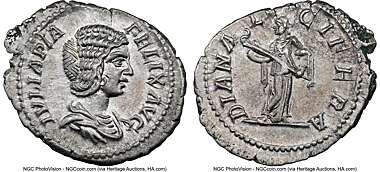
Lote 23111. Julia Domna (AD 193-217). AR denarius (21mm, 3.08 gm, 11h). NGC Choice AU 5/5 - 4/5. Rome, AD 211-217. IVLIA PIA-FELIX AVG, draped bust of Julia Domna right, seen from front, wearing helmet-like wig of plaits with large chignon at back of head, a single lock of her own hair across cheek / DIANA-LV-CIFERA, Diana standing facing, head left, transverse long torch in both hands. RIC IV.I (Caracalla) 373A. Julia Domna was of Syrian-Arab ancestry, as the daughter of the hereditary high priest of Elagabal at Emesa, a wealthy caravan city in the Syrian desert. Beautiful, cultured, and highly educated, she was made even more of a "prize" by a horoscope that proclaimed she would marry a king. Septimius Severus probably encountered her family while serving as a general in Syria in the AD 180s; when he learned of the horoscope, he immediately wrote to her father and secured her hand in marriage. Upon Severus' ascension as Roman Emperor in AD 193, Julia was named Augusta and became his closest advisor and confidant. Her love of art, learning and philosophy manifested in a cultural Renaissance in Rome. In AD 217, Caracalla was assassinated. Julia Domna, who was already suffering from breast cancer, died by self-starvation. HID05401242017 © 2026 Heritage Auctions | All Rights Reserved www.HA.com/TexasAuctioneerLicenseNotice
  • Precio de salida:
    1 USD
    0 EUR
    0 GBP
    0 CHF

    Importes redondeados, solo aproximadosFecha: 05/11/2026
Lote
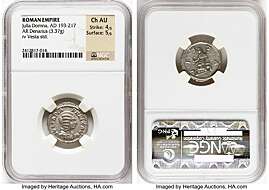
Lote 23112. Julia Domna (AD 193-217). AR denarius (19mm, 3.37 gm, 5h). NGC Choice AU 4/5 - 5/5. Rome, ca. AD 211-217. IVLIA PIA-FELIX AVG, draped bust of Julia Domna right, seen from front, wearing helmet-like wig of plaits with large chignon at back of head, a single lock of her own hair across cheek / VES-TA, Vesta seated left, simpulum in outstretched right hand, transverse scepter cradled in left arm. RIC IV.I (Caracalla) 391. Ex Heritage Auctions, Auction 231439 (25 September 2014), lot 64068. Julia Domna was of Syrian-Arab ancestry, as the daughter of the hereditary high priest of Elagabal at Emesa, a wealthy caravan city in the Syrian desert. Beautiful, cultured, and highly educated, she was made even more of a "prize" by a horoscope that proclaimed she would marry a king. Septimius Severus probably encountered her family while serving as a general in Syria in the AD 180s; when he learned of the horoscope, he immediately wrote to her father and secured her hand in marriage. Upon Severus' ascension as Roman Emperor in AD 193, Julia was named Augusta and became his closest advisor and confidant. Her love of art, learning and philosophy manifested in a cultural Renaissance in Rome. In AD 217, Caracalla was assassinated. Julia Domna, who was already suffering from breast cancer, died by self-starvation. HID05401242017 © 2026 Heritage Auctions | All Rights Reserved www.HA.com/TexasAuctioneerLicenseNotice
  • Precio de salida:
    1 USD
    0 EUR
    0 GBP
    0 CHF

    Importes redondeados, solo aproximadosFecha: 05/11/2026
Lote
Lote 23113. Julia Domna (AD 193-217). AR denarius (19mm, 3.32 gm, 6h). NGC AU 5/5 - 4/5. Rome, AD 196-211. IVLIA-AVGVSTA, draped bust of Julia Domna right, seen from front, wearing helmet-like wig of plaits with large chignon at back of head / FORTVNAE-FELICI, Fortuna standing facing, head left, cornucopia in outstretched right hand, resting left arm on inverted rudder. RIC IV.I (Septimius Severus) 552. Julia Domna was of Syrian-Arab ancestry, as the daughter of the hereditary high priest of Elagabal at Emesa, a wealthy caravan city in the Syrian desert. Beautiful, cultured, and highly educated, she was made even more of a "prize" by a horoscope that proclaimed she would marry a king. Septimius Severus probably encountered her family while serving as a general in Syria in the AD 180s; when he learned of the horoscope, he immediately wrote to her father and secured her hand in marriage. Upon Severus' ascension as Roman Emperor in AD 193, Julia was named Augusta and became his closest advisor and confidant. Her love of art, learning and philosophy manifested in a cultural Renaissance in Rome. In AD 217, Caracalla was assassinated. Julia Domna, who was already suffering from breast cancer, died by self-starvation. HID05401242017 © 2026 Heritage Auctions | All Rights Reserved www.HA.com/TexasAuctioneerLicenseNotice
  • Precio de salida:
    1 USD
    0 EUR
    0 GBP
    0 CHF

    Importes redondeados, solo aproximadosFecha: 05/11/2026
Lote
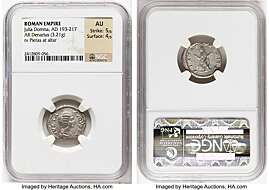
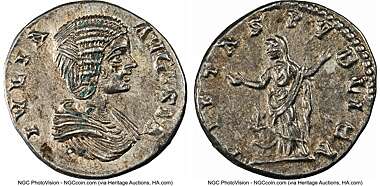
Lote 23114. Julia Domna (AD 193-217). AR denarius (19mm, 3.21 gm, 5h). NGC AU 5/5 - 4/5. Rome, AD 196-211. IVLIA-AVGVSTA, draped bust of Julia Domna right, seen from front, wearing helmet-like wig of plaits with large chignon at back of head / PIETAS-PVBLICA, Pietas standing facing, veiled head left, both hands raised, lit altar at feet before. RIC IV.I (Septimius Severus) 574. Ex Heritage Auctions, Auction 231437 (11 September 2014), lot 62083. Julia Domna was of Syrian-Arab ancestry, as the daughter of the hereditary high priest of Elagabal at Emesa, a wealthy caravan city in the Syrian desert. Beautiful, cultured, and highly educated, she was made even more of a "prize" by a horoscope that proclaimed she would marry a king. Septimius Severus probably encountered her family while serving as a general in Syria in the AD 180s; when he learned of the horoscope, he immediately wrote to her father and secured her hand in marriage. Upon Severus' ascension as Roman Emperor in AD 193, Julia was named Augusta and became his closest advisor and confidant. Her love of art, learning and philosophy manifested in a cultural Renaissance in Rome. In AD 217, Caracalla was assassinated. Julia Domna, who was already suffering from breast cancer, died by self-starvation. HID05401242017 © 2026 Heritage Auctions | All Rights Reserved www.HA.com/TexasAuctioneerLicenseNotice
  • Precio de salida:
    1 USD
    0 EUR
    0 GBP
    0 CHF

    Importes redondeados, solo aproximadosFecha: 05/11/2026
Lote
Lote 23115. Julia Domna (AD 193-217). AR denarius (19mm, 3.59 gm, 12h). NGC AU 5/5 - 3/5. Rome, AD 203. IVLIA-AVGVSTA, draped bust of Julia Domna right, seen from front, wearing helmet-like wig of plaits with large chignon at back of head / PIETAS-PV-BLICA, Pietas standing facing, veiled head left, both arms raised; lit altar at feet before. RIC IV.I (Septimius Severus) 574. Julia Domna was of Syrian-Arab ancestry, as the daughter of the hereditary high priest of Elagabal at Emesa, a wealthy caravan city in the Syrian desert. Beautiful, cultured, and highly educated, she was made even more of a "prize" by a horoscope that proclaimed she would marry a king. Septimius Severus probably encountered her family while serving as a general in Syria in the AD 180s; when he learned of the horoscope, he immediately wrote to her father and secured her hand in marriage. Upon Severus' ascension as Roman Emperor in AD 193, Julia was named Augusta and became his closest advisor and confidant. Her love of art, learning and philosophy manifested in a cultural Renaissance in Rome. In AD 217, Caracalla was assassinated. Julia Domna, who was already suffering from breast cancer, died by self-starvation. HID05401242017 © 2026 Heritage Auctions | All Rights Reserved www.HA.com/TexasAuctioneerLicenseNotice
  • Precio de salida:
    1 USD
    0 EUR
    0 GBP
    0 CHF

    Importes redondeados, solo aproximadosFecha: 05/11/2026
Lote
Lote 23116. Julia Domna (AD 193-217). AR denarius (19mm, 2.76 gm, 12h). NGC Choice XF 5/5 - 4/5. Rome, AD 211-215. IVLIA PIA-FELIX AVG, draped bust of Julia Domna right, seen from front, wearing helmet-like wig of plaits with large chignon at back of head / DIANA LV-CIFERA, Diana Lucifera standing facing, head left, transverse torch in both hands. RIC IV.I (Caracalla) 373a. Ex Edgar L. Owen, private sale with dealer's tag included. Julia Domna was of Syrian-Arab ancestry, as the daughter of the hereditary high priest of Elagabal at Emesa, a wealthy caravan city in the Syrian desert. Beautiful, cultured, and highly educated, she was made even more of a "prize" by a horoscope that proclaimed she would marry a king. Septimius Severus probably encountered her family while serving as a general in Syria in the AD 180s; when he learned of the horoscope, he immediately wrote to her father and secured her hand in marriage. Upon Severus' ascension as Roman Emperor in AD 193, Julia was named Augusta and became his closest advisor and confidant. Her love of art, learning and philosophy manifested in a cultural Renaissance in Rome. In AD 217, Caracalla was assassinated. Julia Domna, who was already suffering from breast cancer, died by self-starvation. HID05401242017 © 2026 Heritage Auctions | All Rights Reserved www.HA.com/TexasAuctioneerLicenseNotice
  • Precio de salida:
    1 USD
    0 EUR
    0 GBP
    0 CHF

    Importes redondeados, solo aproximadosFecha: 05/11/2026
Lote
Lote 23117. Julia Domna (AD 193-217). AR denarius (19mm, 3.36 gm, 7h). NGC Choice XF 5/5 - 3/5. Laodicea ad Mare, AD 196-202. IVLIA-AVGVSTA, draped bust of Julia Domna right, seen from front, wearing helmet-like wig of plaits with large chignon at back of head / CONCO-R-DIA, Concordia seated left, patera in outstretched right hand, double cornucopia cradled in left arm. RIC IV.I 637. Julia Domna was of Syrian-Arab ancestry, as the daughter of the hereditary high priest of Elagabal at Emesa, a wealthy caravan city in the Syrian desert. Beautiful, cultured, and highly educated, she was made even more of a "prize" by a horoscope that proclaimed she would marry a king. Septimius Severus probably encountered her family while serving as a general in Syria in the AD 180s; when he learned of the horoscope, he immediately wrote to her father and secured her hand in marriage. Upon Severus' ascension as Roman Emperor in AD 193, Julia was named Augusta and became his closest advisor and confidant. Her love of art, learning and philosophy manifested in a cultural Renaissance in Rome. In AD 217, Caracalla was assassinated. Julia Domna, who was already suffering from breast cancer, died by self-starvation. HID05401242017 © 2026 Heritage Auctions | All Rights Reserved www.HA.com/TexasAuctioneerLicenseNotice
  • Precio de salida:
    1 USD
    0 EUR
    0 GBP
    0 CHF

    Importes redondeados, solo aproximadosFecha: 05/11/2026
Lote
Lote 23118. Caracalla, as Augustus (AD 198-217). AR antoninianus (23mm, 2h). NGC Choice XF. Rome, AD 216. ANTONINVS PIVS AVG GERM, radiate, draped bust of Caracalla right, seen from behind / P M TR P XVIIII COS IIII P P, Serapis standing facing, polos on head left, raising right hand in gesture of adlocutio, grounded scepter in left hand. RIC IV.I 280d. Ex Heritage Auctions, Auction 232252 (28 December 2022), lot 65285; Nomos, Obolos 7 (9 July 2017), lot 368. Born in Lugdunum in AD 188, while his father was serving as governor of Gaul, Lucius Septimius Bassianus started out life as a cheerful, affable youth whose character deteriorated as he gained more prestige and power. His father, Septimius Severus, seized the throne and defended it against all rival claimants during the civil wars of AD 193-197. Bassianus was named Caesar in AD 195 and was further elevated to co-Augustus with his father three years later, when he was only 10. His name was changed to Marcus Aurelius Antoninus in honor of the revered Antonine dynasty, but the boy preferred barbarian manners and fashions, and he soon earned a nickname after a type of hooded Germanic cloak he liked to wear - Caracalla (or, in modern terms, "hoodie"). Caracalla also arranged for the assassination of his brother, Geta, months after they took power as co-emperors following the death of their father. He was later assassinated by a disgruntled soldier after Caracalla had denied him a promotion. This soldier acted at the behest of Macrinus, who declared himself emperor three days later. HID05401242017 © 2026 Heritage Auctions | All Rights Reserved www.HA.com/TexasAuctioneerLicenseNotice
  • Precio de salida:
    1 USD
    0 EUR
    0 GBP
    0 CHF

    Importes redondeados, solo aproximadosFecha: 05/11/2026
Lote
Lote 23119. Caracalla, as Augustus (AD 198-217). AR antoninianus (25mm, 6h). NGC Choice XF. Rome, AD 215. ANTONINVS-PIVS AVG GERM, radiate, draped, cuirassed bust of Caracalla right, seen from front / P M TR P XVIII COS IIII P P, Jupiter standing right, nude save for chlamys draped across left shoulder, thunderbolt in lowered right hand, grounded scepter in left hand. RIC IV.I 258a. Born in Lugdunum in AD 188, while his father was serving as governor of Gaul, Lucius Septimius Bassianus started out life as a cheerful, affable youth whose character deteriorated as he gained more prestige and power. His father, Septimius Severus, seized the throne and defended it against all rival claimants during the civil wars of AD 193-197. Bassianus was named Caesar in AD 195 and was further elevated to co-Augustus with his father three years later, when he was only 10. His name was changed to Marcus Aurelius Antoninus in honor of the revered Antonine dynasty, but the boy preferred barbarian manners and fashions, and he soon earned a nickname after a type of hooded Germanic cloak he liked to wear - Caracalla (or, in modern terms, "hoodie"). Caracalla also arranged for the assassination of his brother, Geta, months after they took power as co-emperors following the death of their father. He was later assassinated by a disgruntled soldier after Caracalla had denied him a promotion. This soldier acted at the behest of Macrinus, who declared himself emperor three days later. HID05401242017 © 2026 Heritage Auctions | All Rights Reserved www.HA.com/TexasAuctioneerLicenseNotice
  • Precio de salida:
    1 USD
    0 EUR
    0 GBP
    0 CHF

    Importes redondeados, solo aproximadosFecha: 05/11/2026
Lote
Lote 23120. Caracalla, as Augustus (AD 198-217). AR denarius (19mm, 3.20 gm, 1h). NGC Choice AU 5/5 - 5/5. Rome, AD 210. ANTONINVS-PIVS AVG, laureate head of Caracalla right / PONTIF TR P-XIII COS III, Virtus standing facing, head right, left foot on helmet, grounded reversed spear in right hand, parazonium cradled in left arm. RIC IV.I 117a. Born in Lugdunum in AD 188, while his father was serving as governor of Gaul, Lucius Septimius Bassianus started out life as a cheerful, affable youth whose character deteriorated as he gained more prestige and power. His father, Septimius Severus, seized the throne and defended it against all rival claimants during the civil wars of AD 193-197. Bassianus was named Caesar in AD 195 and was further elevated to co-Augustus with his father three years later, when he was only 10. His name was changed to Marcus Aurelius Antoninus in honor of the revered Antonine dynasty, but the boy preferred barbarian manners and fashions, and he soon earned a nickname after a type of hooded Germanic cloak he liked to wear - Caracalla (or, in modern terms, "hoodie"). Caracalla also arranged for the assassination of his brother, Geta, months after they took power as co-emperors following the death of their father. He was later assassinated by a disgruntled soldier after Caracalla had denied him a promotion. This soldier acted at the behest of Macrinus, who declared himself emperor three days later. HID05401242017 © 2026 Heritage Auctions | All Rights Reserved www.HA.com/TexasAuctioneerLicenseNotice
  • Precio de salida:
    1 USD
    0 EUR
    0 GBP
    0 CHF

    Importes redondeados, solo aproximadosFecha: 05/11/2026
Lote
Lote 23121. Caracalla, as Augustus (AD 198-217). AR denarius (19mm, 2.87 gm, 11h). NGC Choice AU 5/5 - 3/5, brushed. Rome, AD 214. ANTONINVS PIVS AVG GERM, laureate head of Caracalla right / P M TR P XVII COS IIII P P, Apollo seated left, laurel branch raised in outstretched right hand, leaning on lyre set on tripod with left arm. RIC IV.I 238a. Born in Lugdunum in AD 188, while his father was serving as governor of Gaul, Lucius Septimius Bassianus started out life as a cheerful, affable youth whose character deteriorated as he gained more prestige and power. His father, Septimius Severus, seized the throne and defended it against all rival claimants during the civil wars of AD 193-197. Bassianus was named Caesar in AD 195 and was further elevated to co-Augustus with his father three years later, when he was only 10. His name was changed to Marcus Aurelius Antoninus in honor of the revered Antonine dynasty, but the boy preferred barbarian manners and fashions, and he soon earned a nickname after a type of hooded Germanic cloak he liked to wear - Caracalla (or, in modern terms, "hoodie"). Caracalla also arranged for the assassination of his brother, Geta, months after they took power as co-emperors following the death of their father. He was later assassinated by a disgruntled soldier after Caracalla had denied him a promotion. This soldier acted at the behest of Macrinus, who declared himself emperor three days later. HID05401242017 © 2026 Heritage Auctions | All Rights Reserved www.HA.com/TexasAuctioneerLicenseNotice
  • Precio de salida:
    1 USD
    0 EUR
    0 GBP
    0 CHF

    Importes redondeados, solo aproximadosFecha: 05/11/2026
Lote
Lote 23122. Caracalla, as Augustus (AD 198-217). AE sestertius (33mm, 22.52 gm, 11h). VF, tooled. Rome, 215. M AVREL ANTONINVS PIVS AVG GERM, laureate, draped, and cuirassed bust of Caracalla right, seen from behind / P M TR P XVIII IMP III COS IIII P P, Aesculapius standing facing, head left, leaning on snake-entwined staff with right hand, Telesphorus standing to left, globe on ground to right; S-C across fields. RIC IV.I 538a. Tooled, thus ineligible for encapsulation. Ex Classical Numismatic Group, Auction 38 (6-7 June 1996), lot 1053. Born in Lugdunum in AD 188, while his father was serving as governor of Gaul, Lucius Septimius Bassianus started out life as a cheerful, affable youth whose character deteriorated as he gained more prestige and power. His father, Septimius Severus, seized the throne and defended it against all rival claimants during the civil wars of AD 193-197. Bassianus was named Caesar in AD 195 and was further elevated to co-Augustus with his father three years later, when he was only 10. His name was changed to Marcus Aurelius Antoninus in honor of the revered Antonine dynasty, but the boy preferred barbarian manners and fashions, and he soon earned a nickname after a type of hooded Germanic cloak he liked to wear - Caracalla (or, in modern terms, "hoodie"). Caracalla also arranged for the assassination of his brother, Geta, months after they took power as co-emperors following the death of their father. He was later assassinated by a disgruntled soldier after Caracalla had denied him a promotion. This soldier acted at the behest of Macrinus, who declared himself emperor three days later. HID05401242017 © 2026 Heritage Auctions | All Rights Reserved www.HA.com/TexasAuctioneerLicenseNotice
  • Precio de salida:
    1 USD
    0 EUR
    0 GBP
    0 CHF

    Importes redondeados, solo aproximadosFecha: 05/11/2026
Lote
Lote 23123. Macrinus (AD 217-218). AR antoninianus (22mm, 4.75 gm, 5h). NGC Choice VF 5/5 - 4/5. Rome. IMP C M OPEL SEV MACRINVS AVG, radiate, draped, and cuirassed bust of Macrinus right, seen from behind / FIDE-S MILITVM, Fides standing facing, head left, a standard in each hand, flanked by standard on either side. RIC IV.II 69. Macrinus was born in Mauritania around AD 165. His family was upper middle-class, allowing him to receive an education that propelled him to high ranks as a bureaucrat during the reign of Septimius Severus. Caracalla appointed Macrinus as praetorian prefect, a position of significant power, second only to the emperor. In AD 216, while accompanying Caracalla on a campaign against the Parthians, Macrinus learned of a letter implicating him in a plot against the emperor. Acting swiftly, he arranged for Caracalla to be assassinated by one of his bodyguards. Macrinus proclaimed his innocence and convinced the army to declare him emperor on April 11, AD 217. Though the Senate in Rome was pleased to be rid of the unpopular Caracalla, they viewed Macrinus with skepticism but were willing to give him a chance. Hoping to disengage from the campaign and return to Rome, Macrinus sought a peace agreement with the Parthians. However, sensing weakness, they massed their forces, forcing Macrinus to concede large bribes and reparations. To the Roman soldiers, this seemed like a defeat, and Macrinus further alienated them by revoking the generous pay increase Caracalla had granted. Discontent grew, and Caracalla's influential aunt, Julia Maesa, bribed the Roman garrison of Emesa in Syria to proclaim her 13-year-old grandson, Elagabalus, as emperor on May 15, AD 218. Initially dismissive of the revolt, Macrinus eventually marshaled his loyal legions to meet the rebels near Antioch on June 8. Despite his troops nearing victory, Macrinus lost his resolve and fled. His demoralized soldiers switched sides, declaring their support for Elagabalus. Disguised as a courier, Macrinus attempted to escape across Asia Minor but was captured in Chalcedon and executed. His son met a similar fate while en route to exile in Parthia. HID05401242017 © 2026 Heritage Auctions | All Rights Reserved www.HA.com/TexasAuctioneerLicenseNotice
  • Precio de salida:
    1 USD
    0 EUR
    0 GBP
    0 CHF

    Importes redondeados, solo aproximadosFecha: 05/11/2026
Lote
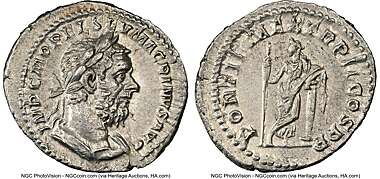
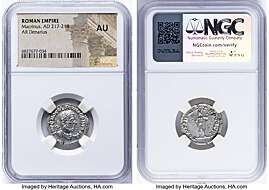
Lote 23124. Macrinus (AD 217-218). AR denarius (21mm, 3.31 gm, 1h). NGC AU 5/5 - 4/5, brushed. Rome. IMP C M OPEL SEV MACRINVS AVG, laureate, cuirassed bust of Macrinus right, seen from front, with older features and long beard / PONTIF MAX TR P II COS P P, Securitas standing facing, head left, legs crossed, grounded scepter in right hand, resting left elbow on behind. RIC IV.II 35. Macrinus was born in Mauritania around AD 165. His family was upper middle-class, allowing him to receive an education that propelled him to high ranks as a bureaucrat during the reign of Septimius Severus. Caracalla appointed Macrinus as praetorian prefect, a position of significant power, second only to the emperor. In AD 216, while accompanying Caracalla on a campaign against the Parthians, Macrinus learned of a letter implicating him in a plot against the emperor. Acting swiftly, he arranged for Caracalla to be assassinated by one of his bodyguards. Macrinus proclaimed his innocence and convinced the army to declare him emperor on April 11, AD 217. Though the Senate in Rome was pleased to be rid of the unpopular Caracalla, they viewed Macrinus with skepticism but were willing to give him a chance. Hoping to disengage from the campaign and return to Rome, Macrinus sought a peace agreement with the Parthians. However, sensing weakness, they massed their forces, forcing Macrinus to concede large bribes and reparations. To the Roman soldiers, this seemed like a defeat, and Macrinus further alienated them by revoking the generous pay increase Caracalla had granted. Discontent grew, and Caracalla's influential aunt, Julia Maesa, bribed the Roman garrison of Emesa in Syria to proclaim her 13-year-old grandson, Elagabalus, as emperor on May 15, AD 218. Initially dismissive of the revolt, Macrinus eventually marshaled his loyal legions to meet the rebels near Antioch on June 8. Despite his troops nearing victory, Macrinus lost his resolve and fled. His demoralized soldiers switched sides, declaring their support for Elagabalus. Disguised as a courier, Macrinus attempted to escape across Asia Minor but was captured in Chalcedon and executed. His son met a similar fate while en route to exile in Parthia. HID05401242017 © 2026 Heritage Auctions | All Rights Reserved www.HA.com/TexasAuctioneerLicenseNotice
  • Precio de salida:
    1 USD
    0 EUR
    0 GBP
    0 CHF

    Importes redondeados, solo aproximadosFecha: 05/11/2026
Lote
Lote 23125. Macrinus (AD 217-218). AR denarius (20mm, 11h). NGC AU. Rome, AD 217. IMP C M OPEL SEV MACRINVS AVG, laureate, draped, and cuirassed bust of Macrinus right, with older features and long beard / PONTIF MAX T-R P COS P P, Jupiter, nude, standing facing, head left, thunderbolt in outstretched right hand, grounded scepter in left. RIC IV.II 15 var. (bust type). 17 var. (cloak on left arm). Macrinus was born in Mauritania around AD 165. His family was upper middle-class, allowing him to receive an education that propelled him to high ranks as a bureaucrat during the reign of Septimius Severus. Caracalla appointed Macrinus as praetorian prefect, a position of significant power, second only to the emperor. In AD 216, while accompanying Caracalla on a campaign against the Parthians, Macrinus learned of a letter implicating him in a plot against the emperor. Acting swiftly, he arranged for Caracalla to be assassinated by one of his bodyguards. Macrinus proclaimed his innocence and convinced the army to declare him emperor on April 11, AD 217. Though the Senate in Rome was pleased to be rid of the unpopular Caracalla, they viewed Macrinus with skepticism but were willing to give him a chance. Hoping to disengage from the campaign and return to Rome, Macrinus sought a peace agreement with the Parthians. However, sensing weakness, they massed their forces, forcing Macrinus to concede large bribes and reparations. To the Roman soldiers, this seemed like a defeat, and Macrinus further alienated them by revoking the generous pay increase Caracalla had granted. Discontent grew, and Caracalla's influential aunt, Julia Maesa, bribed the Roman garrison of Emesa in Syria to proclaim her 13-year-old grandson, Elagabalus, as emperor on May 15, AD 218. Initially dismissive of the revolt, Macrinus eventually marshaled his loyal legions to meet the rebels near Antioch on June 8. Despite his troops nearing victory, Macrinus lost his resolve and fled. His demoralized soldiers switched sides, declaring their support for Elagabalus. Disguised as a courier, Macrinus attempted to escape across Asia Minor but was captured in Chalcedon and executed. His son met a similar fate while en route to exile in Parthia. HID05401242017 © 2026 Heritage Auctions | All Rights Reserved www.HA.com/TexasAuctioneerLicenseNotice
  • Precio de salida:
    1 USD
    0 EUR
    0 GBP
    0 CHF

    Importes redondeados, solo aproximadosFecha: 05/11/2026
Lote
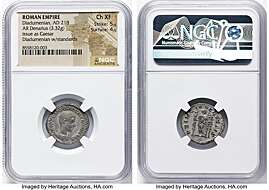
Lote 23126. Diadumenian, as Caesar (AD 218). AR denarius (20mm, 3.32 gm, 1h). NGC Choice XF 5/5 - 4/5. Rome, 218 AD. M OPEL ANT DIADVMENIAN CAES, bare headed, draped, and cuirassed bust of Diadumenian right, seen from front / PRINC IVVENTVTIS, Diadumenian standing facing, head right, grounded standard in right hand, transverse scepter in left; two standards in right field. RIC IV.II (Macrinus) 102. Diadumenian was a short-lived Roman emperor born in AD 208, the son of Emperor Macrinus. In AD 217, after Macrinus seized power following the assassination of Emperor Caracalla, Diadumenian was given the title of Caesar and later elevated to co-Augustus while still a child. His reign was brief and unstable, as their rule faced strong opposition from supporters of the Severan dynasty. After the rise of Elagabalus, Macrinus was defeated in AD 218, and Diadumenian was captured while attempting to flee to Parthia. He was executed soon after, at just ten years old, ending one of the shortest reigns in Roman imperial history. HID05401242017 © 2026 Heritage Auctions | All Rights Reserved www.HA.com/TexasAuctioneerLicenseNotice
  • Precio de salida:
    1 USD
    0 EUR
    0 GBP
    0 CHF

    Importes redondeados, solo aproximadosFecha: 05/11/2026
Lote
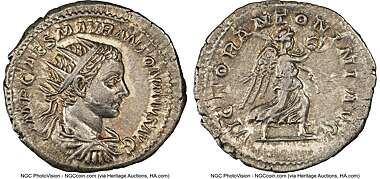
Lote 23127. Elagabalus (AD 218-222). AR antoninianus (23mm, 5.02 gm, 6h). NGC XF 5/5 - 3/5, brushed. Rome. IMP CAES M AVR ANTONINVS AVG, radiate, draped, and cuirassed bust of Elagabalus right, seen from behind / VICTOR ANTONINI AVG, Victory advancing right, wreath in outstretched right hand, palm over left shoulder. RIC IV.II 155. Ex Dr. Busso Peus Nachfolger, private sale with dealer's tag included. Elagabalus, the posthumous nickname for Sextus Varius Avitus Bassianus, was emperor at fourteen years old and died at eighteen. Despite his short tenure, rumors abound about his lifestyle as a teenage emperor. His grandmother, Julia Maesa, spread rumors that he was the son of Caracalla, a rumor supposedly confirmed by his mother, Julia Soaemias, and Cassius Dio recounts that the young ruler had four wives, including a Vestal Virgin, and male courtiers who were rumored to be his lovers. He brought the Stone of Emesa to Rome, as is featured on some issues of his coinage, which was a religiously controversial decision. When he fell out of favor, his mother and grandmother orchestrated for him to take Severus Alexander as his heir, which he unsuccessfully tried to undo. When he attempted an overreach of political violence, members of the Praetorian Guard killed Elagabalus and his mother, Julia Soaemias, and dragged their bodies through the streets. HID05401242017 © 2026 Heritage Auctions | All Rights Reserved www.HA.com/TexasAuctioneerLicenseNotice
  • Precio de salida:
    1 USD
    0 EUR
    0 GBP
    0 CHF

    Importes redondeados, solo aproximadosFecha: 05/11/2026
Lote
Lote 23128. Elagabalus (AD 218-222). AR denarius (20mm, 3.23 gm, 11h). NGC AU 4/5 - 4/5. Rome. IMP ANTONINVS-PIVS AVG, horned, laureate, draped bust of Elagabalus right, seen from front / INVICTVS SACERDOS AVG, Elagabalus standing facing, head left, sacrificing from patera in outstretched right hand over lit altar at feet before, club cradled in left arm; recumbent bull behind altar, star in left field. RIC IV.II 88. Ex Heritage Auctions, Auction 232147 (24 November 2021), lot 64252. Elagabalus, the posthumous nickname for Sextus Varius Avitus Bassianus, was emperor at fourteen years old and died at eighteen. Despite his short tenure, rumors abound about his lifestyle as a teenage emperor. His grandmother, Julia Maesa, spread rumors that he was the son of Caracalla, a rumor supposedly confirmed by his mother, Julia Soaemias, and Cassius Dio recounts that the young ruler had four wives, including a Vestal Virgin, and male courtiers who were rumored to be his lovers. He brought the Stone of Emesa to Rome, as is featured on some issues of his coinage, which was a religiously controversial decision. When he fell out of favor, his mother and grandmother orchestrated for him to take Severus Alexander as his heir, which he unsuccessfully tried to undo. When he attempted an overreach of political violence, members of the Praetorian Guard killed Elagabalus and his mother, Julia Soaemias, and dragged their bodies through the streets. HID05401242017 © 2026 Heritage Auctions | All Rights Reserved www.HA.com/TexasAuctioneerLicenseNotice
  • Precio de salida:
    1 USD
    0 EUR
    0 GBP
    0 CHF

    Importes redondeados, solo aproximadosFecha: 05/11/2026
Lote
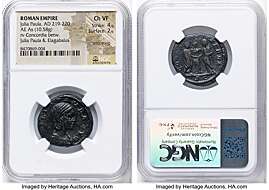
Lote 23129. Julia Paula (AD 219-220). AE as (26mm, 10.58 gm, 5h). NGC Choice VF 4/5 - 2/5, smoothing. Rome. IVLIA PAVLA AVG, draped bust of Julia Paula right, seen from front, hair braided in rows and looped in back in large chignon / CONCORDIA AETERNA, Elagabalus standing right, clasping hands with Julia Paula standing facing, head left, Concordia standing facing between; S C in exergue. RIC IV.II (Elagabalus) 387. Ex Sotheby Parke Bernet, private sale. Julia Paula, the first wife of Elagabalus, was born to the patrician Cornelia family. At this point, they had been one of the most powerful patrician houses for over 700 years. She was a sensible choice of match for a nonsensical emperor, so he divorced her after less than two years to marry a Vestal Virgin. HID05401242017 © 2026 Heritage Auctions | All Rights Reserved www.HA.com/TexasAuctioneerLicenseNotice
  • Precio de salida:
    1 USD
    0 EUR
    0 GBP
    0 CHF

    Importes redondeados, solo aproximadosFecha: 05/11/2026
Lote
Lote 23130. Aquilia Severa (AD 220-222). AR denarius (20mm, 3.58 gm, 5h). NGC Choice VF 5/5 - 4/5. Rome. IVLIA AQVILIA SEVERA AVG, draped bust of Aquilia Severa right, seen from front, hair brushed in waves and bound in small chignon at base of neck / CONC-ORDIA, Concordia standing facing, head left, sacrificing from patera in outstretched right hand over lit altar at feet before, double cornucopia cradled in left arm; star in left field. RIC IV.II (Elagabalus) 225. One of the more scandalous choices of the young emperor Elagabalus was to marry Aquilia Severa, a Vestal Virgin. Traditionally, the punishment for breaking the thirty-year vow of celibacy was to be buried alive; that does not appear to be Aquilia Severa's fate. He did divorce her, but he remarried her after the divorce of his third wife, Annia Faustina. Her opinions on being married not once, but twice, to Elagabalus, her thoughts on forsaking her vows of celibacy, and her fate after his death in AD 222 are not known. HID05401242017 © 2026 Heritage Auctions | All Rights Reserved www.HA.com/TexasAuctioneerLicenseNotice
  • Precio de salida:
    1 USD
    0 EUR
    0 GBP
    0 CHF

    Importes redondeados, solo aproximadosFecha: 05/11/2026
Lote
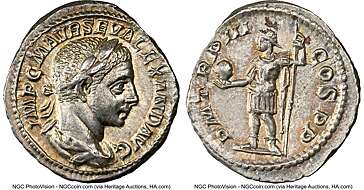
Lote 23131. Severus Alexander, as Augustus (AD 222-235). AR denarius (20mm, 2.88 gm, 1h). NGC Choice AU 5/5 - 4/5. Rome, AD 222-228. IMP C M AVR SEV ALEXAND AVG, laureate, draped bust of Severus Alexander right, seen from behind / PROVIDEN-TIA AVG, Providentia standing facing, head left, wand in right hand over globe at feet to left, grounded scepter in left hand. RIC IV.II 173. Ex Heritage Auctions, Auction 3035 (9 September 2014), lot 32189. The reign of Severus Alexander presents the last relatively tranquil interlude before the mid-third century storm swept away the Pax Romana. He was born Marcus Julius Gessius Bassianus Alexianus, in AD 208, into a clan of Syrian nobility from the caravan city of Emesa. His maternal grand-aunt, Julia Domna, was married to the Emperor Septimius Severus, making him part of an Imperial family that was largely dominated by a clique of strong-minded and clever women, all named Julia. His grandmother, Julia Maesa, engineered the Severan dynasty's return to power in AD 218, by fomenting the military coup that placed Alexander's cousin Varius Avitus, known to history as Elagabalus, on the throne. Once ensconced in Rome, however, Elagabalus' behavior grew ever more erratic and outrageous. In AD 222, fearing for the dynasty's future, Maesa engineered the murder of Elagabalus and his replacement by her other, more docile grandson, Alexander. Handsome and affable, the youth was really never more than a figurehead ruler, first for Maesa and then, after her death in AD 225/6, for his mother Julia Mamaea. HID05401242017 © 2026 Heritage Auctions | All Rights Reserved www.HA.com/TexasAuctioneerLicenseNotice
  • Precio de salida:
    1 USD
    0 EUR
    0 GBP
    0 CHF

    Importes redondeados, solo aproximadosFecha: 05/11/2026
Lote
Lote 23132. Severus Alexander, as Augustus (AD 222-235). AR denarius (19mm, 3.17 gm, 8h). NGC Choice AU 5/5 - 3/5. Rome, AD 231-235. IMP ALEXAN-DER PIVS AVG, laureate, draped, and cuirassed bust of Severus Alexander right, seen from front / SPE-S P-VBLICA, Spes advancing left, flower in outstretched right hand, hitching stola with left. RIC IV.II 254. The reign of Severus Alexander presents the last relatively tranquil interlude before the mid-third century storm swept away the Pax Romana. He was born Marcus Julius Gessius Bassianus Alexianus, in AD 208, into a clan of Syrian nobility from the caravan city of Emesa. His maternal grand-aunt, Julia Domna, was married to the Emperor Septimius Severus, making him part of an Imperial family that was largely dominated by a clique of strong-minded and clever women, all named Julia. His grandmother, Julia Maesa, engineered the Severan dynasty's return to power in AD 218, by fomenting the military coup that placed Alexander's cousin Varius Avitus, known to history as Elagabalus, on the throne. Once ensconced in Rome, however, Elagabalus' behavior grew ever more erratic and outrageous. In AD 222, fearing for the dynasty's future, Maesa engineered the murder of Elagabalus and his replacement by her other, more docile grandson, Alexander. Handsome and affable, the youth was really never more than a figurehead ruler, first for Maesa and then, after her death in AD 225/6, for his mother Julia Mamaea. HID05401242017 © 2026 Heritage Auctions | All Rights Reserved www.HA.com/TexasAuctioneerLicenseNotice
  • Precio de salida:
    1 USD
    0 EUR
    0 GBP
    0 CHF

    Importes redondeados, solo aproximadosFecha: 05/11/2026
Lote
Lote 23133. Severus Alexander, as Augustus (AD 222-235). AR denarius (20mm, 6h). NGC Choice AU. Rome, ca. AD 228-231. IMP SEV ALE-XAND AVG, laureate head of Severus Alexander right / FIDES-MI-LITVM, Fides seated left, grounded standard in each hand. RIC IV.II 193. The reign of Severus Alexander presents the last relatively tranquil interlude before the mid-third century storm swept away the Pax Romana. He was born Marcus Julius Gessius Bassianus Alexianus, in AD 208, into a clan of Syrian nobility from the caravan city of Emesa. His maternal grand-aunt, Julia Domna, was married to the Emperor Septimius Severus, making him part of an Imperial family that was largely dominated by a clique of strong-minded and clever women, all named Julia. His grandmother, Julia Maesa, engineered the Severan dynasty's return to power in AD 218, by fomenting the military coup that placed Alexander's cousin Varius Avitus, known to history as Elagabalus, on the throne. Once ensconced in Rome, however, Elagabalus' behavior grew ever more erratic and outrageous. In AD 222, fearing for the dynasty's future, Maesa engineered the murder of Elagabalus and his replacement by her other, more docile grandson, Alexander. Handsome and affable, the youth was really never more than a figurehead ruler, first for Maesa and then, after her death in AD 225/6, for his mother Julia Mamaea. HID05401242017 © 2026 Heritage Auctions | All Rights Reserved www.HA.com/TexasAuctioneerLicenseNotice
  • Precio de salida:
    1 USD
    0 EUR
    0 GBP
    0 CHF

    Importes redondeados, solo aproximadosFecha: 05/11/2026
Lote
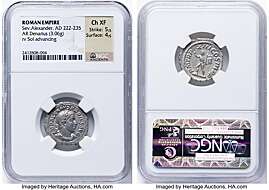
Lote 23134. Severus Alexander, as Augustus (AD 222-235). AR denarius (20mm, 3.23 gm, 1h). NGC AU 5/5 - 3/5, brushed. Rome, ca. AD 224. IMP C M AVR SEV ALEXAND AVG, laureate, draped bust of Severus Alexander right / P M TR P III-COS P P, Emperor standing facing, head left, in military dress, globe in outstretched right hand, grounded scepter in left hand. RIC IV.II 44. The reign of Severus Alexander presents the last relatively tranquil interlude before the mid-third century storm swept away the Pax Romana. He was born Marcus Julius Gessius Bassianus Alexianus, in AD 208, into a clan of Syrian nobility from the caravan city of Emesa. His maternal grand-aunt, Julia Domna, was married to the Emperor Septimius Severus, making him part of an Imperial family that was largely dominated by a clique of strong-minded and clever women, all named Julia. His grandmother, Julia Maesa, engineered the Severan dynasty's return to power in AD 218, by fomenting the military coup that placed Alexander's cousin Varius Avitus, known to history as Elagabalus, on the throne. Once ensconced in Rome, however, Elagabalus' behavior grew ever more erratic and outrageous. In AD 222, fearing for the dynasty's future, Maesa engineered the murder of Elagabalus and his replacement by her other, more docile grandson, Alexander. Handsome and affable, the youth was really never more than a figurehead ruler, first for Maesa and then, after her death in AD 225/6, for his mother Julia Mamaea. HID05401242017 © 2026 Heritage Auctions | All Rights Reserved www.HA.com/TexasAuctioneerLicenseNotice
  • Precio de salida:
    1 USD
    0 EUR
    0 GBP
    0 CHF

    Importes redondeados, solo aproximadosFecha: 05/11/2026
Lote
Lote 23135. Severus Alexander, as Augustus (AD 222-235). AR denarius (20mm, 5h). NGC AU. AD 225. IMP C M AVR SEV-ALEXANDER AVG, laureate, draped bust of Severus Alexander right / P M TR P-IIII COS P P, Mars, nude, advancing right, transverse spear in right hand, trophy over left shoulder. RIC IV.II 45. Ex Heritage Auctions, Auction 232542 (15 October 2025), lot 63091. The reign of Severus Alexander presents the last relatively tranquil interlude before the mid-third century storm swept away the Pax Romana. He was born Marcus Julius Gessius Bassianus Alexianus, in AD 208, into a clan of Syrian nobility from the caravan city of Emesa. His maternal grand-aunt, Julia Domna, was married to the Emperor Septimius Severus, making him part of an Imperial family that was largely dominated by a clique of strong-minded and clever women, all named Julia. His grandmother, Julia Maesa, engineered the Severan dynasty's return to power in AD 218, by fomenting the military coup that placed Alexander's cousin Varius Avitus, known to history as Elagabalus, on the throne. Once ensconced in Rome, however, Elagabalus' behavior grew ever more erratic and outrageous. In AD 222, fearing for the dynasty's future, Maesa engineered the murder of Elagabalus and his replacement by her other, more docile grandson, Alexander. Handsome and affable, the youth was really never more than a figurehead ruler, first for Maesa and then, after her death in AD 225/6, for his mother Julia Mamaea. HID05401242017 © 2026 Heritage Auctions | All Rights Reserved www.HA.com/TexasAuctioneerLicenseNotice
  • Precio de salida:
    1 USD
    0 EUR
    0 GBP
    0 CHF

    Importes redondeados, solo aproximadosFecha: 05/11/2026
Lote
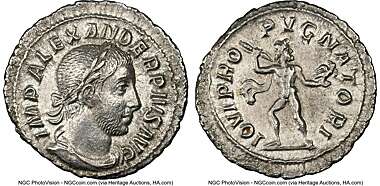
Lote 23136. Severus Alexander, as Augustus (AD 222-235). AR denarius (20mm, 2.58 gm, 7h). NGC Choice XF 5/5 - 4/5. Rome, ca. AD 231-235. IMP ALEXANDER PIVS AVG, laureate, draped bust of Severus Alexander right, seen from front / IOVI PRO-PVGNATORI, Jupiter standing facing, leaning left, head right, nude save for chlamys over across shoulders, brandishing thunderbolt in right hand, eagle in outstretched left. RIC IV.II 239. The reign of Severus Alexander presents the last relatively tranquil interlude before the mid-third century storm swept away the Pax Romana. He was born Marcus Julius Gessius Bassianus Alexianus, in AD 208, into a clan of Syrian nobility from the caravan city of Emesa. His maternal grand-aunt, Julia Domna, was married to the Emperor Septimius Severus, making him part of an Imperial family that was largely dominated by a clique of strong-minded and clever women, all named Julia. His grandmother, Julia Maesa, engineered the Severan dynasty's return to power in AD 218, by fomenting the military coup that placed Alexander's cousin Varius Avitus, known to history as Elagabalus, on the throne. Once ensconced in Rome, however, Elagabalus' behavior grew ever more erratic and outrageous. In AD 222, fearing for the dynasty's future, Maesa engineered the murder of Elagabalus and his replacement by her other, more docile grandson, Alexander. Handsome and affable, the youth was really never more than a figurehead ruler, first for Maesa and then, after her death in AD 225/6, for his mother Julia Mamaea. HID05401242017 © 2026 Heritage Auctions | All Rights Reserved www.HA.com/TexasAuctioneerLicenseNotice
  • Precio de salida:
    1 USD
    0 EUR
    0 GBP
    0 CHF

    Importes redondeados, solo aproximadosFecha: 05/11/2026
Lote
Lote 23137. Severus Alexander, as Augustus (AD 222-235). AR denarius (21mm, 3.06 gm, 7h). NGC Choice XF 5/5 - 4/5. Rome, AD 234. IMP ALEXANDER PIVS AVG, laureate, draped, and cuirassed bust of Severus Alexander right, seen from front / PM TR P-XIII COS III P P, Sol advancing left, right hand raised, whip in left. RIC IV.II 123. Ex Heritage Auctions, Auction 231843 (25 October 2018), lot 64075; Heritage Auctions, Auction 231450 (11 December 2014), lot 62072. The reign of Severus Alexander presents the last relatively tranquil interlude before the mid-third century storm swept away the Pax Romana. He was born Marcus Julius Gessius Bassianus Alexianus, in AD 208, into a clan of Syrian nobility from the caravan city of Emesa. His maternal grand-aunt, Julia Domna, was married to the Emperor Septimius Severus, making him part of an Imperial family that was largely dominated by a clique of strong-minded and clever women, all named Julia. His grandmother, Julia Maesa, engineered the Severan dynasty's return to power in AD 218, by fomenting the military coup that placed Alexander's cousin Varius Avitus, known to history as Elagabalus, on the throne. Once ensconced in Rome, however, Elagabalus' behavior grew ever more erratic and outrageous. In AD 222, fearing for the dynasty's future, Maesa engineered the murder of Elagabalus and his replacement by her other, more docile grandson, Alexander. Handsome and affable, the youth was really never more than a figurehead ruler, first for Maesa and then, after her death in AD 225/6, for his mother Julia Mamaea. HID05401242017 © 2026 Heritage Auctions | All Rights Reserved www.HA.com/TexasAuctioneerLicenseNotice
  • Precio de salida:
    1 USD
    0 EUR
    0 GBP
    0 CHF

    Importes redondeados, solo aproximadosFecha: 05/11/2026
Lote
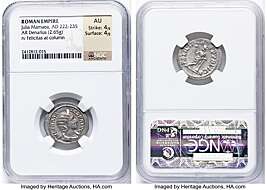
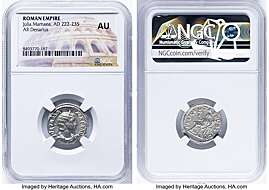
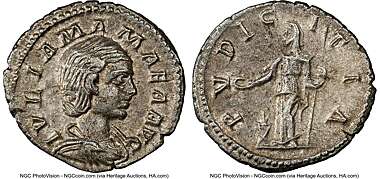
Lote 23138. Julia Mamaea (AD 222-235). AR denarius (21mm, 2.65 gm, 7h). NGC AU 4/5 - 4/5. Rome. IVLIA MA-MAEA AVG, draped bust of Julia Mamaea right, seen from front, wearing stephane, hair braided in rows and tucked in small chignon at base of head / FELICITA-S PVBLICA, Felicitas standing facing, head left, legs crossed, caduceus in outstretched right hand, leaning on column with left arm. RIC IV.II (Severus Alexander) 335. Ex Heritage Auctions, Auction 231438 (18 September 2014), lot 63082. Julia Mamaea was the last remaining matriarch of the Severan dynasty. Her mother, Julia Maesa; her aunt, Julia Domna; her sister, Julia Soaemias; and she were key advisors of their husbands and sons as they ruled and were instrumental in determining lines of succession. After Elagabalus and Julia Soaemias's deaths, Julia Maesa and Julia Mamaea ruled through Julia Mamaea's son, Severus Alexander. He had a relatively peaceful reign and is well regarded by historians, if a bit of a mama's boy. After Julia Maesa's death in AD 225/6, Julia Mamaea was left to carry on the matriarchal legacy through her work with Severus Alexander for another decade before they were both killed in AD 235. He was the first emperor to be overthrown by large-scale discontent in the military, which has been somewhat attributed to his mother's advice on not putting himself in harm's way in battle. HID05401242017 © 2026 Heritage Auctions | All Rights Reserved www.HA.com/TexasAuctioneerLicenseNotice
  • Precio de salida:
    1 USD
    0 EUR
    0 GBP
    0 CHF

    Importes redondeados, solo aproximadosFecha: 05/11/2026
Lote
Lote 23139. Julia Mamaea (AD 222-235). AR denarius (19mm, 1h). NGC AU. Rome. IVLIA MA-MAEA AVG, draped bust of Julia Mamaea right, seen from front, wearing stephane, hair braided in rows and tucked in small chignon at base of head / FELICI-TAS PVBLICA, Felicitas seated left, caduceus in raised right hand, cornucopia cradled in left arm. RIC IV.II (Severus Alexander) 338. Julia Mamaea was the last remaining matriarch of the Severan dynasty. Her mother, Julia Maesa; her aunt, Julia Domna; her sister, Julia Soaemias; and she were key advisors of their husbands and sons as they ruled and were instrumental in determining lines of succession. After Elagabalus and Julia Soaemias's deaths, Julia Maesa and Julia Mamaea ruled through Julia Mamaea's son, Severus Alexander. He had a relatively peaceful reign and is well regarded by historians, if a bit of a mama's boy. After Julia Maesa's death in AD 225/6, Julia Mamaea was left to carry on the matriarchal legacy through her work with Severus Alexander for another decade before they were both killed in AD 235. He was the first emperor to be overthrown by large-scale discontent in the military, which has been somewhat attributed to his mother's advice on not putting himself in harm's way in battle. HID05401242017 © 2026 Heritage Auctions | All Rights Reserved www.HA.com/TexasAuctioneerLicenseNotice
  • Precio de salida:
    1 USD
    0 EUR
    0 GBP
    0 CHF

    Importes redondeados, solo aproximadosFecha: 05/11/2026
Lote
Lote 23140. Julia Mamaea (AD 222-235). AR imitative denarius (20mm, 3.14 gm, 11h). NGC Choice XF 5/5 - 4/5. Ancient imitation of Rome. IVLIA MAMAEA AVG, draped bust of Julia Mamaea right, seen from front, hair braided in rows and tuck at base of head in small chignon / PVDIC-I-TIA, Juno standing facing, veiled head left, sacrificing from patera in outstretched right hand over lit altar at feet before, grounded scepter in left hand. RIC IV.II-, cf. (Severus Alexander) 340 for reverse scene prototype and 347 for reverse legend prototype. Julia Mamaea was the last remaining matriarch of the Severan dynasty. Her mother, Julia Maesa; her aunt, Julia Domna; her sister, Julia Soaemias; and she were key advisors of their husbands and sons as they ruled and were instrumental in determining lines of succession. After Elagabalus and Julia Soaemias's deaths, Julia Maesa and Julia Mamaea ruled through Julia Mamaea's son, Severus Alexander. He had a relatively peaceful reign and is well regarded by historians, if a bit of a mama's boy. After Julia Maesa's death in AD 225/6, Julia Mamaea was left to carry on the matriarchal legacy through her work with Severus Alexander for another decade before they were both killed in AD 235. He was the first emperor to be overthrown by large-scale discontent in the military, which has been somewhat attributed to his mother's advice on not putting himself in harm's way in battle. HID05401242017 © 2026 Heritage Auctions | All Rights Reserved www.HA.com/TexasAuctioneerLicenseNotice
  • Precio de salida:
    1 USD
    0 EUR
    0 GBP
    0 CHF

    Importes redondeados, solo aproximadosFecha: 05/11/2026
Lote
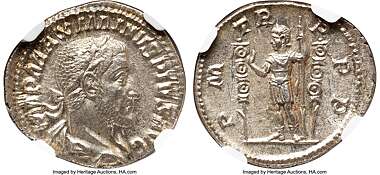
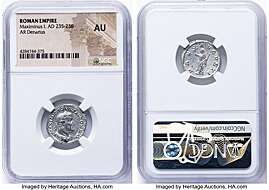
Lote 23141. Maximinus I (AD 235-238). AR denarius (19mm, 2.81 gm, 1h). NGC MS 5/5 - 3/5. Rome, 235. IMP MAXIMINVS PIVS AVG, laureate, draped, and cuirassed bust right, seen from behind / P M-TR-P-P P, emperor standing facing in military attire, head left, right hand raised in gesture of adlocutio, grounded spear in left hand, flanked by standard on either side. RIC IV.II 1. Gaius Julius Verus Maximinus, known then for his abnormally tall stature and humble upbringing was nicknamed "Thrax" due to his Thracian ancestry. When Severus Alexander was murdered in AD 235, Maximinus was promptly proclaimed emperor by his troops. He was the first non-senatorially backed emperor, so a senate revolt broke out. Five other men were made emperor; thus began the Crisis of the Third Century. Maximinus would ultimately march against these senatorially backed usurpers against him, defeating Gordian I and II. Maximinus' troops murdered him while sieging the Balbinus-Pupienus controlled Aquileia in AD 238. His coinage is notable for its dramatic emphasis on the supposed appearance of Maximinus. These include a pronounced brow, nose, and jaw. Modern historians suspect these symptoms to be that of acromegaly, a genetic disorder resulting in the enlargement of certain body parts. HID05401242017 © 2026 Heritage Auctions | All Rights Reserved www.HA.com/TexasAuctioneerLicenseNotice
  • Precio de salida:
    1 USD
    0 EUR
    0 GBP
    0 CHF

    Importes redondeados, solo aproximadosFecha: 05/11/2026
Lote
Lote 23142. Maximinus I (AD 235-238). AR denarius (19mm, 4.02 gm, 12h). NGC Choice AU 4/5 - 4/5. Rome, AD 236. MAXIMINVS PIVS AVG GERM, laureate, draped, and cuirassed bust of Maximinus I right, seen from behind / P M TR P II-COS P P, Maximinus I standing facing, head left, in military attire, raising right hand, grounded spear in left; standard to either side. RIC IV.II 4. Ex Pegasi Numismatics, private sale with dealer's tag included. Gaius Julius Verus Maximinus, known then for his abnormally tall stature and humble upbringing was nicknamed "Thrax" due to his Thracian ancestry. When Severus Alexander was murdered in AD 235, Maximinus was promptly proclaimed emperor by his troops. He was the first non-senatorially backed emperor, so a senate revolt broke out. Five other men were made emperor; thus began the Crisis of the Third Century. Maximinus would ultimately march against these senatorially backed usurpers against him, defeating Gordian I and II. Maximinus's troops murdered him while sieging the Balbinus-Pupienus controlled Aquileia in AD 238. His coinage is notable for its dramatic emphasis on the supposed appearance of Maximinus. These include a pronounced brow, nose, and jaw. Modern historians suspect these symptoms to be that of acromegaly, a genetic disorder resulting in the enlargement of certain body parts. HID05401242017 © 2026 Heritage Auctions | All Rights Reserved www.HA.com/TexasAuctioneerLicenseNotice
  • Precio de salida:
    1 USD
    0 EUR
    0 GBP
    0 CHF

    Importes redondeados, solo aproximadosFecha: 05/11/2026
Lote
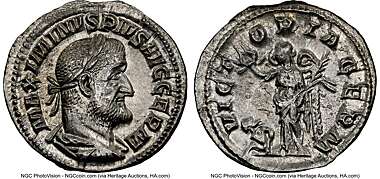
Lote 23143. Maximinus I (AD 235-238). AR denarius (20mm, 12h). NGC Choice AU. Rome, January AD 236-March or April AD 238. MAXIMINVS PIVS AVG GERM, laureate, draped, and cuirassed bust of Maximinus I right, seen from behind / VICT-ORIA GERM, Victory standing facing, head left, wreath in outstretched right hand, palm cradled in left arm; captive seated left at feet before, head reverted. RIC IV.II 23. Gaius Julius Verus Maximinus, known then for his abnormally tall stature and humble upbringing was nicknamed "Thrax" due to his Thracian ancestry. When Severus Alexander was murdered in AD 235, Maximinus was promptly proclaimed emperor by his troops. He was the first non-senatorially backed emperor, so a senate revolt broke out. Five other men were made emperor; thus began the Crisis of the Third Century. Maximinus would ultimately march against these senatorially backed usurpers against him, defeating Gordian I and II. Maximinus' troops murdered him while sieging the Balbinus-Pupienus controlled Aquileia in AD 238. His coinage is notable for its dramatic emphasis on the supposed appearance of Maximinus. These include a pronounced brow, nose, and jaw. Modern historians suspect these symptoms to be that of acromegaly, a genetic disorder resulting in the enlargement of certain body parts. HID05401242017 © 2026 Heritage Auctions | All Rights Reserved www.HA.com/TexasAuctioneerLicenseNotice
  • Precio de salida:
    1 USD
    0 EUR
    0 GBP
    0 CHF

    Importes redondeados, solo aproximadosFecha: 05/11/2026
Lote
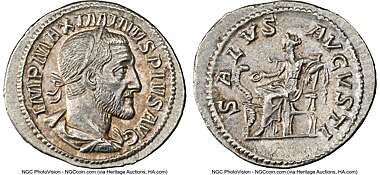
Lote 23144. Maximinus I (AD 235-238). AR denarius (20mm, 2.84 gm, 5h). NGC AU 5/5 - 4/5. Rome, AD 235-236. IMP MAXIMINVS PIVS AVG, laureate, draped, and cuirassed bust of Maximinus I right, seen from behind / SALVS AVGVSTI, Salus enthroned left, feeding serpent rising from altar at feet before from patera in outstretched right hand, left arm resting on throne. RIC IV.II 14. Gaius Julius Verus Maximinus, known then for his abnormally tall stature and humble upbringing was nicknamed "Thrax" due to his Thracian ancestry. When Severus Alexander was murdered in AD 235, Maximinus was promptly proclaimed emperor by his troops. He was the first non-senatorially backed emperor, so a senate revolt broke out. Five other men were made emperor; thus began the Crisis of the Third Century. Maximinus would ultimately march against these senatorially backed usurpers against him, defeating Gordian I and II. Maximinus' troops murdered him while sieging the Balbinus-Pupienus controlled Aquileia in AD 238. His coinage is notable for its dramatic emphasis on the supposed appearance of Maximinus. These include a pronounced brow, nose, and jaw. Modern historians suspect these symptoms to be that of acromegaly, a genetic disorder resulting in the enlargement of certain body parts. HID05401242017 © 2026 Heritage Auctions | All Rights Reserved www.HA.com/TexasAuctioneerLicenseNotice
  • Precio de salida:
    1 USD
    0 EUR
    0 GBP
    0 CHF

    Importes redondeados, solo aproximadosFecha: 05/11/2026
Lote
Lote 23145. Maximinus I (AD 235-238). AR denarius (20mm, 2.80 gm, 11h). NGC AU 5/5 - 3/5. Rome, March AD 235-January AD 236. IMP MAXIMINVS PIVS AVG, laureate, draped, and cuirassed bust of Maximinus I right, seen from behind / VICTO-RI-A AVG, Victory advancing right, wreath upward in right hand, palm over left shoulder. RIC IV.II 16. Gaius Julius Verus Maximinus, known then for his abnormally tall stature and humble upbringing was nicknamed "Thrax" due to his Thracian ancestry. When Severus Alexander was murdered in AD 235, Maximinus was promptly proclaimed emperor by his troops. He was the first non-senatorially backed emperor, so a senate revolt broke out. Five other men were made emperor; thus began the Crisis of the Third Century. Maximinus would ultimately march against these senatorially backed usurpers against him, defeating Gordian I and II. Maximinus's troops murdered him while sieging the Balbinus-Pupienus controlled Aquileia in AD 238. His coinage is notable for its dramatic emphasis on the supposed appearance of Maximinus. These include a pronounced brow, nose, and jaw. Modern historians suspect these symptoms to be that of acromegaly, a genetic disorder resulting in the enlargement of certain body parts. HID05401242017 © 2026 Heritage Auctions | All Rights Reserved www.HA.com/TexasAuctioneerLicenseNotice
  • Precio de salida:
    1 USD
    0 EUR
    0 GBP
    0 CHF

    Importes redondeados, solo aproximadosFecha: 05/11/2026
Lote
Lote 23146. Maximinus I (AD 235-238). AR denarius (20mm, 6h). NGC AU. Rome, January AD 236-April AD 238. MAXIMINVS PIVS AVG GERM, laureate, draped, and cuirassed bust of Maximinus I right, seen from behind / PAX-AVGVSTI, Pax standing facing, head left, branch in outstretched right hand, transverse scepter cradled in left arm. RIC IV.II 19. Ex Heritage Auctions, Auction 232209 (2 March 2022), lot 61294. Gaius Julius Verus Maximinus, known then for his abnormally tall stature and humble upbringing was nicknamed "Thrax" due to his Thracian ancestry. When Severus Alexander was murdered in AD 235, Maximinus was promptly proclaimed emperor by his troops. He was the first non-senatorially backed emperor, so a senate revolt broke out. Five other men were made emperor; thus began the Crisis of the Third Century. Maximinus would ultimately march against these senatorially backed usurpers against him, defeating Gordian I and II. Maximinus's troops murdered him while sieging the Balbinus-Pupienus controlled Aquileia in AD 238. His coinage is notable for its dramatic emphasis on the supposed appearance of Maximinus. These include a pronounced brow, nose, and jaw. Modern historians suspect these symptoms to be that of acromegaly, a genetic disorder resulting in the enlargement of certain body parts. HID05401242017 © 2026 Heritage Auctions | All Rights Reserved www.HA.com/TexasAuctioneerLicenseNotice
  • Precio de salida:
    1 USD
    0 EUR
    0 GBP
    0 CHF

    Importes redondeados, solo aproximadosFecha: 05/11/2026
Lote
Lote 23147. Diva Paulina (died before AD 235). AR denarius (21mm, 2.82 gm, 12h). NGC MS 5/5 - 5/5. Rome, AD 236. DIVA PAVLINA, veiled and draped bust of Diva Paulina right, seen from front / CONSECRATIO, the apotheosis of Diva Paulina, reclining left on peacock flying upward to right, right hand raised, transverse scepter in left. RIC IV.II 2. HID05401242017 © 2026 Heritage Auctions | All Rights Reserved www.HA.com/TexasAuctioneerLicenseNotice
  • Precio de salida:
    1 USD
    0 EUR
    0 GBP
    0 CHF

    Importes redondeados, solo aproximadosFecha: 05/11/2026
Lote
Lote 23148. Gordian I Africanus (March-April AD 238). AR denarius (21mm, 2.81 gm, 7h). NGC AU 5/5 - 4/5. Rome. IMP M ANT GORDIANVS AFR AVG, laureate, draped, and cuirassed bust of Gordian I right, seen from behind / ROMAE AE-TERNAE, Roma enthroned left on shield, Victory right in outstretched right hand, grounded scepter in left. RIC IV.II 4. An enduring mystery is the excellent quality of the Roman coinage of Gordian I and II, whose reign totaled 21 days, during which neither emperor left North Africa. Despite their brief production run, coins of Gordian I and II are notable for their fine portraiture and careful quality control. Both portraits are distinctive, carefully engraved, and clearly modeled on the actual rulers. There seems to have been no "interim phase" during which the imperial portrait was simply a modified version of the predecessor (as with Trajan and Maximinus I, both of whom were absent from Rome when raised to the purple). Two possibilities suggest themselves: (1) The "spontaneous" revolt of the Gordians in Africa had actually been carefully planned in advance, with coin dies prepared in secret from busts provided to the mint workers by their backers in the Senate; (2) the production of coins for Gordian I and II extended well beyond their brief reign, perhaps running concurrently with the coinage of Balbinus, Pupienus and Gordian III as Caesar, allowing time for proper effigies of the deceased rulers to be provided to the mint. HID05401242017 © 2026 Heritage Auctions | All Rights Reserved www.HA.com/TexasAuctioneerLicenseNotice
  • Precio de salida:
    1 USD
    0 EUR
    0 GBP
    0 CHF

    Importes redondeados, solo aproximadosFecha: 05/11/2026
Lote
Lote 23149. Gordian II Africanus (March-April AD 238). AR denarius (20mm, 3.06 gm, 5h). NGC Choice XF 5/5 - 4/5. Rome. IMP M ANT GORDIANVS AFR AVG, laureate, draped, and cuirassed bust of Gordian II right, seen from behind / VICTORIA AVGG, Victory advancing left, wreath in outstretched right hand, palm cradled in left arm. RIC IV.II 2. Born around AD 192, Marcus Antonius Gordianus Sempronianus Romanus the Younger followed his father into the Roman Senate during the reign of Elagabalus (AD 218-222). He attained the consulship in the reign of Severus Alexander (AD 222-235) and served as legate of Legio IV Scythica near Antioch, as well as governor of Achaea. In AD 237, he was appointed as a legate (or general) to Africa, a province then governed by his father. While a son serving under a father was hardly unusual, Africa at this time had no legionary force of its own, meaning Gordian II had command only over a small band of palace guards and auxiliary troops. In March of AD 238, a cadre of North African nobles in the town of Thysdrus forced the elder Gordian to accept the purple. Aged nearly 80, Gordian I realized he could not carry the burden alone and proclaimed his son Gordian II as co-emperor. However, Capelianus, governor of neighboring Numidia, remained loyal to Maximinus I and marched on Carthage with the veteran Legio III Cyrenaica. Gordian II gathered a ragtag force and marched out to meet him, but the defenders had more heart than skill and fell in droves before the swords of Capelianus' legionaries. Gordian II died in battle and his body was never recovered. Upon hearing of the outcome, the elder Gordian hung himself. But the 22-day reign of the Gordians proved the aristocracy of Rome was not yet a spent force, and the revolt they began eventually succeeded in toppling Maximinus. HID05401242017 © 2026 Heritage Auctions | All Rights Reserved www.HA.com/TexasAuctioneerLicenseNotice
  • Precio de salida:
    1 USD
    0 EUR
    0 GBP
    0 CHF

    Importes redondeados, solo aproximadosFecha: 05/11/2026
Lote
Lote 23150. Pupienus (April-July AD 238). AR denarius (21mm, 2.32 gm, 5h). NGC MS 4/5 - 2/5, marks. Rome. IMP C M CLOD PVPIENVS AVG, laureate, draped, and cuirassed bust of Pupienus right, seen from behind / PAX-PVBLICA, Pax enthroned left, branch in raised right hand, transverse scepter cradled in left arm. RIC IV.II 4. Marcus Clodius Pupienus Maximus was elected as co-emperor to Balbinus by the senate following the death of both Gordian I and II in the tumultuous Year of the Six Emperors. While Pupienus was tasked with leading military efforts against the usurper Maximinus Thrax, tensions quickly arose between him and Balbinus. Nevertheless, Pupienus's reign would not last, as only after 99 days in office, he and his co-emperor would be hacked to death in a bath house by the Praetorian Guards. HID05401242017 © 2026 Heritage Auctions | All Rights Reserved www.HA.com/TexasAuctioneerLicenseNotice
  • Precio de salida:
    1 USD
    0 EUR
    0 GBP
    0 CHF

    Importes redondeados, solo aproximadosFecha: 05/11/2026
Lote
Lote 23151. Pupienus (April-July AD 238). AE sestertius (29mm, 18.07 gm, 1h). NGC XF 4/5 - 2/5. Rome. IMP CAES PVPIEN MAXIMVS AVG, laureate, draped, and cuirassed bust of Pupienus right, seen from behind / VICT-ORIA AVGG, Victory standing facing, head left, wreath in outstretched right hand, palm cradled in left arm; S-C across fields. RIC IV.II 23b. Ex Heritage Auctions, Auction 61210 (16 May 2021), lot 99209; Morris Collection (Heritage Auctions, Auction 271920, 26 May 2019), lot 40328 Marcus Clodius Pupienus Maximus was elected as co-emperor to Balbinus by the senate following the death of both Gordian I and II in the tumultuous Year of the Six Emperors. While Pupienus was tasked with leading military efforts against the usurper Maximinus Thrax, tensions quickly arose between him and Balbinus. Nevertheless, Pupienus's reign would not last, as only after 99 days in office, he and his co-emperor would be hacked to death in a bath house by the Praetorian Guards. HID05401242017 © 2026 Heritage Auctions | All Rights Reserved www.HA.com/TexasAuctioneerLicenseNotice
  • Precio de salida:
    1 USD
    0 EUR
    0 GBP
    0 CHF

    Importes redondeados, solo aproximadosFecha: 05/11/2026
Lote
Lote 23152. Gordian III, as Augustus (AD 238-244). AR antoninianus (23mm, 5.26 gm, 1h). NGC MS 5/5 - 4/5. Rome, AD 241-243. IMP GORDIANVS PIVS FEL AVG, radiate, draped, and cuirassed bust of Gordian III right, seen from behind / P M T-R P V COS II P P, Apollo seated left, nude to waist, branch in outstretched right hand, resting left arm on lyre. RIC IV.III 89. The youngest sole emperor of the Roman Empire, Gordian III (225-244 BC), born Marcus Antonius Gordianus, was ruler for eight politically dramatic years. In 238 BC, a senatorial revolt led to his grandfather, Gordian I, and his uncle, Gordian II, to become joint emperors in opposition to Emperor Maximinus. However, they would rule for only twenty-two days when Gordian II would die in the Battle of Carthage, in which Gordian I would commit suicide shortly after. The anti-Maximinus senate appointed two elderly senators, Pupienus and Balbinus, as the new emperors. Due to their age and lack of popularity, the Senate named Gordian III as Caesar, or heir. In a matter of months, Maximinus, Pupienus, and Balbinus would all be killed by Roman rebellions. Thus, by August of that year, Gordian III was named sole emperor at only thirteen. Gordian III would have many notable moments of his reign, such as being the last emperor to open the doors of the Temple of Janus, the numerous earthquakes that forced him to consult the Sibylline Books, and his two campaigns against the Sassanids. Though the details are debated, Gordian III most likely died in the Battle of Misiche in 244 BC at nineteen. This opened the door for Philip I to become emperor, who was accused in many ancient sources as having been directly involved in the death of Gordian III. HID05401242017 © 2026 Heritage Auctions | All Rights Reserved www.HA.com/TexasAuctioneerLicenseNotice
  • Precio de salida:
    1 USD
    0 EUR
    0 GBP
    0 CHF

    Importes redondeados, solo aproximadosFecha: 05/11/2026
Lote
Lote 23153. Gordian III, as Augustus (AD 238-244). AR antoninianus (23mm, 4.36 gm, 7h). NGC MS 5/5 - 4/5. Rome, fourth issue, AD 241-243. IMP GORDIANVS PIVS FEL AVG, radiate, draped, and cuirassed bust of Gordian III right, seen from behind / AETER-N-ITATI AVG, Sol standing facing, radiate head left, nude save for chlamys over left shoulder, right hand raised in gesture of adlocutio, globe in outstretched left. RIC IV.III 83. The youngest sole emperor of the Roman Empire, Gordian III (225-244 BC), born Marcus Antonius Gordianus, was ruler for eight politically dramatic years. In 238 BC, a senatorial revolt led to his grandfather, Gordian I, and his uncle, Gordian II, to become joint emperors in opposition to Emperor Maximinus. However, they would rule for only twenty-two days when Gordian II would die in the Battle of Carthage, in which Gordian I would commit suicide shortly after. The anti-Maximinus senate appointed two elderly senators, Pupienus and Balbinus, as the new emperors. Due to their age and lack of popularity, the Senate named Gordian III as Caesar, or heir. In a matter of months, Maximinus, Pupienus, and Balbinus would all be killed by Roman rebellions. Thus, by August of that year, Gordian III was named sole emperor at only thirteen. Gordian III would have many notable moments of his reign, such as being the last emperor to open the doors of the Temple of Janus, the numerous earthquakes that forced him to consult the Sibylline Books, and his two campaigns against the Sassanids. Though the details are debated, Gordian III most likely died in the Battle of Misiche in 244 BC at nineteen. This opened the door for Philip I to become emperor, who was accused in many ancient sources as having been directly involved in the death of Gordian III. HID05401242017 © 2026 Heritage Auctions | All Rights Reserved www.HA.com/TexasAuctioneerLicenseNotice
  • Precio de salida:
    1 USD
    0 EUR
    0 GBP
    0 CHF

    Importes redondeados, solo aproximadosFecha: 05/11/2026
Lote
Lote 23154. Gordian III, as Augustus (AD 238-244). AE sestertius (32mm, 1h). NGC Choice XF. Rome, July AD 238-July AD 239. IMP CAES M ANT GORDIANVS AVG, laureate, draped, and cuirassed bust of Gordian III right / VIRTVS-AVG, Gordian III advancing right, spear forward in right hand, shield on left arm. RIC IV.III 259a corr. (bare headed on reverse). HID05401242017 © 2026 Heritage Auctions | All Rights Reserved www.HA.com/TexasAuctioneerLicenseNotice
  • Precio de salida:
    1 USD
    0 EUR
    0 GBP
    0 CHF

    Importes redondeados, solo aproximadosFecha: 05/11/2026
Lote
Lote 23155. Philip I (AD 244-249). AR antoninianus (23mm, 3.92 gm, 7h). NGC MS 5/5 - 5/5. Rome, AD 244-247. IMP M IVL PHILIPPVS AVG, radiate, draped, and cuirassed bust of Philip I right, seen from behind / ADVENTVS AVGG, Philip I on horseback left, right hand raised in gesture of adlocutio, transverse scepter cradled in left arm. RIC IV.III 26b. The elder Philip was a nobleman of Arab descent who had risen to the post of Praetorian Prefect in the reign of Gordian III (AD 238-244) before staging a successful coup against the young emperor while they were on campaign in Persia. Although the empire was beset with many troubles, the reign started off with some promise. Philip was a conscientious ruler that showed tolerance toward Christians and other persecuted groups. In AD 247, the younger Philip was elevated to the rank of co-Augustus, and together father and son presided over the Saecular Games that marked Rome's 1,000th anniversary in AD 248. However, in the following months turmoil on the frontiers led to a rash of attempted usurpations, prompting the elder Philip to send the general Trajan Decius to put them down. Instead, Decius was proclaimed emperor by his soldiers, who then marched against Rome. The two Philips gathered a legionary force and marched out to meet the usurper at Verona but were defeated and slain in battle. An alternative account states that the younger Philip remained at Rome but was murdered by the Praetorians once the outcome became known. HID05401242017 © 2026 Heritage Auctions | All Rights Reserved www.HA.com/TexasAuctioneerLicenseNotice
  • Precio de salida:
    1 USD
    0 EUR
    0 GBP
    0 CHF

    Importes redondeados, solo aproximadosFecha: 05/11/2026
Lote
Lote 23156. Philip I (AD 244-249). AR antoninianus (23mm, 4.01 gm, 1h). NGC MS 5/5 - 4/5. Rome, 2nd officina, AD 248. IMP PHILIPPVS AVG, radiate, draped, and cuirassed bust of Philip I right, seen from behind / SAECVLARES AVGG, she-wolf standing left, head reverted, suckling twins Romulus and Remus below; II in exergue. RIC IV.III 15. Struck to celebrate the Saecular Games marking Rome's 1000th anniversary. The elder Philip was a nobleman of Arab descent who had risen to the post of Praetorian Prefect in the reign of Gordian III (AD 238-244) before staging a successful coup against the young emperor while they were on campaign in Persia. Although the empire was beset with many troubles, the reign started off with some promise. Philip was a conscientious ruler that showed tolerance toward Christians and other persecuted groups. In AD 247, the younger Philip was elevated to the rank of co-Augustus, and together father and son presided over the Saecular Games that marked Rome's 1,000th anniversary in AD 248. However, in the following months turmoil on the frontiers led to a rash of attempted usurpations, prompting the elder Philip to send the general Trajan Decius to put them down. Instead, Decius was proclaimed emperor by his soldiers, who then marched against Rome. The two Philips gathered a legionary force and marched out to meet the usurper at Verona but were defeated and slain in battle. An alternative account states that the younger Philip remained at Rome but was murdered by the Praetorians once the outcome became known. HID05401242017 © 2026 Heritage Auctions | All Rights Reserved www.HA.com/TexasAuctioneerLicenseNotice
  • Precio de salida:
    1 USD
    0 EUR
    0 GBP
    0 CHF

    Importes redondeados, solo aproximadosFecha: 05/11/2026
Lote
Lote 23157. Philip I (AD 244-249). AR antoninianus (21mm, 3.96 gm, 1h). NGC MS 5/5 - 4/5. Rome, AD 244-247. IMP M IVL PHILIPPVS AVG, radiate, draped, and cuirassed bust of Philip I right, seen from behind / AEQVITAS AVGG, Aequitas standing facing, head left, scales in outstretched right hand, cornucopia cradled in left arm. RIC IV.III 27b. The elder Philip was a nobleman of Arab descent who had risen to the post of Praetorian Prefect in the reign of Gordian III (AD 238-244) before staging a successful coup against the young emperor while they were on campaign in Persia. Although the empire was beset with many troubles, the reign started off with some promise. Philip was a conscientious ruler that showed tolerance toward Christians and other persecuted groups. In AD 247, the younger Philip was elevated to the rank of co-Augustus, and together father and son presided over the Saecular Games that marked Rome's 1,000th anniversary in AD 248. However, in the following months turmoil on the frontiers led to a rash of attempted usurpations, prompting the elder Philip to send the general Trajan Decius to put them down. Instead, Decius was proclaimed emperor by his soldiers, who then marched against Rome. The two Philips gathered a legionary force and marched out to meet the usurper at Verona but were defeated and slain in battle. An alternative account states that the younger Philip remained at Rome but was murdered by the Praetorians once the outcome became known. HID05401242017 © 2026 Heritage Auctions | All Rights Reserved www.HA.com/TexasAuctioneerLicenseNotice
  • Precio de salida:
    1 USD
    0 EUR
    0 GBP
    0 CHF

    Importes redondeados, solo aproximadosFecha: 05/11/2026
Lote
Lote 23158. Philip I (AD 244-249). AR antoninianus (23mm, 5.12 gm, 5h). NGC AU 5/5 - 3/5. Rome, 2nd officina, AD 248. IMP PHILIPPVS AVG, radiate, draped, and cuirassed bust of Philip I right, seen from behind / SAECVLARES AVGG, she-wolf standing left, head reverted, suckling twins Romulus and Remus below; II in exergue. RIC IV.III 15. Struck to celebrate the Saecular Games marking Rome's 1000th anniversary. The elder Philip was a nobleman of Arab descent who had risen to the post of Praetorian Prefect in the reign of Gordian III (AD 238-244) before staging a successful coup against the young emperor while they were on campaign in Persia. Although the empire was beset with many troubles, the reign started off with some promise. Philip was a conscientious ruler that showed tolerance toward Christians and other persecuted groups. In AD 247, the younger Philip was elevated to the rank of co-Augustus, and together father and son presided over the Saecular Games that marked Rome's 1,000th anniversary in AD 248. However, in the following months turmoil on the frontiers led to a rash of attempted usurpations, prompting the elder Philip to send the general Trajan Decius to put them down. Instead, Decius was proclaimed emperor by his soldiers, who then marched against Rome. The two Philips gathered a legionary force and marched out to meet the usurper at Verona but were defeated and slain in battle. An alternative account states that the younger Philip remained at Rome but was murdered by the Praetorians once the outcome became known. HID05401242017 © 2026 Heritage Auctions | All Rights Reserved www.HA.com/TexasAuctioneerLicenseNotice
  • Precio de salida:
    1 USD
    0 EUR
    0 GBP
    0 CHF

    Importes redondeados, solo aproximadosFecha: 05/11/2026
Lote
Lote 23159. Philip I (AD 244-249). AR antoninianus (21mm, 3.75 gm, 7h). NGC Choice XF 5/5 - 3/5, brushed. Rome. IMP PHILIPPVS AVG, radiate, draped, and cuirassed bust of Philip I right, seen from behind / FIDES EXERCITVS, Fides standing facing, head left, grounded standard i right hand, transverse standard cradled in left arm. RIC IV.III 61. Fiery toning. The elder Philip was a nobleman of Arab descent who had risen to the post of Praetorian Prefect in the reign of Gordian III (AD 238-244) before staging a successful coup against the young emperor while they were on campaign in Persia. Although the empire was beset with many troubles, the reign started off with some promise. Philip was a conscientious ruler that showed tolerance toward Christians and other persecuted groups. In AD 247, the younger Philip was elevated to the rank of co-Augustus, and together father and son presided over the Saecular Games that marked Rome's 1,000th anniversary in AD 248. However, in the following months turmoil on the frontiers led to a rash of attempted usurpations, prompting the elder Philip to send the general Trajan Decius to put them down. Instead, Decius was proclaimed emperor by his soldiers, who then marched against Rome. The two Philips gathered a legionary force and marched out to meet the usurper at Verona but were defeated and slain in battle. An alternative account states that the younger Philip remained at Rome but was murdered by the Praetorians once the outcome became known. HID05401242017 © 2026 Heritage Auctions | All Rights Reserved www.HA.com/TexasAuctioneerLicenseNotice
  • Precio de salida:
    1 USD
    0 EUR
    0 GBP
    0 CHF

    Importes redondeados, solo aproximadosFecha: 05/11/2026
Lote
Lote 23160. Philip I (AD 244-249). AE sestertius (28mm, 11h). NGC Choice XF. Rome, AD 246. IMP M IVL PHILIPPVS AVG, laureate, draped, and cuirassed bust of Philip I right, seen from behind / P M TR P V COS III P P, Felicitas standing facing, head left, grounded caduceus in right hand, cornucopia cradled in left arm; S-C across fields. RIC IV.III 153a. The elder Philip was a nobleman of Arab descent who had risen to the post of Praetorian Prefect in the reign of Gordian III (AD 238-244) before staging a successful coup against the young emperor while they were on campaign in Persia. Although the empire was beset with many troubles, the reign started off with some promise. Philip was a conscientious ruler that showed tolerance toward Christians and other persecuted groups. In AD 247, the younger Philip was elevated to the rank of co-Augustus, and together father and son presided over the Saecular Games that marked Rome's 1,000th anniversary in AD 248. However, in the following months turmoil on the frontiers led to a rash of attempted usurpations, prompting the elder Philip to send the general Trajan Decius to put them down. Instead, Decius was proclaimed emperor by his soldiers, who then marched against Rome. The two Philips gathered a legionary force and marched out to meet the usurper at Verona but were defeated and slain in battle. An alternative account states that the younger Philip remained at Rome but was murdered by the Praetorians once the outcome became known. HID05401242017 © 2026 Heritage Auctions | All Rights Reserved www.HA.com/TexasAuctioneerLicenseNotice
  • Precio de salida:
    1 USD
    0 EUR
    0 GBP
    0 CHF

    Importes redondeados, solo aproximadosFecha: 05/11/2026
Lote
Lote 23161. Philip II, as Caesar (AD 247-249). AR antoninianus (21mm, 4.60 gm, 4h). NGC Choice AU 4/5 - 4/5. Antioch. IMP M IVL PHILIPPVS AVG, radiate, cuirassed bust of Philip I left, seen from front / CONCORDIA AVGG, Concordia seated left, patera in outstretched right hand, double cornucopia cradled in left arm. RIC IV.III 241 var. (bust type). Ex Heritage Auctions, Auction 232332 (9 August 2023), lot 62196. Son of Philip I, Philip II was appointed Caesar at just seven years old in AD 244 and then Augustus in AD 247. Unfortunately, he died when he was only twelve when his father was killed by Decius' army in AD 249. His death is debated, historians arguing he was killed either on the field alongside his father or back in Rome by the Praetorian Guard. HID05401242017 © 2026 Heritage Auctions | All Rights Reserved www.HA.com/TexasAuctioneerLicenseNotice
  • Precio de salida:
    1 USD
    0 EUR
    0 GBP
    0 CHF

    Importes redondeados, solo aproximadosFecha: 05/11/2026
Lote
Lote 23162. Philip II, as Caesar (AD 247-249). AR antoninianus (22mm, 4.15 gm, 1h). NGC AU 5/5 - 3/5. Rome, 3rd officina, Millennium Issue, AD 248. IMP PHILIPPVS AVG, radiate, draped, and cuirassed bust of Philip II right, seen from behind / SAECVLARES AVGG, European elk (American moose) walking left; III in exergue. RIC IV.III 224 (goat). Ex Heritage Auctions, Auction 231932 (8 August 2019), lot 62099. Son of Philip I, Philip II was appointed Caesar at just seven years old in AD 244 and then Augustus in AD 247. Unfortunately, he died when he was only twelve when his father was killed by Decius' army in AD 249. His death is debated, historians arguing he was killed either on the field alongside his father or back in Rome by the Praetorian Guard. HID05401242017 © 2026 Heritage Auctions | All Rights Reserved www.HA.com/TexasAuctioneerLicenseNotice
  • Precio de salida:
    1 USD
    0 EUR
    0 GBP
    0 CHF

    Importes redondeados, solo aproximadosFecha: 05/11/2026
Lote
Lote 23163. Philip II, as Caesar (AD 247-249). AE sestertius (28mm, 15.58 gm, 12h). NGC XF 4/5 - 2/5, scratches. Rome, ca. AD 248. IMP M IVL PHILIPPVS AVG, laureate, draped, and cuirassed bust of Phillip II right / SAECVLARES AVGG, European elk (moose) advancing left; S C in exergue. RIC IV.III 264a (goat). Struck to celebrate the Saecular Games marking Rome's 1000th anniversary. Son of Philip I, Philip II was appointed Caesar at just seven years old in AD 244 and then Augustus in AD 247. Unfortunately, he died when he was only twelve when his father was killed by Decius' army in AD 249. His death is debated, historians arguing he was killed either on the field alongside his father or back in Rome by the Praetorian Guard. HID05401242017 © 2026 Heritage Auctions | All Rights Reserved www.HA.com/TexasAuctioneerLicenseNotice
  • Precio de salida:
    1 USD
    0 EUR
    0 GBP
    0 CHF

    Importes redondeados, solo aproximadosFecha: 05/11/2026
Lote
Lote 23164. Trebonianus Gallus (AD 251-253). AR antoninianus (22mm, 3.38 gm, 1h). NGC Choice AU 4/5 - 3/5. Rome. IMP CAE C VIB TREB GALLVS AVG, radiate, draped, and cuirassed bust of Trebonianus Gallus right, seen from behind / LIBERTA-S AVGG, Libertas standing left, pileus in outstretched right hand, grounded scepter in left hand; star in right field. RIC IV.III 38. After the deaths of co-emperors Decius and Herennius Etruscus in June of AD 251 at the hands of the Goths, Trebonianus Gallus, then governor of Moesia Superior, was deemed emperor. In order to avoid another civil war, Gallus would accept Hostilian, son of Decius, as co-emperor. Although, Hostilian would die that same year, perhaps by an illness. Gallus would quickly make peace with the Goths, an act that secured his leadership and thus his son, Volusian, was appointed Caesar. However, tensions with the Persians and Scythians over the next few years made Gallus unfavorable, and his army would proclaim Aemilian, a prominent commander, as emperor. The two would fight for their claim, resulting in the deaths of Gallus and Volusian in August of AD 253. HID05401242017 © 2026 Heritage Auctions | All Rights Reserved www.HA.com/TexasAuctioneerLicenseNotice
  • Precio de salida:
    1 USD
    0 EUR
    0 GBP
    0 CHF

    Importes redondeados, solo aproximadosFecha: 05/11/2026
Lote
Lote 23165. Trebonianus Gallus (AD 251-253). AR antoninianus (21mm, 1h). NGC Choice AU. Rome, AD 251-253. IMP CAE C VIB TREB GALLVS AVG, radiate, draped, and cuirassed bust of Trebonianus Gallus right, seen from behind / ANNO-NA AVGG, Annona standing facing, head right, left foot on prow, grounded rudder in right hand, grain ears cradled in left arm. RIC IV.III 31. Ex Heritage Auctions, Auction 232315 (12 April 2023), lot 62251. After the deaths of co-emperors Decius and Herennius Etruscus in June of AD 251 at the hands of the Goths, Trebonianus Gallus, then governor of Moesia Superior, was deemed emperor. In order to avoid another civil war, Gallus would accept Hostilian, son of Decius, as co-emperor. Although, Hostilian would die that same year, perhaps by an illness. Gallus would quickly make peace with the Goths, an act that secured his leadership and thus his son, Volusian, was appointed Caesar. However, tensions with the Persians and Scythians over the next few years made Gallus unfavorable, and his army would proclaim Aemilian, a prominent commander, as emperor. The two would fight for their claim, resulting in the deaths of Gallus and Volusian in August of AD 253. HID05401242017 © 2026 Heritage Auctions | All Rights Reserved www.HA.com/TexasAuctioneerLicenseNotice
  • Precio de salida:
    1 USD
    0 EUR
    0 GBP
    0 CHF

    Importes redondeados, solo aproximadosFecha: 05/11/2026
Lote
Lote 23166. Volusian, as Caesar (AD 251-253). AR antoninianus (21mm, 1h). NGC Choice AU. Milan, AD 251-253. IMP C C VIB VOLVSIANIVS AVG, radiate, draped, and cuirassed bust of Volusian right / VIRT-VS AVGG, Virtus standing facing, head right, reversed grounded spear in left hand, right hand resting on grounded shield. RIC IV.III (Trebonianus Gallus) 206. Ex Heritage Auctions, Auction 232314 (5 April 2023), lot 61239. Volusian began his tenure as Caesar while his father, Trebonianus Gallus, was co-emperor with Hostilian. This arrangement involved tenuous family politics, such as Volusian's betrothal to Hostilian's sister. It dissolved in AD 251 with the death of Hostilian by plague, leading to Volusian taking the role of junior Augustus. Volusian and his father chose to stay in Rome while the East was ravaged by Sasanians and Goths, leading to Aemilian being proclaimed emperor by his troops. Volusian and Gallus scrambled to pull together an army and were a mere two-day march from Rome to stop Aemilian when their own troops murdered them, seemingly unwilling to lose to Aemilian's much larger army. Volusian's short reign came during a period of crisis marked by plagues, invasions, and widespread instability. HID05401242017 © 2026 Heritage Auctions | All Rights Reserved www.HA.com/TexasAuctioneerLicenseNotice
  • Precio de salida:
    1 USD
    0 EUR
    0 GBP
    0 CHF

    Importes redondeados, solo aproximadosFecha: 05/11/2026
Lote
Lote 23167. Gallienus, Sole Reign (AD 253-268). BI antoninianus (20mm, 6h). NGC MS, Silvering. Antioch. GALLIENVS AVG, radiate, cuirassed bust of Gallienus right, seen from front / SOLI-I-NVICTO, Sol standing facing, radiate head left, draped, right hand raised in gesture of adlocutio, globe in outstretched left hand; PXV in exergue. RIC V.I 611 (Asia). Ex Heritage Auctions, Auction 232335 (30 August 2023), lot 65130. Publius Licinius Egnatius Gallienus proudly holds the title of longest ruling emperor during the Crisis of the Third Century. In a time of chaos and the potential collapse of the Empire as a whole, Gallienus stands out as an emperor who made significant reforms, including strengthening the cavalry and relying more on professional soldiers over senatorial generals. He also supported the arts and promoted a more centralized imperial authority. Though he managed to fend off several external threats, his rule was plagued by internal rebellion, and he was ultimately assassinated by his own officers. Gallienus' coinage is notable for its rapid debasement throughout his reign - early reign issues being much finer and fully silvered as compared to his later coinage being little more than lightly silvered base metal pieces. HID05401242017 © 2026 Heritage Auctions | All Rights Reserved www.HA.com/TexasAuctioneerLicenseNotice
  • Precio de salida:
    1 USD
    0 EUR
    0 GBP
    0 CHF

    Importes redondeados, solo aproximadosFecha: 05/11/2026
Lote
Lote 23168. Gallienus, Sole Reign (AD 253-268). BI antoninianus (22mm, 5h). NGC MS, Silvering. Rome, 2nd officina. GALLIENVS AVG, radiate head of Gallienus right / LIBERO P CONS AVG, panther advancing left; B in exergue. RIC V.I 229 var. (obverse legend), 230 var. (bust type). Publius Licinius Egnatius Gallienus proudly holds the title of longest ruling emperor during the Crisis of the Third Century. In a time of chaos and the potential collapse of the Empire as a whole, Gallienus stands out as an emperor who made significant reforms, including strengthening the cavalry and relying more on professional soldiers over senatorial generals. He also supported the arts and promoted a more centralized imperial authority. Though he managed to fend off several external threats, his rule was plagued by internal rebellion, and he was ultimately assassinated by his own officers. Gallienus' coinage is notable for its rapid debasement throughout his reign - early reign issues being much finer and fully silvered as compared to his later coinage being little more than lightly silvered base metal pieces. HID05401242017 © 2026 Heritage Auctions | All Rights Reserved www.HA.com/TexasAuctioneerLicenseNotice
  • Precio de salida:
    1 USD
    0 EUR
    0 GBP
    0 CHF

    Importes redondeados, solo aproximadosFecha: 05/11/2026
Lote
Lote 23169. Claudius II (AD 268-270). BI antoninianus (21mm, 5h). NGC MS, Silvering. Rome. IMP C CLAVDIVS AVG, radiate head of Claudius II left / SALV-S AVG, Isis Faria standing facing, head left, sistrum in outstretched right hand, basket in lowered left hand. RIC V.I 217 HID05401242017 © 2026 Heritage Auctions | All Rights Reserved www.HA.com/TexasAuctioneerLicenseNotice
  • Precio de salida:
    1 USD
    0 EUR
    0 GBP
    0 CHF

    Importes redondeados, solo aproximadosFecha: 05/11/2026
Lote
Lote 23170. Claudius II (AD 268-270). BI antoninianus (20mm, 5h). NGC MS, Silvering. Antioch, 2nd officina. IMP C CLAVDIVS AVG, radiate, draped, and cuirassed bust of Claudius II right, seen from behind / JVNO RE-GINA, Juno standing facing, head left, patera in outstretched right hand, grounded scepter in left; peacock standing left, head reverted, at feet before; B in exergue. RIC V.I 212 var. (bust type). Ex Heritage Auctions, Auction 232349 (6 December 2023), lot 61113. HID05401242017 © 2026 Heritage Auctions | All Rights Reserved www.HA.com/TexasAuctioneerLicenseNotice
  • Precio de salida:
    1 USD
    0 EUR
    0 GBP
    0 CHF

    Importes redondeados, solo aproximadosFecha: 05/11/2026
Lote
Lote 23171. Claudius II (AD 268-270). BI antoninianus (20mm, 6h). NGC MS, Silvering. Antioch. IMP C CLAVDIVS AVG, radiate head of Claudius II left / SOL-AVG, Sol standing facing, head left, nude save for chlamys across shoulders, right hand raised in gesture of adlocutio, whip cradled in left arm. RIC V.I 221. Ex Heritage Auctions, Auction 232402 (10 January 2024), lot 62142. HID05401242017 © 2026 Heritage Auctions | All Rights Reserved www.HA.com/TexasAuctioneerLicenseNotice
  • Precio de salida:
    1 USD
    0 EUR
    0 GBP
    0 CHF

    Importes redondeados, solo aproximadosFecha: 05/11/2026
Lote
Lote 23172. Quintillus (AD 270). BI antoninianus (19mm, 5h). NGC AU. Rome. IMP C M AVR QVINTILLVS AVG, radiate, draped bust of Quintillus right, seen from front / PAX-AVGVSTI, Pax standing facing, head left, olive branch in raised right hand, transverse spear in left hand; H in exergue. RIC V.I 26. HID05401242017 © 2026 Heritage Auctions | All Rights Reserved www.HA.com/TexasAuctioneerLicenseNotice
  • Precio de salida:
    1 USD
    0 EUR
    0 GBP
    0 CHF

    Importes redondeados, solo aproximadosFecha: 05/11/2026
Lote
Lote 23173. Aurelian (AD 270-275). BI antoninianus (22mm, 4.76 gm, 11h). NGC MS 5/5 - 4/5, Silvering. Serdica, 1st officina. IMP AVRELIANVS AVG, radiate, cuirassed bust of Aurelian right, seen from front / ORI-ENS AVG, Sol standing left, right hand raised in gesture of adlocutio, globe in outstretched left, right foot on one of two bound captives seated to either side; XXIP in exergue. RIC V.I 279. Ex Heritage Auctions, Auction 232416 (17 April 2024), lot 63159. HID05401242017 © 2026 Heritage Auctions | All Rights Reserved www.HA.com/TexasAuctioneerLicenseNotice
  • Precio de salida:
    1 USD
    0 EUR
    0 GBP
    0 CHF

    Importes redondeados, solo aproximadosFecha: 05/11/2026
Lote
Lote 23174. Tacitus (AD 275-276). BI antoninianus (23mm, 2.95 gm, 6h). NGC Choice XF 3/5 - 4/5. Ticinum. IMP C M CL TACITVS AVG, radiate, draped, and cuirassed bust of Tacitus right, seen from front / SALVS AVG, Salus seated left, feeding snake rising from altar with right hand from patera in outstretched left hand; T in exergue. RIC V.I 158 var. (Salus standing). Rare. Ex Euclidean Collection (Coin Cabinet, Ancient Auction 17, 19 December 2024), lot 397. HID05401242017 © 2026 Heritage Auctions | All Rights Reserved www.HA.com/TexasAuctioneerLicenseNotice
  • Precio de salida:
    1 USD
    0 EUR
    0 GBP
    0 CHF

    Importes redondeados, solo aproximadosFecha: 05/11/2026
Lote
Lote 23175. Florian (AD 276). BI antoninianus (21mm, 3.30 gm, 12h). NGC Choice XF 5/5 - 3/5. Serdica, 3rd officina. IMP C M AN FLORIANVS AVG, radiate, cuirassed bust of Florian right, seen from the front / PRO-VIDEN D-EOR, Fides standing facing (on left), head right, grounded standard in each hand, Sol standing facing (on right), head left, right hand raised in gesture of adlocutio, globe in outstretched left hand; star between, Γ in exergue. RIC V.I 112 var. (KA Γ in exergue). HID05401242017 © 2026 Heritage Auctions | All Rights Reserved www.HA.com/TexasAuctioneerLicenseNotice
  • Precio de salida:
    1 USD
    0 EUR
    0 GBP
    0 CHF

    Importes redondeados, solo aproximadosFecha: 05/11/2026
Lote
Lote 23176. Florian (AD 276). BI antoninianus (23mm, 5h). NGC XF, Silvering. Rome, 1st officina. IMP C FLORIANVS AVG, radiate, draped, cuirassed bust right, seen from the front / PROVIDENTIA AVG, Providentia standing facing, head left, wand in outstretched right hand over globe at feet before, cornucopia cradled in left arm. Cf. RIC V.I 39. HID05401242017 © 2026 Heritage Auctions | All Rights Reserved www.HA.com/TexasAuctioneerLicenseNotice
  • Precio de salida:
    1 USD
    0 EUR
    0 GBP
    0 CHF

    Importes redondeados, solo aproximadosFecha: 05/11/2026
Lote
Lote 23177. Probus (AD 276-282). BI antoninianus (23mm, 3.30 gm, 7h). NGC MS 5/5 - 3/5, Silvering. Siscia, 6th officina, 7th emission AD 280. IMP C M AVR PROBVS P F AVG, radiate, mantled bust of Probus left, eagle-tipped scepter in right hand, seen from the front / CONSE-R-VAT AVG, Sol standing facing, head left, nude save for chlamys across shoulders, right hand raised in gesture of adlocutio, globe in outstretched left; VI in right field, XXI in exergue. RIC V.I 672. Ex Heritage Auctions, Auction 232435 (28 August 2024), lot 65122; Heritage Auctions, Auction 232039 (23 September 2020), lot 64202. HID05401242017 © 2026 Heritage Auctions | All Rights Reserved www.HA.com/TexasAuctioneerLicenseNotice
  • Precio de salida:
    1 USD
    0 EUR
    0 GBP
    0 CHF

    Importes redondeados, solo aproximadosFecha: 05/11/2026
Lote
Lote 23178. Probus (AD 276-282). BI antoninianus (22mm, 3.48 gm, 6h). NGC Choice AU 5/5 - 3/5, Silvering. Rome, 5th officina. IMP-C M AVR PROBVS P F AVG, radiate, mantled bust of Probus left, eagle-tipped scepter in right hand, seen from front / SO-LI I-NVIC-TO, Sol in spread quadriga to front, head left, right hand raised, globe in left; R star Є exergue. RIC V.II 204. Marcus Aurelius Probus reigned during a time when strong military command and effective administration was needed to preserve the Roman Empire. Probus reflected these attributes and was able to rule for a total of six years - no easy feat at this time. Probus excelled militarily, similarly to that of Claudius Gothicus and Aurelian. He ultimately spent most of his reign on campaign against several invading tribes in the West. His attention soon turned towards the East; however, this would be cut short when his own troops would murder him due to either a usurpation by the later emperor Carus or his enforced civil duty required by him, to his troops. HID05401242017 © 2026 Heritage Auctions | All Rights Reserved www.HA.com/TexasAuctioneerLicenseNotice
  • Precio de salida:
    1 USD
    0 EUR
    0 GBP
    0 CHF

    Importes redondeados, solo aproximadosFecha: 05/11/2026
Lote
Lote 23179. Probus (AD 276-282). BI antoninianus (24mm, 4.31 gm, 7h). NGC Choice AU 4/5 - 4/5, Silvering. Serdica, 3rd officina. IMP C M AVR PROBVS AVG, radiate, mantled bust of Probus left, eagle-tipped scepter in right hand, seen from front / SOLI INVICT-O, Sol in spread quadriga to front, head left, right hand raised, globe in left; KA•Γ in exergue. RIC V.II 862. HID05401242017 © 2026 Heritage Auctions | All Rights Reserved www.HA.com/TexasAuctioneerLicenseNotice
  • Precio de salida:
    1 USD
    0 EUR
    0 GBP
    0 CHF

    Importes redondeados, solo aproximadosFecha: 05/11/2026
Lote
Lote 23180. Probus (AD 276-282). BI antoninianus (21mm, 6h). NGC Choice AU. Rome, 1st (or 4th) officina. IMP C M AVR PROBVS AVG, radiate, cuirassed bust of Probus right, seen from front / SALVS AVG, Salus standing facing, head left, feeding serpent rising from altar before from patera in outstretched right hand, grounded scepter in left hand; XXIA(or Δ) in exergue. RIC V.II 744. HID05401242017 © 2026 Heritage Auctions | All Rights Reserved www.HA.com/TexasAuctioneerLicenseNotice
  • Precio de salida:
    1 USD
    0 EUR
    0 GBP
    0 CHF

    Importes redondeados, solo aproximadosFecha: 05/11/2026
Lote
Lote 23181. Carinus (AD 283-285). BI antoninianus (24mm, 7h). NGC Choice XF, Silvering. Lugdunum, AD 282-283. IMP C M AVR CARINVS AVG, radiate, draped, and cuirassed bust of Carinus right, seen from the front / SAECVLI FEL-ICITAS, Carinus, in military attire, standing facing, head right, transverse spear in right hand, globe in outstretched right hand; D in right field. RIC V.II 214. HID05401242017 © 2026 Heritage Auctions | All Rights Reserved www.HA.com/TexasAuctioneerLicenseNotice
  • Precio de salida:
    1 USD
    0 EUR
    0 GBP
    0 CHF

    Importes redondeados, solo aproximadosFecha: 05/11/2026
Lote
Lote 23182. Magnia Urbica (AD 283-285). BI antoninianus (21mm, 3.46 gm, 6h). NGC Choice AU 4/5 - 3/5, light smoothing. Rome. MAGN VRBICA AVG, diademed, draped bust of Magnia Urbica right on crescent, seen from front, hair weaved in straight lines and rows with long plait carried up the back of head and tucked under stephane / VEN-V-S V-I-CTRIX, Venus Victrix standing facing, head left, helmet in outstretched right hand, grounded scepter in left, shield resting at feet to left; KA crescent Ϛ in exergue. RIC V.II 343. Ex Heritage Auctions, Auction 3064 (23 April 2018), lot 32343; Classical Numismatic Group, Auction 49 (17 March 1999), lot 1737. HID05401242017 © 2026 Heritage Auctions | All Rights Reserved www.HA.com/TexasAuctioneerLicenseNotice
  • Precio de salida:
    1 USD
    0 EUR
    0 GBP
    0 CHF

    Importes redondeados, solo aproximadosFecha: 05/11/2026
Lote
Lote 23183. Victorinus (AD 269-271). BI antoninianus (20mm, 11h). NGC MS, Silvering. Trier. IMP C VICTORINVS P F AVG, radiate, draped, cuirassed bust of Victorinus right, seen from front / PA-X-A-VG, Pax standing facing, head left, branch in raised right hand, transverse scepter in left; V in left field, star in right field. RIC V.II 118 (Cologne). HID05401242017 © 2026 Heritage Auctions | All Rights Reserved www.HA.com/TexasAuctioneerLicenseNotice
  • Precio de salida:
    1 USD
    0 EUR
    0 GBP
    0 CHF

    Importes redondeados, solo aproximadosFecha: 05/11/2026
Lote
Lote 23184. Carausius, Romano-British Empire (AD 286/287-293). BI antoninianus (23mm, 4.03 gm, 6h). NGC Choice XF 4/5 - 3/5. Camulodunum. IMP C CARAVSIVS P AVG, radiate, draped, and cuirassed bust of Carausius right, seen from front / PROV-ID AVG, Providentia standing facing, head left, globe in outstretched right, transverse scepter baton cradled in left arm; S-P across fields, C(?) in exergue. RIC V.II 354 var. (cornucopia in left arm). Ex Heritage Auctions, Auction 231913 (28 May 2019), lot 64135. HID05401242017 © 2026 Heritage Auctions | All Rights Reserved www.HA.com/TexasAuctioneerLicenseNotice
  • Precio de salida:
    1 USD
    0 EUR
    0 GBP
    0 CHF

    Importes redondeados, solo aproximadosFecha: 05/11/2026
Lote
Lote 23185. Allectus, Romano-British Empire (AD 293-296/297). AE antoninianus (23mm, 3.47 gm, 5h). NGC AU 4/5 - 2/5, bent, marks. London. IMP C ALLECTVS P F AVG, radiate, cuirassed bust of Allectus right, seen from front / PA-X-AVG, Pax standing facing, head left, branch upward in right hand, grounded scepter in left; S-A across fields, MSL in exergue. RIC V.II 28. Ex Pegasi Numismatics, private sale with dealer's tag included. Appointed treasurer under the emperor Carausius of the Romano-Britannian Empire, Allectus would betray Carausius, resulting in the latter's death. Allectus' reign would be short-lived as he would be defeated in AD 296 after being caught by the troops of future emperor Constantius I. HID05401242017 © 2026 Heritage Auctions | All Rights Reserved www.HA.com/TexasAuctioneerLicenseNotice
  • Precio de salida:
    1 USD
    0 EUR
    0 GBP
    0 CHF

    Importes redondeados, solo aproximadosFecha: 05/11/2026
Lote
Lote 23186. Diocletian (AD 284-305). BI antoninianus (25mm, 1h). NGC AU. Siscia, 2nd officina, AD 289-290. IMP C C VAL DIOCLETIANVS P F AVG, radiate, cuirassed bust of Diocletian right, seen from front / CONSERVATOR-AVGG, emperor standing right (on left), Jupiter standing facing, head left (on right), each sacrificing at altar between them from patera in outstretched right hand, grounded scepter in left; •Γ•XXI•BI• in exergue. RIC V.II 263. Chamapgen toning. When Diocletian came into power, he realized that the empire was too large to be run by one person. To solve this problem, he divided the Roman Empire into four parts to be ruled by four men, the Tetrachy, with himself and Maximian as Augusti and Galerius and Constantius I as Caesares. The art of this short-lived period emphasized the equality of these emperors and stripped away their individuality. Unfortunately, after Diocletian's death, the tetrarchy quickly fell apart with infighting for control, resulting in Constantine the Great, the son of Constantius I, coming out on top. HID05401242017 © 2026 Heritage Auctions | All Rights Reserved www.HA.com/TexasAuctioneerLicenseNotice
  • Precio de salida:
    1 USD
    0 EUR
    0 GBP
    0 CHF

    Importes redondeados, solo aproximadosFecha: 05/11/2026
Lote
Lote 23187. Diocletian (AD 284-305). AR argenteus (19mm, 3.27 gm, 5h). NGC MS 5/5 - 3/5, reverse scrape. Ticinum, ca. AD 294. DIOCLETI-ANVS AVG, laureate head of Diocletian right / VICTORIA-SARMAT, the four tetrarchs sacrificing before campgate with six turrets. RIC VI 12a. Ex Heritage Auctions, Auction 3035 (9 September 2014), lot 32203. When Diocletian came into power, he realized that the empire was too large to be run by one person. To solve this problem, he divided the Roman Empire into four parts to be ruled by four men, the Tetrachy, with himself and Maximian as Augusti and Galerius and Constantius I as Caesares. The art of this short-lived period emphasized the equality of these emperors and stripped away their individuality. Such imagery is demonstrated predominantly on coinage, such as this piece, and the famous porphyry statue from Philadelphion. Unfortunately, after Diocletian's death, the tetrarchy quickly fell apart with infighting for control, resulting in Constantine the Great, the son of Constantius I, coming out on top. HID05401242017 © 2026 Heritage Auctions | All Rights Reserved www.HA.com/TexasAuctioneerLicenseNotice
  • Precio de salida:
    1 USD
    0 EUR
    0 GBP
    0 CHF

    Importes redondeados, solo aproximadosFecha: 05/11/2026
Lote
Lote 23188. Diocletian (AD 284-305). BI follis or nummus (29mm, 10.32 gm, 5h). NGC Choice AU 5/5 - 4/5. Trier, 1st officina, AD 303-305. IMP DIOCLETIANVS AVG, laureate, cuirassed bust of Diocletian right, seen from front / GENIO POPV-LI ROMANI, Genius standing facing, modius on head left, nude save for chlamys over left shoulder, patera in outstretched right hand, cornucopia cradled in left arm; S-F across fields, PTR in exergue. RIC VI 583a. When Diocletian came into power, he realized that the empire was too large to be run by one person. To solve this problem, he divided the Roman Empire into four parts to be ruled by four men, the Tetrachy, with himself and Maximian as Augusti and Galerius and Constantius I as Caesares. The art of this short-lived period emphasized the equality of these emperors and stripped away their individuality. Unfortunately, after Diocletian's death, the tetrarchy quickly fell apart with infighting for control, resulting in Constantine the Great, the son of Constantius I, coming out on top. HID05401242017 © 2026 Heritage Auctions | All Rights Reserved www.HA.com/TexasAuctioneerLicenseNotice
  • Precio de salida:
    1 USD
    0 EUR
    0 GBP
    0 CHF

    Importes redondeados, solo aproximadosFecha: 05/11/2026
Lote
Lote 23189. Maximian (AD 286-310). BI antoninianus (22mm, 11h). NGC MS, Silvering. Ticinum, 2nd officina, AD 287. IMP C M A VAL MAXIMIANVS P F AVG, radiate, draped and cuirassed bust of Maximian right, seen from front / IOVI CONS-ERVAT AVGG, Jupiter standing facing, head left, thunderbolt in outstretched right hand, grounded scepter in left; SXXIT in exergue. RIC V.II 558. HID05401242017 © 2026 Heritage Auctions | All Rights Reserved www.HA.com/TexasAuctioneerLicenseNotice
  • Precio de salida:
    1 USD
    0 EUR
    0 GBP
    0 CHF

    Importes redondeados, solo aproximadosFecha: 05/11/2026
Lote
Lote 23190. Maximian (AD 286-310). BI antoninianus (23mm, 12h). NGC AU, Silvering. Lugdunum, ca. AD 290-291. IMP MAXIMIANVS AVG, radiate bust of Maximian left, seen from the front wearing imperial mantel, with eagle tipped spear in right hand / IOVI-AVGG, Jupiter standing facing, head left, Victory on globe in outstretched right hand, grounded scepter in left; eagle standing left, head reverted, at feet before; A in exergue. RIC V.II 384. Ex Heritage Auctions, Auction 232205 (2 February 2022), lot 61311. HID05401242017 © 2026 Heritage Auctions | All Rights Reserved www.HA.com/TexasAuctioneerLicenseNotice
  • Precio de salida:
    1 USD
    0 EUR
    0 GBP
    0 CHF

    Importes redondeados, solo aproximadosFecha: 05/11/2026
Lote
Lote 23191. Galeria Valeria (AD 293-311). BI follis or nummus (24mm, 5h). NGC Choice XF. Alexandria, 2nd officina, ca. AD 308. GAL VAL-ERIA AVG, draped, cuirassed bust of Galeria Valeria right, seen from front, hair in waves along brow line, brushed in straight lines and carried up the back of head in long braid and tucked under pearled stephane / VENERI V-ICTRICI, Venus standing facing, head left, apple in raised right hand, fold of stola drawn up in left; P-R/B across fields, ALE in exergue. RIC VI 74 note. HID05401242017 © 2026 Heritage Auctions | All Rights Reserved www.HA.com/TexasAuctioneerLicenseNotice
  • Precio de salida:
    1 USD
    0 EUR
    0 GBP
    0 CHF

    Importes redondeados, solo aproximadosFecha: 05/11/2026
Lote
Lote 23192. Constantius I, as Caesar (AD 305-306). AR argenteus (19mm, 3.22 gm, 5h). NGC Choice AU 4/5 - 4/5. Antioch, 8th officina, ca. AD 297. CONSTAN-TIVS CAESAR, laureate head of Constantius I right / VIRTVS-MILITVM, campgate with three turrets, six layers, and no doors; ANT•H in exergue. RIC VI 40a. Rare type. Ex Heritage Auctions, Auction 3035 (9 September 2014), lot 32205. Constantius I, also known as Constantius Chlorus, had a brief but intriguing reign as Roman Emperor from AD 305 to 306. His rule was marked by both notable achievements and challenges. Constantius played a pivotal role in the Tetrarchy, a unique system of joint rule, managing the Western Roman Empire with a focus on economic stability, frontier defense, and the persecution of Christians. He showcased military prowess, portrayed here on this bronze issue, winning battles against the Allemanni and securing Roman control in Britannia. Nonetheless, challenges persisted, notably the usurpation of Britannia by Carausius, a rival emperor. Constantius's reign, captured in primary sources like Eumenius's panegyrics and contemporary inscriptions, lays the foundation for the later ascent of his son, Constantine the Great, and the transformative events that reshaped the Roman Empire. HID05401242017 © 2026 Heritage Auctions | All Rights Reserved www.HA.com/TexasAuctioneerLicenseNotice
  • Precio de salida:
    1 USD
    0 EUR
    0 GBP
    0 CHF

    Importes redondeados, solo aproximadosFecha: 05/11/2026
Lote
Lote 23193. Severus II, as Caesar (AD 306-307). AE follis or BI nummus (27mm, 11.28 gm, 5h). NGC Choice AU 5/5 - 4/5, Silvering. Serdica, 1st officina. FL VAL SEVERVS NOB CAESAR, laureate head of Severus II right / GENIO POPV-L-I ROMANI, Genius standing facing, head left, nude save for chlamys over left shoulder, patera in outstretched right hand, cornucopia cradled in left arm; A in right field, •SM•SD• in exergue. RIC VI 13a. HID05401242017 © 2026 Heritage Auctions | All Rights Reserved www.HA.com/TexasAuctioneerLicenseNotice
  • Precio de salida:
    1 USD
    0 EUR
    0 GBP
    0 CHF

    Importes redondeados, solo aproximadosFecha: 05/11/2026
Lote
Lote 23194. Maximinus II, as Augustus (AD 310-313). BI argenteus (18mm, 12h). NGC VF. Trier, 1st officina, group IV, ca. AD 310-313. IMP MAXI-MINVS AVG, radiate, draped, cuirassed bust of Maximinus II left, right hand raised, globe in left hand / SOLI INVIC-TO COMITI, Sol, radiate, nude to waist, standing facing, head left, in facing quadriga, right hand raised, globe and whip in left hand; PTR in exergue. RIC VI 826. HID05401242017 © 2026 Heritage Auctions | All Rights Reserved www.HA.com/TexasAuctioneerLicenseNotice
  • Precio de salida:
    1 USD
    0 EUR
    0 GBP
    0 CHF

    Importes redondeados, solo aproximadosFecha: 05/11/2026
Lote
Lote 23195. Constantine I the Great, as Augustus (AD 307-337). AE3 or BI nummus (18mm, 2.00 gm, 5h). NGC MS 5/5 - 4/5. Antioch, 3rd officina, ca. AD 324-325. Laureate head of Constantine I right / CONSTAN/TINVS / AVG / SMANTΓ, legend in four lines; wreath above, pellet below. RIC VII 57. HID05401242017 © 2026 Heritage Auctions | All Rights Reserved www.HA.com/TexasAuctioneerLicenseNotice
  • Precio de salida:
    1 USD
    0 EUR
    0 GBP
    0 CHF

    Importes redondeados, solo aproximadosFecha: 05/11/2026
Lote
Lote 23196. Constantine I the Great, as Augustus (AD 307-337). AE3 or BI nummus (22mm, 3.16 gm, 5h). NGC Choice AU 5/5 - 4/5. London, 1st officina, ca. AD 312-313. IMP CONSTANTINVS P AVG, laureate, cuirassed bust of Constantine I right, seen from front SOLI INV-IC-TO COMITI, Sol standing facing, radiate head left, nude save for chlamys across left shoulder, right hand raised in gesture of adlocutio, globe in outstretched left hand; star in left field, PLN in exergue. RIC VI 281. Ex Pegasi Numismatics, private sale with dealer's tag included. HID05401242017 © 2026 Heritage Auctions | All Rights Reserved www.HA.com/TexasAuctioneerLicenseNotice
  • Precio de salida:
    1 USD
    0 EUR
    0 GBP
    0 CHF

    Importes redondeados, solo aproximadosFecha: 05/11/2026
Lote
Lote 23197. Delmatius, as Caesar (AD 335-337). AE3 or BI nummus (17mm, 1.32 gm, 12h). NGC Choice AU 5/5 - 2/5, smoothing. Thessalonica, 5th officina, ca. AD 336-337. FL DALMATIVS NOB C, laureate, draped, and cuirassed bust right / GLORI-A EXER-CITVS, two soldiers standing facing one another, each holding grounded spear in outer hand and resting inner hand on grounded shield; standard between them; SMTSЄ in exergue. RIC VII 227. Ex Heritage Auctions, Auction 231914 (4 April 2019), lot 61132. HID05401242017 © 2026 Heritage Auctions | All Rights Reserved www.HA.com/TexasAuctioneerLicenseNotice
  • Precio de salida:
    1 USD
    0 EUR
    0 GBP
    0 CHF

    Importes redondeados, solo aproximadosFecha: 05/11/2026
Lote
Lote 23198. Constantius II, as Augustus (AD 337-361). AR heavy siliqua (21mm, 3.39 gm, 6h). NGC AU 5/5 - 3/5, brushed. Sirmium, AD 351-355. D N CONSTAN-TIVS P F AVG, pearl-diademed, draped, and cuirassed bust of Constantius II right, seen from front / VOTIS / XXX / MVLTIS / XXXX, legend in four lines within wreath with elaborate base and terminating in large jewel; •SIRM below. RIC VIII 17. From the Gonzaga Collection. Ex Goldberg, Auction 84 (27 January 2015), lot 3196; Rauch, Auction 94 (9 April 2014), lot 1366. The third son of Constantine the Great, Constantius II was the most successful of Constantine's heirs. Born in AD 317, Flavius Julius Valerius Constantius was raised to the rank of Caesar along with his younger brother Constans in AD 324. Upon their father's death, the three sons of Constantine carved up the Empire among themselves, Constantius receiving the prosperous Eastern portion of the Roman Empire. A long-running border war with the Sasanian Persians kept Constantius preoccupied, and when Constans was overthrown by the usurper Magnentius in AD 350, it took Constantius a year to disengage his army and march westward to put down the pretender. With the Persians again threatening the eastern frontier, Constantius named his cousin Julian as Caesar in AD 355 to mind affairs in the west while he returned to Antioch. But Julian's popularity roused Constantius' suspicious nature. He forced Julian into open revolt in AD 360, but before full-scale civil war could erupt, Constantius fell suddenly fell ill and died in on November 3, AD 361. He had reigned with dour, plodding competence for 24 years and left a fairly stable and prosperous Empire to his successors. HID05401242017 © 2026 Heritage Auctions | All Rights Reserved www.HA.com/TexasAuctioneerLicenseNotice
  • Precio de salida:
    1 USD
    0 EUR
    0 GBP
    0 CHF

    Importes redondeados, solo aproximadosFecha: 05/11/2026
Lote
Lote 23199. Vetranio (AD 350). BI centenionalis (23mm, 5.49 gm, 5h). NGC MS 5/5 - 4/5. Siscia, 1st officina, 19 January-25 December AD 350, in the name of Constantius II. D N CONSTAN-TIVS P F AVG, pearl-diademed, draped, and cuirassed bust of Constantius II right, seen from front; A behind / CONCORDIA-MILITVM, Vetranio in military dress standing facing, head left, standard with Christogram on banner in each hand; star above, A in left field, •ASIS star in exergue. RIC VIII 280. HID05401242017 © 2026 Heritage Auctions | All Rights Reserved www.HA.com/TexasAuctioneerLicenseNotice
  • Precio de salida:
    1 USD
    0 EUR
    0 GBP
    0 CHF

    Importes redondeados, solo aproximadosFecha: 05/11/2026
Lote
Lote 23200. Julian II, as Augustus (AD 360-363). AE3 or BI nummus (20mm, 3.54 gm, 11h). NGC MS 5/5 - 5/5. Heraclea, 2nd officina, ca. AD 362-363. D N FL CL IVLI-ANVS P F AVG, pearl-diademed, helmeted, cuirassed bust of Julian II left, seen from front, spear forward in right hand, shield on left arm / VOT / X / MVLT / XX, legend in four lines within wreath terminating in large jewel; HERACL•B in exergue. RIC VIII 106. Ex Heritage Auctions, Auction 231620 (19 May 2016), lot 62090. HID05401242017 © 2026 Heritage Auctions | All Rights Reserved www.HA.com/TexasAuctioneerLicenseNotice
  • Precio de salida:
    1 USD
    0 EUR
    0 GBP
    0 CHF

    Importes redondeados, solo aproximadosFecha: 05/11/2026
La configuración de privacidadLa configuración de privacidad