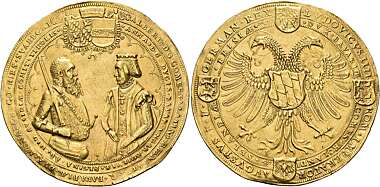
Lote 1127. Duchy of Bayern. Albrecht V, 1550-1579. Medal (25 Ducats) undated (c. 1575), AV 73 mm, 86.67 g. ALBERT9 D G COMES PALATIN9 RHENI VTRI9 Q BAVARÆ DVX MONARCH CO HIRS SVABECRI / ANNA D G DVCIS BAVAR VNGAR BOHEMIÆ REGINA ARCHID AVSTRIÆ COMIT TIROLIS Hip-length portraits of the late Duke and Duchess Anna of Austria, facing each other. The Duke armoured, bareheaded, with shouldered sword and chain of the Order of the Golden Fleece, the Duchess with a decorated bodice and cap on her head; the shields of of arms of Bavaria and Habsburg surrounded by the chain of the Golden Fleece above, surmounted by two angels with wreaths supporting the duke's coronet. multifoil border around the field. Rev. LVDOVICVS IIII - ROM IMPERATOR - AVGVSTVS P F - GERMAN REX / DVX BAVARIÆ - COMES HOLANDI-Æ SELANDIÆ - FRISIÆ Double-headed eagle with Bavarian shield of arms on its breast, the legend is interrupted by four shields of arms: At the top, the quartered Bavarian, at the bottom, the single-headed eagle, on the left, the two leopards of Friesland; on the right, the four lions of Zeeland. Beierlein 393 (AR); Habich p 470, illus. 485 (AR). Unique and from the Wittelsbach family’s collection. An exquisite struck medal and a true masterpiece from the late German Renaissance. Minor marks, otherwise about extremely fine Ex Waldo Newcomer Collection - privately purchased from J. Schulman 13.12.1936. Ex Leo Hamburger, Frankfurt sale 7.4.1924, 501 (result 7'150.- Rentenmark =1'700 USD). From the collection of the former Kings of Bavaria. We are aware of three pieces in silver, all of which are in public collections (Munich, Vienna and Berlin ex Auktion Schulthess-Rechberg 1869, no. 3311). The occasion for the minting of this undated medal remains unclear, just as the engraver of what is arguably the most beautiful medal of German Mannerism could not be identified, even though this unique piece has been the subject of numerous studies for over 200 years (Hermann Scholliner, Muthmaßliche Erklärung einer seltenen Medaille Albrecht des Fünften, Herzogs in Baiern, in: Historische Abhandlungen der königlich-baierischen Akademie der Wissenschaften 1, 1807, 239-258; Franz Ignaz Streber, Ueber einige seltene und unbekannte Schaumünzen Herzogs Albert V. aus Baiern, Eine Vorlesung gehalten in der öffentlichen Versammlung der königl. Akademie der Wissenschaften den 12. October 1814, München 1819; J. V. Kull, Die Münzen, Medaillen und Siegel Kaiser Ludwigs IV des Bayern, in: MBNG 6, 1887, p 1-40, no. 88; K. Roll, Zu den Medaillen Albrechts V. von Bayern, in: MBNG 26/27, 1908/1909, p. 46-47). On the one hand, the iconographic programme highlights the close connection between the House of Wittelsbach and the House of Habsburg; on the other hand, the seal-like design on the reverse and the mention of the last emperor from the House of Wittelsbach, Ludwig IV, the Bavarian, also reflects the line of succession of the House of Habsburg. There was hope that, should the male line of the Habsburgs die out, the Bavarian House would inherit the Habsburg legacy. The collections of the art lover Albrecht V not only formed the foundation of the Bavarian State Library and the Munich art museums, but also of the State Coin Collection in Munich. The creator of this work of art is likely to be sought among the successors of the Bavarian sculptor and medalist Hans Aesslinger (†1567), or possibly Hans Wild, who is documented in Tyrol and Augsburg in the 1560s; Georg Habich cautiously suggested Peter Weyherr (MBNG 26/27, 1908/1909, p. 49). Whether the medal was minted at the Munich mint, which closed in 1573, or at the Salzburg mint in 1576/1577 remains an open question. Please find here the video of the coin
 consentmanager.net