Se connecter pour des enchères en direct
Nomos AG Logo
Lot
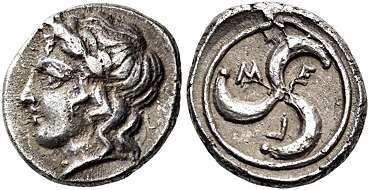
Lot 201. MEGARIS. Megara. Circa 375-338 BC. Trihemiobol (Silver, 12 mm, 1.60 g, 12 h), Aeginetic standard. Laureate head of Apollo to left, his long hair falling down the back of his neck. Rev. Μ - Ε - Γ Triskeles of crescents (=mark of value?) curving to right. BCD Peloponnesos 6.3 (this reverse die). BMC 3 (no denomination). Dreni, Period I. HGC 4, 1787. SNG Copenhagen 462 (Attic triobol?). Traité II, 3, 106 and pl. CXCIV, 9 (Corinthian triobol). Porous surfaces. Good very fine. This is presumably an Aeginetic trihemiobol (putative weight, 1.55 g) rather than any of the other strange denominations it has been termed. It was also struck in very small numbers and, like all the other coins of this series, it is commonly found in rather worn condition (if found at all); this indicates that they circulated for a considerable time and were not hoarded when new. It also suggests that Megara simply was not prosperous enough to require a more extensive coinage. As such this is a remarkably fine example of these elusive coins!
  • Mise à prix:
    600 CHF
    653 EUR
    545 GBP
    734 USD

    Valeurs approximatives et arrondiesDate: 04/11/2026
Lot
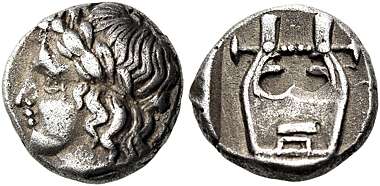
Lot 202. Extremely rare Megara diobol MEGARIS. Megara. Circa 385-375 BC. Diobol (Silver, 10 mm, 1.36 g, 6 h), Aeginetic standard. Laureate head of Apollo to left. Rev. [MEΓA] Kithara within shallow incuse square. BCD -. BMC 4-5. Dreni, Period I. HGC -. Pozzi 2022. SNG Copenhagen 463-464. Extremely rare, Dreni only knew of six examples. Clear and nicely toned. Struck on a slightly narrow flan, otherwise, nearly extremely fine.
  • Mise à prix:
    600 CHF
    653 EUR
    545 GBP
    734 USD

    Valeurs approximatives et arrondiesDate: 04/11/2026
Lot
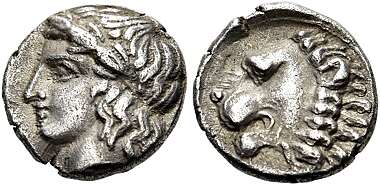
Lot 203. MEGARIS. Megara. Circa 375-338 BC. Obol (Silver, 9.5 mm, 0.86 g, 7 h), Aeginetic standard. Laureate head of Apollo to left. Rev. Lion's head facing to left. As Megara: BMC -. HGC 4, -. SNG Copenhagen -. As Oitaioi, in error: see De Luynes 1854 = Traité II, 4, 441 and pl. CCLXXXVII, 5. Extremely rare, the second example known and the only one in private hands. Toned and of lovely style. Minor roughness, otherwise, good very fine. In the Traité, Babelon mistakenly cited the de Luynes example as having a lion with a spearhead in its mouth, as is standard for the coinage of the Oitaioi. Thus, his mint attribution. However, what he thought was a spear tip was actually a simple die break.In addition, this coinʼs fabric and style are quite different from the Oitaian issues (especially since Apollo does not appear there: though he does, quite suitably, appear on the coinage of Megara).
  • Mise à prix:
    1'000 CHF
    1'089 EUR
    908 GBP
    1'223 USD

    Valeurs approximatives et arrondiesDate: 04/11/2026
Lot
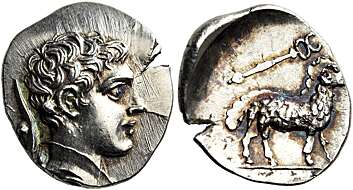
Lot 204. ARKADIA. Pheneos. Circa 370-340 BC. Obol (Silver, 13 mm, 0.90 g, 2 h), Aeginetic standard. Bust of youthful Hermes to right, his cloak tied around his neck and with his petasos hanging behind, suspended by a cord. Rev. [ΦΕ] Ram standing to right; above, kerykeion to right. BCD Peloponnesos 1608. BMC 5. Traité II, 3, 891. Weber 4317. Rare. With a wonderful head of Hermes in high relief on the obverse. Minor flan crack and with a slightly double-struck reverse, otherwise, virtually as struck. From a European collection, ex Nomos 6, 8 May 2012, 78, and originally acquired prior to 2009. The main 4th century silver coinage of Pheneos consisted of very rare staters and drachms and very scarce hemidrachms, all bearing heads of Demeter on their obverses and either a standing or seated figure of Hermes or a bull on their reverses. Most of these coins were probably used for trade or mercenary pay. For local use the city also issued bronzes and a relatively small and rare group of obols, as this, bearing a head of Hermes and a ram.
  • Mise à prix:
    1'200 CHF
    1'307 EUR
    1'090 GBP
    1'468 USD

    Valeurs approximatives et arrondiesDate: 04/11/2026
Lot
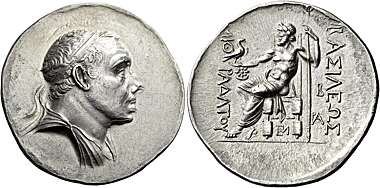
Lot 205. KINGS OF PONTOS. Mithradates III, circa 220-200 BC. Tetradrachm (Silver, 34 mm, 16.86 g, 12 h). Diademed and draped bust of Mithradates to right. Rev. ΒΑΣΙΛΕΩΣ - MIΘ-PAΔATOY Zeus seated to left on a high-backed throne, holding a long scepter with his left hand and, in his extended right, an eagle with closed wings standing to right; in the inner field to left, below his extended hand, eight-pointed star within a crescent; below throne, monogram of EMΠ; in the inner field to right, B over monogram of ΡΑ. De Callataÿ, First, 5 (O5/R1) = Mattingly, "The Coinage of Mithridates III, Pharnakes and Mithridates IV of Pontos", Studies Price, pl. 56, 4 (same dies). Very rare. Well-centered, toned and clear. Struck in high relief. A coin of wonderful quality. Obverse with traces of very light double striking, otherwise, good extremely fine. From a European collection, ex Nomos 32, 8 June 2024, 434. This impressive coin was struck by one of the most obscure and mysterious kings of the early Mithradatic dynasty of Pontos. Aside from his production of a handsome series of tetradrachms featuring a remarkably veristic portrait, virtually nothing is known about Mithradates III. Nevertheless, he is sometimes suspected of having been responsible for a failed Pontic attack on the Greek city of Sinope at the beginning of his reign, although this event might have taken place under the rule of his predecessor. https://cdn.nomosag.com/auctions/95/video00205.mp4?sv=2023-01-03&ss=b&srt=co&st=2025-03-10T16%3A25%3A27Z&se=2099-03-11T16%3A25%3A00Z&sp=rl&sig=i7RzFAqwYGMJUp3u71BbRyL3HhIAtR%2F8cUnRnTVQfyU%3D&rsct=video%2Fmp4
  • Mise à prix:
    24'000 CHF
    26'149 EUR
    21'802 GBP
    29'364 USD

    Valeurs approximatives et arrondiesDate: 04/11/2026
Lot
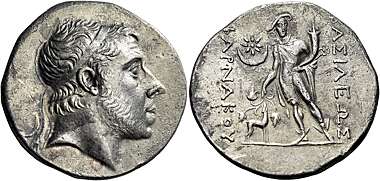
Lot 206. KINGS OF PONTOS. Pharnakes I, circa 200-179 BC. Tetradrachm (Silver, 30.5 mm, 16.71 g, 12 h), Sinope. Diademed and bearded head of Pharnakes I to right. Rev. BAΣIΛEΩΣ - ΦAPNAKOY Uncertain male figure standing facing, wearing a floppy petasos, a chlamys and low boots, holding a cornucopia and a kerykeion with his left hand and a vine branch, from which a deer, standing to right, eats the leaves, with his right; in the upper inner field to left, eight-pointed star within a crescent with points upwards. De Callataÿ First, - (but cf. fig. 19 = Pharnakes, with the monogram ΠΥΜ O5/R1, for a die pair that is stylistically very similar to our piece). Extremely rare, possibly unique lacking a monogram, and with a powerfully realistic portrait. Surfaces with some traces of corrosion, otherwise, about extremely fine. The figure on the reverse, presumably a god, or at least a hero, is most difficult to identify. This is because he bears what might be termed 'composite attributes': singly they identify the person carrying them, but all together they are quite confusing. His petasos, cloak and boots point toward a hunter; the vine branch suggests Dionysos; the kerykeion is usually held by Hermes; as for the cornucopiae, it is often associated with Plutus, but Plutus is traditionally depicted as a child, and never as a hunter. He must be the hellenised version of a deity local to Pontos. https://cdn.nomosag.com/auctions/95/video00206.mp4?sv=2023-01-03&ss=b&srt=co&st=2025-03-10T16%3A25%3A27Z&se=2099-03-11T16%3A25%3A00Z&sp=rl&sig=i7RzFAqwYGMJUp3u71BbRyL3HhIAtR%2F8cUnRnTVQfyU%3D&rsct=video%2Fmp4
  • Mise à prix:
    8'000 CHF
    8'716 EUR
    7'267 GBP
    9'788 USD

    Valeurs approximatives et arrondiesDate: 04/11/2026
Lot
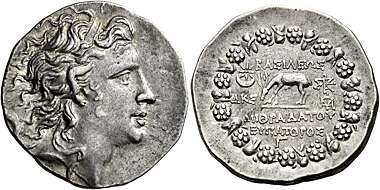
Lot 207. KINGS OF PONTOS. Mithradates VI Eupator, circa 120-63 BC. Tetradrachm (Silver, 31 mm, 16.78 g, 11 h), Pergamon mint, dated to month Γ = 3, year ΔΚΣ = 224 = December 74. Diademed head of Mithradates VI to right. Rev. ΒΑΣΙΛΕΩΣ - ΜΙΘΡΑΔΑΤΟΥ/ΕYΠΑΤΟΡΟΣ Stag grazing to left; in the field to left, eight-pointed star within a crescent with points upward, over ΔΚΣ; in the field to right, monogram of ΣΤΑKΩ over monogram of ΑΥΡ; below, Γ; all within a Dionysiac wreath of ivy and fruit. Callataÿ p.21, D62. DCA2 561. HGC 7, 340. SNG Copenhagen 236. SNG Delepierre 2476. Toned and well-centered. Minor marks, otherwise, good very fine. From the Down-Under Collection and from the Wild Rose Collection (= Terrence Cheesman), Classical Numismatic Group 126, 28 May 2024, 203, acquired privately from Gorny &; Mosch in January 2018, ex Roma XIV, 21 September 2017, 274 and Roma XII, 29 September 2016, 359. https://cdn.nomosag.com/auctions/95/video00207.mp4?sv=2023-01-03&ss=b&srt=co&st=2025-03-10T16%3A25%3A27Z&se=2099-03-11T16%3A25%3A00Z&sp=rl&sig=i7RzFAqwYGMJUp3u71BbRyL3HhIAtR%2F8cUnRnTVQfyU%3D&rsct=video%2Fmp4
  • Mise à prix:
    2'000 CHF
    2'179 EUR
    1'816 GBP
    2'447 USD

    Valeurs approximatives et arrondiesDate: 04/11/2026
Lot
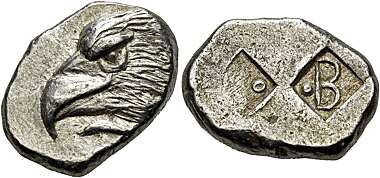
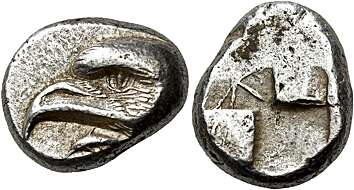
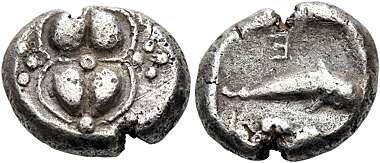
Lot 208. PAPHLAGONIA. Sinope. Circa 425-410 BC. Drachm (Silver, 19 mm, 6.08 g), Aeginetic standard. Head of a sea eagle to left; below, dolphin swimming to left. Rev. Quadripartite incuse square composed of two raised and two sunken squares; within one of the sunken squares, a pellet (and an effaced letter?); in the opposing square, a pellet and a large letter B. HGC 7, 387. SNG BM Black Sea 1371. SNG Stancomb -. SNG von Aulock 6839. Among the best examples of this type known. With a very beady-eyed eagle in high relief. Nearly extremely fine.
  • Mise à prix:
    800 CHF
    871 EUR
    726 GBP
    978 USD

    Valeurs approximatives et arrondiesDate: 04/11/2026
Lot
Lot 209. PAPHLAGONIA. Sinope. Circa 425-410 BC. Drachm (Silver, 17 mm, 6.11 g), Aeginetic standard. Head of a sea eagle to left; below, dolphin swimming to left. Rev. Quadripartite incuse square composed of two raised and two sunken squares; within one of the sunken squares, K. HGC 7, 388 var. (pellet in quarters). SNG Ashmolean 265. SNG BM Black Sea -. SNG von Aulock 6837. About extremely fine. This is a remarkably fine example of an Aeginetic weight drachm from Sinope. The early issues bear a head that is crudely schematic; this changes over time to a rudely powerful one, with long parallel feathers and a strongly curved beak. Unlike all of those, the present piece was struck from dies cut by an artist-engraver who was both fully conversant with the contemporary stylistic trends in Greek art, and had the ability to use them.
  • Mise à prix:
    800 CHF
    871 EUR
    726 GBP
    978 USD

    Valeurs approximatives et arrondiesDate: 04/11/2026
Lot
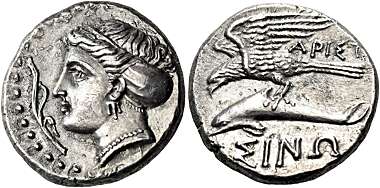
Lot 210. PAPHLAGONIA. Sinope. Circa 330-300 BC. Drachm (Silver, 18.5 mm, 6.05 g, 6 h), struck under the magistrate Aristoboulos. Head of the nymph Sinope to left, her hair bound in a sakkos and wearing a triple-pendant earring and a pearl necklace; before her to left, aplustre. Rev. ΣΙΝΩ Sea-eagle with spread wings standing on dolphin swimming to left; below eagle's wings, ΑΡΙΣΤ. HGC 7, 391. SNG BM Black Sea 1462 (same dies). RG 31. Fine late Classical style. Extremely fine.
  • Mise à prix:
    400 CHF
    435 EUR
    363 GBP
    489 USD

    Valeurs approximatives et arrondiesDate: 04/11/2026
Lot
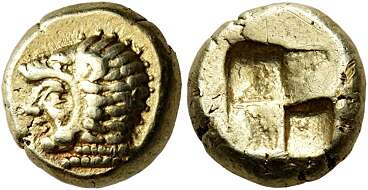
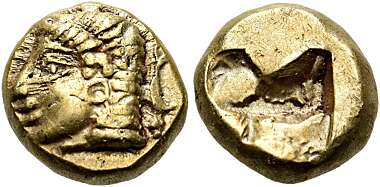
Lot 211. BITHYNIA. Herakleia Pontika. Circa 500 BC. Hekte (Electrum, 10 mm, 2.54 g). Head of Herakles to left, wearing lion's skin headdress. Rev. Quadripartite incuse square. Fischer-Bossert, Elektronhekten 156 (V71 R114). SNG Kayhan 737-738 (Erythrai). SNG von Aulock 1942 (Erythrai). Well-centered. Light scratches, otherwise, good very fine. Up until a short time ago the relatively common electrum coins of this type were attributed to Erythrae in Ionia, however, in 2020 W. Fischer-Bossert (NZ 126, 2020, pp. 15-166) published an extensive article, "Die Elektronhekten mit dem Herakleskopf: Herakleia Pontike, nicht Erythrai", proving they were better located at Herakleia Pontika.
  • Mise à prix:
    600 CHF
    653 EUR
    545 GBP
    734 USD

    Valeurs approximatives et arrondiesDate: 04/11/2026
Lot
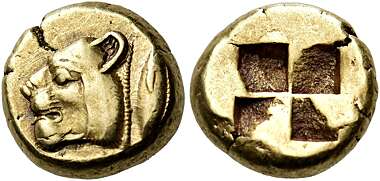
Lot 212. MYSIA. Kyzikos. Circa 550-500 BC. Hekte (Electrum, 11 mm, 2.75 g). Head of a lioness to left; behind, tunny swimming upwards. Rev. Quadripartite incuse square. BMFA 1413. HGC 8.1, 267. Rosen 432. SNG Paris 178. Von Fritze 39. Clear and well struck. About extremely fine.
  • Mise à prix:
    600 CHF
    653 EUR
    545 GBP
    734 USD

    Valeurs approximatives et arrondiesDate: 04/11/2026
Lot
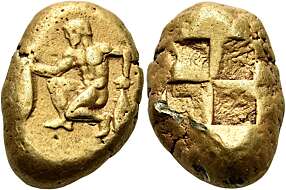
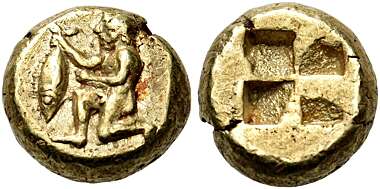
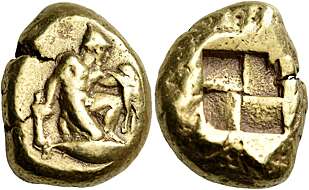
Lot 213. MYSIA. Kyzikos. Circa 550-500 BC. Stater (Electrum, 23 mm, 15.99 g). Nude male athlete kneeling to left, holding a tunny by the tail in each hand. Rev. Quadripartite incuse square. BMFA 1478. Greenwell 87. HGC 8.1, 103. SNG Paris -. Von Fritze 70, and pl. II, 23. Removed from NGC holder #4632785-004, where it was graded "choice VF". Very rare. Attractive, clear and well-centered. Scuff on the reverse, otherwise, good very fine. From a European collection, ex Nomos 25, 20 November 2022, 165. The figure on the obverse is an illustration of one of the events held during the Kyzikene Games in honor of city's fishing fleet. Ephebes, nude, would run a course holding a heavy fish in each hand, after starting from a kneeling position (shown here). The race was the length of a stadion (600 ancient feet) and the winner was the runner who managed to cross the finish line still holding the slippery fish. https://cdn.nomosag.com/auctions/95/video00213.mp4?sv=2023-01-03&ss=b&srt=co&st=2025-03-10T16%3A25%3A27Z&se=2099-03-11T16%3A25%3A00Z&sp=rl&sig=i7RzFAqwYGMJUp3u71BbRyL3HhIAtR%2F8cUnRnTVQfyU%3D&rsct=video%2Fmp4
  • Mise à prix:
    4'000 CHF
    4'358 EUR
    3'633 GBP
    4'894 USD

    Valeurs approximatives et arrondiesDate: 04/11/2026
Lot
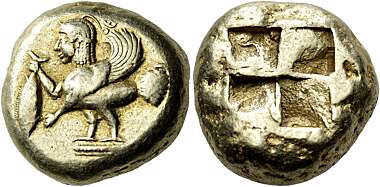
Lot 214. MYSIA. Kyzikos. Circa 550-500 BC. Stater (Electrum, 19 mm, 16.08 g). Harpy, her diademed head adorned with a plume, standing to left on a dotted ground line, holding a tunny by its tail with her right hand and supporting it with her left. Rev. Quadripartite incuse square. BMFA 1441. Greenwell 97. HGC 8.1, 107 (this coin). Cf. SNG Paris 203-4 (hektes). Von Fritze 74, and pl. II, 29 (same obverse die?). Light toning around the devices, perfect centering; clearly among the best examples known. Good very fine. From a European collection, ex Nomos 25, 20 November 2022, 166, ex Roma XVIII, 29 September 2019, 614, and from the A.F. Collection, Roma XV, 5 April 2018, 217. What is this harpy doing? On the surface she is simply holding the city badge, thus connecting the magistrate's identifier - the harpy - with the city in a more intimate way since she is not just standing on the tunny. But could it be more than that? Could it be that the die was designed as a kind of "in-joke" referring to a well-known woman, the owner of one of the fish markets of Kyzikos? Or is she displaying the fish to a customer and saying, "Such a nice fish! For you, the best I'm giving!!". https://cdn.nomosag.com/auctions/95/video00214.mp4?sv=2023-01-03&ss=b&srt=co&st=2025-03-10T16%3A25%3A27Z&se=2099-03-11T16%3A25%3A00Z&sp=rl&sig=i7RzFAqwYGMJUp3u71BbRyL3HhIAtR%2F8cUnRnTVQfyU%3D&rsct=video%2Fmp4
  • Mise à prix:
    6'000 CHF
    6'537 EUR
    5'450 GBP
    7'341 USD

    Valeurs approximatives et arrondiesDate: 04/11/2026
Lot
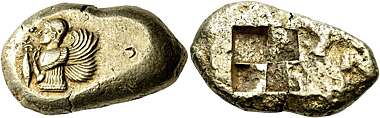
Lot 215. Among the best known! MYSIA. Kyzikos. Circa 550-500 BC. Stater (Electrum, 27x15.5 mm, 16.14 g). Half-length bust of a winged woman, perhaps a harpy, to left, wearing a chiton with tight folds, a tight-fitting cap and a circular hoop earring, holding a tunny by the tail in her right hand and a flower in her left. Rev. Quadripartite incuse square. BMFA 1448. Greenwell 98. HGC 8.1, 108. SNG Paris 205 (same obverse die). Von Fritze 75, and pl. II, 30. A fascinating type sharply struck on an oblong flan, surely one of the finest examples known. Very attractive and clear. Minor banker's mark in the obverse field, otherwise, extremely fine. From a European collection, ex Nomos 25, 20 November 2022, 168, Roma 1, 27 September 2015, 479. This is thought to be a harpy, but is it??? Do harpies wear chitons or peploi or other such feminine garments? This winged female certainly is wearing something, so perhaps she is some other kind of winged female. She is holding a fish, but she is also holding a flower; could she be doing so to disguise the fish's aroma - might she have bought it on discount at the end of the day? Is she thinking, "once I put some good sauce on this and grill it to a toast everyone will be happy!". https://cdn.nomosag.com/auctions/95/video00215.mp4?sv=2023-01-03&ss=b&srt=co&st=2025-03-10T16%3A25%3A27Z&se=2099-03-11T16%3A25%3A00Z&sp=rl&sig=i7RzFAqwYGMJUp3u71BbRyL3HhIAtR%2F8cUnRnTVQfyU%3D&rsct=video%2Fmp4
  • Mise à prix:
    10'000 CHF
    10'895 EUR
    9'084 GBP
    12'235 USD

    Valeurs approximatives et arrondiesDate: 04/11/2026
Lot
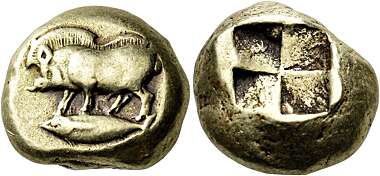
Lot 216. MYSIA. Kyzikos. Circa 500-450 BC. Stater (Electrum, 18.5 mm, 16.18 g). Boar standing to left on tunny swimming to left. Rev. Quadripartite incuse square. BMFA -. Greenwell 136. HGC 8, 122. Jameson 2164. SNG von Aulock 7275. Von Fritze 90 (same obverse die). Very well centered; toned around the devices. Good very fine. https://cdn.nomosag.com/auctions/95/video00216.mp4?sv=2023-01-03&ss=b&srt=co&st=2025-03-10T16%3A25%3A27Z&se=2099-03-11T16%3A25%3A00Z&sp=rl&sig=i7RzFAqwYGMJUp3u71BbRyL3HhIAtR%2F8cUnRnTVQfyU%3D&rsct=video%2Fmp4
  • Mise à prix:
    4'000 CHF
    4'358 EUR
    3'633 GBP
    4'894 USD

    Valeurs approximatives et arrondiesDate: 04/11/2026
Lot
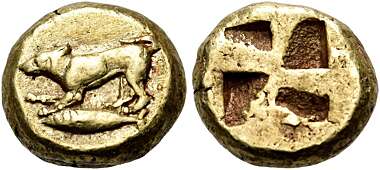
Lot 217. MYSIA. Kyzikos. Circa 500-450 BC. Hekte (Electrum, 10 mm, 2.71 g). Hunting dog prowling left, right forepaw raised; below, tunny fish swimming to left. Rev. Quadripartite incuse square. BMFA 1469. HGC 8.1, 313. SNG Paris 231-2. SNG von Aulock 1192. Von Fritze 93. Perfectly centered. Good very fine.
  • Mise à prix:
    600 CHF
    653 EUR
    545 GBP
    734 USD

    Valeurs approximatives et arrondiesDate: 04/11/2026
Lot
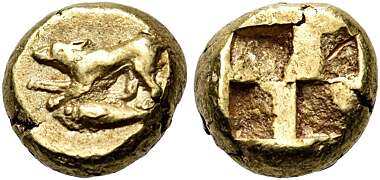
Lot 218. MYSIA. Kyzikos. Circa 500-450 BC. Hemihekte or 1/12 Stater (Electrum, 7 mm, 1.37 g). Hunting dog prowling left, right forepaw raised; below, tunny fish swimming to left. Rev. Quadripartite incuse square. BMFA 1471. HGC 8.1, 421. SNG Paris 233-5. Von Fritze 93. Quite scarce in this denomination; well-centered and attractive. Good very fine.
  • Mise à prix:
    360 CHF
    392 EUR
    327 GBP
    440 USD

    Valeurs approximatives et arrondiesDate: 04/11/2026
Lot
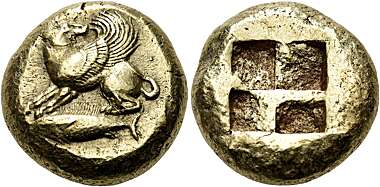
Lot 219. MYSIA. Kyzikos. Circa 500-450 BC. Stater (Electrum, 19 mm, 16.14 g). Winged dog, his head turned back to right, crouching to left on a tunny. Rev. Quadripartite incuse square. BMFA 1433. Greenwell 140. HGC 8.1, 136. SNG Paris 245. Von Fritze 104, and pl. III, 23. Well-centered and nicely struck. Minor marks, otherwise, nearly extremely fine. From a European collection, ex Nomos 25, 20 November 2022, 174, ex Roma XX, 29 October 2020, 216. https://cdn.nomosag.com/auctions/95/video00219.mp4?sv=2023-01-03&ss=b&srt=co&st=2025-03-10T16%3A25%3A27Z&se=2099-03-11T16%3A25%3A00Z&sp=rl&sig=i7RzFAqwYGMJUp3u71BbRyL3HhIAtR%2F8cUnRnTVQfyU%3D&rsct=video%2Fmp4
  • Mise à prix:
    3'200 CHF
    3'486 EUR
    2'906 GBP
    3'915 USD

    Valeurs approximatives et arrondiesDate: 04/11/2026
Lot
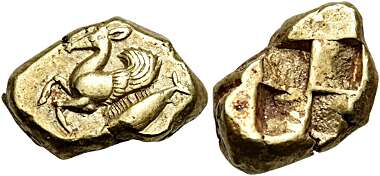
Lot 220. MYSIA. Kyzikos. Circa 500-450 BC. Hekte (Electrum, 13 mm, 2.70 g). Forepart of winged stag to left; below, tunny fish downwards to left. Rev. Quadripartite incuse punch. HGC 8.1, 319. SNG Paris 241. Von Fritze I 102. Oblong flan, otherwise, good very fine.
  • Mise à prix:
    400 CHF
    435 EUR
    363 GBP
    489 USD

    Valeurs approximatives et arrondiesDate: 04/11/2026
Lot
Lot 221. MYSIA. Kyzikos. Circa 500-450 BC. Hemihekte or 1/12 Stater (Electrum, 8 mm, 1.37 g). Nude male kneeling to left, holding a tunny fish with his right hand. Rev. Quadripartite incuse punch. BMFA 1489. HGC 8.1, 427. SNG Paris 253 var. (stater). Von Fritze I 112. Very well centered; toned. Good very fine.
  • Mise à prix:
    360 CHF
    392 EUR
    327 GBP
    440 USD

    Valeurs approximatives et arrondiesDate: 04/11/2026
Lot
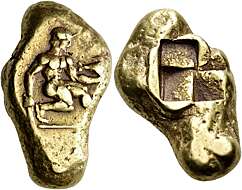
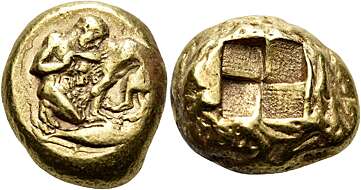
Lot 222. MYSIA. Kyzikos. Circa 500-450 BC. Stater (Electrum, 26x15 mm, 16.00 g). Youthful male figure, wearing taenia with frontal horn (Pan?), kneeling to right, holding tunny with his extended left hand and preparing to cut it with a knife held in his right hand. Rev. Quadripartite incuse square. BMC 30. BMFA 1479. Greenwell 88. HGC 8, 143. SNG France 245. Von Fritze I 113. Struck on a curiously oblong flan, but still clear and intriguing. Nearly extremely fine. Who is this muscular young man? And why does he wear this odd taenia that has something upright above his forehead like the snake on the Egyptian uraeus? Not only that, why does he hold his sword, a kopis, in one hand and a tunny in the other: is he a fish seller? It is interesting to note how most commentators describe what they see on coins like this, but virtually never explain what they have described! Let's try. Perhaps what we have here is the winner of a ritual race: he is nude (as ancient Greek athletes were), wears an honorary headdress, and bears a tunny (symbol of the city of Kyzikos), which he has safely carried from the harbour (protected by his kopis) to the sanctuary. There it will be sacrificed to Kore, with parts being dedicated to her and the remainder eaten raw (with a sacred sauce) by the priests and worshippers. Apparently there was a similar ritual in Medieval Japan but a direct connection seems unlikely. https://cdn.nomosag.com/auctions/95/video00222.mp4?sv=2023-01-03&ss=b&srt=co&st=2025-03-10T16%3A25%3A27Z&se=2099-03-11T16%3A25%3A00Z&sp=rl&sig=i7RzFAqwYGMJUp3u71BbRyL3HhIAtR%2F8cUnRnTVQfyU%3D&rsct=video%2Fmp4
  • Mise à prix:
    8'000 CHF
    8'716 EUR
    7'267 GBP
    9'788 USD

    Valeurs approximatives et arrondiesDate: 04/11/2026
Lot
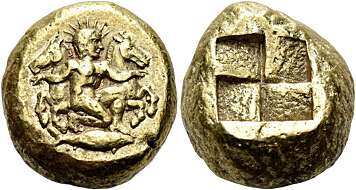
Lot 223. MYSIA. Kyzikos. Circa 450-400 BC. Stater (Electrum, 18 mm, 16.14 g). Helios, nude and with his head radiate, kneeling to right, holding, in each hand, the bridles of two horses galloping to left and to right behind him; below, tunny swimming to right. Rev. Quadripartite incuse square. BMFA 1515. HGC 8, 173. SNG Paris 274. SNG von Aulock 7311. Von Fritze 148. Very rare, perfectly centered on the flan, and with Helio's head unusually clear; a wonderfully detailed and attractive example. Somewhat porous, otherwise, good very fine. The obverse of this coin shows Helios with two of his horses, the ones that drew him across the sky as he carried the sun. Is he getting ready to set off on his journey, or has he just come back? The perfectly symmetrical composition of this type is sometimes compared to contemporary sculpture, especially temple metopes. This may well be right, but no matching metopes have yet been found at Kyzikos, and no strong connection between the city and the god is attested. However, on their way to Colchis to take the Golden Fleece from King Aeëtes, the son of Helios (!), the Argonauts passed by Kyzikos and killed its eponymous king! https://cdn.nomosag.com/auctions/95/video00223.mp4?sv=2023-01-03&ss=b&srt=co&st=2025-03-10T16%3A25%3A27Z&se=2099-03-11T16%3A25%3A00Z&sp=rl&sig=i7RzFAqwYGMJUp3u71BbRyL3HhIAtR%2F8cUnRnTVQfyU%3D&rsct=video%2Fmp4
  • Mise à prix:
    12'000 CHF
    13'074 EUR
    10'901 GBP
    14'682 USD

    Valeurs approximatives et arrondiesDate: 04/11/2026
Lot
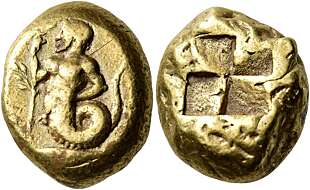
Lot 224. MYSIA. Kyzikos. Circa 450-400 BC. Stater (Electrum, 20 mm, 16.10 g). Kekrops standing to left, nude to the waist with his body ending in a coiled serpent's tail, leaning on an olive tree, which he grasps with his right hand, and resting his left hand on his side just above his waist; below, tunny swimming to left. Rev. Quadripartite incuse square. BMFA 1499. HGC 8, 183. Von Fritze 158. Extremely rare. Well-centered and with a fascinating mythological type connected to Athens. Light scratch and some flatness, otherwise, very fine. Kekrops was the mythological first king of Attica: he was born from the Earth and his body ended in a serpent's tail rather than legs. He appears on Athenian Red Figure pottery and his statue was in the West Pediment of the Parthenon. On this coin he is holding the olive tree that Athena gave to Athens during her contest with Poseidon for the city's allegiance. As the story goes, Poseidon offered a salt-water spring on the Acropolis and Athena presented the olive: Kekrops chose Athena's gift and, thus, Athena became the city's patroness and the city was named after her. The fact that this distinctly Athenian myth should appear on the coinage of Kyzikos can be explained by the close ties between the two cities. https://cdn.nomosag.com/auctions/95/video00224.mp4?sv=2023-01-03&ss=b&srt=co&st=2025-03-10T16%3A25%3A27Z&se=2099-03-11T16%3A25%3A00Z&sp=rl&sig=i7RzFAqwYGMJUp3u71BbRyL3HhIAtR%2F8cUnRnTVQfyU%3D&rsct=video%2Fmp4
  • Mise à prix:
    3'200 CHF
    3'486 EUR
    2'906 GBP
    3'915 USD

    Valeurs approximatives et arrondiesDate: 04/11/2026
Lot
Lot 225. MYSIA. Kyzikos. Circa 430-400 BC. Stater (Electrum, 19 mm, 16.08 g). Youthful Herakles, nude and apparently beardless, kneeling to right, strangling the Nemean Lion struggling to left; below tunny to right. Rev. Quadripartite incuse square. BMFA 1494. HGC 8, 185. SNG Paris 308. Von Fritze 161 and pl. V, 9. Extremely rare type. Nicely centered. Slightly double-struck and with a little die rust, otherwise, about extremely fine. https://cdn.nomosag.com/auctions/95/video00225.mp4?sv=2023-01-03&ss=b&srt=co&st=2025-03-10T16%3A25%3A27Z&se=2099-03-11T16%3A25%3A00Z&sp=rl&sig=i7RzFAqwYGMJUp3u71BbRyL3HhIAtR%2F8cUnRnTVQfyU%3D&rsct=video%2Fmp4
  • Mise à prix:
    8'000 CHF
    8'716 EUR
    7'267 GBP
    9'788 USD

    Valeurs approximatives et arrondiesDate: 04/11/2026
Lot
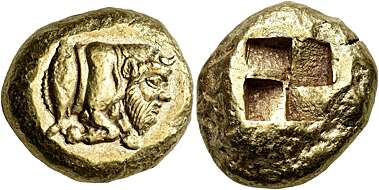
Lot 226. MYSIA. Kyzikos. Circa 500-450 BC. Stater (Electrum, 19.5 mm, 16.12 g). Forepart of man-headed bull - a river god - to right; behind, tunny swimming upwards. Rev. Quadripartite incuse square. BMFA 1491. Greenwell 51. HGC 8.1, 198. SNG Paris 320. Von Fritze 174 and pl. V, 22. Rare. With a powerful, rather wild-looking 'portrait' of a river god, much less mannered looking than others in this series. Minor marks and scrapes, otherwise, about extremely fine. In 1887, Greenwell described this type as a straight copy of the standard coin of Gela in Sicily, noting that it could have come from the Gela mint itself, were it not for the electrum and the tunny. Kyzikos is well known for borrowing other cities' coin types, among them the dolphin rider and horseman of Taras, the female head of Syracuse and the Pegasos of Corinth. The city's far-flung trading contacts probably played a part in this. https://cdn.nomosag.com/auctions/95/video00226.mp4?sv=2023-01-03&ss=b&srt=co&st=2025-03-10T16%3A25%3A27Z&se=2099-03-11T16%3A25%3A00Z&sp=rl&sig=i7RzFAqwYGMJUp3u71BbRyL3HhIAtR%2F8cUnRnTVQfyU%3D&rsct=video%2Fmp4
  • Mise à prix:
    12'000 CHF
    13'074 EUR
    10'901 GBP
    14'682 USD

    Valeurs approximatives et arrondiesDate: 04/11/2026
Lot
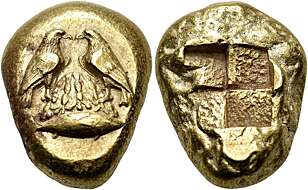
Lot 227. MYSIA. Kyzikos. Circa 450-400 BC. Stater (Electrum, 20.5 mm, 16.15 g). Two eagles, with closed wings, facing each other while perched on a filleted omphalos; below, tunny to right. Rev. Quadripartite incuse square. BMFA 1535. HGC 8, 245. SNG Paris 348. Von Fritze 220. Rare. Sharply struck and lightly toned. Some areas flatly struck, otherwise, nearly extremely fine. This coin refers to one of the legends concerning the founding of the sanctuary of Delphi. To determine the center of the Earth Zeus released two eagles from the ends of the world, one flying east and the other west. Where they met in the sky was deemed the center, and the spot on the ground below, coincidentally the site of Apollo's Temple, was marked by a conical stone - the omphalos - which was effectively the navel of the world. This coin shows the two eagles perched on the omphalos, already decorated with fillets. https://cdn.nomosag.com/auctions/95/video00227.mp4?sv=2023-01-03&ss=b&srt=co&st=2025-03-10T16%3A25%3A27Z&se=2099-03-11T16%3A25%3A00Z&sp=rl&sig=i7RzFAqwYGMJUp3u71BbRyL3HhIAtR%2F8cUnRnTVQfyU%3D&rsct=video%2Fmp4
  • Mise à prix:
    8'000 CHF
    8'716 EUR
    7'267 GBP
    9'788 USD

    Valeurs approximatives et arrondiesDate: 04/11/2026
Lot
Lot 228. MYSIA. Kyzikos. Circa 430-400 BC. Stater (Electrum, 21 mm, 15.94 g). Young man, nude but for the pilos he wears on his head, kneeling to right, holding a slim club in his lowered right hand and brandishing a shield-like lion (?) skin with his left; below, tunny to right. Rev. Quadripartite incuse square. BMC 71. Greenwell 68. Gulbenkian 637. HGC 8, 191. Jameson 2200. Von Fritze 167 and pl. V, 15. Very rare. Clear and well-centered. Minor die breaks and striking flatness, otherwise, very fine. Who is this nude young man wearing a pilos and holding a rather slim club that is almost, but not quite, a lagobolon? Can he be Herakles: if so, why is he wearing a pilos? One of the Dioskouroi: if so, why is he nude, lacking a star on his pilos, and carrying an animal skin and a club? Could he be Theseus? We are told he once played with Herakles' lionskin and once used a club - but where did he get the pilos? Puzzles like this are now best explained as being taken from a local myth that only appeared in ancient sources that haven't survived! Any better ideas?
  • Mise à prix:
    4'000 CHF
    4'358 EUR
    3'633 GBP
    4'894 USD

    Valeurs approximatives et arrondiesDate: 04/11/2026
Lot
Lot 229. MYSIA. Lampsakos. Circa 412 BC. Stater (Electrum, 20.5 mm, 15.38 g). Forepart of Pegasos with curved wings to left, surrounded by a vine with leaves and bunches of grapes. Rev. Quadripartite incuse square. Baldwin, Electrum pl. I, 11. BMC 9. BMFA 1582. HGC 8.1, 551. SNG Paris 1111. Clear and well-centered; light reddish tone. Very fine. From a European collection, Nomos 25, 20 November 2022, 187, ex Künker 295, 25 September 2017, 288 and Numismatica Ars Classica 78 - II, 27 May 2014, 1462 (from an Australian collection, originally purchased in 1999).
  • Mise à prix:
    4'000 CHF
    4'358 EUR
    3'633 GBP
    4'894 USD

    Valeurs approximatives et arrondiesDate: 04/11/2026
Lot
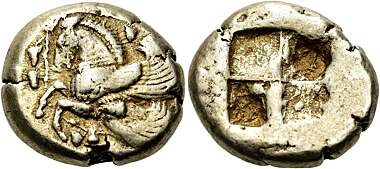
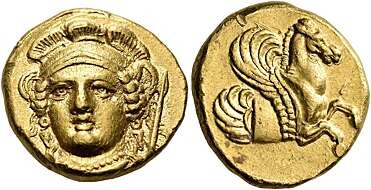
Lot 230. Unique Lampsakos stater MYSIA. Lampsakos. Circa 400-370 BC. Stater (Gold, 16.5 mm, 8.38 g, 3 h). Head of Athena Parthenos facing, turned slightly to the left, wearing a triple-crested Attic helmet with raised earflaps, disc earrings with double pendants and a pearl necklace; with the tip of her spear over left shoulder. Rev. Forepart of Pegasos to right, his right wing over his back and his left appearing behind the truncation. Cf. Baldwin 20 and pl. II, 14 = SNG Paris 1141 = Traité II 2, 2541 and pl. CLXXI, 7 (but with Athena's head turned slightly to the right and with no spear). Apparently unique, of particularly fine style and well-struck. Very minor marks and traces of die rust, otherwise, nearly extremely fine. It is not every day that one gets to catalogue a hitherto unknown gold stater of Lampsakos! We previously knew of a very similar type, but with Athena turned slightly to right (Baldwin 20; as Nomos 24, 2022, 178, one of three examples - from three different die pairs - that came on the market during the past generation); that die was much less artistically engraved than the one that struck the present example. The head of Athena we have here is a truly inspirational and noble one, looking off into the distance and clearly protective of the city the coins of which she adorns. https://cdn.nomosag.com/auctions/95/video00230.mp4?sv=2023-01-03&ss=b&srt=co&st=2025-03-10T16%3A25%3A27Z&se=2099-03-11T16%3A25%3A00Z&sp=rl&sig=i7RzFAqwYGMJUp3u71BbRyL3HhIAtR%2F8cUnRnTVQfyU%3D&rsct=video%2Fmp4
  • Mise à prix:
    24'000 CHF
    26'149 EUR
    21'802 GBP
    29'364 USD

    Valeurs approximatives et arrondiesDate: 04/11/2026
Lot
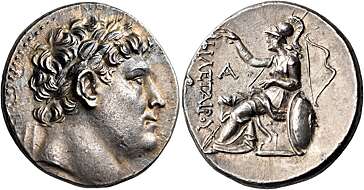
Lot 231. KINGS OF PERGAMON. Eumenes I, 263-241 BC. Tetradrachm (Silver, 29 mm, 16.99 g, 12 h), struck in the name of and with the portrait of Philetairos, founder of the kingdom, Pergamon, circa 255/50-241. Laureate head of Philetairos to right. Rev. ΦΙΛΕΤΑΙΡΟΥ Athena enthroned to left, crowning the royal name with a wreath held in her right hand, resting her left on her lap, and with her left elbow on a round shield by her side; in the field to left, ivy leaf; in the inner field, above her knee, Α; in the field to right, bow. HGC 8.1, 788. SNG Paris 1610. SNG von Aulock 1356. Westermark Group IVA (both dies unrecorded). Lovely light toning and superb details. Good extremely fine. Ex Roma XXV, 23 September 2022, 397, and from the JTB collection, privately acquired from Tradart in December 1988.
  • Mise à prix:
    1'200 CHF
    1'307 EUR
    1'090 GBP
    1'468 USD

    Valeurs approximatives et arrondiesDate: 04/11/2026
Lot
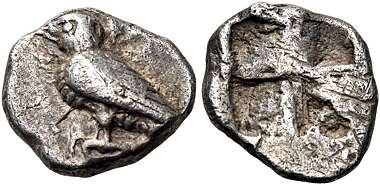
Lot 232. TROAS. Abydos. Circa 500-480 BC. Diobol (Silver, 11 mm, 1.24 g). Eagle with closed wings standing to left. Rev. Quadripartite incuse square. Rosen 526. SNG Copenhagen 1-2. SNG von Aulock 1439. Toned and well-centered on an irregular flan. Very fine. From the Apollo to Apollo Collection, acquired on 2 July 2022 from Odysseus Numismatique in Montpellier.
  • Mise à prix:
    200 CHF
    217 EUR
    181 GBP
    244 USD

    Valeurs approximatives et arrondiesDate: 04/11/2026
Lot
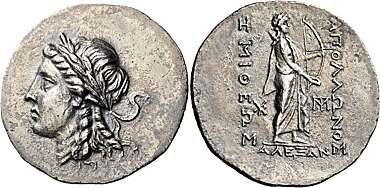
Lot 233. TROAS. Alexandreia. Circa 164-135 BC. Tetradrachm (Silver, 35 mm, 14.44 g, 12 h), Stephanephoric type, early series, c. 160s - 150s. Laureate head of Apollo to left. Rev. ΑΠΟΛΛΩΝΟΣ / ΣΜΙΘΕΩΣ / ΑΛΕΞΑΝ Draped figure of Apollo Smintheos standing to left, holding a phiale in his lowered right hand and a bow with an arrow with his left; in the inner field to left, monogram of ΧΡΥ; in the inner field to right, monogram of ΠΥΙ. Bellinger -. HGC 8.1, 921. SNG Copenhagen -. Struck from the same obverse die as Leu (W) 5, 2019, 112. Very rare, apparently the second example known. Toned and struck on a broad flan. Slightly rough surfaces, otherwise, nearly extremely fine. https://cdn.nomosag.com/auctions/95/video00233.mp4?sv=2023-01-03&ss=b&srt=co&st=2025-03-10T16%3A25%3A27Z&se=2099-03-11T16%3A25%3A00Z&sp=rl&sig=i7RzFAqwYGMJUp3u71BbRyL3HhIAtR%2F8cUnRnTVQfyU%3D&rsct=video%2Fmp4
  • Mise à prix:
    1'200 CHF
    1'307 EUR
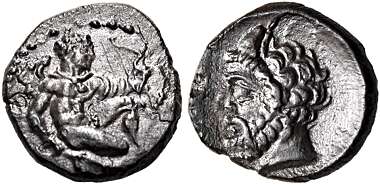
    1'090 GBP
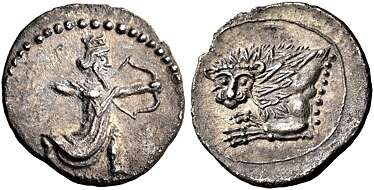
    1'468 USD

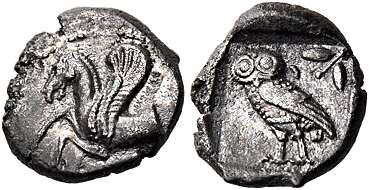
    Valeurs approximatives et arrondiesDate: 04/11/2026
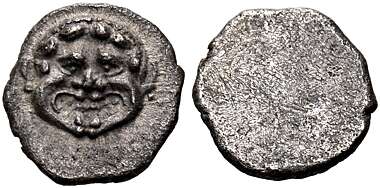
Lot
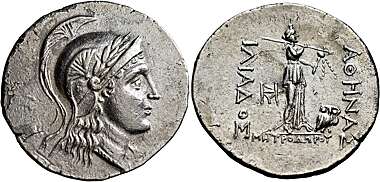
Lot 234. TROAS. Ilion. Circa 188-133 BC. Tetradrachm (Silver, 35 mm, 16.72 g, 12 h), Metrodoros, President of the Aonothetai - the magistrates who supervised the public games run by the city, c. 155-150. Head of Athena to right, wearing a crested Attic helmet, decorated with an olive wreath above the visor, and a pearl necklace. Rev. ΑΘΗΝΑΣ-ΙΛΙΑΔΟΣ MHTPOΔΩΡΟΥ Athena Ilias standing to right, wearing a polos and holding a distaff and a spear; at her feet to right, owl standing to right, head facing; in inner field to left, monogram of ΔΗΥ. Bellinger -. Boehringer, SNR 54 (1975), 75. Ellis-Evans, Metrodoros (O6/R15). HGC 8.1, 1078. Extremely rare, only three other examples known. With a very noble head of Athena on the obverse and an interesting representation of Athena Ilias (with her distaff for peace and spear for war) on the reverse. Minor peripheral rough spots, otherwise, good very fine.
  • Mise à prix:
    800 CHF
    871 EUR
    726 GBP
    978 USD

    Valeurs approximatives et arrondiesDate: 04/11/2026
Lot
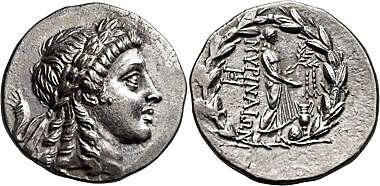
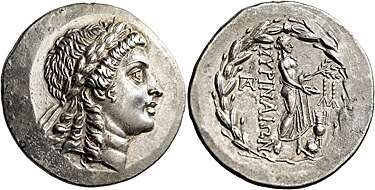
Lot 235. AEOLIS. Myrina. Circa 155-145 BC. Tetradrachm (Silver, 33 mm, 16.36 g, 12 h). Laureate head of Apollo to right, his long hair falling down the back of his neck. Rev. MΥΡINAIΩN Apollo Grynios standing right, draped from the waist, holding a phiale with his right hand and a laurel branch with his left; in the lower right field, omphalos and amphora; in the field to left, monogram of ΠΑ. Sacks Issue 20, obverse die 23 (&; same dies as 23l). SNG Copenhagen 223. SNG Lockett 2749. A particularly beautiful coin, struck in high relief; fine style. Extremely fine. https://cdn.nomosag.com/auctions/95/video00235.mp4?sv=2023-01-03&ss=b&srt=co&st=2025-03-10T16%3A25%3A27Z&se=2099-03-11T16%3A25%3A00Z&sp=rl&sig=i7RzFAqwYGMJUp3u71BbRyL3HhIAtR%2F8cUnRnTVQfyU%3D&rsct=video%2Fmp4
  • Mise à prix:
    800 CHF
    871 EUR
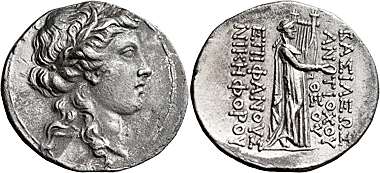
    726 GBP
    978 USD

    Valeurs approximatives et arrondiesDate: 04/11/2026
Lot
Lot 236. AEOLIS. Myrina. Circa 160-143 BC. Tetradrachm (Silver, 32.5 mm, 14.70 g, 12 h). Laureate head of Apollo to right, his long hair falling down the back of his neck. Rev. ΜΥΡΙΝΑΙΩΝ Apollo Grynios standing right, draped from the waist, holding a phiale with his right hand and a laurel branch with his left; in the lower right field, omphalos and amphora; in the field to left, monogram of ΖΕΘ; all within a laurel wreath tied at the bottom. Sacks, Issue 35, obverse die 61f = SNG von Aulock 1662 (same dies). Particularly scarce with this monogram. With a bold head of Apollo struck in high relief. Extremely fine. https://cdn.nomosag.com/auctions/95/video00236.mp4?sv=2023-01-03&ss=b&srt=co&st=2025-03-10T16%3A25%3A27Z&se=2099-03-11T16%3A25%3A00Z&sp=rl&sig=i7RzFAqwYGMJUp3u71BbRyL3HhIAtR%2F8cUnRnTVQfyU%3D&rsct=video%2Fmp4
  • Mise à prix:
    800 CHF
    871 EUR
    726 GBP
    978 USD

    Valeurs approximatives et arrondiesDate: 04/11/2026
Lot
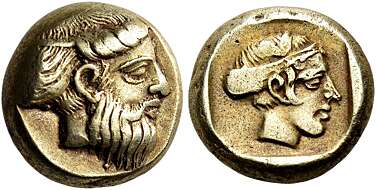
Lot 237. LESBOS. Mytilene. Circa 454-428/7 BC. Hekte (Electrum, 10 mm, 2.52 g, 3 h). Bearded head of Priapos to right, wearing tainia. Rev. Female head (the nymph Chione or Dione?) to right, with her hair in sphendone; the whole within shallow incuse square. BMC 47-8. Bodenstedt 43 a/β. De Luynes 2556. HGC 6, 969. Very rare, and with an impressively elegant and refined head of Priapos. Toned and well-centered. Good very fine.
  • Mise à prix:
    800 CHF
    871 EUR
    726 GBP
    978 USD

    Valeurs approximatives et arrondiesDate: 04/11/2026
Lot
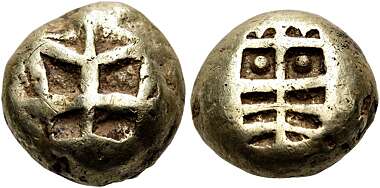
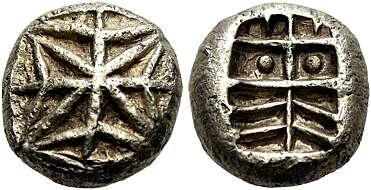
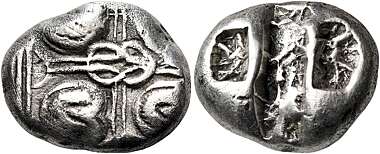
Lot 238. IONIA. Uncertain mint. Circa 600-550 BC. Trite (Electrum, 11 mm, 4.62 g), Lydo-Milesian standard. Geometric figure resembling a star, composed of a cross centered upon an octagon. Rev. Rectangular incuse divided vertically into two large compartments: the upper divided into four squares, each containing a pellet; and the lower divided into six rectangles by horizontal bars. SNG Kayhan 697. Konuk &; Lorber fig. 14. E. Linzalone LN 1062. McFadden, “A Hoard of Early Multi-Denominational Electrum Coins” in SAN XXI, 2002, 1. Very rare and attractive. Good very fine.
  • Mise à prix:
    1'200 CHF
    1'307 EUR
    1'090 GBP
    1'468 USD

    Valeurs approximatives et arrondiesDate: 04/11/2026
Lot
Lot 239. IONIA. Uncertain mint. Circa 600-550 BC. Hekte (Electrum, 10 mm, 1.84 g), Lydo-Milesian standard. Geometric figure resembling a star, composed of a cross centered upon an octagon. Rev. Rectangular incuse divided vertically into two large compartments: the upper divided into four squares, each containing a pellet; and the lower divided into six rectangles by horizontal bars. SNG Kayhan 698. Konuk &; Lorber fig. 14. Linzalone LN 1063. McFadden, “A Hoard of Early Multi-Denominational Electrum Coins” in SAN XXI, 2002, 2. Rare and very well centered. Nearly extremely fine.
  • Mise à prix:
    1'200 CHF
    1'307 EUR
    1'090 GBP
    1'468 USD

    Valeurs approximatives et arrondiesDate: 04/11/2026
Lot
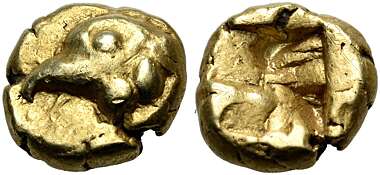
Lot 240. IONIA. Uncertain mint. Circa 600-550 BC. Myshemihekte or 1/24th Stater (Electrum, 6 mm, 0.67 g), Lydo-Milesian standard. Head of eagle to left. Rev. Quadripartite incuse square. Rosen 331. SNG Kayhan 720. Struck from the same dies as Nomos 37, 2025, 144. Rare. Good very fine.
  • Mise à prix:
    320 CHF
    348 EUR
    290 GBP
    391 USD

    Valeurs approximatives et arrondiesDate: 04/11/2026
Lot
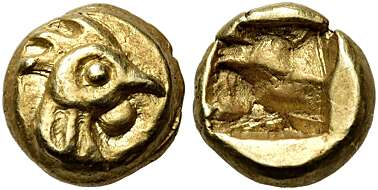
Lot 241. IONIA. Uncertain mint. Circa 600-550 BC. 1/24 Stater (Electrum, 7 mm, 0.69 g), Lydo-Milesian standard, possibly struck in Dardanos in Troas. Head of a rooster to right. Rev. Incuse punch. Rosen -. SNG Kayhan -. Traité II, 1, 111 and pl. III, 12. Weidauer -. A lovely, clear and very well centered example; among the best examples of this type known. Extremely fine. For an example from the same series, but struck in the weight of a 1/48th stater, see below, lot 242.
  • Mise à prix:
    800 CHF
    871 EUR
    726 GBP
    978 USD

    Valeurs approximatives et arrondiesDate: 04/11/2026
Lot
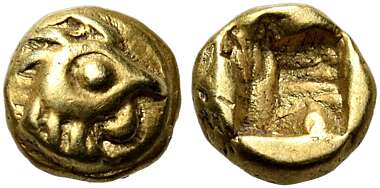
Lot 242. IONIA. Uncertain mint. Circa 600-550 BC. 1/48 Stater (Electrum, 5 mm, 0.34 g), Lydo-Milesian standard, possibly struck in Dardanos in Troas. Head of a rooster to right. Rev. Incuse punch. Apparently unpublished: Rosen -. SNG Kayhan -. Weidauer -. For a similar 1/24th stater cf. Traité II, 1, 111 and pl. III, 12; and lot 241, above. Struck from the same dies as CNG e553, 2024, 90. Extremely rare! Boldly struck, well-centered and complete. Good very fine. For an example from the same series struck as a 1/24th Stater, see above, lot 241.
  • Mise à prix:
    600 CHF
    653 EUR
    545 GBP
    734 USD

    Valeurs approximatives et arrondiesDate: 04/11/2026
Lot
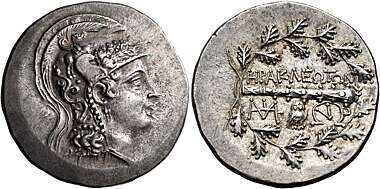
Lot 243. IONIA. Herakleia ad Latmon. Circa 150-142 BC. Tetradrachm (Silver, 31.5 mm, 17.00 g, 9 h), Stephanophoric series. Head of Athena to right, wearing a triple-crested Attic helmet adorned with Pegasos flying to right, the foreparts of five horses over the visor, tendrils at the back and a raised cheek piece, a pendant earring and a necklace of pearls. Rev. ΗΡΑΚΛΕΩΤΩΝ Horizontal club with its head to right; below, owl standing to right, head facing, between two monograms; all within oak wreath with ties to left. Pozzi 2453. SNG Lockett 2824. SNG von Aulock 1977 (same obverse die). Clear, lightly toned and of fine style. Obverse struck from a slightly worn die, otherwise, nearly extremely fine. From a German collection.
  • Mise à prix:
    2'000 CHF
    2'179 EUR
    1'816 GBP
    2'447 USD

    Valeurs approximatives et arrondiesDate: 04/11/2026
Lot
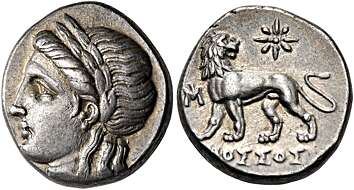
Lot 244. IONIA. Miletos. Circa 340-325 BC. Drachm (Silver, 14.5 mm, 3.63 g, 1 h), struck under the magistrate Nossos. Laureate head of Apollo to left. Rev. ΝΟΣΣΟΣ Lion standing to left, his head turned back to right; above, eight-pointed star; in the field to left, monogram of ΜΙ. BMC -. Deppert-Lippitz 182 (V5/R18). Of a particularly fine and sober Classical style. Lightly toned. Nearly extremely fine.
  • Mise à prix:
    600 CHF
    653 EUR
    545 GBP
    734 USD

    Valeurs approximatives et arrondiesDate: 04/11/2026
Lot
Lot 245. Unpublished Phokaian Hekte IONIA. Phokaia. Circa 625/0-522 BC. Hekte (Electrum, 10 mm, 2.57 g). Female head to left, with a narrow hair band (?), long flowing hair, and an annular earring; behind, seal swimming downwards. Rev. Irregular incuse square. Apparently unpublished: i.e., BMC -. Bodenstedt -. BMFA -. SNG von Aulock -. Struck from the same dies as the examples in Nomos 15, 2017, 153 and in the Prospero Collection, New York Sale XXVI, 2012, 520. Extremely rare and of very attractive archaic style. Struck from a worn obverse die, otherwise, good very fine. Coins of this type were unknown to Bodenstedt: including this piece there seem to be less than ten known, all from a single reverse punch linked to two very similar obverse dies.
  • Mise à prix:
    600 CHF
    653 EUR
    545 GBP
    734 USD

    Valeurs approximatives et arrondiesDate: 04/11/2026
Lot
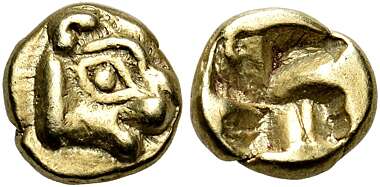
Lot 246. IONIA. Phokaia. Circa 625/0-522 BC. One twenty-fourth stater (Electrum, 7 mm, 0.63 g). Head of a calf (or a seal?) to right, with a very large eye and an open mouth. Rev. Quadripartite incuse square. Bodenstedt 2.1 1/24 a/α (same dies). Rosen 328. SNG von Aulock 7774. An unusually fine and well centered example of this very rare type. Extremely fine. From the Apollo to Apollo Collection, ex Naumann 78, 2 June 2019, 292. What seems to be a prominent ear sticking up from this animal's head implies that this is a calf rather than a seal (as it is often thought to be).
  • Mise à prix:
    280 CHF
    305 EUR
    254 GBP
    342 USD

    Valeurs approximatives et arrondiesDate: 04/11/2026
Lot
Lot 247. IONIA. Phokaia. Circa 625/0-522 BC. 1/48 Stater (Electrum, 5 mm, 0.30 g). Head of seal to left. Rev. Rough quadripartite incuse square. BMC 11. Bodenstedt 2.2 1/48 (a/α). SNG von Aulock 7781 (same dies). Very rare. Edge split, otherwise, good very fine.
  • Mise à prix:
    280 CHF
    305 EUR
    254 GBP
    342 USD

    Valeurs approximatives et arrondiesDate: 04/11/2026
Lot
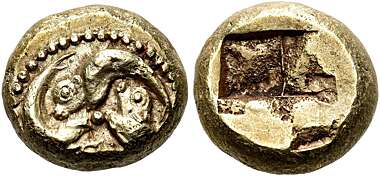
Lot 248. IONIA. Phokaia. Circa 521-478 BC. Hekte (Electrum, 10 mm, 2.57 g). Three seals swimming counterclockwise around annulet with pellet in the center; all within beaded circular border. Rev. Incuse punch. Bodenstedt 29 (a/β). BMFA 1895 = Warren 1666. SNG von Aulock 7940 (this obverse die). Traité II 2090 (this obverse die). Very sharp. Obverse struck slightly off centre, otherwise, good extremely fine.
  • Mise à prix:
    1'600 CHF
    1'743 EUR
    1'453 GBP
    1'957 USD

    Valeurs approximatives et arrondiesDate: 04/11/2026
Lot
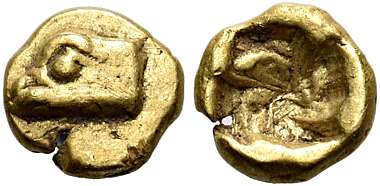
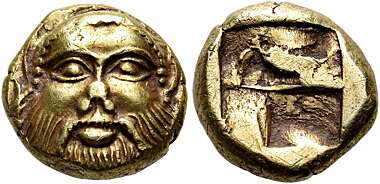
Lot 249. IONIA. Phokaia. Circa 521-478 BC. Hekte (Electrum, 10 mm, 2.56 g), struck in the 490s. Bald and wreathed head of Silenos facing, with wide, open eyes, broad beard and long mustache; to left, seal swimming upwards. Rev. Quadripartite incuse square. BMC 3. Bodenstedt 43 (f/η). SNG Fitzwilliam 4559. A wonderful example with a fine head of Silenos. Faint marks on reverse, otherwise, extremely fine. Given its small size this coin can only be termed a masterpiece. Virtually no other coin bearing a facing head produced during the Archaic period rivals the virtuosity of its engraving – Silenos’ head on this coin has a presence that more than belies its small size. Coins of this type have been long known, but this is surely one of the finest examples extant. https://cdn.nomosag.com/auctions/95/video00249.mp4?sv=2023-01-03&ss=b&srt=co&st=2025-03-10T16%3A25%3A27Z&se=2099-03-11T16%3A25%3A00Z&sp=rl&sig=i7RzFAqwYGMJUp3u71BbRyL3HhIAtR%2F8cUnRnTVQfyU%3D&rsct=video%2Fmp4
  • Mise à prix:
    2'000 CHF
    2'179 EUR
    1'816 GBP
    2'447 USD

    Valeurs approximatives et arrondiesDate: 04/11/2026
Lot
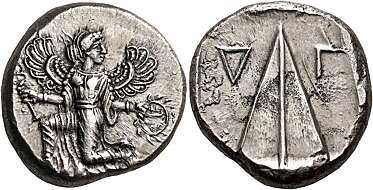
Lot 250. CARIA. Kaunos. Circa 410-390 BC. Stater (Silver, 22 mm, 11.77 g, 12 h). Winged female goddess (Iris?) moving to left, her head turned back to right, holding a wreath in her right hand and a kerykeion in her left. Rev. Triangular baetyl flanked by two letters of the ethnic, 𐊼-Γ ( = K-B in Carian). BMC 11. HNO 5. Konuk 114 (O53/R54). SNG Kayhan 799 (same dies). SNG von Aulock 2350 (same dies). Extremely fine. https://cdn.nomosag.com/auctions/95/video00250.mp4?sv=2023-01-03&ss=b&srt=co&st=2025-03-10T16%3A25%3A27Z&se=2099-03-11T16%3A25%3A00Z&sp=rl&sig=i7RzFAqwYGMJUp3u71BbRyL3HhIAtR%2F8cUnRnTVQfyU%3D&rsct=video%2Fmp4
  • Mise à prix:
    2'800 CHF
    3'050 EUR
    2'543 GBP
    3'425 USD

    Valeurs approximatives et arrondiesDate: 04/11/2026
Lot
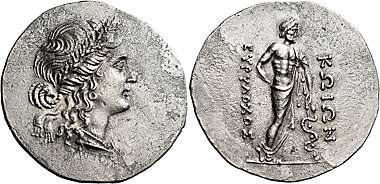
Lot 251. ISLANDS OFF CARIA, Kos. Circa 170-162 BC. Tetradrachm (Silver, 34.5 mm, 16.59 g, 12 h), struck under the magistrate Eurylochos. Head of Aphrodite to right, wearing a wreath of myrtle. Rev. KΩION-EYPYΛOXOΣ Asklepios standing to right, placing his right hand on his hip and leaning left on serpent-entwined staff. HGC 6, 1319 var. (magistrate). HNO 2309. Leu 30, 1982, 183. Stefanaki Series XV, Emission 45, 1796-8. Porous surfaces, otherwise, extremely fine.
  • Mise à prix:
    1'200 CHF
    1'307 EUR
    1'090 GBP
    1'468 USD

    Valeurs approximatives et arrondiesDate: 04/11/2026
Lot
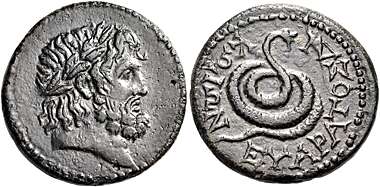
Lot 252. ISLANDS OFF CARIA, Kos. Pseudo-autonomous issue, Time of Hadrian, 117-138. (Bronze, 21 mm, 6.16 g, 12 h). Laureate and bearded head of Asklepios to right. Rev. ΚΩΙΩΝ ΕΥΑΡΑΤΟΣ ΔΙ Serpent coiled to the right. BMC 194. RPC I, 2731a. SNG Copenhagen 684-5. Stefanaki K292 (same dies). Dark-brown patina. Extremely fine.
  • Mise à prix:
    200 CHF
    217 EUR
    181 GBP
    244 USD

    Valeurs approximatives et arrondiesDate: 04/11/2026
Lot
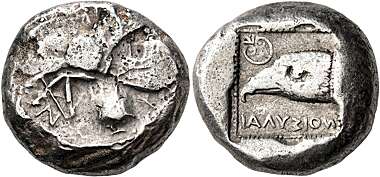
Lot 253. ISLANDS OFF CARIA, Rhodos. Ialysos. Circa 520 BC. Stater (Silver, 21 mm, 14.39 g, 12 h). [IAΛΥΣΙ]ΟΝ Forepart of a winged boar flying to left; below, helmet to right. Rev. IAΛΥΣΙΟΝ (partially retrograde) Head of an eagle to left within a shallow incuse square bordered by dots; in the upper left corner, palmette. BMC 3 = HGC 6, 1365 = Traité II, 2, 1683 and pl CXLVI, 30 = Weiss &; Hurter 22 (O10/R-, this obverse die but from a later stage, our reverse die is unpublished). Of great rarity, W&;H only knew of a single example. Obverse struck from a worn die, otherwise, very fine.
  • Mise à prix:
    3'200 CHF
    3'486 EUR
    2'906 GBP
    3'915 USD

    Valeurs approximatives et arrondiesDate: 04/11/2026
Lot
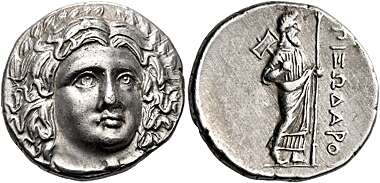
Lot 254. SATRAPS OF CARIA. Pixodaros, circa 341/0-336/5 BC. Didrachm (Silver, 20.5 mm, 6.97 g, 2 h), Halikarnassos. Laureate head of Apollo facing, turned slightly to right; at his neck, edge of his cloak held together by circular brooch. Rev. ΠΙΞΩΔΑΡΟΥ Zeus Labraundos standing right, fully draped and holding a long scepter with his left hand and a double-axe with his right. HNO 241. Konuk, Identities, 30. SNG Kayhan 892 (this obverse die). SNG Keckman 280. SNG von Aulock 2375-6. Exceptional style. Extremely fine. https://cdn.nomosag.com/auctions/95/video00254.mp4?sv=2023-01-03&ss=b&srt=co&st=2025-03-10T16%3A25%3A27Z&se=2099-03-11T16%3A25%3A00Z&sp=rl&sig=i7RzFAqwYGMJUp3u71BbRyL3HhIAtR%2F8cUnRnTVQfyU%3D&rsct=video%2Fmp4
  • Mise à prix:
    800 CHF
    871 EUR
    726 GBP
    978 USD

    Valeurs approximatives et arrondiesDate: 04/11/2026
Lot
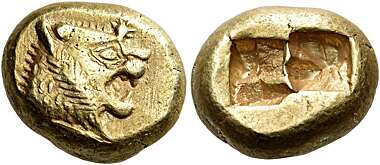
Lot 255. KINGS OF LYDIA. Alyattes II to Kroisos, circa 610-546 BC. Trite (Electrum, 12.5 mm, 4.75 g), Sardes. Head of a lion with open jaws to right and, on his forehead, over his eye, sun with rays. Rev. Two irregular incuse squares of unequal size. SNG Kayhan 1013. SNG von Aulock 2868-9. Weidauer 86-9. Struck on a broad flan; complete and clear. Nearly extremely fine.
  • Mise à prix:
    1'600 CHF
    1'743 EUR
    1'453 GBP
    1'957 USD

    Valeurs approximatives et arrondiesDate: 04/11/2026
Lot
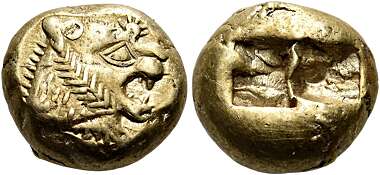
Lot 256. KINGS OF LYDIA. Alyattes II to Kroisos, circa 610-546 BC. Trite (Electrum, 12 mm, 4.74 g), Sardes. Head of a lion with open jaws to right and, on his forehead, over his eye, sun with rays. Rev. Two irregular incuse squares of unequal size. SNG Kayhan 1013. SNG von Aulock 2868-9. Weidauer 86-9. About extremely fine.
  • Mise à prix:
    1'200 CHF
    1'307 EUR
    1'090 GBP
    1'468 USD

    Valeurs approximatives et arrondiesDate: 04/11/2026
Lot
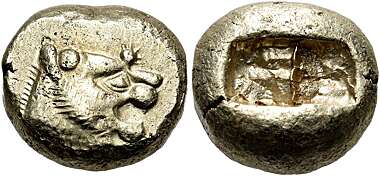
Lot 257. KINGS OF LYDIA. Alyattes II to Kroisos, circa 610-546 BC. Trite (Electrum, 12 mm, 4.77 g), Sardes. Head of lion to right, with open jaws and with a sun and rays on its forehead. Rev. Two incuse squares of unequal size. SNG Kayhan 1013. SNG von Aulock 2868-9. Weidauer 86-9. Very fine.
  • Mise à prix:
    1'200 CHF
    1'307 EUR
    1'090 GBP
    1'468 USD

    Valeurs approximatives et arrondiesDate: 04/11/2026
Lot
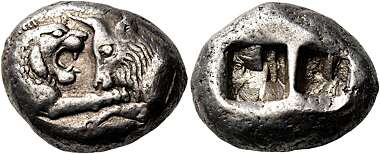
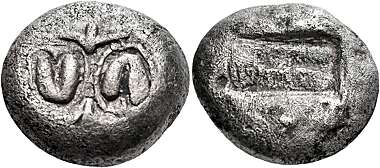
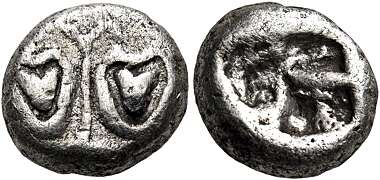
Lot 258. KINGS OF LYDIA. Kroisos, circa 560-546 BC. Stater (Silver, 20.5 mm, 10.51 g), Sardes. On the left, forepart of a lion to right confronting, on the right, the forepart of a bull to left. Rev. Two incuse squares, of unequal size, side by side. ACGC 79. SNG Kayhan 1018. SNG von Aulock 2873. Traité II, 1, 407 and pl. X, 7. Lightly toned. Good very fine.
  • Mise à prix:
    1'200 CHF
    1'307 EUR
    1'090 GBP
    1'468 USD

    Valeurs approximatives et arrondiesDate: 04/11/2026
Lot
Lot 259. PERSIAN ASIA MINOR, Achaemenid Empire. Kyros the Younger, Satrap of Lydia, Phrygia and Cappadocia, 408-401 BC. Tetradrachm (Silver, 24 mm, 16.42 g, 9 h), Sardes. Head of Athena to right, wearing crested Attic helmet adorned with three olive leaves and palmette, round earring and pearl necklace; on the cheek, 𐡔‎ (S in Aramaic). Rev. AΘΕ Owl standing to right, head facing; behind, olive spray and crescent moon; the whole within incuse square. SNG ANS Palestine - South Arabia, 3 (same dies, as issue of the Samaritan city of Shormon). =W. Weiser, Die Eulen von Kyros dem Jüngeren: Zu den ersten Münzporträts lebender Menschen, ZPE 76 (1989) pp. 267-296, pl. XVI, 2-3 (same dies) = Hess-Leu 49, 1971, 163 (same dies). Obverse very slightly doubled, otherwise, extremely fine. In his seminal 1989 paper on the 'owls' of Cyrus the Younger, Wolfram Weiser linked a group of coins—two of which are featured in this auction—to the mercenary pay provided to Greek soldiers in the service of the ill-fated Persian prince between 407 and 405 BC. According to his argument, such coinage eventually helped the Spartan faction win the Battle of Aegospotami and, consequently, the Peloponnesian War. These deliberations are supported by ancient historiographers, most notably Xenophon in his Hellenica. However, a second possibility must be considered, and it also involves Xenophon: What if these high-quality imitations of Athenian owls were actually produced to pay a different group of mercenaries? Specifically, the Greek elite warriors enlisted by Cyrus to overthrow his brother Artaxerxes II, whose adventures were immortalized in the Anabasis? https://cdn.nomosag.com/auctions/95/video00259.mp4?sv=2023-01-03&ss=b&srt=co&st=2025-03-10T16%3A25%3A27Z&se=2099-03-11T16%3A25%3A00Z&sp=rl&sig=i7RzFAqwYGMJUp3u71BbRyL3HhIAtR%2F8cUnRnTVQfyU%3D&rsct=video%2Fmp4
  • Mise à prix:
    4'000 CHF
    4'358 EUR
    3'633 GBP
    4'894 USD

    Valeurs approximatives et arrondiesDate: 04/11/2026
Lot
Lot 260. PERSIAN ASIA MINOR, Achaemenid Empire. Kyros the Younger, Satrap of Lydia, Phrygia and Cappadocia, 408-401 BC. Tetradrachm (Silver, 24 mm, 16.24 g, 9 h), Sardes, 402-401 BC. Head of Athena to right, wearing crested Attic helmet adorned with three olive leaves and palmette, round earring and pearl necklace. Rev. AΘΕ Owl standing to right, head facing; behind, olive spray and crescent moon; on the lower right field, crowned and bearded head of Persian king to right; the whole within incuse square. W. Weiser, Die Eulen von Kyros dem Jüngeren: Zu den ersten Münzporträts lebender Menschen, ZPE 76 (1989) pp. 267-296, pl. XVI, 5-7 (same dies) = M&;M 64, 1984, 201 (then unique and sold for 24,000 CHF). Good very fine / extremely fine. In his seminal 1989 paper on the 'owls' of Cyrus the Younger, Wolfram Weiser linked a group of coins—two of which are featured in this auction—to the mercenary pay provided to Greek soldiers in the service of the ill-fated Persian prince between 407 and 405 BC. According to his argument, such coinage eventually helped the Spartan faction win the Battle of Aegospotami and, consequently, the Peloponnesian War. These deliberations are supported by ancient historiographers, most notably Xenophon in his Hellenica. However, a second possibility must be considered, and it also involves Xenophon: What if these high-quality imitations of Athenian owls were actually produced to pay a different group of mercenaries? Specifically, the Greek elite warriors enlisted by Cyrus to overthrow his brother Artaxerxes II, whose adventures were immortalized in the Anabasis? https://cdn.nomosag.com/auctions/95/video00260.mp4?sv=2023-01-03&ss=b&srt=co&st=2025-03-10T16%3A25%3A27Z&se=2099-03-11T16%3A25%3A00Z&sp=rl&sig=i7RzFAqwYGMJUp3u71BbRyL3HhIAtR%2F8cUnRnTVQfyU%3D&rsct=video%2Fmp4
  • Mise à prix:
    4'000 CHF
    4'358 EUR
    3'633 GBP
    4'894 USD

    Valeurs approximatives et arrondiesDate: 04/11/2026
Lot
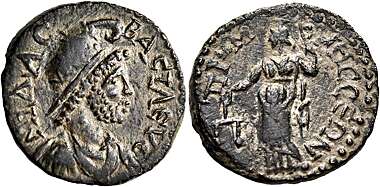
Lot 261. PHRYGIA. Prymnessos. Pseudo-autonomous, Time of Gallienus, 260-268. Assarion (Bronze, 22 mm, 7.42 g, 6 h). ΜΙΔΑC ΒΑCΙΛΕΥC Bearded and draped bust of king Midas to right, wearing a Phrygian cap. Rev. ΠΡΥΜ-ΝΗCCΕΩΝ Dikaiosyne standing to left, holding a scepter with her left hand and a pair of scales with her right. RPC X, ID 63256. SNG von Aulock 3938 = Von Aulock, Phrygiens, 960. With a fascinating depiction of a local myth in Roman times. Well-struck and attractive. About extremely fine. From the Apollo to Apollo Collection. The mythical King Midas was renowned for his 'Golden Touch', which meant that anything he touched turned into gold, thus putting him on a nearly fatal diet (until Apollo took the touch away).
  • Mise à prix:
    360 CHF
    392 EUR
    327 GBP
    440 USD

    Valeurs approximatives et arrondiesDate: 04/11/2026
Lot
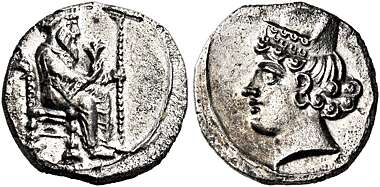
Lot 262. CILICIA. Uncertain mint. Early 4th century BC. Obol (Silver, 11 mm, 0.78 g, 6 h). Persian King, bearded, wearing the Double Crown of Egypt, and holding a lotus-tipped sceptre with his left hand and a lotus in his right, seated to right on a throne. Rev. Youthful male head to left, wearing the Double Crown of Egypt and a circular earring. Göktürk 35. SNG Paris 429. Sharply struck and attractive. Nearly extremely fine. Having conquered Egypt in 525 BC, the Persian kings then became the Egyptian 27th Dynasty, which lasted until the Egyptians revolted in 404 BC and became independent under its native 28th, 29th and 30th Dynasties. Artaxerxes III Ochus (359/8-338 BC) first attempted to reconquer Egypt in 351, but he was defeated by Nectanebo II who had the help of a powerful force of Greek mercenaries (the famous "nub nefer" gold pieces were used by the Egyptians to pay those troops). In 340 Artaxerxes tried again, but this time he succeeded. This coin commemorates the victory: the enthroned, and bearded, king on the obverse, wearing the Egyptian royal crown, is surely Artaxerxes III, while the beardless young man on the reverse, also wearing the Egyptian royal headdress, must be the king's heir, Arses (also known as Artaxerxes IV, 338-336 BC). In the event, both Artaxerxes III and his son Arses were poisoned by the powerful eunuch Bagoas, who arranged the accession of Darius III.
  • Mise à prix:
    200 CHF
    217 EUR
    181 GBP
    244 USD

    Valeurs approximatives et arrondiesDate: 04/11/2026
Lot
Lot 263. CILICIA. Uncertain mint. 4th Century BC. Obol (Silver, 10 mm, 0.71 g, 3 h). Herakles, nude but for his lion's skin tied around his neck, kneeling to right, holding his bow with his left hand and club with his right. Rev. Bearded head of Pan to left. Göktürk -. SNG Levante 237. SNG Paris -. Traité II, 1381 (Tarsos). Toned and with powerful designs. Good very fine.
  • Mise à prix:
    200 CHF
    217 EUR
    181 GBP
    244 USD

    Valeurs approximatives et arrondiesDate: 04/11/2026
Lot
Lot 264. Unpublished Cilician obol of outstanding quality CILICIA. Uncertain mint. Time of Artaxerxes III, circa 340 BC. Obol (Silver, 11 mm, 0.56 g, 12 h). The Persian Great King, wearing a tiara and long robes, in the running-kneeling stance to right, extending his left hand to right and holding his bow, while apparently drawing the bow and holding the arrow with his right hand (see the note below for an explanation). Rev. Forepart of a lion to left, his head turned to face the viewer. Seemingly unpublished, but cf. the obols Göktürk 39, Mildenberg, Kleingeld, 37, and SNG Levante 215, which are all from the same mint, and have the same reverse, but have the Persian King fighting a winged lion on the obverse. Very rare. Very well-struck from finely engraved dies of excellent style. Toned. Minor marks, otherwise, good extremely fine. One of the problems many ancient die cutters had was how to represent over-lapping fields of design. While the die engraver responsible for the obverse of this coin was very good, indeed, he had a big problem with the bow. He did not want to obscure the King's body with either the bow string or the arrow so he, 1) had the bow string seemingly drawn by "a third" arm behind the King's back (notice the strings going behind his shoulder and his armpit) and, 2) had the King's right hand drawn back to hold the arrow for firing - but the arrow is, in fact, like the center of the bowstring, behind his back! Otherwise he would have had to show the arrow running from his right hand, across his chest, and then over his extended left arm!! Other ancient engravers managed to solve this problem! https://cdn.nomosag.com/auctions/95/video00264.mp4?sv=2023-01-03&ss=b&srt=co&st=2025-03-10T16%3A25%3A27Z&se=2099-03-11T16%3A25%3A00Z&sp=rl&sig=i7RzFAqwYGMJUp3u71BbRyL3HhIAtR%2F8cUnRnTVQfyU%3D&rsct=video%2Fmp4
  • Mise à prix:
    400 CHF
    435 EUR
    363 GBP
    489 USD

    Valeurs approximatives et arrondiesDate: 04/11/2026
Lot
Lot 265. CILICIA. Mallos. Circa 440-390 BC. Obol (Silver, 9 mm, 0.69 g, 3 h). Forepart of Pegasos to left. Rev. Owl standing to left, with its head facing in the Athenian manner; on the upper right, olive sprig; behind the owl's head and neck, crescent. Göktürk -. SNG Levante 208 (as uncertain Cilician city). SNG Paris -. Struck from the same dies, but far better, than CNG e599, 2025, 232 (which realised 1200 USD). Very rare, well struck and particularly clear. Good very fine.
  • Mise à prix:
    200 CHF
    217 EUR
    181 GBP
    244 USD

    Valeurs approximatives et arrondiesDate: 04/11/2026
Lot
Lot 266. CILICIA. Mallos. Circa 4th century BC. Tetartemorion (Silver, 7 mm, 0.26 g). Head of gorgoneion facing, with protruding tongue. Göktürk -. SNG BNF -. SNG Levante 252 (as uncertain Cilician mint). Same dies but by far superior to Astarte 5e, 2024, 127. Extremely rare, well centered and in exceptional condition. Extremely fine.
  • Mise à prix:
    200 CHF
    217 EUR
    181 GBP
    244 USD

    Valeurs approximatives et arrondiesDate: 04/11/2026
Lot
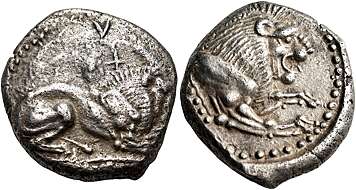
Lot 267. A new king of Amathous? CYPRUS. Amathos. Uncertain king (Lo-), Circa 460-450 BC. Stater (Silver, 22 mm, 10.92 g, 12 h). 𐠒𐠨 "lo-sa" in Cypriot syllabic script. Lion crouching to right, its forepaw raised. Rev. Forepart of roaring lion to right; the whole within a circular dotted border within a shallow circular incuse. Amandry, Amathonte, - but cf. 126.1 for an anepigraphic coin of similar type. Cf. BMC 3 for a similar type. Traité -. Cf. Tziambazis 2. Apparently unpublished and seemingly unique. Possibly overstruck on an uncertain undertype, otherwise, good very fine. https://cdn.nomosag.com/auctions/95/video00267.mp4?sv=2023-01-03&ss=b&srt=co&st=2025-03-10T16%3A25%3A27Z&se=2099-03-11T16%3A25%3A00Z&sp=rl&sig=i7RzFAqwYGMJUp3u71BbRyL3HhIAtR%2F8cUnRnTVQfyU%3D&rsct=video%2Fmp4
  • Mise à prix:
    2'800 CHF
    3'050 EUR
    2'543 GBP
    3'425 USD

    Valeurs approximatives et arrondiesDate: 04/11/2026
Lot
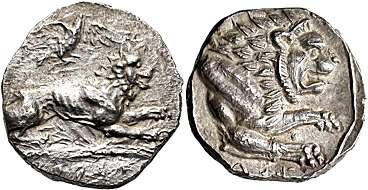
Lot 268. CYPRUS. Amathos. Zotimos (?), circa 385/0 BC. Didrachm (Silver, 21 mm, 6.65 g, 8 h). 'zo ti mo' in Cypriot syllabic script). Lion recumbent to right on dotted exergual line; above, eagle flying to right. Rev. 𐠿𐠵𐠗 (= 'zo ti mo' in Cypriot syllabic script). Forepart of a roaring lion to right. Amandry, Amathonte 130 (D1/R-). BMC -. Jameson 1913 (this obverse die). Tziambazis 7. Struck from the same obverse die as Nomos 38, 2026, 352. Extremely rare! Struck from a broken obverse die, otherwise, about extremely fine/extremely fine. From the Horowitz Collection, Gorny &; Mosch 314, 14 October 2025, 445 (but identified as Epipalos in error). https://cdn.nomosag.com/auctions/95/video00268.mp4?sv=2023-01-03&ss=b&srt=co&st=2025-03-10T16%3A25%3A27Z&se=2099-03-11T16%3A25%3A00Z&sp=rl&sig=i7RzFAqwYGMJUp3u71BbRyL3HhIAtR%2F8cUnRnTVQfyU%3D&rsct=video%2Fmp4
  • Mise à prix:
    2'800 CHF
    3'050 EUR
    2'543 GBP
    3'425 USD

    Valeurs approximatives et arrondiesDate: 04/11/2026
Lot
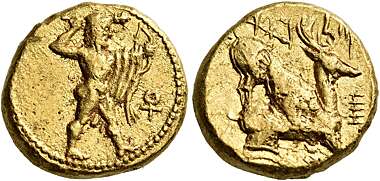
Lot 269. New date for Pumiathon! CYPRUS. Kition. Pumiathon, circa 362-312 BC. Hemistater (Gold, 13 mm, 4.16 g, 9 h), dated year 5 = 358/7. Herakles, bearded and nude but for his lion's skin headdress and the lion's skin over his left arm, striding to right, brandishing his club held over his head with his right hand, and holding his bow with his outstretched left; in the lower right field, crux ansata (= sign of Tanit). Rev. L MLK PMJTN (=of King Pumiathon in Phoenician Aramaic) Lion attacking stag to right; in the field to right, IIIII (= year 5). Unpublished with this date, but cf. BMC 75 ff. and Markou 43ff. for type. Well centered and with a clear date. Marks on the reverse, otherwise, good very fine. https://cdn.nomosag.com/auctions/95/video00269.mp4?sv=2023-01-03&ss=b&srt=co&st=2025-03-10T16%3A25%3A27Z&se=2099-03-11T16%3A25%3A00Z&sp=rl&sig=i7RzFAqwYGMJUp3u71BbRyL3HhIAtR%2F8cUnRnTVQfyU%3D&rsct=video%2Fmp4
  • Mise à prix:
    3'200 CHF
    3'486 EUR
    2'906 GBP
    3'915 USD

    Valeurs approximatives et arrondiesDate: 04/11/2026
Lot
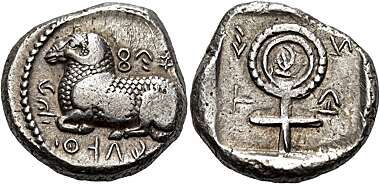
Lot 270. CYPRUS. Salamis. Nikodamos, circa 460-450 BC. Stater (Silver, 23 mm, 11.21 g, 12 h), "Kalarita" type. 𐠛𐠍𐠭𐠗 - 𐠩𐠵𐠐𐠪𐠞 (= 'pa-si-le-wo-se //Ni-ko-da-mo'), 'of the king Nikodamos', in retrograde Cypriot syllabics, starting on the top right, continuing to the middle left, then on to the bottom right) Ram recumbent to left. Rev. 𐠊-𐠭/𐠏-𐠥 (= 'ri-la-ta-ka'), in retrograde Cypriot syllabics, counter-clockwise from the bottom right) Ankh; within the circle, Cypriot syllabic letter 𐠛 (= ni, the initial of Nikodamos). Apparently unpublished. Cf. J. I. McGregor, The Coinage of Salamis, Cyprus, from the Sixth to the Fourth Centuries. University College London (PhD Thesis 1998, unpublished) 321 var. = Traité II, 1, 948 (1/3rd stater). Struck from the same dies as Nomos 28, 2023, 1235. Undoubtedly the better of just two examples known. A fascinating coin of great interest; complete with clear legends. Good very fine. This coin is a part of an extremely limited series, which has a reverse legend that is atypical compared to the standard types of Nikodamos (as McGregor 321-324). In fact, this legend arrangement is only known from less than a dozen fractions, ranging from 1/3rd to 1/12th staters. The intriguing legend "Kalarita" caught the imagination of some of the most prominent numismatists of the late 19th and early 20th centuries. Hoffmann and Deecke proposed that it was an ethnic associated with the area of the river Klyrios. Six, Hill and Babelon thought that it was the name of either a brother or co-ruler of Nikodamos, who was possibly named Lacharidas. The reverse legends on the majority of Nikodamos's staters either bear the name of the king, ni-ko-da-mo for Nikodamos, or the name of the mint, se-la-mi-ni for Salamis, but in case of this coin, we have something quite different. The appearance of the Cypriot syllabic letter ni, the first letter of Nikodamos's name, in the center of the ankh, reminds us of the way it appears on most known examples of the type (as on Nomos 24, lot 240, where it is surrounded by the letters of the mint name se-la-mi-ni, Salamis). This makes it highly unlikely to be a personal name like Lacharidas; rather, it supports the probability that it is a mint name. However, the fact that, according to McGregor's study, the tritai with the "kalarita" reverse are die-linked to others bearing the mint name "selamini", suggests that the dies for this issue were made centrally and were then either subsequently sent out to the "kalarita" mint, or were actually struck in Salamis from silver supplied from Kalarita. Another, though somewhat far-fetched possibility, is that the term, Kala Rita, refers to a highly successful and locally famous courtesan who donated the bullion to make this rare issue. https://cdn.nomosag.com/auctions/95/video00270.mp4?sv=2023-01-03&ss=b&srt=co&st=2025-03-10T16%3A25%3A27Z&se=2099-03-11T16%3A25%3A00Z&sp=rl&sig=i7RzFAqwYGMJUp3u71BbRyL3HhIAtR%2F8cUnRnTVQfyU%3D&rsct=video%2Fmp4
  • Mise à prix:
    4'000 CHF
    4'358 EUR
    3'633 GBP
    4'894 USD

    Valeurs approximatives et arrondiesDate: 04/11/2026
Lot
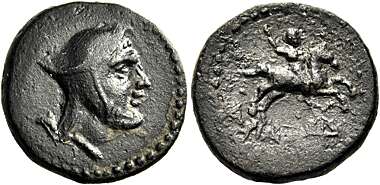
Lot 271. KINGS OF CAPPADOCIA. Ariaramnes, circa 280-230 BC. (Bronze, 16 mm, 3.20 g, 6 h), Tyana. Head of Ariaramnes to right, wearing satrapal headdress. Rev. Cavalryman on a horse galloping to right, thrusting downwards with a spear held in his upraised right hand; below horse, monogram of ΔΥ; in the exergue, APIAP. Seemingly unpublished and unique (?) with this monogram and the legend placement. Henseler -. HGC - (but cf. 794-796). Simonetta -. SNG Copenhagen -. With a clear and bold portrait. Reverse surfaces very rough, otherwise, good very fine.
  • Mise à prix:
    280 CHF
    305 EUR
    254 GBP
    342 USD

    Valeurs approximatives et arrondiesDate: 04/11/2026
Lot
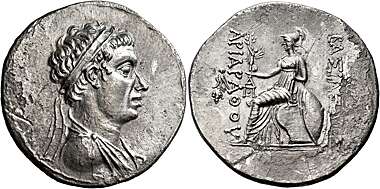
Lot 272. KINGS OF CAPPADOCIA. Ariarathes III, circa 230-220 BC. Tetradrachm (Silver, 32.5 mm, 15.80 g, 12 h). Diademed and draped bust of Ariarathes IV to right; fillet border. Rev. ΒΑΣΙΛΕΩΣ - Athena seated to left on a kippos, holding Nike, standing left and crowning the king's name, in her outstretched right hand and resting her left elbow on a shield by her side; behind her, transverse spear; in the inner field to left, monogram of ΑΠΙ; in the outer left field, owl with folded wings standing to left on bunch of grapes; in the outer right field, uncertain letter (obscured by corrosion). Cf. Simonetta Ariarathes III, 1 = Mørkholm, NC 1962 pl. XX, 1 (Ariarathes IV) = Paris, CdM IFN-8502360 - FRBNF41764847 (that coin has the letter Α [year 1] in the field to right; but our coin is from different dies and the field letter is corroded away). Extremely rare, the second genuine example of a tetradrachm of Ariarathes III known (the other example of this type, from the collection of Bono Simonetta, = Bertolami 109, 2022, 180 and M&;M DE 27, 2008, 2136, is a modern forgery). With an extraordinarily individualistic and realistic portrait. Reverse with heavy damage from corrosion and lesser damage on the obverse, otherwise, extremely fine. From an English collection formed in the late 1990s. This undoubtedly realistic portrait is one of the most extraordinary to ever appear on a Greek coin. It can best be compared to the equally realistic, but artistically more refined portraits on the coins of the Pontic kings. It makes perfect sense that Ariarathes III took great care over how he was portrayed, as he was the first ruler of his dynasty to call himself basileus (king). This marked Cappadocia's transition from a semi-independent, Persian-style dynasty to a fully fledged Hellenistic kingdom. https://cdn.nomosag.com/auctions/95/video00272.mp4?sv=2023-01-03&ss=b&srt=co&st=2025-03-10T16%3A25%3A27Z&se=2099-03-11T16%3A25%3A00Z&sp=rl&sig=i7RzFAqwYGMJUp3u71BbRyL3HhIAtR%2F8cUnRnTVQfyU%3D&rsct=video%2Fmp4
  • Mise à prix:
    1'600 CHF
    1'743 EUR
    1'453 GBP
    1'957 USD

    Valeurs approximatives et arrondiesDate: 04/11/2026
Lot
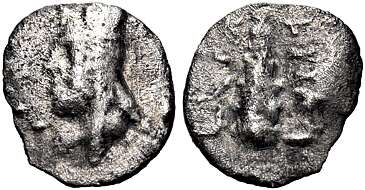
Lot 273. The first Armenian silver coin? KINGS OF ARMENIA MINOR. Mithradates, Satrap, 180s-170s BC. Hemiobol (Silver, 7.5 mm, 0.24 g, 3 h). Draped bust of Mithradates to left, bearded and wearing an upright bashlyk tied with a diadem. Rev. Unclear and uncertain Aramaic (?) legend, above and below a club with head to left. Seemingly unpublished and by far the better of the two examples known; for the other see Leu (W) e34, 2025, 812, though its cataloguer somewhat inexplicably termed the club a bee. Extremely rare. Porous, otherwise, good fine.
  • Mise à prix:
    800 CHF
    871 EUR
    726 GBP
    978 USD

    Valeurs approximatives et arrondiesDate: 04/11/2026
Lot
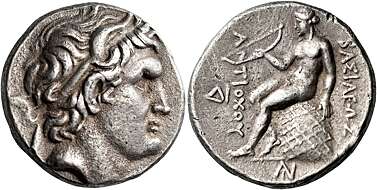
Lot 274. Unpublished Antiochos I Tetradrachm from Sardes SELEUKID KINGS. Antiochos I Soter, 281-261 BC. Tetradrachm (Silver, 25 mm, 17.14 g, 12 h), Sardes, circa 274-271. Diademed head of the deified Seleukos I to right, with bull's horn above his ear. Rev. ΒΑΣΙΛΕΩΣ - ΑΝΤΙΟΧΟΥ Apollo seated to left on omphalos, holding bow with his right hand and resting his left on the omphalos; in the outer left field, ΔΙ; in the exergue, monogram of either ΑΝ or ANT (the Τ may actually be corrosion). HGC 9, 130 var. (these controls unrecorded). SC - (as 323, but with these controls in these positions unrecorded). An unpublished variant of a very rare type. Struck from a slightly worn and rusty obverse die, and with slightly rough surfaces, otherwise, good very fine. Antiochos I issued a number of coins that bore the craggy head of his deified father Seleukos I, this being one of them. While this die gives us a rather ageless portrait, it is surely accurate and shows us a very tough character. Seleukos was one of Alexander's close companions, like Philetairos and Ptolemy I - both of whom are also known from 'tough' portraits - and both of whom also founded dynasties of their own. https://cdn.nomosag.com/auctions/95/video00274.mp4?sv=2023-01-03&ss=b&srt=co&st=2025-03-10T16%3A25%3A27Z&se=2099-03-11T16%3A25%3A00Z&sp=rl&sig=i7RzFAqwYGMJUp3u71BbRyL3HhIAtR%2F8cUnRnTVQfyU%3D&rsct=video%2Fmp4
  • Mise à prix:
    2'800 CHF
    3'050 EUR
    2'543 GBP
    3'425 USD

    Valeurs approximatives et arrondiesDate: 04/11/2026
Lot
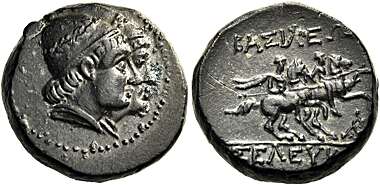
Lot 275. Spectacular SELEUKID KINGS. Seleukos II Kallinikos, 246-226 BC. (Bronze, 15.5 mm, 4.11 g, 12 h), Denomination D, Nisibis. Jugate draped busts of the Dioskouroi to right, each wearing a pileos with a laurel wreath. Rev. ΒΑΣΙΛΕΩ[Σ] ΣΕΛΕΥΚ[ΟΥ] The Dioskouroi riding horses rearing to right; below the horses to right, monogram of AY. SC 760. WSM 827. Extremely rare; clearly struck and with a dark green glossy patina. Obverse struck slightly off centre, otherwise, nearly extremely fine.
  • Mise à prix:
    400 CHF
    435 EUR
    363 GBP
    489 USD

    Valeurs approximatives et arrondiesDate: 04/11/2026
Lot
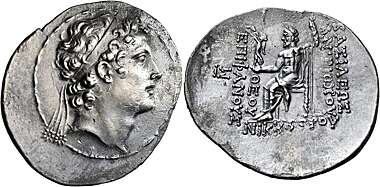
Lot 276. SELEUKID KINGS. Antiochos IV Epiphanes, 175-164 BC. Tetradrachm (Silver, 40 mm, 15.91 g, 2 h), Antioch-on-the-Orontes, circa 168-4. Diademed head of Antiochos IV to right with his diadem ends each adorned with a star. Rev. BAΣIΛEΩΣ ANTIOΧOY / ΘEOY EΠIΦANOYΣ / NIKHΦOPOY Zeus seated to left, holding Nike, who is crowning inscriptions to left, in his outstretched right hand and a long sceptre with his left; in the outer left field, IΣ. HGC 9, 619. Le Rider, Antioche 273-281. SC 1400β. Struck on a very broad flan, perhaps overstruck on a stephanephoros(?), and a very rare variety. Unobtrusive rough areas, and reverse slightly doubled, otherwise, nearly extremely fine.
  • Mise à prix:
    600 CHF
    653 EUR
    545 GBP
    734 USD

    Valeurs approximatives et arrondiesDate: 04/11/2026
Lot
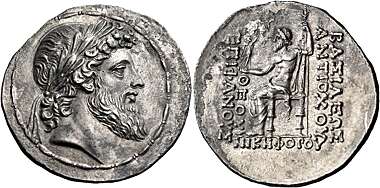
Lot 277. SELEUKID KINGS. Antiochos IV Epiphanes, 175-164 BC. Tetradrachm (Silver, 34 mm, 16.08 g, 11 h), Antioch-on-the-Orontes, summer/autumn 168, in honor of the return of Antiochos IV from his second Egyptian campaign. Laureate and bearded head of Zeus to right; fillet border. Rev. BAΣIΛEΩΣ - ANTIOXOY / ΘEOY - EΠIΦANOYΣ / NIKHΦOPOY Zeus seated left on a high-backed throne, holding Nike, standing right and offering a wreath to Zeus, in his outstretched right hand and a long scepter with his left. HGC 9, 620a. SC 1398. SMA 63. With a head of Zeus in a particularly noble and ripe Hellenistic style, struck in high relief from a die of the finest artistic quality. Beautifully centered. Peripheral roughness on the reverse, otherwise, extremely fine. https://cdn.nomosag.com/auctions/95/video00277.mp4?sv=2023-01-03&ss=b&srt=co&st=2025-03-10T16%3A25%3A27Z&se=2099-03-11T16%3A25%3A00Z&sp=rl&sig=i7RzFAqwYGMJUp3u71BbRyL3HhIAtR%2F8cUnRnTVQfyU%3D&rsct=video%2Fmp4
  • Mise à prix:
    4'000 CHF
    4'358 EUR
    3'633 GBP
    4'894 USD

    Valeurs approximatives et arrondiesDate: 04/11/2026
Lot
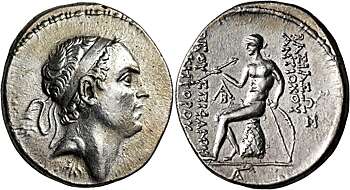
Lot 278. A very rare historical issue! SELEUKID KINGS. Antiochos IV Epiphanes, 175-164 BC. Tetradrachm (Silver, 30 mm, 16.96 g, 12 h), struck during the Sixth Syrian War, Ptolemaïs (Ake) mint, summer/autumn 168, or slightly later. Diademed head of Antiochos IV to right, with his diadem ends adorned with stars; fillet border. Rev. ΒAΣΙΛEΩΣ ΑNTIOXOY - ΘΕΟΥ ΕΠΙΦΑΝΟΥΣ NIKHΦΟΡΟΥ Apollo seated to left on an omphalos, testing an arrow with his right hand and resting his left on his grounded bow; in the outer left field, here off the flan, [palm frond]; in the inner left field, monogram of ΑΒ; in the exergue, monogram of ΑΓ. HGC 9, 620c. Cf. SC 1474 (but with a different monogram in the exergue. Mørkholm 4, obv. die A2. Extremely rare. With an unidealized and realistic portrait of great individuality. Obverse struck from a worn die and minor marks, otherwise, extremely fine.
  • Mise à prix:
    600 CHF
    653 EUR
    545 GBP
    734 USD

    Valeurs approximatives et arrondiesDate: 04/11/2026
Lot
Lot 279. SELEUKID KINGS. Antiochos IV Epiphanes, 175-164 BC. Tetradrachm (Silver, 33 mm, 16.41 g, 12 h), in honor of the Panhellenic Festival of Apollo at Daphne, Antioch-on-the-Orontes, or in the Sanctuary of Daphne, circa 166. Laureate head of Apollo to right. Rev. BAΣIΛEΩΣ -ANTIOXOY-ΘEOY / EΠIΦANOYΣ-NIKHΦOPOY The cult statue of Apollo in Daphne by Bryaxis: Apollo Kitharodos, wearing a laurel wreath and a long chiton, standing to right, holding a phiale in his extended right hand and cradling his kithara with his left arm. HGC 9, 622. Le Rider, Antioche, 560 (obverse die A57'). SC 1401. SMA 64. Extremely rare. Slightly rough surfaces, otherwise, good very fine. According to Le Rider, the manufacturing technique that was used to produce this series was not the usual way minting was done in Antioch. Thus, it is an indication that a temporary mint was opened in Daphne itself, solely to produce these special coins in honor of Apollo for the great festival of 166 BC. The fact that this, now very rare, issue was only minted in very small numbers - especially as compared to the Zeus head issues (above lot 277) - is attested by the use of only a single obverse die in its manufacture (it was recut during use). At present only around 20 specimens of this type are known; assuming an original mintage of between 20,000-30,000 coins (as is suggested by die studies), the survival rate for this issue - perhaps 1 in a 1000 - is very low, though not abnormally so.
  • Mise à prix:
    2'400 CHF
    2'614 EUR
    2'180 GBP
    2'936 USD

    Valeurs approximatives et arrondiesDate: 04/11/2026
Lot
Lot 280. SELEUKID KINGS. Antiochos V Eupator, 164-162 BC. Tetradrachm (Silver, 28 mm, 16.67 g, 12 h), struck under the vice regent Lysias, Ptolemaïs (Ake), 164. Diademed head of Antiochos V as a young child to right; in the field to left, behind his neck, monogram of ΛY (=Lysias). Rev. BAΣIΛEΩΣ ANTIOXOY Apollo seated to left on an omphalos, testing an arrow with his right hand and resting his left on his grounded bow; in the outer left field, monogram of ΛY; in the outer right field, monogram of NE; in the exergue, [monograms of AB and HP]. CSE 772. HGC 9, 751b. Houghton &; Le Rider, D1/R-, (unlisted reverse die, but certainly with the HP monogram in exergue). SC 1581a. Very rare. Rough areas on the obverse and reverse struck off center, otherwise, extremely fine. The extremely youthful portrait, combined with the simple legend without epithet, has led to the speculation that this coin was minted in Ptolemaïs as part of an issue celebrating the coregency of Antiochos IV and V. When Antiochos IV moved east he would have left his son in charge along with the vice regent Lysias, who was himself in Judaea attempting to put down the revolt of the Maccabees. This coin may have been produced in support of that campaign; thus, the unexpected monogram on the obverse, which almost certainly refers to the regent.
  • Mise à prix:
    2'000 CHF
    2'179 EUR
    1'816 GBP
    2'447 USD

    Valeurs approximatives et arrondiesDate: 04/11/2026
Lot
Lot 281. Extremely rare 2nd Reign Tarsos tetradrachm SELEUKID KINGS. Antiochos IX Eusebes Philopator (Kyzikenos), 114/3-95 BC. Tetradrachm (Silver, 28 mm, 15.58 g, 12 h), Tarsos, second reign, 96-95. Diademed head of Antiochos IX to right, beardless. Rev. ΒΑΣΙΛΕΩΣ ΑΝΤΙΟΧΟΥ // ΦΙΛΟΠΑΤΟΡΟΣ Altar of Sandan; to left, monogram of ΔΗ over monogram of ΠΡ. CSE 493. HGC 9, 1230. SC 2355b = NC 1919, pl. 11.5. (but the upper monogram given a slightly different form, rather than as here and on the drachm 2356b). Extremely rare. Apparently the second example known of this variety. Nicely struck and with a dark patina as found. Some scratches, otherwise, nearly extremely fine. Sandan was a local god of Tarsos, whose worship goes back to at least Hittite times. The way he was depicted, standing on the back of a lion-monster, is characteristically Hittite in nature. In his cult his image was placed on a special altar, a 'pyre', and burnt once a year to ensure fertility. He was later assimilated with Herakles - his appearance on coins provides us with one of the few non-Hellenic deities to appear on ancient Greek coinage.
  • Mise à prix:
    800 CHF
    871 EUR
    726 GBP
    978 USD

    Valeurs approximatives et arrondiesDate: 04/11/2026
Lot
Lot 282. SELEUKID KINGS. Antiochos IX Eusebes Philopator (Kyzikenos), 114/3-95 BC. Diobol (Silver, 11 mm, 1.22 g, 12 h), Antioch-on-the-Orontes, third reign, 96-95. Diademed head of Antiochos IX to right. Rev. ΒΑΣΙΛΕΩΣ / ANTIOXOY // ΦΙΛΟΠATOPOΣ Wheat ear with leaf to left; on the outer left, monogram of EA over Π. HGC 9, 1244 (R3) = SC 2372 (this obverse die). Very rare, seemingly the third or fourth known example, well-centered and well-struck. Good very fine.
  • Mise à prix:
    400 CHF
    435 EUR
    363 GBP
    489 USD

    Valeurs approximatives et arrondiesDate: 04/11/2026
Lot
Lot 283. SYRIA, Seleukis and Pieria. Seleukeia Pieria. Autonomous issues, 105/4-83/82 BC. Tetradrachm (Silver, 35 mm, 14.62 g, 12 h), era of Seleukeia, S = 6 = 103/2. Turreted, veiled and draped bust of Tyche to right, wearing a pendant earring and a pearl necklace; all within a bead and reel border. Rev. ΣEΛEYKEΩN / THΣ IEPAΣ / KAI / AYTONOMOY Filleted thunderbolt on throne; below, S; in the lower right field, Δ; the whole within a laurel wreath with ties at the bottom. Callataÿ, Production, pp. 73-4. DCA 697. HGC 9, 1382. SNG Manchester 1368. Struck on a very broad flan. Reverse slightly doubled, otherwise, good very fine.
  • Mise à prix:
    400 CHF
    435 EUR
    363 GBP
    489 USD

    Valeurs approximatives et arrondiesDate: 04/11/2026
Lot
Lot 284. PHOENICIA. Arados. Circa 138/7-44/3 BC. Tetradrachm (Silver, 30 mm, 14.88 g, 12 h), dated Era of Arados, ςΛΡ = 136 = 124-3. Turreted, veiled, and draped bust of Tyche right. Rev. ΑΡΑΔΙΩΝ Nike standing to left, holding an aplustre in her right hand and palm frond over her left shoulder with her left; in the field to left, ςΛΡ over 𐤁 and ΘΝ; all with in laurel wreath. HGC 10, 72. DCA 772. Duryat 3112 (D18/R76). Clear and attractive. Extremely fine.
  • Mise à prix:
    280 CHF
    305 EUR
    254 GBP
    342 USD

    Valeurs approximatives et arrondiesDate: 04/11/2026
Lot
Lot 285. PHOENICIA. Tyre. 126/5 BC-AD 65/6. Shekel (Silver, 30 mm, 14.23 g, 12 h), dated year E = 5 = 122/1 BC. Laureate head of Melqart to right, with lion's skin tied around his neck. Rev. ΤΥΡΟΥ ΙΕΡΑΣ ΚΑΙ ΑΣΥΛΟΥ Eagle standing left on prow, with palm frond over his far shoulder; in the field to left, LE above club; between eagle's legs, Phoenician letter beth below monogram of ZB. DCA 2, 946. DCA Tyre 12. HGC 10, 357. Toned and boldly struck. Some marks on the reverse, otherwise, nearly extremely fine.
  • Mise à prix:
    1'200 CHF
    1'307 EUR
    1'090 GBP
    1'468 USD

    Valeurs approximatives et arrondiesDate: 04/11/2026
Lot
Lot 286. PHOENICIA. Tyre. 126/5 BC-AD 65/6. Shekel (Silver, 28 mm, 14.20 g, 1 h), dated civic year ΟΓ = 73 = 54/3. Laureate head of Melqart to right, with lion's skin tied around his neck. Rev. ΤΥΡΟΥ ΙΕΡΑΣ ΚΑΙ ΑΣΥΛΟΥ Eagle standing left on prow, with palm frond on his far shoulder; in the left field, ΟΓ above club; in field to right, monogram; below legs, 𐤀. DCA 2, 946. DCA Tyre 249. HGC 10, 357. Fine style portrait of Melqart. Nearly extremely fine.
  • Mise à prix:
    1'200 CHF
    1'307 EUR
    1'090 GBP
    1'468 USD

    Valeurs approximatives et arrondiesDate: 04/11/2026
Lot
Lot 287. PHILISTIA (PALESTINE). Gaza. 5th-4th centuries BC. Tetradrachm (Silver, 23 mm, 17.64 g, 12 h). Head of Athena to right, wearing a crested Attic helmet, with a palmette and scroll on the bowl and three upright olive leaves above the visor, and a disc earring. Rev. Zayin - 'Ayin Owl standing facing with wings closed, between two olive sprays each with a berry; all within an incuse square. BMC pl. XLII, 1. BMFA 2203. Gitler &; Tal V.5T = HGC 10, 532. P. van Alfen, "Two Unpublished Hoards and Other Owls from Egypt", AJN 14, 2002, pl. 15, 9 (same dies). Svoronos pl. 110, 49. Extremely rare and of great interest and importance. Very fine. This coin was struck in Gaza, probably during the final third of the fifth century (or slightly later), and copies the well-known types of Athens. Athenian coins circulated widely in trade throughout the Mediterranean world, though especially in the Levant. The head of Athena, with her frontal eye and Attic helmet, precisely copies the heads that appeared on the abundant Athenian tetradrachms produced in the third quarter of the 5th century, but the reverse is a surprise. Instead of the usual owl standing to right of the tetradrachms, what we have here is the facing owl found on contemporary Athenian triobols. It would certainly be interesting to know if any of those triobols have been found in the area of ancient Palestine: in any case, they must have been the model used for this coin. The letters on the reverse, reading from right to left 'Ayin Zayin (or 'Z), are the abbreviated form of the city name, Gaza, but which was typically written Aza,. Interestingly enough the letter 'Ayin has an added central pellet, thus, assimilating it to the form of the letter Θ which appears on the genuine Athenian coins of this period. https://cdn.nomosag.com/auctions/95/video00287.mp4?sv=2023-01-03&ss=b&srt=co&st=2025-03-10T16%3A25%3A27Z&se=2099-03-11T16%3A25%3A00Z&sp=rl&sig=i7RzFAqwYGMJUp3u71BbRyL3HhIAtR%2F8cUnRnTVQfyU%3D&rsct=video%2Fmp4
  • Mise à prix:
    8'000 CHF
    8'716 EUR
    7'267 GBP
    9'788 USD

    Valeurs approximatives et arrondiesDate: 04/11/2026
Lot
Lot 288. JUDAEA, The Jewish War. 66-70. Shekel (Silver, 23 mm, 14.39 g, 12 h), year 3 = April 68 - May 69. Shekel of Israel (in Paleo-Hebrew) Chalice with a pearled rim and a wide base with a foot at each end; above, year 3 (in Paleo-Hebrew). Rev. Jerusalem is Holy (in Paleo-Hebrew) Staff with three pomegranates and a globular base. AJC 18. Hendin 6390. Meshorer 202a. Sharply struck and beautifully toned. Good extremely fine. From an old Swiss collection, ex Bank Leu 42, 12 May 1987, 371. https://cdn.nomosag.com/auctions/95/video00288.mp4?sv=2023-01-03&ss=b&srt=co&st=2025-03-10T16%3A25%3A27Z&se=2099-03-11T16%3A25%3A00Z&sp=rl&sig=i7RzFAqwYGMJUp3u71BbRyL3HhIAtR%2F8cUnRnTVQfyU%3D&rsct=video%2Fmp4
  • Mise à prix:
    4'000 CHF
    4'358 EUR
    3'633 GBP
    4'894 USD

    Valeurs approximatives et arrondiesDate: 04/11/2026
Lot
Lot 289. SASANIAN KINGS. Shahpur I, 240-272. Dinar (Gold, 21 mm, 7.42 g, 12 h), Mint I ("Ctesiphon"), phase 2, circa 260-272. mzdysn bgy šhpwhry MRKAn MRKA ‘yr’n MNW ctry MN yzd’n Elaborate diademed and draped bust of Shahpur I, with neat beard, mural crown and korymbos. Rev. NWRAZY šhpwhry Fire altar flanked by two attendants, both wearing mural crowns and each holding a spear. Göbl I/1. SNS Type IIc/1b, Style P, Group d/1. Sunrise 740. Good extremely fine. https://cdn.nomosag.com/auctions/95/video00289.mp4?sv=2023-01-03&ss=b&srt=co&st=2025-03-10T16%3A25%3A27Z&se=2099-03-11T16%3A25%3A00Z&sp=rl&sig=i7RzFAqwYGMJUp3u71BbRyL3HhIAtR%2F8cUnRnTVQfyU%3D&rsct=video%2Fmp4
  • Mise à prix:
    2'800 CHF
    3'050 EUR
    2'543 GBP
    3'425 USD

    Valeurs approximatives et arrondiesDate: 04/11/2026
Lot
Lot 290. BAKTRIA, Greco-Baktrian Kingdom. Eukratides I, circa 170-145 BC. Tetradrachm (Silver, 35 mm, 17.02 g, 12 h). Diademed, draped and cuirassed bust of Eukratides I to right, wearing crested helmet adorned with a bull's horn and ear; bead and reel border. Rev. BAΣIΛEΩΣ MEΓAΛOY / EYKPATIΔOY The Dioskouroi on horses prancing to right, each holding a palm branch with his left hand and a couched spear with his right; in the lower right field, monogram based on Α. Bopearachchi 6W. Mitchiner 177f. SNG ANS 469-71. Perfectly struck on a broad flan, beautifully toned. Minor flan flaw in the obverse field, otherwise, good extremely fine. From an English collection, Nomos 28, 22 May 2023, 1249. https://cdn.nomosag.com/auctions/95/video00290.mp4?sv=2023-01-03&ss=b&srt=co&st=2025-03-10T16%3A25%3A27Z&se=2099-03-11T16%3A25%3A00Z&sp=rl&sig=i7RzFAqwYGMJUp3u71BbRyL3HhIAtR%2F8cUnRnTVQfyU%3D&rsct=video%2Fmp4
  • Mise à prix:
    1'600 CHF
    1'743 EUR
    1'453 GBP
    1'957 USD

    Valeurs approximatives et arrondiesDate: 04/11/2026
Lot
Lot 291. Extremely rare Ptolemaic tetrobol PTOLEMAIC KINGS OF EGYPT. Ptolemy I Soter, 305-282 BC. Tetrobol (Gold, 12 mm, 2.82 g, 12 h), under Magas, circa 300-282, Kyrene. Diademed head of Ptolemy I to right, with aegis around his neck truncation. Rev. ΒΑΣΙΛΕΩΣ (retrograde, on the left) - ΠΤΟΛΕΜΑΙΟΥ Nike standing left, holding a wreath in her extended right hand and a stylis with her left; in the field to left, crab to left; in the lower right field, 𐊈. BMC Cyrenaica 3, pl. XXVIII, 5. CPE 274a. Naville 258 (same dies) = Svoronos 304a (same dies). Of the highest rarity. Clear and well-centered. Minor marks, otherwise, about extremely fine. From a Swiss collection. This very rare gold fraction combines the then new portrait of Ptolemy I on the obverse with the depiction of Nike that Alexander III introduced for his gold coinage over a generation earlier. The pairing of these two types is somewhat unexpected: all the other portrait gold of Ptolemy I either bears an elephant quadriga or an eagle on the reverse; while reverses bearing figures of Nike are only found on Alexander III-type gold with heads of Athena on their obverses. Someone had a bright idea, but one that was presumably not successful, since it was never repeated. https://cdn.nomosag.com/auctions/95/video00291.mp4?sv=2023-01-03&ss=b&srt=co&st=2025-03-10T16%3A25%3A27Z&se=2099-03-11T16%3A25%3A00Z&sp=rl&sig=i7RzFAqwYGMJUp3u71BbRyL3HhIAtR%2F8cUnRnTVQfyU%3D&rsct=video%2Fmp4
  • Mise à prix:
    6'000 CHF
    6'537 EUR
    5'450 GBP
    7'341 USD

    Valeurs approximatives et arrondiesDate: 04/11/2026
Lot
Lot 292. PTOLEMAIC KINGS OF EGYPT. Ptolemy II Philadelphos, with Arsinöe II, Ptolemy I, and Berenike I, 285-246 BC. Mnaeion or Octadrachm (Gold, 26 mm, 27.36 g, 12 h), Alexandria, circa 272-261/0. ΑΔΕΛΦΩΝ diademed jugate busts of Ptolemy II, draped, and Arsinöe II, veiled, to right; behind, Gallic shield. Rev. ΘΕΩΝ diademed jugate busts of Ptolemy I, draped, and Berenike I, veiled, to right. CPE 313. Olivier &; Lorber dies 2/8. SNG Copenhagen 132. Svoronos 603 pl. XIV 15-17. Marks and scratches and edge marks; ex jewelry, otherwise, good very fine. The Ptolemies were famous for the vast amount of gold coins they issued during the first century or so of their rule. These coins were used for trade, major payments and for prestige gifts to high ranking individuals; and, of course, they were also used for subsidies to allies. The gold came from mines to the south, in Nubia and elsewhere. This piece is part of a major issue showing the reigning monarch, his sister-wife, and their parents, the founders of the dynasty. https://cdn.nomosag.com/auctions/95/video00292.mp4?sv=2023-01-03&ss=b&srt=co&st=2025-03-10T16%3A25%3A27Z&se=2099-03-11T16%3A25%3A00Z&sp=rl&sig=i7RzFAqwYGMJUp3u71BbRyL3HhIAtR%2F8cUnRnTVQfyU%3D&rsct=video%2Fmp4
  • Mise à prix:
    8'000 CHF
    8'716 EUR
    7'267 GBP
    9'788 USD

    Valeurs approximatives et arrondiesDate: 04/11/2026
Lot
Lot 293. An unpublished didrachm of Ptolemy I PTOLEMAIC KINGS OF EGYPT. Ptolemy II Philadelphos, 285-246 BC. Didrachm (Silver, 20 mm, 6.55 g, 12 h), Kyrene, 260s-250/24. Diademed head of Ptolemy I to right, wearing aegis at his neck. Rev. BAΣIΛEΩΣ / ΠTOΛE (retrograde) Eagle, with closed wings, standing to right on a thunderbolt; in the field to left, monogram of ΜΑΓ (=Magas) over monogram of ΛΥ. Cf. CPE 715 (with a differing legend arrangement and with the monograms in the left and right fields). Extremely rare and apparently unpublished. Clear and struck on a small, thick flan. Slightly rough surfaces, otherwise, good very fine. From the Battos Collection. https://cdn.nomosag.com/auctions/95/video00293.mp4?sv=2023-01-03&ss=b&srt=co&st=2025-03-10T16%3A25%3A27Z&se=2099-03-11T16%3A25%3A00Z&sp=rl&sig=i7RzFAqwYGMJUp3u71BbRyL3HhIAtR%2F8cUnRnTVQfyU%3D&rsct=video%2Fmp4
  • Mise à prix:
    600 CHF
    653 EUR
    545 GBP
    734 USD

    Valeurs approximatives et arrondiesDate: 04/11/2026
Lot
Lot 294. PTOLEMAIC KINGS OF EGYPT. Ptolemy IV Philopator, 225-205 BC. Oktadrachm or Mnaieion (Gold, 27 mm, 27.82 g, 12 h), Alexandria, circa 219-217 BC. Radiate and diademed bust of the deified Ptolemy III to right, wearing aegis and with a trident over his left shoulder. Rev. ΒΑΣΙΛΕΩΣ ΠΤΟΛΕΜΑΙΟΥ radiate cornucopia bound with royal diadem; below, ΔΙ. CPE 888. Olivier &; Lorber 135-6, (AV3/RV15). SNG Copenhagen 196. Svoronos 1117. Clear, lightly toned and well-centered. Minor marks, otherwise, nearly extremely fine. From an American collection, ex Nomos FPL 9, Winter/Spring 2016, 69. Ptolemy IV was a relatively unpleasant character who was infamous for the murder of his mother Berenike II. The portrait on this coin is of his far more popular father, Ptolemy III. These coins were actually struck in enormous numbers - Egypt was famous throughout antiquity for its great wealth in gold (it had far smaller silver sources, especially in Pharaonic times) - but the vast majority of them were melted down and reused in ancient times. https://cdn.nomosag.com/auctions/95/video00294.mp4?sv=2023-01-03&ss=b&srt=co&st=2025-03-10T16%3A25%3A27Z&se=2099-03-11T16%3A25%3A00Z&sp=rl&sig=i7RzFAqwYGMJUp3u71BbRyL3HhIAtR%2F8cUnRnTVQfyU%3D&rsct=video%2Fmp4
  • Mise à prix:
    8'000 CHF
    8'716 EUR
    7'267 GBP
    9'788 USD

    Valeurs approximatives et arrondiesDate: 04/11/2026
Lot
Lot 295. PTOLEMAIC KINGS OF EGYPT. Ptolemy V Epiphanes, 205-180 BC. Tetradrachm (Silver, 28 mm, 13.78 g, 6 h), Alexandria. Diademed bust of Ptolemy I to right, wearing aegis. Rev. ΒΑΣΙΛΕΩΣ ΠΤΟΛΕΜΑΙΟΥ Eagle with closed wings standing left on thunderbolt. CPE 968. SNG Copenhagen 244. Svoronos 1231. Attractively toned. Some roughness on the reverse; minor flan crack, otherwise, nearly extremely fine. From the "Treasures of a Numismatist", De Baecque, Marseille, 20 March 2025, 249.
  • Mise à prix:
    600 CHF
    653 EUR
    545 GBP
    734 USD

    Valeurs approximatives et arrondiesDate: 04/11/2026
Lot
Lot 296. Best known Barke Gold Hemiobol! KYRENAIKA. Barke. Circa 435-331 BC. Hemiobol or 1/20 Stater (Gold, 7 mm, 0.44 g, 7 h). Head of a horse to right. Rev. Head of a ram to right. BMC, p. clxxx, note 1. Naville 261 (same dies). SNG Copenhagen -. A very rare and exceptionally well preserved coin. A beautiful piece. Extremely fine. The horse head on the obverse of this coin reminds us of how important horses were to the states of North Africa; they took pride of place in Carthage. As for the ram, that surely refers to Zeus Ammon.
  • Mise à prix:
    1'400 CHF
    1'525 EUR
    1'271 GBP
    1'712 USD

    Valeurs approximatives et arrondiesDate: 04/11/2026
Lot
Lot 297. Unique Tetrobol of Euhesperides KYRENAIKA. Euhesperides. Circa 500-480 BC. Tetrobol (Silver, 13 mm, 2.62 g, 12 h), Attic standard. Pellet between two silphium fruits top to top; to left and right, three pellets. Rev. E-Y (retrograde) Dolphin swimming to right; below, foreleg of a hoofed animal to right. Unpublished in all consulted references! Unique and seemingly the very first coin of Euhesperides ever to be minted. Good very fine/very fine.
  • Mise à prix:
    2'000 CHF
    2'179 EUR
    1'816 GBP
    2'447 USD

    Valeurs approximatives et arrondiesDate: 04/11/2026
Lot
Lot 298. KYRENAIKA. Kyrene. Circa 550-500 BC. Didrachm (Silver, 19.5 mm, 8.47 g). Fillet tied into a Herakles knot between two silphium fruits, points downwards, surmounted by circular ornaments. Rev. Rectangular incuse punch, flanked by square incuse punches. Apparently unpublished. Cf. Nomos 32, 2024, 508, for a tetradrachm of the same series. Seemingly unique. A fascinating coin, with a most unusual geometric design. Good very fine. From a Swiss collection, and that of Battos, Nomos 35, 15 June 2025, 540. What is going on here? This design, as a coin type, is highly unexpected: could it relate to architecture, like the ceiling coffer on the tridrachms of Delphi, or does it reflect the pattern on a luxury fabric? Or, if we assume that it is being viewed from above, could this be a gift-box containing four silphium fruits bound with a ribbon tied with a Herakles knot. https://cdn.nomosag.com/auctions/95/video00298.mp4?sv=2023-01-03&ss=b&srt=co&st=2025-03-10T16%3A25%3A27Z&se=2099-03-11T16%3A25%3A00Z&sp=rl&sig=i7RzFAqwYGMJUp3u71BbRyL3HhIAtR%2F8cUnRnTVQfyU%3D&rsct=video%2Fmp4
  • Mise à prix:
    6'000 CHF
    6'537 EUR
    5'450 GBP
    7'341 USD

    Valeurs approximatives et arrondiesDate: 04/11/2026
Lot
Lot 299. KYRENAIKA. Kyrene. Circa 500-480 BC. Stater (Silver, 22.5 mm, 16.35 g), Attic standard. Two silphium fruits side by side, the one with the point upwards while the other with the point downwards, flanked above and below by a triple fleuron. Rev. Oblong incuse square. BMC p. xix 1b, pl. I, 3. Buttrey -. Of the highest rarity - one of the earliest staters of Kyrene and seemingly the only example in private hands. Good very fine. https://cdn.nomosag.com/auctions/95/video00299.mp4?sv=2023-01-03&ss=b&srt=co&st=2025-03-10T16%3A25%3A27Z&se=2099-03-11T16%3A25%3A00Z&sp=rl&sig=i7RzFAqwYGMJUp3u71BbRyL3HhIAtR%2F8cUnRnTVQfyU%3D&rsct=video%2Fmp4
  • Mise à prix:
    6'000 CHF
    6'537 EUR
    5'450 GBP
    7'341 USD

    Valeurs approximatives et arrondiesDate: 04/11/2026
Lot
Lot 300. KYRENAIKA. Kyrene. Circa 500-480 BC. Hemidrachm (Silver, 11 mm, 2.09 g), Attic standard. Two silphion fruits side by side; separated by silphium plant. Rev. Incuse square. Buttrey 28. Cf. BMC, p. xxi, 4a, pl. II, 4 (drachm). SNG Copenhagen -. Same dies as Leu (W) 19, 2025, 101. Very rare; bright surfaces. Some minor scratches and marks, otherwise, very fine.
  • Mise à prix:
    520 CHF
    566 EUR
    472 GBP
    636 USD

    Valeurs approximatives et arrondiesDate: 04/11/2026
Paramètres de confidentialitéParamètres de confidentialité