Se connecter pour des enchères en direct
Stack’s Bowers and Ponterio Logo
Lot
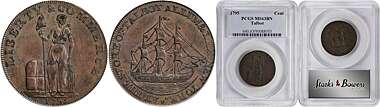
Lot 1301. 1795 Talbot, Allum & Lee Cent. Fuld-1, W-8620. Rarity-1. Lettered Edge: WE PROMISE TO PAY THE BEARER ONE CENT. MS-63 BN (PCGS). Universally sharp in strike detail, an attribute not always noted in examples of this type, both sides also deliver undeniably original surfaces dressed in a blend of faded autumn-orange mint color and warm olive-brown patina. Hard and satiny in texture with only a few faint carbon flecks and other trivial blemishes precluding a higher numeric grade. From the Emerald Coast Collection. PCGS# 640. NGC ID: 2B64.
  • Mise à prix:
    1 USD
    0 EUR
    0 GBP
    0 CHF

    Valeurs approximatives et arrondiesDate: 06/11/2026
Lot
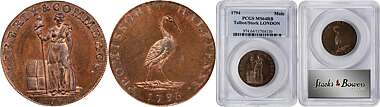
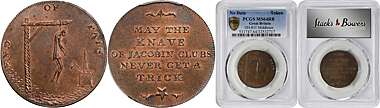
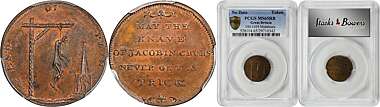
Lot 1302. 1794 Talbot, Allum & Lee Cent / Promissory Halfpenny Mule. Fuld Mule-2A, W-8690. Rarity-5. Copper. LONDON Edge. MS-64 RB (PCGS). A frosty to decidedly semi-prooflike example with delicate olive and gray-brown toning to otherwise vivid mint orange surfaces. Sharply struck and nicely composed, a few faint carbon spots and wispy handling marks preclude a full Gem grade, but do not inhibit strong eye appeal. Really a lovely piece, and perfect for inclusion in a specialized collection. From the Emerald Coast Collection. PCGS# 974.
  • Mise à prix:
    1 USD
    0 EUR
    0 GBP
    0 CHF

    Valeurs approximatives et arrondiesDate: 06/11/2026
Lot
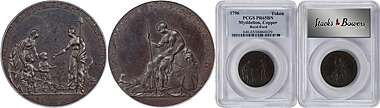
Lot 1303. 1796 Myddelton Token. W-8900. Rarity-7. Copper. Proof-65 BN (PCGS). With "Chapman" Tag and Fitted Metal Case. 199.2 grains. An absolutely exceptional specimen, profoundly well-struck, beautifully toned, and tied for finest certified by PCGS. Reflective surfaces show ideal medium brown color that complicates upon examination like the mechanism of a fine timepiece: deep chestnut merges into olive, and faded mint red evolves into a firmament of pinkish-gold. Underlying powder blue is also present to further enhance the color. The devices, often seen somewhat soft, are needle-sharp throughout both sides, doing honor to engraver Conrad Kuchler's imagination and execution. The denticulated wire rim is intact, and no significant marks or lines are seen.While never intended to circulate in America, this piece has a profound story to tell about American immigration in the post-Revolutionary period. Philip Parry Price Myddelton controlled a large piece of real estate in Kentucky but, while attempting to people it with useful tradesmen interested in emigrating from England, ran afoul of a British law meant to stop the exporting of valuable laborers. The project ended, but not before the dies for these tokens, executed by Conrad Kuchler at Boulton and Watt, had been executed. Myddelton was indicted just a month after the dies were completed. Despite the failure of the project, the sheer beauty of the production and the interest in all things American guaranteed that the tokens would become popular among the collectors of the day. Though most were lovingly cherished in contemporary British cabinets, fewer than 20 silver specimens exist today, along with just eight to 10 in copper. Few of the latter could compare to this one.This lot includes a small handwritten tag signed on the back CHAPMAN, along with a fitted two-piece metal case, 30.0 mm, that helped to preserve this specimen with such care during the decades before it was certified by PCGS. (Total: 1 token; 1 case; 1 tag) From the Emerald Coast Collection. Earlier ex "Chapman," privately, date not recorded; F.C.C. Boyd estate; John J. Ford, Jr.; our (Stack's) sale of the John J. Ford, Jr. Collection, Part VII, January 2005, lot 132. PCGS# 646. NGC ID: 2B66. PCGS Population: 5; 0 graded higher in any category. Stellar Copper 1796 Myddelton Token Gem Proof-65 BN (PCGS)Ex Boyd-Ford
  • Mise à prix:
    1 USD
    0 EUR
    0 GBP
    0 CHF

    Valeurs approximatives et arrondiesDate: 06/11/2026
Lot
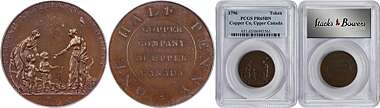
Lot 1304. "1796" Myddelton / Copper Company of Upper Canada Halfpenny Token Muling. Breton-722, W-8910. Proof-65 BN (PCGS). A beautiful and fascinating muling, a fine example of a variety that continues to see popularity in both the United States and Canada. Dressed in deep autumn-orange brown with hints of soft olive and underlying antique gold, the surfaces are both glossy and reflective, and remain free of all but a few wispy handling marks that are easily overlooked in most viewing situations. Very well struck and highly appealing. This variety appears to only exist in copper; it is a lovely way to include this Myddelton die in your cabinet. From the Emerald Coast Collection. PCGS# 651. PCGS Population: 3; 2 finer (both MS-66 BN). Gem Myddelton / Copper Company of Upper Canada Mule
  • Mise à prix:
    1 USD
    0 EUR
    0 GBP
    0 CHF

    Valeurs approximatives et arrondiesDate: 06/11/2026
Lot
Lot 1305. GREAT BRITAIN. Middlesex. Undated (1790s) End of Pain Halfpenny Token. D&H-831, W-8992. Copper. Plain Edge. MS-64 RB (PCGS). A highly attractive near-Gem Uncirculated example of this extremely popular token type. Both sides are toned in warm, original, olive-brown patina with soft powder blue undertones and, in the protected areas around the design elements, much bright mint orange color. Texture is hard and frosty, the strike nicely centered with razor sharp to full detail throughout.These English tokens are popular with collectors of American colonial era types due to the fact that Thomas Paine's writings helped to inspire the American Revolution. The English writer was born in 1737 and died in New York City in 1809, having emigrated to America in 1774 at the invitation of Benjamin Franklin. From the Emerald Coast Collection. PCGS# 531747.
  • Mise à prix:
    1 USD
    0 EUR
    0 GBP
    0 CHF

    Valeurs approximatives et arrondiesDate: 06/11/2026
Lot
Lot 1306. GREAT BRITAIN. Middlesex. Undated (1790s) End of Pain Farthing Token. D&H-1105, W-8920. Copper. MS-65 RB (PCGS). Frosty in finish with a hard and tight texture, both sides of this predominantly orange-brown example exhibit soft blue-gray undertones to medium brown patina. Direct lighting also calls forth brighter mint orange color from the protected areas around many of the design elements - very attractive. Obverse impression a bit tight to lower right with no denticulation at 5 o'clock, reverse similar to bottom/6 o'clock. Otherwise this piece is well struck with razor sharp to full detail for all design elements. Carefully preserved, as well, and worthy of strong bids. From the Emerald Coast Collection. PCGS# 528104.
  • Mise à prix:
    1 USD
    0 EUR
    0 GBP
    0 CHF

    Valeurs approximatives et arrondiesDate: 06/11/2026
Lot
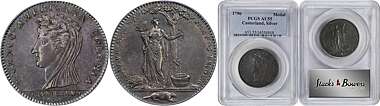
Lot 1307. 1796 Castorland Medal, or Jeton. Original. Lecompte-185, W-9100. Rarity-6. Silver. Reeded Edge. AU-55 (PCGS). A handsome piece dressed in rich, original, steel-olive and mauve-gray. Direct lighting reveals more vivid iridescent undertones of champagne-gold and powder blue, as well as hints of reflectivity remaining in the fields. Boldly defined in the absence of all but light wear that finds greatest expression at the central high points. Further confirming that this is a lightly handled piece, close inspection with a loupe reveals myriad small and a few moderate size marks on both sides, mostly in the open field areas. None of these are worthy of individual attention, the in-hand appearance impressively smooth and inviting. There is no trace of the reverse die buckling at the letter S in PARENS.The Castorland medals or jetons (or as Breen called them "demi ecu") are as enigmatic as they are rare. The original strikes in silver, as here, were probably struck to circulate among the denizens of the 630,000 acre parcel of upstate New York which French settlers founded in 1793. The settlers built a mill, a forge, and a canal and settled two villages, Castorville (now Castorland), and Carthage. The name itself, Castorland, is from the French "castor" or beaver, an example of which figures prominently in the medal's design. Nearly always seen in well-circulated condition, original Castorland pieces - they have been restruck many times over the past two centuries - have long been popular with collectors in America. We see these only occasionally, rarely in or close to full Mint State, and when offered the bidding is substantial. From the Emerald Coast Collection. Earlier from Heritage's Long Beach Signature Auction of June 2010, lot 32. PCGS# 653. NGC ID: 2B69. Rare Original Castorland Medal in Silver
  • Mise à prix:
    1 USD
    0 EUR
    0 GBP
    0 CHF

    Valeurs approximatives et arrondiesDate: 06/11/2026
Lot
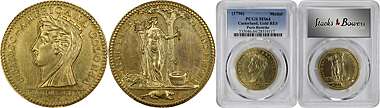
Lot 1308. "1796" (post-World War I) Castorland Medal, or Jeton. Paris Mint Restrike. W-9160. Gold. Plain Edge with (cornucopia) 3OR. MS-64 (PCGS). A gorgeous piece, as perhaps expected given the manner of production, distribution, and the assigned grade. Both sides are frosty to semi-reflective in finish and deliver wonderfully original color in bright yellow gold. Fully struck and a nicely preserved, a Gem were it not for a few faint hairlines from numismatic handling that are not in any way distracting. This is a highly elusive, if relatively modern, production struck at the Paris Mint from copy obverse and reverse dies. Garrett owned a specimen in gold from the original obverse and copy reverse that he acquired in 1883; Norweb's was from the same dies. Regardless of striking period, these gold restrikes of the Castorland medal appear very rarely under normal market conditions and are avidly bid on when presented. From the Emerald Coast Collection. PCGS# 535046.
  • Mise à prix:
    1 USD
    0 EUR
    0 GBP
    0 CHF

    Valeurs approximatives et arrondiesDate: 06/11/2026
Lot
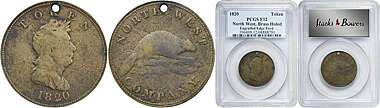
Lot 1309. 1820 North West Company Token. Rulau-E Ore 1A, W-9250. Rarity-4. Brass. Fine-12 (PCGS). 134.3 grains. Pierced for suspension at 12 o'clock, as issued. Both sides are medium golden-olive brown in color, some areas of darker toning visible at and toward the borders. Some light porosity can be seen, very common for the type. Detail is boldest at the peripheries, but the central motifs are fully appreciable with some finer detail to the effigy on the obverse. All in all, a nice brass striking of the challenging North West Company token, and one with an impressive numismatic provenance further enhancing its desirability. From the Emerald Coast Collection. Earlier ex Ralph J. Lathrop (Carmel, New York), August 23, 1967; John J. Ford, Jr.; our (Stack's) sale of the John J. Ford, Jr. Collection, Part II, May 2004, lot 253; Heritage's sale of the Troy Wiseman Collection, Part II, January 2007 FUN Signature Auction, lot 235. PCGS# 952. NGC ID: 2B6H.
  • Mise à prix:
    1 USD
    0 EUR
    0 GBP
    0 CHF

    Valeurs approximatives et arrondiesDate: 06/11/2026
Lot
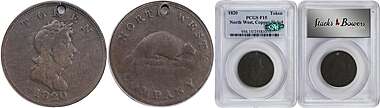
Lot 1310. 1820 North West Company Token. Rulau-E Ore 2, W-9252. Copper. Fine-15 (PCGS). CAC. Pierced for suspension at 12 o'clock, as issued. Here is a perfectly smooth, medium brown specimen whose only "problem" is wear! Of course we can nitpick and point out the usual complement of surface marks or very minor corrosion seen on this piece, but it is far and away superior to most seen at this grade level. Wear is quite even on the obverse; the reverse, as usual, shows more advanced wear in its lower half than its upper, caused by years of wear against a Native American's chest. Here is one of the rare variants struck in copper rather than the more ubiquitous brass seen for this issue.The North West Company was one of the most significant companies involved in the North American fur trade during the 18th and 19th centuries. Founded in Montreal in 1779, it grew to be the biggest competitor to the Hudson Bay Company. This token was issued in 1820, valued at one beaver pelt. The following year the company merged with and into Hudson Bay Company. The tokens are believed to have been struck in Birmingham, England, by John Walker & Co for the Canadian and American market. Normally, these tokens are found very well worn and often corroded from having been unearthed in the region of the Lower Columbia River and Umpqua River valleys in Oregon. However, this example remains exceptionally well-composed and probably survived through different means. It brought $11,500 when we last offered it in January 2011, confirmation of its premium quality for the type. From the Emerald Coast Collection. Earlier from our (Stack's) New York Americana Sale of January 2011, lot 6076, where it realized $11,500 in an NGC VF-20 BN holder. PCGS# 956. NGC ID: 2B6J. PCGS Population: 1; 7 finer (AU-58 finest).CAC Stickered Population: 1 in all grades. Exceptionally Choice North West Company Token
  • Mise à prix:
    1 USD
    0 EUR
    0 GBP
    0 CHF

    Valeurs approximatives et arrondiesDate: 06/11/2026
Lot
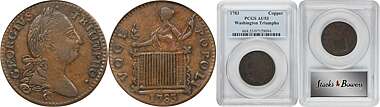
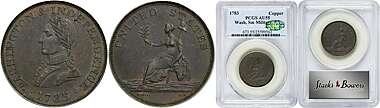
Lot 1311. 1783 Washington Georgivs Triumpho Token. Musante GW-54, Baker-7, W-10100. AU-53 (PCGS). A nicely centered, well struck example with bold to sharp detail in virtually all areas. Microroughness is largely in the planchet, the surfaces generally hard with no sizeable blemishes and some light frost seen in the fields. Handsome chestnut brown patina with steel-olive peripheral highlights. The design of this type remains somewhat enigmatic, though the fleur-de-lis decorated basket in which Britannia sits is now thought to be that of a hot air balloon - this theory suggested as the first hot air balloon made its ascent in September 1783, the same month in which the Treaty of Paris was signed, marking the official end of the Revolutionary War. From the Emerald Coast Collection. PCGS# 664. NGC ID: 2B6K.
  • Mise à prix:
    1 USD
    0 EUR
    0 GBP
    0 CHF

    Valeurs approximatives et arrondiesDate: 06/11/2026
Lot
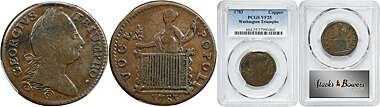
Lot 1312. 1783 Washington Georgivs Triumpho Token. Musante GW-54, Baker-7, W-10100. VF-25 (PCGS). Nice and glossy with a bisecting swath of steel-brown patina through the top of Washington's head, surfaces otherwise evenly toned in lovely deep golden-brown. From the Emerald Coast Collection. PCGS# 664. NGC ID: 2B6K.
  • Mise à prix:
    1 USD
    0 EUR
    0 GBP
    0 CHF

    Valeurs approximatives et arrondiesDate: 06/11/2026
Lot
Lot 1313. "1783" (ca. 1820) Washington Military Bust Copper. Musante GW-109, Vlack 1-A, Baker-4B, W-10150. Small Military Bust. Engrailed Edge. AU-55 (PCGS). CAC. Deep, original toning in dusky gray-brown with sandy-gold from faded mint color in the protected areas around some of the design elements. Sharply struck from a late state of these dies, the obverse shattered with numerous fascinating cracks around the periphery. From the Emerald Coast Collection. PCGS# 673. NGC ID: 2B6N.
  • Mise à prix:
    1 USD
    0 EUR
    0 GBP
    0 CHF

    Valeurs approximatives et arrondiesDate: 06/11/2026
Lot
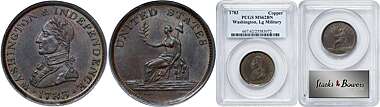
Lot 1314. "1783" (ca. 1820) Washington Military Bust Copper. Musante GW-109E, Vlack 5-D, Baker-4, W-10190. Large Military Bust. MS-62 BN (PCGS). Softly lustrous and satiny, both sides are also hard and tight with no marks of consequence. We offer only a few faint hairlines and some muting to the overall appearance as support for the BU assessment from PCGS. Sharply struck overall with steel-brown central toning that gives way to lighter walnut brown at the borders, especially on the obverse. From the Emerald Coast Collection. PCGS# 667. NGC ID: 2B6L.
  • Mise à prix:
    1 USD
    0 EUR
    0 GBP
    0 CHF

    Valeurs approximatives et arrondiesDate: 06/11/2026
Lot
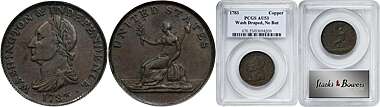
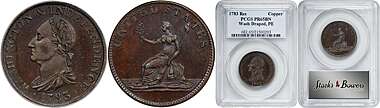
Lot 1315. "1783" (ca. 1820) Washington Draped Bust Copper. Musante GW-106, Vlack 13-J, Baker-2, W-10300. No Button. Copper. Plain Edge. AU-53 (PCGS). Nice saddle brown patina overall, the reverse with a swirls of slightly deeper color around the seated figure's head. There is a tiny surface dig in the same general area, specifically in the field below the letter E in UNITED, obverse with a trio of tiny nicks in the field before Washington's throat. Strike detail is bold to sharp throughout, the texture hard with subtle frost. From the Emerald Coast Collection. Earlier from Heritage's Charlotte ANA Money Show Signature Sale of March 2003, lot 5013. PCGS# 676. NGC ID: 2B6R.
  • Mise à prix:
    1 USD
    0 EUR
    0 GBP
    0 CHF

    Valeurs approximatives et arrondiesDate: 06/11/2026
Lot
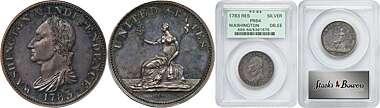
Lot 1316. "1783" (ca. 1860) Washington Draped Bust Copper. Restrike. Musante GW-107, Vlack 17-L, Baker-3A, W-10380. No Button. Silver. Engrailed Edge. Proof-64 (PCGS). OGH. Reflective fields support frosty, fully impressed motifs on both sides of this gorgeous specimen. Both sides are originally and attractively toned in warm silver-mauve with mottled blushes of charcoal-olive at the peripheries. Vivid undertones in powder blue and golden-apricot iridescence are also discernible as the surfaces rotate into direct lighting - highly attractive. Nicely preserved with only faint, well concealed hairlines precluding an even higher grade. According to the Rulau-Fuld Washingtoniana reference (1999), only 50 to 100 silver specimens were struck from this die pairing. Only on rare occasions do we have the opportunity to offer one for sale. From the Emerald Coast Collection. PCGS# 688. NGC ID: 2B6U.
  • Mise à prix:
    1 USD
    0 EUR
    0 GBP
    0 CHF

    Valeurs approximatives et arrondiesDate: 06/11/2026
Lot
Lot 1317. "1783" (ca. 1860) Washington Draped Bust Copper. Restrike. Musante GW-107, Vlack 17-L, Baker-3, var., W-Unlisted. No Button. Copper. Plain Edge. Proof-65 BN (PCGS). A scarcer variety of this popular restrike, neither the Baker nor Whitman references include attributions for plain edge strikings from the Vlack 17-L dies. This piece exhibits richly original mahogany and copper-rose patina with strong underlying reflectivity in the fields. The design elements are thickly frosted in texture with full, razor sharp strike detail throughout. This is a lovely Gem Proof, expertly produced and carefully preserved, and it will please even the most discerning numismatist. From the Emerald Coast Collection. PCGS# 682. NGC ID: 2B6S.
  • Mise à prix:
    1 USD
    0 EUR
    0 GBP
    0 CHF

    Valeurs approximatives et arrondiesDate: 06/11/2026
Lot
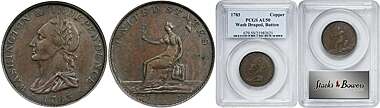
Lot 1318. "1783" (ca. 1820) Washington Draped Bust Copper. Musante GW-108C, Vlack 22-R, Baker-5, W-10440. With Button. AU-50 (PCGS). Hard, frosty surfaces are toned in deep walnut brown with an intermingling of olive-copper at the peripheries. There are a couple of obverse digs at the letters ASH in WASHINGTON, but both sides are otherwise well composed for the assigned grade. Boldly defined, as well, and a nice AU example for both the type and Vlack number. From the Emerald Coast Collection. Earlier from Heritage's sale of the Oak Collection of American Colonial Coinage, September 2005 Long Beach Signature Auction, lot 442. PCGS# 679. NGC ID: 2B6P.
  • Mise à prix:
    1 USD
    0 EUR
    0 GBP
    0 CHF

    Valeurs approximatives et arrondiesDate: 06/11/2026
Lot
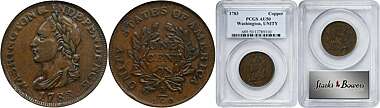
Lot 1319. "1783" (ca. 1820) Washington Unity States Cent. Musante GW-104, Baker-1, W-10130. AU-50 (PCGS). Peripheral softness is typical for the type, but all letters are more or less complete and we see very little of the planchet adjustment marks that are quite heavy on many Washington Unity States cents. Richly original in handsome chestnut and olive-brown patina with superior quality and eye appeal that will catch the eye of discerning bidders. From the Emerald Coast Collection. PCGS# 689. NGC ID: 2B6V.
  • Mise à prix:
    1 USD
    0 EUR
    0 GBP
    0 CHF

    Valeurs approximatives et arrondiesDate: 06/11/2026
Lot
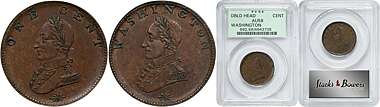
Lot 1320. Undated (ca. 1820) Washington Double-Head Cent. Musante GW-110, Baker-6, W-11200. Plain Edge. AU-58 (PCGS). OGH. Satiny chestnut brown with some intermingled sandy-gold and autumn orange colors in the fields around the central motifs. Nicely struck and satisfying overall. From the Emerald Coast Collection. Earlier from Heritage's New York Signature Sale of July 2002, lot 5755; Heritage's Dallas Signature Auction of November 2007, lot 28. PCGS# 692. NGC ID: 2B6W.
  • Mise à prix:
    1 USD
    0 EUR
    0 GBP
    0 CHF

    Valeurs approximatives et arrondiesDate: 06/11/2026
Lot
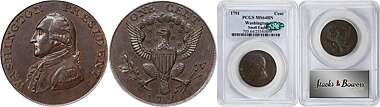
Lot 1321. 1791 Washington Small Eagle Cent. Musante GW-17, Baker-16, W-10630. Copper. UNITED STATES Edge. MS-64 BN (PCGS). CAC. Nice walnut brown patina with traces of faded mint orange color that are most pronounced along the right obverse border. The surfaces are hard and frosty, and also show hints of lilac-blue undertones as they rotate into direct lighting. Striking detail is sharp in most areas, and there are no singularly mentionable blemishes as perhaps one should expect for a Choice Mint State coin with CAC approval. A popular issue as an early coinage proposal, just barely predating the establishment of the first U.S. Mint. From the Emerald Coast Collection. Earlier from Heritage's CSNS Signature Auction of April 2014, lot 3863. PCGS# 705. NGC ID: 2B73.
  • Mise à prix:
    1 USD
    0 EUR
    0 GBP
    0 CHF

    Valeurs approximatives et arrondiesDate: 06/11/2026
Lot
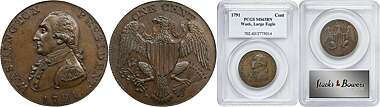
Lot 1322. 1791 Washington Large Eagle Cent. Musante GW-15, Baker-15, W-10610. Lettered Edge, UNITED STATES OF AMERICA. MS-63 BN (PCGS). This solid Select-quality example offers uncommonly sharp detail for the type with emerging to bold detail to the hair behind Washington's brow, all other features razor sharp to full. Frosty to faintly semi-reflective surfaces are warmly toned in golden-brown and olive-copper, direct lighting calls forth not only vivid powder blue and champagne-gold undertones, but also hints of faded mint color on the reverse around the eagle's head and along the tops of its wings. Just a few faint, easily overlooked hairlines from ancient numismatic handling are all that separate this lovely piece from a Choice Mint State grade. This popular Washington type was produced in England as part of a bid to secure a coinage contract from the United States Congress. While many examples that were shipped to America eventually found their way into circulation, many Mint State examples such as this were preserved by collectors and others in England. From the Emerald Coast Collection. PCGS# 702. NGC ID: 2B6Z.
  • Mise à prix:
    1 USD
    0 EUR
    0 GBP
    0 CHF

    Valeurs approximatives et arrondiesDate: 06/11/2026
Lot
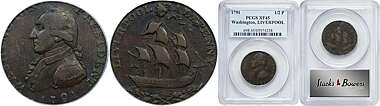
Lot 1323. 1791 Washington Liverpool Halfpenny. Musante GW-19, Baker-17, W-10650. Copper. Lettered Edge. EF-45 (PCGS). Edge lettered PAYABLE IN ANGLESEY LONDON OR LIVERPOOL. Rich blended chestnut and steel-brown, faintly microgranular in places, but presenting as smooth in-hand due to a lack of sizeable marks. Adequate strike for this challenging issue, usual softness in Washington's hair and in the ship's hull directly opposite, letters in WASHINGTON running off flan along the left obverse border. Estimates suggest that perhaps only 25 of these exist, and they were clearly circulated to some degree. This has long been noted a rarity among the more available Washington Guide Book types. As related in our November 2019 sale, the writer of the 1890 R. Coulton Davis Collection sale stated that just four were known at the time. From the Emerald Coast Collection. PCGS# 698. NGC ID: 2B7H.
  • Mise à prix:
    1 USD
    0 EUR
    0 GBP
    0 CHF

    Valeurs approximatives et arrondiesDate: 06/11/2026
Lot
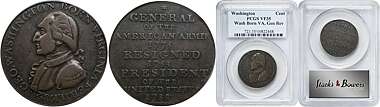
Lot 1324. "1789" (ca. 1792) Washington Born Virginia Copper. Legend Reverse. Musante GW-33, Baker-60, W-10730. Second Reverse. Copper. Plain Edge. VF-35 (PCGS). This is a respectable example of this challenging type that delivers universally bold detail throughout the design. Even the central reverse is clearly defined with all four digits in both dates and the surrounding letters in AMERICAN, RESIGNED, and PRESIDENT fully outlined and clear. Centering is also above average for the type, words BORN VIGINIA just a bit tight to the right obverse border, lower reverse border trivially into the bottoms of the letters U in UNITED and the second S in STATES. The surfaces are microscopically rough and show some curious underlying gloss that suggests an old cleaning, but both sides have retoned naturally and attractively in rich copper-rose and olive-charcoal. Scattered marks and nicks include a few faint pin scratches in the lower left obverse field and behind Washington's forehead, although no other blemishes are worthy of individual attention.Among the somewhat scarcer Washington Guide Book types and one that is almost always seen in grades below VF, with the central reverse so weak that much of the legend is often smooth or close to it. In contrast, a small group of superb Mint State examples survives, but are out of reach to most collectors due to their very high price points. Very little is to be found in the middle ground of quality between these two extremes. In PCGS Choice VF with superior central strike detail on the reverse, as related above, this is among the nicer mid-grade examples we have seen. These were clearly placed into circulation, as evidenced by the commonly seen degree of wear. Were this primarily intended as a commemorative medal, more of the known pieces would be Mint State or very high grade, but only a handful can be considered so fine. Further setting these apart from other Washington Guide Book types is the significant historic fact that these are American-made, not English, engraved and struck by Jacob Perkins in Newburyport, Massachusetts. From the Emerald Coast Collection. Earlier from Heritage's FUN Signature Auction of January 2007, lot 60109. PCGS# 723. NGC ID: 2B79.
  • Mise à prix:
    1 USD
    0 EUR
    0 GBP
    0 CHF

    Valeurs approximatives et arrondiesDate: 06/11/2026
Lot
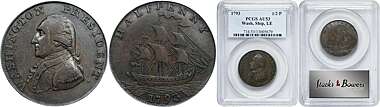
Lot 1325. 1793/2 Washington Ship Halfpenny. Musante GW-20, Baker-18, W-10855. Copper. Lettered Edge. AU-53 (PCGS). This popular Washington type was struck from the same obverse die as used on the 1791 Small Eagle cents. The offered example is nicely toned in warm olive-brown with glints of sandy-gold from faded mint color. Softness to the top of Washington's head and at central reverse is typical for the type, but there is only light wear, and the overall design remains bold. From the Emerald Coast Collection. Earlier from Heritage's Long Beach Signature Auction of September 2008, lot 76. PCGS# 734. NGC ID: 2B7J.
  • Mise à prix:
    1 USD
    0 EUR
    0 GBP
    0 CHF

    Valeurs approximatives et arrondiesDate: 06/11/2026
Lot
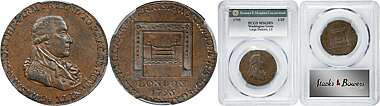
Lot 1326. 1795 Washington Grate Halfpenny. Musante GW-49, Baker-29, W-10990. Large Buttons. Copper. Lettered Edge. MS-63 BN (PCGS). 135.1 grains. Beautiful chocolate and olive-brown with soft accents of faded orange in the peripheries. Glossy throughout with slight prooflike flash in the fields that gives this exceptional eye appeal. Very nicely struck with the entirety of the grate and hearth ornamentation sharply expressed. In 1988, Walter Breen identified Grate halfpence with this edge device as very rare, noting that there were only "4 or 5 known" and citing only the Roper and Robison pieces. There are at least nine in our online archives, including this one. The examples Breen cited do not appear to match this one, nor do they seem to match the others in our archives, bringing this easily found total to 11. Rulau and Fuld noted about 10. This said, most do not have the overall quality, eye appeal or strike of this superb example. From the Emerald Coast Collection. Earlier ex Lawrence R. Stack Collection, November 2006; Sydney F. Martin; our sale of the Sydney F. Martin Collection, Winter 2022 Auction, November, lot 2050. PCGS# 743. NGC ID: 2B7K.
  • Mise à prix:
    1 USD
    0 EUR
    0 GBP
    0 CHF

    Valeurs approximatives et arrondiesDate: 06/11/2026
Lot
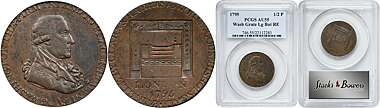
Lot 1327. 1795 Washington Grate Halfpenny. Musante GW-49, Baker-29B, W-10955. Large Buttons. Copper. Reeded Edge. AU-55 (PCGS). Mottled olive and golden-brown patina with hints of faded mint red color here and there at the peripheries, especially at right obverse. From the Emerald Coast Collection. PCGS# 746. NGC ID: 2B7M.
  • Mise à prix:
    1 USD
    0 EUR
    0 GBP
    0 CHF

    Valeurs approximatives et arrondiesDate: 06/11/2026
Lot
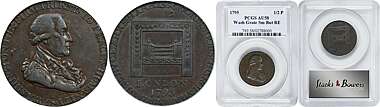
Lot 1328. 1795 Washington Grate Halfpenny. Musante GW-50, Baker-29D, W-10950. Small Buttons. Reeded Edge. AU-58 (PCGS). A richly original deep olive-brown example with intermingled chestnut highlights that are more prominent on the obverse. From the Emerald Coast Collection. PCGS# 749. NGC ID: 2B7N.
  • Mise à prix:
    1 USD
    0 EUR
    0 GBP
    0 CHF

    Valeurs approximatives et arrondiesDate: 06/11/2026
Lot
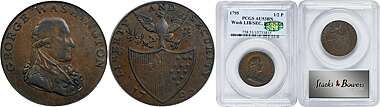
Lot 1329. 1795 Washington Liberty and Security Halfpenny. Musante GW-48, Baker-31, W-11015. Copper. LONDON Edge. AU-58 (PCGS). Steel-brown patina with hints of chestnut and deep rose. There is some muting to the finish, obverse with some marks on the portrait, these attributes pointing to minor handling. The high points of Washington's bust and the eagle on the reverse are softly struck, latter area retaining original planchet roller marks. This is one of the more frequently encountered edge varieties of the Musante GW-48 attribution, and this Choice AU example will nicely represent the Liberty and Security halfpenny in a high grad type set. From the Emerald Coast Collection. Earlier from Heritage's sale of the Joseph M. Seventko Collection, January 2002 FUN Signature Sale, lot 5204. PCGS# 755. NGC ID: 2B7R.
  • Mise à prix:
    1 USD
    0 EUR
    0 GBP
    0 CHF

    Valeurs approximatives et arrondiesDate: 06/11/2026
Lot
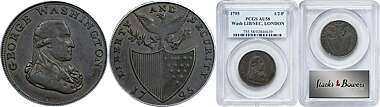
Lot 1330. 1795 Washington Liberty and Security Halfpenny. Musante GW-48, Baker-31B, W-11010. Copper. BIRMINGHAM Edge. AU-53 BN (PCGS). CAC. The surface quality is high for the collector, with satin brown fields and a touch darker brown on the lightly worn high points. The strike is a tad weak on Washington's face as well as the corresponding section of the shield on the reverse. So often these early coppers are fraught with challenges such as porosity, spotting or corrosion, not so here and a delight for the specialist who knows eye appeal. An excellent specimen of this elusive edge variety of the Liberty and Security halfpenny. From the Emerald Coast Collection. Earlier from our Chicago ANA Auction of August 2011, lot 6128. PCGS# 758. NGC ID: 2B7S.
  • Mise à prix:
    1 USD
    0 EUR
    0 GBP
    0 CHF

    Valeurs approximatives et arrondiesDate: 06/11/2026
Lot
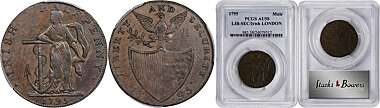
Lot 1331. 1795 Washington Liberty and Security Halfpenny / Irish Halfpenny Mule. Baker-31M, D&H Dublin-9, W-11020. LONDON Edge. AU-58 (PCGS). An attractively original example dressed in a gentle marbling of autumn-orange, steel and mahogany-brown patina. Well centered in strike, although the upper left obverse exhibits scant denticulation, all major design elements are bold despite typical softness to the high points of the standing figure and in the center of the shield on the reverse. A few minor pits in the planchet and wispy handling marks are of no concern at the assigned grade level. The reverse, used on the Liberty and Security halfpence, is in a slightly earlier state than the Birmingham edged pieces, with the arc die crack present but not as bold. It is uncertain whether these saw circulation only in the British Isles or if some may have come to America with those that bore the Washington portrait obverse. From the Emerald Coast Collection. PCGS# 985. NGC ID: BP6U.
  • Mise à prix:
    1 USD
    0 EUR
    0 GBP
    0 CHF

    Valeurs approximatives et arrondiesDate: 06/11/2026
Lot
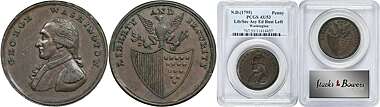
Lot 1332. Undated (1795) Washington Liberty and Security Penny. Musante GW-45, Baker-30, W-11050. Copper. ASYLUM Edge. AU-53 (PCGS). This Liberty and Security issue was made by Peter Kempson in 1795. It is believed to have been a speculative attempt to land a coinage contract at a time when the fledgling U.S. Mint was foundering, though no specific information exists to substantiate this theory. Now mostly hidden from view in slabs, the edges of these Washington pieces can be fascinating. For this type it reads AN ASYLUM FOR THE OPPRESS'D OF ALL NATIONS, an interesting motto given the politics of today. From the Emerald Coast Collection. PCGS# 767. NGC ID: CC42.
  • Mise à prix:
    1 USD
    0 EUR
    0 GBP
    0 CHF

    Valeurs approximatives et arrondiesDate: 06/11/2026
Lot
Lot 1333. Undated (1795) Washington Liberty and Security Penny. Musante GW-45, Baker-30D, W-11060. Fire-Gilt Copper. Lettered Edge. AU-50 (PCGS). Partially gilt, otherwise olive-brown surfaces with plenty of medium to bright gold. An attractive AU example of this popular staple among Washingtoniana specialists and "colonial" coin enthusiasts alike, here with a generous amount of underlying luster. Devoid of significant marks and choice, as such. The Breen Encyclopedia (1988) assures us that this variety is seen "rarely gilt." Since the fire-gilding process was dangerous, exposing the makers to lead fumes, these specially prepared pieces certainly tend to be the rarer versions of their production output. From the Emerald Coast Collection. Earlier from Heritage's Dallas Signature Sale of December 2004, lot 5009; our (American Numismatic Rarities') Richard C. Jewell Collection sale, March 2005, lot 1110. PCGS# 767. NGC ID: CC42.
  • Mise à prix:
    1 USD
    0 EUR
    0 GBP
    0 CHF

    Valeurs approximatives et arrondiesDate: 06/11/2026
Lot
Lot 1334. Undated (1795) Washington Liberty and Security Penny. Musante GW-45, Baker-30E, W-11055. Copper. ASYLUM Edge, Corded Outer Rims. AU-55 (PCGS). A handsome piece dressed in dominant steel-brown patina with intermingled deep reddish-gold representing where original color was last to fade. The strike is superior for the type, even the top of Washington's head and lower right portion of the shield on the reverse displaying bold to sharp detail. Uncommonly smooth for having seen light handling, the surfaces are free of sizeable or otherwise singularly distracting marks. It has been estimated that just eight to 10 examples exist with this distinctive rim treatment, but the number might be just a hair higher. We have five distinct specimens in our online archives going back to 2007, and it seems that as many as eight others can be fairly quickly found. It would appear that the number of corded rim specimens produced might be similar to the number struck with fire gilt surfaces, but the corded rim examples tend to survive in higher grades for some reason. It might point to a different distribution that resulted in them being more protected, but this is not likely to be sorted with certainty. From the Emerald Coast Collection. PCGS# 784. NGC ID: 2B7W.
  • Mise à prix:
    1 USD
    0 EUR
    0 GBP
    0 CHF

    Valeurs approximatives et arrondiesDate: 06/11/2026
Lot
Lot 1335. Undated (1795) Washington Liberty and Security Penny. Musante GW-45, Baker-30D/E, W-11055. Fire-Gilt Copper. ASYLUM Edge, Corded Outer Rims. AU-55 (PCGS). Handsome surfaces retain considerable gilding, with deep brown copper revealed only on the higher points of the motifs. Some scattered marks as expected for the grade include a minor reverse scratch under the letters UR in SECURITY, but this is easily overlooked. Nicely struck, with very good details and eye appeal. The corded rim medals of this series are much rarer than their non-corded counterparts and they seem to often be higher grade survivors suggesting that they were probably produced with a different intent general circulation. These were probably presentation pieces, or similar, and cared for. The writer suspects that this treatment was intended to even out the rims on this issue, which are often wavy due to interference from the edge lettering application. Fire gilt specimens are also quite scarce, but in contrast, these tend to be worn more often than not, with most of their gilding lost. They are very rare with anything close to full gilding as seen here.In recent offerings we have noted "the number of corded rim specimens produced might be similar to the number struck with fire gilt surfaces," but in this medal these rare features are combined. It is the only such example we are aware of. It is thus a great rarity of the series, and could well be unique. It is an ideal candidate for a specialized and extensive collection of Washington medals. From the Emerald Coast Collection. PCGS# 784. NGC ID: 2B7W. Outstanding Liberty and Security Penny Corded Rims and Fire Gilt
  • Mise à prix:
    1 USD
    0 EUR
    0 GBP
    0 CHF

    Valeurs approximatives et arrondiesDate: 06/11/2026
Lot
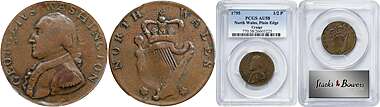
Lot 1336. Undated (1795) Washington North Wales Halfpenny. Musante GW-51, Baker-34, W-11150. Two Stars. Copper. Plain Edge. AU-58 (PCGS). 98.5 grains. Medium autumn-orange brown with a hint of deep oxblood-red at Washington's shoulder. Struck from purposely worn dies to give the type credence as having been in circulation for a lengthy visit. The fields of the present coin are filled with raised die lines that faded quickly with use. Choice for the grade, especially given the nature of this issue. From the Emerald Coast Collection. Earlier from Abner Kreisberg's sale of April 1959, lot 1207; later, Ted L. Craige; our sale of the Ted L. Craige Collection, January 2013 Americana Sale, lot 11522. PCGS# 770. NGC ID: 2B87.
  • Mise à prix:
    1 USD
    0 EUR
    0 GBP
    0 CHF

    Valeurs approximatives et arrondiesDate: 06/11/2026
Lot
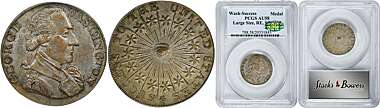
Lot 1337. Undated (possibly ca. 1793) Washington Success Medal. Large Size. Musante GW-41, Baker-265, DeWitt-GW 1792-1, W-10900. First Die. Brass, Tinned. Reeded Edge. AU-58 (PCGS). CAC. From a somewhat early die state for this particular variety with a light obverse crack passing through the lower right corner of the first letter N in WASHINGTON. Much of the original tin wash remains on surfaces that blend bright silver gray with warmer olive-gold, the latter color indicating where the underlying brass is visible. There is little border denticulation, but the strike is otherwise uncommonly well executed with most features sharp and the all-seeing eye at central reverse showing emerging to bold definition. Lustrous and frosty with no troublesome marks or other blemishes to inhibit strong eye appeal. From the Emerald Coast Collection. PCGS# 974000.
  • Mise à prix:
    1 USD
    0 EUR
    0 GBP
    0 CHF

    Valeurs approximatives et arrondiesDate: 06/11/2026
Lot
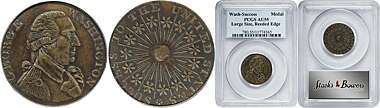
Lot 1338. Undated (possibly ca. 1793) Washington Success Medal. Large Size. Musante GW-42, Baker-266, W-10915. Second Die. Brass. Reeded Edge. AU-55 (PCGS). Richly original surfaces are toned in a blend of deep antique brassy-gold and saddle brown. There is some nice gloss to the obverse, a bit less so on the reverse where some minor roughness is noted, to no detriment. Marks are also minor and largely confined to the obverse, on which side an old, faint carbon spot lower in the right field area is noted for accuracy. This piece is well struck overall and appears hard and frosty during in-hand appreciation, and it will nicely represent the type or individual die pairing in a superior-quality collection. From the Emerald Coast Collection. Earlier from Heritage's Long Beach Signature Auction of September 2007, lot 50. PCGS# 780. NGC ID: 2VZ7.
  • Mise à prix:
    1 USD
    0 EUR
    0 GBP
    0 CHF

    Valeurs approximatives et arrondiesDate: 06/11/2026
Lot
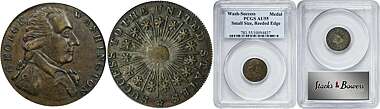
Lot 1339. Undated (possibly ca. 1793) Washington Success Medal. Small Size. Musante GW-44, Baker-267, W-10875. Brass. Reeded Edge. AU-55 (PCGS). Premium Choice AU quality, the surfaces are predominantly rich brassy-olive copper and exude originality. The central reverse exhibits a halo of light pewter-silver color around the eye where some tinning remains. Softly frosted with some nice gloss, the surfaces are smooth and inviting in the absence of even trivial blemishes. Softly struck at the eye, as expected for the type, although this feature is basically outlined, and all other design elements are boldly to sharply defined. An outstanding type candidate in a reeded edge small size Success medal. From the Emerald Coast Collection. PCGS# 783. NGC ID: 2VZB.
  • Mise à prix:
    1 USD
    0 EUR
    0 GBP
    0 CHF

    Valeurs approximatives et arrondiesDate: 06/11/2026
Lot
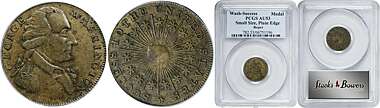
Lot 1340. Undated (possibly ca. 1793) Washington Success Medal. Small Size. Musante GW-44, Baker-267A, W-10877. Brass. Plain Edge. AU-53 (PCGS). A generally smooth, visually appealing example with richly original toning in deep brassy-gold. There are a few faint pin scratches on the obverse, but they are buried within Washington's portrait and requite magnification and intent to discern. Some old surface crust is nestled around many of the design elements, more so on the reverse, and rather than detract this helps to confirm this medal's originality. Well struck apart from typical softness in the center of the reverse (although the eye is fully outlined), an impressive numismatic provenance further enhances the desirability of this handsome piece. From the Emerald Coast Collection. Earlier from our (Stack's) sale of the John L. Roper, 2nd Collection of Colonial & Early American Coins, December 1983, lot 407. PCGS# 782. NGC ID: 2VZ9.
  • Mise à prix:
    1 USD
    0 EUR
    0 GBP
    0 CHF

    Valeurs approximatives et arrondiesDate: 06/11/2026
Lot
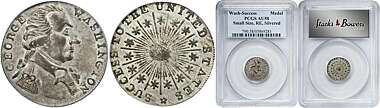
Lot 1341. Undated (possibly ca. 1793) Washington Success Medal. Small Size. Musante GW-44, Baker-267B, W-10875. Brass, Tinned. Reeded Edge. AU-58 (PCGS). A great example of this small size variant of the Washington Success medal, this minimally worn example retains nearly complete tinning. The obverse is predominantly pewter gray with flashes of bright silver in the protected areas around some of the peripheral design elements. The reverse, more lustrous, delivers brighter silver gray color overall. Tinges of light antique gold patina are also present to further enhance the eye appeal. The eye at central reverse lacks finer detail, as typically seen, but it is fully outlined, and the balance of the design elements on both sides are well struck in bold to sharp detail. Impressively smooth in overall appearance, this is one of the absolute finest examples of the type that we have ever had the privilege of bringing to auction. From the Emerald Coast Collection. PCGS# 790. NGC ID: 2VZA.
  • Mise à prix:
    1 USD
    0 EUR
    0 GBP
    0 CHF

    Valeurs approximatives et arrondiesDate: 06/11/2026
Lot
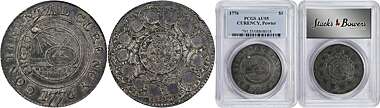
Lot 1342. "1776" (1783) Continental Dollar. Newman 1-C, W-8445. Rarity-3. CURENCY. Pewter. AU-55 (PCGS). This is a handsome Choice About Uncirculated example of the fabled Continental dollar, a type whose history has recently been rewritten by numismatic researchers, but whose popularity is as strong today as it has ever been. Richly original pewter and steel gray surfaces with hints of deep olive. Both sides retain faint traces of frosty mint luster that are best appreciated at direct viewing angles. Well centered in strike with nearly complete border denticulation and all major design elements sharp. Struck from a late obverse die state, there are internal cud breaks at the tops of the letters GI in FUGIO and the base of the letters NT in CONTINENTAL, with cracks extending left and right from both. Free of significant handling marks with a lovely appearance in hand.The Continental dollar is an enigmatic type for which no specific documentation detailing its origin has ever been found. Numismatic scholars have been able to piece together a story that, up until recently, had become the generally accepted version of events. According to this story, resolutions passed by the Continental Congress on February 17, 1776, and May 9 of the same year provided for the issuance of paper money in various denominations, including a $1 note. Resolutions passed later in the year on July 22 and November 2, however, omitted the $1 note. Based on these facts and supported by the existence of these coins, it was theorized that the Continental Congress intended these pieces to serve in lieu of the $1 note beginning in the latter half of 1776. The vast majority of surviving examples are struck in pewter, as here, although a few silver and brass impressions are also known. It was easy to conclude that pewter was the intended composition of such a coin, as the coins would have been fiat money without intrinsic backing, as the notes were. In addition, the fledgling government did not have a significant treasury reserve. Elisha Gallaudet was identified by Eric Newman as the likely maker based on convenient circumstantial evidence. He was a New York City engraver of the period who was known to have been involved in production of New York paper money issues of the 1770s and thus clearly a prime candidate.The earliest known published record of the Continental dollar came, oddly enough, in the German book Historical and Genealogical Almanac, or Yearbook of the Most Remarkable New World Events for 1784 by Matthias Christian Sprengel. Despite the date in the title, the book was published in 1783, the captions for its illustrations rendered in German for the benefit of its target audience. Two illustrations were used to represent the new American nation: one depicting the famous Libertas Americana medal and the other the equally iconic Continental dollar. The caption provided for the obverse of the Continental dollar was AMERICANISCHE LANDES MUNTZE, which roughly translates into "American Country Money." The publisher actually wrote to Benjamin Franklin requesting illustrations to use in the book, although with no record of Franklin's reply the exact origin of Sprengel's illustrations remains unknown.A few years later, in 1786, Bishop Richard Watson's Chemical Essays (Volume IV) also mentioned the Continental dollar. Watson was a professor of chemistry and divinity at Cambridge sanctioned by the British Crown. After discussing the "gun money" issues of King James III, Watson writes:The Congress in America had recourse to the same expedient; they coined several pieces of about an inch and a half in diameter, and of 240 grains in weight; on one side of which was inscribed in a circular ring near the edge - Continental Currency, 1776 - and within the ring a rising sun, with - fugio - at the side of it, shining upon a dial, under which was - Mind your business. - On the reverse were thirteen small circles joined together like the rings of a chain, on each of which was inscribed the name of some one of the thirteen states; on another circular ring, within these, was inscribed - American Congress - and in the central space - We are One.Although the authors of these early publications obviously believed that the Continental dollars were coins of American manufacture, no documentary evidence was provided to substantiate this claim. In fact, it is the lack of documentary evidence authorizing the issue of these pieces in the records of the Continental Congress that has long troubled numismatic researchers.As convincing as the traditional story of these pieces seems, and as tempting as it is to assign primary source status to the Sprengel and Bishop Watson accounts because they date to the 1780s, modern research and a two-part article by Erik Goldstein and David McCarthy entitled "The Myth of the Continental Dollar" published in the January and July 2018 editions of The Numismatist challenge the long accepted theories surrounding these coins. They discovered that a long string of early Americans - people who were actually in a position to provide concrete facts about these pieces - went on the record to mention that they had never seen or heard of such a thing as a Continental dollar coin. Paul Revere and Josiah Meigs both went on the record within a decade of the end of the American Revolution to correct Bishop Watson's report that the pewter "dollar" was an American coin. In the December 12, 1788 issue of The New Haven Gazette, which he owned and published, Meigs, who at the time was New Haven's city clerk, boldly rebuked Bishop Watson's conclusion:The following extract from the learned Bishop Watson's Chemical Essays Vol. 4. Page 136. shews how easily strange errors are introduced into the writing of even careful men when they write on any subject relative to distant countries--It is probable that some workman amused himself with copying one of the small bills emitted by Congress, into a die or mould, and then impressed or cast a piece of Pewter such as the Bishop has described.--If the author of that work should publish a future addition, it is hoped that clause will be omitted.Goldstein and McCarthy also quote Paul Revere's correction to Bishop Watson's conclusion about the Continental dollar, which the famous Boston silversmith and American patriot sent in a letter dated February 21, 1790:In perusing your valuable Chemical Essays vol. 4 page 136, you make mention of pewter money coined by the American Congress, and give a description of it. The very great pleasure which I have received from the perusal of those volumes and the exceeding good character I have heard of you, from some of your countrymen, as a Man and for fear some person of consequence, has not endeavored to set you right in that piece of History; I have enclosed you two pieces of money, one of them printed under the direction of the American Congress, the other I am not so fully assured of; as they both answer to your description, except the metal, I have sent them, supposing, if you were not possessed of them before, they might be acceptable to you as curiosities.As for pewter money struck in America, I never saw any. I have made careful enquiry, and have all the reason in the world to believe that you were imposed upon by those who informed you.As the most significant American coin collector of the 18th century, Pierre Eugene Du Simitiere, a Philadelphian, was also ideally placed to understand the true origin and status of the Continental dollar. Before his death in 1784, he amassed every kind of rare and common American coin then available, including seven Higley coppers that he scrupulously sketched in his inventory book. In November 1779 the Congress officially proposed naming him "Historiographer of the Congress of the United States," with a salary paid in Continental Currency and a three-year contract to write the Congress' official history. Du Simitiere, a numismatist and daily observer of the Congress, not only never owned a Continental dollar, but he described it in his notes as "a coin of the size of a crown, with devices and Mottos, taken from the continental money, Struck't in London on Type-Metal and dated 1776." In truth, there was literally not a single American better equipped to know its story than he.Du Simitiere was just the first of many pioneering numismatists who never owned or saw a Continental dollar, and who denied its American provenance. Matthew A. Stickney began collecting in 1823. He traded his Immune Columbia piece to the United States Mint in 1843 to get a brand-new 1804 dollar. His acquisition of his first Continental dollar came a full decade later, while on a trip to England. Joseph B. Felt was a leading American antiquarian when he wrote his Historical Account of Massachusetts Currency in 1839. He noted the 1786 account of Bishop Watson in Chemical Essays, quoted above, and acted incredulous that Watson believed the Continental dollar to be an American coin:It will be perceived that such a description was similar, in several respects, to that on the copper coin, which Congress ordered, in 1787, to be issued. The preceding coin, so particularly mentioned by Bishop Watson, has no reference made to it in the Congress Journals.Jeremiah Colburn never saw or heard of one until Matthew Stickney showed him his, as he noted in his column in Historical Magazine in 1857. Colburn noted "no coins were ever in circulation, as currency, of this type, but copies of the Medal are extant struck in white metal." And Sarah Sophia Banks, the London numismatist whose father was the world's most renowned scientist of his day, purchased her Continental dollar new upon issuance, logging its acquisition in her pre-1790 inventory books with the notes "Congress Dollar. 1776. never current, struck on speculation in Europe, for sale in America." In sum, those who were there knew the score: the Continental dollar was a London-made medal, made with designs inspired by Continental Currency, not a coin made by the Continental Congress.Perhaps the most persuasive document is the paperwork Sarah Sophia Banks preserved with her "Congress Dollar." The two best known American-reference medals of 1783, the year the Continental dollar appears to have been struck, were initially sold with what the French called an "explication," a simple handbill or flyer explaining the designs, what they meant, and where they came from. The Libertas Americana medal was sold with one. Betts-610, the usually pewter medal coined to celebrate the Treaty of Paris, was also sold with one. And so, too, was the Continental dollar. Banks preserved hers, and it reads just as other contemporary explications do, explaining the motifs, "representing the Paper Currency of a Dollar....the Thirteen Colonies united like a Chain....the Date, 1776, is the time they declared Independency."As David McCarthy noted in greater detail in a more recent article published in the August 2022 edition of The Numismatist, the handbill advertised "'these American Medals at Six-Pence Each,' followed by a careful description of the Continental dollar, ending with the words, 'the Letters E.G. Fecit, its maker's Name.'" McCarthy, following a discovery by collector Ed Hohertz, built a strong case to identify the diesinker as German engraver Elias Gervais. McCarthy offered stylistic and circumstantial links to Gervais, who was the engraver at the mint in Cologne in the 1770s and used both E.G and E.G. F. as signatures on his dies.That the Continental dollar was intended as a medal and not a coin, and that it was struck in Germany (i.e. the Holy Roman Empire) in 1783 instead of an unknown American location in 1776, changes very little in the scheme of things. The Libertas Americana medal was coined in Paris but is consistently rated as among the most desirable American numismatic collectibles; the Continental dollar should not forfeit a similar place in the hearts of American collectors. It remains scarce, attractive, historic and valuable. It's a piece that Paul Revere - no man of letters, typically - felt passionately enough about to write a missive to the Bishop of London. And it's a piece that all of us grew up looking at and wanting to own, just as every generation of American collector since 1823 has. Indeed, the inclusion of an attractive Continental dollar, as here, will continue to help define the difference between an average and outstanding collection of early American types. From the Emerald Coast Collection. PCGS# 791. NGC ID: 2AYN. Classic Continental Dollar
  • Mise à prix:
    1 USD
    0 EUR
    0 GBP
    0 CHF

    Valeurs approximatives et arrondiesDate: 06/11/2026
Lot
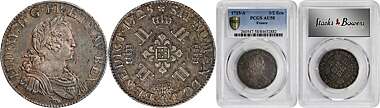
Lot 1343. FRANCE. 1725-A 1/2 Ecu aux 8 L. Paris Mint. Gadoury-312. AU-58 (PCGS). Boldly to sharply defined with softly frosted luster, both sides are wonderfully original in preservation. Generally pewter-olive gray, but with more vivid antique gold, pale pink and powder blue iridescence evident as the surfaces rotate into direct lighting. The Emerald Coast collector included this coin due to the issue's association with the Le Chameau shipwreck, the treasure of which included many 1/2 écu aux 8 L among the silver coins in its treasure. From the Emerald Coast Collection. PCGS# 260547.
  • Mise à prix:
    1 USD
    0 EUR
    0 GBP
    0 CHF

    Valeurs approximatives et arrondiesDate: 06/11/2026
Lot
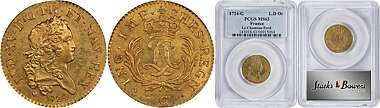
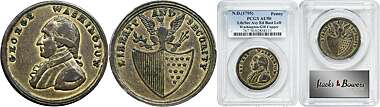
Lot 1344. FRANCE. 1724-G Louis d'or Mirliton, grandes palmes. Poitiers Mint. Gadoury-339. MS-63 (PCGS). Spectacular bright gold with nearly full mint luster showing on both sides. Rim imperfect (lightly clipped) at 12 o'clock relative to the obverse. A quite remarkable specimen from a quality standpoint, especially given its exciting history.Le Chameau (The Camel) was a 48-gun French military transport ship, constructed in 1717. When she left La Rochelle, the main New World-facing port on France's Atlantic Coast, in July 1725, she was bound for Fortress Louisbourg, the dominating French fort that controlled entry to the interior of Canada. She carried 316 passengers, including at least 100 soldiers and the new appointee for the position of Intendant of Canada. She also carried thousands of French coins, both gold and silver. The treasure aboard Le Chameau exceeded 82,000 livres tournois, several million dollars today, all intended to pay the troops who made Fortress Louisbourg the most formidable defensive structure in the entire New World.Late August is hurricane season in the North Atlantic, and when Le Chameau approached the coastline of Nova Scotia's Cape Breton Island the night of August 25, the seas were unquiet and the winds were strong. During the overnight hours on the morning of August 26, within sight of Louisbourg, the ship hit an outcropping known today as Chameau Rock. It was a total loss, and daylight revealed the telltale signs of a nautical disaster up and down the beaches nearby.Salvage operations began soon thereafter, but the swirling sand and surf amidst the currents where the St. Lawrence and the Atlantic join made diving on the wreck nearly impossible. A few thousand livres tournois were recovered washed up on the shore, but then the site was abandoned to history. Two decades later, New Englanders attacked and captured Fortress Louisbourg in the name of King George II; they were disheartened when the prize was given back to the French at the treaty table. In 1759, the fortress fell again, and all of Canada was turned over to the English in 1763. What was Acadia became Nova Scotia, but thousands of French coins that were royally authorized for New World circulation remained beneath the waves just off shore.On September 19, 1965, three men from Cape Breton Island - Alex Storm, David MacEachern, and Harvey MacLeod - found the first coins to be salvaged from Le Chameau in more than 200 years. Gold coins and a trove of artifacts followed, and worldwide celebrity visited upon the three men in April 1966. Television appearances and a book deal made them household names in Canada, but within a week Storm was served with a lawsuit. A partnership to find the vessel was undertaken by Storm and others in 1961, and never legally terminated, though it did peter out. In December 1967, a judge awarded three-quarters of the treasure to Storm and one-quarter to his earlier partners. Under Canadian Treasure Trove law, Provincial authorities got first crack, and many of Le Chameau's relics (as well as all base metal coins found) are currently the property of Parks Canada.The first lease on the wreck site of Le Chameau recovered 878 Louis d'ors and 7,861 silver ecus, as recounted by Jim Charlton in the Canadian Numismatic Journal in 1976. The December 1971 Parke-Bernet sale included 513 Louis d'ors and subsequent salvage operations have found more coins, but gold has been sparse and quality has been poor; the 1999 Stack's Americana sale included many hundreds of mostly poor ecus but just two Louis d'ors. The 72 lots in our (Stack's) Ford XIII were cherrypicked by Ford prior to the treasure's dispersal and represent some of the choicest specimens known; this is one of those coins.The bulk of the coins recovered were Louis XV ecus, mostly dated 1724 and 1725 and predominantly struck at the mint in La Rochelle. The gold coins were mostly Louis d'ors aux mirlitons, almost all dated 1723 to 1725. Some smaller coins were shipped as well, along with a handful of other issues. Each of these types was carefully cataloged by Walter Breen for his 1988 Encyclopedia, and they've been popular among Canadian, American, and French collectors since their rediscovery. From the Emerald Coast Collection. Earlier ex Le Chameau shipwreck, sunk 1725; our sale of the John J. Ford. Jr. Collection, Part XIII, January 2006, lot 424. PCGS# 141018.
  • Mise à prix:
    1 USD
    0 EUR
    0 GBP
    0 CHF

    Valeurs approximatives et arrondiesDate: 06/11/2026
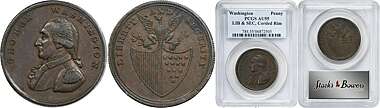
Lot
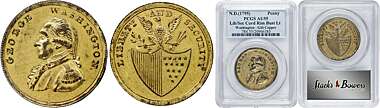
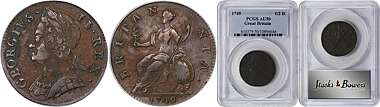
Lot 1345. GREAT BRITAIN. 1749 Halfpenny. Spink-3719, KM-579.2. AU-50 (PCGS). A rather earthy example, both sides are granular and a bit hazy with blushes of olive-charcoal to dominant tobacco brown color. The planchet is smooth and free of flaws, both sides also devoid of distracting marks. Well struck and bold for the grade.Although British regal halfpennies of various dates circulated widely throughout the American Colonies, those dated 1749 are particularly significant for U.S. collectors. Examples of this date, along with 1749 farthings, were sent to the colonies as reimbursement for the 1745 capture of Fortress Louisbourg on Cape Breton Island by New Englanders during King George's War (the North American theater of the War of the Austrian Succession). From the Emerald Coast Collection. PCGS# 610379.
  • Mise à prix:
    1 USD
    0 EUR
    0 GBP
    0 CHF

    Valeurs approximatives et arrondiesDate: 06/11/2026
Lot
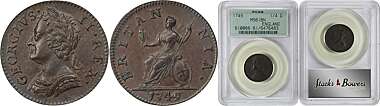
Lot 1346. GREAT BRITAIN. 1749 Farthing. Spink-3722, KM-581.2. MS-61 BN (PCGS). OGH. The farthing counterpart to the George II halfpenny of the same date offered above, and also an American colonial type due to the dispatch of examples to New England as reimbursement for the 1745 capture of Fortress Louisbourg on Cape Breton Island. This is a sharply struck example that is well centered on the obverse, less so on the reverse where the border is wider at upper left. Subdued copper brown surfaces and hazy silvery tinting explain the MS-61 numeric grade from PCGS, but both sides are hard and tight with neither detracting flan flaws or troublesome post-strike marks. From the Emerald Coast Collection. PCGS# 610088.
  • Mise à prix:
    1 USD
    0 EUR
    0 GBP
    0 CHF

    Valeurs approximatives et arrondiesDate: 06/11/2026
Lot
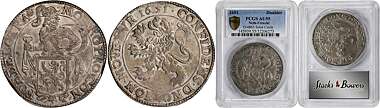
Lot 1347. REPUBLIC OF THE SEVEN UNITED NETHERLANDS. Utrecht. 1651-(shield) Leeuwendaalder. Royal Dutch Mint. Delmonte-845, Davenport-4863, KM-30. Solid Inner Circle. AU-55 (PCGS). Well above average for this very common colonial era type, yet one that is notoriously challenging to find "nice." Markedly unlike the typical hoard coin with conserved surfaces, poor strike quality, and/or significant planchet problems, this one excels in all categories. The flan is near-fully round, free of flaws, with only shallow clips at 1, 4 and 7 o'clock relative to the obverse. The strike is outstanding, trivially soft in only a few peripheral areas and at the lion's trailing leg, with most features razor sharp to full and the overall design appreciable to an extant rarely allowed by examples of this type. Lustrous and frosty with delicate retoning in natural iridescent golden-gray, the surfaces are smooth in the absence of detracting marks. For the advanced collector of colonial American circulating coinage, this piece would be difficult to improve upon and, indeed, is far more appealing that the typical AU or even Mint State leeuwendaalder seen in today's market.This iconic type served alongside cob 8 reales and French écus as the principle crowns in colonial North American circulation until the introduction of milled 8 reales coinage at the Spanish colonial mints beginning in 1732. John Kleeberg (2013) reports that the source for leeuwendaalders in the English colonies was the little-known Madagascar trade between America and East Africa during the late 17th and early 18th centuries. Once introduced in American commerce, these coins circulated in all of the English colonies except for New England from about 1693 to 1733. The abandonment of the Madagascar trade as unprofitable also contributed to the eclipse of leeuwendaalders in colonial American circulation. From the Emerald Coast Collection. PCGS# 145939.
  • Mise à prix:
    1 USD
    0 EUR
    0 GBP
    0 CHF

    Valeurs approximatives et arrondiesDate: 06/11/2026
Lot
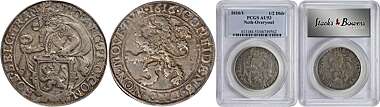
Lot 1348. REPUBLIC OF THE SEVEN UNITED NETHERLANDS. Overijssel. 1616/Z 1/2 Leeuwendaalder. Delmonte-885, KM-11.1. AU-53 (PCGS). Uncommonly well detailed for one of these, we note bold to sharp definition in virtually all areas, just minor softness at the lower obverse and reverse borders, also at the rampant lion's front paws on the latter side. The entire design is fully appreciable, as such, and the surfaces retain appreciable luster in a softly frosted texture. Naturally and attractively retoning, as well, with iridescent golden-apricot and powder blue nestling among the design elements. This type's connection to colonial American commerce is not as well established as that of its leeuwendaalder counterpart, but examples are still eagerly sought by advanced collectors in this discipline, who recognize that the 1/2 leeuweendaalder is very much the rarer type. From the Emerald Coast Collection. PCGS# 413184.
  • Mise à prix:
    1 USD
    0 EUR
    0 GBP
    0 CHF

    Valeurs approximatives et arrondiesDate: 06/11/2026
Lot
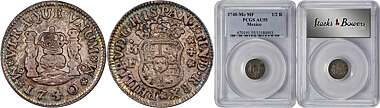
Lot 1349. SPAIN. Viceroyalty of New Spain. 1740-Mo MF 1/2 Real. Mexico City Mint. Calico-264, Yonaka-M05-40, KM-65. AU-55 (PCGS). A pretty piece with dominant olive-gray patina backlit by pink and blue iridescence, the latter most intense at the borders. Detail is suitably bold for a lightly circulated example of this challenging type, all major features fully appreciable, lower reverse periphery with light clash marks from the reverse die. Softly lustrous with much of the frosty luster discernible as the surface rotate unto direct lighting. From the Emerald Coast Collection. PCGS# 670191.
  • Mise à prix:
    1 USD
    0 EUR
    0 GBP
    0 CHF

    Valeurs approximatives et arrondiesDate: 06/11/2026
Lot
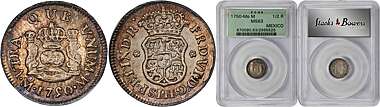
Lot 1350. SPAIN. Viceroyalty of New Spain. 1750-Mo M 1/2 Real. Mexico City Mint. Calico-83, Yonaka-M05-50, KM-67.1. MS-63 (PCGS). OGH. Attractive golden-apricot iridescence is a bit bolder on the pillars side, where it mingles with coppery highlights that appear to drift toward the border. Frosty with nice luster for the grade, bold to sharp strike detail further enhances this coin's appeal. From the Emerald Coast Collection. PCGS# 670090.
  • Mise à prix:
    1 USD
    0 EUR
    0 GBP
    0 CHF

    Valeurs approximatives et arrondiesDate: 06/11/2026
Lot
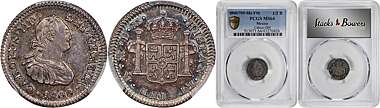
Lot 1351. SPAIN. Viceroyalty of New Spain. 1800/799-Mo FM 1/2 Real. Mexico City Mint. Calico-284, Yonaka-M05-100a, KM-72. MS-64 (PCGS). The overdate is clear on this boldly struck, ideally centered example. Both sides are fully lustrous and frosty in texture, the surfaces further enhanced by pretty iridescent toning in olive-apricot, champagne pink and powder blue. The reverse is the more colorful of the two sides, and it also exhibits a delightful target-like distribution to the toning. From the Emerald Coast Collection. PCGS# 513071.
  • Mise à prix:
    1 USD
    0 EUR
    0 GBP
    0 CHF

    Valeurs approximatives et arrondiesDate: 06/11/2026
Lot
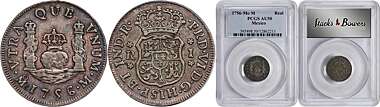
Lot 1352. SPAIN. Viceroyalty of New Spain. 1756-Mo M Real. Mexico City Mint. Calico-196, Yonaka-M1-56, KM-76.1. AU-50 (PCGS). Handsome olive-gray patina on the crowned arms side, the pillars side is more colorful with iridescent highlights of salmon-pink and powder blue to dominant pewter gray. Overall strike detail is bold for the type, especially given the presence of light wear. A nice-looking AU for this Spanish colonial minor type. From the Emerald Coast Collection. PCGS# 395498.
  • Mise à prix:
    1 USD
    0 EUR
    0 GBP
    0 CHF

    Valeurs approximatives et arrondiesDate: 06/11/2026
Lot
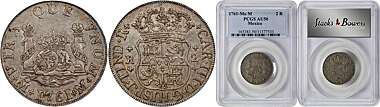
Lot 1353. SPAIN. Viceroyalty of New Spain. 1761-Mo M 2 Reales. Mexico City Mint. Calico-Unlisted, Yonaka-M2-61b, KM-87. Finely Detailed Globes. AU-50 (PCGS). Much softly frosted luster remains on light olive-gray surfaces that also reveal pretty gold, blue and pink undertones as the coin rotates under lighting. A well balanced piece with universally bold to sharp detail and no sizeable or otherwise singularly mentionable marks. From the Emerald Coast Collection. PCGS# 165383.
  • Mise à prix:
    1 USD
    0 EUR
    0 GBP
    0 CHF

    Valeurs approximatives et arrondiesDate: 06/11/2026
Lot
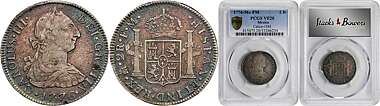
Lot 1354. SPAIN. Viceroyalty of New Spain. 1776-Mo FM 2 Reales. Mexico City Mint. Calico-1343, Yonaka-M2-76, KM-88.2. VF-20 (PCGS). Warm sandy-gray and olive-charcoal patina with a lovely target-like distribution to strong underlying antique gold, cobalt blue and rose-red iridescence. Arguably the most significant Spanish silver denomination to circulate in early America, the 2 reales from New World mints remained in active commerce for decades after the American Revolution. In fact, the sufficient quantity of Spanish colonial 2 reales in domestic circulation in large part explains the limited production of quarter dollars at the United States Mint from the denomination's debut in 1796 until passage of the Act of February 21, 1853. From the Emerald Coast Collection. PCGS# 415475.
  • Mise à prix:
    1 USD
    0 EUR
    0 GBP
    0 CHF

    Valeurs approximatives et arrondiesDate: 06/11/2026
Lot
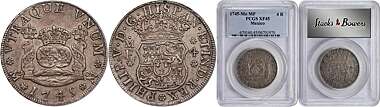
Lot 1355. SPAIN. Viceroyalty of New Spain. 1745-Mo MF 4 Reales. Mexico City Mint. Calico-1132, Yonaka-M4-45, KM-94. EF-45 (PCGS). The 4 reales is the scarcest of the Spanish colonial silver denominations in today's market, and also the most challenging to find "nice." This Choice EF measures up nicely with warm, even pewter gray patina to faintly lustrous surfaces. Boldly to sharpy defined overall. From the Emerald Coast Collection. PCGS# 670160.
  • Mise à prix:
    1 USD
    0 EUR
    0 GBP
    0 CHF

    Valeurs approximatives et arrondiesDate: 06/11/2026
Lot
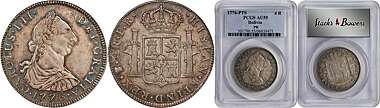
Lot 1356. SPAIN. Viceroyalty of the Río de la Plata. Upper Peru (Bolivia). 1776-PTS PR 4 Reales. Potosí Mint. Calico-934, KM-54. AU-55 (PCGS). Attractively toned in dominant golden-gray and reddish-apricot with rich olive-blue iridescence ringing the obverse periphery. The surfaces show some underlying brightness, but retain appreciable frosty luster, and are free of sizeable marks. This is a "magic" date among collectors of American colonial coinage, offered here on an example of a challenging Spanish silver denomination from a legendary New World mint. From the Emerald Coast Collection. PCGS# 501790.
  • Mise à prix:
    1 USD
    0 EUR
    0 GBP
    0 CHF

    Valeurs approximatives et arrondiesDate: 06/11/2026
Lot
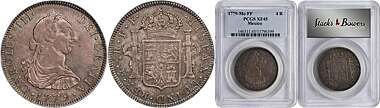
Lot 1357. SPAIN. Viceroyalty of New Spain. 1779-Mo FF 4 Reales. Mexico City Mint. Calico-891, Yonaka-M4-79, KM-97.2. EF-45 (PCGS). Boldly defined from a nicely executed strike, this lightly circulated example reveals flickers of original frosty luster as the surfaces rotate into direct lighting. Rich toning dominates the in-hand appearance, however, with dominant mauve-gray and olive-russet backlit by iridescent gold, blue and rose. Moderately abraded on the obverse, although the marks are buried in the toning and singularly inconspicuous during in-hand appreciation. From the Emerald Coast Collection. PCGS# 146311.
  • Mise à prix:
    1 USD
    0 EUR
    0 GBP
    0 CHF

    Valeurs approximatives et arrondiesDate: 06/11/2026
Lot
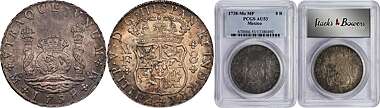
Lot 1358. SPAIN. Viceroyalty of New Spain. 1738-Mo MF 8 Reales. Mexico City Mint. Calico-1449, Yonaka-M8-38, KM-103. AU-53 (PCGS). An American colonial classic, and popular with collectors ever since its inclusion in the Guide Book has helped to identify the Spanish pillar dollar as the most immediate predecessor to the United States silver dollar. This is a nice early date example from the Mexico City Mint with much frosty mint luster retained. Evenly toned in blended silver-apricot and olive-gray iridescence, the pillars side contrasts with a crowned arms side on which warmer golden-apricot and copper-russet patina is seen. This is certainly secondary toning, as fully original AU examples of this type are virtually unknown, but it is attractive, and the surfaces show few hairlines and even fewer singularly distracting marks. Well centered in strike with universally sharp detail, this coin appears to be more of an AU-55 to your cataloger. Regardless of the specific certified grade, it is an above average AU for the type that will nicely represent the iconic pillar dollar in another advanced collection. From the Emerald Coast Collection. PCGS# 670066.
  • Mise à prix:
    1 USD
    0 EUR
    0 GBP
    0 CHF

    Valeurs approximatives et arrondiesDate: 06/11/2026
Lot
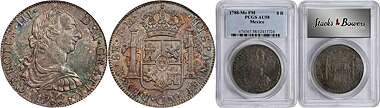
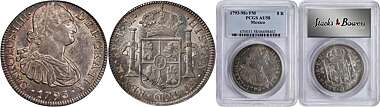
Lot 1359. SPAIN. Viceroyalty of New Spain. 1788-Mo FM 8 Reales. Mexico City Mint. Calico-1132, Yonaka-M8-88, KM-106.2a. AU-58 (PCGS). Uncommonly well struck for this challenging type, both sides boast virtually full detail in the absence of significant rub. The surfaces are toned in dominant pewter gray, the obverse with mottled overlying olive-blue and reddish-gold, the reverse with blushes of reddish-apricot and cobalt blue that are mostly confined to the periphery. Underlying hairlines are noted for accuracy, more so on the reverse, but the in-hand appearance is pleasingly smooth in the absence of sizeable or otherwise singularly distracting marks. Like so many Spanish colonial silver types, the C3 portrait 8 reales is seldom encountered with solid technical quality and strong eye appeal. This one has both, and it is an above average example for the consideration of advanced bidders. From the Emerald Coast Collection. PCGS# 670167.
  • Mise à prix:
    1 USD
    0 EUR
    0 GBP
    0 CHF

    Valeurs approximatives et arrondiesDate: 06/11/2026
Lot
Lot 1360. SPAIN. Viceroyalty of New Spain. 1793-Mo FM 8 Reales. Mexico City Mint. Calico-955, Yonaka-M8-93, KM-109. AU-58 (PCGS). Flashy and lustrous surfaces are minimally toned to allow ready appreciation of a frosty to semi-reflective finish from the dies. We note only light secondary toning in champagne-pink that is bolder on the obverse, and then again at the periphery, where it joins wisps of iridescent powder blue in a few isolated areas. The strike is trivially off center to 12 o'clock, but both sides show full border denticulation and are boldly to sharply defined at most design elements. A nice Spanish colonial 8 reales of Chares IV with much eye appeal. From the Emerald Coast Collection. PCGS# 670031.
  • Mise à prix:
    1 USD
    0 EUR
    0 GBP
    0 CHF

    Valeurs approximatives et arrondiesDate: 06/11/2026
Lot
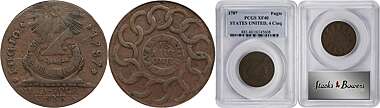
Lot 1361. 1787 Fugio Cent. Pointed Rays. Newman 1-B, W-6600. Rarity-4. Obverse Cross After Date, No Cinquefoils, UNITED STATES. VF-35 (PCGS). Newman Die State B/B. A better than usual example of this variety, cherished by collectors for its use of the first Fugio obverse, whose distinctive cross or quatrefoil after the date and the fine crosshatching in MIND YOUR BUSINESS make this a type all its own. Surfaces are generally warm, even deep golden-brown, upper right reverse with some old, hard scale through the rings that explains the darker color in that area. Magnification reveals a few faint hairlines in and around the central obverse that are consistent with the grade, and in no way distracting; there are no other notable blemishes. Both sides are hard and generally smooth, in fact, with some nice gloss. Obverse aligned to 3 o'clock with the date approaching the border, yet still complete, minor softness at the lower border weakens some of the letters in BUSINESS. The reverse impression is more significantly off center to 1 o'clock with the upper right border lightly into the rings, unusually broad border from 4 to 10 o'clock. The overall design is fully appreciable, and given this coin's other positives - which are many - it is an appealing example of this Newman number for collectors of all levels of experience and enthusiasm. From the Emerald Coast Collection. PCGS# 880. NGC ID: 2B8D.
  • Mise à prix:
    1 USD
    0 EUR
    0 GBP
    0 CHF

    Valeurs approximatives et arrondiesDate: 06/11/2026
Lot
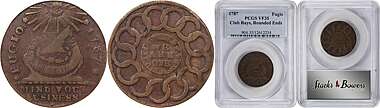
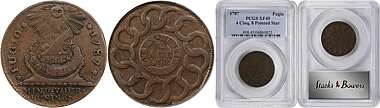
Lot 1362. 1787 Fugio Cent. Club Rays. Newman 4-E, W-6685. Rarity-3. Rounded Ends. VF-35 (PCGS). Newman Die State A/A, a scarcer attribution for the variety, with the bottom of the digit 8 in the date not yet filled by crumbling or chipping of the die. Richly original surfaces exhibit deep reddish-copper patina in the fields, devices lighter in golden-brown, the contrast between the two providing a nice circulated cameo appearance for both sides. There is a trace of microroughness, but the surfaces are generally hard and tight with only a few trivial, easily overlooked planchet fissures at upper and lower reverse, left and upper left obverse borders. The centers are a tad soft due to a confluence of strike weakness and wear, but centering is good with most major design elements bold and the overall design fully appreciable. A few relatively fresh marks are seen within the rings at 4 o'clock on the reverse, but they are of little concern given this coin's highly positive appearance at the Choice VF level. Though the Newman 4-E is a common variety in the Fugio series, pressure from Guide Book collectors seeking an example of the Clubs Rays, Rounded Ends design type means that attractive examples are scarce from a market availability standpoint. Most are either much more worn or with more extensive planchet flaws than this example, as well, which confirms the significance of its offering for quality-conscious bidders. From the Emerald Coast Collection. PCGS# 904. NGC ID: AX5E.
  • Mise à prix:
    1 USD
    0 EUR
    0 GBP
    0 CHF

    Valeurs approximatives et arrondiesDate: 06/11/2026
Lot
Lot 1363. 1787 Fugio Cent. Pointed Rays. Newman 8-B, W-6740. Rarity-2. UNITED STATES, 4 Cinquefoils. MS-64 BN (PCGS). This is an exceptional Choice Uncirculated Fugio cent that would make an impressive addition to an advanced type set. Warmly and evenly toned in medium brown, both sides are hard and frosty in texture with plenty of nice gloss. The persistent viewer aided by strong lighting will even discern hints of faded mint orange color that are most pronounced within the rings at upper reverse. The strike is trivially off center to lower left obverse, upper left reverse, the design elements flush with the borders in those areas, yet still bold to complete. All additional devices are boldly to sharply rendered, allowing full appreciation of the design. A small, dark planchet impurity is well concealed within the lower rays of the sun, at the junction with the top of the sundial, but otherwise the surfaces are smooth, essentially blemish free, and challenge full Gem Mint State preservation.By Fugio copper standards Newman 8-B is an available die marriage in Mint State. Most such pieces trace their pedigree to the Bank of New York Hoard, in which some 246 examples of Newman 8-B resided as late as 1948. A common provenance is where the similarity between this PCGS-certified, premium near-Gem and most other Mint State examples of the die pair comes to an abrupt end. Exceptionally nice, this is a noteworthy condition scarcity fit for inclusion in an advanced type set or specialized Fugio cabinet. From the Emerald Coast Collection. PCGS# 889. NGC ID: 2B8F. Lovely Choice Mint State Newman 8-B Fugio
  • Mise à prix:
    1 USD
    0 EUR
    0 GBP
    0 CHF

    Valeurs approximatives et arrondiesDate: 06/11/2026
Lot
Lot 1364. 1787 Fugio Cent. Pointed Rays. Newman 12-M, W-6800. Rarity-3. STATES UNITED, 4 Cinquefoils. EF-45 (PCGS). Newman Die State B/D, the reverse heavily clashed through the rings at top. About as nice as one could hope to find in a Fugio in certified Choice EF, this is a great coin to represent either the STATES UNITED, 4 Cinquefoils Guide Book variety or Newman 12-M dies. Both sides are warmly and evenly toned, the obverse in chestnut brown, the reverse in a blend of olive and walnut brown. The surfaces are hard and tight with a soft satin texture overall. A thin, faint planchet fissure at the upper right reverse border is mentioned solely for accuracy, there being really no distractions of either a pre- or post-strike nature to inhibit the eye appeal. Obverse impression a bit tight to upper right, reverse similarly aligned to 3 o'clock, but while there is consequent loss of border detail in these and adjacent areas, the overall design on both sides is nearly complete and universally bold at the assigned grade level. A lovely piece worthy of strong bids. From the Emerald Coast Collection. PCGS# 883. NGC ID: 2B8E.
  • Mise à prix:
    1 USD
    0 EUR
    0 GBP
    0 CHF

    Valeurs approximatives et arrondiesDate: 06/11/2026
Lot
Lot 1365. 1787 Fugio Cent. Pointed Rays. Newman 13-X, W-6855. Rarity-1. STATES UNITED, 4 Cinquefoils. EF-40 (PCGS). Newman Die State D/C. Solid collector quality for the type, and a grade seen less often for this Bank of New York Hoard variety that is frequently offered in Mint State. Handsome autumn-orange brown patina blankets both sides with some of the design elements showing olive-brown highlights, especially on the obverse. Good hard copper with no flan flaws, porosity, or even distracting marks to report. A few tiny, ancient carbon deposits are nestled around some of the design elements and border denticles, but these are mentioned solely for accuracy as they do not detract from either the quality or eye appeal. Well centered in strike with universally bold EF detail rounding out an impressive list of positives for this Newman 13-X Fugio. From the Emerald Coast Collection. PCGS# 883. NGC ID: 2B8E.
  • Mise à prix:
    1 USD
    0 EUR
    0 GBP
    0 CHF

    Valeurs approximatives et arrondiesDate: 06/11/2026
Lot
Lot 1366. 1787 Fugio Cent. Pointed Rays. Newman 15-Y, W-6915. Rarity-2. STATES UNITED, 4 Cinquefoils, 8-Pointed Stars on Label. EF-45 (PCGS). Newman Die State B/A. Exceptional Choice EF quality for this distinct and eagerly sought Guide Book variety of the Fugio cent. Both sides are universally bold in detail from a well centered, nicely executed strike that acquired only light wear from commercial use. Circulation was gentle, as well, as the surfaces have come down to the present day without so much as a single troublesome mark. Hard, tight, and also free of significant flan flaws, porosity, and other potential detractions. Wonderfully original in preservation, to boot, we note warm autumn-orange brown patina overall with deeper olive-copper outlines enhancing most of the design elements. No fully Mint State specimens of Newman 15-Y are known, just a few nice AU coins and a handful of choice EFs. This deserves to be counted among their number and should easily find a place in another advanced collection. From the Emerald Coast Collection. PCGS# 898. NGC ID: 2B8K.
  • Mise à prix:
    1 USD
    0 EUR
    0 GBP
    0 CHF

    Valeurs approximatives et arrondiesDate: 06/11/2026
Lot
Lot 1367. "1787" (ca. 1860) Fugio Cent. "New Haven Restrike," Horatio Rust Strike. Newman 104-FF, W-17570. Rarity-5. Silver. AU-58 (PCGS). This is a Horatio Rust issue, circa 1860, with a mintage in silver of 100 pieces struck from these well-known fabrication dies. While PCGS has certified a small number of Mint State examples (including the stunning MS-63+ that brought $16,800 in our November 2025 Showcase Auction), this premium Choice AU coin is among the nicest for the type that we have ever had the privilege of bringing to auction. Temptingly close to full Mint State preservation, both sides are sharply struck, near-fully defined, and also retain virtually complete luster. The softly frosted surfaces, in fact, show just a trace of friction on the obverse that confirms the AU-58 assessment from PCGS. Warmly toned in dominant pewter gray, blushes of soft powder blue and pinkish-gold iridescence flash into view as the surfaces rotate into direct lighting; the colors are most vivid at the peripheries. The finely granular texture is as made, the reverse with several more prominent die rust lumps within the rings at left that are also characteristic of the type. There are no troublesome handling marks or other post-production blemishes to report, and the eye appeal is outstanding. A highly collectible example for discerning type purposes, and a coin that will also fit comfortably into many specialized collections. From the Emerald Coast Collection. PCGS# 915. NGC ID: 2B8U. PCGS Population: 6; 19 finer (MS-63+ finest). Premium Choice AU Newman 104-FF "New Haven Restrike" in Silver From a Mintage of Just 100 Coins, ca. 1860
  • Mise à prix:
    1 USD
    0 EUR
    0 GBP
    0 CHF

    Valeurs approximatives et arrondiesDate: 06/11/2026
Lot
Lot 1368. "1787" (ca. 1860) Fugio Cent. "New Haven Restrike," Horatio Rust Strike. Newman-104-FF, W-17560. Rarity-3. Red Brass. AU-55 (PCGS). Blended autumn-orange and olive-brown on fully struck, minimally handled surfaces. Both sides retain plenty of bright luster in the fields. Although 19th century products, the "New Haven restrikes" are intriguing in their own right, displaying their characteristic charming triangular-jawed sunface. Based on modern research into die states for this type by Craig Sholley and John W. Dannreuther, this piece in red brass, from fabrication dies made circa 1859, is a Horatio Rust strike. From the Emerald Coast Collection. Earlier from Heritage's Long Beach Signature Auction of June 2006, lot 57; Heritage's Summer FUN Signature Auction of July 2010, lot 3029; our Baltimore Auction of March 2012, lot 1184. PCGS# 919. NGC ID: 2B8T.
  • Mise à prix:
    1 USD
    0 EUR
    0 GBP
    0 CHF

    Valeurs approximatives et arrondiesDate: 06/11/2026
Lot
Lot 1369. "1787" (ca. 1882/1883) Fugio Cent. "New Haven Restrike," J. Colvin Randall Strike. Newman 104-FF, W-17560. Rarity-3. Copper. MS-63 BN (PCGS). Desirable Select Uncirculated quality for this type, the dies for which are fabrications made circa 1859. The Newman 104-FF in PCGS MS-64 BN that sold as lot 1438 in our Summer 2025 Global Showcase Auction was in an advanced state with a sharp die crack at upper left obverse. Based on modern research into die states for this type by Craig Sholley and John W. Dannreuther, that piece is a J. Colvin Randall strike of late 1882/early 1883. The present example is an earlier Randall strike of the same general era. Satiny in texture with handsome, nicely preserved surfaces, we note rich toning in olive-brown, but also hints of vivid mint orange color that persist in many peripheral areas. Fully struck and crisp, this conservatively graded piece will delight even the most discerning collector. From the Emerald Coast Collection. PCGS# 916. NGC ID: 2B8S.
  • Mise à prix:
    1 USD
    0 EUR
    0 GBP
    0 CHF

    Valeurs approximatives et arrondiesDate: 06/11/2026
Lot
Lot 1370. 1652 Willow Tree Shilling. Noe 2-B, Salmon 2-B, W-170. Rarity-7. Clipped (NGC). A coin where numismatic rarity and historical significance outweigh quality, for even the most poorly struck and lowest grade Willow Tree shilling is an important property. Deeply toned in somewhat mottled steel, pewter and sandy-gray, the surfaces reveal only a few small planchet depressions during in-hand viewing, the most sizeable of which is at lower right obverse. The peripheral letters run off the flan on both sides, as perhaps one would expect given the NGC qualifier for clipping. Wear is also overall heavy, and the strike is typically incomplete for the type, the combination of which is actually more of a detriment to the coin's remaining detail than the clipping. For the peripheral legends we see portions of most letters in MASATHVSETS IN on the obverse, some quite faint, while the reverse is bold at AN D and NEW with faint traces of a few other letters. There is little discernible at central reverse apart from portions of the inner beaded circle, obverse with considerably more detail in the center including about half of the tree's branches and most of the inner beaded circle. Between the details of the tree and several of the peripheral letters on the reverse, the Noe 2-B attribution is confirmed. Closer inspection with a loupe is required to see several faint scratches and other minor marks scattered about, none of which are significant given how much circulation this coin obviously experienced. This brings us to the coin's details grade, which NGC did not provide. Grading a coin such as this is a challenge, for all Willow Tree shillings are more or less softly struck, particularly in the centers. Given how little central detail is present here, as well as the similar situation at the peripheries, a grade of Good Details seems appropriate to your cataloger.Willow Tree shillings are rarer than NE shillings in real terms, and as the second design type employed by the Boston Mint, they are every bit as significant both historically and numismatically. That offered here is one of only eight to 10 examples believed extant for the Noe 2-B variety. PCGS# 16. NGC ID: 2ARC. Extremely Rare Noe 2-B Willow Tree Shilling
  • Mise à prix:
    1 USD
    0 EUR
    0 GBP
    0 CHF

    Valeurs approximatives et arrondiesDate: 06/11/2026
Lot
Lot 1371. 1652 Oak Tree Shilling. Noe-6, Salmon 4-D, W-480. Rarity-6. IN at Bottom. EF Details--Damaged (NGC). 69.6 grains. Dark steely-charcoal gray surfaces are microscopically rough in places, these being the most obvious explanations for the PCGS qualifier. While closer scrutiny with a loupe reveals a few faint pin scratches, most significantly left and right of center on the reverse, these are easily overlooked during in-hand appreciation. Obverse appears rippled and swollen in places, characteristic of the typical Noe-6 die state, with the diagnostic die cracks and internal cud breaks readily evident on the reverse. Lack of detail is most significant where the obverse is swollen, at right reverse, and at the upper borders on both sides. On the other hand, the right obverse, left reverse and lower peripheries on both sides are quite sharp, central obverse shows at least half of the tree details, and the central reverse is sharp for the digits 16 in the date with a full XII denomination. Certainly a suitable filler example of the type or Noe number, yet a coin that is still significant as such in today's highly competitive numismatic market. PCGS# 45362. NGC ID: 2ARL.
  • Mise à prix:
    1 USD
    0 EUR
    0 GBP
    0 CHF

    Valeurs approximatives et arrondiesDate: 06/11/2026
Lot
Lot 1372. 1652 Oak Tree Shilling. Noe-7, Salmon 5-D, W-480. Rarity-5. IN at Bottom. MS-62 (NGC). CAC. 71.0 grains. Struck from an advanced state of these dies, although not as late as the state seen on the NGC MS-62 Noe-7 that appeared in our November 2025 Showcase Auction, lot 4346. The reverse does display several prominent internal cud breaks at right, but here the obverse die has not yet failed to a point where the central obverse detail has become indistinct in places. As such, we note a virtually complete oak tree with fully discernible trunk and branch features, ground line clear, root structure faint, although portions of it are discernible with patience. The obverse impression is off center to 3 o'clock, border into the letter THVSETS IN to one degree or another, although all are discernible except for the V, which is mostly beyond the flan and soft at its base. The left border on this side shows a trace of outer beading beyond the letters ASA, the S bisected by a gentle vertical crease that is opposite the vertical reverse cud break through the letters ND A. Regarding the reverse impression, it is off center to 11 o'clock, letters EW ENGLA run off the flan and/or are otherwise soft, lower right border with traces of outer beading from 2:30 to 7 o'clock. The planchet is charmingly out of round, clips most prominent at right obverse, short wedge-shaped split in the flan at the letter N in IN. Both sides are warmly toned in light pewter gray, reverse with enhancing steely-russet overtones that provide further visual appeal. Somewhat subdued overall to help explain the MS-62 grade from NGC, but not even close inspection with a loupe reveals a mentionable handling mark to surfaces that are pleasingly smooth when admired in hand.In terms of certified grade this is one of the finest Noe-7 Oak Trees that we have ever offered, and certainly in recent years. Both Ford coins are nicer, of course, but the Kendall specimen in our March 2015 Baltimore Auction is clearly lower grade in its PCGS EF-40 holder; the extensive Syd Martin cabinet lacked this Noe number entirely. Whether you are a high grade colonial era type collector or advanced specialist in Massachusetts Bay Colony silver, this represents a significant find worthy of serious consideration. Property from an Alabama Family. Earlier ex Richard Picker; Donald Groves Partrick; Heritage's FUN Signature Auction of January 2015, lot 5535. PCGS# 898265. BASE PCGS# 45362. NGC ID: 2ARL. The Picker-Partrick Noe-7 Oak Tree Shilling
  • Mise à prix:
    1 USD
    0 EUR
    0 GBP
    0 CHF

    Valeurs approximatives et arrondiesDate: 06/11/2026
Lot
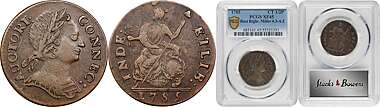
Lot 1373. 1652 Pine Tree Shilling. Small Planchet. Noe-16, Salmon 2-B, W-835. Rarity-2. VF Details--Plugged (PCGS). 71.9 grains. Struck from a late state of these dies, with the obverse broken at inner circle of beads at 5 to 6 o'clock, and across rosette. This coin was certified VF Details--Plugged, Whizzed by NCS when offered in Heritage's September 2006 Long Beach Signature Auction. Ex Heritage's Long Beach Signature Auction of September 2006, lot 3; unrecorded seller, via eBay, October 2006; Sydney F. Martin; our sale of the Sydney F. Martin Collection, December 2023 Collectors Choice Online Auction, lot 96005. PCGS# 889620. BASE PCGS# 24. NGC ID: 2ARZ.
  • Mise à prix:
    1 USD
    0 EUR
    0 GBP
    0 CHF

    Valeurs approximatives et arrondiesDate: 06/11/2026
Lot
Lot 1374. 1652 Pine Tree Shilling. Small Planchet. Noe-29, Salmon 11-F, W-930. Rarity-3. VF-35 (PCGS). 71.0 grains. Otherwise light pewter gray surfaces show wisps of light olive and russet patina that finds greatest expression at the peripheries. The central design elements are boldly defined, including complete inner beaded circles on both sides, but the left obverse and reverse peripheral features off the flan due to off center impressions from the dies. As such, the obverse legend is only partially legible, fullest at ETS IN, reverse fairly complete for NGLAND AN. Impressively smooth for the assigned grade with no marks of other blemishes of note. The Noe-29 variety is readily available overall but is seldom encountered above the lower reaches of VF condition. The present example is a noteworthy survivor from these dies and a wholesome coin worthy of serious bidder consideration. PCGS# 24. NGC ID: 2ARZ.
  • Mise à prix:
    1 USD
    0 EUR
    0 GBP
    0 CHF

    Valeurs approximatives et arrondiesDate: 06/11/2026
Lot
Lot 1375. Undated (1688) American Plantations Token, or 1/24 Part Real. Original. Newman 2-B, W-1135. Rarity-5+. 7 Harp Strings. MS-64 (NGC). From our November 2020 offering of the E Pluribus Unum Collection, where it was described as:A good deal of silvery luster persists across attractive medium gray surfaces, tinted with a bit of gold. Hints of green are seen on both sides. Sharp and fairly even in appearance, though the rims have begun to crumble a bit and tinpest has attacked the crown above the Hibernian shield. A circular pit on the horse's forequarters is noted as an identifier, but this piece is largely free of the tinpest corrosion that plagues these pieces. Good sharpness and eye appeal, a better than usual example of this historic early tin coinage.This stands as the single finest original American Plantation token ever certified by NGC. PCGS has never graded one finer than MS-63. From the Winslet Collection. Earlier from our sale of the E Pluribus Unum Collection, Part II, November 2020 Auction, lot 4038. PCGS# 49. NGC ID: AUB2. NGC Census: 1; 0 finer. Impressive Original American Plantations Token
  • Mise à prix:
    1 USD
    0 EUR
    0 GBP
    0 CHF

    Valeurs approximatives et arrondiesDate: 06/11/2026
Lot
Lot 1376. Undated (ca. 1828) American Plantations Token, or 1/24 Part Real. Restrike. Newman 5-D, W-1160. Rarity-4+. 11 Harp Strings. MS-62 (NGC). Last offered (as MS-64 PCGS) in our sale of November 2017, where we described this as:An absolutely amazing American Plantations token, with bold silvery mint frost unlike anything seen on the usually less intense luster of other high quality survivors. The strike is sharp and full and the surfaces are absolutely free of any of the tin pest that plagues almost all survivors to some degree. Some very minor flecks in the planchet are as struck and microscopic, and there is some darker patina in the central fields and intricacies on the reverse. This is the best one of these, restrike or not, that we have seen, and is the finest certified by PCGS. With the recent dispersal of several old time Colonial coin collections like Ford, Newman, Craige, etc., a small supply of rare or high quality Plantation Tokens has entered the marketplace, though none as fine as this; a finer quality American Plantations Token may not exist.At the time, this was the sole finest certified by PCGS. The current PCGS Population Report shows three graded MS-64 with none higher. This seems to still be among that number. From the Winslet Collection. Earlier from Heritage's sale of September 2016, lot 5360; Heritage's sale of August 2017, lot 3009; our sale of November 2017, lot 4018. PCGS# 52. NGC ID: AUB5. NGC Census: 7, 6 finer (MS-64 finest). Superb American Plantations Token Matthew Young Restrike
  • Mise à prix:
    1 USD
    0 EUR
    0 GBP
    0 CHF

    Valeurs approximatives et arrondiesDate: 06/11/2026
Lot
Lot 1377. 1722 Rosa Americana Penny. Martin 2.11-C.8, W-1264. Rarity-5. UTILE DULCI. MS-64 (NGC). An exceptional specimen we last offered in Part I of the Sydney F. Martin Collection, where we described it as:Delightful, original medium brown surfaces with frosty luster gleaming through the brassy-yellow color in the protected areas. Predominantly hard and slightly reflective with just a few traces of minutely rough planchet texture in a few small areas of the fields. Well preserved with no contact marks that catch the eye and no trace of wear. Nicely struck on a slightly underweight planchet. Excellent definition throughout. A lovely and well pedigreed example of either the date, legend type, or perhaps as a representative of the Martin 2-C die group. Obverse group 2 is characterized by a stop after REX and reverse group C by the placement of a stop after AMERICANA combined with a rosette after the date. This piece is also the finest of which we are aware for the die pair. Even if there are other unattributed high grade examples out there, Rosa Americana pennies don't get much nicer than this.Even today, seeing this one evokes a strongly positive reaction. This is a really nice coin, one we're glad to have the chance to see and handle again. From the Winslet Collection. Earlier ex Henry Chapman, February 1919, privately; F.C.C. Boyd; Boyd estate; John J. Ford, Jr.; our (Stack's) sale of the John J. Ford, Jr. Collection, Part IX, May 2005, lot 112; Sydney F. Martin; our sale of the Sydney F. Martin Collection, Part I, October 2022, lot 1188. PCGS# 113. NGC ID: 2ASP. Superb 1722 Utile Dulci Rosa Americana 1d Boyd-Ford-Martin
  • Mise à prix:
    1 USD
    0 EUR
    0 GBP
    0 CHF

    Valeurs approximatives et arrondiesDate: 06/11/2026
Lot
Lot 1378. Undated (1722) Rosa Americana Twopence. Martin 2.1-B.1, W-1322. Rarity-3. Motto in Ribbon. MS-63 (NGC). A beautiful and original example, with abundant golden surface mellowed in areas to chestnut brown. Glossy and free of any significant marks or flaws, just the occasional natural planchet pit and a little spot over the last letter A in AMERICANA. The reverse is lightly double struck, but detail on both sides is exceptionally strong. The look of this coin is simply superb, and it's difficult to imagine an example with better aesthetics at this grade level. The provenance is also about as impressive as one could ever hope for on a Rosa Americana twopence, extending back over a century to the collection of the man who wrote the first long-used reference on the series. From the Winslet Collection. Earlier ex Philip Nelson; F.C.C. Boyd, December 1913; Boyd estate; John J. Ford, Jr.; our (Stack's) sale of the John J. Ford, Jr. Collection, Part IX, May 2005, lot 86. PCGS# 92. NGC ID: 2U3Z. Lovely Mint State (1722) Rosa Americana Twopence From the Nelson, Boyd, and Ford Collections
  • Mise à prix:
    1 USD
    0 EUR
    0 GBP
    0 CHF

    Valeurs approximatives et arrondiesDate: 06/11/2026
Lot
Lot 1379. 1723 Wood's Hibernia Farthing. Martin 3.3-Bc.3, W-12500. Rarity-5. Silver. VF Details--Damage (PCGS). While this variety appears relatively frequently in silver, nearly every silver specimen shows appreciable wear, as here. Of the five pieces we've offered since 2016, and prior to the present sale, the finest was a PCGS AU-58+, with the others ranging in grade from EF-40 to AU-58. For the other silver varieties of this issue, examples tend to come in higher grades. Returning to Martin 3.3-Bc.3, the present example is not only moderately worn, but shows digs and scrapes at right and lower left obverse, right and upper left reverse - the explanation for the PCGS qualifier, and suggesting that the coin was caught in a vice or gear at some point. Rich pewter-mauve patina with virtually all major design elements boldly rendered. PCGS# 179. NGC ID: F7HP.
  • Mise à prix:
    1 USD
    0 EUR
    0 GBP
    0 CHF

    Valeurs approximatives et arrondiesDate: 06/11/2026
Lot
Lot 1380. 1723 Wood's Hibernia Halfpenny. Martin 4.74-Gb.11, W-13120. Rarity-4. MS-64 RD (NGC). We have seen a lot of nice Wood's Hibernias, even a lot with mint color, but this example stands out as one of the very boldest and most original. The color is bright and impressive, not really mellowed at all, just showing a little bit of subtle specking across the surfaces. The surfaces are free of any significant marks or distractions, showing eye appeal that must closely resemble how this piece looked in the 18th century. From the Winslet Collection. Earlier from Heritage's sale of the Old New England Collection, April 2014 CSNS Signature Auction, lot 3681; Heritage's sale of the Dickson Collection, August 2021 ANA Signature Auction, lot 3548. PCGS# 182. NGC ID: F7J4. NGC Census (all die marriages of the issue): just three examples in all grades in the RD category, all at the MS-64 grade level. PCGS has certified four total coins as RD, none graded finer than this one.
  • Mise à prix:
    1 USD
    0 EUR
    0 GBP
    0 CHF

    Valeurs approximatives et arrondiesDate: 06/11/2026
Lot
Lot 1381. 1773 Virginia Halfpenny. Newman 24-K, W-1570. Rarity-2. Period After GEORGIVS, 7 Harp Strings. MS-64 BN (NGC). Hints of warm olive blend with dominant medium brown patina to deliver an attractively original appearance. Hard and frosty, as well, both sides also reveal subtle semi-reflective qualities in the fields as the coin rotates into direct lighting. Soft power blue iridescence and faint remnants of pinkish red mint color are also present to further tempt the persistent viewer. A sharply struck and nicely preserved Choice Uncirculated example of this significant colonial era copper type. From the Bryan C. Tipton Collection. PCGS# 240. NGC ID: 2ATK.
  • Mise à prix:
    1 USD
    0 EUR
    0 GBP
    0 CHF

    Valeurs approximatives et arrondiesDate: 06/11/2026
Lot
Lot 1382. 1760 Voce Populi Halfpenny. Nelson-3, Zelinka 7-E, W-13930. Rarity-3. No P, VOOE POPULI. AU-55 BN (NGC). The VOOE variety is full and clear, with the die chip at the letter C in VOCE filling the full distance of the opening of the C and essentially transforming it into an O. This is a richly toned chestnut brown example with deeper olive-charcoal within and around many of the design elements; the latter is associated with old, inactive carbon/surface build up. A short, thin planchet flaw is out of the way at the upper right reverse border, surfaces otherwise free of significant flaws with no mentionable marks. Obverse off center to upper left, reverse to lower left, border denticulation absent in those areas, but all major design elements boldly to sharply defined. An impressive numismatic provenance rounds out a lengthy list of positive attributes for this handsome Choice AU Voce. From Heritage's sale of the Donald G. Partrick Collection of Extraordinary Colonial Coinage, March 2021 Signature Auction, lot 15278. PCGS# 924113. BASE PCGS# 265. NGC ID: 2AUD.
  • Mise à prix:
    1 USD
    0 EUR
    0 GBP
    0 CHF

    Valeurs approximatives et arrondiesDate: 06/11/2026
Lot
Lot 1383. 1783 John Chalmers Shilling. W-1785. Rarity-4+. Birds, Short Worm. EF-45 (PCGS). Warm olive-gray toning to both sides provides strong visual appeal. Well struck, we note good central details with a bold clasped hands motif and full bird scene, features rarely seen in clear in survivors of this type. There are only trivial signs of handling, and overall light wear that does little more than define the Choice EF grade from PCGS. An above average example of the Chalmers birds type shilling, nicer even that many examples certified in AU grades that your cataloger (JLA) has handled over the years.Coins of this type are attributed to John Chalmers, a goldsmith and silversmith in Annapolis, Maryland. Chalmers issued these coins to prevent some of the abusive practices associated with fractional parts of the Spanish dollar, those being the most widely used coins in the early United States. While it was customary at the time to cut Spanish dollars into halves, quarters and eighths, unscrupulous persons would attempt to make a profit by cutting five "quarters" or nine or ten "eighths" out of one coin. Chalmers' solution to this problem was to redeem various fractional parts in exchange for his own coins, charging a commission for this service. Examples were produced in threepence, sixpence and shilling denominations, the dies engraved by Thomas Sparrow, if not by Chalmers himself, and the coins struck at a building at the corner of Fleet and Cornhill streets in Annapolis. Given that several hundred Chalmers pieces are known today, and that most display significant wear from extensive commercial use, the issue appears to have been well received by the contemporary public and widely used in commerce. In an absolute sense, of course, all Chalmers coins are rare irrespective of denomination or variety. Those most often seen are shillings of the birds type, the short worm variant offered here perhaps slightly scarcer than its long worm counterpart. PCGS# 596. NGC ID: 2AUU. Nice Chalmers Short Worm Shilling
  • Mise à prix:
    1 USD
    0 EUR
    0 GBP
    0 CHF

    Valeurs approximatives et arrondiesDate: 06/11/2026
Lot
Lot 1384. 1783 John Chalmers Shilling. W-1790. Rarity-4. Birds, Long Worm. MS-62 (NGC). A superb example of this classic American type, struck in Annapolis when it served as the home of the Continental Congress and, thus, served as the U.S. capital at the time. Striking variations impact the quality of Chalmers shillings as much as pure grade considerations, and this piece ranks with the finest Long Worn shillings known on both fronts. Both sides show frosty luster and lovely originality, with medium silver gray surfaces toned in lightly gold shades across both sides. The obverse is ideally centered, with the thick denticles surrounding the entire circumference. The entire length of the denticles are visible in the southeast quadrant of that side, while they are truncated at the northwest quadrant, where the planchet is trivially out of round. The usual axial misalignment is milder here than often seen, though the right side of the obverse is more deeply struck than the left. The depth of that impression shows the full rounded relief of the birds, the snake, and the legends; it also shows that the snake and birds are essentially free of internal detail. The reverse is aligned to roughly 1 o'clock, with ANNAPOLIS around the top above the handshake. A substantial unstruck area is seen outside the denticles at the base of that side. The legends are complete and bold despite the absence of the denticles across the top of that side. A thin planchet striation, as often seen on these, crosses the reverse, extending from the comma after CHALMERS to below the letters CH of that word. A pair of more subtle striations are seen at the central reverse as well. No significant post-striking flaws are seen: no digs, no scratches, no evidence of poor handling. The aesthetic appeal is immense, which is no less a testament to this coin's quality because it also has a high technical grade. This issue doesn't often survive choice or beautiful. This one breaks that pattern.This coin, last sold by us 15 years ago, remains the only certified Mint State Long Worm we have ever handled. We've sold just three others certified as AU, one each graded 55, 53, and 50, and we've sold nothing better than AU-50 since 2017. Further, it's the only Chalmers shilling of any variety that PCGS has ever graded as Mint State, making this a prime target for connoisseurs of Confederation-era rarities. This piece was certified as PCGS/CAC MS-62 when we last offered it in 2011, and it remains the featured plate at PCGS CoinFactsJohn Chalmers was a well regarded silversmith in Annapolis when he made the decision to coin his own small change coins out of melted down cut pistareens, which then made up a substantial proportion of the circulating medium in the Chesapeake region. Pistareens were first imported into the region in huge numbers in 1755, when General Edward Braddock ordered £4,000 to £5,000 worth of the lower fineness 2 reales made at Spain's mainland mints. Braddock was in Williamsburg, Virginia when he asked for them and Alexandria, Virginia when he received them. The coins, whose central cross made them easy to cut into halves (worth 10 cents) and quarters (5 cents), quickly spread throughout the region. Braddock first saw their utility while stationed in Gibraltar in 1753 and 1754. By 1784, when Jefferson wrote his Notes on Coinage, he described them - with his usual perspective that places Virginia as the center of the world - as a coin "perfectly familiar to us all."Not coincidentally, Jefferson wrote his Notes on Coinage while he was a Congressional delegate in Annapolis between March and May of 1784. At that time, the Chalmers workshop and mint was in sight of the State House, just two blocks up Cornhill Street from Chalmers' front door. Jefferson and his fellow delegates undoubtedly encountered these Chalmers coins in the temporary capital of the United States. When Washington resigned his commission in the State House chambers on December 22, 1783, he may well have had a Chalmers shilling or two in his pocket.With its distinctive designs, accomplished by engraved Thomas Sparrow, the Chalmers shillings have always been a standout in an advanced cabinet of early American coins. This superlative survivor is perhaps the Chalmers non pareil, fit for a world class collection. From the Winslet Collection. Earlier, acquired privately from Don Taxay in the 1970s; Howard Collection; our Chicago ANA Auction of August 2011, lot 7170, as PCGS/CAC MS-62, where it realized $63,250. Featured at PCGS CoinFacts. PCGS# 595. NGC ID: 2AUT. NGC Census: 2; 0 finer. Important Mint State Long Worm 1783 Chalmers Shilling The Only Chalmers Shilling Ever Certified as Mint State by PCGS
  • Mise à prix:
    1 USD
    0 EUR
    0 GBP
    0 CHF

    Valeurs approximatives et arrondiesDate: 06/11/2026
Lot
Lot 1385. 1785 Nova Constellatio Copper. Crosby 3-B, W-1895. Rarity-2. CONSTELLATIO, Pointed Rays, Large Date. MS-64 BN (PCGS). 116.4 grains. An exceptional piece, with fully frosty surfaces toned medium brown and olive in thoroughly attractive fashion. A hint of mint color remains around some letters in CONSTELLATIO. Choice and problem free on both sides. The die state is advanced, with all the usual die rust around the all-seeing eye in addition to two cracks through the letter N in NOVA, the longer of which extends more than halfway to the final letter O in CONSTELLATIO. This is a variety that is found in high grade with some frequency, but examples this nice are few and far between. We've never sold an example from these dies certified at a higher grade than MS-65, and we prefer the look of this one to most others at the MS-63 and MS-64 grade levels. Ex our (Stack's) sale of March 2000, lot 1000; Lawrence R. Stack Collection, November 2006; Sydney F. Martin; our sale of the Sydney F. Martin Collection, Part III, Spring 2023 Auction, March, lot 1056, as PCGS MS-63 BN; our Summer 2025 Global Showcase Auction, August, lot 1282, as PCGS MS-63 BN. PCGS# 813. NGC ID: 2AZ3. Superior 1785 Crosby 3-B Nova Constellatio
  • Mise à prix:
    1 USD
    0 EUR
    0 GBP
    0 CHF

    Valeurs approximatives et arrondiesDate: 06/11/2026
Lot
Lot 1386. 1785 Nova Constellatio Copper. Crosby 3-B, W-1895. Rarity-2. CONSTELLATIO, Pointed Rays, Large Date. MS-62 BN (NGC). Glossy chocolate brown with lovely aesthetic appeal for the grade. Well struck, with good detail on the eye and other design elements. Some old encrustation is seen within the interstices of the design, but it's harmless overall. A tiny rim abrasion is noted left of the date. A classic early American type, here offered in very desirable grade. From the Winslet Collection. PCGS# 813. NGC ID: 2AZ3.
  • Mise à prix:
    1 USD
    0 EUR
    0 GBP
    0 CHF

    Valeurs approximatives et arrondiesDate: 06/11/2026
Lot
Lot 1387. 1787 Immunis Columbia Copper / Large Eagle Reverse. W-5680. Rarity-4+. Plain Edge, Narrow Planchet. MS-64 BN (NGC). One of the very finest survivors of this fascinating coinage. The surfaces are highly lustrous, frosty, and lovely, with a golden tinge over lovely light steel-brown fields. The detail is exceptional, free from friction or weakness, with every fold of drapery, feature of the face, and feather on the eagle fully delineated. Centering is always an issue on these, with the dies struck on plump, narrow planchets. This one shows full legends on both sides, with the obverse framed by denticles from below 9 o'clock to 1 o'clock. The tops of the letters US UNU are interrupted by the rim on the reverse, and the top halves of all four date digits are visible at the base of the obverse. There are some trivial scattered hairlines, and a couple of insignificant marks like the one under the letter S in IMMUNIS, but this piece shows exceptional eye appeal and preservation. It would be nearly impossible to find a better one.This is the sole example NGC has certified as MS-64 BN, making it their single finest certified. When this was certified as MS-64 BN by PCGS, it was one of four in that grade with a single MS-66 finer.Struck in large enough quantities to be collectible today, this type must have been intended as a profit-making enterprise, even though its designs recall the rare pattern pieces of 1785 and 1786. Most of these are seen very well worn, suggesting a long time in circulation, far beyond the Copper Panic of 1789 that booted lower-weight coppers from American pockets. Examples like this are lucky singletons, accidental survivors, and should be considered a centerpiece in a top-shelf collection of Confederation-era coppers. From the Winslet Collection. Earlier from our (Bowers and Merena's) sale of the Eliasberg Collection, May 1996, lot 55. PCGS# 841. NGC ID: BFJL. NGC Census: 1; 0 finer. Superb Mint State 1787 Immunis Columbia Copper The Eliasberg Specimen
  • Mise à prix:
    1 USD
    0 EUR
    0 GBP
    0 CHF

    Valeurs approximatives et arrondiesDate: 06/11/2026
Lot
Lot 1388. 1788 Massachusetts Cent. Ryder 1-D, W-6190. Rarity-2+. Period After MASSACHUSETTS. AU Details--Environmental Damage (PCGS). 145.4 grains. A boldly struck example with hardly any wear and frosty deep olive-brown surfaces that show just trace roughness under a glass. Small curved planchet clip over the letters CO in COMMON. No distracting marks and overall an impressive piece with a century old provenance. Ex Thomas L. Elder's 47th Sale, January 1911, lot 522; Hillyer C. Ryder; F.C.C. Boyd; our (Stack's) sale of the John J. Ford, Jr. Collection, Part V, October 2004, lot 117; Lawrence R. Stack Collection, November 2006; Sydney F. Martin; our sale of the Sydney F. Martin Collection, June 2023 Collectors Choice Online Auction, lot 92379. PCGS# 688953. BASE PCGS# 948. NGC ID: 2B27.
  • Mise à prix:
    1 USD
    0 EUR
    0 GBP
    0 CHF

    Valeurs approximatives et arrondiesDate: 06/11/2026
Lot
Lot 1389. 1788 Massachusetts Cent. Ryder 3-A, W-6210. Rarity-3+. Slim Indian, Period After MASSACHUSETTS. AU-50 (PCGS). 158.2 grains. Choice, original medium brown surfaces with attractive woodgrain toning across both sides. Nicely glossy and free from roughness and notable marks. An as-made planchet lamination is seen at the lower obverse. Nicely struck on a broader than average planchet measuring 29.5 mm. Desirable quality and eye appeal for the type. From our sale of the Sydney F. Martin Collection, June 2023 Collectors Choice Online Auction, lot 92384. PCGS# 688955. BASE PCGS# 948. NGC ID: 2B27.
  • Mise à prix:
    1 USD
    0 EUR
    0 GBP
    0 CHF

    Valeurs approximatives et arrondiesDate: 06/11/2026
Lot
Lot 1390. 1788 Massachusetts Cent. Ryder 6-N, W-6240. Rarity-3-. No Period After MASSACHUSETTS. AU-53 (PCGS). 179.4 grains. A premium example of the die variety and No Period Guide Book listing. Nicely struck on a stocky planchet. Lovely light olive-tan and reddish-brown surfaces with no notable marks and just a few light planchet laminations at the upper obverse. Ex our (Coin Galleries') sale of November 1999, lot 2617; Tom Rinaldo Collection, April 2008; Sydney F. Martin; our sale of the Sydney F. Martin Collection, June 2023 Collectors Choice Online Auction, lot 92388. PCGS# 688960. BASE PCGS# 45419. NGC ID: 2B28.
  • Mise à prix:
    1 USD
    0 EUR
    0 GBP
    0 CHF

    Valeurs approximatives et arrondiesDate: 06/11/2026
Lot
Lot 1391. 1788 Massachusetts Cent. Ryder 8-C, W-6260. Rarity-3. Period After MASSACHUSETTS. VF-35 (PCGS). Marbled steel-brown, chestnut and olive-copper patina greets the viewer from both sides of this universally bold to sharp Choice VF example. A thin shallow planchet void meanders through the top of obverse, eerily bisecting the Native American's portrait at the neck. There are no other blemishes of note, the surfaces generally hard and tight with a pleasing appearance overall. PCGS# 948. NGC ID: 2B27.
  • Mise à prix:
    1 USD
    0 EUR
    0 GBP
    0 CHF

    Valeurs approximatives et arrondiesDate: 06/11/2026
Lot
Lot 1392. 1788 Massachusetts Cent. Ryder 15-M, W-6400. Rarity-5-. Period After MASSACHUSETTS. EF-40 (PCGS). A nice-looking piece, the design elements retain plenty of bold strike detail in the presence of light to moderate high point wear. Original, gently mottled patina in medium and olive-brown further enhances the visual appeal, as do surfaces that are hard, tight, and free of troublesome blemishes. Well centered on the planchet, and an overall pleasing PCGS-certified EF to represent the type, date or Ryder number. PCGS# 688358. BASE PCGS# 948. NGC ID: 2B27.
  • Mise à prix:
    1 USD
    0 EUR
    0 GBP
    0 CHF

    Valeurs approximatives et arrondiesDate: 06/11/2026
Lot
Lot 1393. 1788 Massachusetts Cent. Ryder 16-M, W-6410. Rarity-5. Period After MASSACHUSETTS. MS-62 BN (PCGS). A highly significant piece, this is not only one of just two Mint State examples of this Ryder number that we have offered in recent decades, but it also appears to be a newcomer to the modern census as of March of this year. Also a lovely coin, both sides have a generally hard, frosty texture that is free of all but minor planchet texture in the centers, which did not strike out. The strike is actually sharply executed in all but these areas, and it is well centered with just minor thinning to the border denticulation at right obverse and lower right reverse. Color is a lovely, medium walnut brown with hints of olive that deliver further eye appeal. Two minor planchet voids at the reverse border after the final letter S in MASSACHUSETTS are offered as potential provenance markers. This coin will surely garner much attention from advanced specialists in Massachusetts state coppers, and see spirited bidding. From Heritage's March 2026 Signature Auction, lot 3323. PCGS# 948. NGC ID: 2B27.
  • Mise à prix:
    1 USD
    0 EUR
    0 GBP
    0 CHF

    Valeurs approximatives et arrondiesDate: 06/11/2026
Lot
Lot 1394. 1785 Connecticut Copper. Miller 2-A.4, W-2310. Rarity-5. Bust Right, Roman Head. Fine-12 (PCGS). 139.6 grains. Choice light brown surfaces are free from any notable circulation marks, while a curving planchet striation follows the contour of where the obverse effigy's chin should have been. About as attractive an example of this "second" Roman Head that one will find for the given grade. From the John Bolger Collection. Earlier from our (Coin Galleries') Mail Bid Sale of the Richard Picker Reference Collection, July 1992, lot 2591; Stephen L. Tanenbaum; our sale of Collection SLT, January 2012 Americana Sale, lot 7063. PCGS# 685150. BASE PCGS# 316. NGC ID: 2B2A.
  • Mise à prix:
    1 USD
    0 EUR
    0 GBP
    0 CHF

    Valeurs approximatives et arrondiesDate: 06/11/2026
Lot
Lot 1395. 1785 Connecticut Copper. Miller 4.3-A.2, W-2365. Rarity-3. Bust Right. EF-45 (PCGS). 146.4 grains. An impressive piece that is among the finest examples of this Miller number that the discerning collector is likely to find. Handsome surfaces are originally toned in blended golden-tan and chestnut brown, the latter color a bit more pronounced on the reverse. There is a hint of microgranularity to both sides, but the only post-production blemishes of any concern are a shallow scrape in the left reverse field that curves under the letters TO in AUCTORI and a concentration of fine pin scratches on the effigy's neck that require magnification to discern. Centering is quite good, all major design elements on the flan and more or less boldly rendered, obverse just a tad tight to 3 o'clock, reverse likewise to 9 o'clock. Some original planchet texture remains at central obverse and through much of the seated figure on the reverse, latter area also with a slightly more extensive noncontiguous fissure bisecting the shield and exergual line at the digit in the 8.Sorting out the Condition Census for this variety is no easy project. There are at least two technically Mint State pieces known, including the Oechsner-Partrick coin recently sold as NGC MS-61 BN, and the "Long Island Collection" coin ex Hall as NGC MS-63 BN, but those are both flawed and/or weakly struck. Other noteworthy examples include the Newman, Miller sale, and secondary Oechsner coin, all of which appear to be fairly well struck AUs. Syd Martin considered his coin AU-55 and finest known; it realized $2,040 in our November 2022 sale of his collection, as PCGS EF-45. This one is not quite as well struck, but only in isolated areas, and the in-hand appearance is that of a wholesome and pleasing coin. We have seen precious few examples of this Miller number that are clearly superior when taking strike, surface quality, eye appeal, and sharpness all into consideration. A desirable piece and a great addition for the specialist. From the John Bolger Collection. Purchased from Anthony Terranova, July 2002. PCGS# 685161. BASE PCGS# 316. NGC ID: 2B2A.
  • Mise à prix:
    1 USD
    0 EUR
    0 GBP
    0 CHF

    Valeurs approximatives et arrondiesDate: 06/11/2026
Lot
Lot 1396. 1785 Connecticut Copper. Miller 6.1-A.1, W-2390. Rarity-5. Bust Right. VF-30 (PCGS). This piece exhibits handsome original color that is predominantly a blend of golden-brown and chestnut, although some old, inactive carbon build up has resulted in swirls of dark charcoal on the obverse at the letters ORI in AUCTORI, on the reverse in the upper right field area and at the border before the word INDE. Obverse impression off center to 6 o'clock, bust free of border yet soft at bottom. The reverse is similarly off center to 12 o'clock, seated figure's head runs to border at top, where a meandering planchet fissure is seen. Some minor pitting in the planchet meanders through the lower obverse, to no detriment, there are no significant post-production marks, and the surfaces have some nice gloss. PCGS# 316. NGC ID: 2B2A.
  • Mise à prix:
    1 USD
    0 EUR
    0 GBP
    0 CHF

    Valeurs approximatives et arrondiesDate: 06/11/2026
Lot
Lot 1397. 1785 Connecticut Copper. Miller 6.3-G.2, W-2410. Rarity-5. Bust Right. EF-40 (PCGS). A lovely piece with medium golden-brown patina on surfaces that are generally hard and smooth during in-hand appreciation, and also show some nice gloss. There is some minor planchet pitting in and around the centers, as made, and requiring magnification to fully discern. Obverse centering is fairly good, although there is no denticulation and the border at right is nearly into the tops of the letters in AUCTORI. Reverse more significantly off center to 5 o'clock, date digits at least half off the flan, unusually broad and high border opposite. Most major design elements are bold for the grade, nonetheless, typical later reverse die state with a pair of breaks from the border to the top of the letter E in INDE, die sinking from base of that letter into the seated figure's outstretched arm. This coin presents much better that most examples of 6.3-G.2 that we have handled in recent decades, and it would nicely represent this Miller number in many advanced collections. PCGS# 316. NGC ID: 2B2A.
  • Mise à prix:
    1 USD
    0 EUR
    0 GBP
    0 CHF

    Valeurs approximatives et arrondiesDate: 06/11/2026
Lot
Lot 1398. 1786 Connecticut Copper. Miller 1-A, W-2460. Rarity-4. Mailed Bust Right, Double Chin, ETLIB INDE. VF-20 (PCGS). 137.3 grains. An attractively original, well composed example that has the makings of an even EF grade for this challenging Miller number. Both sides are handsomely toned in warm autumn-orange brown with hints of olive engaging the design elements. The latter color is associated with a bit of old, trivial surface build up that is in no way detracting; there are no significant post-production marks, spots, or other blemishes. Essentially perfect centering and nice detail save for the central softness that plaques this variety. Some original planchet texture is seen in these areas, more so on the obverse. As usual, the flan was a little larger than the dies and a narrow lip of unstruck planchet is noted around some of the periphery, namely at upper obverse and left reverse. Overall detail is bold for a 1786 Miller 1-A, and when allowance is made for the strike, and consideration given for the choice surfaces, we suspect that others will have thoughts of EF for this desirable piece.This lot includes NGC cert ID #2040985-018 with a grade of VF-25 BN and Eric P. Newman Collection provenance from an earlier certification of this coin. From the John Bolger Collection. Earlier ex Eric P. Newman Numismatic Education Society; Heritage's sale of the Eric P. Newman Collection, Part IV, May 2014, lot 30062. PCGS# 325. NGC ID: 2B2D.
  • Mise à prix:
    1 USD
    0 EUR
    0 GBP
    0 CHF

    Valeurs approximatives et arrondiesDate: 06/11/2026
Lot
Lot 1399. 1786 Connecticut Copper. Miller 3-D.1, W-2510. Rarity-5-. Mailed Bust Right, Scholar's Head. VF-20 (PCGS). 154.8 grains. A desirable example of this distinctive named variety. Deep olive-copper brown patina blankets both sides, the texture of which is universally microgranular, yet free of sizeable marks and significant flan flaws. There is a very shallow curved clip just past 6 o'clock on the obverse that requires intent to discern, some original roughness in the centers is virgin to the planchet and did not strike out. The strike is actually fairly well executed in an example of this Miller number, obverse nicely centered even though the only denticulation is at the left and right borders. Reverse impression aligned to 7 o'clock, border at lower left into the seated figure's foot and the tops of the letters IN in INDE, but offset by broader than usual denticulation at upper right, legend fully legible, date complete. The central motifs are fully outlined despite the aforementioned softness in these areas, the overall design on both sides is easy to appreciate, and there are even a few faint die finish lines discernible here and there around the peripheries, most noticeably on the reverse at the letters IB in LIB. From the John Bolger Collection. PCGS# 328. NGC ID: 2B2E.
  • Mise à prix:
    1 USD
    0 EUR
    0 GBP
    0 CHF

    Valeurs approximatives et arrondiesDate: 06/11/2026
Lot
Lot 1400. 1786 Connecticut Copper. Miller 4.1-G, W-2525. Rarity-3. Mailed Bust Left. VF-25 (PCGS). 132.2 grains. Nicely toned in moderately deep olive-copper, the surfaces appear fairly smooth during in-hand appreciation. Close inspection with a loupe is required to see a fine layer of granularity to both sides, as well as a light vertical scrape and a few tiny marks in and around the central obverse. A minor planchet lamination on the obverse bisects the top of the letter T in AUCTORI, reverse more substantially flawed within the seated figure's legs, around the pole, and at the digit 7 in the date. Obverse impression off center to 5 o'clock with the border engaging the tops of the letters NEC in CONNEC, reverse similarly aligned to 3 o'clock, right border into the tops of the letters in ET LIB. From the John Bolger Collection. Earlier from McCawley-Grellman's Eighth Annual C-4 Convention Sale, November 2002, lot 83. PCGS# 686827. BASE PCGS# 331. NGC ID: 2B2G.
  • Mise à prix:
    1 USD
    0 EUR
    0 GBP
    0 CHF

    Valeurs approximatives et arrondiesDate: 06/11/2026
Paramètres de confidentialitéParamètres de confidentialité