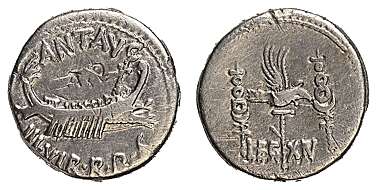
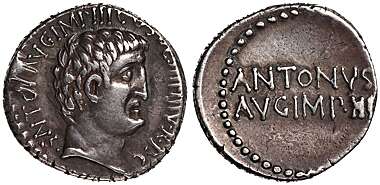
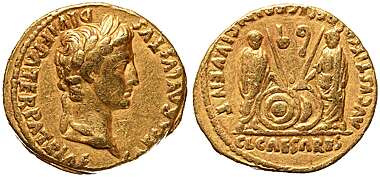
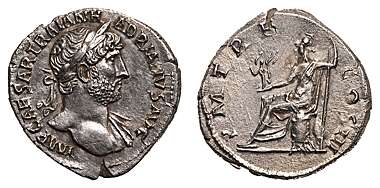
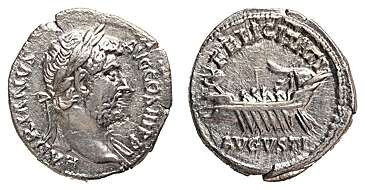
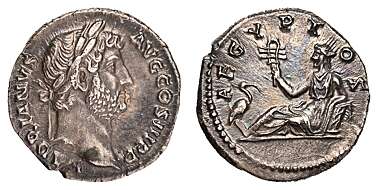
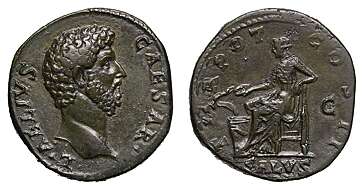
Lot 106. Marc Antony and Octavian AV Aureus About Extremely Fine; a pleasing example of this highly desirable type, with two attractive, well-defined portraits, clear legends and much character | ROMAN REPUBLIC & IMPERATORIAL. Marc Antony and Octavian. Gold Aureus, spring - summer 41 BC. Mint moving with Antony (Ephesus?). M. Barbatius Pollio, quaestor pro praetore. Obv: M·ANT·IMP AVG III VIR·R·P·C M·BARBAT·Q·P, bare head of Antony right. Rev: CAESAR·IMP·PONT·III·VIR·R·P·C, bare head of Octavian right. About Extremely Fine; a pleasing example of this highly desirable type, with two attractive, well-defined portraits, clear legends and much character. Very Rare. Ex Hess-Divo AG, Auction 329 (17/11/2015), lot 141 (hammer: 50,000 CHF); Ex Münzen & Medaillen AG, Auction 64 (1984), lot 235. Struck in 41 BC, during one of the most turbulent periods in Roman history, this exceptionally desirable aureus brings together the portraits of Mark Antony and the young Octavian, two men whose uneasy alliance would shape the final years of the Roman Republic and ultimately determine the political future of Rome. Following the assassination of Julius Caesar in 44, the struggle for control of the Roman state culminated in the formation of the Second Triumvirate in November 43. Unlike the earlier informal arrangement between Caesar, Pompey and Crassus, this new alliance was established by law, granting Antony, Octavian and Lepidus extraordinary powers to reorganise the Republic. Their authority was consolidated through the proscriptions of their political opponents, most notoriously Cicero, and the defeat of Caesar's assassins, Brutus and Cassius, at Philippi in 42. Yet beneath this apparent unity lay profound personal rivalries and competing ambitions. The present aureus was issued in the name of M. Barbatius Pollio, quaestor and a financial official associated with Antony, at a moment when the triumviral settlement was already beginning to fracture. Following Philippi, Antony had assumed responsibility for the eastern provinces, while Octavian faced the difficult task of settling discharged veterans in Italy. The confiscation and redistribution of Italian land provoked widespread resentment, contributing to the outbreak of the Perusine War in 41, in which Antony's brother Lucius Antonius and his wife Fulvia opposed Octavian. Although the two triumvirs remained nominal allies, their supporters were already engaged in open conflict. Against this background, the paired portraits of Antony and Octavian acquire particular significance. Both men appear bareheaded, accompanied by inscriptions proclaiming their respective titles and shared triumviral authority. The coin presents an image of political partnership at precisely the moment when that partnership was being tested. Its substantial gold denomination also reflects the enormous financial demands of the period, when the maintenance of armies, payment of veterans and competition for military loyalty were fundamental to the exercise of power. The alliance would survive the immediate crisis, with Antony and Octavian reaching a renewed settlement at Brundisium in 40. Their rivalry, however, ultimately proved irreconcilable. Following years of mounting tension, Octavian defeated the forces of Antony and Cleopatra at Actium in 31, bringing the last great civil war of the Republic towards its conclusion. Antony's death the following year left Octavian as the undisputed master of the Roman world, paving the way for his assumption of the title Augustus in 27. Reference: Calicó-109; Crawford-517/1a; Sydenham-1180; Babelon (Antonia)-50 and Barbatia-1. Weight: 8.05g. Diameter: 20mm. PLEASE NOTE: A 22.50% buyer's premium will be charged separately. VAT on the buyer's premium may apply in accordance with UK regulations. Payment can be made in EUR, CHF, or USD for an exchange fee. Please contact us to find out more.
 consentmanager.net