Für Live-Bidding anmelden
Heritage Auctions, Inc. Logo
Los
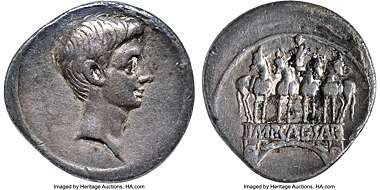
Los 23001. Octavian, as Sole Imperator (30-27 BC). AR denarius (20mm, 3.75 gm, 9h). NGC VF 5/5 - 2/5, scratches. Uncertain Italian mint (Rome or Brundisium?), ca. 30-29 BC. Bare head of Octavian right; linear border / IMP•CAESAR, quadriga facing atop triumphal arch with inscribed architrave; linear border. RIC I 267 (ca. 29-27 BC). Born on 23 September 63 BC into a wealthy plebeian family, Augustus, originally Gaius Octavius, was the grandnephew and posthumously adopted son of Julius Caesar. This inheritance set him on a collision course with Rome's political elite, leading to the formation of the Second Triumvirate with Marc Antony and Marcus Aemilius Lepidus. Their initial unity against Caesar's assassins eventually gave way to conflict, from which Augustus emerged as Rome's first true emperor after victories in key battles like Philippi and Actium. In 27 BC, he was honored with the title "Augustus" by the Senate, signaling the start of his reign and the Pax Romana, a golden era of peace, prosperity, and cultural flourishing that lasted over two centuries. HID05401242017 © 2026 Heritage Auctions | All Rights Reserved www.HA.com/TexasAuctioneerLicenseNotice
  • Startpreis:
    1 USD
    0 EUR
    0 GBP
    0 CHF

    Nur ungefähre, gerundete WerteDatum: 05.11.2026
Los
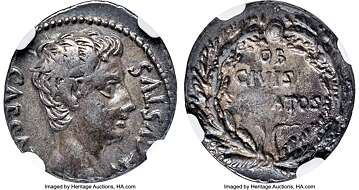
Los 23002. Augustus (27 BC-AD 14). AR denarius (18mm, 3.99 gm, 5h). NGC XF 3/5 - 3/5. Uncertain Spanish mint (Colonia Patricia?), ca. 19 BC. AVGVSTVS-CAESAR, bare head of Augustus right / OB / CIVIS / SERVATOS, legend in three lines within oak wreath terminating in large jewel, ties extending upward within. RIC I 77a. Born on 23 September 63 BC into a wealthy plebeian family, Augustus, originally Gaius Octavius, was the grandnephew and posthumously adopted son of Julius Caesar. This inheritance set him on a collision course with Rome's political elite, leading to the formation of the Second Triumvirate with Marc Antony and Marcus Aemilius Lepidus. Their initial unity against Caesar's assassins eventually gave way to conflict, from which Augustus emerged as Rome's first true emperor after victories in key battles like Philippi and Actium. In 27 BC, he was honored with the title "Augustus" by the Senate, signaling the start of his reign and the Pax Romana, a golden era of peace, prosperity, and cultural flourishing that lasted over two centuries. Augustus' rule saw significant military, administrative, and cultural reforms that stabilized and enriched the empire. He established a standing army, including the Praetorian Guard, reorganized Rome's provinces, and became a patron of the arts, fostering the careers of poets like Virgil and Horace and commissioning monumental buildings that reshaped Rome. His savvy use of coinage to communicate his achievements and vision helped solidify his power and legacy. Augustus died in AD 14, he left behind a transformed Rome. Through Suetonius's "The Twelve Caesars" and his own "Res Gestae Divi Augusti," we glimpse the life and achievements of a ruler who balanced autocracy with republican ideals, setting a precedent for future emperors and leaving an indelible mark on Roman history. HID05401242017 © 2026 Heritage Auctions | All Rights Reserved www.HA.com/TexasAuctioneerLicenseNotice
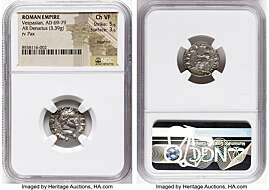
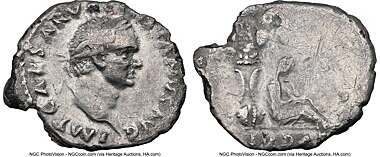
  • Startpreis:
    1 USD
    0 EUR
    0 GBP
    0 CHF

    Nur ungefähre, gerundete WerteDatum: 05.11.2026
Los
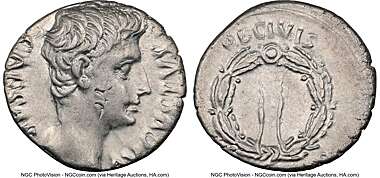
Los 23003. Augustus (27 BC-AD 14). AR denarius (17mm, 3.82 gm, 7h). NGC Choice XF 4/5 - 2/5, bankers mark, brushed. Uncertain mint in Spain (Colonia Caesaraugusta?), ca. 19-18 BC. CAESAR-AVGVSTVS, bare head of Augustus right / OB•CIVIS / SERVATOS, wreath with ties upward. RIC I 40a. Born on 23 September 63 BC into a wealthy plebeian family, Augustus, originally Gaius Octavius, was the grandnephew and posthumously adopted son of Julius Caesar. This inheritance set him on a collision course with Rome's political elite, leading to the formation of the Second Triumvirate with Marc Antony and Marcus Aemilius Lepidus. Their initial unity against Caesar's assassins eventually gave way to conflict, from which Augustus emerged as Rome's first true emperor after victories in key battles like Philippi and Actium. In 27 BC, he was honored with the title "Augustus" by the Senate, signaling the start of his reign and the Pax Romana, a golden era of peace, prosperity, and cultural flourishing that lasted over two centuries. Augustus' rule saw significant military, administrative, and cultural reforms that stabilized and enriched the empire. He established a standing army, including the Praetorian Guard, reorganized Rome's provinces, and became a patron of the arts, fostering the careers of poets like Virgil and Horace and commissioning monumental buildings that reshaped Rome. His savvy use of coinage to communicate his achievements and vision helped solidify his power and legacy. Augustus died in AD 14, he left behind a transformed Rome. Through Suetonius's "The Twelve Caesars" and his own "Res Gestae Divi Augusti," we glimpse the life and achievements of a ruler who balanced autocracy with republican ideals, setting a precedent for future emperors and leaving an indelible mark on Roman history. HID05401242017 © 2026 Heritage Auctions | All Rights Reserved www.HA.com/TexasAuctioneerLicenseNotice
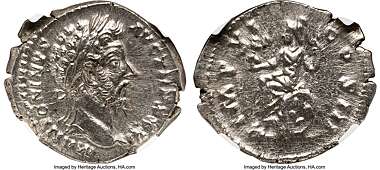
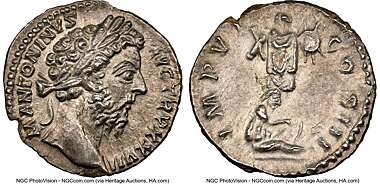
  • Startpreis:
    1 USD
    0 EUR
    0 GBP
    0 CHF

    Nur ungefähre, gerundete WerteDatum: 05.11.2026
Los
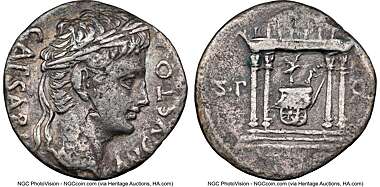
Los 23004. Augustus (27 BC-AD 14). AR denarius (18mm, 3.42 gm, 7h). NGC VF 4/5 - 2/5, bankers marks. Uncertain Spanish mint, ca. 18 BC. CAESARI-AVGVSTO, laureate head of Augustus right / Temple of Mars Ultor: round-domed, tetrastyle temple set on podium of three steps; chariot facing right within, carrying an aquila and a miniature quadriga; S•P-Q•R across fields. RIC I 120a. Ex Pegasi, private sale with dealer's tag included. Augustus keen on sanctifying Rome's divine favor and his own authority, he initiated a robust public works program in Rome. One significant edifice was the Temple of Mars Ultor (Mars the Avenger), inaugurated in 2 BC within the Forum of Augustus. The temple was a votive offering following Augustus' vow made at the Battle of Philippi in 42 BC to honor Mars, the God of War, should victory be secured against Julius Caesar's assassins, Brutus and Cassius. The temple not only stood as a religious edifice but also as a political symbol. It represented Rome's military might under Augustus' leadership, serving both as a tribute to his avenging of Caesar's murder and a reminder of the Pax Romana, the period of relative peace and stability across the empire inaugurated by Augustus' reign. The Temple of Mars Ultor became a fundamental element in Rome's architectural and political landscape, reflecting Augustus' strategic blend of religious tradition and political propaganda. HID05401242017 © 2026 Heritage Auctions | All Rights Reserved www.HA.com/TexasAuctioneerLicenseNotice
  • Startpreis:
    1 USD
    0 EUR
    0 GBP
    0 CHF

    Nur ungefähre, gerundete WerteDatum: 05.11.2026
Los
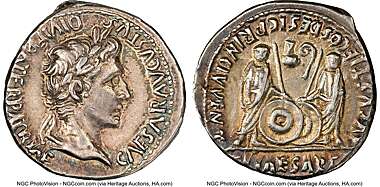
Los 23005. Augustus (27 BC-AD 14). AR denarius (19mm, 3.8 gm, 11h). NGC Choice XF 5/5 - 4/5. Lugdunum, 2 BC-AD 4. CAESAR AVGVSTVS-DIVI F PATER PATRIAE, laureate head of Augustus right / AVGVSTI F COS DESIG PRINC IVVENT, Gaius and Lucius Caesars, togate, standing facing, each supporting grounded shield with inner hand, spears resting against shields; simpulum (on left) and lituus (on right) turned inwards above, C L CAESARES in exergue. RIC I 207. Ex Harlan J. Berk, private sale with dealer's tag included. Augustus minted this series coins in both gold and silver as a way to introduce the world to his beloved grandsons, adopted sons, and heir apparent, Lucius and Gaius. These coins were part of Augustus' effort to secure a dynastic succession. However, fate had other plans as both Lucius and Gaius predeceased him, with Lucius died in AD 2 and Gaius in AD 4, events that deeply saddened Augustus. The premature demise of his grandsons forced him to adopt his stepson, Tiberius, as his heir, as many of his top picks did not outlive Augustus who died at the age of 75. HID05401242017 © 2026 Heritage Auctions | All Rights Reserved www.HA.com/TexasAuctioneerLicenseNotice
  • Startpreis:
    1 USD
    0 EUR
    0 GBP
    0 CHF

    Nur ungefähre, gerundete WerteDatum: 05.11.2026
Los
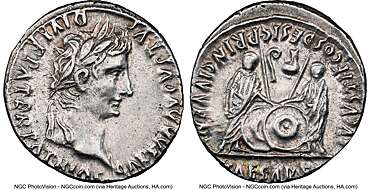
Los 23006. Augustus (27 BC-AD 14). AR denarius (19mm, 3.87 gm, 1h). NGC Choice XF 5/5 - 3/5, brushed. Lugdunum, 2 BC-AD 4. CAESAR AVGVSTVS-DIVI F PATER PATRIAE, laureate head of Augustus right / AVGVSTI F COS DESIG PRINC IVVENT, Gaius and Lucius Caesars, togate, standing facing, each supporting grounded shield with inner hand, spears resting against shields; lituus (on left) and simpulum (on right) turned inwards above, C L CAESARES in exergue. RIC I 210. Ex Imperio Numis, private sale with dealer's tag included. Augustus minted this series coins in both gold and silver as a way to introduce the world to his beloved grandsons, adopted sons, and heir apparent, Lucius and Gaius. These coins were part of Augustus' effort to secure a dynastic succession. However, fate had other plans as both Lucius and Gaius predeceased him, with Lucius died in AD 2 and Gaius in AD 4, events that deeply saddened Augustus. The premature demise of his grandsons forced him to adopt his stepson, Tiberius, as his heir, as many of his top picks did not outlive Augustus who died at the age of 75. HID05401242017 © 2026 Heritage Auctions | All Rights Reserved www.HA.com/TexasAuctioneerLicenseNotice
  • Startpreis:
    1 USD
    0 EUR
    0 GBP
    0 CHF

    Nur ungefähre, gerundete WerteDatum: 05.11.2026
Los
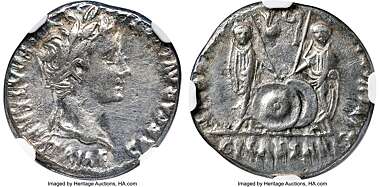
Los 23007. Augustus (27 BC-AD 14). AR denarius (18mm, 3.55 gm, 2h). NGC XF 4/5 - 3/5, brushed. Lugdunum, 2 BC-AD 4. CAESAR AVGVSTVS-DIVI F PATER PATRIAE, laureate head of Augustus right / AVGVSTI F COS DESIG PRINC IVVENT, Gaius and Lucius Caesars, togate, standing facing, each supporting grounded shield with inner hand, spears resting against shields; simpulum (on left) and lituus (on right) turned inwards above, C L CAESARES in exergue. RIC I 207. Augustus minted this series coins in both gold and silver as a way to introduce the world to his beloved grandsons, adopted sons, and heir apparent, Lucius and Gaius. These coins were part of Augustus' effort to secure a dynastic succession. However, fate had other plans as both Lucius and Gaius predeceased him, with Lucius died in AD 2 and Gaius in AD 4, events that deeply saddened Augustus. The premature demise of his grandsons forced him to adopt his stepson, Tiberius, as his heir, as many of his top picks did not outlive Augustus who died at the age of 75. HID05401242017 © 2026 Heritage Auctions | All Rights Reserved www.HA.com/TexasAuctioneerLicenseNotice
  • Startpreis:
    1 USD
    0 EUR
    0 GBP
    0 CHF

    Nur ungefähre, gerundete WerteDatum: 05.11.2026
Los
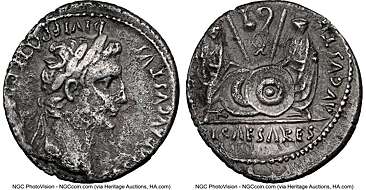
Los 23008. Augustus (27 BC-AD 14). AR denarius (17mm, 3.37 gm, 7h). NGC Choice VF 4/5 - 2/5. Lugdunum, 2 BC-AD 4. CAESAR AVGVSTVS-DIVI F PATER PATRIAE, laureate head of Augustus right / AVGVSTI F COS DESIG PRINC IVVENT, Gaius and Lucius Caesars, togate, standing facing, each supporting grounded shield with inner hand, spears resting against shields; simpulum (on left) and lituus (on right) turned inwards above, C L CAESARES in exergue. RIC I 207. Augustus minted this series coins in both gold and silver as a way to introduce the world to his beloved grandsons, adopted sons, and heir apparent, Lucius and Gaius. These coins were part of Augustus' effort to secure a dynastic succession. However, fate had other plans as both Lucius and Gaius predeceased him, with Lucius died in AD 2 and Gaius in AD 4, events that deeply saddened Augustus. The premature demise of his grandsons forced him to adopt his stepson, Tiberius, as his heir, as many of his top picks did not outlive Augustus who died at the age of 75. HID05401242017 © 2026 Heritage Auctions | All Rights Reserved www.HA.com/TexasAuctioneerLicenseNotice
  • Startpreis:
    1 USD
    0 EUR
    0 GBP
    0 CHF

    Nur ungefähre, gerundete WerteDatum: 05.11.2026
Los
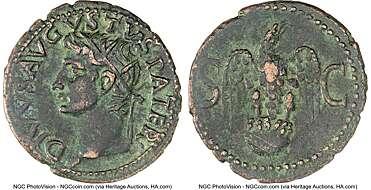
Los 23009. Divus Augustus (27 BC-AD 14). AE as (28mm, 10.95 gm, 5h). NGC XF 5/5 - 4/5. Rome, posthumous issue under Tiberius, AD 34-37. DIVVS AVGVSTVS PATER, radiate head of Divus Augustus left / Eagle standing facing on globe, head right, wings spread; S-C across fields. RIC I (Tiberius) 82. Ex Tamco Numismatics, private sale with dealer's tag included. On 17 September 14 AD, one month after Augustus's death, the Senate voted for the late emperor's deification and the founding of a grand temple in the capital city. Temples, shrines, and altars for the worship of Augustus had already begun sprout up during his lifetime, but after 14 AD religious commemorations surged to prominence as the official imperial cult of the deified Augustus (the "Divus Augustus Pater" often seen on coins issued throughout the Julio-Claudian dynasty). The Temple of Divus Augustus in Rome would not be finished until the start of Tiberius's successor's reign over two decades later: the enormous delays in the temple's completion are thought to have been due to the meticulous care and detail put into the building's construction. Tiberius organized a college of priests and priestesses, known as the Sodales Augustales, to perform the rites of the imperial cult. Members of the Sodales would be chosen from the senatorial elite or the imperial family itself: they even included Augustus's widow, Livia. HID05401242017 © 2026 Heritage Auctions | All Rights Reserved www.HA.com/TexasAuctioneerLicenseNotice
  • Startpreis:
    1 USD
    0 EUR
    0 GBP
    0 CHF

    Nur ungefähre, gerundete WerteDatum: 05.11.2026
Los
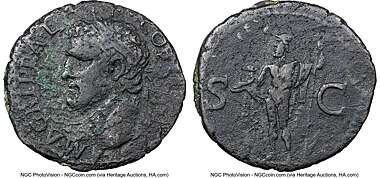
Los 23010. Marcus Agrippa, lieutenant of Augustus (died 12 BC). AE as (29mm, 10.86 gm, 6h). NGC Choice VF 5/5 - 2/5. Posthumous issue, Rome, AD 37-41. M•AGRIPPA•L-•F•-COS•III•, head of Agrippa left, wearing rostral crown / Neptune standing facing, head left, nude save for chlamys hanging behind and over both arms, small dolphin left in outstretched right hand, grounded trident in left hand; S-C across fields. RIC I (Gaius) 58. Ex Edgar L. Owen, private sale with dealer's tag included. Marcus Vipsanius Agrippa, perhaps history's greatest sidekick, was born in 63 BC, the same year as Gaius Octavius, with whom he struck up a close friendship in adolescence. Octavius recognized Agrippa's remarkable qualities as a soldier and statesman and relied heavily on him to put his various plans into action. Agrippa's mastery of strategy secured the naval victory over Sextus Pompey at Naulochus in 36 BC and the defeat of Mark Antony and Cleopatra at Actium five years later. After Octavian assumed the title of Augustus in 27 BC, Agrippa was clearly regarded as second-in-command and the likely heir to the throne, even marrying Octavian's daughter, Julia the Elder. His many building projects, financed out of his own purse, helped transform Rome from a city of brick to one of marble, and his commemorative inscriptions survive on many important monuments, including the Pantheon. His name continued to be revered long after his death in 12 BC, as this coin, struck decades later, attests. HID05401242017 © 2026 Heritage Auctions | All Rights Reserved www.HA.com/TexasAuctioneerLicenseNotice
  • Startpreis:
    1 USD
    0 EUR
    0 GBP
    0 CHF

    Nur ungefähre, gerundete WerteDatum: 05.11.2026
Los
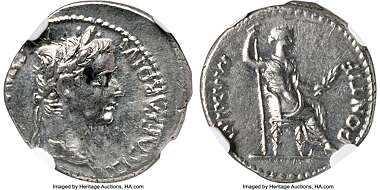
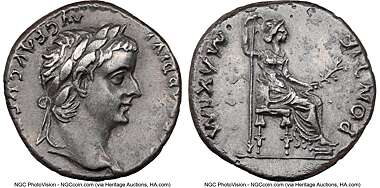
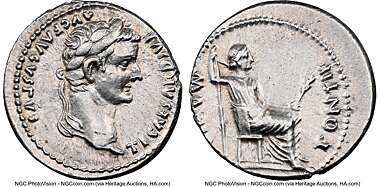
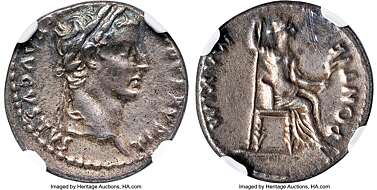
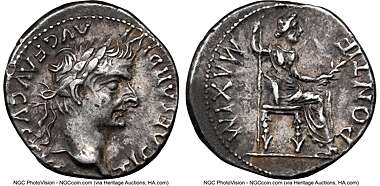
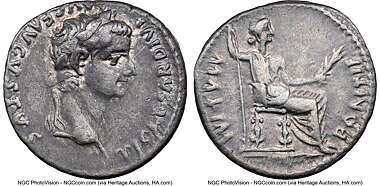
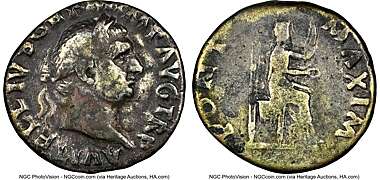
Los 23011. Tiberius (AD 14-37). AR denarius (18mm, 3.75 gm, 8h). NGC MS 4/5 - 3/5. Lugdunum, ca. AD 18-35. TI CAESAR DIVI-AVG F AVGVSTVS, laureate head of Tiberius right / PONTIF-MAXIM, Livia, as Pax, seated right, feet on stool, grounded scepter in right hand, olive branch in outstretched left; chair with ornate legs, single line below. RIC I 30. As the stepchild and unwanted heir of Augustus, Tiberius had a difficult act to follow. Nevertheless, for the first few years of his reign, he did a commendable job running the vast empire bequeathed to his care. Cautious and frugal, he engaged in no wars of conquest and kept the Empire's finances in good order. However, he soon tired of the endless toil and began handing off duties to his unscrupulous second-fiddles, namely the Praetorian Prefect Sejanus and his eventual replacement, Macro. The resulting bloodbath among members of his own family, and their Senatorial supporters, tarnished his name throughout history. There are reports that in the end, Tiberius did not die of natural causes. Suetonius, himself, believed rumors that Caligula had poisoned Tiberius, starved him, and smothered him with a pillow before he fell dead. He was deified upon death. His cautious nature is reflected in his coinage - unlike the proliferation of types employed by Augustus, Tiberius kept the same simple design for both silver denarii and gold aurei for almost the entirety of his reign. This uniformity of type makes it virtually impossible to date any particular aureus or denarius more precisely than somewhere within the last two decades of his reign. Hence, virtually any of his coins could have been struck in the same year as the momentous event he probably never heard about, the crucifixion of Jesus Christ in Judaea, likely between AD 30 and 34. This coin type is most closely associated to Tiberius as the "Tribute Penny," as they are mentioned in the Bible. HID05401242017 © 2026 Heritage Auctions | All Rights Reserved www.HA.com/TexasAuctioneerLicenseNotice
  • Startpreis:
    1 USD
    0 EUR
    0 GBP
    0 CHF

    Nur ungefähre, gerundete WerteDatum: 05.11.2026
Los
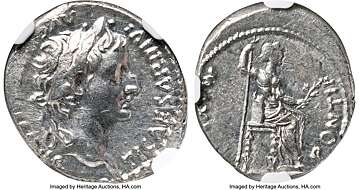
Los 23012. Tiberius (AD 14-37). AR denarius (19mm, 3.77 gm, 1h). NGC AU 3/5 - 3/5, brushed. Lugdunum, ca. AD 18-35. TI CAESAR DIVI-AVG F AVGVSTVS, laureate head of Tiberius right / PONTIF-MAXIM, Livia, as Pax, seated right, feet on stool, grounded scepter in right hand, olive branch in outstretched left; chair with ornate legs, single line below. RIC I 30. As the stepchild and unwanted heir of Augustus, Tiberius had a difficult act to follow. Nevertheless, for the first few years of his reign, he did a commendable job running the vast empire bequeathed to his care. Cautious and frugal, he engaged in no wars of conquest and kept the Empire's finances in good order. However, he soon tired of the endless toil and began handing off duties to his unscrupulous second-fiddles, namely the Praetorian Prefect Sejanus and his eventual replacement, Macro. The resulting bloodbath among members of his own family, and their Senatorial supporters, tarnished his name throughout history. There are reports that in the end, Tiberius did not die of natural causes. Suetonius, himself, believed rumors that Caligula had poisoned Tiberius, starved him, and smothered him with a pillow before he fell dead. He was deified upon death. His cautious nature is reflected in his coinage - unlike the proliferation of types employed by Augustus, Tiberius kept the same simple design for both silver denarii and gold aurei for almost the entirety of his reign. This uniformity of type makes it virtually impossible to date any particular aureus or denarius more precisely than somewhere within the last two decades of his reign. Hence, virtually any of his coins could have been struck in the same year as the momentous event he probably never heard about, the crucifixion of Jesus Christ in Judaea, likely between AD 30 and 34. This coin type is most closely associated to Tiberius as the "Tribute Penny," as they are mentioned in the Bible. HID05401242017 © 2026 Heritage Auctions | All Rights Reserved www.HA.com/TexasAuctioneerLicenseNotice
  • Startpreis:
    1 USD
    0 EUR
    0 GBP
    0 CHF

    Nur ungefähre, gerundete WerteDatum: 05.11.2026
Los
Los 23013. Tiberius (AD 14-37). AR denarius (17mm, 3.62 gm, 4h). NGC Choice XF 4/5 - 3/5, brushed. Lugdunum, ca. AD 18-35. TI CAESAR DIVI-AVG F AVGVSTVS, laureate head of Tiberius right / PONTIF-MAXIM, Livia, as Pax, seated right, feet on stool, grounded scepter in right hand, olive branch in outstretched left; chair with ornate legs, single line below. RIC I 30. Ex Imperio Numis, private sale with dealer's tag included. As the stepchild and unwanted heir of Augustus, Tiberius had a difficult act to follow. Nevertheless, for the first few years of his reign, he did a commendable job running the vast empire bequeathed to his care. Cautious and frugal, he engaged in no wars of conquest and kept the Empire's finances in good order. However, he soon tired of the endless toil and began handing off duties to his unscrupulous second-fiddles, namely the Praetorian Prefect Sejanus and his eventual replacement, Macro. The resulting bloodbath among members of his own family, and their Senatorial supporters, tarnished his name throughout history. There are reports that in the end, Tiberius did not die of natural causes. Suetonius, himself, believed rumors that Caligula had poisoned Tiberius, starved him, and smothered him with a pillow before he fell dead. He was deified upon death. His cautious nature is reflected in his coinage - unlike the proliferation of types employed by Augustus, Tiberius kept the same simple design for both silver denarii and gold aurei for almost the entirety of his reign. This uniformity of type makes it virtually impossible to date any particular aureus or denarius more precisely than somewhere within the last two decades of his reign. Hence, virtually any of his coins could have been struck in the same year as the momentous event he probably never heard about, the crucifixion of Jesus Christ in Judaea, likely between AD 30 and 34. This coin type is most closely associated to Tiberius as the "Tribute Penny," as they are mentioned in the Bible. HID05401242017 © 2026 Heritage Auctions | All Rights Reserved www.HA.com/TexasAuctioneerLicenseNotice
  • Startpreis:
    1 USD
    0 EUR
    0 GBP
    0 CHF

    Nur ungefähre, gerundete WerteDatum: 05.11.2026
Los
Los 23014. Tiberius (AD 14-37). AR denarius (19mm, 3.82 gm, 4h). NGC Choice XF 4/5 - 2/5, brushed. Lugdunum, ca. AD 15-18. TI CAESAR DIVI-AVG F AVGVSTVS, laureate head of Tiberius right / PONTIF-MAXIM, Livia, as Pax, seated right, feet on stool, grounded scepter in right hand, olive branch in outstretched left; chair with plain legs, double line below. RIC I 26. As the stepchild and unwanted heir of Augustus, Tiberius had a difficult act to follow. Nevertheless, for the first few years of his reign, he did a commendable job running the vast empire bequeathed to his care. Cautious and frugal, he engaged in no wars of conquest and kept the Empire's finances in good order. However, he soon tired of the endless toil and began handing off duties to his unscrupulous second-fiddles, namely the Praetorian Prefect Sejanus and his eventual replacement, Macro. The resulting bloodbath among members of his own family, and their Senatorial supporters, tarnished his name throughout history. There are reports that in the end, Tiberius did not die of natural causes. Suetonius, himself, believed rumors that Caligula had poisoned, starved, smothered him with a pillow, and then he fell dead. He was deified upon death. His cautious nature is reflected in his coinage - unlike the proliferation of types employed by Augustus, Tiberius kept the same simple design for both silver denarii and gold aurei for almost the entirety of his reign. This uniformity of type makes it virtually impossible to date any particular aureus or denarius more precisely than somewhere within the last two decades of his reign. Hence, virtually any of his coins could have been struck in the same year as the momentous event he probably never heard about, the crucifixion of Jesus Christ in Judaea, likely between AD 30 and 34. This coin type is most closely associated to Tiberius as the "Tribute Penny," as they are mentioned in the Bible. HID05401242017 © 2026 Heritage Auctions | All Rights Reserved www.HA.com/TexasAuctioneerLicenseNotice
  • Startpreis:
    1 USD
    0 EUR
    0 GBP
    0 CHF

    Nur ungefähre, gerundete WerteDatum: 05.11.2026
Los
Los 23015. Tiberius (AD 14-37). AR denarius (17mm, 3.75 gm, 4h). NGC Choice XF 4/5 - 2/5, scratches. Lugdunum, ca. AD 18-35. TI CAESAR DIVI-AVG F AVGVSTVS, laureate head of Tiberius right / PONTIF-MAXIM, Livia, as Pax, seated right, feet on stool, grounded scepter in right hand, olive branch in outstretched left; chair with ornate legs, single line below. RIC I 30. As the stepchild and unwanted heir of Augustus, Tiberius had a difficult act to follow. Nevertheless, for the first few years of his reign, he did a commendable job running the vast empire bequeathed to his care. Cautious and frugal, he engaged in no wars of conquest and kept the Empire's finances in good order. However, he soon tired of the endless toil and began handing off duties to his unscrupulous second-fiddles, namely the Praetorian Prefect Sejanus and his eventual replacement, Macro. The resulting bloodbath among members of his own family, and their Senatorial supporters, tarnished his name throughout history. There are reports that in the end, Tiberius did not die of natural causes. Suetonius, himself, believed rumors that Caligula had poisoned Tiberius, starved him, and smothered him with a pillow before he fell dead. He was deified upon death. His cautious nature is reflected in his coinage - unlike the proliferation of types employed by Augustus, Tiberius kept the same simple design for both silver denarii and gold aurei for almost the entirety of his reign. This uniformity of type makes it virtually impossible to date any particular aureus or denarius more precisely than somewhere within the last two decades of his reign. Hence, virtually any of his coins could have been struck in the same year as the momentous event he probably never heard about, the crucifixion of Jesus Christ in Judaea, likely between AD 30 and 34. This coin type is most closely associated to Tiberius as the "Tribute Penny," as they are mentioned in the Bible. HID05401242017 © 2026 Heritage Auctions | All Rights Reserved www.HA.com/TexasAuctioneerLicenseNotice
  • Startpreis:
    1 USD
    0 EUR
    0 GBP
    0 CHF

    Nur ungefähre, gerundete WerteDatum: 05.11.2026
Los
Los 23016. Tiberius (AD 14-37). AR denarius (18mm, 3.92 gm, 4h). NGC XF 5/5 - 4/5. Lugdunum, ca. AD 18-35. TI CAESAR DIVI-AVG F AVGVSTVS, laureate head of Tiberius right / PONTIF-MAXIM, Livia, as Pax, seated right, feet on stool, grounded scepter in right hand, olive branch in outstretched left; chair with ornate legs, single line below. RIC I 30. As the stepchild and unwanted heir of Augustus, Tiberius had a difficult act to follow. Nevertheless, for the first few years of his reign, he did a commendable job running the vast empire bequeathed to his care. Cautious and frugal, he engaged in no wars of conquest and kept the Empire's finances in good order. However, he soon tired of the endless toil and began handing off duties to his unscrupulous second-fiddles, namely the Praetorian Prefect Sejanus and his eventual replacement, Macro. The resulting bloodbath among members of his own family, and their Senatorial supporters, tarnished his name throughout history. There are reports that in the end, Tiberius did not die of natural causes. Suetonius, himself, believed rumors that Caligula had poisoned Tiberius, starved him, and smothered him with a pillow before he fell dead. He was deified upon death. His cautious nature is reflected in his coinage - unlike the proliferation of types employed by Augustus, Tiberius kept the same simple design for both silver denarii and gold aurei for almost the entirety of his reign. This uniformity of type makes it virtually impossible to date any particular aureus or denarius more precisely than somewhere within the last two decades of his reign. Hence, virtually any of his coins could have been struck in the same year as the momentous event he probably never heard about, the crucifixion of Jesus Christ in Judaea, likely between AD 30 and 34. This coin type is most closely associated to Tiberius as the "Tribute Penny," as they are mentioned in the Bible. HID05401242017 © 2026 Heritage Auctions | All Rights Reserved www.HA.com/TexasAuctioneerLicenseNotice
  • Startpreis:
    1 USD
    0 EUR
    0 GBP
    0 CHF

    Nur ungefähre, gerundete WerteDatum: 05.11.2026
Los
Los 23017. Tiberius (AD 14-37). AR denarius (18mm, 3.69 gm, 1h). NGC Choice VF 5/5 - 4/5. Lugdunum, ca. AD 18-35. TI CAESAR DIVI-AVG F AVGVSTVS, laureate head of Tiberius right / PONTIF-MAXIM, Livia, as Pax, seated right, olive branch in left hand, grounded spear in right, feet on stool; chair with ornate legs, double line below. RIC I 28 var. (triple line below). Ex Pegasi Numismatics, private sale with dealer's tag included. As the stepchild and unwanted heir of Augustus, Tiberius had a difficult act to follow. Nevertheless, for the first few years of his reign, he did a commendable job running the vast empire bequeathed to his care. Cautious and frugal, he engaged in no wars of conquest and kept the Empire's finances in good order. However, he soon tired of the endless toil and began handing off duties to his unscrupulous second-fiddles, namely the Praetorian Prefect Sejanus and his eventual replacement, Macro. The resulting bloodbath among members of his own family, and their Senatorial supporters, tarnished his name throughout history. There are reports that in the end, Tiberius did not die of natural causes. Suetonius, himself, believed rumors that Caligula had poisoned Tiberius, starved him, and smothered him with a pillow before he fell dead. He was deified upon death. His cautious nature is reflected in his coinage - unlike the proliferation of types employed by Augustus, Tiberius kept the same simple design for both silver denarii and gold aurei for almost the entirety of his reign. This uniformity of type makes it virtually impossible to date any particular aureus or denarius more precisely than somewhere within the last two decades of his reign. Hence, virtually any of his coins could have been struck in the same year as the momentous event he probably never heard about, the crucifixion of Jesus Christ in Judaea, likely between AD 30 and 34. This coin type is most closely associated to Tiberius as the "Tribute Penny," as they are mentioned in the Bible. HID05401242017 © 2026 Heritage Auctions | All Rights Reserved www.HA.com/TexasAuctioneerLicenseNotice
  • Startpreis:
    1 USD
    0 EUR
    0 GBP
    0 CHF

    Nur ungefähre, gerundete WerteDatum: 05.11.2026
Los
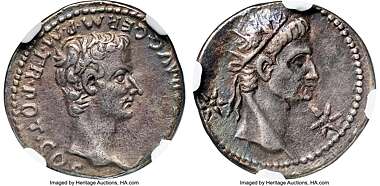
Los 23018. Gaius (Caligula) (AD 37-41). AR denarius (18mm, 3.70 gm, 1h). NGC Choice VF 5/5 - 2/5, brushed. Lugdunum, 1st issue, AD 37. C•CAESAR AVG GERM P M TR POT COS, bare head of Caligula right / Radiate head of Divus Augustus right, flanked by six-pointed star on either side. RIC I 2. Born as Gaius Julius Caesar Germanicus in AD 12, he soon became the mascot for the army of his father, the popular general Germanicus. During that time, he acquired the nickname "Caligula," or "Little Boots," for the miniature army boots (called caligae) he wore. When his predecessor, Tiberius, finally died in May AD 37, there was much speculation that, in the end, he did not die of natural causes. Suetonius, himself, believed rumors that Caligula had poisoned Tiberius, starved him, and smothered him with a pillow before he fell dead. But he was uniquely unsuited to the task at hand, having no experience in government, finance, or military affairs. He quickly squandered Tiberius' carefully hoarded wealth on frivolous projects, condemned or exiled the most capable men in government, and demanded to be worshipped as a god. After three years of misrule, he was assassinated by a cabal of senators and Praetorian guardsmen led by Cassius Chaerea on 24 January AD 41. Despite being perhaps one of the worst Roman emperors, Caligula's coinage is interesting and attractive. HID05401242017 © 2026 Heritage Auctions | All Rights Reserved www.HA.com/TexasAuctioneerLicenseNotice
  • Startpreis:
    1 USD
    0 EUR
    0 GBP
    0 CHF

    Nur ungefähre, gerundete WerteDatum: 05.11.2026
Los
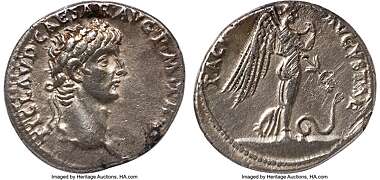
Los 23019. Claudius I (AD 41-54). AR denarius (19mm, 3.61 gm, 1h). NGC XF 4/5 - 2/5, scuffs, brushed, edge chip. Rome, AD 41-42. TI•CLAVD•CAESAR•AVG•P•M•TR•P•, laureate head of Claudius I right / PACI-AVGVSTAE, Pax-Nemesis advancing right, raising fold of drapery with right hand to spit on chest, winged caduceus in lowered left hand pointing at serpent advancing right. RIC I 10. Spitting on one's chest was an apotropaic gesture in Ancient Rome to ward off Nemesis and the ill fortunes she brings. HID05401242017 © 2026 Heritage Auctions | All Rights Reserved www.HA.com/TexasAuctioneerLicenseNotice
  • Startpreis:
    1 USD
    0 EUR
    0 GBP
    0 CHF

    Nur ungefähre, gerundete WerteDatum: 05.11.2026
Los
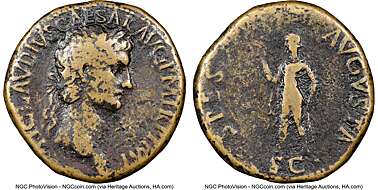
Los 23020. Claudius I (AD 41-54). AE sestertius (34mm, 26.83 gm, 7h). NGC Fine 5/5 - 3/5. Uncertain western mint, ca. AD 42-43. TI•CLAVDIVS•CAESAR•AVG•P•M•TR•P•IMP, laureate head of Claudius I right / SPES-AVGVSTA, Spes advancing left, flower in outstretched right hand, hitching stola with left; S•C below. RIC I 99. Son of the great general Drusus, and Antonia, niece of the emperor Augustus, Tiberius Claudius Drusus seemed well-positioned when he was born in 10 BC. But a serious childhood illness left him with a limp, a stammer, and other qualities that made him the black sheep of the family. While these problems barred him from a political career, such exclusion also granted him immunity from the family's murderous intrigues. Upon Caligula's assassination in January, AD 41, Claudius was the sole surviving Julio-Claudian male and, when members of the Praetorian Guard found him cowering behind a curtain in the palace, they immediately acclaimed him as Emperor. Claudius astutely awarded the Praetorians a substantial bonus, and with 10,000 heavily armed soldiers backing him, he easily forced the Senate to accept him as the next princeps. Once installed, Claudius surprised everyone by ruling with intelligence and moderation. In AD 43, he ordered the invasion and annexation of Britain, the first major addition of territory to the Empire since the days of Augustus. He exercised discernment in his selection of provincial governors and exhibited adept diplomacy in handling foreign relations. However, his notable shortcomings lay in his excessive attention to minutiae, dependence on freedmen and close associates, and his questionable choices in romantic partners. His third wife, Messalina, known for her promiscuity, wielded significant influence as Empress and became embroiled in a scandalous conspiracy in AD 48, which posed a threat to his rule. Subsequently, his next wife, Agrippina the Younger, skillfully utilized her influence to consolidate her own power and advance the position of her son, Nero, from a previous marriage, within the succession plans. This done, she fed Claudius a dish of poisoned mushrooms in October AD 54 and brought his 13-year reign to an end. Despite many missteps and his unsavory demise, Claudius had been a fairly successful ruler and his regime set a pattern for the Flavians and the reigns that followed. HID05401242017 © 2026 Heritage Auctions | All Rights Reserved www.HA.com/TexasAuctioneerLicenseNotice
  • Startpreis:
    1 USD
    0 EUR
    0 GBP
    0 CHF

    Nur ungefähre, gerundete WerteDatum: 05.11.2026
Los
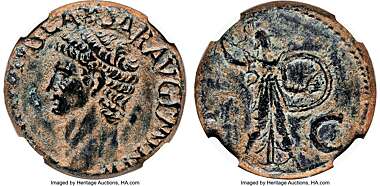
Los 23021. Claudius I (AD 41-54). AE as (25mm, 12.29 gm, 6h). NGC XF 4/5 - 3/5, smoothing. Western mint, ca. AD 41-42. TI CLAVDIVS CAESAR AVG P M TR P IMP, bare head of Claudius left / Minerva advancing right, brandishing spear in right hand, shield on left arm; S-C across field. RIC I 100 (Rome). Son of the great general Drusus, and Antonia, niece of the emperor Augustus, Tiberius Claudius Drusus seemed well-positioned when he was born in 10 BC. But a serious childhood illness left him with a limp, a stammer, and other qualities that made him the black sheep of the family. While these problems barred him from a political career, such exclusion also granted him immunity from the family's murderous intrigues. Upon Caligula's assassination in January, AD 41, Claudius was the sole surviving Julio-Claudian male and, when members of the Praetorian Guard found him cowering behind a curtain in the palace, they immediately acclaimed him as Emperor. Claudius astutely awarded the Praetorians a substantial bonus, and with 10,000 heavily armed soldiers backing him, he easily forced the Senate to accept him as the next princeps. Once installed, Claudius surprised everyone by ruling with intelligence and moderation. In AD 43, he ordered the invasion and annexation of Britain, the first major addition of territory to the Empire since the days of Augustus. He exercised discernment in his selection of provincial governors and exhibited adept diplomacy in handling foreign relations. However, his notable shortcomings lay in his excessive attention to minutiae, dependence on freedmen and close associates, and his questionable choices in romantic partners. His third wife, Messalina, known for her promiscuity, wielded significant influence as Empress and became embroiled in a scandalous conspiracy in AD 48, which posed a threat to his rule. Subsequently, his next wife, Agrippina the Younger, skillfully utilized her influence to consolidate her own power and advance the position of her son, Nero, from a previous marriage, within the succession plans. This done, she fed Claudius a dish of poisoned mushrooms in October AD 54 and brought his 13-year reign to an end. Despite many missteps and his unsavory demise, Claudius had been a fairly successful ruler and his regime set a pattern for the Flavians and the reigns that followed. HID05401242017 © 2026 Heritage Auctions | All Rights Reserved www.HA.com/TexasAuctioneerLicenseNotice
  • Startpreis:
    1 USD
    0 EUR
    0 GBP
    0 CHF

    Nur ungefähre, gerundete WerteDatum: 05.11.2026
Los
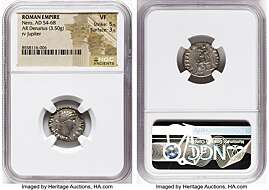
Los 23022. Nero, as Augustus (AD 54-68). AR denarius (17mm, 3.50 gm, 5h). NGC VF 5/5 - 3/5. Rome, ca. AD 67/68. IMP NERO CAESAR-AVG P P, laureate head of Nero right / IVPPITER-CVSTOS, Jupiter enthroned left, thunderbolt in outstretched right hand, grounded scepter in left. RIC I 69. Nero, born Lucius Domitius Ahenobarbus in 37 AD, ascended to the Roman imperial throne in 54 AD, initiating a tumultuous reign that both captivated and horrified contemporaries. Initially perceived as a youthful and promising ruler, Nero's early years were marked by relative stability. However, his later years were characterized by a series of erratic and tyrannical acts. Nero's infatuation with the arts and his lavish spending on grandiose construction projects, such as the Domus Aurea, strained the Roman treasury. His ruthless suppression of the Pisonian conspiracy and persecution of Christians tarnished his legacy further. The Great Fire of Rome in 64 AD, though often attributed to Nero, remains a subject of historical debate. Ultimately, Nero's reign culminated in a revolt by the Roman Senate, leading to his suicide in 68 AD, marking the end of the Julio-Claudian dynasty and leaving a complex legacy as both a patron of the arts and a symbol of tyranny in Roman history. HID05401242017 © 2026 Heritage Auctions | All Rights Reserved www.HA.com/TexasAuctioneerLicenseNotice
  • Startpreis:
    1 USD
    0 EUR
    0 GBP
    0 CHF

    Nur ungefähre, gerundete WerteDatum: 05.11.2026
Los
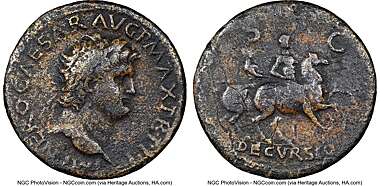
Los 23023. Nero, as Augustus (AD 54-68). AE sestertius (35mm, 24.14 gm, 7h). NGC VF 5/5 - 2/5, scuff. IMP NERO CAESAR AVG P MAX TR P P P, laureate head of Nero right / Emperor on horseback right, spear forward in right hand, soldier on horseback right behind, vexillum over left shoulder; DECVRSIO in exergue, S-C across fields. RIC I 580. The decursio was a ceremonial military training exercise that may have been connected to the earlier Republican tradition. The transvectio equitum was a cavalry procession that took place every 15th of July: first instated in 304 BC by Quintus Fabius Maximus Rullianus, to later be reinstated by Augustus. HID05401242017 © 2026 Heritage Auctions | All Rights Reserved www.HA.com/TexasAuctioneerLicenseNotice
  • Startpreis:
    1 USD
    0 EUR
    0 GBP
    0 CHF

    Nur ungefähre, gerundete WerteDatum: 05.11.2026
Los
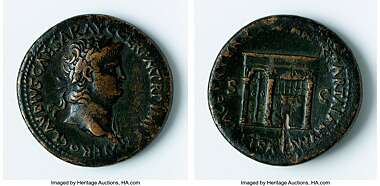
Los 23024. Nero, as Augustus (AD 54-68). AE sestertius (36mm, 27.42 gm, 6h). VF. Rome. NERO CLAVDIVS CAESAR AVG GER P M TR P IMP P P, laureate bust of Nero right, aegis visible on far shoulder / PACE P R TERRA MARIQ PARTA IANVM CLVSIT, three-quarter view of temple of Janus with latticed window on right, front doors closed on left, garland draped across arched entrance; S-C across fields. RIC I 270. Ex Numismatik Naumann, Auction 136 (7 January 2024), lot 502. The Temple of Janus was one of the oldest structures in the Roman Forum. In keeping with the spirit of Janus, the two-faced god, the temple had large doors on two opposing sides. According to tradition, the doors were kept open in wartime and closed during times of peace. The closing of the Temple doors was a rare event, even during the Pax Romana. In AD 66, having recently concluded a favorable peace treaty with Parthia, Nero closed the doors with great fanfare and marked the occasion on his coinage. HID05401242017 © 2026 Heritage Auctions | All Rights Reserved www.HA.com/TexasAuctioneerLicenseNotice
  • Startpreis:
    1 USD
    0 EUR
    0 GBP
    0 CHF

    Nur ungefähre, gerundete WerteDatum: 05.11.2026
Los
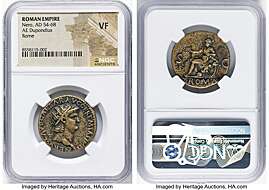
Los 23025. Nero, as Augustus (AD 54-68). AE dupondius (27mm, 6h). NGC VF. Rome, ca. AD 65. NERO CLAVD CAESAR AVG GER P M TR P IMP PP, radiate head of Nero right / Roma seated left on cuirass and arms, wreath in outstretched right hand, parazonium in left hand; S-C across fields, ROMA in exergue. RIC I 296. Nero, born Lucius Domitius Ahenobarbus in 37 AD, ascended to the Roman imperial throne in 54 AD, initiating a tumultuous reign that both captivated and horrified contemporaries. Initially perceived as a youthful and promising ruler, Nero's early years were marked by relative stability. However, his later years were characterized by a series of erratic and tyrannical acts. Nero's infatuation with the arts and his lavish spending on grandiose construction projects, such as the Domus Aurea, strained the Roman treasury. His ruthless suppression of the Pisonian conspiracy and persecution of Christians tarnished his legacy further. The Great Fire of Rome in 64 AD, though often attributed to Nero, remains a subject of historical debate. Ultimately, Nero's reign culminated in a revolt by the Roman Senate, leading to his suicide in 68 AD, marking the end of the Julio-Claudian dynasty and leaving a complex legacy as both a patron of the arts and a symbol of tyranny in Roman history. HID05401242017 © 2026 Heritage Auctions | All Rights Reserved www.HA.com/TexasAuctioneerLicenseNotice
  • Startpreis:
    1 USD
    0 EUR
    0 GBP
    0 CHF

    Nur ungefähre, gerundete WerteDatum: 05.11.2026
Los
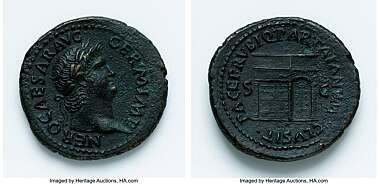
Los 23026. Nero, as Augustus (AD 54-68). AE as (29mm, 11.33 gm, 6h). Choice VF. Rome, ca. AD 65. NERO CAESAR AVG GERM IMP, laureate head of Nero right / PACE P R VBIQ PARTA IANVM-CLVSIT, three-quarter view of temple of Janus with latticed window on left, front doors closed on right, garland draped across arched entrance; S-C across fields. RIC I 306. Ex Gilbert Steinberg Collection (Classical Numismatic Group, Triton XXVII Online Sessions, 17 January 2024), lot 6067; purchased from Bowers & Ruddy Galleries (14 August 1981). The Temple of Janus was one of the oldest structures in the Roman Forum. In keeping with the spirit of Janus, the two-faced god, the temple had large doors on two opposing sides. According to tradition, the doors were kept open in wartime and closed during times of peace. The closing of the Temple doors was a rare event, even during the Pax Romana. In AD 66, having recently concluded a favorable peace treaty with Parthia, Nero closed the doors with great fanfare and marked the occasion on his coinage. HID05401242017 © 2026 Heritage Auctions | All Rights Reserved www.HA.com/TexasAuctioneerLicenseNotice
  • Startpreis:
    1 USD
    0 EUR
    0 GBP
    0 CHF

    Nur ungefähre, gerundete WerteDatum: 05.11.2026
Los
Los 23027. Galba (AD 68-69). AR denarius (18mm, 3.03 gm, 5h). NGC VF 4/5 - 5/5. Rome. IMP SER GALBA-CAESAR AVG, laureate head of Galba right / HISPA-NIA, Hispania advancing left, poppy and grain ears in outstretched right hand, round shield and two spears in left hand. RIC I 193. Servius Sulpicius Galba was born in 3 BC, and early on displayed a gift for cultivating the right friends. During his early manhood, he enjoyed the favor of the emperors Augustus, Tiberius, and Caligula, as well as the empress Livia, whose bequest of 500,000 sesterces helped launch his public career. Elected consul in AD 33, he served as governor in Germany and Africa before, late in life, accepting Nero's appointment as proconsul of Nearer Spain. This came as Nero's popularity was plummeting in Rome, and the aristocracy began looking toward the prestige-laden Galba for leadership. In March of AD 68, Vindex, governor of Gaul, rose in revolt and offered to support Galba as the new ruler. Two months later, Nero's regime collapsed and, at the age of 70, Galba found himself hailed as emperor, the first from outside the Julio-Claudian family. He made his way back to Rome and embarked on an austerity program to restore the state's finances. Although meaning well, Galba proved oblivious to the realities of his situation and soon managed to offend nearly every segment of Roman society. Galba attempted to salvage the situation by adopting a likable young aristocrat, L. Calpurnius Piso, as his successor, but this only alienated another key supporter, M. Salvius Otho, who had hoped to be chosen Caesar himself. Otho bribed Praetorian officers, and on 15 January AD 69, they attacked Galba and Piso in the Forum, hacking them to pieces. His entire reign has lasted seven months and proved only the opening act in the disastrous "Year of the Four Emperors." The historian Tacitus pronounced Galba's epitaph: "It was commonly agreed he possessed the makings of a great ruler- had he never ruled." HID05401242017 © 2026 Heritage Auctions | All Rights Reserved www.HA.com/TexasAuctioneerLicenseNotice
  • Startpreis:
    1 USD
    0 EUR
    0 GBP
    0 CHF

    Nur ungefähre, gerundete WerteDatum: 05.11.2026
Los
Los 23028. Galba (July AD 68-January AD 69). AR quinarius (16mm, 1.66 gm, 8h). VF, tooled. Lugdunum, November AD 68-15 January AD 69. SER GALBA IMP-CAESAR AVG M T P, laureate head of Galba right / VICTORIA-GALBAE AVG, Victory standing right on globe, wreath in outstretched right hand, palm over left shoulder. RIC I 132 var. (obverse legend). Tooled, thus ineligible for encapsulation. Servius Sulpicius Galba was born in 3 BC, and early on displayed a gift for cultivating the right friends. During his early manhood, he enjoyed the favor of the emperors Augustus, Tiberius, and Caligula, as well as the empress Livia, whose bequest of 500,000 sesterces helped launch his public career. Elected consul in AD 33, he served as governor in Germany and Africa before, late in life, accepting Nero's appointment as proconsul of Nearer Spain. This came as Nero's popularity was plummeting in Rome, and the aristocracy began looking toward the prestige-laden Galba for leadership. In March of AD 68, Vindex, governor of Gaul, rose in revolt and offered to support Galba as the new ruler. Two months later, Nero's regime collapsed and, at the age of 70, Galba found himself hailed as emperor, the first from outside the Julio-Claudian family. He made his way back to Rome and embarked on an austerity program to restore the state's finances. Although meaning well, Galba proved oblivious to the realities of his situation and soon managed to offend nearly every segment of Roman society. Galba attempted to salvage the situation by adopting a likable young aristocrat, L. Calpurnius Piso, as his successor, but this only alienated another key supporter, M. Salvius Otho, who had hoped to be chosen Caesar himself. Otho bribed Praetorian officers, and on 15 January AD 69, they attacked Galba and Piso in the Forum, hacking them to pieces. His entire reign has lasted seven months and proved only the opening act in the disastrous "Year of the Four Emperors." The historian Tacitus pronounced Galba's epitaph: "It was commonly agreed he possessed the makings of a great ruler- had he never ruled." HID05401242017 © 2026 Heritage Auctions | All Rights Reserved www.HA.com/TexasAuctioneerLicenseNotice
  • Startpreis:
    1 USD
    0 EUR
    0 GBP
    0 CHF

    Nur ungefähre, gerundete WerteDatum: 05.11.2026
Los
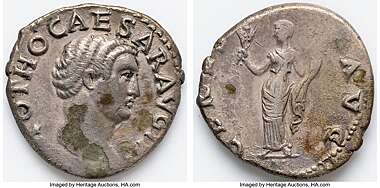
Los 23029. Otho (January-April AD 69). AR denarius (18mm, 3.24 gm, 5h). VF, tooled. Rome. IMP OTHO CAESAR AVG TR P, bare, bewigged head of Otho right / CERES-AVG, Ceres standing facing, head left, two grain ears raised in right hand, cornucopia cradled in left arm. RIC I 2. Tooled, thus ineligible for encapsulation. The rarest known Otho denarius, with only a known examples. Born in AD 32 to a nouveau riche family, Marcus Salvius Otho grew up as a pampered playboy with a taste for the finer things in life. He had a peculiar abhorrence for body hair and depilated every part of his body, including his head. To cover his baldness, he then wore a carefully made wig. Otho became one of the Emperor Nero's high-living friends, but this changed abruptly when Nero took a fancy to his beautiful wife, Poppaea. Otho was thus packed off to govern Lusitania (modern Portugal), where he stewed and plotted revenge. When Nero's regime collapsed in AD 68, Otho was one of Galba's earliest supporters and fully expected to be named the old man's heir apparent. Instead, Galba chose a young aristocrat of better breeding, and the furious Otho began plotting his removal. He bribed the Praetorian Guards to murder Galba on 15 January AD 69, after which the Senate reluctantly confirmed Otho as emperor. But he immediately faced another rebellion, this time by Vitellius, governor of lower Germany, whose sizeable army marched on Italy. Otho hurried north to the River Po; his generals urged him to wait for reinforcements, but Otho was afraid of defections and ordered a premature attack. The sharp clash at Cremona in northern Italy went decisively against him, and he stabbed himself in the heart the morning of 16 or 17 April AD 69, ending a brief reign of about 90 days. His noble end gained him a respect that had eluded him in life. HID05401242017 © 2026 Heritage Auctions | All Rights Reserved www.HA.com/TexasAuctioneerLicenseNotice
  • Startpreis:
    1 USD
    0 EUR
    0 GBP
    0 CHF

    Nur ungefähre, gerundete WerteDatum: 05.11.2026
Los
Los 23030. Vitellius (late April-20 December AD 69). AR (fourée?) denarius (17mm, 3.05 gm, 7h). NGC Fine 5/5 - 2/5, marks. Rome. A VITELLIVS GERM IMP AVG TR P, laureate head of Vitellius right / PONT-MAXIM, Vesta enthroned right, patera in right hand, grounded scepter in left. RIC I 107. Aulus Vitellius, the ninth emperor of Rome and the third in the chaotic Year of the Four Emperors, ruled briefly in a period marked by turbulence and instability. His ascent to power was propelled by the legions under his command in Germania, who declared him emperor following Otho's death. However, Vitellius' tenure was characterized by indulgence and extravagance, subsequently leading to financial strain on the imperial treasury. His governance was also characterized by cruelty and brutality amidst significant political and military upheaval, notably his conflict with Vespasian, whose forces eventually defeated Vitellius in December AD 69. Chronicled by historians like Tacitus and Suetonius as emblematic of the decadence and instability that plagued the Roman imperial succession, Vitellius' brief tenure highlights the dangers of indulgence and the volatility of power during one of Rome's most tumultuous periods. His rule stands in stark contrast to the effective governance that would follow, serving as a cautionary tale of the volatility of imperial succession and the perils of unchecked power in Roman history. HID05401242017 © 2026 Heritage Auctions | All Rights Reserved www.HA.com/TexasAuctioneerLicenseNotice
  • Startpreis:
    1 USD
    0 EUR
    0 GBP
    0 CHF

    Nur ungefähre, gerundete WerteDatum: 05.11.2026
Los
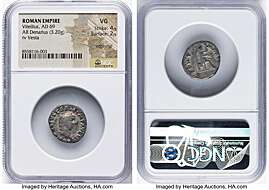
Los 23031. Vitellius (late April-20 December AD 69). AR denarius (19mm, 3.20 gm, 5h). NGC VG 4/5 - 2/5, edge chip. Rome. A VITELLIVS GERM IMP AVG TR P, laureate head of Vitellius right / PONT-MAXIM, Vesta enthroned right, patera in outstretched right hand, grounded scepter in left. RIC I 107. Aulus Vitellius, the ninth emperor of Rome and the third in the chaotic Year of the Four Emperors, ruled briefly in a period marked by turbulence and instability. His ascent to power was propelled by the legions under his command in Germania, who declared him emperor following Otho's death. However, Vitellius' tenure was characterized by indulgence and extravagance, subsequently leading to financial strain on the imperial treasury. His governance was also characterized by cruelty and brutality amidst significant political and military upheaval, notably his conflict with Vespasian, whose forces eventually defeated Vitellius in December AD 69. Chronicled by historians like Tacitus and Suetonius as emblematic of the decadence and instability that plagued the Roman imperial succession, Vitellius' brief tenure highlights the dangers of indulgence and the volatility of power during one of Rome's most tumultuous periods. His rule stands in stark contrast to the effective governance that would follow, serving as a cautionary tale of the volatility of imperial succession and the perils of unchecked power in Roman history. HID05401242017 © 2026 Heritage Auctions | All Rights Reserved www.HA.com/TexasAuctioneerLicenseNotice
  • Startpreis:
    1 USD
    0 EUR
    0 GBP
    0 CHF

    Nur ungefähre, gerundete WerteDatum: 05.11.2026
Los
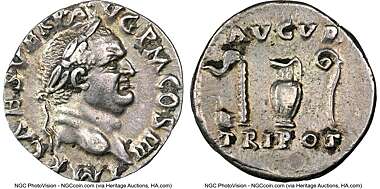
Los 23032. Vespasian (AD 69-79). AR denarius (17mm, 3.23 gm, 7h). NGC Choice XF 5/5 - 2/5, edge cut, light scratches. Rome, AD 72-73. IMP CAES VESP A-VG P M COS IIII, laureate head of Vespasian right / AVGVR / TRI POT, priestly implements: simpulum, aspergillum, ewer, and lituus. RIC II.1, 356. Descended from a family of small-time entrepreneurs and tax farmers in the Sabine hill country north of Rome, Flavius Vespasianus was born in AD 9 and rose to prominence in the Roman Army. He gained distinction during Claudius' invasion of Britain in AD 43-44 and won a Consulship in AD 51, but fell from imperial favor when he dozed off during one of Nero's musical performances. When a Jewish faction in the province of Judaea rebelled and massacred the local Roman garrison in AD 66, Nero sent Vespasian at the head of three legions to crush the revolt. Through his able son Titus, Vespasian gained the friendship and support of Mucianus, governor of Syria, who had another three legions at his disposal. When the collapse of Nero's regime in AD 68 led to a free-for-all for the throne, with Galba, Otho, and Vitellius following in quick succession, Vespasian realized he had the means and ability to make his own try for supreme power. On 1 July AD 69, the legions of Alexandria, Egypt declared Vespasian as emperor. He decided on a policy of blockade and attrition to defeat Vitellius, but the sudden declaration of support by the Danubian legions and their invasion of Italy in the fall of AD 69 brought a much quicker victory. Vitellius was executed on 20 December, and the Senate proclaimed Vespasian emperor two days later. Arriving in Rome the following October, Vespasian celebrated a magnificent triumph for the Judaean campaign before launching an austerity program to put the Empire's finances on sound footing. His decade of rule was largely untroubled by revolts and conspiracies. Upon his death due to a sudden illness in AD 79 he was widely and sincerely mourned, and power passed smoothly to his son Titus. HID05401242017 © 2026 Heritage Auctions | All Rights Reserved www.HA.com/TexasAuctioneerLicenseNotice
  • Startpreis:
    1 USD
    0 EUR
    0 GBP
    0 CHF

    Nur ungefähre, gerundete WerteDatum: 05.11.2026
Los
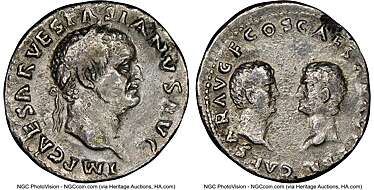
Los 23033. Vespasian (AD 69-79), with Titus and Domitian, as Caesars. AR denarius (18mm, 2.97 gm, 5h). NGC XF 4/5 - 2/5. Rome, ca. AD 70. IMP CAESAR VESPASIANVS AVG, laureate head of Vespasian right / CAESAR AVG F COS CAESAR AVG F PR, bare heads of Titus (on left) and Domitian (on right) confronted. RIC II 2. RIC II.1, 16. Ex Heritage Auctions, Auction 232912 (21 March 2019), lot 63090. HID05401242017 © 2026 Heritage Auctions | All Rights Reserved www.HA.com/TexasAuctioneerLicenseNotice
  • Startpreis:
    1 USD
    0 EUR
    0 GBP
    0 CHF

    Nur ungefähre, gerundete WerteDatum: 05.11.2026
Los
Los 23034. Vespasian (AD 69-79). AR denarius (17mm, 3.39 gm, 7h). NGC Choice VF 5/5 - 3/5, brushed. Rome, AD January-June 71. IMP CAES VESP-AVG P M, laureate head of Vespasian right / TRI POT II-COS III P P, Pax seated left, branch in outstretched right hand, caduceus cradled in left arm. RIC II.1, 41. Descended from a family of small-time entrepreneurs and tax farmers in the Sabine hill country north of Rome, Flavius Vespasianus was born in AD 9 and rose to prominence in the Roman Army. He gained distinction during Claudius' invasion of Britain in AD 43-44 and won a Consulship in AD 51, but fell from imperial favor when he dozed off during one of Nero's musical performances. When a Jewish faction in the province of Judaea rebelled and massacred the local Roman garrison in AD 66, Nero sent Vespasian at the head of three legions to crush the revolt. Through his able son Titus, Vespasian gained the friendship and support of Mucianus, governor of Syria, who had another three legions at his disposal. When the collapse of Nero's regime in AD 68 led to a free-for-all for the throne, with Galba, Otho, and Vitellius following in quick succession, Vespasian realized he had the means and ability to make his own try for supreme power. On 1 July AD 69, the legions of Alexandria, Egypt declared Vespasian as emperor. He decided on a policy of blockade and attrition to defeat Vitellius, but the sudden declaration of support by the Danubian legions and their invasion of Italy in the fall of AD 69 brought a much quicker victory. Vitellius was executed on 20 December, and the Senate proclaimed Vespasian emperor two days later. Arriving in Rome the following October, Vespasian celebrated a magnificent triumph for the Judaean campaign before launching an austerity program to put the Empire's finances on sound footing. His decade of rule was largely untroubled by revolts and conspiracies. Upon his death due to a sudden illness in AD 79 he was widely and sincerely mourned, and power passed smoothly to his son Titus. HID05401242017 © 2026 Heritage Auctions | All Rights Reserved www.HA.com/TexasAuctioneerLicenseNotice
  • Startpreis:
    1 USD
    0 EUR
    0 GBP
    0 CHF

    Nur ungefähre, gerundete WerteDatum: 05.11.2026
Los
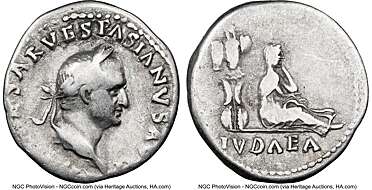
Los 23035. Vespasian (AD 69-79). AR denarius (19mm, 2.90 gm,7h). NGC Choice VF 4/5 - 2/5, edge chips, brushed, marks. Judaea Capta issue, Rome, ca. December AD 69-early AD 70. IMP CAESAR VESPASIANVS AVG, laureate head of Vespasian right / IVDAEA, mourning Judaea, veiled and supporting head with left hand, seated right on ground before military trophy consisting of helmet, cuirass, two shields, and greaves mounted on pole, two more shields at base. RIC II 2. Descended from a family of small-time entrepreneurs and tax farmers in the Sabine hill country north of Rome, Flavius Vespasianus was born in AD 9 and rose to prominence in the Roman Army. He gained distinction during Claudius' invasion of Britain in AD 43-44 and won a Consulship in AD 51, but fell from imperial favor when he dozed off during one of Nero's musical performances. When a Jewish faction in the province of Judaea rebelled and massacred the local Roman garrison in AD 66, Nero sent Vespasian at the head of three legions to crush the revolt. Through his able son Titus, Vespasian gained the friendship and support of Mucianus, governor of Syria, who had another three legions at his disposal. When the collapse of Nero's regime in AD 68 led to a free-for-all for the throne, with Galba, Otho, and Vitellius following in quick succession, Vespasian realized he had the means and ability to make his own try for supreme power. On 1 July AD 69, the legions of Alexandria, Egypt declared Vespasian as emperor. He decided on a policy of blockade and attrition to defeat Vitellius, but the sudden declaration of support by the Danubian legions and their invasion of Italy in the fall of AD 69 brought a much quicker victory. Vitellius was executed on 20 December, and the Senate proclaimed Vespasian emperor two days later. Arriving in Rome the following October, Vespasian celebrated a magnificent triumph for the Judaean campaign before launching an austerity program to put the Empire's finances on sound footing. His decade of rule was largely untroubled by revolts and conspiracies. Upon his death due to a sudden illness in AD 79 he was widely and sincerely mourned, and power passed smoothly to his son Titus. HID05401242017 © 2026 Heritage Auctions | All Rights Reserved www.HA.com/TexasAuctioneerLicenseNotice
  • Startpreis:
    1 USD
    0 EUR
    0 GBP
    0 CHF

    Nur ungefähre, gerundete WerteDatum: 05.11.2026
Los
Los 23036. Vespasian (AD 69-79). AR denarius (18mm, 3.34 gm, 7h). NGC Choice Fine 4/5 - 4/5. Judaea Capta issue, Rome, ca. December AD 69-early AD 70. IMP CAESAR VESPASIANVS AVG, laureate head of Vespasian right / IVDAEA, mourning Judaea, veiled and supporting head with left hand, seated right on ground before military trophy consisting of helmet, cuirass, two shields, and greaves mounted on pole, two more shields at base. RIC II 2. Descended from a family of small-time entrepreneurs and tax farmers in the Sabine hill country north of Rome, Flavius Vespasianus was born in AD 9 and rose to prominence in the Roman Army. He gained distinction during Claudius' invasion of Britain in AD 43-44 and won a Consulship in AD 51, but fell from imperial favor when he dozed off during one of Nero's musical performances. When a Jewish faction in the province of Judaea rebelled and massacred the local Roman garrison in AD 66, Nero sent Vespasian at the head of three legions to crush the revolt. Through his able son Titus, Vespasian gained the friendship and support of Mucianus, governor of Syria, who had another three legions at his disposal. When the collapse of Nero's regime in AD 68 led to a free-for-all for the throne, with Galba, Otho, and Vitellius following in quick succession, Vespasian realized he had the means and ability to make his own try for supreme power. On 1 July AD 69, the legions of Alexandria, Egypt declared Vespasian as emperor. He decided on a policy of blockade and attrition to defeat Vitellius, but the sudden declaration of support by the Danubian legions and their invasion of Italy in the fall of AD 69 brought a much quicker victory. Vitellius was executed on 20 December, and the Senate proclaimed Vespasian emperor two days later. Arriving in Rome the following October, Vespasian celebrated a magnificent triumph for the Judaean campaign before launching an austerity program to put the Empire's finances on sound footing. His decade of rule was largely untroubled by revolts and conspiracies. Upon his death due to a sudden illness in AD 79 he was widely and sincerely mourned, and power passed smoothly to his son Titus. HID05401242017 © 2026 Heritage Auctions | All Rights Reserved www.HA.com/TexasAuctioneerLicenseNotice
  • Startpreis:
    1 USD
    0 EUR
    0 GBP
    0 CHF

    Nur ungefähre, gerundete WerteDatum: 05.11.2026
Los
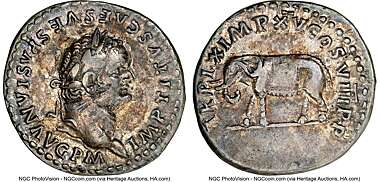
Los 23037. Titus, as Augustus (AD 79-81). AR denarius (19mm, 3.25 gm, 6h). NGC Choice VF 5/5 - 3/5, scuffs, flaws. Rome, AD January-June 80. IMP TITVS CAES VESPASIAN AVG P M, laureate head of Titus right / TR P IX IMP XV COS VIII P P, cuirassed elephant advancing left. RIC II.1, 115. Issued for the dedication of the Colosseum. Born in AD 41, Flavius Titus Vespasianus, the elder son of Vespasian, initially appeared destined for a life akin to that of an upper middle-class civil servant, following in his father's footsteps. Vespasian had earned acclaim as a general during Claudius' invasion of Britain, and Titus, as he matured, developed into an intelligent, handsome, and charismatic young man, eventually serving as his father's second in command during the Judaean campaign of AD 66-69. Following the collapse of Nero's regime in Rome, Vespasian assumed the throne while Titus took charge of the Judaean war, culminating in the conquest of Jerusalem in AD 70. Upon his triumphant return to Rome, where suspicions of a coup surrounded him, Titus warmly reunited with his father and was honored with a grand triumph. Subsequently, he held the position of Praetorian Prefect and diligently safeguarded his family's political influence. Upon Vespasian's death in AD 79, Titus ascended to the imperial throne, initially raising concerns that he might emulate the excesses of Nero or Caligula. However, he swiftly proved to be an unusually benevolent and compassionate ruler to the Roman populace. Unfortunately, after barely two years in office, Titus died of a fever on 13 September AD 81; he was promptly deified by the Roman Senate and succeeded by his younger brother Domitian. HID05401242017 © 2026 Heritage Auctions | All Rights Reserved www.HA.com/TexasAuctioneerLicenseNotice
  • Startpreis:
    1 USD
    0 EUR
    0 GBP
    0 CHF

    Nur ungefähre, gerundete WerteDatum: 05.11.2026
Los
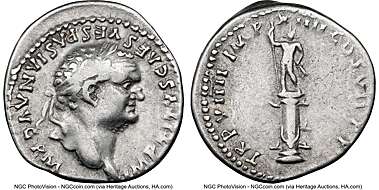
Los 23038. Titus, as Augustus (AD 79-81). AR denarius (18mm, 3.55 gm, 5h). NGC Choice Fine 5/5 - 4/5. Rome, AD 79. IMP TITVS CAES VESPASIAN AVG P M, laureate head of Titus right / TR P VIIII IMP-XIIII COS VII P P, radiate male figure standing facing on rostral column, spear in right hand, parazonium in left. RIC II.1, 28. Born in AD 41, Flavius Titus Vespasianus, the elder son of Vespasian, initially appeared destined for a life akin to that of an upper middle-class civil servant, following in his father's footsteps. Vespasian had earned acclaim as a general during Claudius' invasion of Britain, and Titus, as he matured, developed into an intelligent, handsome, and charismatic young man, eventually serving as his father's second in command during the Judaean campaign of AD 66-69. Following the collapse of Nero's regime in Rome, Vespasian assumed the throne while Titus took charge of the Judaean war, culminating in the conquest of Jerusalem in AD 70. Upon his triumphant return to Rome, where suspicions of a coup surrounded him, Titus warmly reunited with his father and was honored with a grand triumph. Subsequently, he held the position of Praetorian Prefect and diligently safeguarded his family's political influence. Upon Vespasian's death in AD 79, Titus ascended to the imperial throne, initially raising concerns that he might emulate the excesses of Nero or Caligula. However, he swiftly proved to be an unusually benevolent and compassionate ruler to the Roman populace. Unfortunately, after barely two years in office, Titus died of a fever on 13 September AD 81; he was promptly deified by the Roman Senate and succeeded by his younger brother Domitian. HID05401242017 © 2026 Heritage Auctions | All Rights Reserved www.HA.com/TexasAuctioneerLicenseNotice
  • Startpreis:
    1 USD
    0 EUR
    0 GBP
    0 CHF

    Nur ungefähre, gerundete WerteDatum: 05.11.2026
Los
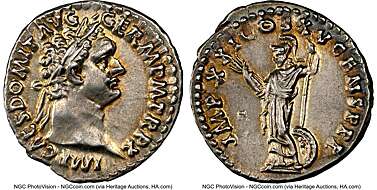
Los 23039. Domitian, as Augustus (AD 81-96). AR denarius (18mm, 3.59 gm, 7h). NGC AU 5/5 - 3/5, brushed. Rome, 14 September AD 90-13 September AD 91. IMP CAES DOMIT AVG-GERM P M TR P X, laureate head of Domitian right / IMP XXI COS XV CENS P P P, Minerva standing facing, head left, thunderbolt in right hand, grounded spear in left, shield behind, against legs. RIC II.I 721. Domitian, often remembered as a controversial figure in Roman history, lived a complex life marked by both admirable achievements and a dark reputation. Born in AD 51 into the esteemed Flavian family, his father Vespasian's rise to power marked the conclusion of the tumultuous Year of the Four Emperors in AD 69. Despite his auspicious lineage, Domitian spent much of his early life in the shadow of his elder brother Titus. This overshadowing may have contributed to the development of his reserved and resentful personality. However, when Titus passed away in AD 81 after a brief two-year rule, Domitian swiftly stepped into the role of emperor, marking the beginning of his own rule within the Flavian dynasty. HID05401242017 © 2026 Heritage Auctions | All Rights Reserved www.HA.com/TexasAuctioneerLicenseNotice
  • Startpreis:
    1 USD
    0 EUR
    0 GBP
    0 CHF

    Nur ungefähre, gerundete WerteDatum: 05.11.2026
Los
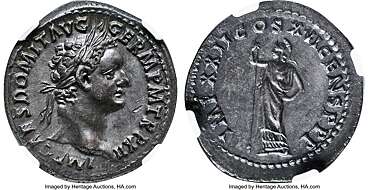
Los 23040. Domitian, as Augustus (AD 81-96). AR denarius (20mm, 3.27 gm, 5h). NGC AU 5/5 - 3/5, marks. AD 92-93. IMP CAES DOMIT AVG-GERM P M TR P XII, laureate head of Domitian right / IMP XXII COS XVI CENS P P P, Minerva standing facing, head left, grounded spear in right hand, placing left hand on hip. RIC II.1, 742. Domitian, often remembered as a controversial figure in Roman history, lived a complex life marked by both admirable achievements and a dark reputation. Born in AD 51 into the esteemed Flavian family, his father Vespasian's rise to power marked the conclusion of the tumultuous Year of the Four Emperors in AD 69. Despite his auspicious lineage, Domitian spent much of his early life in the shadow of his elder brother Titus. This overshadowing may have contributed to the development of his reserved and resentful personality. However, when Titus passed away in AD 81 after a brief two-year rule, Domitian swiftly stepped into the role of emperor, marking the beginning of his own rule within the Flavian dynasty. HID05401242017 © 2026 Heritage Auctions | All Rights Reserved www.HA.com/TexasAuctioneerLicenseNotice
  • Startpreis:
    1 USD
    0 EUR
    0 GBP
    0 CHF

    Nur ungefähre, gerundete WerteDatum: 05.11.2026
Los
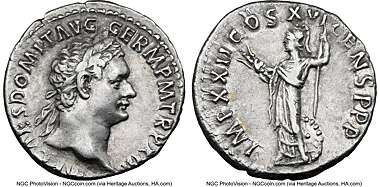
Los 23041. Domitian, as Augustus (AD 81-96). AR denarius (18mm, 3.59 gm, 7h). NGC XF 5/5 - 4/5. Rome, 14 September AD 93-13 September AD 94. IMP CAES DOMIT AVG-GERM P M TR P XIII, laureate head of Domitian right / IMP XXII COS XVI-CENS P P P, Minerva standing facing, head left, thunderbolt in outstretched right hand, grounded spear in left, shield on the ground. RIC II.1, 763. Domitian, often remembered as a controversial figure in Roman history, lived a complex life marked by both admirable achievements and a dark reputation. Born in AD 51 into the esteemed Flavian family, his father Vespasian's rise to power marked the conclusion of the tumultuous Year of the Four Emperors in AD 69. Despite his auspicious lineage, Domitian spent much of his early life in the shadow of his elder brother Titus. This overshadowing may have contributed to the development of his reserved and resentful personality. However, when Titus passed away in AD 81 after a brief two-year rule, Domitian swiftly stepped into the role of emperor, marking the beginning of his own rule within the Flavian dynasty. HID05401242017 © 2026 Heritage Auctions | All Rights Reserved www.HA.com/TexasAuctioneerLicenseNotice
  • Startpreis:
    1 USD
    0 EUR
    0 GBP
    0 CHF

    Nur ungefähre, gerundete WerteDatum: 05.11.2026
Los
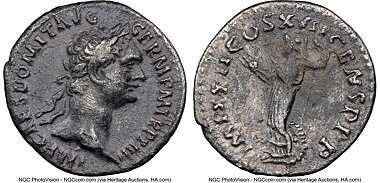
Los 23042. Domitian, as Augustus (AD 81-96). AR denarius (18mm, 2.93 gm, 8h). NGC Choice VF 5/5 - 2/5. Rome, 1 January-13 September AD 95. IMP CAES DOMIT AVG-GERM P M TR P XIIII, laureate head of Domitian right / IMP XXII COS XVII CENS P P P, Minerva standing left, thunderbolt in raised right hand, grounded spear in left; shield behind, against legs. RIC II.1, 772. Domitian, often remembered as a controversial figure in Roman history, lived a complex life marked by both admirable achievements and a dark reputation. Born in AD 51 into the esteemed Flavian family, his father Vespasian's rise to power marked the conclusion of the tumultuous Year of the Four Emperors in AD 69. Despite his auspicious lineage, Domitian spent much of his early life in the shadow of his elder brother Titus. This overshadowing may have contributed to the development of his reserved and resentful personality. However, when Titus passed away in AD 81 after a brief two-year rule, Domitian swiftly stepped into the role of emperor, marking the beginning of his own rule within the Flavian dynasty. HID05401242017 © 2026 Heritage Auctions | All Rights Reserved www.HA.com/TexasAuctioneerLicenseNotice
  • Startpreis:
    1 USD
    0 EUR
    0 GBP
    0 CHF

    Nur ungefähre, gerundete WerteDatum: 05.11.2026
Los
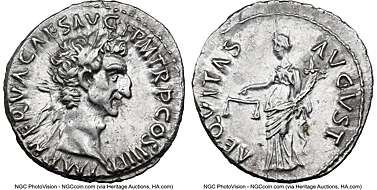
Los 23043. Nerva (AD 96-98). AR denarius (18mm, 3.26 gm, 5h). NGC AU 5/5 - 3/5, brushed. Rome, AD 97. IMP NERVA CAES AVG-P M TR P COS III P P, laureate head of Nerva right / AEQVITAS-AVGVST, Aequitas standing facing, head left, scales in outstretched right hand, cornucopia cradled in left arm. RIC II 13. An elderly senator from a venerable family, Marcus Cocceius Nerva was elected as emperor by the Senate in the immediate aftermath of Domitian's assassination. Known for his adaptability, Nerva had served various regimes with equal fervor and competence. Upon ascending to the throne, he pledged to end Domitian's treason trials and restore constitutional government, yet his easygoing rule and lack of military ties led to tension with the Roman army. Throughout his brief reign, Nerva was forced to make gestures indicating his support for his soldiers and generals. Ultimately, in October AD 97, the Praetorians stormed the palace and forced him to hand over Domitian's killers. This humiliation led Nerva to make his most significant decision: he adopted the popular general M. Ulpius Trajanus as his son and successor. This move, along with the adoption, instantly quelled military unrest and ensured a smooth transition of power upon Nerva's death four months later. HID05401242017 © 2026 Heritage Auctions | All Rights Reserved www.HA.com/TexasAuctioneerLicenseNotice
  • Startpreis:
    1 USD
    0 EUR
    0 GBP
    0 CHF

    Nur ungefähre, gerundete WerteDatum: 05.11.2026
Los
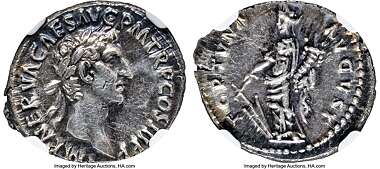
Los 23044. Nerva (AD 96-98). AR denarius (19mm, 3.20 gm, 6h). NGC AU 5/5 - 2/5, brushed. Rome, AD 97. IMP NERVA CAES AVG-P M TR P COS III P P, laureate head of Nerva right / FORTVNA-AVGVST, Fortuna standing facing, head left, grounded rudder in right hand, cornucopia cradled in left arm. RIC II 16. An elderly senator from a venerable family, Marcus Cocceius Nerva was elected as emperor by the Senate in the immediate aftermath of Domitian's assassination. Known for his adaptability, Nerva had served various regimes with equal fervor and competence. Upon ascending to the throne, he pledged to end Domitian's treason trials and restore constitutional government, yet his easygoing rule and lack of military ties led to tension with the Roman army. Throughout his brief reign, Nerva was forced to make gestures indicating his support for his soldiers and generals. Ultimately, in October AD 97, the Praetorians stormed the palace and forced him to hand over Domitian's killers. This humiliation led Nerva to make his most significant decision: he adopted the popular general M. Ulpius Trajanus as his son and successor. This move, along with the adoption, instantly quelled military unrest and ensured a smooth transition of power upon Nerva's death four months later. HID05401242017 © 2026 Heritage Auctions | All Rights Reserved www.HA.com/TexasAuctioneerLicenseNotice
  • Startpreis:
    1 USD
    0 EUR
    0 GBP
    0 CHF

    Nur ungefähre, gerundete WerteDatum: 05.11.2026
Los
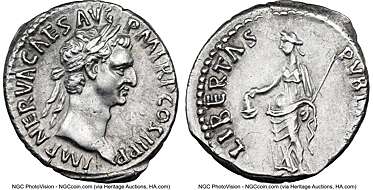
Los 23045. Nerva (AD 96-98). AR denarius (18mm, 3.52 gm, 6h). NGC Choice XF 4/5 - 4/5. Rome, AD 96. IMP NERVA CAES AVG-P M TR P COS II P P, laureate head of Nerva right / LIBERTAS-PVBLICA, Libertas standing facing, head left, pileus in outstretched right hand, transverse scepter in left. RIC II 7. An elderly senator from a venerable family, Marcus Cocceius Nerva was elected as emperor by the Senate in the immediate aftermath of Domitian's assassination. Known for his adaptability, Nerva had served various regimes with equal fervor and competence. Upon ascending to the throne, he pledged to end Domitian's treason trials and restore constitutional government, yet his easygoing rule and lack of military ties led to tension with the Roman army. Throughout his brief reign, Nerva was forced to make gestures indicating his support for his soldiers and generals. Ultimately, in October AD 97, the Praetorians stormed the palace and forced him to hand over Domitian's killers. This humiliation led Nerva to make his most significant decision: he adopted the popular general M. Ulpius Trajanus as his son and successor. This move, along with the adoption, instantly quelled military unrest and ensured a smooth transition of power upon Nerva's death four months later. HID05401242017 © 2026 Heritage Auctions | All Rights Reserved www.HA.com/TexasAuctioneerLicenseNotice
  • Startpreis:
    1 USD
    0 EUR
    0 GBP
    0 CHF

    Nur ungefähre, gerundete WerteDatum: 05.11.2026
Los
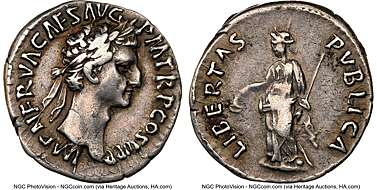
Los 23046. Nerva (AD 96-98). AR denarius (18mm, 3.19 gm, 6h). NGC VF 5/5 - 4/5. Rome, AD 97. IMP NERVA CAES AVG-P M TR P COS III P P, laureate head of Nerva right / LIBERTAS-PVBLICA, Libertas standing facing, head left, pileus in outstretched right hand, transverse scepter in left. RIC II 19. An elderly senator from a venerable family, Marcus Cocceius Nerva was elected as emperor by the Senate in the immediate aftermath of Domitian's assassination. Known for his adaptability, Nerva had served various regimes with equal fervor and competence. Upon ascending to the throne, he pledged to end Domitian's treason trials and restore constitutional government, yet his easygoing rule and lack of military ties led to tension with the Roman army. Throughout his brief reign, Nerva was forced to make gestures indicating his support for his soldiers and generals. Ultimately, in October AD 97, the Praetorians stormed the palace and forced him to hand over Domitian's killers. This humiliation led Nerva to make his most significant decision: he adopted the popular general M. Ulpius Trajanus as his son and successor. This move, along with the adoption, instantly quelled military unrest and ensured a smooth transition of power upon Nerva's death four months later. HID05401242017 © 2026 Heritage Auctions | All Rights Reserved www.HA.com/TexasAuctioneerLicenseNotice
  • Startpreis:
    1 USD
    0 EUR
    0 GBP
    0 CHF

    Nur ungefähre, gerundete WerteDatum: 05.11.2026
Los
Los 23047. Trajan (AD 98-117). AR denarius (18mm, 3.53 gm, 7h). NGC Choice AU 4/5 - 4/5. Rome, AD 114-117. IMP CAES NER TRAIAN OPTIM AVG GERM DAC, laureate bust of Trajan right, aegis on far shoulder / PARTHICO P M T-R P COS VI P P S P Q R, Fortuna seated left, rudder in outstretched right hand, cornucopia cradled in left arm; FORT RED in exergue. RIC II 316. Marcus Ulpius Trajanus, better known as Trajan, carved his name in history as one of ancient Rome's most illustrious emperors, renowned for his military prowess and strategic brilliance. Born the son of a prominent Roman senator under the reign of Vespasian, Trajan followed his father's career in provincial military administration. Having just received the title Germanicus from his exploits at the Germanic frontier, Trajan ascended to power in AD 98 with the death of the elderly Emperor Nerva. Under Trajan the Roman Empire reached its greatest territorial extent, encompassing vast swathes of land across Europe, Asia, and Africa. His military campaigns, particularly the Dacian Wars, secured valuable resources and strategic advantages for the empire. Trajan's conquests also extended into the Middle East, where he captured territories such as Armenia and Mesopotamia, further consolidating Roman influence in the region. Beyond his military achievements, Trajan was renowned for his benevolent governance and commitment to public welfare. He implemented extensive building projects, including the construction of roads, bridges, and aqueducts, which facilitated trade and communication throughout the empire, while also completing iconic landmarks such as Trajan's Column and Trajan's Forum in Rome, showcasing his enduring legacy as a patron of architecture and urban development. Trajan's reign is remembered as achieving the heights of the golden age of the Roman Empire, characterized by stability, prosperity, and imperial expansion. The Senate conferred onto him the title of "Best" (Optimus) and and future emperors would be inaugurated with the phrase that they be "luckier than Augustus, better than Trajan" (Felicior Augusto, melior Traiano). HID05401242017 © 2026 Heritage Auctions | All Rights Reserved www.HA.com/TexasAuctioneerLicenseNotice
  • Startpreis:
    1 USD
    0 EUR
    0 GBP
    0 CHF

    Nur ungefähre, gerundete WerteDatum: 05.11.2026
Los
Los 23048. Trajan (AD 98-117). AR denarius (19mm, 3.29 gm, 7h). NGC Choice AU 4/5 - 4/5. Rome, AD 103-111. IMP TRAIANO AVG GER DAC P M TR P, laureate bust right of Trajan right, slight drapery visible on far shoulder / COS V P P S P Q R OPTIMO PRINC, Felicitas standing facing, head left, caduceus in outstretched right hand, cornucopia cradled in left arm. RIC II 121. Marcus Ulpius Trajanus, better known as Trajan, carved his name in history as one of ancient Rome's most illustrious emperors, renowned for his military prowess and strategic brilliance. Born the son of a prominent Roman senator under the reign of Vespasian, Trajan followed his father's career in provincial military administration. Having just received the title Germanicus from his exploits at the Germanic frontier, Trajan ascended to power in AD 98 with the death of the elderly Emperor Nerva. Under Trajan the Roman Empire reached its greatest territorial extent, encompassing vast swathes of land across Europe, Asia, and Africa. His military campaigns, particularly the Dacian Wars, secured valuable resources and strategic advantages for the empire. Trajan's conquests also extended into the Middle East, where he captured territories such as Armenia and Mesopotamia, further consolidating Roman influence in the region. Beyond his military achievements, Trajan was renowned for his benevolent governance and commitment to public welfare. He implemented extensive building projects, including the construction of roads, bridges, and aqueducts, which facilitated trade and communication throughout the empire, while also completing iconic landmarks such as Trajan's Column and Trajan's Forum in Rome, showcasing his enduring legacy as a patron of architecture and urban development. Trajan's reign is remembered as achieving the heights of the golden age of the Roman Empire, characterized by stability, prosperity, and imperial expansion. The Senate conferred onto him the title of "Best" (Optimus) and future emperors would be inaugurated with the phrase that they be "luckier than Augustus, better than Trajan" (Felicior Augusto, melior Traiano). HID05401242017 © 2026 Heritage Auctions | All Rights Reserved www.HA.com/TexasAuctioneerLicenseNotice
  • Startpreis:
    1 USD
    0 EUR
    0 GBP
    0 CHF

    Nur ungefähre, gerundete WerteDatum: 05.11.2026
Los
Los 23049. Trajan (AD 98-117). AR denarius (18mm, 3.48 gm, 5h). NGC Choice AU 5/5 - 3/5, brushed. Rome, AD 101-102. IMP CAES NERVA TRA-IAN AVG GERM, laureate bust of Trajan right / P M TR P COS IIII P P, Victory standing right on prow terminating with serpent, wreath upward in right hand, palm over shoulder in left. RIC II 59. Marcus Ulpius Trajanus, better known as Trajan, carved his name in history as one of ancient Rome's most illustrious emperors, renowned for his military prowess and strategic brilliance. Born the son of a prominent Roman senator under the reign of Vespasian, Trajan followed his father's career in provincial military administration. Having just received the title Germanicus from his exploits at the Germanic frontier, Trajan ascended to power in AD 98 with the death of the elderly Emperor Nerva. Under Trajan the Roman Empire reached its greatest territorial extent, encompassing vast swathes of land across Europe, Asia, and Africa. His military campaigns, particularly the Dacian Wars, secured valuable resources and strategic advantages for the empire. Trajan's conquests also extended into the Middle East, where he captured territories such as Armenia and Mesopotamia, further consolidating Roman influence in the region. Beyond his military achievements, Trajan was renowned for his benevolent governance and commitment to public welfare. He implemented extensive building projects, including the construction of roads, bridges, and aqueducts, which facilitated trade and communication throughout the empire, while also completing iconic landmarks such as Trajan's Column and Trajan's Forum in Rome, showcasing his enduring legacy as a patron of architecture and urban development. Trajan's reign is remembered as achieving the heights of the golden age of the Roman Empire, characterized by stability, prosperity, and imperial expansion. The Senate conferred onto him the title of "Best" (Optimus) and future emperors would be inaugurated with the phrase that they be "luckier than Augustus, better than Trajan" (Felicior Augusto, melior Traiano). HID05401242017 © 2026 Heritage Auctions | All Rights Reserved www.HA.com/TexasAuctioneerLicenseNotice
  • Startpreis:
    1 USD
    0 EUR
    0 GBP
    0 CHF

    Nur ungefähre, gerundete WerteDatum: 05.11.2026
Los
Los 23050. Trajan (AD 98-117). AR denarius (18mm, 3.85 gm, 7h). NGC AU 5/5 - 4/5. Rome, AD 112-113. IMP TRAIANO AVG GER DAC P M TR P COS VI P P, laureate bust of Trajan right, slight drapery visible on far shoulder / SPQR OPTIMO PRINCIPI, Via Traiana reclining left on rocks, wheel in right hand on right knee, branch cradled in left arm; VIA TRAIANA in exergue. RIC III 266. Marcus Ulpius Trajanus, better known as Trajan, carved his name in history as one of ancient Rome's most illustrious emperors, renowned for his military prowess and strategic brilliance. Born the son of a prominent Roman senator under the reign of Vespasian, Trajan followed his father's career in provincial military administration. Having just received the title Germanicus from his exploits at the Germanic frontier, Trajan ascended to power in AD 98 with the death of the elderly Emperor Nerva. Under Trajan the Roman Empire reached its greatest territorial extent, encompassing vast swathes of land across Europe, Asia, and Africa. His military campaigns, particularly the Dacian Wars, secured valuable resources and strategic advantages for the empire. Trajan's conquests also extended into the Middle East, where he captured territories such as Armenia and Mesopotamia, further consolidating Roman influence in the region. Beyond his military achievements, Trajan was renowned for his benevolent governance and commitment to public welfare. He implemented extensive building projects, including the construction of roads, bridges, and aqueducts, which facilitated trade and communication throughout the empire, while also completing iconic landmarks such as Trajan's Column and Trajan's Forum in Rome, showcasing his enduring legacy as a patron of architecture and urban development. Trajan's reign is remembered as achieving the heights of the golden age of the Roman Empire, characterized by stability, prosperity, and imperial expansion. The Senate conferred onto him the title of "Best" (Optimus) and future emperors would be inaugurated with the phrase that they be "luckier than Augustus, better than Trajan" (Felicior Augusto, melior Traiano). HID05401242017 © 2026 Heritage Auctions | All Rights Reserved www.HA.com/TexasAuctioneerLicenseNotice
  • Startpreis:
    1 USD
    0 EUR
    0 GBP
    0 CHF

    Nur ungefähre, gerundete WerteDatum: 05.11.2026
Los
Los 23051. Trajan (AD 98-117). AR denarius (19mm, 3.38 gm, 7h). NGC AU 5/5 - 4/5. Rome, AD 115-116. IMP CAES NER TRAIANO OPTIMO AVG GER DAC, laureate, draped bust of Trajan right / P M TR P C-O-S VI P P S P Q R, Felicitas standing facing, head left, caduceus in outstretched right hand, cornucopia cradled in left arm. RIC II 343. Marcus Ulpius Trajanus, better known as Trajan, carved his name in history as one of ancient Rome's most illustrious emperors, renowned for his military prowess and strategic brilliance. Born the son of a prominent Roman senator under the reign of Vespasian, Trajan followed his father's career in provincial military administration. Having just received the title Germanicus from his exploits at the Germanic frontier, Trajan ascended to power in AD 98 with the death of the elderly Emperor Nerva. Under Trajan the Roman Empire reached its greatest territorial extent, encompassing vast swathes of land across Europe, Asia, and Africa. His military campaigns, particularly the Dacian Wars, secured valuable resources and strategic advantages for the empire. Trajan's conquests also extended into the Middle East, where he captured territories such as Armenia and Mesopotamia, further consolidating Roman influence in the region. Beyond his military achievements, Trajan was renowned for his benevolent governance and commitment to public welfare. He implemented extensive building projects, including the construction of roads, bridges, and aqueducts, which facilitated trade and communication throughout the empire, while also completing iconic landmarks such as Trajan's Column and Trajan's Forum in Rome, showcasing his enduring legacy as a patron of architecture and urban development. Trajan's reign is remembered as achieving the heights of the golden age of the Roman Empire, characterized by stability, prosperity, and imperial expansion. The Senate conferred onto him the title of "Best" (Optimus) and and future emperors would be inaugurated with the phrase that they be "luckier than Augustus, better than Trajan" (Felicior Augusto, melior Traiano). HID05401242017 © 2026 Heritage Auctions | All Rights Reserved www.HA.com/TexasAuctioneerLicenseNotice
  • Startpreis:
    1 USD
    0 EUR
    0 GBP
    0 CHF

    Nur ungefähre, gerundete WerteDatum: 05.11.2026
Los
Los 23052. Trajan (AD 98-117). AR denarius (18mm, 3.22 gm, 7h). NGC AU 5/5 - 3/5. Rome, AD 114-117. IMP TRAIANO OPTIMO AVG GER DAC P M TR P, laureate, draped bust of Trajan right, seen from behind / COS VI P P-S P Q R, Jupiter (on right), nude, standing facing, head left, thunderbolt in outstretched right hand, scepter cradled in left arm, Trajan (on left) standing facing, head left, below protection of thunderbolt, branch upward in right hand, parazonium in left hand. RIC II 298. During the Eastern campaign of AD 114-117, Trajan barely escaped death in Antioch when a severe earthquake collapsed the building where he was in residence, forcing him to escape through a window. According to Cassius Dio, Trajan was rescued "by some being, of greater than human stature, who came to him and led him forth, so he escaped with only a few slight injuries." The figure was later taken to be a god, perhaps Jupiter himself in quasi-mortal guise. This denarius, which shows a giant figure of Jupiter shielding the emperor, likely refers to this episode. HID05401242017 © 2026 Heritage Auctions | All Rights Reserved www.HA.com/TexasAuctioneerLicenseNotice
  • Startpreis:
    1 USD
    0 EUR
    0 GBP
    0 CHF

    Nur ungefähre, gerundete WerteDatum: 05.11.2026
Los
Los 23053. Trajan (AD 98-117). AR denarius (19mm, 3.50 gm, 7h). NGC Choice XF 5/5 - 4/5. Rome, AD 114-117. IMP CAES NER TRAIAN OPTIM AVG GER DAC PARTHICO, laureate, draped bust of Trajan right, seen from front / P M TR P CO-S-VI P P S P Q R, Providentia standing facing, head left, pointing with right hand at large globe with celestial bands at feet, grounded scepter in left, resting left elbow on column behind; PRO-VID across fields. RIC II 364. Marcus Ulpius Trajanus, better known as Trajan, carved his name in history as one of ancient Rome's most illustrious emperors, renowned for his military prowess and strategic brilliance. Born the son of a prominent Roman senator under the reign of Vespasian, Trajan followed his father's career in provincial military administration. Having just received the title Germanicus from his exploits at the Germanic frontier, Trajan ascended to power in AD 98 with the death of the elderly Emperor Nerva. Under Trajan the Roman Empire reached its greatest territorial extent, encompassing vast swathes of land across Europe, Asia, and Africa. His military campaigns, particularly the Dacian Wars, secured valuable resources and strategic advantages for the empire. Trajan's conquests also extended into the Middle East, where he captured territories such as Armenia and Mesopotamia, further consolidating Roman influence in the region. Beyond his military achievements, Trajan was renowned for his benevolent governance and commitment to public welfare. He implemented extensive building projects, including the construction of roads, bridges, and aqueducts, which facilitated trade and communication throughout the empire, while also completing iconic landmarks such as Trajan's Column and Trajan's Forum in Rome, showcasing his enduring legacy as a patron of architecture and urban development. Trajan's reign is remembered as achieving the heights of the golden age of the Roman Empire, characterized by stability, prosperity, and imperial expansion. The Senate conferred onto him the title of "Best" (Optimus) and and future emperors would be inaugurated with the phrase that they be "luckier than Augustus, better than Trajan" (Felicior Augusto, melior Traiano). HID05401242017 © 2026 Heritage Auctions | All Rights Reserved www.HA.com/TexasAuctioneerLicenseNotice
  • Startpreis:
    1 USD
    0 EUR
    0 GBP
    0 CHF

    Nur ungefähre, gerundete WerteDatum: 05.11.2026
Los
Los 23054. Trajan (AD 98-117). AR denarius (21mm, 3.34 gm, 7h). NGC Choice XF 5/5 - 4/5. Rome, AD 114-117. IMP CAES NER TRAIANO OPTIMO AVG GER DAC, laureate, draped bust of Trajan right / P M TR P C-OS VI-P P S P Q R, Mars advancing right, transverse spear in right hand, trophy in left hand over shoulder. RIC II 337. Marcus Ulpius Trajanus, better known as Trajan, carved his name in history as one of ancient Rome's most illustrious emperors, renowned for his military prowess and strategic brilliance. Born the son of a prominent Roman senator under the reign of Vespasian, Trajan followed his father's career in provincial military administration. Having just received the title Germanicus from his exploits at the Germanic frontier, Trajan ascended to power in AD 98 with the death of the elderly Emperor Nerva. Under Trajan the Roman Empire reached its greatest territorial extent, encompassing vast swathes of land across Europe, Asia, and Africa. His military campaigns, particularly the Dacian Wars, secured valuable resources and strategic advantages for the empire. Trajan's conquests also extended into the Middle East, where he captured territories such as Armenia and Mesopotamia, further consolidating Roman influence in the region. Beyond his military achievements, Trajan was renowned for his benevolent governance and commitment to public welfare. He implemented extensive building projects, including the construction of roads, bridges, and aqueducts, which facilitated trade and communication throughout the empire, while also completing iconic landmarks such as Trajan's Column and Trajan's Forum in Rome, showcasing his enduring legacy as a patron of architecture and urban development. Trajan's reign is remembered as achieving the heights of the golden age of the Roman Empire, characterized by stability, prosperity, and imperial expansion. The Senate conferred onto him the title of "Best" (Optimus) and and future emperors would be inaugurated with the phrase that they be "luckier than Augustus, better than Trajan" (Felicior Augusto, melior Traiano). HID05401242017 © 2026 Heritage Auctions | All Rights Reserved www.HA.com/TexasAuctioneerLicenseNotice
  • Startpreis:
    1 USD
    0 EUR
    0 GBP
    0 CHF

    Nur ungefähre, gerundete WerteDatum: 05.11.2026
Los
Los 23055. Trajan (AD 98-117). AR denarius (19mm, 3.16 gm, 7h). NGC Choice XF 5/5 - 4/5. Rome, ca. AD 103-111. IMP TRAIANO AVG GER DAC P M TR P, laureate bust of Trajan right, slight drapery visible on far shoulder / COS V P P S P Q R OPTIMO PRINC, Victory standing facing, head left, wreath in outstretched right hand, palm cradled in left arm. RIC II 128. Marcus Ulpius Trajanus, better known as Trajan, carved his name in history as one of ancient Rome's most illustrious emperors, renowned for his military prowess and strategic brilliance. Born the son of a prominent Roman senator under the reign of Vespasian, Trajan followed his father's career in provincial military administration. Having just received the title Germanicus from his exploits at the Germanic frontier, Trajan ascended to power in AD 98 with the death of the elderly Emperor Nerva. Under Trajan the Roman Empire reached its greatest territorial extent, encompassing vast swathes of land across Europe, Asia, and Africa. His military campaigns, particularly the Dacian Wars, secured valuable resources and strategic advantages for the empire. Trajan's conquests also extended into the Middle East, where he captured territories such as Armenia and Mesopotamia, further consolidating Roman influence in the region. Beyond his military achievements, Trajan was renowned for his benevolent governance and commitment to public welfare. He implemented extensive building projects, including the construction of roads, bridges, and aqueducts, which facilitated trade and communication throughout the empire, while also completing iconic landmarks such as Trajan's Column and Trajan's Forum in Rome, showcasing his enduring legacy as a patron of architecture and urban development. Trajan's reign is remembered as achieving the heights of the golden age of the Roman Empire, characterized by stability, prosperity, and imperial expansion. The Senate conferred onto him the title of "Best" (Optimus) and future emperors would be inaugurated with the phrase that they be "luckier than Augustus, better than Trajan" (Felicior Augusto, melior Traiano). HID05401242017 © 2026 Heritage Auctions | All Rights Reserved www.HA.com/TexasAuctioneerLicenseNotice
  • Startpreis:
    1 USD
    0 EUR
    0 GBP
    0 CHF

    Nur ungefähre, gerundete WerteDatum: 05.11.2026
Los
Los 23056. Trajan (AD 98-117). AR denarius (19mm, 3.36 gm, 7h). NGC Choice XF 5/5 - 4/5. Rome, AD 112-114. IMP TRAIANO AVG GER DAC P M TR P COS VI P P, laureate head of Trajan right, slight drapery visible on far shoulder, seen from front / S P Q R OPTIMO PRINCIPI, Trajan on horseback advancing left, spear in right hand, small Victory and reins in left. RIC II 291. Marcus Ulpius Trajanus, better known as Trajan, carved his name in history as one of ancient Rome's most illustrious emperors, renowned for his military prowess and strategic brilliance. Born the son of a prominent Roman senator under the reign of Vespasian, Trajan followed his father's career in provincial military administration. Having just received the title Germanicus from his exploits at the Germanic frontier, Trajan ascended to power in AD 98 with the death of the elderly Emperor Nerva. Under Trajan the Roman Empire reached its greatest territorial extent, encompassing vast swathes of land across Europe, Asia, and Africa. His military campaigns, particularly the Dacian Wars, secured valuable resources and strategic advantages for the empire. Trajan's conquests also extended into the Middle East, where he captured territories such as Armenia and Mesopotamia, further consolidating Roman influence in the region. Beyond his military achievements, Trajan was renowned for his benevolent governance and commitment to public welfare. He implemented extensive building projects, including the construction of roads, bridges, and aqueducts, which facilitated trade and communication throughout the empire, while also completing iconic landmarks such as Trajan's Column and Trajan's Forum in Rome, showcasing his enduring legacy as a patron of architecture and urban development. Trajan's reign is remembered as achieving the heights of the golden age of the Roman Empire, characterized by stability, prosperity, and imperial expansion. The Senate conferred onto him the title of "Best" (Optimus) and future emperors would be inaugurated with the phrase that they be "luckier than Augustus, better than Trajan" (Felicior Augusto, melior Traiano). HID05401242017 © 2026 Heritage Auctions | All Rights Reserved www.HA.com/TexasAuctioneerLicenseNotice
  • Startpreis:
    1 USD
    0 EUR
    0 GBP
    0 CHF

    Nur ungefähre, gerundete WerteDatum: 05.11.2026
Los
Los 23057. Trajan (AD 98-117). AR denarius (19mm, 3.14 gm, 7h). NGC Choice XF 5/5 - 4/5. Rome, AD 111. IMP TRAIANO AVG GER DAC P M TR P , laureate head of Trajan right, slight drapery visible on far shoulder / COS V P P S P Q R OPTIMO PRINC, Pax standing facing, head left, cornucopia cradled in left arm, lit torch lowered in right hand, setting light to pile of arms at feet before; PAX in exergue. RIC II 125. Marcus Ulpius Trajanus, better known as Trajan, carved his name in history as one of ancient Rome's most illustrious emperors, renowned for his military prowess and strategic brilliance. Born the son of a prominent Roman senator under the reign of Vespasian, Trajan followed his father's career in provincial military administration. Having just received the title Germanicus from his exploits at the Germanic frontier, Trajan ascended to power in AD 98 with the death of the elderly Emperor Nerva. Under Trajan the Roman Empire reached its greatest territorial extent, encompassing vast swathes of land across Europe, Asia, and Africa. His military campaigns, particularly the Dacian Wars, secured valuable resources and strategic advantages for the empire. Trajan's conquests also extended into the Middle East, where he captured territories such as Armenia and Mesopotamia, further consolidating Roman influence in the region. Beyond his military achievements, Trajan was renowned for his benevolent governance and commitment to public welfare. He implemented extensive building projects, including the construction of roads, bridges, and aqueducts, which facilitated trade and communication throughout the empire, while also completing iconic landmarks such as Trajan's Column and Trajan's Forum in Rome, showcasing his enduring legacy as a patron of architecture and urban development. Trajan's reign is remembered as achieving the heights of the golden age of the Roman Empire, characterized by stability, prosperity, and imperial expansion. The Senate conferred onto him the title of "Best" (Optimus) and future emperors would be inaugurated with the phrase that they be "luckier than Augustus, better than Trajan" (Felicior Augusto, melior Traiano). HID05401242017 © 2026 Heritage Auctions | All Rights Reserved www.HA.com/TexasAuctioneerLicenseNotice
  • Startpreis:
    1 USD
    0 EUR
    0 GBP
    0 CHF

    Nur ungefähre, gerundete WerteDatum: 05.11.2026
Los
Los 23058. Trajan (AD 98-117). AR denarius (20mm, 3.03 gm, 7h). NGC Choice XF 5/5 - 4/5. Rome, AD 107-108. IMP TRAIANO AVG GER DAC P M TR P, laureate head of Trajan right, slight drapery visible on far shoulder / COS V P P S P Q R OPTIMO PRINC, Fortuna standing facing, head left, rudder in right hand set on prow, cornucopia cradled in left arm. RIC II 122. Marcus Ulpius Trajanus, better known as Trajan, carved his name in history as one of ancient Rome's most illustrious emperors, renowned for his military prowess and strategic brilliance. Born the son of a prominent Roman senator under the reign of Vespasian, Trajan followed his father's career in provincial military administration. Having just received the title Germanicus from his exploits at the Germanic frontier, Trajan ascended to power in AD 98 with the death of the elderly Emperor Nerva. Under Trajan the Roman Empire reached its greatest territorial extent, encompassing vast swathes of land across Europe, Asia, and Africa. His military campaigns, particularly the Dacian Wars, secured valuable resources and strategic advantages for the empire. Trajan's conquests also extended into the Middle East, where he captured territories such as Armenia and Mesopotamia, further consolidating Roman influence in the region. Beyond his military achievements, Trajan was renowned for his benevolent governance and commitment to public welfare. He implemented extensive building projects, including the construction of roads, bridges, and aqueducts, which facilitated trade and communication throughout the empire, while also completing iconic landmarks such as Trajan's Column and Trajan's Forum in Rome, showcasing his enduring legacy as a patron of architecture and urban development. Trajan's reign is remembered as achieving the heights of the golden age of the Roman Empire, characterized by stability, prosperity, and imperial expansion. The Senate conferred onto him the title of "Best" (Optimus) and future emperors would be inaugurated with the phrase that they be "luckier than Augustus, better than Trajan" (Felicior Augusto, melior Traiano). HID05401242017 © 2026 Heritage Auctions | All Rights Reserved www.HA.com/TexasAuctioneerLicenseNotice
  • Startpreis:
    1 USD
    0 EUR
    0 GBP
    0 CHF

    Nur ungefähre, gerundete WerteDatum: 05.11.2026
Los
Los 23059. Trajan (AD 98-117). AR denarius (18mm, 3.43 gm, 7h). NGC Choice XF 5/5 - 4/5. Rome, AD 103-111. IMP TRAIANO AVG GER DAC P M TR P COS V P P, laureate head of Trajan right, slight drapery visible on far shoulder / SPQR OPTIMO PRINCIPI, Felicitas standing facing, head left, caduceus in outstretched right hand, cornucopia cradled in left; altar at feet before. RIC II 174. Marcus Ulpius Trajanus, better known as Trajan, carved his name in history as one of ancient Rome's most illustrious emperors, renowned for his military prowess and strategic brilliance. Born the son of a prominent Roman senator under the reign of Vespasian, Trajan followed his father's career in provincial military administration. Having just received the title Germanicus from his exploits at the Germanic frontier, Trajan ascended to power in AD 98 with the death of the elderly Emperor Nerva. Under Trajan the Roman Empire reached its greatest territorial extent, encompassing vast swathes of land across Europe, Asia, and Africa. His military campaigns, particularly the Dacian Wars, secured valuable resources and strategic advantages for the empire. Trajan's conquests also extended into the Middle East, where he captured territories such as Armenia and Mesopotamia, further consolidating Roman influence in the region. Beyond his military achievements, Trajan was renowned for his benevolent governance and commitment to public welfare. He implemented extensive building projects, including the construction of roads, bridges, and aqueducts, which facilitated trade and communication throughout the empire, while also completing iconic landmarks such as Trajan's Column and Trajan's Forum in Rome, showcasing his enduring legacy as a patron of architecture and urban development. Trajan's reign is remembered as achieving the heights of the golden age of the Roman Empire, characterized by stability, prosperity, and imperial expansion. The Senate conferred onto him the title of "Best" (Optimus) and future emperors would be inaugurated with the phrase that they be "luckier than Augustus, better than Trajan" (Felicior Augusto, melior Traiano). HID05401242017 © 2026 Heritage Auctions | All Rights Reserved www.HA.com/TexasAuctioneerLicenseNotice
  • Startpreis:
    1 USD
    0 EUR
    0 GBP
    0 CHF

    Nur ungefähre, gerundete WerteDatum: 05.11.2026
Los
Los 23060. Trajan (AD 98-117). AR denarius (19mm, 3.51 gm, 7h). NGC Choice XF 5/5 - 4/5. Rome, AD 115-116. IMP CAES NER TRAIANO OPTIMO AVG GER DAC, laureate, draped bust of Trajan right / P M TR P-CO-S VI P P S P Q R, Felicitas standing facing, head left, caduceus in outstretched right hand, cornucopia cradled in left arm. RIC II 343. Marcus Ulpius Trajanus, better known as Trajan, carved his name in history as one of ancient Rome's most illustrious emperors, renowned for his military prowess and strategic brilliance. Born the son of a prominent Roman senator under the reign of Vespasian, Trajan followed his father's career in provincial military administration. Having just received the title Germanicus from his exploits at the Germanic frontier, Trajan ascended to power in AD 98 with the death of the elderly Emperor Nerva. Under Trajan the Roman Empire reached its greatest territorial extent, encompassing vast swathes of land across Europe, Asia, and Africa. His military campaigns, particularly the Dacian Wars, secured valuable resources and strategic advantages for the empire. Trajan's conquests also extended into the Middle East, where he captured territories such as Armenia and Mesopotamia, further consolidating Roman influence in the region. Beyond his military achievements, Trajan was renowned for his benevolent governance and commitment to public welfare. He implemented extensive building projects, including the construction of roads, bridges, and aqueducts, which facilitated trade and communication throughout the empire, while also completing iconic landmarks such as Trajan's Column and Trajan's Forum in Rome, showcasing his enduring legacy as a patron of architecture and urban development. Trajan's reign is remembered as achieving the heights of the golden age of the Roman Empire, characterized by stability, prosperity, and imperial expansion. The Senate conferred onto him the title of "Best" (Optimus) and and future emperors would be inaugurated with the phrase that they be "luckier than Augustus, better than Trajan" (Felicior Augusto, melior Traiano). HID05401242017 © 2026 Heritage Auctions | All Rights Reserved www.HA.com/TexasAuctioneerLicenseNotice
  • Startpreis:
    1 USD
    0 EUR
    0 GBP
    0 CHF

    Nur ungefähre, gerundete WerteDatum: 05.11.2026
Los
Los 23061. Trajan (AD 98-117). AR denarius (18mm, 3.24 gm, 7h). NGC Choice XF 5/5 - 3/5. Rome, AD 103-111. IMP TRAIANO AVG GER DAC P M TR P, laureate bust of Trajan right, slight drapery visible on far shoulder / COS V P P S P Q R OPTIMO PRINC, trophy, round shield on left, two hexagonal shields on right, two swords, javelins, and shields at base. RIC II 147b. Marcus Ulpius Trajanus, better known as Trajan, carved his name in history as one of ancient Rome's most illustrious emperors, renowned for his military prowess and strategic brilliance. Born the son of a prominent Roman senator under the reign of Vespasian, Trajan followed his father's career in provincial military administration. Having just received the title Germanicus from his exploits at the Germanic frontier, Trajan ascended to power in AD 98 with the death of the elderly Emperor Nerva. Under Trajan the Roman Empire reached its greatest territorial extent, encompassing vast swathes of land across Europe, Asia, and Africa. His military campaigns, particularly the Dacian Wars, secured valuable resources and strategic advantages for the empire. Trajan's conquests also extended into the Middle East, where he captured territories such as Armenia and Mesopotamia, further consolidating Roman influence in the region. Beyond his military achievements, Trajan was renowned for his benevolent governance and commitment to public welfare. He implemented extensive building projects, including the construction of roads, bridges, and aqueducts, which facilitated trade and communication throughout the empire, while also completing iconic landmarks such as Trajan's Column and Trajan's Forum in Rome, showcasing his enduring legacy as a patron of architecture and urban development. Trajan's reign is remembered as achieving the heights of the golden age of the Roman Empire, characterized by stability, prosperity, and imperial expansion. The Senate conferred onto him the title of "Best" (Optimus) and future emperors would be inaugurated with the phrase that they be "luckier than Augustus, better than Trajan" (Felicior Augusto, melior Traiano). HID05401242017 © 2026 Heritage Auctions | All Rights Reserved www.HA.com/TexasAuctioneerLicenseNotice
  • Startpreis:
    1 USD
    0 EUR
    0 GBP
    0 CHF

    Nur ungefähre, gerundete WerteDatum: 05.11.2026
Los
Los 23062. Trajan (AD 98-117). AR denarius (19mm, 3.38 gm, 7h). NGC Choice XF 4/5 - 4/5, flan flaw. Rome, AD 114-117. IMP CAES NER TRAIAN OPTIM AVG GERM DAC, laureate, draped bust of Trajan right, seen from side / PARTHICO P M TR P COS VI P P S P Q R, radiate, draped bust of Sol right, seen from front. RIC II 329 var. (bust type). Marcus Ulpius Trajanus, better known as Trajan, carved his name in history as one of ancient Rome's most illustrious emperors, renowned for his military prowess and strategic brilliance. Born the son of a prominent Roman senator under the reign of Vespasian, Trajan followed his father's career in provincial military administration. Having just received the title Germanicus from his exploits at the Germanic frontier, Trajan ascended to power in AD 98 with the death of the elderly Emperor Nerva. Under Trajan the Roman Empire reached its greatest territorial extent, encompassing vast swathes of land across Europe, Asia, and Africa. His military campaigns, particularly the Dacian Wars, secured valuable resources and strategic advantages for the empire. Trajan's conquests also extended into the Middle East, where he captured territories such as Armenia and Mesopotamia, further consolidating Roman influence in the region. Beyond his military achievements, Trajan was renowned for his benevolent governance and commitment to public welfare. He implemented extensive building projects, including the construction of roads, bridges, and aqueducts, which facilitated trade and communication throughout the empire, while also completing iconic landmarks such as Trajan's Column and Trajan's Forum in Rome, showcasing his enduring legacy as a patron of architecture and urban development. Trajan's reign is remembered as achieving the heights of the golden age of the Roman Empire, characterized by stability, prosperity, and imperial expansion. The Senate conferred onto him the title of "Best" (Optimus) and future emperors would be inaugurated with the phrase that they be "luckier than Augustus, better than Trajan" (Felicior Augusto, melior Traiano). HID05401242017 © 2026 Heritage Auctions | All Rights Reserved www.HA.com/TexasAuctioneerLicenseNotice
  • Startpreis:
    1 USD
    0 EUR
    0 GBP
    0 CHF

    Nur ungefähre, gerundete WerteDatum: 05.11.2026
Los
Los 23063. Trajan (AD 98-117). AR denarius (19mm, 3.34 gm, 7h). NGC XF 5/5 - 4/5. Rome, AD 98-99. IMP CAES NERVA TRAIAN AVG GERM, laureate head of Trajan right / PONT MAX TR POT COS II, Vesta seated left, patera in outstretched right hand, torch cradled in left arm. RIC II 53. Marcus Ulpius Trajanus, better known as Trajan, carved his name in history as one of ancient Rome's most illustrious emperors, renowned for his military prowess and strategic brilliance. Born the son of a prominent Roman senator under the reign of Vespasian, Trajan followed his father's career in provincial military administration. Having just received the title Germanicus from his exploits at the Germanic frontier, Trajan ascended to power in AD 98 with the death of the elderly Emperor Nerva. Under Trajan the Roman Empire reached its greatest territorial extent, encompassing vast swathes of land across Europe, Asia, and Africa. His military campaigns, particularly the Dacian Wars, secured valuable resources and strategic advantages for the empire. Trajan's conquests also extended into the Middle East, where he captured territories such as Armenia and Mesopotamia, further consolidating Roman influence in the region. Beyond his military achievements, Trajan was renowned for his benevolent governance and commitment to public welfare. He implemented extensive building projects, including the construction of roads, bridges, and aqueducts, which facilitated trade and communication throughout the empire, while also completing iconic landmarks such as Trajan's Column and Trajan's Forum in Rome, showcasing his enduring legacy as a patron of architecture and urban development. Trajan's reign is remembered as achieving the heights of the golden age of the Roman Empire, characterized by stability, prosperity, and imperial expansion. The Senate conferred onto him the title of "Best" (Optimus) and and future emperors would be inaugurated with the phrase that they be "luckier than Augustus, better than Trajan" (Felicior Augusto, melior Traiano). HID05401242017 © 2026 Heritage Auctions | All Rights Reserved www.HA.com/TexasAuctioneerLicenseNotice
  • Startpreis:
    1 USD
    0 EUR
    0 GBP
    0 CHF

    Nur ungefähre, gerundete WerteDatum: 05.11.2026
Los
Los 23064. Trajan (AD 98-117). AR denarius (19mm, 3.45 gm, 7h). NGC XF 4/5 - 4/5. Rome, AD 114-117. IMP TRAIANO OPTIMO AVG GER DAC P M TR P, laureate, draped bust of Trajan right, seen from front / COS•VI•P•-P•S•P•Q•R•, Trajan's Column: column surmounted by statute of Trajan, spiral relief decorating shaft, base flanked by eagles, entrance below. RIC II 307. Marcus Ulpius Trajanus, better known as Trajan, carved his name in history as one of ancient Rome's most illustrious emperors, renowned for his military prowess and strategic brilliance. Born the son of a prominent Roman senator under the reign of Vespasian, Trajan followed his father's career in provincial military administration. Having just received the title Germanicus from his exploits at the Germanic frontier, Trajan ascended to power in AD 98 with the death of the elderly Emperor Nerva. Under Trajan the Roman Empire reached its greatest territorial extent, encompassing vast swathes of land across Europe, Asia, and Africa. His military campaigns, particularly the Dacian Wars, secured valuable resources and strategic advantages for the empire. Trajan's conquests also extended into the Middle East, where he captured territories such as Armenia and Mesopotamia, further consolidating Roman influence in the region. Beyond his military achievements, Trajan was renowned for his benevolent governance and commitment to public welfare. He implemented extensive building projects, including the construction of roads, bridges, and aqueducts, which facilitated trade and communication throughout the empire, while also completing iconic landmarks such as Trajan's Column and Trajan's Forum in Rome, showcasing his enduring legacy as a patron of architecture and urban development. Trajan's reign is remembered as achieving the heights of the golden age of the Roman Empire, characterized by stability, prosperity, and imperial expansion. The Senate conferred onto him the title of "Best" (Optimus) and future emperors would be inaugurated with the phrase that they be "luckier than Augustus, better than Trajan" (Felicior Augusto, melior Traiano). HID05401242017 © 2026 Heritage Auctions | All Rights Reserved www.HA.com/TexasAuctioneerLicenseNotice
  • Startpreis:
    1 USD
    0 EUR
    0 GBP
    0 CHF

    Nur ungefähre, gerundete WerteDatum: 05.11.2026
Los
Los 23065. Trajan (AD 98-117). AR denarius (18mm, 3.46 gm, 7h). NGC Choice VF 5/5 - 4/5. Rome, AD 103-111. IMP TRAIANO AVG GER DAC P M TR P, laureate bust of Trajan right, slight drapery on far shoulder / COS V P P S P Q R OPTIMO PRINC, Moneta-Aequitas standing facing, head left, scales in outstretched right hand, cornucopia cradled in left arm. RIC II 118. Marcus Ulpius Trajanus, better known as Trajan, carved his name in history as one of ancient Rome's most illustrious emperors, renowned for his military prowess and strategic brilliance. Born the son of a prominent Roman senator under the reign of Vespasian, Trajan followed his father's career in provincial military administration. Having just received the title Germanicus from his exploits at the Germanic frontier, Trajan ascended to power in AD 98 with the death of the elderly Emperor Nerva. Under Trajan the Roman Empire reached its greatest territorial extent, encompassing vast swathes of land across Europe, Asia, and Africa. His military campaigns, particularly the Dacian Wars, secured valuable resources and strategic advantages for the empire. Trajan's conquests also extended into the Middle East, where he captured territories such as Armenia and Mesopotamia, further consolidating Roman influence in the region. Beyond his military achievements, Trajan was renowned for his benevolent governance and commitment to public welfare. He implemented extensive building projects, including the construction of roads, bridges, and aqueducts, which facilitated trade and communication throughout the empire, while also completing iconic landmarks such as Trajan's Column and Trajan's Forum in Rome, showcasing his enduring legacy as a patron of architecture and urban development. Trajan's reign is remembered as achieving the heights of the golden age of the Roman Empire, characterized by stability, prosperity, and imperial expansion. The Senate conferred onto him the title of "Best" (Optimus) and future emperors would be inaugurated with the phrase that they be "luckier than Augustus, better than Trajan" (Felicior Augusto, melior Traiano). HID05401242017 © 2026 Heritage Auctions | All Rights Reserved www.HA.com/TexasAuctioneerLicenseNotice
  • Startpreis:
    1 USD
    0 EUR
    0 GBP
    0 CHF

    Nur ungefähre, gerundete WerteDatum: 05.11.2026
Los
Los 23066. Trajan (AD 98-117). AR denarius (19mm, 3.44 gm, 6h). NGC Choice VF 5/5 - 3/5, brushed. Rome, AD 112-117. IMP TRAIANO AVG GER DAC P M TR P COS VI P P, laureate head of Trajan right, slight drapery visible on far shoulder / S P Q R OPTIMO PRINCIPI, Arabia standing facing, head left, branch in lowered right hand above camel walking left at feet to left, bundle of cinnamon sticks cradled in left arm; ARAB ADQ in exergue. RIC II 245. From the Nancy & Randy Best Collection. This denarius was part of a series of coins and monuments that commemorated Trajan's annexation of the Nabataean Kingdom in AD 106, which was the last major permanent addition to Roman territory in the East. The new eastern border (limes), stretching from the Gulf of Aqaba in the south through Syria and Asia Minor to the Black Sea in the north, would remain essentially stable for the next five centuries despite the near-constant warfare with Persia. HID05401242017 © 2026 Heritage Auctions | All Rights Reserved www.HA.com/TexasAuctioneerLicenseNotice
  • Startpreis:
    1 USD
    0 EUR
    0 GBP
    0 CHF

    Nur ungefähre, gerundete WerteDatum: 05.11.2026
Los
Los 23067. Trajan (AD 98-117). AR denarius (19mm, 3.32 gm, 7h). NGC VF 5/5 - 3/5. Rome, AD 107-108. IMP TRAIANO AVG GER DAC P M TR P, laureate head of Trajan right, slight drapery visible on left shoulder / COS V P P S P Q R OPTIMO PRINC, Danube reclining left on rocks, right hand resting on prow of ship, left on urn, cloak billowing above; DANVVIVS in exergue. RIC II 100. Ex Edgar L. Owen, private sale with dealer's tag included. Marcus Ulpius Trajanus, better known as Trajan, carved his name in history as one of ancient Rome's most illustrious emperors, renowned for his military prowess and strategic brilliance. Born the son of a prominent Roman senator under the reign of Vespasian, Trajan followed his father's career in provincial military administration. Having just received the title Germanicus from his exploits at the Germanic frontier, Trajan ascended to power in AD 98 with the death of the elderly Emperor Nerva. Under Trajan the Roman Empire reached its greatest territorial extent, encompassing vast swathes of land across Europe, Asia, and Africa. His military campaigns, particularly the Dacian Wars, secured valuable resources and strategic advantages for the empire. Trajan's conquests also extended into the Middle East, where he captured territories such as Armenia and Mesopotamia, further consolidating Roman influence in the region. Beyond his military achievements, Trajan was renowned for his benevolent governance and commitment to public welfare. He implemented extensive building projects, including the construction of roads, bridges, and aqueducts, which facilitated trade and communication throughout the empire, while also completing iconic landmarks such as Trajan's Column and Trajan's Forum in Rome, showcasing his enduring legacy as a patron of architecture and urban development. Trajan's reign is remembered as achieving the heights of the golden age of the Roman Empire, characterized by stability, prosperity, and imperial expansion. The Senate conferred onto him the title of "Best" (Optimus) and and future emperors would be inaugurated with the phrase that they be "luckier than Augustus, better than Trajan" (Felicior Augusto, melior Traiano). HID05401242017 © 2026 Heritage Auctions | All Rights Reserved www.HA.com/TexasAuctioneerLicenseNotice
  • Startpreis:
    1 USD
    0 EUR
    0 GBP
    0 CHF

    Nur ungefähre, gerundete WerteDatum: 05.11.2026
Los
Los 23068. Hadrian (AD 117-138). AR denarius (19mm, 2.97 gm, 5h). NGC Choice AU 5/5 - 3/5. Rome, ca. AD 128-129. HADRIANVS-AVGVSTVS P P, laureate head of Hadrian right, slight drapery visible on far shoulder / COS-III, Victory seated left, wreath in outstretched right hand, palm cradled in left arm. RIC II.3, 916. Publius Aelius Hadrianus was born in AD 76, the son of a distinguished Spanish senator and related through his mother to the future Emperor Trajan, who took him into his household when Hadrian was nine years old. After Trajan's accession, Hadrian held a series of civilian posts, including a consulship in AD 108, and commanded legions during the Dacian and Parthian wars. Hadrian was not formally adopted until Trajan lay on his deathbed in August, AD 117; after succeeding to the throne, Hadrian abandoned many of Trajan's over-ambitious conquests and engaged in a policy of peace abroad and reform at home. He spent most of his 21-year reign traveling, visiting every province of the Roman Empire. Under his patronage, Roman art and sculpture reached its creative peak. Hadrian came to see himself as a "second Augustus," providing the empire with a new foundation as a vast commonwealth of nations under Rome's guiding hand. HID05401242017 © 2026 Heritage Auctions | All Rights Reserved www.HA.com/TexasAuctioneerLicenseNotice
  • Startpreis:
    1 USD
    0 EUR
    0 GBP
    0 CHF

    Nur ungefähre, gerundete WerteDatum: 05.11.2026
Los
Los 23069. Hadrian (AD 117-138). AR denarius (18mm, 3.57 gm, 8h). NGC Choice AU 4/5 - 4/5. Rome, AD 119-120. IMP CAESAR TRAIAN HA-DRIANVS AVG, laureate bust of Hadrian right, slight drapery visible on far shoulder, seen from front / PM TR P-COS III, Pietas standing facing, veiled head left, both hands raised in prayer. RIC II.3, 229. Publius Aelius Hadrianus was born in AD 76, the son of a distinguished Spanish senator and related through his mother to the future Emperor Trajan, who took him into his household when Hadrian was nine years old. After Trajan's accession, Hadrian held a series of civilian posts, including a consulship in AD 108, and commanded legions during the Dacian and Parthian wars. Hadrian was not formally adopted until Trajan lay on his deathbed in August, AD 117; after succeeding to the throne, Hadrian abandoned many of Trajan's over-ambitious conquests and engaged in a policy of peace abroad and reform at home. He spent most of his 21-year reign traveling, visiting every province of the Roman Empire. Under his patronage, Roman art and sculpture reached its creative peak. Hadrian came to see himself as a "second Augustus," providing the empire with a new foundation as a vast commonwealth of nations under Rome's guiding hand. HID05401242017 © 2026 Heritage Auctions | All Rights Reserved www.HA.com/TexasAuctioneerLicenseNotice
  • Startpreis:
    1 USD
    0 EUR
    0 GBP
    0 CHF

    Nur ungefähre, gerundete WerteDatum: 05.11.2026
Los
Los 23070. Hadrian (AD 117-138). AR denarius (18mm, 3.36 gm, 7h). NGC Choice AU 4/5 - 4/5. Rome, ca. AD 118. IMP CAESAR TRAIAN-HADRIANVS AVG, laureate, draped, bare-chested bust of Hadrian right, slight drapery visible on far shoulder, seen from front / P M T-R-P COS II, Pietas veiled, standing facing, head left, right hand raised; PIE-TAS across fields. RIC II.3 127. Publius Aelius Hadrianus was born in AD 76, the son of a distinguished Spanish senator and related through his mother to the future Emperor Trajan, who took him into his household when Hadrian was nine years old. After Trajan's accession, Hadrian held a series of civilian posts, including a consulship in AD 108, and commanded legions during the Dacian and Parthian wars. Hadrian was not formally adopted until Trajan lay on his deathbed in August, AD 117; after succeeding to the throne, Hadrian abandoned many of Trajan's over-ambitious conquests and engaged in a policy of peace abroad and reform at home. He spent most of his 21-year reign traveling, visiting every province of the Roman Empire. Under his patronage, Roman art and sculpture reached its creative peak. Hadrian came to see himself as a "second Augustus," providing the empire with a new foundation as a vast commonwealth of nations under Rome's guiding hand. HID05401242017 © 2026 Heritage Auctions | All Rights Reserved www.HA.com/TexasAuctioneerLicenseNotice
  • Startpreis:
    1 USD
    0 EUR
    0 GBP
    0 CHF

    Nur ungefähre, gerundete WerteDatum: 05.11.2026
Los
Los 23071. Hadrian (AD 117-138). AR denarius (18mm, 3.47 gm, 7h). NGC AU 5/5 - 4/5. Rome, AD 119-120. IMP CAESAR TRAIAN HADRIANVS AVG, laureate, bare-chested bust of Hadrian right, slight drapery on visible on left shoulder, seen from front / P M-TR-P-C-OS-III, Aeternitas standing facing, head left, hands extended to each side, with heads of Sol, in right hand, and Luna, in left; AET[E]R-AVG across fields. RIC II.3 202. Publius Aelius Hadrianus was born in AD 76, the son of a distinguished Spanish senator and related through his mother to the future Emperor Trajan, who took him into his household when Hadrian was nine years old. After Trajan's accession, Hadrian held a series of civilian posts, including a consulship in AD 108, and commanded legions during the Dacian and Parthian wars. Hadrian was not formally adopted until Trajan lay on his deathbed in August, AD 117; after succeeding to the throne, Hadrian abandoned many of Trajan's over-ambitious conquests and engaged in a policy of peace abroad and reform at home. He spent most of his 21-year reign traveling, visiting every province of the Roman Empire. Under his patronage, Roman art and sculpture reached its creative peak. Hadrian came to see himself as a "second Augustus," providing the empire with a new foundation as a vast commonwealth of nations under Rome's guiding hand. HID05401242017 © 2026 Heritage Auctions | All Rights Reserved www.HA.com/TexasAuctioneerLicenseNotice
  • Startpreis:
    1 USD
    0 EUR
    0 GBP
    0 CHF

    Nur ungefähre, gerundete WerteDatum: 05.11.2026
Los
Los 23072. Hadrian (AD 117-138). AR denarius (18mm, 3.36 gm, 7h). NGC AU 5/5 - 4/5. Rome, ca. AD 118. IMP CAESAR TRAIAN-HADRIANVS AVG, laureate, draped, bare-chested bust of Hadrian right, slight drapery visible on far shoulder, seen from front / P M T-R-P COS II, Pietas veiled, standing facing, head left, right hand raised; PIE-TAS across fields. RIC II.3 127. Publius Aelius Hadrianus was born in AD 76, the son of a distinguished Spanish senator and related through his mother to the future Emperor Trajan, who took him into his household when Hadrian was nine years old. After Trajan's accession, Hadrian held a series of civilian posts, including a consulship in AD 108, and commanded legions during the Dacian and Parthian wars. Hadrian was not formally adopted until Trajan lay on his deathbed in August, AD 117; after succeeding to the throne, Hadrian abandoned many of Trajan's over-ambitious conquests and engaged in a policy of peace abroad and reform at home. He spent most of his 21-year reign traveling, visiting every province of the Roman Empire. Under his patronage, Roman art and sculpture reached its creative peak. Hadrian came to see himself as a "second Augustus," providing the empire with a new foundation as a vast commonwealth of nations under Rome's guiding hand. HID05401242017 © 2026 Heritage Auctions | All Rights Reserved www.HA.com/TexasAuctioneerLicenseNotice
  • Startpreis:
    1 USD
    0 EUR
    0 GBP
    0 CHF

    Nur ungefähre, gerundete WerteDatum: 05.11.2026
Los
Los 23073. Hadrian (AD 117-138). AR denarius (18mm, 3.19 gm, 8h). NGC AU 4/5 - 4/5. Rome, ca. late AD 120-121. IMP CAESAR TRAIA-N ADRIANVS AVG, laureate, draped bust of Hadrian right, seen from front / P M TR-P C-OS III, Hadrian seated left on curule chair on platform, extending right hand towards attendant seated left before, who distributes to citizen ascending front steps of the platform, statue(?) of Liberalitas stands facing in background, coin scoop raised in right hand; LIBERAL AVG / III in exergue. RIC II.3 318. Rare type. HID05401242017 © 2026 Heritage Auctions | All Rights Reserved www.HA.com/TexasAuctioneerLicenseNotice
  • Startpreis:
    1 USD
    0 EUR
    0 GBP
    0 CHF

    Nur ungefähre, gerundete WerteDatum: 05.11.2026
Los
Los 23074. Hadrian (AD 117-138). AR denarius (19mm, 3.05 gm, 7h). NGC AU 4/5 - 4/5. Rome, AD 119-123. IMP CAESAR TRAIAN H-ADRIANVS AVG, laureate head of Hadrian right / P M TR P-COS III, Libertas seated left, branch in outstretched right hand, grounded scepter in left; LIB PVB in exergue. RIC II.3, 363. Publius Aelius Hadrianus was born in AD 76, the son of a distinguished Spanish senator and related through his mother to the future Emperor Trajan, who took him into his household when Hadrian was nine years old. After Trajan's accession, Hadrian held a series of civilian posts, including a consulship in AD 108, and commanded legions during the Dacian and Parthian wars. Hadrian was not formally adopted until Trajan lay on his deathbed in August, AD 117; after succeeding to the throne, Hadrian abandoned many of Trajan's over-ambitious conquests and engaged in a policy of peace abroad and reform at home. He spent most of his 21-year reign traveling, visiting every province of the Roman Empire. Under his patronage, Roman art and sculpture reached its creative peak. Hadrian came to see himself as a "second Augustus," providing the empire with a new foundation as a vast commonwealth of nations under Rome's guiding hand. HID05401242017 © 2026 Heritage Auctions | All Rights Reserved www.HA.com/TexasAuctioneerLicenseNotice
  • Startpreis:
    1 USD
    0 EUR
    0 GBP
    0 CHF

    Nur ungefähre, gerundete WerteDatum: 05.11.2026
Los
Los 23075. Hadrian (AD 117-138). AR denarius (19mm, 3.23 gm, 7h). NGC AU 5/5 - 3/5, brushed. Rome, AD 119-123. IMP CAESAR TRAIAN-HADRIANVS AVG, laureate head of Hadrian right / P M TR P-COS III, Libertas seated left, branch in outstretched right hand, grounded scepter in left; LIB PVB in exergue. RIC II.3, 363. Publius Aelius Hadrianus was born in AD 76, the son of a distinguished Spanish senator and related through his mother to the future Emperor Trajan, who took him into his household when Hadrian was nine years old. After Trajan's accession, Hadrian held a series of civilian posts, including a consulship in AD 108, and commanded legions during the Dacian and Parthian wars. Hadrian was not formally adopted until Trajan lay on his deathbed in August, AD 117; after succeeding to the throne, Hadrian abandoned many of Trajan's over-ambitious conquests and engaged in a policy of peace abroad and reform at home. He spent most of his 21-year reign traveling, visiting every province of the Roman Empire. Under his patronage, Roman art and sculpture reached its creative peak. Hadrian came to see himself as a "second Augustus," providing the empire with a new foundation as a vast commonwealth of nations under Rome's guiding hand. HID05401242017 © 2026 Heritage Auctions | All Rights Reserved www.HA.com/TexasAuctioneerLicenseNotice
  • Startpreis:
    1 USD
    0 EUR
    0 GBP
    0 CHF

    Nur ungefähre, gerundete WerteDatum: 05.11.2026
Los
Los 23076. Hadrian (AD 117-138). AR denarius (18mm, 3.42 gm, 7h). NGC Choice XF 5/5 - 4/5. Rome, AD 119-120. IMP CAESAR TRAIAN-HADRIANVS AVG, laureate bust of Hadrian right, slight drapery visible on far shoulder, seen from front / P M-T-R-P-CO-S III, Felicitas standing facing, head left, caduceus in outstretched right hand, cornucopia cradled in left arm. RIC II.3 221. Publius Aelius Hadrianus was born in AD 76, the son of a distinguished Spanish senator and related through his mother to the future Emperor Trajan, who took him into his household when Hadrian was nine years old. After Trajan's accession, Hadrian held a series of civilian posts, including a consulship in AD 108, and commanded legions during the Dacian and Parthian wars. Hadrian was not formally adopted until Trajan lay on his deathbed in August, AD 117; after succeeding to the throne, Hadrian abandoned many of Trajan's over-ambitious conquests and engaged in a policy of peace abroad and reform at home. He spent most of his 21-year reign traveling, visiting every province of the Roman Empire. Under his patronage, Roman art and sculpture reached its creative peak. Hadrian came to see himself as a "second Augustus," providing the empire with a new foundation as a vast commonwealth of nations under Rome's guiding hand. HID05401242017 © 2026 Heritage Auctions | All Rights Reserved www.HA.com/TexasAuctioneerLicenseNotice
  • Startpreis:
    1 USD
    0 EUR
    0 GBP
    0 CHF

    Nur ungefähre, gerundete WerteDatum: 05.11.2026
Los
Los 23077. Hadrian (AD 117-138). AR denarius (18mm, 3.63 gm, 7h). NGC Choice XF 5/5 - 4/5. Rome, ca. AD 117. IMP CAES TRAIAN HADRIAN OPT AVG GER DAC, laureate, cuirassed bust of Hadrian right, with balteus strap, seen from front / PARTHIC DIVI TRAIAN AVG F P M TR P COS P P, Trajan and Hadrian standing inwards, clasping right hands; ADOPTIO in exergue. RIC II.3, 11. On August 9 of AD 177, while serving as governor in Antioch, Hadrian received a letter of his adoption by emperor Trajan. Two days later, Trajan would die and an army was sent out to crown Hadrian as emperor. Although, some ancient historians, like Cassius Dio, claim Trajan had died before the letter was written and that the adoption was orchestrated by Pompeia Plotina (Trajan's wife). Regardless, Hadrian's succession was considered legitimate. HID05401242017 © 2026 Heritage Auctions | All Rights Reserved www.HA.com/TexasAuctioneerLicenseNotice
  • Startpreis:
    1 USD
    0 EUR
    0 GBP
    0 CHF

    Nur ungefähre, gerundete WerteDatum: 05.11.2026
Los
Los 23078. Hadrian (AD 117-138). AR denarius (20mm, 3.40 gm, 6h). NGC Choice XF 5/5 - 3/5, scuff. Rome, AD 125-128. HADRIANVS-AVGVSTVS, laureate head of Hadrian right, slight drapery visible on far shoulder / COS-III, cluster of seven stars over crescent moon. RIC 202. RSC 466. BMCRE 463. Publius Aelius Hadrianus was born in AD 76, the son of a distinguished Spanish senator and related through his mother to the future Emperor Trajan, who took him into his household when Hadrian was nine years old. After Trajan's accession, Hadrian held a series of civilian posts, including a consulship in AD 108, and commanded legions during the Dacian and Parthian wars. Hadrian was not formally adopted until Trajan lay on his deathbed in August, AD 117; after succeeding to the throne, Hadrian abandoned many of Trajan's over-ambitious conquests and engaged in a policy of peace abroad and reform at home. He spent most of his 21-year reign traveling, visiting every province of the Roman Empire. Under his patronage, Roman art and sculpture reached its creative peak. Hadrian came to see himself as a "second Augustus," providing the empire with a new foundation as a vast commonwealth of nations under Rome's guiding hand. HID05401242017 © 2026 Heritage Auctions | All Rights Reserved www.HA.com/TexasAuctioneerLicenseNotice
  • Startpreis:
    1 USD
    0 EUR
    0 GBP
    0 CHF

    Nur ungefähre, gerundete WerteDatum: 05.11.2026
Los
Los 23079. Hadrian (AD 117-138). AR denarius (18mm, 3.12 gm, 7h). NGC Choice XF 4/5 - 3/5. Rome, ca. AD 120-121. IMP CAESAR TRAIAN HADRIANVS AVG, laureate bust of Hadrian right / P M TR P COS III, Hilaritas veiled, standing facing, adjusting veil with both hands; HI-LAR / P-R across field. RIC II.3, 303. HID05401242017 © 2026 Heritage Auctions | All Rights Reserved www.HA.com/TexasAuctioneerLicenseNotice
  • Startpreis:
    1 USD
    0 EUR
    0 GBP
    0 CHF

    Nur ungefähre, gerundete WerteDatum: 05.11.2026
Los
Los 23080. Hadrian (AD 117-138). AR denarius (18mm, 3.16 gm, 6h). NGC Choice XF 4/5 - 2/5, brushed. Antioch, ca. AD 119. IMP CAESAR TRAIAN HADRIANVS AVG, laureate, cuirassed bust of Hadrian right / P M TR POTE-S-COS III, Concordia seated left, patera in outstretched right hand, cornucopia cradled in left arm. RIC II.3, 2965. Extremely rare. Publius Aelius Hadrianus was born in AD 76, the son of a distinguished Spanish senator and related through his mother to the future Emperor Trajan, who took him into his household when Hadrian was nine years old. After Trajan's accession, Hadrian held a series of civilian posts, including a consulship in AD 108, and commanded legions during the Dacian and Parthian wars. Hadrian was not formally adopted until Trajan lay on his deathbed in August, AD 117; after succeeding to the throne, Hadrian abandoned many of Trajan's over-ambitious conquests and engaged in a policy of peace abroad and reform at home. He spent most of his 21-year reign traveling, visiting every province of the Roman Empire. Under his patronage, Roman art and sculpture reached its creative peak. Hadrian came to see himself as a "second Augustus," providing the empire with a new foundation as a vast commonwealth of nations under Rome's guiding hand. HID05401242017 © 2026 Heritage Auctions | All Rights Reserved www.HA.com/TexasAuctioneerLicenseNotice
  • Startpreis:
    1 USD
    0 EUR
    0 GBP
    0 CHF

    Nur ungefähre, gerundete WerteDatum: 05.11.2026
Los
Los 23081. Hadrian (AD 117-138). AR denarius (19mm, 3.63 gm, 7h). NGC XF 5/5 - 4/5. Rome, AD 117. IMP CAES TRAIAN HADR-IAN OPT AVG GER DAC, laureate, cuirassed bust of Hadrian right, exposed upper part of breastplate / PARTHIC DIVI TRAIAN AVG F P M TR P COS P P, Pax standing facing, head left, branch in outstretched right hand, cornucopia cradled in left arm; PA-X across fields. RIC II.3, 22. Publius Aelius Hadrianus was born in AD 76, the son of a distinguished Spanish senator and related through his mother to the future Emperor Trajan, who took him into his household when Hadrian was nine years old. After Trajan's accession, Hadrian held a series of civilian posts, including a consulship in AD 108, and commanded legions during the Dacian and Parthian wars. Hadrian was not formally adopted until Trajan lay on his deathbed in August, AD 117; after succeeding to the throne, Hadrian abandoned many of Trajan's over-ambitious conquests and engaged in a policy of peace abroad and reform at home. He spent most of his 21-year reign traveling, visiting every province of the Roman Empire. Under his patronage, Roman art and sculpture reached its creative peak. Hadrian came to see himself as a "second Augustus," providing the empire with a new foundation as a vast commonwealth of nations under Rome's guiding hand. HID05401242017 © 2026 Heritage Auctions | All Rights Reserved www.HA.com/TexasAuctioneerLicenseNotice
  • Startpreis:
    1 USD
    0 EUR
    0 GBP
    0 CHF

    Nur ungefähre, gerundete WerteDatum: 05.11.2026
Los
Los 23082. Hadrian (AD 117-138). AR denarius (20mm, 3.31 gm, 8h). NGC XF 5/5 - 4/5. Rome, AD 117. IMP CAES TRAIAN HADRIANO AVG DIVI TRA, laureate, bare-chested bust of Hadrian right, slight drapery visible on far shoulder, seen from front / PARTH F DIVI NER NEP P M TR P COS, Fortuna seated left, rudder in right hand, cornucopia cradled in left arm; FORT RED in exergue. RIC II.3, 57. Publius Aelius Hadrianus was born in AD 76, the son of a distinguished Spanish senator and related through his mother to the future Emperor Trajan, who took him into his household when Hadrian was nine years old. After Trajan's accession, Hadrian held a series of civilian posts, including a consulship in AD 108, and commanded legions during the Dacian and Parthian wars. Hadrian was not formally adopted until Trajan lay on his deathbed in August, AD 117; after succeeding to the throne, Hadrian abandoned many of Trajan's over-ambitious conquests and engaged in a policy of peace abroad and reform at home. He spent most of his 21-year reign traveling, visiting every province of the Roman Empire. Under his patronage, Roman art and sculpture reached its creative peak. Hadrian came to see himself as a "second Augustus," providing the empire with a new foundation as a vast commonwealth of nations under Rome's guiding hand. HID05401242017 © 2026 Heritage Auctions | All Rights Reserved www.HA.com/TexasAuctioneerLicenseNotice
  • Startpreis:
    1 USD
    0 EUR
    0 GBP
    0 CHF

    Nur ungefähre, gerundete WerteDatum: 05.11.2026
Los
Los 23083. Hadrian (AD 117-138). AR denarius (18mm, 3.39 gm, 7h). NGC XF 5/5 - 4/5. Rome, ca. AD 119-120. IMP CAESAR TRAIAN HADRIANVS AVG, laureate,bare-chested bust of Hadrian right, slight drapery visible on far shoulder / P M-TR P-COS-III, Pietas standing facing, veiled head right, with both hands raised, palms up; VOT-PVB across fields. RIC II.3 199. HID05401242017 © 2026 Heritage Auctions | All Rights Reserved www.HA.com/TexasAuctioneerLicenseNotice
  • Startpreis:
    1 USD
    0 EUR
    0 GBP
    0 CHF

    Nur ungefähre, gerundete WerteDatum: 05.11.2026
Los
Los 23084. Sabina (AD 128-136/137). AR denarius (18mm, 3.14 gm, 7h). NGC Choice Fine 5/5 - 4/5. Rome, ca. AD 133-135. SABINA-AVGVSTA, draped head of Sabina right, wearing single stephane with unbraided hair piled up / IVNO-NI-REGINAE, Juno standing facing, head left, patera in outstretched right hand, grounded scepter in left hand. RIC II.3 (Hadrian) 2551. Rare type. Ex Coins of Antiquity, private sale with dealer's tag included. Vibia Sabina, born AD 83, was the long-suffering wife of Hadrian. At one point, Hadrian felt that Suetonius, his secretary and the biographer of The Twelve Caesars, was acting in an informal manner towards her, so Hadrian dismissed him from his position. Hadrian and Sabina did not favor each other and never had children. HID05401242017 © 2026 Heritage Auctions | All Rights Reserved www.HA.com/TexasAuctioneerLicenseNotice
  • Startpreis:
    1 USD
    0 EUR
    0 GBP
    0 CHF

    Nur ungefähre, gerundete WerteDatum: 05.11.2026
Los
Los 23085. Antoninus Pius, as Augustus (AD 138-161). AR denarius (19mm, 3.49 gm, 6h). NGC Choice MS 5/5 - 5/5. Rome, AD 151-152. ANTONINVS AVG-PIVS P P TR P XV, laureate head of Antoninus Pius right / COS-IIII, Vesta standing facing, veiled head left, simpulum in outstretched right hand, palladium cradled in left arm. RIC III 203. Ex Heritage Auctions, Auction 231823 (7 June 2018), lot 61073; Classical Numismatic Group, Triton XXV (11 January 2022), lot 5387. Born in AD 86 as T. Aurelius Fulvius Boionius Antoninus to a wealthy family from Nemausus in Gaul. His grandfather and father had each risen to Consul, and like them, he entered the Senate at the appropriate age and enjoyed a distinguished career. Around AD 120, he married Annia Galeria Faustina, an aristocratic lady of Spanish descent with family ties to the emperors Trajan and Hadrian. He earned a consulship in AD 130 and served as the Proconsul of Asia. Tall, handsome, and widely admired for his sober judgment, he soon attracted the attention of Hadrian, who made him a close advisor. When Hadrian's intended successor, Aelius, died early in AD 138, the ailing emperor settled on the 52-year-old Antoninus as his replacement. Hadrian died on July 10, and Antoninus succeeded without serious opposition. Unlike the restless Hadrian, Antoninus never left Italy and was content to rule from Rome. Stability and equanimity were his watchwords, and his policies kept the Empire on an even keel for 24 years. He put no one to death, friend or foe. Only minor flare-ups in northern Britain and northern Africa disturbed the general peace. The frontiers were maintained and defended, with his decision to build a new wall in Britain 90 miles north of the Hadrian's Wall the only instance of imperial expansion. He carefully groomed Marcus Aurelius as his successor but neglected to provide him with any military training. In fact, the mild, civilian character of his reign may have unwittingly allowed storm clouds to gather and strengthen both within and beyond the frontiers. Nevertheless, later generations viewed Antoninus as the perfect emperor, and the tranquility of his reign took on the sheen of a lost golden age. HID05401242017 © 2026 Heritage Auctions | All Rights Reserved www.HA.com/TexasAuctioneerLicenseNotice
  • Startpreis:
    1 USD
    0 EUR
    0 GBP
    0 CHF

    Nur ungefähre, gerundete WerteDatum: 05.11.2026
Los
Los 23086. Antoninus Pius, as Augustus (AD 138-161). AR denarius (18mm, 2.95 gm, 5h). NGC Choice AU 4/5 - 4/5. Rome, AD 152-153. ANTONINVS AVG-PIVS P P TR P XV-I, laureate head of Antoninus Pius right / C-OS-IIII, Vesta standing facing, head left, simpulum in outstretched right hand, palladium cradled in left arm. RIC III 219. Born in AD 86 as T. Aurelius Fulvius Boionius Antoninus to a wealthy family from Nemausus in Gaul. His grandfather and father had each risen to Consul, and like them, he entered the Senate at the appropriate age and enjoyed a distinguished career. Around AD 120, he married Annia Galeria Faustina, an aristocratic lady of Spanish descent with family ties to the emperors Trajan and Hadrian. He earned a consulship in AD 130 and served as the Proconsul of Asia. Tall, handsome, and widely admired for his sober judgment, he soon attracted the attention of Hadrian, who made him a close advisor. When Hadrian's intended successor, Aelius, died early in AD 138, the ailing emperor settled on the 52-year-old Antoninus as his replacement. Hadrian died on July 10, and Antoninus succeeded without serious opposition. Unlike the restless Hadrian, Antoninus never left Italy and was content to rule from Rome. Stability and equanimity were his watchwords, and his policies kept the Empire on an even keel for 24 years. He put no one to death, friend or foe. Only minor flare-ups in northern Britain and northern Africa disturbed the general peace. The frontiers were maintained and defended, with his decision to build a new wall in Britain 90 miles north of the Hadrian's Wall the only instance of imperial expansion. He carefully groomed Marcus Aurelius as his successor but neglected to provide him with any military training. In fact, the mild, civilian character of his reign may have unwittingly allowed storm clouds to gather and strengthen both within and beyond the frontiers. Nevertheless, later generations viewed Antoninus as the perfect emperor, and the tranquility of his reign took on the sheen of a lost golden age. HID05401242017 © 2026 Heritage Auctions | All Rights Reserved www.HA.com/TexasAuctioneerLicenseNotice
  • Startpreis:
    1 USD
    0 EUR
    0 GBP
    0 CHF

    Nur ungefähre, gerundete WerteDatum: 05.11.2026
Los
Los 23087. Antoninus Pius, as Augustus (AD 138-161). AR denarius (17mm, 2.82 gm, 11h). NGC AU 4/5 - 5/5. Rome, AD 147-148. ANTONINVS AVG-PIVS P P TR P XI, laureate head of Antoninus Pius right / PRIMI / DECEN / COS IIII, legend in three lines within oak wreath. RIC III 171. Born in AD 86 as T. Aurelius Fulvius Boionius Antoninus to a wealthy family from Nemausus in Gaul. His grandfather and father had each risen to Consul, and like them, he entered the Senate at the appropriate age and enjoyed a distinguished career. Around AD 120, he married Annia Galeria Faustina, an aristocratic lady of Spanish descent with family ties to the emperors Trajan and Hadrian. He earned a consulship in AD 130 and served as the Proconsul of Asia. Tall, handsome, and widely admired for his sober judgment, he soon attracted the attention of Hadrian, who made him a close advisor. When Hadrian's intended successor, Aelius, died early in AD 138, the ailing emperor settled on the 52-year-old Antoninus as his replacement. Hadrian died on July 10, and Antoninus succeeded without serious opposition. Unlike the restless Hadrian, Antoninus never left Italy and was content to rule from Rome. Stability and equanimity were his watchwords, and his policies kept the Empire on an even keel for 24 years. He put no one to death, friend or foe. Only minor flare-ups in northern Britain and northern Africa disturbed the general peace. The frontiers were maintained and defended, with his decision to build a new wall in Britain 90 miles north of the Hadrian's Wall the only instance of imperial expansion. He carefully groomed Marcus Aurelius as his successor but neglected to provide him with any military training. In fact, the mild, civilian character of his reign may have unwittingly allowed storm clouds to gather and strengthen both within and beyond the frontiers. Nevertheless, later generations viewed Antoninus as the perfect emperor, and the tranquility of his reign took on the sheen of a lost golden age. HID05401242017 © 2026 Heritage Auctions | All Rights Reserved www.HA.com/TexasAuctioneerLicenseNotice
  • Startpreis:
    1 USD
    0 EUR
    0 GBP
    0 CHF

    Nur ungefähre, gerundete WerteDatum: 05.11.2026
Los
Los 23088. Antoninus Pius, as Augustus (AD 138-161). AR denarius (18mm, 3.01 gm, 5h). NGC Choice XF 5/5 - 4/5. Rome, AD 152-153. ANTONINVS AVG-PIVS P P TR P XVI, laureate head of Antoninus Pius right / C-OS-IIII, Vesta standing facing, head left, simpulum in outstretched right hand, palladium cradled in left arm. RIC III 219. Born in AD 86 as T. Aurelius Fulvius Boionius Antoninus to a wealthy family from Nemausus in Gaul. His grandfather and father had each risen to Consul, and like them, he entered the Senate at the appropriate age and enjoyed a distinguished career. Around AD 120, he married Annia Galeria Faustina, an aristocratic lady of Spanish descent with family ties to the emperors Trajan and Hadrian. He earned a consulship in AD 130 and served as the Proconsul of Asia. Tall, handsome, and widely admired for his sober judgment, he soon attracted the attention of Hadrian, who made him a close advisor. When Hadrian's intended successor, Aelius, died early in AD 138, the ailing emperor settled on the 52-year-old Antoninus as his replacement. Hadrian died on July 10, and Antoninus succeeded without serious opposition. Unlike the restless Hadrian, Antoninus never left Italy and was content to rule from Rome. Stability and equanimity were his watchwords, and his policies kept the Empire on an even keel for 24 years. He put no one to death, friend or foe. Only minor flare-ups in northern Britain and northern Africa disturbed the general peace. The frontiers were maintained and defended, with his decision to build a new wall in Britain 90 miles north of the Hadrian's Wall the only instance of imperial expansion. He carefully groomed Marcus Aurelius as his successor but neglected to provide him with any military training. In fact, the mild, civilian character of his reign may have unwittingly allowed storm clouds to gather and strengthen both within and beyond the frontiers. Nevertheless, later generations viewed Antoninus as the perfect emperor, and the tranquility of his reign took on the sheen of a lost golden age. HID05401242017 © 2026 Heritage Auctions | All Rights Reserved www.HA.com/TexasAuctioneerLicenseNotice
  • Startpreis:
    1 USD
    0 EUR
    0 GBP
    0 CHF

    Nur ungefähre, gerundete WerteDatum: 05.11.2026
Los
Los 23089. Antoninus Pius, as Augustus (AD 138-161). AR denarius (18mm, 3.35 gm, 6h). NGC Choice XF 5/5 - 3/5, brushed. Rome, AD 139. ANTONINVS-AVG PIVS P P, bare head of Antoninus Pius right / T-R P-COS I I, Pax standing facing, head left, branch in lowered right hand, cornucopia cradled in left arm. RIC III 51. Ex Busso Peus Nachfolger, private sale with dealer's tag included. Born in AD 86 as T. Aurelius Fulvius Boionius Antoninus to a wealthy family from Nemausus in Gaul. His grandfather and father had each risen to Consul, and like them, he entered the Senate at the appropriate age and enjoyed a distinguished career. Around AD 120, he married Annia Galeria Faustina, an aristocratic lady of Spanish descent with family ties to the emperors Trajan and Hadrian. He earned a consulship in AD 130 and served as the Proconsul of Asia. Tall, handsome, and widely admired for his sober judgment, he soon attracted the attention of Hadrian, who made him a close advisor. When Hadrian's intended successor, Aelius, died early in AD 138, the ailing emperor settled on the 52-year-old Antoninus as his replacement. Hadrian died on July 10, and Antoninus succeeded without serious opposition. Unlike the restless Hadrian, Antoninus never left Italy and was content to rule from Rome. Stability and equanimity were his watchwords, and his policies kept the Empire on an even keel for 24 years. He put no one to death, friend or foe. Only minor flare-ups in northern Britain and northern Africa disturbed the general peace. The frontiers were maintained and defended, with his decision to build a new wall in Britain 90 miles north of the Hadrian's Wall the only instance of imperial expansion. He carefully groomed Marcus Aurelius as his successor but neglected to provide him with any military training. In fact, the mild, civilian character of his reign may have unwittingly allowed storm clouds to gather and strengthen both within and beyond the frontiers. Nevertheless, later generations viewed Antoninus as the perfect emperor, and the tranquility of his reign took on the sheen of a lost golden age. HID05401242017 © 2026 Heritage Auctions | All Rights Reserved www.HA.com/TexasAuctioneerLicenseNotice
  • Startpreis:
    1 USD
    0 EUR
    0 GBP
    0 CHF

    Nur ungefähre, gerundete WerteDatum: 05.11.2026
Los
Los 23090. Antoninus Pius, as Augustus (AD 138-161). AE sestertius (33mm, 32.24 gm, 1h). NGC VF 5/5 - 3/5. Rome, AD 144. ANTONINVS AVG PI-VS P P TR P COS III, laureate head of Antoninus Pius right / ANNONA-AVG, Annona standing facing, head right, grain ears in lowered right hand, cornucopia cradled in left arm; filled modius at feet to left, prow behind, S-C across fields. RIC III 597. Born in AD 86 as T. Aurelius Fulvius Boionius Antoninus to a wealthy family from Nemausus in Gaul. His grandfather and father had each risen to Consul, and like them, he entered the Senate at the appropriate age and enjoyed a distinguished career. Around AD 120, he married Annia Galeria Faustina, an aristocratic lady of Spanish descent with family ties to the emperors Trajan and Hadrian. He earned a consulship in AD 130 and served as the Proconsul of Asia. Tall, handsome, and widely admired for his sober judgment, he soon attracted the attention of Hadrian, who made him a close advisor. When Hadrian's intended successor, Aelius, died early in AD 138, the ailing emperor settled on the 52-year-old Antoninus as his replacement. Hadrian died on July 10, and Antoninus succeeded without serious opposition. Unlike the restless Hadrian, Antoninus never left Italy and was content to rule from Rome. Stability and equanimity were his watchwords, and his policies kept the Empire on an even keel for 24 years. He put no one to death, friend or foe. Only minor flare-ups in northern Britain and northern Africa disturbed the general peace. The frontiers were maintained and defended, with his decision to build a new wall in Britain 90 miles north of the Hadrian's Wall the only instance of imperial expansion. He carefully groomed Marcus Aurelius as his successor but neglected to provide him with any military training. In fact, the mild, civilian character of his reign may have unwittingly allowed storm clouds to gather and strengthen both within and beyond the frontiers. Nevertheless, later generations viewed Antoninus as the perfect emperor, and the tranquility of his reign took on the sheen of a lost golden age. HID05401242017 © 2026 Heritage Auctions | All Rights Reserved www.HA.com/TexasAuctioneerLicenseNotice
  • Startpreis:
    1 USD
    0 EUR
    0 GBP
    0 CHF

    Nur ungefähre, gerundete WerteDatum: 05.11.2026
Los
Los 23091. Antoninus Pius, as Augustus (AD 138-161), with Marcus Aurelius, as Caesar. AE sestertius (32mm, 22.62 gm, 11h). NGC Choice Fine 5/5 - 3/5. Rome, ca. AD 140-144. ANTONINVS AVG PI-VS P P TR P COS III, laureate head of Antoninus Pius right / CON-COR-DIAE, Antoninus Pius standing right, statuette of Concordia in outstretched left hand, clasping hands with Faustina Senior standing facing, head left, scepter cradled in left arm, between them in smaller form is Marcus Aurelius standing right and Faustina Junior standing facing, head left, clasping hands over altar; S-C across fields. RIC III 601. HID05401242017 © 2026 Heritage Auctions | All Rights Reserved www.HA.com/TexasAuctioneerLicenseNotice
  • Startpreis:
    1 USD
    0 EUR
    0 GBP
    0 CHF

    Nur ungefähre, gerundete WerteDatum: 05.11.2026
Los
Los 23092. Diva Faustina Senior (AD 138-140/141). AE sestertius (33mm, 23.64 gm, 11h). NGC XF 5/5 - 4/5. Posthumous issue of Rome, after ca. AD 141. DIVA-FAVSTINA, draped bust of Diva Faustina right, seen from front, hair elaborately waved in several loops around head under thin band, braided, drawn up and coiled on top with pearls / I-V-N-O, Juno standing facing, veiled head left, patera in outstretched right hand, grounded scepter in left hand; S-C across fields. RIC III (Antoninus Pius) 1143. Annia Galeria Faustina was born into an aristocratic Roman senatorial family of Spanish descent. Her father and one brother achieved the rank of Consul; her other brother, Marcus Annius Verus, became Praetor and was father to the future Emperor Marcus Aurelius. Her maternal uncle was the Emperor Hadrian. In about AD 115, she married Titus Fulvius Antoninus, a respected Senator, and through her connections he became a close advisor to Hadrian. When Hadrian's intended successor, Aelius Caesar, died early in AD 138, the ailing emperor settled on the 52-year-old Antoninus as his replacement. Antoninus succeeded to the throne later that year and Faustina was acclaimed as Augusta, or Empress. Antoninus honored her extensively on the coinage and her vivacity, fashion sense and compassion for the poor made her very popular. Her distinctive hairstyle, with a plait wrapped in a tight coil atop her head, was copied by women throughout the Empire. While the staid Roman historians of later eras criticized her lack of "gravitas," Antoninus was devoted to her. The couple had four children, two sons and two daughters; both male children died in infancy, but the daughters lived to adulthood and one, Faustina the Younger, married Marcus Aurelius and became Augusta herself. Only two years into Antoninus' reign, Faustina died of an unknown illness. The grief-stricken Antoninus secured her deification and issued an immense coinage in her name, the largest for any Roman woman to that point. This magnificent aureus falls into the posthumous series. HID05401242017 © 2026 Heritage Auctions | All Rights Reserved www.HA.com/TexasAuctioneerLicenseNotice
  • Startpreis:
    1 USD
    0 EUR
    0 GBP
    0 CHF

    Nur ungefähre, gerundete WerteDatum: 05.11.2026
Los
Los 23093. Marcus Aurelius, as Caesar (AD 161-180). AR denarius (17mm, 3.21 gm, 7h). NGC Choice XF 5/5 - 4/5. Rome, AD 146-147. AVRELIVS CAE-SAR AVG P II F, bare head of Marcus Aurelius right / TR PO-T-COS II, Spes advancing left, flower in outstretched right hand, hitching stola with left. RIC III (Antoninus Pius) 437. Ex Dr. Busso Peus Nachfolger, private sale with dealer's tag included. Originally given the name Marcus Annius Verus, the future Marcus Aurelius was born in AD 121 into a patrician family of Spanish origin. Gaining the favor of Emperor Hadrian early on, he was educated at the Imperial court and adopted by Antoninus Pius at 17, alongside Lucius Verus, as part of Hadrian's succession plan. Upon Antoninus Pius's ascension to the throne in AD 138, Marcus was elevated to Caesar, marking the start of his prominent role in governance. As emperor, Marcus Aurelius navigated the Roman Empire through numerous military conflicts, including the Marcomannic Wars, and faced a devastating plague that significantly impacted the Roman population. His tenure is notably marked by his Stoic philosophy, as captured in his work "Meditations," which remains influential. Despite the lack of military training, his leadership during these tumultuous times reflected a deep commitment to his duties and philosophical principles. Marcus Aurelius died in AD 180, leaving a legacy as a philosopher-king, revered for his wisdom and the stoic fortitude with which he governed the Roman Empire. HID05401242017 © 2026 Heritage Auctions | All Rights Reserved www.HA.com/TexasAuctioneerLicenseNotice
  • Startpreis:
    1 USD
    0 EUR
    0 GBP
    0 CHF

    Nur ungefähre, gerundete WerteDatum: 05.11.2026
Los
Los 23094. Marcus Aurelius, as Augustus (AD 161-180). AR denarius (20mm, 3.51 gm, 12h). NGC Choice AU 5/5 - 2/5, edge filing, brushed. Rome, AD 172. M ANTONINVS-AVG TR P XXVI, laureate head of Marcus Aurelius right / IMP VI-COS III, Roma seated left on backless throne, feet on stool, Victory right in outstretched right hand, grounded spear in left; shield at right behind. RIC III 259. Originally given the name Marcus Annius Verus, the future Marcus Aurelius was born in AD 121 into a patrician family of Spanish origin. Gaining the favor of Emperor Hadrian early on, he was educated at the Imperial court and adopted by Antoninus Pius at 17, alongside Lucius Verus, as part of Hadrian's succession plan. Upon Antoninus Pius's ascension to the throne in AD 138, Marcus was elevated to Caesar, marking the start of his prominent role in governance. As emperor, Marcus Aurelius navigated the Roman Empire through numerous military conflicts, including the Marcomannic Wars, and faced a devastating plague that significantly impacted the Roman population. His tenure is notably marked by his Stoic philosophy, as captured in his work "Meditations," which remains influential. Despite the lack of military training, his leadership during these tumultuous times reflected a deep commitment to his duties and philosophical principles. Marcus Aurelius died in AD 180, leaving a legacy as a philosopher-king, revered for his wisdom and the stoic fortitude with which he governed the Roman Empire. HID05401242017 © 2026 Heritage Auctions | All Rights Reserved www.HA.com/TexasAuctioneerLicenseNotice
  • Startpreis:
    1 USD
    0 EUR
    0 GBP
    0 CHF

    Nur ungefähre, gerundete WerteDatum: 05.11.2026
Los
Los 23095. Marcus Aurelius, as Augustus (AD 161-180). AR denarius (18mm, 2.79 gm, 5h). NGC Choice AU 4/5 - 3/5, flan flaw, brushed. Rome, ca. AD December 172 - June 173. M ANTONINVS-AVG TR P XXVII, laureate head of Marcus Aurelius right / IMP VI-COS III, German captive seated right at foot of trophy, surrounded by various weapons. RIC III 278. Originally given the name Marcus Annius Verus, the future Marcus Aurelius was born in AD 121 into a patrician family of Spanish origin. Gaining the favor of Emperor Hadrian early on, he was educated at the Imperial court and adopted by Antoninus Pius at 17, alongside Lucius Verus, as part of Hadrian's succession plan. Upon Antoninus Pius's ascension to the throne in AD 138, Marcus was elevated to Caesar, marking the start of his prominent role in governance. As emperor, Marcus Aurelius navigated the Roman Empire through numerous military conflicts, including the Marcomannic Wars, and faced a devastating plague that significantly impacted the Roman population. His tenure is notably marked by his Stoic philosophy, as captured in his work "Meditations," which remains influential. Despite the lack of military training, his leadership during these tumultuous times reflected a deep commitment to his duties and philosophical principles. Marcus Aurelius died in AD 180, leaving a legacy as a philosopher-king, revered for his wisdom and the stoic fortitude with which he governed the Roman Empire. HID05401242017 © 2026 Heritage Auctions | All Rights Reserved www.HA.com/TexasAuctioneerLicenseNotice
  • Startpreis:
    1 USD
    0 EUR
    0 GBP
    0 CHF

    Nur ungefähre, gerundete WerteDatum: 05.11.2026
Los
Los 23096. Marcus Aurelius, as Augustus (AD 161-180). AR denarius (18mm, 3.51 gm, 1h). NGC AU 5/5 - 2/5, brushed. Rome, AD 173. M ANTONINVS AVG-TR P XXVI, laureate head of Marcus Aurelius right / IMP VI-COS III, Aequitas standing facing, head left, scales in outstretched right hand, cornucopia cradled in left arm. RIC III 252. Originally given the name Marcus Annius Verus, the future Marcus Aurelius was born in AD 121 into a patrician family of Spanish origin. Gaining the favor of Emperor Hadrian early on, he was educated at the Imperial court and adopted by Antoninus Pius at 17, alongside Lucius Verus, as part of Hadrian's succession plan. Upon Antoninus Pius's ascension to the throne in AD 138, Marcus was elevated to Caesar, marking the start of his prominent role in governance. As emperor, Marcus Aurelius navigated the Roman Empire through numerous military conflicts, including the Marcomannic Wars, and faced a devastating plague that significantly impacted the Roman population. His tenure is notably marked by his Stoic philosophy, as captured in his work "Meditations," which remains influential. Despite the lack of military training, his leadership during these tumultuous times reflected a deep commitment to his duties and philosophical principles. Marcus Aurelius died in AD 180, leaving a legacy as a philosopher-king, revered for his wisdom and the stoic fortitude with which he governed the Roman Empire. HID05401242017 © 2026 Heritage Auctions | All Rights Reserved www.HA.com/TexasAuctioneerLicenseNotice
  • Startpreis:
    1 USD
    0 EUR
    0 GBP
    0 CHF

    Nur ungefähre, gerundete WerteDatum: 05.11.2026
Los
Los 23097. Marcus Aurelius, as Augustus (AD 161-180). AR denarius (18mm, 3.34 gm, 11h). NGC XF 5/5 - 3/5, brushed. Rome, AD 161-163. IMP M ANTONINVS AVG, laureate head of Marcus Aurelius right, slight drapery visible on far shoulder / PROV DEOR TR P XVII COS III, Providentia standing facing, head left, globe in outstretched right hand, cornucopia cradled in left arm. RIC III 71. Originally given the name Marcus Annius Verus, the future Marcus Aurelius was born in AD 121 into a patrician family of Spanish origin. Gaining the favor of Emperor Hadrian early on, he was educated at the Imperial court and adopted by Antoninus Pius at 17, alongside Lucius Verus, as part of Hadrian's succession plan. Upon Antoninus Pius's ascension to the throne in AD 138, Marcus was elevated to Caesar, marking the start of his prominent role in governance. As emperor, Marcus Aurelius navigated the Roman Empire through numerous military conflicts, including the Marcomannic Wars, and faced a devastating plague that significantly impacted the Roman population. His tenure is notably marked by his Stoic philosophy, as captured in his work "Meditations," which remains influential. Despite the lack of military training, his leadership during these tumultuous times reflected a deep commitment to his duties and philosophical principles. Marcus Aurelius died in AD 180, leaving a legacy as a philosopher-king, revered for his wisdom and the stoic fortitude with which he governed the Roman Empire. HID05401242017 © 2026 Heritage Auctions | All Rights Reserved www.HA.com/TexasAuctioneerLicenseNotice
  • Startpreis:
    1 USD
    0 EUR
    0 GBP
    0 CHF

    Nur ungefähre, gerundete WerteDatum: 05.11.2026
Los
Los 23098. Faustina Junior (AD 147-175/176). AR denarius (19mm, 3.26 gm, 11h). NGC Choice MS 5/5 - 5/5. Rome, AD 161-175/176. FAVSTINA-AVGVSTA, draped bust of Faustina Junior right, seen from front, hair waved and coiled at lower back of head in chignon, wearing pearl headband / IV-NO, Juno seated left, with patera in outstretched right hand and grounded scepter in left; peacock left before. RIC III (Marcus Aurelius) 689. Annia Galeria Faustina the Younger was born in about AD 129 to Antoninus Pius and his wife, Faustina the Elder. When Antoninus was adopted by Hadrian as his successor in AD 138, the emperor arranged for her betrothal to Lucius Verus, also about eight, the son of the "heir consumptive" Aelius Caesar, who had died the same year. When Antoninus inherited the throne, he broke the engagement and instead betrothed her to his nephew (and adoptive son) Marcus Aurelius. They were wed in AD 145 to great rejoicing and went on to produce at least 13 children, of which only three or four survived to adulthood, among them the future emperor Commodus. Faustina seems to have been a free, fun-loving spirit in the mold of her mother, which earned the disapproval of staid Roman historians. Marcus Aurelius, after he became emperor in AD 161, spent long years on campaign, which must have strained the relationship. Faustina accompanied him on some of these and was given the honorific title "Mater Castrorum," or "Mother of the Camp." Nevertheless, there were rumors of adulteries with soldiers, sailors and gladiators, which do not seem to have altered her husband's devotion to her. More serious are allegations that she had some part in the abortive rebellion of the eastern general Avidius Cassius in AD 175. Whatever the truth, she died soon thereafter, either of illness or as the result of an accident. Reputation or no, Marcus grieved greatly and ordered her deification. The lifetime coinage of Faustina started at the time of her marriage and continued over 30 years, showing her from a fresh-faced princess to a mature matron, and providing a pageant of Roman feminine hairstyles over that span. HID05401242017 © 2026 Heritage Auctions | All Rights Reserved www.HA.com/TexasAuctioneerLicenseNotice
  • Startpreis:
    1 USD
    0 EUR
    0 GBP
    0 CHF

    Nur ungefähre, gerundete WerteDatum: 05.11.2026
Los
Los 23099. Faustina Junior (AD 147-175/176). AR denarius (18mm, 3.45 gm, 5h). NGC Choice MS 5/5 - 5/5. Rome, AD 161-175/176. FAVSTINA AVGVSTA, draped bust of Faustina Junior right, seen from front, wearing diadem, hair brushed in waves and gathered into small jeweled chignon at base of head / FECVND AVGVSTAE, Fecunditas standing facing, head left, between two children, an infant in each arm. RIC III (Marcus Aurelius) 676. Ex Ira & Larry Goldberg, Auction 59 (30 May 2010), lot 2464. Annia Galeria Faustina the Younger was born in about AD 129 to Antoninus Pius and his wife, Faustina the Elder. When Antoninus was adopted by Hadrian as his successor in AD 138, the emperor arranged for her betrothal to Lucius Verus, also about eight, the son of the "heir consumptive" Aelius Caesar, who had died the same year. When Antoninus inherited the throne, he broke the engagement and instead betrothed her to his nephew (and adoptive son) Marcus Aurelius. They were wed in AD 145 to great rejoicing and went on to produce at least 13 children, of which only three or four survived to adulthood, among them the future emperor Commodus. Faustina seems to have been a free, fun-loving spirit in the mold of her mother, which earned the disapproval of staid Roman historians. Marcus Aurelius, after he became emperor in AD 161, spent long years on campaign, which must have strained the relationship. Faustina accompanied him on some of these and was given the honorific title "Mater Castrorum," or "Mother of the Camp." Nevertheless, there were rumors of adulteries with soldiers, sailors and gladiators, which do not seem to have altered her husband's devotion to her. More serious are allegations that she had some part in the abortive rebellion of the eastern general Avidius Cassius in AD 175. Whatever the truth, she died soon thereafter, either of illness or as the result of an accident. Reputation or no, Marcus grieved greatly and ordered her deification. The lifetime coinage of Faustina started at the time of her marriage and continued over 30 years, showing her from a fresh-faced princess to a mature matron, and providing a pageant of Roman feminine hairstyles over that span. HID05401242017 © 2026 Heritage Auctions | All Rights Reserved www.HA.com/TexasAuctioneerLicenseNotice
  • Startpreis:
    1 USD
    0 EUR
    0 GBP
    0 CHF

    Nur ungefähre, gerundete WerteDatum: 05.11.2026
Los
Los 23100. Lucilla (AD 164-182). AR denarius (19mm, 2.82 gm, 8h). NGC Choice AU 5/5 - 4/5. Rome. LVCILLAE AVG ANTONINI AVG F, draped bust of Lucilla right, seen from front, hair woven and coiled at lower back of head in small chignon / CONC-ORDIA, Concordia seated left, patera in right hand, resting left arm on statue of Spes; cornucopia below seat. RIC III (Marcus Aurelius) 757. Ex Heritage Auctions, Auction 3035 (3 September 2014), lot 29224. Lucilla was a Roman noblewoman born in AD 148, the daughter of Emperor Marcus Aurelius and Empress Faustina the Younger. At a young age, she was married to Lucius Verus, her father's co-emperor, becoming Augusta and enjoying high status in the imperial court. After Verus' death in AD 169, Lucilla remained influential but reportedly grew resentful of her brother Commodus's rule. In AD 182, she was implicated in a failed plot to assassinate Commodus and replace him with her lover. As a result, Lucilla was exiled and later executed on her brother's orders. Her life reflects both the privileges and perils of imperial power. HID05401242017 © 2026 Heritage Auctions | All Rights Reserved www.HA.com/TexasAuctioneerLicenseNotice
  • Startpreis:
    1 USD
    0 EUR
    0 GBP
    0 CHF

    Nur ungefähre, gerundete WerteDatum: 05.11.2026
Datenschutz-EinstellungenDatenschutz-Einstellungen