Für Live-Bidding anmelden
Numismatica Ars Classica, Zurich Logo
Los
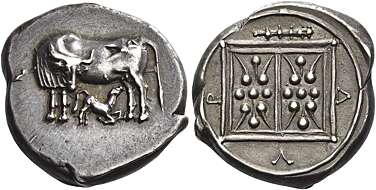
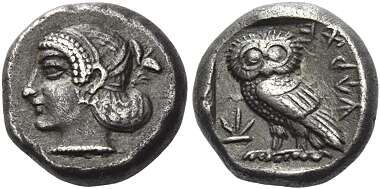
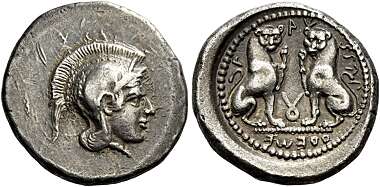
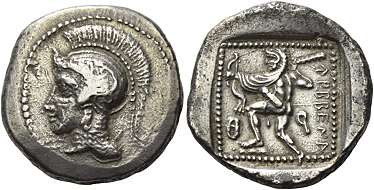
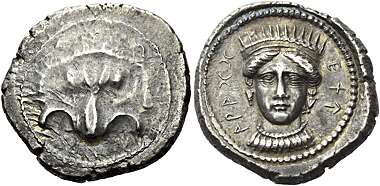
Los 101. Stater circa 340-280, AR 23 mm, 10.88 g. Cow standing l., with head turned back, suckling calf kneeling r.; on flank, Δ. Rev. Δ – Υ – Ρ around floral pattern within linear frame; in exergue, club. C.C. Vermeule, Greek Coins in the Elisabeth Washburn King Collection at Bryn Mawr College, NC 1956, 87 (this coin). A. Maier, Die Silberprägung von Apollonia und Dyrrhachion" in NZ 41, 1907, 13. HGC 3.1, 33. Rare. Perfectly struck on sound metal and with a superb old cabinet tone. Good extremely fine Ex Hess 28 April 1936, 627; Christie’s 11 December 1992, Elisabeth Washburn King collection at the Bryn Mawr college, 679; NAC 48, 2008, 75; NGSA 9, 2015, 44 and Leu Numismatik Winterthur 3, 2018, 72 sales. Privately purchased from M&M in 1946 for $46.40. From the Baron Lorne Thyssen- Borne­misza and Dr. S. Kaplan and Starr collections. Please find here the video of the coin
  • Startpreis:
    12'000 CHF
    13'110 EUR
    10'929 GBP
    14'736 USD

    Nur ungefähre, gerundete WerteDatum: 05.11.2026
Los
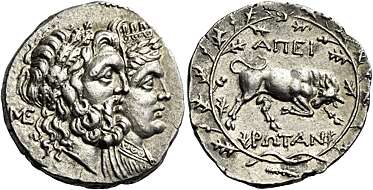
Los 102. Didrachm circa 234-168, AR 26 mm, 10.14 g. Jugate heads r. of Dodonean Zeus and veiled Dione, wearing respectively oak-wreath and diadem; in field l., monograms. Rev. AΠEI / PΩTAN Bull butting r.; all within oak-wreath. Franke 3-4. BMC 11 (these dies). HGC 3.1, 170. Extremely rare and in exceptional condition for the issue, among the finest specimens in private hands. An excellent jugate portrait of fine Hellenistic struck on excellent metal. Light tone and extremely fine Ex Gorny & Mosch 265, 2019, 282 and Roma Numismatics XX, 2020, 92 sales. Please find here the video of the coin
  • Startpreis:
    12'000 CHF
    13'110 EUR
    10'929 GBP
    14'736 USD

    Nur ungefähre, gerundete WerteDatum: 05.11.2026
Los
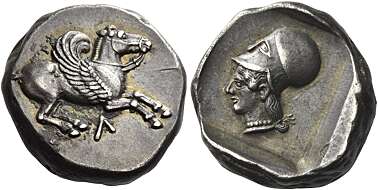
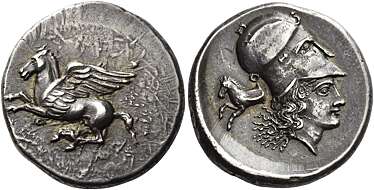
Los 103. Stater circa 465-450, AR 19 mm, 8.59 g. Pegasus flying r.; below, Λ. Rev. Head of Athena l., wearing Corinthian helmet. BMC 4. Pozzi 1726 (this coin). SNG Lockett 2274 (this coin). Calciati, Pegasi 15 (these dies). BCD Akarnania und Aetolia 177. Prospero 347 (this coin). HGC 4, 813 (this coin illustrated). Rare and in exceptional condition for the issue. A portrait of excellent style struck on fresh metal and with a delightful old cabinet tone. Extremely fine Ex Naville 1, 1921, Pozzi, 1726; Glendining 27 May 1959, Lockett, 1883; New York XXVII, 2012, Prospero (1910-2001), 347 and Nomos 16, 2018, 96 sales. Privately purchased from Spink & Son in 1985. Please find here the video of the coin
  • Startpreis:
    8'000 CHF
    8'740 EUR
    7'286 GBP
    9'824 USD

    Nur ungefähre, gerundete WerteDatum: 05.11.2026
Los
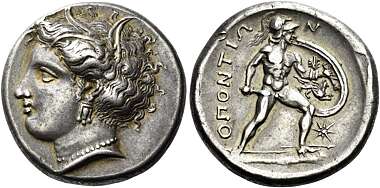
Los 104. Stater circa 360-350, AR 24 mm, 12.27 g. Head of Demeter l. Rev. Ajax advancing r., below, two short spears on the ground, one to r. and one to l., also an 8-rayed star in the lower r. field. Symbols inside the shield, palmette with griffin. OΠONTIΩ l. up, N top r. Corpus group 14, 127v. Gulbenkian 491. BCD Lokris-Phokis 68 (this coin). Humphris, D Delbridge, The Coinage of the Opountian Lokrians, Group 14, 127c (this coin). Lovely old cabinet tone and about extremely fine Ex NAC 55, 2010, BCD, 58; Roma Numismatics III, 2012, 11; Roma Numismatics XVI, 2018, 157 and Künker 333, 2020, 752 sales. From the Ambrose collection. Please find here the video of the coin
  • Startpreis:
    4'000 CHF
    4'370 EUR
    3'643 GBP
    4'912 USD

    Nur ungefähre, gerundete WerteDatum: 05.11.2026
Los
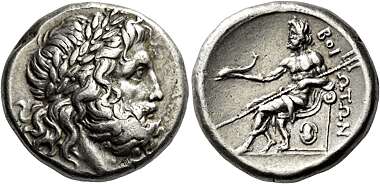
Los 105. Tetradrachm circa 287, AR 26 mm, 17.13 g. Laureate head of Poseidon r. Rev. ΒΟΙ – ΩΤΩΝ Poseidon seated l. on throne, holding dolphin and trident; below, shield. BCD Boiotia 81 (this reverse die). de Luynes 1980 (this obverse die). Gulbenkian 920 (this reverse die). Head, Boeotia, 81. HGC 4, 1177. Extremely rare and in exceptional condition for the issue, possibly the finest specimen in private hands. A portrait of fine style struck in high relief and a lovely light tone. Minor area of weakness on obverse, otherwise about extremely fine Ex Triton XI, 2008, 147; Nomos 2, 2010, 71; Nomos 5, 2011, 158; NGSA 7, 2012, 187 and Nomos 15, 2017, 106 sales. The earliest coins of Thebes (drachms produced starting c. 525 BC) paired a 'Boeotian shield' design with a utilitarian punch, which became increasingly sophisticated over the course of six or seven decades. In about 460 or 450 BC a legitimate reverse design was introduced in the form of an amphora; creating the shield-and- amphora that is so familiar to numismatists. With minor interruption it would last until the final staters were produced, not long before the Macedonian King Philip II put an end to Theban authority at the battle of Chaeronea in August, 338 B.C. Demetrios I Poliorcetes gave Thebes autonomy in 287 BC, after it had languished under Macedonian domination for many years. In celebration Demetrius chose Poseidon, his patron, on both sides of the coin because the deity was neither important in Boeotia or specially in Thebes. Please find here the video of the coin
  • Startpreis:
    12'000 CHF
    13'110 EUR
    10'929 GBP
    14'736 USD

    Nur ungefähre, gerundete WerteDatum: 05.11.2026
Los
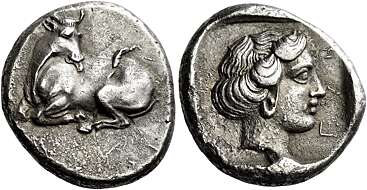
Los 106. Euboean league. Didrachm circa 411-410, AR 23 mm, 12.08 g. Recumbent cow l., head turned r. Rev. EYB Head of the nymph Euboia r. Wallace, ANSMMN 134, 3 (same dies). Kraay-Hirmer pl. 122, 370 (this coin). SNG Lockett 1777 (these dies). SNG Delepierre 1387 (this reverse die). HGC 4, 1411. BCD Euboia 1 (these dies). Rare. Struck on a very broad flan and with a pleasant old cabinet tone, minor areas of porosity, otherwise about extremely fine Ex Leu 13, 1975, 153; Triton IV, 2000, 205 and Lansky with IBelgica 1, 2019, 41 sales. From the Max Hirmer collection and from the 1951 Euboia-Boiotian hoard. The elongated island of Euboia (located off the coast of Thessaly, Boiotia, and Attica) was believed to have been cut off from mainland Greece by a major earthquake. It was known to be a good region for pasturing cattle as well as a strategic location. Movement from Thessaly to Central Greece was easier through Euboia than via the dangerous mountain passes, thanks to a bridge connecting the island to Attica. The four major cities of Euboia including Chalkis, Eretria, Histiaia, and Karystos appear to have banded together to form a federal state known as the Euboian League, perhaps influenced through their close alliance with Thebes and the creation of the respective Boiotian League. The Thebans strongly supported the creation of larger states-federal – designed after 371 BC to be a bulwark against the restoration of Spartan power, as in the case of Messenia and the Arkadian League. This first Euboian League is thought to have flourished while Theban hegemony remained strong in Greece, but came to be driven by pro-Athenian and pro-Theban factionalism as Theban power waned. By 357 BC, the league had disintegrated and individual Euboian cities became members of a new Athenian Naval League. It was subsequently restored in the 350s BC in an attempt to resist increasing Athenian influence over Euboia and its cities. This stater is a beautiful example of the federal coinage struck for the Euboian League. It features the head of the eponymous nymph Euboia. According to one mythological tradition she was rooted in the sea by Poseidon himself. The recumbent bull on the obverse is a pun on the name of the island; literally meaning "Rich in Cattle". Please find here the video of the coin
  • Startpreis:
    6'400 CHF
    6'992 EUR
    5'829 GBP
    7'859 USD

    Nur ungefähre, gerundete WerteDatum: 05.11.2026
Los
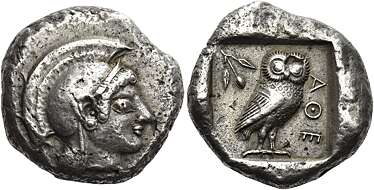
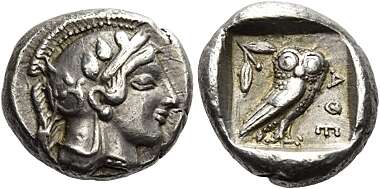
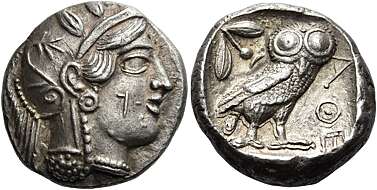
Los 107. Tetradrachm circa 510-500, AR 25 mm, 17.60 g. Helmeted head of Athena r., decorated with chevron pattern. Rev. AΘΕ Owl standing r., head facing, olive sprig l.; all within incuse square. Setman, Group L, 338. Svoronos pl. 6, 12. HGC 4, 1590. Rare. Of excellent Archaic style and struck on a very large flan with a light old cabinet tone. Minor metal flaw on reverse, otherwise good very fine / about extremely fine Ex Hess-Leu 45, 1970, 185; Leu 77, 2000, 205; NAC 29, 2005, 181; Stack's 14 January 2008, 2183; Busso-Peus 407, 2012, 378 and Heritage 3061, 2018, 32029 sales. From the de Nanteuil and Lawrence Stack collections. Graded XF* Strike 4/5 Surface 4/5, NCG certificate number 4625250-007 (previously graded and no longer in holder) Please find here the video of the coin
  • Startpreis:
    6'000 CHF
    6'555 EUR
    5'464 GBP
    7'368 USD

    Nur ungefähre, gerundete WerteDatum: 05.11.2026
Los
Los 108. Didrachm circa 475-465, AR 20 mm, 8.42 g. Head of Athena r., wearing Attic helmet with three olive leaves. Rev. AΘE Owl standing r., head facing, olive sprig l., within incuse square. All within incuse circle. K. Schefold, Meisterwerke Griechischer Kunst, 458 (this coin). Seltman Group O, 473. Svoronos pl. 9, 16 and 19 (these dies). Starr, Group IV, 143. SNG Copenhagen 30 (these dies). Boston, MFA 1602. HGC 4, 1617 corr. (Starr Group). Very rare. A portrait of excellent style struck in high relief and with a superb old cabinet tone. Good very fine / about extremely fine Ex New York IV, 2002, 157 and Triton XXI, 2018, 419 sales. From the Harald Salvesen (1928-2016) collection. Only two years after the Greeks defeated the Persians at Salamis in 480, Cimon played an instrumental role in forming the Delian League, by which Athens took the lead role in a combined Greek navy and treasury. Thucydides describes the league merely as a pretext for continuing hostilities with the Persians, and there can be no question that over time the Athenians abused their privilege as de facto leaders. Cimon led most of the league's naval operations from c.476 to 463, and if the current view of the dating for Athenian didrachms is correct, we can say they were issued when Cimon was at his peak of influence. Cimon had especially strong ties to Sparta, which did not please all Athenians, yet seems to have allowed for comparatively peaceful co-relations. When in 475 a faction at Sparta proposed going to war against Athens to challenge its supremacy in the Delian League, the majority at Sparta opposed the idea, believing they could trust Cimon to deal fairly. But it was never smooth sailing between the cities, and in 465 it seems the Spartans would have invaded Attica had an earthquake and a rebellion by the helots not prevented it. Cimon's greatest victory occurred at the end of the didrachm period, when in c.466 he defeated the Persians at sea and on land at the Eurymedon River, allowing cities as far east as Phaeselis to join the Delian League. But, the careers of politicians and generals in Athens were fickle, and in 461, not long after he forced the rebellious Thasians to surrender, Cimon was ostracised for ten years. He returned briefly to his beloved city before he died in its service, during an expedition to eject the Persians from Cyprus and recover Athenian control of the seas. Please find here the video of the coin
  • Startpreis:
    28'000 CHF
    30'592 EUR
    25'502 GBP
    34'384 USD

    Nur ungefähre, gerundete WerteDatum: 05.11.2026
Los
Los 109. Drachm circa 465-460, AR 15 mm, 4.26 g. Head of Athena r., wearing crested Athenian helmet and disc earring; bowl ornamented with spiral and three olive leaves. Rev. AΘE Owl, with closed wings, standing r. with head facing; in upper l. field, olive twig with two leaves and berry; all within partially incuse square. Seltman p-l. XX, 66. Svoronos pl. 8, 39. Starr, group IIC. HGC 4, 1627. Rare and in exceptional condition for the issue. Of fine style and with a light iridescent tone. Extremely fine Ex NAC sale 114, 2019, 187. Privately purchased from M&M in 1992 and from the Harald Salvesen (1928- 2016) collection. Please find here the video of the coin
  • Startpreis:
    6'000 CHF
    6'555 EUR
    5'464 GBP
    7'368 USD

    Nur ungefähre, gerundete WerteDatum: 05.11.2026
Los
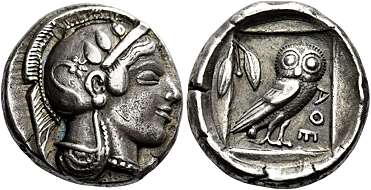
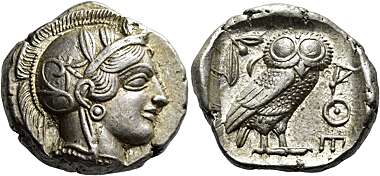
Los 110. Tetradrachm circa 454-404, AR 26 mm, 17.19 g. Head of Athena r., wearing crested Attic helmet. Rev. ΑΘΕ Owl standing r., head facing, olive sprig and crescent to upper l.; all within incuse square. Flament, Le monnayage en argent d'Athènes: de l'époque archaïque à l'époque hellénistique (c. 550-c. 40 av. J.-C.), Group II. Kroll 8. SNG Copenhagen 31. Svoronos pl. XIV. HGC 4, 1597. Light iridescent tone, virtually as struck and almost Fdc Ex Heritage sale 3073, 2019, 30101. Graded Ch AU Strike 5/5 Surface 4/5, Full Crest, NCG certificate number 4629244-057 (previously graded and no longer in holder) Please find here the video of the coin
  • Startpreis:
    1'600 CHF
    1'748 EUR
    1'457 GBP
    1'964 USD

    Nur ungefähre, gerundete WerteDatum: 05.11.2026
Los
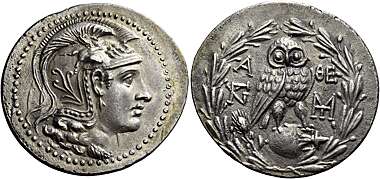
Los 111. Tetradrachm circa 165-148, AR 35 mm, 16.60 g. Head of Athena r., wearing crested Attic helmet decorated with Pegasus. Rev. Α – ΘΕ Owl standing r., head facing, on amphora; all within laurel wreath; in field, monograms and below, grain ear. Thompson 54 (this obverse die). BCM 290. McClean 5898. HGC 4, 1602. A portrait of excellent style struck on a very broad flan. Old cabinet tone and extremely fine Ex Triton sale XXIII, 2020, 263. From the Matthew Curtis collection. Please find here the video of the coin
  • Startpreis:
    2'000 CHF
    2'185 EUR
    1'821 GBP
    2'456 USD

    Nur ungefähre, gerundete WerteDatum: 05.11.2026
Los
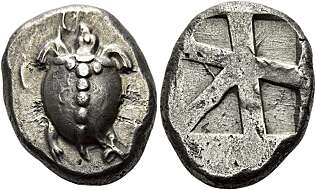
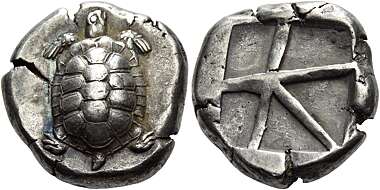
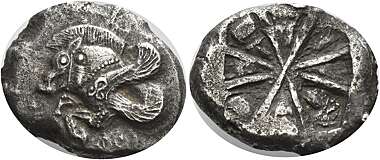
Los 112. Stater circa 470-440, AR 23 mm, 12.22 g. Sea turtle with line of five large pellets down the back of its shell, and two smaller ones at the collar. Rev. Quadripartite incuse square with one square divided. Milbank, ANSNNM 24, Period III, b and pl. I, 14. HGC 6, 435. Struck in high relief and complete. Old cabinet tone and extremely fine Ex Gorny & Mosch sale 249, 2017, 247. Please find here the video of the coin
  • Startpreis:
    3'200 CHF
    3'496 EUR
    2'914 GBP
    3'929 USD

    Nur ungefähre, gerundete WerteDatum: 05.11.2026
Los
Los 113. Stater circa 456-431, AR 20 mm, 12.39 g. Tortoise. Rev. Large incuse square with heavy skew pattern. Milbank, ANSNNM 24, pl. II, 13. SNG Copenhagen 517 var. (head not in profile). HGC 6, 437 var. (head not in profile). An very rare variety with with head in profile. Perfectly struck in very high relief and with a superb light light iridescent tone. Fan crack at ten o'clock on obverse, otherwise extremely fine Ex Sotheby 8 July 1996, 55; Manhattan IV, 2013, 46 and Triton XXII, 2019, 223 sales. Though it is technically impossible to know which city-state was the first in Greece to strike coins, it would seem that the honour belongs to Aegina, an island off the coast of Attica whose people excelled as sailors and merchants. The first type of Aeginetan stater, now attributed to c. 555-550 B.C., has on its obverse a turtle with spider-like flippers and a narrow, shield-shaped carapace decorated with a row of pellets along the central ridge; the reverse features a small, deep incuse square with raised, thin criss-crossing ridges. Such was the basic form of Aeginetan coinage for centuries to come. The initial issue was followed by a similar one (c. 550-530 B.C.) on which the turtle had a heavy collar, and the raised dividers in the incuse square assumed the familiar 'Union Jack' pattern. The collared turtle/'Union Jack' type subsequently went through at least five stages of development, covering the period c. 530 to c. 450 B.C. The shell on these later pieces is often decorated with a trefoil collar, with some taking on the form usually described as a 'T-back' – the T-form created by the decorative pellets. Curiously enough, mixed within these turtles, from the periods c. 550-530 and c. 500-490/80 B.C., are 'proto-tortoise' coins, which instead of a turtle show a tortoise with a shield-shaped, segmented shell. Aegina's next evolution was dramatic, for the familiar turtle was permanently replaced with a tortoise. The date of this exchange is not certainly known, though dates such as c. 457, c. 450, or c. 446 B.C. have been offered. In this case the tortoise had an oblong-shaped shell with raised, segmented squares that made it distinct from the earlier 'proto-tortoises', which had a shell that tapered at the end and which was of sharper relief. The 'Union Jack' incuse punch remained with the incuse areas being relatively shallow, with thick bars separating the sunken squares and triangles. The bars eventually became thinner, and various symbols and letters were placed within the sunken areas. On some of the last staters, generally dated from c. 350 into the 320s, the island's ethnic appears in the obverse field as the letters AI flanking the tortoise, or within the incuse portions of the reverse, abbreviated as AI, AIΓ or AIΓI. Though minting of the tortoises seems to have ended by the late 4th Century B.C., they continued to circulate, with some of the later drachms even being included in a hoard from Zougra in the Peloponnese (ICGH 301) that was buried in about 146 B.C. Please find here the video of the coin
  • Startpreis:
    10'000 CHF
    10'925 EUR
    9'108 GBP
    12'280 USD

    Nur ungefähre, gerundete WerteDatum: 05.11.2026
Los
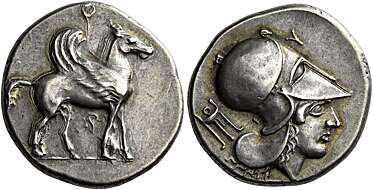
Los 114. Stater circa 410-380, AR 23 mm, 8.62 g. Pegasus flying l.; below [koppa]. Rev. Head of Athena r., wearing Corinthian helmet; behind, horse forepart l. Pozzi 1665 (this coin). Calciati 143/2. BCD Korinth 55 (this reverse die). Ravel 432a. HGC 4, 1833. Superb old cabinet tone, unobtrusive traces of overstriking, otherwise good extremely fine Ex Naville I, Pozzi (1846-1918), 1665; Tkalec-Rauch 16-17 November 1987, 94 and NAC 106, 2018, 238 sales. From the Harald Salvesen (1928-2016) collection. Graded XF* Strike 5/5 Surface 4/5, edge marks, NCG photo certificate number 8561097-008 Please find here the video of the coin
  • Startpreis:
    2'800 CHF
    3'059 EUR
    2'550 GBP
    3'438 USD

    Nur ungefähre, gerundete WerteDatum: 05.11.2026
Los
Los 115. Stater circa 380-360, AR 22 mm, 8.45 g. Pegasus advancing r.; above and between its legs, [koppa]. Rev. Head of Athena r., wearing Corinthian helmet; above, Y and behind, tripod. Calciati, Pegasi 658 (misdescribed). Ravel 658. HGC 4, 1839. Very rare. Struck on exceptionally fresh metal and with a wonderful iridescent tone. Extremely fine Ex M&M 64, 1984, 124; M&M 79, 1994, 286 and NAC 106, 2018, 240 sales. From the collection of E.B. Cahn. Please find here the video of the coin
  • Startpreis:
    2'400 CHF
    2'622 EUR
    2'185 GBP
    2'947 USD

    Nur ungefähre, gerundete WerteDatum: 05.11.2026
Los
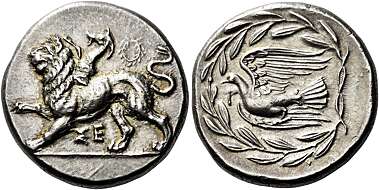
Los 116. Stater circa late 330s, AR 25 mm, 12.20 g. Chimera advancing l., with r. paw raised; above, wreath and beneath, ΣE. Rev. Dove flying l., below its neck, I. All within olive wreath. Traité 775 and pl. CCXX, 12. BMC 56. Wartenberg, NC 1997, 80. Warren, Pour Denise, 10. BCD Peloponnesos I, 219. Struck on very fresh metal and with a light iridescent tone and good extremely fine Ex Nomos sale 27, 2023, 1087. Please find here the video of the coin
  • Startpreis:
    4'000 CHF
    4'370 EUR
    3'643 GBP
    4'912 USD

    Nur ungefähre, gerundete WerteDatum: 05.11.2026
Los
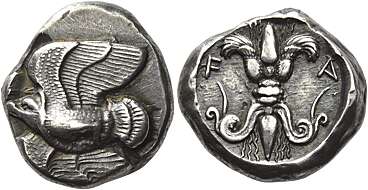
Los 117. Stater circa 468-460, AR 21 mm, 11.95 g. Eagle flying l. Rev. F – A Winged thunderbolt with volutes. Seltman, Temple, Series II, 14. BCD Olympia 5. SNG Berry –, cf. 803 (for obverse) and 808 (for reverse). HGC 5, 288. Extremely rare and in exceptional condition for the issue, undoubtedly one of the finest specimens in private hands. One of the earliest staters produced by Elis with a wonderful old cabinet tone. Obverse slightly off-centre, otherwise good extremely fine. Privately purchased from Edward J. Waddell in 2018. The sanctuary of Zeus and Hera at Olympia in the northern Peloponnese were originally controlled and administered by the city of Pisa. Great wealth accrued to the Pisatans from possession of these sacred sites thanks to the introduction of the first Olympic Games in 776 BC. This great Panhellenic festival, which involved athletic and artistic competitions in honour of Zeus, brought tourists and money to Olympia from throughout Greece. Indeed, the Olympic Games were such an important event for the Greeks, that truces were invoked in ongoing wars in order to permit safe passage to and from the festival. Around the mid-eighth century BC, the Elean neighbours of Pisa decided that despite the Panhellenic character of the Olympic Games, they would prefer to see the profits from the festival go to them. Therefore, they conquered Pisa and assumed control of the sanctuaries and the festivals at Olympia. The sanctuary inherited from Pisa consisted of a single temple shared by both Zeus and Hera and a sacred grove known as the Altis. However, between 470 and 456 BC-the period in which the present silver stater was struck-the Eleans constructed a new grand temple for Zeus Olympius alone that was famous for its colossal cult statue of the god sculpted by the artist Phidias from gold and ivory. In the Hellenistic period the statue was considered one of the Seven Wonders of the World and is thought to have provided the model for many representations of Zeus enthroned on Greek coinages. The silver stater was struck during the construction of the new temple of Zeus and before the completion of Phidias' masterwork. Zeus is not actually depicted on the coins of Olympia until the 430s BC. It therefore follows an earlier iconographic program that features an eagle-the bird of Zeus-on the obverse. As here, the eagle is often shown fighting with a coiling snake, which has sometimes suggested the influence of the contemporary silver coinage of Euboean Chalcis. The reverse features an archaic depiction of Zeus' thunderbolt with curving wings and detailed representation of its destructive fire. The abbreviated legend FA refers to the Eleans using an epichoric (local) alphabet that still included the letter digamma (F). This letter, which had died out in many other Greek alphabets by the fifth century BC, represented the w-sound, meaning that the legend should probably be more properly understood as identifying the issuing authority as the "Waleans." Please find here the video of the coin
  • Startpreis:
    20'000 CHF
    21'851 EUR
    18'216 GBP
    24'560 USD

    Nur ungefähre, gerundete WerteDatum: 05.11.2026
Los
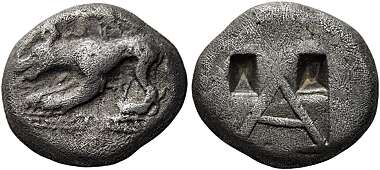
Los 118. Drachm circa 490-470, AR 14 mm, 5.80 g. Wolf at bay l., on double line. Rev. Large "A" within incuse square; above, two deep incuses. Jameson 1253 (this coin). BCD Peloponnesos I, 1003. HGC 5, 657. Of the highest rarity, six specimens known of which only 3 are in private hands. Old cabinet tone and about very fine Ex J. Hirsch XXI, 1908, Weber (1830-1907), 2004 and Busso-Peus 428, 2021, 134 sales. Privately purchased from M&M in 1960. From the Jameson (1861-1942) and Dr. H.M. collections. Around 800 BC, at the end of the Dark Age in Greece, the city of Argos began to emerge from a group of smaller towns and villages in the Argive Plain. Associated with the new city was the construction of a large temple dedicated to the goddess Hera, who was said to have been born on a mountain near Argos. The earliest Argive coinage is extremely rare. There were only three known specimens (two in London and one in Paris) when Traité was published in 1907. The next year, this specimen was sold in the Consul Weber sale, and it was purchased by Rollin et Feuardent and apparently is now only the sixth known. The fact that all the specimens are quite worn suggests that they were used for a long time. The Argives' devastating defeat at Sepeia in 494 BC to the Spartans under Kleomenes I, in which they lost six thousand hoplites, could be one explanation for this. Herodotus claims that the Spartan army deceived the Argives into thinking they were heading to their evening meal. When the Argives followed suit, the Spartans grabbed their weapons and launched an assault, winning the battle handily. The Spartan narrative surrounding the battle is contentious since, according to Herodotus, the last Argives were killed by Spartan King Kleomenes, who burned them alive in the sacred grove of Argos, where they had sought safety. One possible reason for this may be ascribed to the devastating defeat at Sepeia in 494 BC against the Spartans under Kleomenes I. After it, Argos's prosperity was greatly hampered by a serious deficit during the following generation. A century later, in 370–350 BC, Argos produced a second significant coinage; before that it appears that only smaller fractions were made. Please find here the video of the coin
  • Startpreis:
    6'000 CHF
    6'555 EUR
    5'464 GBP
    7'368 USD

    Nur ungefähre, gerundete WerteDatum: 05.11.2026
Los
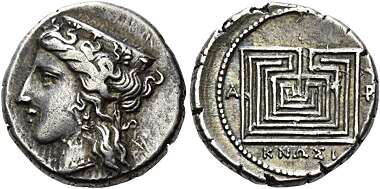
Los 119. Drachm circa 300-270, AR 19 mm, 5.42 g. Head of Hera l., wearing stephane decorated with palmettes, earring and pearl necklace. Rev. A – P Square labyrinth; in exergue, KNΩΣΙ. Traité III, 1548 and pl. CCL 14. Svoronos Crète, pl. VI, 7. SNG Copenhagen 374. Very rare. A very interesting and fascinating issue struck on very fresh metal. Light old cabinet tone and good very fine Ex Naville 5, 1923, Duplicates of British Museum, 2266; Hess-Leu 31, 1966, 366; Hirsch 229, 2003, 1806; Gorny & Mosch 129, 2004, 131; Gorny & Mosch 236, 2016, 209 and NAC 106, 2018, 244 sales. Although it had been inhabited since the Neolithic period, in the Bronze Age Knossos grew into a major city centred on a palace complex that may have been home to as many as 100,000 people. Knossos served as a political and cultural capital for Minoan civilisation – the distinctive culture of Bronze Age Crete named after the mythological King Minos of Knossos. The impressive remains of the Minoan palace complex of Knossos was excavated by Sir Arthur Evans beginning in 1901 and resulted in the discovery of two previously unknown early Greek scripts, Linear A and Linear B. The invasions and natural disasters that brought about the collapse of many Bronze Age states around 1200-1100 B.C. also ended Minoan civilisation. Nevertheless, while the age of the palace was gone, Knossos survived to become one of the most important cities of Crete in the Iron Age. In the Classical and Hellenistic periods, Knossos was frequently at war with neighbouring Cretan cities, especially Lyttos and Polyrrhenia. This coin may have been produced in the context of these intercity struggles. The glory days of Minoan civilisation were far in the past when this drachm was struck, nevertheless, the reverse type harks back to the time when King Minos ruled from Knossos and the Greeks of both the surrounding islands and even the mainland paid him tribute. Here we see an aerial view of the famous Labyrinth. Minos ordered this maze-like prison constructed to contain the monstrous Minotaur, a cannibalistic half-man, half-bull creature born from the unnatural love of Minos' queen, Pasiphae, and the Cretan Bull. Minos demanded youths and maidens to be sent to Knossos as tribute by subject cities. These were sent into the Labyrinth and soon became hopelessly lost in its winding passages before they were devoured by the Minotaur. This horrific custom only came to an end when the hero Theseus had himself included among the human tribute from Athens. With the help of Minos' daughter, Ariadne, Theseus killed the monster and found his way out of the Labyrinth thanks to a ball of string he had unwound as he advanced. Please find here the video of the coin
  • Startpreis:
    8'000 CHF
    8'740 EUR
    7'286 GBP
    9'824 USD

    Nur ungefähre, gerundete WerteDatum: 05.11.2026
Los
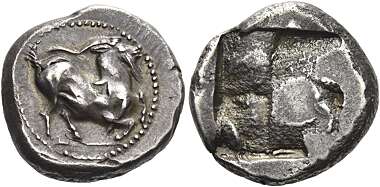
Los 120. Drachm circa 500-495, AR 18 mm, 6.06 g. Goat kneeling r. Rev. Quadripartite incuse square. Sheedy 73a (this coin). HGC 6, 653. In exceptional state of preservation. Struck in high relief on a very large flan and with a superb old cabinet tone. Good extremely fine Ex Leu 13, 1975, 175; Nomos 2, 2010, 104; Hess-Divo 328, 2015, 53; CNG 103, 2016, 187; Triton XIX, 2016, 137 and Künker 304, 2018, 419 sales. The Athenians asserted that Ionian Greeks from Athens colonized the island of Paros; however, according to other ancient authors, the island was originally founded by Cretans and Arcadians under the leadership of the hero Paros of Parrhasia. Although there were several important communities on the island, the city of Paros dominated them by the seventh century BC. Despite its flourishing, Paros came under the control of neighbouring Naxos by the end of the sixth century BC, and remained so until 490 BC, when the Persians permanently overthrew Naxos' dominance. After Persian rule, the clashes with Athens and a brief period of Spartan influence, Paros became an ally of Athens at the beginning of the fourth century BC, joining the Second Athenian League. In an effort to conquer the Aegean, in 314 BC Antigonos Monophthalmos united Paros and the other Cyclades into the First Nesiotic League, which was ruled by the Ptolemaic kings of Egypt from 287 BC until 246 BC. At the start of his Carian expedition, Philip V of Macedon conquered and garrisoned Paros. The pirate fleets used by Mithradates VI of Pontos throughout his three wars against Rome probably caused the city and the other Cycladic islands to suffer.The extensive series of silver didrachms and drachms produced between the late sixth and early fifth centuries BC provides evidence of Paros' affluence during the Archaic and early Classical periods. Usually featuring a goat on the obverse and an incuse square on the reverse, these were struck using the Aeginetic standard. Around 470 BC, this coinage came to an end, and the mint closed as well. The Parians appear to have struck no coinage in the fifth century BC, in part because of Athenian demands that tribute payments be made in Athenian coinage. Parian silver coinage resumed in the fourth century BC, perhaps in the context of the Social War or the birth of the League of Corinth. Please find here the video of the coin
  • Startpreis:
    6'400 CHF
    6'992 EUR
    5'829 GBP
    7'859 USD

    Nur ungefähre, gerundete WerteDatum: 05.11.2026
Los
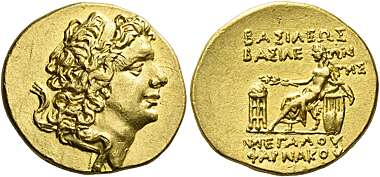
Los 121. Stater, Panticapaeum 55-54 (year 243), AV 20 mm, 8.11 g. Diademed bust r. Rev. BAΣIΛEΩΣ / BAΣIΛE-ΩN / MEΓAΛOY / ΦAPNAKOY Apollo seated l., holding laurel branch over tripod, his l. elbow resting on kithara; in r. field, ΓΜΣ. Macdonald, An introduction to the history and coinage of the kingdom of the Bosporus: including the coinage of Panticapeum (with "Apollonia" and "Myrmecium"), Phanagoria, Gorgippia, Sindicus Limen or the Sindoi, Nymphaeum, Theodosia, and the kings of the Cimmerian Empire, 182. Golenko, P. J. Karyszkowski, The gold coinage of King Pharnaces of the Bosporus, NC 1972, 1. Anokhin 216. SNG von Auclok –. de Luynes 2396 (these dies). SNG Copenhagen –. HGC 7, 198 (this coin illustrated). Extremely rare, apparently only four specimens known of the first issue. Struck on a very broad flan, minor marks, otherwise good extremely fine Ex Triton XII, 2009, 266 and Heritage 3061, 2018, 32038 sales. From the Buzz Owen collection. Graded Ch AU Strike 5/5 Surface 3/5, edge filing, NCG certificate number 4241949-002 (previously graded and no longer in holder) As Rome sought to tighten its authority over the lands it had inherited in 133 B.C. from the last Pergamene king, Attallus III, and even to expand its reach, there were a few formidable kings and numerous petty rulers who had to be reckoned with. Chief among them was the Pontic King Mithradates VI (120-63), who caused so much devastation to Romans, their property, and their political interests for such a prolonged period that his infamy equalled that of Hannibal. Finally, in 63 B.C. options for Mithradates VI had expired, and the king who with such pride had throughout his life immunised himself against poisons committed suicide by consuming a lethal dose of poison, which seemingly was followed up with a sword thrust. This courageous and resourceful king seems to have been pushed to the brink by the betrayal of his son Pharnaces II, who in exchange for this act had been assured the throne of the Cimmerian Bosporus. His new allies, the Romans, declared him and his subjects 'friends and allies of the Roman people' (amicorum et socium populi Romani). Though he had gained his throne through treachery against his father, in collusion with a sworn enemy, Pharnaces ruled for seventeen years, and on his coinage he unashamedly uses the title 'Great King of Kings.' No other Pontic or Bosporan king had done so, and his successor, Asander (47-22 B.C.), reverted to the title 'King'. Pharnaces' portraits are modelled after those of the Macedonian king Alexander III, yet that was a tradition he inherited from his father, and it cannot necessarily be seen as an individual trait. Pharnaces is described in the ancient sources as treacherous, power-hungry and haughty. Though a Roman client king, he had inherited from his father a desire for conquest, and he invaded Asia Minor, via Colchis, while Pompey and Julius Caesar were at war. His betrayal was rewarded by Caesar with a crushing defeat at Zela in 47 B.C., after which he famously stated: "I came, I saw, I conquered." Pharnaces was allowed by Caesar to continue his rule, and his life ended only after taking the field against the rebel-successor Asander. The Romans initially opposed Asander, but Octavian soon endorsed him as king. Stylistically, Pharnaces' gold staters form a tightly knit group, and it is possible – even likely – that the same engraver produced every die for his staters. They are known only for a period of five years, dated to the years 243 to 247 of the Bithynian Era (55/4-51/0 B.C.). In their 1972 study of these staters, Golenko and Karyszkowski note: "We cannot refer to any circumstances in the internal history of the Bosporan kingdom which could be connected with the sudden appearance and then the unexpected cessation of the gold coins. ... The coins, therefore, seem to have been a mere political gesture rather than a thought-out economic enterprise." Asander was far more assertive with his coinage, issuing staters dated by his regal years rather than to the Bithynian Era; he is known to have issued them in all four of his years as Archon (1-4) and for all but four of his over twenty years as King (5-29). Please find here the video of the coin
  • Startpreis:
    10'000 CHF
    10'925 EUR
    9'108 GBP
    12'280 USD

    Nur ungefähre, gerundete WerteDatum: 05.11.2026
Los
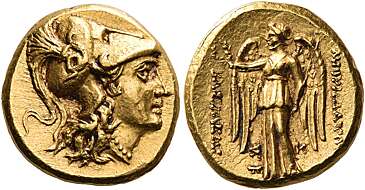
Los 122. Stater, Amisus circa 220-200, AV 18 mm, 8.50 g. Head of Athena r., wearing crested Corinthian helmet decorated with snake. Rev. ΒΑΣΙΛΕΩΣ / ΜΙΘΡΑΔΑΤΟΥ Nike standing l., holding wreath and stylis; in inner fields, Σ / Π – Κ. SNG von Aulock 1 (this coin). de Callataÿ, The first Royal Coinages of Pontos (From Mithridates III to Mithridates V) in Mithridates VI and the Pontic Kingdom, dies O2/R2, a and fig. 3 (this coin). Göbl, Antike 876 (this coin). Alram 22 (this coin referenced). HGC 7, 318. Of the highest rarity, one of two known staters for Mithridates III and the only one with these control marks. Minor edge marks, otherwise extremely fine Ex Jean Vinchon 24 November 1994, James et Sneja Velkov, 51; Sincona 10, 2013, 107; Triton XIX, 2016, 2052; Heritage 3048, 2016, 32037 and Triton XXIII, 2020, 290 sales. From the von Aulock, Jonathan P. Rosen and Lawrence A. Adams collections. Graded AU* Strike 5/5 Surface 4/5, edge marks (previously graded and no longer in holder) Unfortunately, almost nothing is known about the reign of Mithridates III of Pontos. His existence is assumed based on the mention of six Pontic kings of this name in the ancient sources although historical details are only attached to five. The typology of this stater illustrates the continued influence of Alexander the Great's coinage at the end of the third century BC, even if at the same time, on the silver issue appears the distinctive portrait of the Pontic king, reflecting the new developments in Hellenistic portraiture. Please find here the video of the coin
  • Startpreis:
    16'000 CHF
    17'481 EUR
    14'572 GBP
    19'648 USD

    Nur ungefähre, gerundete WerteDatum: 05.11.2026
Los
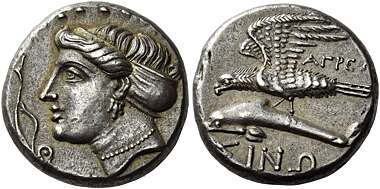
Los 123. Drachm circa 330-300, AR 22 mm, 6.14 g. Head of Sinope l.; in l. field, aphlaston. Rev. ΑΓΡΕΩ[Σ] / ΣΙΝΩ Eagle flying l. on dolphin l. Recueil Général 31.1. SNG Stancomb 763 (this coin). HGC 7, 391. Wonderful old cabinet tone and about extremely fine Please find here the video of the coin
  • Startpreis:
    600 CHF
    655 EUR
    546 GBP
    736 USD

    Nur ungefähre, gerundete WerteDatum: 05.11.2026
Los
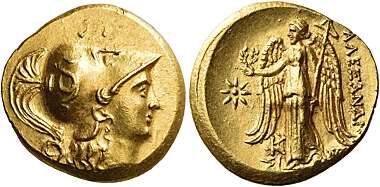
Los 124. Stater in name and types of Alexander III circa 235-215, AV 19 mm, 8.50 g. Helmeted head of Athena r. Rev. ΑΛΕΞΑΝΔΡΟΥ Nike standing l., holding wreath and stylis; in l. field, star and below, monograms. SNG Stancomb 782 (this coin). Price 1238. HGC 7, 383. Virtually as struck and almost Fdc Ex Roma Numismatics sale XVIII, 2019, 428. Privately purchased from Glendining in 1989. From the William Stancomb collection. Graded Ch AU Strike 5/5 Surface 4/5, NCG photo certificate number 8561100-008 Please find here the video of the coin
  • Startpreis:
    2'800 CHF
    3'059 EUR
    2'550 GBP
    3'438 USD

    Nur ungefähre, gerundete WerteDatum: 05.11.2026
Los
Los 125. Drachm circa 352-345, AR 19 mm, 6.69 g. Head of Heracles three-quarters facing r., wearing lion skin headdress. Rev. ΗΡΑΚΛΕΙΑ Nike crouching l. and inscribing on club. SNG von Aulock 356 (this coin). F. Imhoof-Blumer, Griechische Münzen in der Grossherzoglichen Badischen Sammlung in Karlsruhe, ZfN 7, 1880, p. 23, 4. J.P. Six, Sinope, NC 1885, 65. Extremely rare, possibly only three specimens known. A very interesting and appealing issue perfectly centred on a large flan and with a lovely old cabinet tone. Surface somewhat porous, otherwise good very fine Ex Leu 61, 1995, 130 (incorrect further pedigree) and Leu Numismatik Winterthur 6, 2020, 159 sales. From the von Aulock and Kleinkunst collections. Please find here the video of the coin
  • Startpreis:
    2'800 CHF
    3'059 EUR
    2'550 GBP
    3'438 USD

    Nur ungefähre, gerundete WerteDatum: 05.11.2026
Los
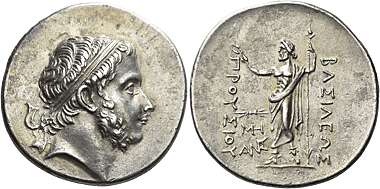
Los 126. Tetradrachm, Nicomedia 210-182, AR 32 mm, 16.75 g. Diademed head r. Rev. ΒΑΣΙΛΕΩΣ – ΠΡΟΥΣΙΟΥ Zeus Stratius standing l., holding wreath over royal name and sceptre; in inner l. field, thunderbolt / ME ligate / monogram. Waddington 9b. Jameson 1387. SNG von Aulock 6878. HGC 7, 614. A spectacular Hellenistic portrait of excellent style struck in high relief. Wonderful iridescent tone and good extremely fine Ex Tkalec 22 April 2007, 60 and Hermitage Fine Art 25, 2019, 32 sales. Please find here the video of the coin
  • Startpreis:
    2'800 CHF
    3'059 EUR
    2'550 GBP
    3'438 USD

    Nur ungefähre, gerundete WerteDatum: 05.11.2026
Los
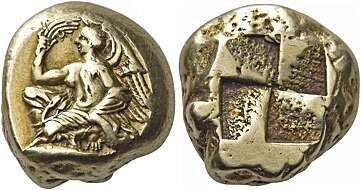
Los 127. Stater circa 400-350, EL 18 mm, 15.98 g. Nike kneeling l., holding aphlaston in r. hand; below, tunny- fish l. Rev. Quadripartite square incuse. von Fritze 154 and pl. 5, 2. Kappeli-Berger, Kunstwerke der antike, 24 (this coin). SNG France 301. Very rare and in unusually fine condition for this difficult issue, among the finest specimens in private hands. Good very fine Ex M&M VIII, 1949, 838 and NGSA 7, 2012, 75 sales. From the Robert Käppeli (1900-2000) collection. Cyzicus was a critical center for Greek coin production in northwestern Asia Minor. Although most cities had abandoned the use of electrum as an alloy for coinage by the mid-sixth century BC, Cyzicus continued to produce a vast array of staters and fractions in electrum down to the last decades of the fourth century BC. Finds of Cyzicene staters in the Black Sea region and a decree from Olbia regulating the value of the local coinage in relation to the Cyzicene stater suggest that the coins were struck for use in the Black Sea grain trade. As the indigenous grain producers of the Black Sea region had come to expect payment in electrum early on, electrum coins were needed to sustain the trade, even though the rest of the Greek world had moved on from this alloy. As Cyzicus was located on the Hellespontine shipment route for ships coming and going from the Black Sea, it took up the job of continuing electrum coin production. Some 207 individual types and varieties of Cyzicene electrum coins have been catalogued, but almost all of them include the badge of the city—a tunny (tuna) fish—as an adjunct symbol or incorporated into the main design. The depiction of Nike on this stater is a rare example of a historical type in the Cyzicene electrum series. She is shown here holding an aphlaston, the curved ornament on the prow of ancient galleys that was traditionally cut off defeated ships as a trophy of victory. Since the type obviously refers to a naval victory and it is on a Cyzicene coin, it is generally believed that the victory in question is that of the Battle of Cyzicus in 410 BC. This important battle late in the Peloponnesian War (431–404 BC) saw the Athenian fleet, under the command of the devious Alcibiades, rout the Peloponnesian fleet, commanded by the Spartan general Mindarus, in the waters before the harbor of Cyzicus. In the aftermath of the Athenian victory, Cyzicus, which had previously supported the Spartans, surrendered without a fight, thereby giving the Athenians control of the Hellespont and the Black Sea grain supply critical for Athens’ survival. Mindarus was killed in the fighting, and the Spartans who escaped total destruction found themselves stranded in western Asia Minor. A letter from the defeated Spartans was captured by the Athenians as it traveled to Sparta. Written in typical laconic style, it expressed the deep distress of those who had survived the Athenian victory: “The ships are gone. Mindarus is dead. The men are starving. We know not what to do.” In response, the demoralized Spartan government sent an embassy to Athens to make peace, but the Athenians refused to negotiate.  As it turned out, this was a critical mistake. Sparta recovered and rebuilt its fleet with Persian financial assistance, and in 405 inflicted a crushing defeat on the Athenians at Aegospotami, ending the war in Spartan triumph. Please find here the video of the coin
  • Startpreis:
    12'000 CHF
    13'110 EUR
    10'929 GBP
    14'736 USD

    Nur ungefähre, gerundete WerteDatum: 05.11.2026
Los
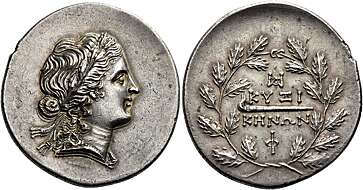
Los 128. Tetradrachm circa 150, AR 37 mm, 17.07 g. Laureate and draped bust of Kore Soteira r. Rev. Monogram / KYZI / KHNΩN / Φ above and below lit torch to l.; all within oak wreath. von Fritze pl. VI, 13 var. (different monograms). SNG France 450 var. (different monograms). In exceptional condition for the issue, undoubtedly among the finest specimens in private hands. An excellent portrait perfectly struck in high relief and with a wonderful iridescent tone. Virtually as struck and almost Fdc Ex Gitta Kastner 6, 1974, 93; NAC 2, 1990, 181 and NAC 106, 2018, 257 sales. From the Harald Salvesen (1928- 2016) collection. Please find here the video of the coin
  • Startpreis:
    12'000 CHF
    13'110 EUR
    10'929 GBP
    14'736 USD

    Nur ungefähre, gerundete WerteDatum: 05.11.2026
Los
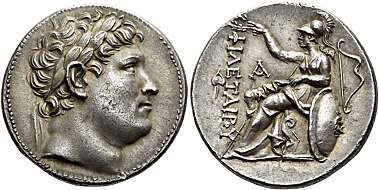
Los 129. Tetradrachm circa 255-241, AR 30 mm, 17.05 g. Diademed head of Philetairos r. Rev. ΦΙΛΕΤΑΙΡΟΥ Athena seated l., r. hand resting on shield; in r. field, bow, above, A in in outer l. field, ivy leaf. Westermark, Pergamon 233. SNG Copenhagen 335. SNG von Aulock 1356. A portrait of excellent style struck in high relief. Light old cabinet tone and good extremely fine Ex Giessener Munzhandlung Dieter Gorny 76, 1996, 198; Giessener Munzhandlung Dieter Gorny 82, 1997, 97; Gorny & Mosch 121, 2003 and Gorny & Mosch 164, 2008, 176 sales. Graded Ch AU* Strike 5/5 Surface 4/5, Fine style, light marks, NCG photo certificate number 8561097-003 Please find here the video of the coin
  • Startpreis:
    2'000 CHF
    2'185 EUR
    1'821 GBP
    2'456 USD

    Nur ungefähre, gerundete WerteDatum: 05.11.2026
Los
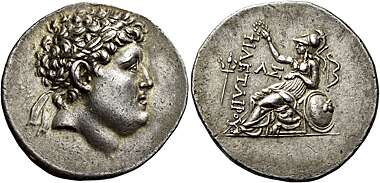
Los 130. Tetradrachm circa 197-160, AR 33 mm, 16.80 g. Laureate head of Philetairos r. Rev. ΦIΛETAIPOY Athena enthroned l., r. hand resting on shield set at her feet, l.; transverse spear in background, in l. field, trident, in central field, ΑΣ and in r. field, bow. Westermark V.CXLVII (this obverse die). SNG von Aulock 1361. A portrait of excellent style struck on a very large flan. Lovely iridescent tone and extremely fine Ex Morton & Eden sale 124, 2023, 414. From an European Connoisseur collection. Please find here the video of the coin
  • Startpreis:
    1'600 CHF
    1'748 EUR
    1'457 GBP
    1'964 USD

    Nur ungefähre, gerundete WerteDatum: 05.11.2026
Los
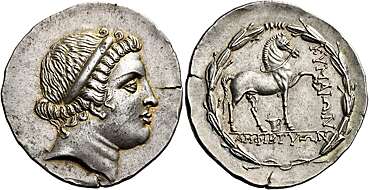
Los 131. Tetradrachm circa 165-140, AR 37 mm, 16.80 g. Diademed head of Apollo r. Rev. ΚΥΜΑΙΩΝ Bridled horse standing r., with l. foreleg raised; below, vase and, in exergue, ΑΜΦΙΚΤΥΩΝ. (All within wreath). cf. CNG E-sale 388, 2016, 113 (these dies). Oakley ANSMN 27, –, this die unlisted, cf. 75-79. An unusual portrait struck on a very broad flan with a light iridescent tone. Two minor flan cracks, otherwise extremely fine / good extremely fine Ex NAC sale 106, 2018, 265. Privately purchased from NFA on the 9th of May 1986. From the Harald Salvesen (1928-2016) collection. Please find here the video of the coin
  • Startpreis:
    1'600 CHF
    1'748 EUR
    1'457 GBP
    1'964 USD

    Nur ungefähre, gerundete WerteDatum: 05.11.2026
Los
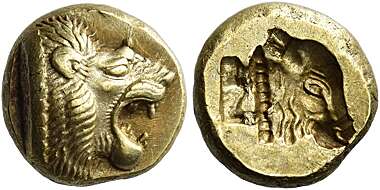
Los 132. Hecte circa 521-478, EL 10 mm, 2.55 g. Head of lion r., with open jaws. Rev. Calf's head r., incuse. Rosen 554. Dewing 2233. Boston, MFA 1679. Bodenstedt 13. In exceptional state of preservation. Virtually as struck and almost Fdc Ex Tkalec 29 February 2000, 92 and NAC 138, 2023, 218 sales. Please find here the video of the coin
  • Startpreis:
    2'000 CHF
    2'185 EUR
    1'821 GBP
    2'456 USD

    Nur ungefähre, gerundete WerteDatum: 05.11.2026
Los
Los 133. Tetradrachm circa 150-142, AR 34 mm, 16.73 g. Head of Athena r., wearing Attic helmet decorated with Pegasus. Rev. ΗΡΑΚΛΕΩΤΩΝ Club; below, owl standing r. All within oak wreath. SNG von Aulock 1977. SNG Lockett 2824. Lavva 3. A portrait of enchanting beauty, certainly one of the finest of the series. Struck in high relief and with a superb iridescent tone. Minor areas of weakness, otherwise good extremely fine Ex Sternebrg VIII, 1978, 112; M&M 96, 2004, 50 and Nomos 18, 2019, 157 sales. Please find here the video of the coin
  • Startpreis:
    2'800 CHF
    3'059 EUR
    2'550 GBP
    3'438 USD

    Nur ungefähre, gerundete WerteDatum: 05.11.2026
Los
Los 134. Tetradrachm, magistrate Herostratos circa 380-350, AR 23 mm, 15.18 g. Sphinx seated l.; in l. field, grapes on amphora. Rev. Quadripartite incuse square with striated borders; on horizontal band, HPOΣTPATOΣ. Mavrogordato 56 and pl. VI, 2. Baldwin, Chios –. Hurter, Pixodarus 19 (this coin illustrated). Rare. A fascinating representation of fine style struck in high relief with a wonderful iridescent tone. Extremely fine Ex Maison Palombo sale 12, 2013, 21. From the Pixodaros hoard. One of the twelve founding members of the Ionian League, Chios was among the first cities to strike coin around the end of the seventh century BC, swiftly making the Sphinx its emblem. The sphinx, a winged hybrid creature with a female head and a lioness body, was adapted by the Greeks from an Egyptian mythological creature, and Greek art often features it. According to some Greek mythology, the sphinx was the progeny of Orthos, Geryon's hound, and Echidna, a monster who was half nymph and half snake. During the Archaic and Classical periods, Chios was one of the richest towns in the world, prospering from marine trade and the production and distribution of local wine, which enabled it to play a significant part in the League. Naucratis in Egypt, where archeological evidence suggests a substantial Chian presence, was the most well-known overseas commerce hub founded by the Chians. It appears that early Archaic traders were involved in the movement of products between Asia Minor and mainland Greece because of Chios' excellent location and one of the largest merchant fleets in the region. Luxury items from the Near East, which were becoming more and more popular in mainland Greece, were the main focus of this commerce. Large-scale wine exports appear to have begun in the early sixth century, and the wine's remarkable quality soon made it well-known throughout the Greek world. The sphinx is known to have been used as the city's civic badge on pottery stamps, coin weights, headings of official decrees, and gravestones of Chians overseas. It was also used as the primary symbol of their coinage for about eight hundred years, a length of time that no other Greek city can match. Please find here the video of the coin
  • Startpreis:
    16'000 CHF
    17'481 EUR
    14'572 GBP
    19'648 USD

    Nur ungefähre, gerundete WerteDatum: 05.11.2026
Los
Los 135. Triobol circa V century BC, AR 15 mm, 3.04 g. Gorgoneion's head facing, surrounded by four wings in circular pattern around. Rev. Harpy flying r. within pelleted square border. Traité II, 1606 and pl. CXLV, 1. de Luynes 2751. HN Online 2552.2 (this coin). Very rare. Old cabinet tone and good very fine Ex Numismatik Naumann sale 64, 2018, 194. Please find here the video of the coin
  • Startpreis:
    800 CHF
    874 EUR
    728 GBP
    982 USD

    Nur ungefähre, gerundete WerteDatum: 05.11.2026
Los
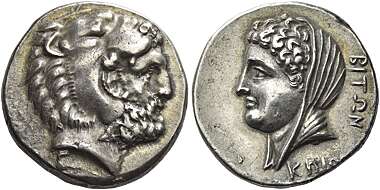
Los 136. Didrachm, magistrate Biton circa 365-355, AR 20 mm, 6.93 g. Head of Heracles r., wearing lion skin headdress. Rev. ΚΩΙΟ[N] / ΒΙΤΩΝ Veiled female head l. Pixodarus 29b (this coin). Ingvaldsen, Cos – Coinage and Society. The Chronology and Function of a City-State Coinage in the Classical and Hellenistic Period, c. 390-c. 170 BC., 22a (this coin). HN Online 761.3 (this coin illustrated). HGC 6, 1306. Very rare. Two elegant portraits of fine style struck on excellent metal with a light iridescent tone. Extremely fine Ex Sternberg X, 1980, 133; Künker 94, 2004, 1184 and Künker 312, 2018, 2440 sales. From the Pixodarus hoard (CH IX, 421). Please find here the video of the coin
  • Startpreis:
    2'800 CHF
    3'059 EUR
    2'550 GBP
    3'438 USD

    Nur ungefähre, gerundete WerteDatum: 05.11.2026
Los
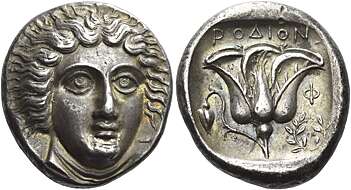
Los 137. Tetradrachm circa 404-385, AR 25 mm, 15.22 g. Head of Helios facing three-quarters r. Rev. POΔION Rose with single bud on l., in r. field, Φ / wreath. All within incuse square. Bérend, SNR 51, 40 = Ashton Hecatomnus 69a (this coin). Ashton 35. HN Online 1021 (this coin illustrated). HGC 6, 1418. Very rare. An impressive portrait struck in very high relief on exceptionally fresh metal. Lovely old cabinet tone and extremely fine Ex Leu 86, 2003, 411; Ira & Larry Goldberg 46, 2008, Millenia, 45; Nomos 3, 2011, 139; NAC 72, 2013, 377 and NAC 96, 2016, America, 1102 and Heritage 3061, 2018, 32051 sales. From the Guermantes collection and from the Marmaris Hoard of 1970 (IGCH 1209). Graded NCG AU★ Strike 5/5 Surface 5/5, Fine style (previously graded and no longer in holder) The coinage of Rhodes has been the subject of intensive study in recent decades, and many aspects of the series are now more clearly defined. Coinage for 'Rhodes' commenced in 408/7 B.C. after the citizens of three major cities on the island largely abandoned their ancestral homes to create a new city, Rhodes, on the northern tip of their island. This bold act was the catalyst by which Rhodes became a powerful maritime state that prospered throughout the political chaos of the Greek world during the forthcoming age of the Hellenistic monarchies. This Chian-weight tetradrachm was struck in the midst of the period of great production at Rhodes, by which time the mint's engravers were routinely producing facing heads of excellent style in high relief. This series covers nearly two decades that span the tail end of the 5th and the early years of the 4th Century B.C.; it includes 41 different symbols and control letters that have thus far been identified, though statistical analysis suggests that more are yet to be discovered. Perhaps the most surprising aspect of Rhodian coinage from this period is that it appears to have enjoyed relatively limited circulation. Hoard evidence shows that they are seldom found outside of the island of Rhodes or the nearby regions on the mainland. Considering the formidable reputation of Rhodian sailors and their extensive mercantile contacts, one might presume that the larger silver coins would be widely dispersed throughout the Greek world, especially since the Delian inventories indicate that Rhodian coinage was commonly used, and coins of the Rhodian type apparently were in demand by Greek mercenaries. A key to this riddle might be the anachronistic weight standard used by Rhodes, which may have assured that its coins were not readily exchangeable with those struck to the more popular Attic and Phoenician/Ptolemaic weight standards. Though it is always possible that most of the Rhodian coins exported in trade were melted due to their inconvenient weight, it is just as likely that Rhodian coinage was struck to a local standard with the intention that it would remain local to pay for the extraordinary expenses accrued each year by this powerful state, and that trade was largely conducted in the 'international trade currencies' produced by the major Greek states. Please find here the video of the coin
  • Startpreis:
    20'000 CHF
    21'851 EUR
    18'216 GBP
    24'560 USD

    Nur ungefähre, gerundete WerteDatum: 05.11.2026
Los
Los 138. Tetradrachm imitating Athens, Sardis circa 404-401, AR 24 mm, 17.16 g. Helmeted head of Athena r., bowl decorated with three olive leaves and vine scroll. On cheek, Aramaic letter Kaf. Rev. ΑΘΕ Owl standing r., head facing; in l. field, olive spray and crescent. All within incuse square. Winzer, Antike Portraitmünzen der Perser und Griechen aus vor-hellenistischer Zeit (Zeitraum ca. 510-322 v.Chr.) : die frühesten Portraits lebender Menschen von Dareios I. bis Alexander III. 5.1c (this coin). W. Weiser, Die Eulen von Kyros dem Jüngeren. Zu den ersten Münzporträts lebender Menschen, ZPE 76, 1989, pl. XVI, 11 (this coin). Extremely rare. Struck on excellent metal and with a light iridescent tone. Extremely fine Ex Schweizerische Kreditanstalt 4, 1985, 227; Vecchi & Numismatic Services 8 October 1986, 282; CNG 18, 1991, 206 and Künker 304, 2018, 549 sales. From the collection of a history friend. Please find here the video of the coin
  • Startpreis:
    2'800 CHF
    3'059 EUR
    2'550 GBP
    3'438 USD

    Nur ungefähre, gerundete WerteDatum: 05.11.2026
Los
Los 139. Stater circa 500-480, AR 22 mm, 9.65 g. ΦΟΙ Forepart of a winged boar l.; horseshoe-shaped symbol on upper wing. Rev. Incuse square with Maltese cross pattern. SNG von Aulock 4048 corr. (this coin) (legend omitted and attributed to uncertain dynast). Müseler, Lykische Münzen, II, 9 var. (this obverse die but without the symbol). An apparently unique variety of an extremely rare issue. Old cabinet tone, surface somewhat porous, otherwise good very fine Ex Leu 54, 1992, 150 and Leu Numismatik Winterthur 6, 2020, 220 sales. From the Hans von Aulock (1906-1980) and Kleinkunst collections. Please find here the video of the coin
  • Startpreis:
    1'600 CHF
    1'748 EUR
    1'457 GBP
    1'964 USD

    Nur ungefähre, gerundete WerteDatum: 05.11.2026
Los
Los 140. Stater, uncertain circa 480-460, AR 21 mm, 9.45 g. Bull kneeling r., head reverted. Rev. Head of ram l.; all within incuse square with dotted border. SNG von Aulock 4078. Müseler, Lykische II, 28-29. Extremely rare and in unusually fine condition for the issue. Light iridescent tone and good very fine Ex Rauch sale 111, 2020, 544. Privately purchased from Shanna Schmidt in 2020. Please find here the video of the coin
  • Startpreis:
    2'000 CHF
    2'185 EUR
    1'821 GBP
    2'456 USD

    Nur ungefähre, gerundete WerteDatum: 05.11.2026
Los
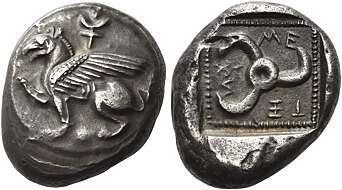
Los 141. Stater, uncertain mint circa 460, AR 19 mm, 8.47 g. Griffin crouching l.; above, ankh (?). All on round shield. Rev. TΞ / NX / ME in Lycian Lycian triskeles in incuse square with dotted border. Müseler, Lykische IV, 91 (this coin). Rosen 732 (this coin). Very rare and in exceptional condition for the issue, possibly the finest specimen in private hands. Wonderful old cabinet tone and extremely fine Ex M&M Fixed Price List 408, 1979, 14; Leu 28, 1981, 176; M&M 72, 1987, Rosen, 359; LHS 102, 2008, 296 and Busso-Peus 407, 2012, 718 sales. Privately purchased from E.J. Waddel in 2017. From the Jonathan P. Rosen collection. Please find here the video of the coin
  • Startpreis:
    4'000 CHF
    4'370 EUR
    3'643 GBP
    4'912 USD

    Nur ungefähre, gerundete WerteDatum: 05.11.2026
Los
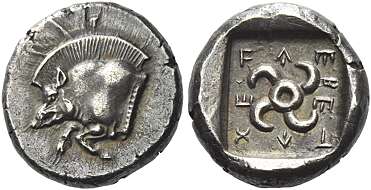
Los 142. Tetrobol, uncertain mint circa 450-420, AR 13 mm, 2.55 g. Forepart of boar l. Rev. 'teththiweibi' in Lycian Tetraskeles within incuse square. M. Bendenoun, Les monnaies de l'Antiquité: splendeurs et témoignages, 67 (this coin). Müseler, Lykisce –, cf. V, 41 (stater). Vismara, Lycia 138 var. (stater). Perfectly struck and centred on a very large flan and with a superb old cabinet tone. Good extremely fine Ex M&M 72, 1987, Rosen, 672 and iBelgica 27 March 2019, 143 sales. Please find here the video of the coin
  • Startpreis:
    1'200 CHF
    1'311 EUR
    1'092 GBP
    1'473 USD

    Nur ungefähre, gerundete WerteDatum: 05.11.2026
Los
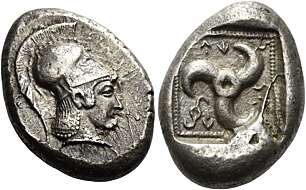
Los 143. Stater, Xanthos circa 440-430, AR 22 mm, 8.52 g. Head of Athena r., wearing Attic crested helmet. Rev. Wekhssere in Lycian Triskeles; above, diskeles. All within incuse square with dotted border. Müseler, Lykische V, 12 var. Vismara, Lycia I, 37 and II, 155. A lovely portrait struck on excellent metal with a light tone. A die break on reverse, otherwise extremely fine Ex Gorny & Mosch 97, 1999, 438; M&M 90, 2000, 259 and Busso-Peus 428, 2021, 296 sales. From the Graeculus collection. Please find here the video of the coin
  • Startpreis:
    1'600 CHF
    1'748 EUR
    1'457 GBP
    1'964 USD

    Nur ungefähre, gerundete WerteDatum: 05.11.2026
Los
Los 144. Tetrobol circa 410-390, AR 13 mm, 3.22 g. Head of Aphrodite (?) l., hair bound up at the back, wearing earrings and necklace: above, flower. Rev. Kherêi in Lycian characters Owl standing l., head facing: in l. field, olive spring. All within incuse square. Mørkholm 10 (this coin). SNG von Aulock 4170 (this coin). In exceptional condition for the issue. A wonderful portrait of fine style, old cabinet tone and extremely fine Ex Leu 50, 1990, 181; Bru & Wellico 6, 2001, 86 and NAC 116, 2019, Man in Love with Art part I, 196 sales. From the H.S. von Aulock (1906-1980) collection. Please find here the video of the coin
  • Startpreis:
    8'000 CHF
    8'740 EUR
    7'286 GBP
    9'824 USD

    Nur ungefähre, gerundete WerteDatum: 05.11.2026
Los
Los 145. Drachm circa 400-380, AR 19 mm, 4.24 g. Head of Athena r., wearing crested Attic helmet. Rev. Lycian legend Two lions seated facing each other, with raised paws; all within dotted circular border within shallow incuse. Müseler, Lykische –, cf. VII, 11 (stater). SNG von Aulock –, cf. 4200 (stater) Traitè II, 442 and pl. CII, 14 (these dies). Very rare. Struck on a very broad flan and with a lovely iridescent tone. Extremely fine Ex Roma Numismatics sale XIX, 2020. 555. From the Kleines Meisterwerk collection. Please find here the video of the coin
  • Startpreis:
    1'200 CHF
    1'311 EUR
    1'092 GBP
    1'473 USD

    Nur ungefähre, gerundete WerteDatum: 05.11.2026
Los
Los 146. Stater circa 390-380, AR 23 mm, 8.39 g. Helmeted head of Athena l. Rev. Erbinna in Lycia characters Heracles striding l. with his l. foot standing on a rock, wielding club and holding bow; in field, Carian letters. All within incuse square with dotted border. Mørkholm-Zahle 74 (these dies). Müseler, Lykische VI, 83-84 var. (without letters). Very rare. A fascinating issue with a finely detailed reverse composition. Lovely light old cabinet tone, obverse from a worn die, otherwise good very fine / about extremely fine Ex NFA 7, 1979, 233 (illustrated on cover); Leu 76, 1999, 204 and Leu Numismatik Winterthur 6, 2020, 232 sales. From the Kleinkunst collection. Please find here the video of the coin
  • Startpreis:
    6'000 CHF
    6'555 EUR
    5'464 GBP
    7'368 USD

    Nur ungefähre, gerundete WerteDatum: 05.11.2026
Los
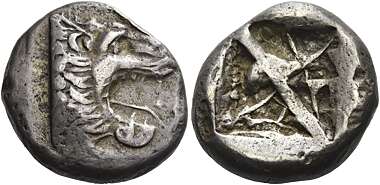
Los 147. Stater circa 380, AR 23 mm, 8.37 g. Lion's head facing. Rev. Araththihe in Lycian characters Female head facing, wearing a radiate crown, earrings and a necklace. All within incuse circle. Mørkholm-Neumann, Die Lykischen Münzlegend, p. 31, M. 247 and pl. 4,3. S. Hurter, Der Tissaphernes-Fund", in Greek numismatics and Archaeology in Essays Thompson, 35a and pl. 9, 35a (this coin). Of the highest rarity, apparently only the second specimen known and the only one in private hands. An absolutely spectacular and unusual portrait finely engraved, lovely old cabinet tone, weakly struck on obverse and with unobtrusive traces of double striking on reverse, otherwise extremely fine Ex Leu 18, 1977, 226; Sotheby's 21-22 June 1990, Hunt (1926-2014), 555; New York XXVII, 2012, Prospero (1910-2001), 579 and NAC 116, 2019, Man in Love with Art, 198 sales. Please find here the video of the coin
  • Startpreis:
    24'000 CHF
    26'221 EUR
    21'859 GBP
    29'472 USD

    Nur ungefähre, gerundete WerteDatum: 05.11.2026
Los
Los 148. Trihemiobol circa 385, AR 9 mm, 0.89 g. Draped bust of Heracles r. Rev. Head of satrap r. wearing satrap headdress. Winzer, Antike Portraitmünzen der Perser und Griechen aus vor-hellenistischer Zeit (Zeitraum ca. 510-322 v.Chr.) : die frühesten Portraits lebender Menschen von Dareios I. bis Alexander III, 10.8 (this coin). SNG Levante –. SNG France –. Rare. Two lovely portraits and a lovely iridescent tone, virtually as struck and almost Fdc Ex Busso-Peus 366, 2000, 215 and Künker 312, 2018, 2514 sales. From the collection of a history friend. Graded Ch AU* Strike 5/5 Surface 5/5, NCG photo certificate number 8561098-012 Please find here the video of the coin
  • Startpreis:
    400 CHF
    437 EUR
    364 GBP
    491 USD

    Nur ungefähre, gerundete WerteDatum: 05.11.2026
Los
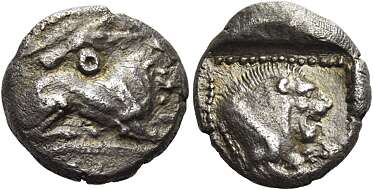
Los 149. Uncertain king. Stater circa 450-430, AR 24 mm, 11.22 g. Lion lying r.; above, eagle flying r.; in exergue, Cypriot mo. Rev. Forepart of lion r. with open mouth. All within incuse square. Traité II 1262 and pl. CXXXII, 17. BMC 3 and pl. XVIII, 3 (this obverse die). Tziambazis 2 (this obverse die). Amandry, Amathonte, 126, 1 (this coin). Of the highest rarity, the only specimen in private hands of only four known. An issue of tremendous importance and fascination and of superb style. Lovely old cabinet tone, minor die break on reverse, otherwise extremely fine Ex Leu 13, 1975, 291; Leu 30, 1982, 198 and NAC 106, 2018, 282 sales. From the collection of a Discerning collector. The city of Amathos on Cyprus is counted among the oldest royal centres on the island, with a history of settlement extending back as far as ca. 1100 B.C. It was founded by an indigenous Cypriot people described as "Pelasgians" in the Greek sources, but came to host important communities of Greek and Phoenician traders interested in the nearby copper mines. Politically, Amathos seems to have been aligned more closely with the Semitic cities of the Phoenician coast than with the Greek cities of Cyprus and openly opposed a revolt against Persian authority organised by Onesilos, the Greek king of Salamis, in 499-494 B.C. Onesilos, leading Salamis and the other Greek cities against Amathos, besieged but failed to capture the city. The Amathousians avenged themselves by capturing and beheading Onesilos. According to Herodotos, the head of the Salaminian king was hung up before the gates of Amathos as a warning to potential enemies, but eventually the grisly trophy became the home for a swarm of bees that filled the dead king's skull with honeycomb. Alarmed at this portent, the Amathousians consulted an oracle that advised them to appease the shade of the king by burying the head and offering him sacrifice as a hero. The city was famous for its temple dedicated to a local goddess, whom the Greeks considered a form of Aphrodite. This Aphrodite Amathousia was distinguished from other forms of the goddess by her association with an Aphrodite figure with male genitalia, whom the Greeks called Aphroditos and worshipped in rites that involved the exchange of clothing between men and women. The mix of cultural influences that can be seen in the history and archaeology of Amathos are also visible in the coinage of the city. At the same time that the beautiful archaic lions on this stater are very Greek in their execution and style, the emphasis on the animal's ribs, the extension of the mane onto the belly, and the treatment of the muzzle seem to derive from Persian and Phoenician artistic influence (cf. the lion on the stater of Baalmelek I of Citium in this sale). To this combination of stylistic influences should be added the inscription, which give the initials of the city not in Greek or Phoenician script, but in Cypriot syllabic script - a native writing system derived from the Linear A script of the Minoan Bronze Age. Thus the cultural history of ancient Amathos is summarised in a single coin. Please find here the video of the coin
  • Startpreis:
    20'000 CHF
    21'851 EUR
    18'216 GBP
    24'560 USD

    Nur ungefähre, gerundete WerteDatum: 05.11.2026
Los
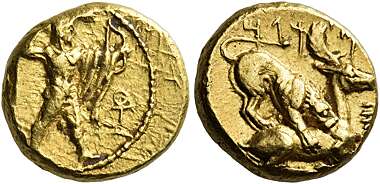
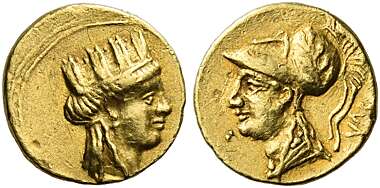
Los 150. Half Stater circa 355-354, AV 13 mm, 4.13 g. Heracles advancing r., holding club overhead, bow in l. hand, lion-skin draped over extended l. arm; in r. field, ankh. Rev. L MLK PMJTN (of King Pumiathon in Aramaic) Lion devouring fallen stag r.; in r. field, date (year 8). Markou 57 (this coin). A. Destrooper- Georgiades 4 (this coin). A. Destrooper-Georgiades, "Les monnaies en or de Pumiathon de Kition (Chypre). Note complémentaire", RBN 152, 2006, 12 (this coin). Rare. Slightly off-centre, otherwise good very fine Ex Münzen & Medaillen 28, 1964, 184; Auctiones AG 8, 1978, 337; Triton XV, 2012, 1261 and Heritage 3076, 2019, 30188 sales. Graded Ch XF Strike 3/5 Surface 4/5 (previously graded and no longer in holder) Please find here the video of the coin
  • Startpreis:
    2'400 CHF
    2'622 EUR
    2'185 GBP
    2'947 USD

    Nur ungefähre, gerundete WerteDatum: 05.11.2026
Los
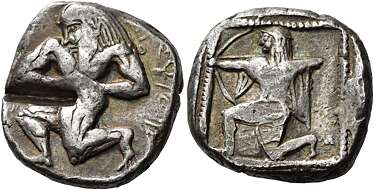
Los 151. Uncertain king. Stater circa 475-455, AR 21 mm, 11.11 g. Aramaic legend Nude, muscular male figure, in kneeling-running stance l.; long straight hair, holding object with both hands. Rev. Archer, wearing long garment over shoulder and helmet (?), in "kneeling-running" stance l., drawing bow; all within dotted square within incuse square. A. Destrooper-Georgiades, Le Trésor de Larnaca (IGCH 1272) Réexaminé, in Report of the Department of Antiquities Cyprus, 1984, p.144-145 and pl. xxviii, 12-13. P. Dikaios, A hoard of silver Cypriot Staters from Larnaca, NC 1935, 528-529. E.S.G. Robinson, Notes on the Larnaca Hoard, NC 1935, pp. 185-186. E.T. Newell, Miscellanea numismatica: Cyrene to India, ANSNNM 82, 1938, pp. 14-17. Apparently unique and unrecorded. An issue of tremendous fascination with a lovely iridescent tone. Test-cut on obverse, otherwise good very fine Ex CNG sale 115, 2020, 266. Greek tradition held that the city of Lapethus was founded by Lakonians under the leadership of a certain Praxander, but it actually seems to have been a Phoenician settlement since the eleventh century B.C. The history of the city and its kings in the Classical period is poorly known, but local coinage, which begins the name of King Sidqmelek in ca. 450-435 B.C., provides some names. This unique fifth-century BC stater of Lapethus is closely related to a group of extremely rare staters known primarily from the Larnaca Hoard (IGCH 1272), the Persepolis deposit (IGCH 1789), in museum collections. These feature the same running figure holding his hands over his belly, with an archer on the reverse. Taken together, the obverse and reverse types have been interpreted as depicting the Gigantomachy, the great battle between the Giants and the Olympian gods. According to Greek mythology, the Giants were born when the blood of the castrated Uranus fell to earth and climbed Mount Olympus, intent on overthrowing Zeus and the other gods. In the great battle that followed, the Olympian gods were assisted by the mortal hero Hercules in fulfillment of a prophecy and defeated the Giants. In this context, the running figure on the obverse is normally interpreted as a fleeing Giant clutching at a wound while the archer figure is understood as Heracles. This interpretation is undoubtedly correct with respect to the examples from the Larnaca Hoard and the Persepolis deposit, since the archer is also shown holding a club and wearing a lion's skin, both trademark iconographic elements of Heracles. On the present coin, however, the archer cannot be interpreted as Heracles, as there is no lion’s skin and no club present. Instead, the archer here seems to be Apollo, indicated by the omphalos visible between his kneeling legs. Apollo seems to have frequently worked alongside Heracles during the Gigantomachy. Together, they killed the Giant Ephialtes when Apollo shot an arrow into his left eye, and Heracles shot at his right.  Since the Giant on the obverse of this coin is holding his gut and not his eyes, it seems unlikely that we are to understand the death of Ephialtes here. Instead, the obverse figure is probably intended to represent Porphyrion, the leader of the Giants, who was slain by Apollo’s golden bow according to the poet Pindar (Pyth.8). This impressive coin shows that Heracles was not the only Olympian participant depicted in the extremely rare Gigantomachy series of Lapethus. If Apollo was also depicted, as on this unique stater, one wonders whether other Olympians might also appear on other staters not yet discovered. It is a truly important coin that expands our knowledge of an extremely rare and fascinating issue. Please find here the video of the coin
  • Startpreis:
    2'800 CHF
    3'059 EUR
    2'550 GBP
    3'438 USD

    Nur ungefähre, gerundete WerteDatum: 05.11.2026
Los
Los 152. Samarios (?), 450. Siglos circa 450, AR 26 mm, 11.13 g. sa sa ma o to ka sa to ro in Cypriot characters Lion standing r., licking forepaw: above, double axe. In exergue, spiral ornament. Rev. ma ri e u se in Cypriot characters Nude male figure (Phrixos) hanging ram running l; below, double axe. All within incuse square. Traité II 1366 (uncertain mint) and pl. CXXXVI, 17 (these dies). BMC p. LXXI, 1 (uncertain mint) and pl. XIII, 11 (these dies). Robinson NC 1932, 10, pl. XVI (these dies). Tziambazis 50 (these dies). SNG Copenhagen 24 (these dies). Very rare and in exceptional condition for the issue. Lovely old cabinet tone, minor areas of weakness, otherwise good very fine / about extremely fine Ex Hess-Leu 36, 1968, 311 and NAC 106, 2018, 296 sales. From the collection of a Discerning Collector. Please find here the video of the coin
  • Startpreis:
    8'000 CHF
    8'740 EUR
    7'286 GBP
    9'824 USD

    Nur ungefähre, gerundete WerteDatum: 05.11.2026
Los
Los 153. Uncertain king, 525 – 480. Siglos circa 525-480, AR 23 mm, 11.33 g. si ro mo [..] se in Cypriot characters Man-faced bull crouching r., head l. Rev. ba in Cypriot characters Astragalos. Traité II –. BMC p. lxv, pl. XXI, 2 (this obverse die). Jameson 2334 (these dies). ANSMN 15, 1969, 18 (this coin). Masson and Amandry pl. I, 3 (this coin). Weber 7701. De Luynes 3006. Extremely rare. An issue of tremendous interest and fascination, surface somewhat porous, otherwise very fine / good very fine Ex Spink & Son 40, 1984, 244 and NAC 106, 2018, 299 sales. From the collection of a Discerning collector. According to Greek mythological tradition, when famine struck Cilicia, a son of a Phoenician woman named Paphos and a Syrian called Sandokos, sailed to Cyprus in search of more fertile lands. Upon his arrival in southwestern Cyprus, Kinyras founded the city of Paphos in honour of his mother, and established a temple dedicated to Aphrodite, the goddess who guided him on his journey. Aphrodite was herself closely associated with the site of Paphos. It was believed that when she was born from the sea foam, Aphrodite came ashore on Cyprus at a promontory near Paphos. The city's temple of Aphrodite – actually Phoenician Astarte, whom the Greeks considered a form of their own goddess of love – was already famous in the time of Homer and had a reputation for its oracle. Its priests, known as the Kinyradai, claimed descent from Kinyras and wielded the power of kings in the city. Siromos(?), the Paphian ruler named on this stater, is thought to have been a Kinyrad king of the late fifth century B.C., but almost nothing is known about his reign. The coin types allude to both geographical features of his kingdom and the cult of Aphrodite at Paphos. The obverse type depicts a man-faced bull – the usual Greek means of representing a river-god – that almost certainly represents the River Bokaros. The mouth of this small river formed the harbour of Paphos. The reverse type represents an astragalos (knucklebone). Astragaloi were thrown in a manner similar to dice and were frequently used in ritual fashion to divine the will of the gods. Here the astragalos is thought to indicate the method by which the oracle of Aphrodite determined answers to the questions asked of it. Please find here the video of the coin
  • Startpreis:
    10'000 CHF
    10'925 EUR
    9'108 GBP
    12'280 USD

    Nur ungefähre, gerundete WerteDatum: 05.11.2026
Los
Los 154. Stasandros, circa 460. Siglos circa 460, AR 26 mm, 10.87 g. pa si sa ta sa to in Cypriot characters Bull standing l.; above, solar disc and in l. field, ankh. Rev. pa si sa ta sa to in Cypriot characters Eagle standing l; in l. field, ankh. All within incuse square. Traité II 1285, pl. CXXXIII, 24 (these dies). BMC p. LXIX, note 3 and pl. XXI, 9 (this coin illustrated). Weber 7706 (this coin). Tziambazis 71 var. (with vase on reverse field). SNG Copenhagen 26 var. (with vase on reverse field). Very rare. Wonderful old cabinet tone, obverse from a worn die, otherwise good very fine / extremely fine Ex Naville 4, 1923, Michailovitch, 959, Naville 10, 1925, Petrovicz, 738; Hess-Leu December 31, 1966, 503 and NAC 106, 2018, 303 sales. From the Weber (1823-1918) collection and from the collection of a Discerning collector. Please find here the video of the coin
  • Startpreis:
    4'000 CHF
    4'370 EUR
    3'643 GBP
    4'912 USD

    Nur ungefähre, gerundete WerteDatum: 05.11.2026
Los
Los 155. Aristo. (?), late V century. Siglos late V century BC, AR 22 mm, 11.06 g. ari in Cypriot characters Bull standing l.; above, solar disc and in l. field, ankh. Rev. Eagle flying l.; all within incuse square. Traité II 1311, pl. CXXXIV, 25. BMC 39, pl. VIII, 1 (these dies). Tziambazis 79 (these dies). Weber 7709. SilCoinCy A7682. Extremely rare. Old cabinet tone and good very fine / about extremely fine Ex Sotheby's 19-20 June 1991, Hunt (1926-2014) part II, 442 and NAC 106, 2018, 306 sales. From the collection of a Discerning Collector. Please find here the video of the coin
  • Startpreis:
    6'000 CHF
    6'555 EUR
    5'464 GBP
    7'368 USD

    Nur ungefähre, gerundete WerteDatum: 05.11.2026
Los
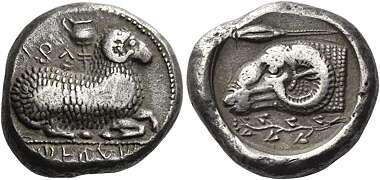
Los 156. Nikodamos, circa 460-450. Siglos circa 460-450, AR 21 mm, 11.32 g. ba si le fo se ni ko da mo in Cypriot characters Ram lying r.; above, vase. Rev. Ram's head l.; above, corn of grain and below, ivy sprig. All within incuse square. Traité II, –. BMC –. Tziambazis –. Kunstfreund 169 (this coin). Masson-Amandry p. 33 and pl. II, 4-5 (this coin). Apparently unique. Of lovely style and with a delightful old cabinet tone, minor areas of weakness, otherwise good very fine Ex M&M-Leu 1974, Kunstfreund, 169; Giessener Münzhandlung Dieter Gorny 69, 1994, 425 and NAC 106, 2018, 311 sales. From the Charles Gillet (1879-1972) and the collection of a Discerning collector. Salamis on Cyprus was reputedly founded by the Achaean hero, Teucer, who was unable to return home after the Trojan War because of his failure to avenge his brother Ajax. The historical city had been inhabited by a population reflecting Greek and Phoenician cultural influences since the eleventh century B.C., but by the sixth century B.C. the Greek element had become dominant. In the Classical period, the city was frequently in alliance with Athens in order to oppose the Persians and to expand Salaminian influence over the other cities of Cyprus. Nikodamas, the issuer of this stater, was a Greek king of Salamis in the decade before the expedition of an Athenian fleet under the general Kimon against the Persians on Cyprus in 450 B.C. Simultaneous battles fought on land and on the sea before the walls of Salamis resulted in victory for the Greeks. Unfortunately, what role Nikodamas may have played in these events, if any, are unknown. This unique and artistically attractive stater ultimately derives its recumbent ram from the coinage of Evelthon, the first king of Salamis to strike coins in the sixth century B.C. This reuse of this old type served to advertise Nikodamas as a legitimate king from the dynasty of Evelthon (other rare issues also include the name of Evelthon in the obverse legend) and followed the royal numismatic custom at Salamis. Nikodamas' recognised predecessors, as well as Evanthes, who has been variously considered a successor or predecessor of Nikodamas, all employed this dynastic ram obverse type. The ram's head of the reverse may have been a novelty introduced by Nikodamas, if he did not inherit this reverse type from Evanthes, who also used it. The detailed execution of the head invites comparison with the best of the ram's head rhyta (drinking horns) that were fashionable at Greek drinking parties at the time that Nikodamas and Evanthes produced their coinages. Please find here the video of the coin
  • Startpreis:
    16'000 CHF
    17'481 EUR
    14'572 GBP
    19'648 USD

    Nur ungefähre, gerundete WerteDatum: 05.11.2026
Los
Los 157. Evagoras II, 361-351. 1/12 stater circa 361-351, AV 9 mm, 0.69 g. Bust of Aphrodite r., wearing turreted crown. Rev. EVA Head of Athena l., wearing crested Corinthian helmet. Markou 380 (this coin). E. Zapiti, L. Michaelidou, Coins of Cyprus: from the collection of the Bank of Cyprus Cultural Foundation, 18. SNG Copenhagen 52 (this obverse die). Rare and in exceptional condition for the issue. Good extremely fine Ex J.C. Morgenthau 338, 1934, 230; NFA 4, 1977, 347; CNG 100, 2015, 106 and Triton XXI, 2018, 517 sales. Privately purchased from CNG in 2004. From the Russell Burrage and Lawrence A. Adams collections. Graded Ch AU Strike 5/5 Surface 4/5 (previously graded and no longer in holder) Please find here the video of the coin
  • Startpreis:
    1'600 CHF
    1'748 EUR
    1'457 GBP
    1'964 USD

    Nur ungefähre, gerundete WerteDatum: 05.11.2026
Los
Los 158. Siglos circa 515-485, AR 21 mm, 10.59 g. Lion's head r. with open mouth. Rev. Incuse punch. Traité II –. BMC p. xlvi and pl. XXV, 11 (Golgi). Tziambazis 146 (uncertain mint). Very rare. Old cabinet tone and very fine Ex Aufhäuser 21 October 1985, 142 and NAC 114, 2019, 338 sales. From the collection of a Discerning Collector. The lion is one of the most common animal types on Cypriot coinage. Many of the island's kingdoms used it, but each in its own way, so the animal by itself rarely identifies a mint. Marion's earliest silver sigloi have a crouching lion on the obverse, with the naked figure of Phrixos beside a running ram on the reverse. Amathus used a recumbent lion as its standard type, and in the fourth century its smaller silver under Rhoikos paired a lion's head with the forepart of a lion, together with the syllabic sign ro. At Kition, Baalmilk I (479-449 BC) put a seated lion with open jaws on the reverse of coins whose obverse shows Herakles-Melqart, and smaller denominations combine a bearded head of Herakles with the same reverse. Salamis used the lion on its gold staters, which show a lion devouring its prey with an eagle on its back. Late in the series, Stasioikos II's bronze coins from Marion have a lion's head on the reverse and a Greek legend, which names the mint outright. The lion also appears indirectly, since Herakles, the commonest human figure on Cypriot coins, is shown wearing the lion skin. The animal's frequency makes uninscribed lion issues hard to attribute. For example, this archaic siglos with only a lion's head and an incuse punch has been assigned to Golgoi in older catalogues but is now listed as uncertain, or similar lion staters, with bull on reverse, have been tentatively suggested for Kourion (J. Kagan 1999, The Archaic and Early Classical Coinage of Kourion). Please find here the video of the coin
  • Startpreis:
    4'000 CHF
    4'370 EUR
    3'643 GBP
    4'912 USD

    Nur ungefähre, gerundete WerteDatum: 05.11.2026
Los
Los 159. Uncertain king (Mo-), 450-430. Drachm circa 450-430, AR 16 mm, 3.62 g. mo in Cypriot characters Lion lying r.; above eagle flying r. Rev. Forepart of lion r., with open jaws; within incuse square. Traité II 1263 and pl. CXXXII, 18 var. (without Θ). Weber 7684 var. (without Θ). BMC pl. XVIII and 5 var. (without Θ). Tziambazis –, cf. 2 (stater). Amandry, Amathonte 126 var. (without Θ). SNG Copenhagen –. SilCoinCy –. An apparently unrecorded denomination. Good very fine Ex NAC sale 114, 2019, 263. Privately purchased from Spink & Son in the 60's. From the collection of a Discerning Collector. Please find here the video of the coin
  • Startpreis:
    2'000 CHF
    2'185 EUR
    1'821 GBP
    2'456 USD

    Nur ungefähre, gerundete WerteDatum: 05.11.2026
Los
Los 160. King sa.... Hemistater circa 315-312, AV 13 mm, 4.12 g. Head of Athena r., wearing crested Attic helmet: in r. field, Σ – A. Rev. pa sa in Cypriot characters Bull advancing r., below, A – P. BMC p. 33 and 4 (Marium, Stasioikos II). Tziambazis 60 (king Stasioikos II for Marium). Markou, L'or 2 (this coin). Of the highest rarity, the only specimen in private hands of only five known. Reverse slightly off-centre, otherwise good very fine Ex Sotheby's 20 November 1980, 284 and NAC 114, 2019, 346 sales. From the collection of a Discerning Collector. Gold coinage reached Cyprus in the fourth century BC, roughly a century and a half after the island's kingdoms began striking silver sigloi in the late sixth century. Only some of the kingdoms issued it. Evagoras of Salamis was among the first Cypriot rulers to strike gold, and his son Nicocles (373-361 BC) continued the practice with gold fractions. Melikiathon of Kition (392-361 BC) is also known for a gold hemistater. The new coins differed in character from the older silver. The animal types typical of the fifth century gave way to Greek divinities such as Athena, Apollo, Zeus and Aphrodite, often assimilated to local gods, and Greek letters gradually replaced the Cypriot syllabary. Gold seems to have lasted only a short time. It was tied to the last generation of independent kings, and the wars of Alexander's successors ended their rule in the 310s BC. This extremely rare hemistater has been attribuited, in the earlier catalogues (BMC p. 33; BMC no. 4; Tziambazis 60) to Marion under Stasioikos II, the last king, on the reading of the Greek letters on the reverse as MAP. Recently, Evangeline Markou, the author of the L'or catalogue your entry cites, studied this Athena/bull-or-eagle gold series, and she reconsidered it, changing the attribution and the ruler. Please find here the video of the coin
  • Startpreis:
    8'000 CHF
    8'740 EUR
    7'286 GBP
    9'824 USD

    Nur ungefähre, gerundete WerteDatum: 05.11.2026
Los
Los 161. Drachm, Gaziura 333-325, AR 19 mm, 5.35 g. B'L GZYR in Aramaic Baal of Gaziura seated l., holding eagle, bunch of grapes, grain ear and sceptre. Rev. ARIORATH in Aramaic Griffin l. attacking stag. Simonetta 1a (this coin). HGC 7, 790. Very rare and in exceptional condition for the issue. Old cabinet tone and about extremely fine / good very fine Ex Sternberg 14, 1984, 165 and Künker 312, 2018, 2528 sales. Please find here the video of the coin
  • Startpreis:
    1'600 CHF
    1'748 EUR
    1'457 GBP
    1'964 USD

    Nur ungefähre, gerundete WerteDatum: 05.11.2026
Los
Los 162. Tetradrachm, Eusebeia-Mazaca 133, AR 33 mm, 16.76 g. Diademed head r. Rev. ΒΑΣΙΛΕΩΣ - ΑΡΙΑΡΑΘΟΥ Athena standing l. with spear and shield, holding Nike crowning royal name; monograms in outer l., inner l., and outer r. fields. In exergue, ΕΥΣΕΒΟΥ / Λ (year 30). Waddington 6834 and pl. XIX, 23 (this coin). SNG von Aulock 6263 (this obverse die). Richter fig. 1936. Simonetta 2 (Ariarathes IV, this obverse die). Extremely rare. A pleasant portrait struck in high relief, lovely old cabinet tone and about extremely fine Ex M&M XIX, 1959, 516; NFA XXV, 1990, 179; Leu 20, 1978, 153 and NAC 106, 2018, 332 sales. From the duplicates of the Bibliothèque Nationale, Paris and from a Distinguished Northern Californian Collector. From the W. H. Waddington (1826-1894) and Harlad Salvesen (1928-2016) collections. Please find here the video of the coin
  • Startpreis:
    4'000 CHF
    4'370 EUR
    3'643 GBP
    4'912 USD

    Nur ungefähre, gerundete WerteDatum: 05.11.2026
Los
Los 163. Tetradrachm, Priene circa 160-156, AR 32 mm, 16.53 g. Diademed head r. Rev. ΒΑΣΙΛΕΩΣ – ΟΡΟΦΕΡΝΟΥ Nike standing l., crowning royal name with r. hand and holding palm branch in her l.; in inner l. field, owl standing three-quarters l. on altar above monogram. In exergue, ΝΙΚΗΦΟΡΟΥ. Regling, Priene, pp. 8-10, 44-45. Richter fig. 1939. Simonetta 1 (this obverse die). Mørkholm, Some Cappadocian problems, NC 1962, pl. XX, 3 (this obverse die). H. Salvesen, "The tetradrachm of Orophernes," in Nomismatika Khronika 21 (2000), pp. 8-16. Kraay-Hirmer, pl. 209, 768 (this die). EHC 655 (this obverse die). Extremely rare, only very few specimens known of which this is the finest in private hands. A realistic portrait of superb style, work of a very talented master engraver. Undoubtedly one of finest Hellenistic portraits on a Greek coin. Struck in high relief and with a wonderful old cabinet tone, extremely fine Ex Hess-Leu 27 March 1956, 320; Leu 20, 1978, 152; NFA 25, 1990, 178 and NAC 106, 2018, 331 sales. From a Distinguished Northern Californian Collector and from the Priene hoard of 1870 (IGCH 1323). From the Harald Salvesen (1928-2016) collection. Desperate to retain her status as queen of Cappadocia, the apparently infertile Antiochis presented her husband, King Ariarathes IV, with two false sons, named Ariarathes and Orophernes. These were to be heirs to the Cappadocian throne, but then something unexpected happened. Antiochis conceived and gave birth to two daughters and a son by her husband. Having produced a proper heir (the future Ariarathes V), Antiochis revealed the truth to Ariarathes IV and sent her false sons far away from Cappadocia in order to prevent them from challenging the rights of her true son. The young Ariarathes was sent off to Rome while Orophernes was dispatched to the Ionian city of Priene. Although he lived in luxury at Priene, Orophernes remained desirous of what he had lost. In 163 B.C., Ariarathes IV died and Ariarathes V became king in Cappadocia and soon provided Orophernes with his chance to claim the throne for himself. Concerned to keep his kingdom on the good side of the Romans, Ariarathes V refused a marriage alliance with the Seleukid king, Demetrios I, who ruled in Syria without the sanction of the Senate. Offended by the refusal, Demetrios I plotted to overthrow Ariarathes V and establish Orophernes as Cappadocian king. In 158 B.C., Orophernes invaded Cappadocia at the head of a Seleucid army and forced Ariarathes V to flee. Orophernes' reign in Cappadocia was brief and unpleasant. He gained a reputation for oppressing his subjects and for executing the wealthy elites of Cappadocia in order to seize their property. He is said to have deposited some 400 talents with the Prieneans as security against a reversal of fortune, which, as it turned out, was just on the horizon. The Senate demanded the restoration of Ariarathes V, but curiously did not insist that Orophernes abdicate. Nevertheless, fear of growing discontent in the Cappadocian army soon caused Orophernes to give up Cappadocia and seek safety in Syria with Demetrios I in 156 B.C. The Seleukid king accepted the failed Cappadocian monarch at his court, but found it necessary to arrest him when Orophernes entered into a conspiracy with the Antiochenes to overthrow Demetrios I. Evidently, Orophernes was not picky about which kingdom he ruled. Cappadocia or Syria did not really matter so long as he had subjects somewhere to squeeze for cash. Although his treachery certainly made Orophernes worthy of execution, Demetrios I spared his life so that he could continue to threaten the restored Ariarathes V with his release. Six years later, Demetrios I got a taste of his own medicine when Ariarathes V and other enemies found their own pretender at the Ionian city of Smyrna and proceeded to use him to overthrow the Seleukid king. What goes around comes around, even where Hellenistic rulers are concerned. Once Ariarathes V was back in power, he demanded that Priene return the 400 talents that Orophernes had drained from the kingdom. Unwilling to give this vast sum to Ariarathes V while Orophernes still lived, and hoping to keep it once he died, the Prieneans refused. In response, Ariarathes V and his powerful ally, Attalos II of Pergamon, attacked the city and plundered it to reclaim the money – with painfully high interest. This coin represents the pinnacle of Hellenistic portrait coinage. Not only is it an extremely rare piece depicting an obscure and dramatic royal personage, but the artistry of the portrait itself is superlative. Looking upon the image of Orophernes here, it is hardly a wonder that the modern Alexandrian poet, C. P. Cavafy (1866-1933), found himself moved to write a poem about the life and adventures of the Cappadocian pretender in response to the coin portrait. The reverse type, depicting Nike crowning Orophernes' name, is a grand and oft repeated Hellenistic cliché that can be traced all the way back to the coins of Lysimachos (323-281 B.C.), which feature Athena holding a Nike who crowns the king's name. Here, Nike also serves to visually express Orophernes' title Nikephoros ("Victory-bearer") but gives no hint that the Cappadocian pretender was about to drop it. Adding further to the already great interest of this particular coin is the fact that it actually belongs to the 400 talents that Orophernes left with the Prieneans for safekeeping. It is one of only six specimens that were found beneath the pedestal of a statue of Athena Polias during the early excavations at Priene in 1870. Evidently Ariarathes V and Attalos II had not managed to find everything that Orophernes had spirited away. The owl and altar mint mark combined with the treatment of the flan and the high quality of the engraving and composition all suggest that not only did Orophernes deposit his ill-gotten gains at Priene, but he had it coined there too. Please find here the video of the coin
  • Startpreis:
    120'000 CHF
    131'109 EUR
    109'297 GBP
    147'362 USD

    Nur ungefähre, gerundete WerteDatum: 05.11.2026
Los
Los 164. Stater, Babylon circa 311-300, AV 18 mm, 8.58 g. Head of Athena r., wearing Corinthian helmet decorated with griffin. Rev. ΒΑΣΙΛΕΩΣ – ΑΛΕΞΑΝΔΡΟΥ Nike standing to l., holding stylis in l. hand and wreath in r.; in l. outer field, MI and below, monogram within wreath. Price 3749 corr. (griffin, not sphinx). SC 81.3 corr. (griffin, not sphinx). Extremely fine Ex Gorny & Mosch sale 249, 2017, 195. Graded AU Strike 4/5 Surface 4/5, Fine style, die shift, NCG photo certificate number 8561097-004 Please find here the video of the coin
  • Startpreis:
    2'800 CHF
    3'059 EUR
    2'550 GBP
    3'438 USD

    Nur ungefähre, gerundete WerteDatum: 05.11.2026
Los
Los 165. Tetradrachm, Ecbatana circa 295-281, AR 28 mm, 17.14 g. Head of Heracles r., wearing lion skin headdress. Rev. ΣΕΛΕΥΚΟΥ / BAΣΙΛΕΩΣ Zeus seated l., holding eagle and sceptre; in l. field, anchor, horse and monogram, below throne, monogram. SC 204.3 (this coin). HGC 9, 12k. Struck on a very broad flan and with a light old cabinet tone. About extremely fine Ex M&M 54, 1978, 354; Busso Peus 28 October 1980, 144; NFA 19, 1987, Rosen, 410 and CNG 108, 2018, 286 sales. From the MNL collection. Please find here the video of the coin
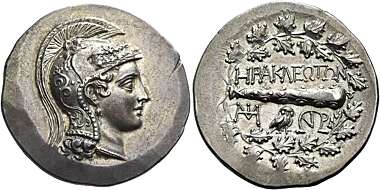
  • Startpreis:
    1'600 CHF
    1'748 EUR
    1'457 GBP
    1'964 USD

    Nur ungefähre, gerundete WerteDatum: 05.11.2026
Los
Los 166. Tetradrachm, Cyme circa 261-241, AR 29 mm, 17.03 g. Diademed head r. Rev. ΒΑΣΙΛΕΩΣ / ΑΝΤΙΟΧΟΥ Heracles seated l. on rock and lion skin, holding club; in l. field, cup and in exergue, two monograms. SC 505. HGC 9, 241c. Lovely iridescent tone and about extremely fine Ex Monetarium 59, 1993, 91 and Gorny & Mosch 269, 2020, 520 sales. From the Dr. G. W. collection. Please find here the video of the coin
  • Startpreis:
    1'600 CHF
    1'748 EUR
    1'457 GBP
    1'964 USD

    Nur ungefähre, gerundete WerteDatum: 05.11.2026
Los
Los 167. Drachm, Antiochia circa 173-168, AR 21 mm, 4.09 g. Diademed head r.; bead-and-reel border. Rev. ΒΑΣΙΛΕΩΣ / ANTIOXΟΥ / ΘEOY / EΠIΦ-ΑΝΟΥΣ Apollo seated l. on omphalos, testing arrow and resting l. hand on grounded bow. Le Rider, Antioche de Syrie sous les Séleucides: corpus des monnaies d'or et d'argent. I. De Séleucos à Antiochos V, c. 300-161, 18 corr. (A3/P13) (this coin illustrated). SC 1403. HGC 9, 626. Rare. Struck on an exceptionally fresh metal and with a lovely iridescent tone. Extremely fine Ex Schweizerische Kreditanstalt 2, 1984, 7; Busso-Peus 314, 1985, 150; Leu 53, 1991, 130; Hess-Divo 328, 2015, 68 and CNG 108, 2018, 328 sales. From the MNL collection. Please find here the video of the coin
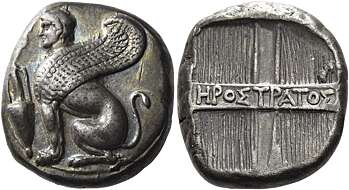
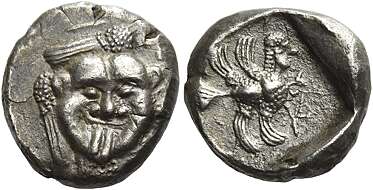
  • Startpreis:
    800 CHF
    874 EUR
    728 GBP
    982 USD

    Nur ungefähre, gerundete WerteDatum: 05.11.2026
Los
Los 168. Tetradrachm posthmous issues, Antiochia circa 146-145, AR 30 mm, 16.89 g. Diademed head r.; bead and reel border. Rev. [B]AΣΙΛΕΩΣ / ANTIOXOY / EΠIΦANOYΣ Zeus seated l. on throne, holding Nike facing r. offering wreath on outstretched r. hand and sceptre in l. SC 1885.1 (this coin listed). HGC 9, 744 corr. An extremely rare issue without date or monogram. Lovely iridescent tone and extremely fine Ex CNG sale 114, 2020, 404. From the W.K. Raymond and MNL collections. Please find here the video of the coin
  • Startpreis:
    1'000 CHF
    1'092 EUR
    910 GBP
    1'228 USD

    Nur ungefähre, gerundete WerteDatum: 05.11.2026
Los
Los 169. Tetradrachm, Sidon 151-150 (year 162), AR 29 mm, 14.23 g. Diademed head r. Rev. BAΣIΛEΩΣ – AΛEΞANΔΡOΥ Eagle, with closed wings standing l.; behind, palm branch, in l. field, BΞΡ and in r. field, ΣIΔΩ on aphlaston. Rouvier –, cf. 1227. CSE 713. SC 1830.1. HGC 9, 882. Struck on a very broad flan and with magnificent old cabinet tone. Good extremely fine Ex Naville X, 1925, 1153; Hess 207, 1931, 666; M&M 19, 1959, 543; Leu-M&M 3-4 December 1965, Niggeler (1878-1964), 466; New York I, 1998, 154 and Ira & Larry Godberg 106, 2018, 1102 sales. Privately purchased from Freeman & Sear in 2000. From the H. Otto and Lee Rousseau collections. Please find here the video of the coin
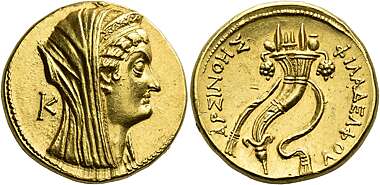
  • Startpreis:
    1'600 CHF
    1'748 EUR
    1'457 GBP
    1'964 USD

    Nur ungefähre, gerundete WerteDatum: 05.11.2026
Los
Los 170. Tetradrachm, Soloi circa 155-150, AR 31 mm, 16.68 g. Diademed head r.; all within laurel wreath. Rev. BAΣΙΛΕΩΣ / ΔHMHTPIOY Tyche seated l. on backless throne with winged tritoness support, holding short sceptre and cornucopia; in outer fields, monograms. SC 1611.3 (this coin illustrated). Arthur A. Houghton, The Royal Seleucid Mint of Soli, NC 149, 70 (this coin). O. Mørkholm, Seleucid coins from Cilicia c. 220-150 B.C., ANSMN 11, 60, Ib (this coin). CSE 527 (this coin). An absolutely spectacular portrait struck in high relief. Wonderful old cabinet tone, minor flan crack at twelve o'clock on obverse, otherwise extremely fine Ex Hess-Leu 24, 1964, 239; Leu 50, 1990, 202; Leu 81, 2001, Outstanding collection, 336; Nomos 6, 2012, 107 and Triton XXII, 2019, 314 sales. From the Arthur A. Houghton and MNL collections. Please find here the video of the coin
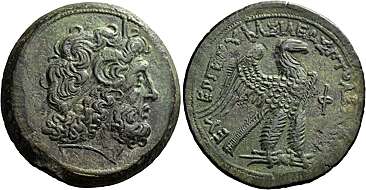
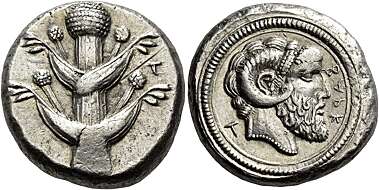
  • Startpreis:
    4'000 CHF
    4'370 EUR
    3'643 GBP
    4'912 USD

    Nur ungefähre, gerundete WerteDatum: 05.11.2026
Los
Los 171. Tetradrachm, Mallus circa 138-129, AR 28 mm, 16.74 g. Diademed head r.; in l. field, monogram. Around bead-and-reel border. Rev. ΒΑΣΙΛΕΩΣ / ΑΝΤΙΟΧΟΥ / ΕΥΕΡΓΕΤΟΥ Cult statue of Athena Magarsia standing facing, holding spear; above, stars and below, monogram. SC 2059.2. Houghton, The Seleucid mint of Mallus and the cult figure of Athena Magarsia, in Festschrift für Leo Mildenberg, 13 (this obverse die). HGC 9, 1072. Extremely rare. A bold portrait and a lovely old cabinet tone. About extremely fine Ex NGSA 5, 2008, 140 and Hermitage Fine Art 25, 2019, 43 sales. Please find here the video of the coin
  • Startpreis:
    2'000 CHF
    2'185 EUR
    1'821 GBP
    2'456 USD

    Nur ungefähre, gerundete WerteDatum: 05.11.2026
Los
Los 172. Tetradrachm, Tarsus circa 114-112, AR 30 mm, 16.64 g. Diademed head r.; around, bead-and-reel border. Rev. [Β]ΑΣΙΛΕΩΣ ΑΝΤΙΟΧΟΥ / ΦΙΛΟΠΑΤΟΡΟΣ Garlanded altar with baldachin under which Sandan standing r. on back of horned, winged lion-griffin r.; in outer l., monograms. SNG Lockett 3187 (this coin). SC 2349.1b. Pozzi 3028 (this coin). HGC 9, 1230. Very rare and in exceptional condition for the issue. Wonderful old cabinet tone and extremely fine Ex Naville I, 1921, Pozzi (1846-1918), 3028; Glendining 21 February 1961, Lockett (1873-1950), 2639; Leu 45, 1988, 273; J. Elsen 93, 2007, 378; 51 Gallery 13 November 2015, 98 and CNG 109, 2018, 338 sales. From the MNL collection. Please find here the video of the coin
  • Startpreis:
    2'400 CHF
    2'622 EUR
    2'185 GBP
    2'947 USD

    Nur ungefähre, gerundete WerteDatum: 05.11.2026
Los
Los 173. Tetradrachm circa III century BC, AR 25 mm, 16.92 g. Head of Artaxerxes I r., with moustache and earring, wearing kyrbasia. Rev. Aramaic legend Fire temple of Ahura-Mazda; in l. field, Ardaxšir standing r., hands raised in adoration, and in r. field, standard. Sunrise 562 (this obverse die). D.O. Klose, W. Müseler, Statthalter, Rebellen, Könige : die Münzen aus Persepolis von Alexander dem Grossen zu den Sasaniden, 2/9 (this obverse die). For type, cf. Alram 520. Rare. In exceptional condition for the issue, undoubtedly among the finest specimens known. A magnificent portrait of Hellenistic style struck on excellent metal and with a lovely iridescent tone. Good extremely fine Ex Superior Galleries 79, 1989, 6169A; Leu 52, 1991, 124; Triton VII, 2004, 538; Heritage 3044, 2016, 30052 and Triton XXI, 2018, 568 sales. From the Bellaria and Nisa collections. Graded MS Strike 5/5 Surface 4/5, Fine style (previously graded and no longer in holder) Please find here the video of the coin
  • Startpreis:
    6'400 CHF
    6'992 EUR
    5'829 GBP
    7'859 USD

    Nur ungefähre, gerundete WerteDatum: 05.11.2026
Los
Los 174. Temp. Darios I to Xerxes I. Siglos, Sardis circa 505-480, AV 13 mm, 8.33 g. Persian king, quiver over shoulder, in kneeling-running stance r., drawing bow. Rev. Incuse punch. Carradice, Type II and pl. XI, 11. Meadows, The Administration of the Achaemenid Empire in J.E. Curtis & N. Tallis, Forgotten Empire: The World of Ancient Persia, 319. Sunrise 19. Rare. About extremely fine Ex NFA XXV, 1990, 190 and Triton XXIII, 2020, 503 sales. From the Matthew Curtis collection. Please find here the video of the coin
  • Startpreis:
    4'000 CHF
    4'370 EUR
    3'643 GBP
    4'912 USD

    Nur ungefähre, gerundete WerteDatum: 05.11.2026
Los
Los 175. Time of Artaxerxes I to Xerxes II. Daric, Sardis circa 455-420, AV 16 mm, 8.31 g. Persian King, quiver over shoulder, in kneeling-running stance, holding dagger and bow. Rev. Incuse punch, small lion head r. within. Carradice, Type IV, Group A and for type, cf. pl. XIII, 32. cf. Triton sale IX, 1065 (this reverse punch). An extremely rare variety with lion head on reverse. Struck on a narrow flan, otherwise good very fine Ex Tkalec AG 9 May 2005, 98 and Triton XXIII, 2020, 506 sales. From the Jonathan P. Rosen collection. Please find here the video of the coin
  • Startpreis:
    4'800 CHF
    5'244 EUR
    4'371 GBP
    5'894 USD

    Nur ungefähre, gerundete WerteDatum: 05.11.2026
Los
Los 176. Time of Artaxerxes I to Xerxes II. Daric circa 455-420, AV 17 mm, 8.35 g. Persian King, quiver over shoulder, in kneeling-running stance r., holding dagger in r. hand, bow in l. Rev. Incuse punch. BMC pl. XXVI, 9. A. Meadows, The Administration of the Achaemenid Empire in Forgotten Empire: The World of Ancient Persia, –. Sunrise 27. Carradice, Type IV, Group A and pl. XIII, 32. Very rare and in exceptional for issue. Virtually as struck and almost Fdc Ex Tkalec 9 May 2005, 99 and Triton XXIII, 2020, 504 sales. From the Jonathan P. Rosen collection. Graded MS Strike 4/5 Surface 5/5, NCG photo certificate number 8561100-009 Please find here the video of the coin
  • Startpreis:
    6'400 CHF
    6'992 EUR
    5'829 GBP
    7'859 USD

    Nur ungefähre, gerundete WerteDatum: 05.11.2026
Los
Los 177. Tetradrachm, Panijhir (?) circa 200-190, AR 35 mm, 16.91 g. Draped bust r., wearing elephant headdress. Rev. ΒΑΣΙΛΕΩΣ - ΔΗΜΗΤΡΙΟΥ Heracles standing facing, crowning himself with r. hand and holding club and lion's skin in l.; in lower inner l. field, monogram. MIG 103d var. Bopearachchi Série 1D, 2-3. SNG ANS 188. Rare. A spectacular portrait struck on a very large flan, old cabinet tone and extremely fine Ex NFA XXII, 1989, 358 and NAC 106, 2018, 338 sales. From the the Harald Salvesen (1928-2016) collection. Please find here the video of the coin
  • Startpreis:
    8'000 CHF
    8'740 EUR
    7'286 GBP
    9'824 USD

    Nur ungefähre, gerundete WerteDatum: 05.11.2026
Los
Los 178. Drachm circa 185-170, AR 20 mm, 4.19 g. Diademed and draped bust r. Rev. ΒΑΣΙΛΕΩΣ / ΑΓΑΘΟΚΛΕΟΥΣ / ΔΙΚΑΙΟΥ Zeus standing facing, holding sceptre and Hecate; in l field, monogram. Bopearachchi 4A. SNG ANS 233. HGC 12, 91. Of the highest rarity, only the second and by far the finest specimen known. Wonderful iridescent tone and good extremely fine Ex Gorny & Mosch sale 297, 2023, 207. Please find here the video of the coin
  • Startpreis:
    2'400 CHF
    2'622 EUR
    2'185 GBP
    2'947 USD

    Nur ungefähre, gerundete WerteDatum: 05.11.2026
Los
Los 179. Tetradrachm circa 170-145, AR 35 mm, 16.95 g. Diademed, draped, and cuirassed bust of Eucratides I. r., wearing crested helmet adorned with bull's horn and ear; all within bead-and-reel border. Rev. BAΣIΛEΩΣ MEΓAΛOΥ – EΥKΡATIΔOΥ The Dioscuri, holding palm fronds and spears, on horses advancing r.; in lower r. field, monogram. Mitchiner 177ee. Bopearachchi series 6E. SNG ANS 465. HGC 12, 131. Light iridescent tone and good extremely fine Ex Gorny & Mosch sale 253, 2018, 259. Please find here the video of the coin
  • Startpreis:
    2'000 CHF
    2'185 EUR
    1'821 GBP
    2'456 USD

    Nur ungefähre, gerundete WerteDatum: 05.11.2026
Los
Los 180. Unit circa 290, AV 15 mm, 2.80 g. ENΔYBIC BACIΛEYC Draped bust of Endubis r., wearing head-cloth and circular earring; around, two wheat stalks; above, pellet in crescent. Rev. AΞWMITW BICIΔAXY (= of the Axumites, Man of Dakhu) Draped bust of Endubis r., wearing head-cloth and circular earring; around, two wheat stalks; above, pellet in crescent. Juel-Jensen 1. MH BM type 1. Good extremely fine Ex Gorny & Mosch sale 240, 2016, 325. Graded AU Strike 5/5 Surface 4/5, NCG photo certificate number 8561098-002 Please find here the video of the coin
  • Startpreis:
    1'600 CHF
    1'748 EUR
    1'457 GBP
    1'964 USD

    Nur ungefähre, gerundete WerteDatum: 05.11.2026
Los
Los 181. Tetradrachm in name and types of Alexander III, Memphis circa 323-322, AR 29 mm, 17.21 g. Head of Heracles r., wearing lion-skin headdress. Rev. ΑΛΕΞΑΝΔΡΟΥ Zeus seated l., holding eagle and sceptre; in l. field, ram-head with Isis crown and below the throne, monogram. Price 3964. CPE 4. In exceptional condition for the issue, undoubtedly among the finest specimens known. A portrait of fine style struck in high relief on a very broad flan with a lovely iridescent tone. Extremely fine Ex New York XXVII, 2012, Prospero (1910-2001), 303 and Sovereign Rarities 2, 2019, 363 sales. Privately purchased from Spink & Sons in 1985. Please find here the video of the coin
  • Startpreis:
    4'000 CHF
    4'370 EUR
    3'643 GBP
    4'912 USD

    Nur ungefähre, gerundete WerteDatum: 05.11.2026
Los
Los 182. Tetradrachm in name of Alexander III, Alexandria circa 306, AR 29 mm, 15.75 g. Diademed head of the deified Alexander r., wearing elephant skin, aegis around neck. Rev. AΛEΞANΔPOY Athena advancing r., brandishing spear and shield; in r. field, eagle standing r. on thunderbolt and in field, monogram - ΔI. CPE 73. SNG Lockett 3394 (this coin). Zervos issue 33, dies 534/d (this coin cited). Svoronos 177. Wonderful iridescent tone and good extremely fine Ex Munzhandlung Basel 4, 1935, 950; Glendining's 21 February 1961, Lockett (1873-1950), 2781; Triton XIX, 2016, 325; Obolos 5, 2016, 489 and New York XLII, 2018, 405 sales. Privately purchased from Shanna Schmidt in 2018. From the Dr. Patrick H. C. Tan and Cartwright collections. Graded Ch AU* Strike 5/5 Surface 5/5, Fine style (previously graded and no longer in holder) Please find here the video of the coin
  • Startpreis:
    2'800 CHF
    3'059 EUR
    2'550 GBP
    3'438 USD

    Nur ungefähre, gerundete WerteDatum: 05.11.2026
Los
Los 183. Tetradrachm in name of Alexander III, uncertain mint circa 306, AR 30 mm, 15.63 g. Horned Head of the deified Alexander r., wearing elephant headdress. Rev. AΛΕΞΑΝΔΡΟY Athena advancing r., brandishing spear and shield; in field, monograms and in r. field, eagle standing r. Wayte Raymond, The J. Pierpont Morgan Collection: Catalogue of Greek and Roman Coins, 189 (this coin). Zervos, Issue 67, dies 630/a (this coin cited). Svoronos 139. SNG Copenhagen 23. Boston, MFA 2256. Gulbenkian 1073. CPE 89. Struck on a very broad flan and with a wonderful old cabinet tone, a small graffito on reverse, otherwise about extremely fine Ex Stack's 14 September 1983, 31; Stack's 3-4 December 1996, Price, 82; Leu 83, 2002, 456; Kirk Davis 41, 2003, 62 and Triton XXIII, 2020, 517 sales. From the J. Pierpont Morgan (1837-1913) and Matthew Curtis collection. Please find here the video of the coin
  • Startpreis:
    2'400 CHF
    2'622 EUR
    2'185 GBP
    2'947 USD

    Nur ungefähre, gerundete WerteDatum: 05.11.2026
Los
Los 184. Tetradrachm in the name of Alexander III, Alexandria circa 306-303, AR 30 mm, 15.54 g. Diademed head of Alexander r., wearing elephant skin headdress. Rev. ΑΛΕΞΑΝΔΡΟY Athena advancing r., brandishing spear and holding shield; in l. field, monogram and in r. field, ΔI and eagle. CPE 79. SNG Lockett 3386 (this coin). Svoronos 142. SNG Copenhagen 21. In exceptional condition for the issue, possibly the finest specimen known. A superb portrait of great beauty and a lovely old cabinet tone, good extremely fine Ex Naville I, 1921, Pozzi (1846-1918), 3191; Glendining 23 February 1961, Lockett (1873-1950) part XII, 2773 and NAC 110, 2018, 72 sales. In the decades that followed the death of Alexander III, the deified king's legacy lost none of its lustre. Indeed, it remained an important tool of the diadochi in their individual quests for legitimacy. The head of Alexander on the obverse of this tetradrachm lies at the core of Ptolemy's claim as the inheritor of Alexander's legacy, for in 322/1 he had taken possession of Alexander's embalmed body by intercepting it in Syria while it was being escorted from Babylon to Macedon. Ptolemy brought the corpse to Memphis, but some time later it was relocated to a grand tomb in Alexandria. In the same way that Alexander's body became an object of cult worship, Ptolemy's coinage with the head of Alexander wearing an elephant scalp promoted the idea that the conqueror's legacy was firmly rooted within the realm of the Ptolemies. Interest in Alexander's corpse survived well into Roman times, and many emperors visited his tomb. Suetonius (Augustus 18) tells us that when Augustus landed in Alexandria after his victory at Actium, he gazed upon Alexander's mummified remains, placed a golden diadem on its head and sprinkled flowers on the body. When the attendant asked him if he wished to see the Mausoleum of the Ptolemies, Augustus replied "I came to see a king, not a row of corpses." The presentation of Alexander's portrait on this coinage is layered in symbolism: the elephant scalp refers his easternmost conquests and perhaps also alludes to his connection to Heracles; the ram's horn is an attribute of Zeus-Ammon and must allude to the king's visit to the oracle of Ammon in Siwa; and the scaly aegis is a reference to Zeus. The band at Alexander's forehead, usually described as a diadem to signify kingship, may be a tainia intended to symbolise victory, perhaps in association with Dionysus. The version of Athena on the reverse is often described as Athena Promachus ("Athena who leads in battle" or "fighter in front"), which may have been inspired by a mid-5th Century statue by Phidias that was installed to face the entrance of the Acropolis. She was known to the Athenians as the "bronze Athena" and was dedicated for the victory over the Persians. However, Zervos suggested she was a striding variety of the Palladian Athena, which had fallen from the heavens to Troy. Others, including Brett and Hazzard, describe her as Athena Alkidemos (the "defender/ protector of the people") because her temple was located in Pella, the birthplace of Alexander and home of the ancient palace of the Macedonians. Please find here the video of the coin
  • Startpreis:
    8'000 CHF
    8'740 EUR
    7'286 GBP
    9'824 USD

    Nur ungefähre, gerundete WerteDatum: 05.11.2026
Los
Los 185. Stater, Alexandria circa 299-295, AV 18 mm, 7.11 g. Laureate head r., wearing diadem and aegis. Rev. ΠTOΛEMAIOY / BAΣIΛEΩΣ Charioteer, holding thunderbolt in r. hand, driving elephant quadriga l.; in exergue, monogram. SNG Copenhagen –. Svoronos 111 and pl. IV, 5 (these dies). CPE 91 (these dies). Very rare. A wonderful portrait perfectly centred on a full flan and a light reddish tone. Extremely fine Ex Münzhandlung Basel IV, 1935, Prince W., 928; Bank Leu / Münzen und Medaillen, 3-4 December 1965, Niggeler (1878-1964), 518; Leu 33, 1983, 448; Superior Galleries 9-10 December 1989, Jasha Heifetz part II, 3001 and New York XXVII, 2012, Prospero (1910-2001), 627 sales. The earliest Greek gold coins of Egypt were struck in the form of the standard 'Alexandrine' staters showing the head of Athena and the standing figure of Nike. They were first issued by Alexander, and after he departed they were produced by his regent in Egypt, Cleomenes of Naucratis. Once Ptolemy became satrap of Egypt in 323 B.C., he continued to issue Athena-Nike gold staters until about 310. Except for some issues produced for Nikokreon and Menelaos in Cyprus and Ophellas in Cyrene, the pattern of Egyptian gold coinage was not changed until c.313/311, when it seems Ptolemy authorised a special issue at Alexandria. It had no inscription and portrayed the deified Alexander wearing horns, an aegis and an elephant headdress, and on its reverse showed a prow. The next issue, struck sometime between c.304 and 295, is of the type offered here. It was an innovation on many levels since it not only bore the diademed portrait of Ptolemy, but an inscription on the reverse that describes Ptolemy as king, a title he had taken in the late summer or autumn of 306. The weight was also innovative, as it was the first of his gold coins to use the lighter, Ptolemaic/Phoenician standard. For the main issue, presumably struck in Alexandria, there are at least 15 recorded variants based on different monograms and monogram combinations. Somewhat later, it seems, this type was also produced on a smaller scale in Cyrene during the rule of Magas. The head of Alexander that appears on many of Ptolemy's coins, as well as his depiction in an elephant quadriga, helped reinforce Ptolemy's claim of being the inheritor of Alexander's legacy, a tradition he initiated in 322/1 by taking possession of Alexander's body while it was in transit from Babylon to Macedon. He initially brought the corpse to Memphis, but eventually it was placed in a grand tomb in Alexandria, remaining an object of worship. After this issue of gold staters, Ptolemy's remaining gold coins (perhaps issued from about 295 to 284/3) were of a standard type showing his portrait on the obverse and an eagle on the reverse, typically with the Delta signature secreted behind Ptolemy's ear. Please find here the video of the coin
  • Startpreis:
    12'000 CHF
    13'110 EUR
    10'929 GBP
    14'736 USD

    Nur ungefähre, gerundete WerteDatum: 05.11.2026
Los
Los 186. Pentadrachm, Cyprus circa 294-282, AV 25 mm, 17.76 g. Diademed head r., wearing aegis; behind ear, Δ. Rev. ΒΑΣΙΛΕΩΣ ΠΤΟΛΕΜΑΙΟΥ Eagle standing l. on thunderbolt; in l. field, EY / monogram / A. CPE 226. SNG Copenhagen –. Svoronos 374. Extremely rare. A portrait of unusually fine style, graffiti on obverse, otherwise extremely fine Ex Heritage sale 3075, 2019, 32035. From the Allen Moretti collection. Graded AU Strike 5/5 Surface 3/5, Fine Style, graffiti, NCG photo certificate number 8561100-010 Please find here the video of the coin
  • Startpreis:
    6'400 CHF
    6'992 EUR
    5'829 GBP
    7'859 USD

    Nur ungefähre, gerundete WerteDatum: 05.11.2026
Los
Los 187. Tetradrachm, Alexandria 294-282, AR 29 mm, 14.20 g. Diademed head r.; behind ear, tiny Δ. Rev. ΠΤΟΛEΜΑΙOΥ BAΣΙΛEΩΣ Eagle with closed wings standing l. on thunderbolt; in l. field, P on monogram. Svoronos 255. SNG Copenhagen 71. CPE 168. Lovely old cabinet tone and extremely fine Ex Triton XV, 2012, 1309 and Triton XXIII, 2020, 519 sales. Please find here the video of the coin
  • Startpreis:
    1'600 CHF
    1'748 EUR
    1'457 GBP
    1'964 USD

    Nur ungefähre, gerundete WerteDatum: 05.11.2026
Los
Los 188. In the name of Arsinoe II. Decadrachm, Alexandria circa 249-245, AR 33 mm, 35.57 g. Veiled and diademed head of Arsinoe II r.; behind head, monogram. Rev. ΑΡΣΙΝΟΗΣ – ΦΙΛΑΔΕΛΦΟΥ Double cornucopiae filled with fruit and bound with fillet. Svoronos 961 (Ptolemy III). Troxell 45 and pl. VIII, 7 (this obverse die). CPE 368. Very rare. Lovely old cabinet tone and extremely fine Ex Adolph Hess 7 October 1907, 1487; Leu 54, 1992, 195; Gemini I, 2005, 250; NAC 64, 2012, 856 and NAC 106, 2018, 346 sales. From the collection of Ed Milas. Upon her death in July of 270 BC, Arsinoe II, the sister-wife of King Ptolemy II, was deified and a cult was established in her honour as Thea Philadelphus ('brother-loving goddess'). It was a new cult, distinct from the Theoi Adelphoi ('sibling gods') cult, which by 272/1 had been established for Arsinoe and her husband. The first honorary coinage for Arsinoe II and her new cult appears to have been silver decadrachms, which were issued soon after her death. Starting in about 261/0, the same types were employed for gold coins that must have been as impressive then as they are today. The largest of these was an octodrachm or mnaieion (one-mina piece) that appears to have been worth 100 silver drachms, and was struck under successive Ptolemaic kings for about 150 years or more. Arsinoe's portrait is carefully composed to show her royal pedigree and her divinity. Her status as a queen is attested by the jewelled diadem at her forehead, and her divinity by the lotus sceptre at her shoulder and the ram's horn at her ear. While the obverse is devoted solely to the queen, the reverse is dedicated to her sibling relationship with Ptolemy II. The inscription APΣINOHΣ ΦIΛAΔEΛΦOY ("[coin] of Arsinoe, brother-lover") is paired with a double cornucopiae, which presumably represents brother and sister. As a symbol of bounty and fertility, the double-cornucopia laden with grain and fruit and bound by a fillet is thought to have been a personal badge of Arsinoe II. Please find here the video of the coin
  • Startpreis:
    8'000 CHF
    8'740 EUR
    7'286 GBP
    9'824 USD

    Nur ungefähre, gerundete WerteDatum: 05.11.2026
Los
Los 189. In name of Berenice II. Drachm, Alexandria circa 242-222, AV 15 mm, 4.29 g. Veiled and draped bust r., wearing necklace. Rev. BAΣIΛΣΣHΣ BEPENIKHΣ Filleted cornucopia; stars flanking. Svoronos 980 (this coin listed). CPE 739. SNG Lockett 3419 (this coin). Extremely rare and in exceptional condition for the issue. Almost invisible marks, otherwise virtually as struck and almost Fdc Ex Sotheby, Wilkinson & Hodge 31 May 1900, Late collector, 476 and Glendining 21-23 February 1961, Richard Cyril Lockett (1873-1950), 2804 sales. From the Huth collection. Graded MS* Strike 5/5 Surface 3/5, brushed, NCG photo certificate number 8561098-004 Please find here the video of the coin
  • Startpreis:
    10'000 CHF
    10'925 EUR
    9'108 GBP
    12'280 USD

    Nur ungefähre, gerundete WerteDatum: 05.11.2026
Los
Los 190. Tetradrachm, Sidon circa 217-204, AR 25 mm, 14.23 g. Jugate busts right of Serapis and Isis. Rev. ΠTOΛEMAIOY BAΣIΛEΩΣ Eagle with closed wings standing l. on thunderbolt, head reverted, with double cornucopiae at his shoulder; in l. field, Ω /Σ and between legs, ΣΙ. CPE 920. Landvatter, AJN 24, 76. Svoronos 1186. Rare. A bold jugate portrait struck on excellent metal, reverse slightly off-centre, otherwise extremely fine Ex Nomos sale 15, 2017, 199. Please find here the video of the coin
  • Startpreis:
    2'800 CHF
    3'059 EUR
    2'550 GBP
    3'438 USD

    Nur ungefähre, gerundete WerteDatum: 05.11.2026
Los
Los 191. In name of Berenice II. Tetradrachm, Alexandria circa 211-210, AR 28 mm, 13.64 g. Diademed and veiled head r. Rev. ΒΕΡΕΝΙΚΗΣ ΒΑΣΙΛΙΣΣΗΣ Cornucopia with grape bunches hanging l., bound with fillet. CPE 897. Svoronos 1115. SNG Berry 1487. Very rare. A lovely portrait and a wonderful light iridescent tone, reverse somewhat porous, otherwise about extremely fine Ex Hirsch XXXII, 1912, Philipsen (1853-1925), 596; Adolph Hess Fixed price List 1 Janury 1950, 33; M&M Fixed Price List 466, 1984, 16; Sotheby's 9 June 1983, Brand part III, 185 and Morton & Eden 100, 2019, 318 sales. Please find here the video of the coin
  • Startpreis:
    4'000 CHF
    4'370 EUR
    3'643 GBP
    4'912 USD

    Nur ungefähre, gerundete WerteDatum: 05.11.2026
Los
Los 192. Tetradrachm, Alexandria circa 180-145, AR 27 mm, 14.29 g. Diademed head r., wearing aegis. Rev. ΠΤΟΛΕΜΑΙΟΥ ΒΑΣΙΛΕΩΣ Eagle with closed wings standing l. on thunderbolt. Svoronos 1489. CPE 1117. SNG Copenhagen 262. Wonderful old cabinet tone. Virtually as struck and almost Fdc Ex NFA 18, 1987, 269 and Heritage 3082, 2020, 33168 sales. Graded MS* Strike 5/5 Surface 5/5 (previously graded and no longer in holder) Please find here the video of the coin
  • Startpreis:
    2'000 CHF
    2'185 EUR
    1'821 GBP
    2'456 USD

    Nur ungefähre, gerundete WerteDatum: 05.11.2026
Los
Los 193. In the name of Arsinoe II. Octodrachm, Alexandria 180-116, AV 29 mm, 27.47 g. Diademed and veiled head of the deified Arsinoe II r.; in l. field, K. Rev. ΑΡΣIΝΟΗΣ – ΦΙΛΑΔΕΛΦΟΥ Double cornucopiae filled with fruit and bound with fillets. CPE K57. Svoronos 1499. SNG Copenhagen 322. Boston, MFA 2293. Struck in high relief, minor marks in field, otherwise good extremely fine Ex Roma Numismatics XII, 2016, 371 and Gorny & Mosch 249, 2017, 381 sales. Graded Ch AU Strike 5/5 Surface 2/5, Brushed, marks, ex jewellery, NCG photo certificate number 8561100-005 Please find here the video of the coin
  • Startpreis:
    6'000 CHF
    6'555 EUR
    5'464 GBP
    7'368 USD

    Nur ungefähre, gerundete WerteDatum: 05.11.2026
Los
Los 194. Hemidrachm, Cyrene circa 145-116, AE 48 mm, 17.17 g. Diademed head of Zeus Ammon r. Rev. BAΣIΛEΩΣ ΠTOΛEMAIOY EY-EPΓETOY Eagle standing r. on thunderbolt, wings spread; in r. field, Φ. Svoronos 1641. Asolati 84. Wonderful old cabinet tone and extremely fine Ex Leu Numismatik Winterthur sale 3, 2018, 128. Please find here the video of the coin
  • Startpreis:
    600 CHF
    655 EUR
    546 GBP
    736 USD

    Nur ungefähre, gerundete WerteDatum: 05.11.2026
Los
Los 195. Tetradrachm, in alliance with Teuchira circa 480-435, AR 26 mm, 17.38 g. Silphium plant; in r. field, T. Rev. BAPK retrograde Head of Zeus Ammon r.; in l. field, T. E.S.G. Robinson, Quaestiones Cyrenaicae, NC 1915, 19 corr. (on obverse, T not noted) (these dies). cf. BMC 60e. Extremely rare and in exceptional condition for the issue, among the finest specimens known. Exceptionally well-struck on both obverse and reverse and with a portrait of excellent Classical style. Good extremely fine Ex Nomos sale 19, 2019, 226. About three or four generations after Cyrene was founded, a new settlement, Barce, was established in the 570s or 560s B.C. It was located about seventy-five miles westwards down the coast from Cyrene, and sixteen miles inland, in the midst of a large and fertile plain. The impetus for the new colony was a feud among the brothers of Cyrene's ruling Battiad family, then led by Arcesilaus II. Rarely does a family quarrel have such great consequences: Barce became one of the most prosperous Greek cities of North Africa, such that it rivalled the capital. Like Cyrene, it submitted to Persian rule late in the 6th Century B.C., yet the people of Barce still seem to have enjoyed a good degree of autonomy before a general revolt was staged. The Persian governor of Egypt, Aryandes, responded with great force, destroying the city, and taking most of its people into captivity. Barce recovered with relative speed, no doubt because of its resources. If the designs of coinage can be taken as evidence, it would seem that the main product of Barce at this time was the silphium plant. A veritable cure-all, it is said to have had hundreds of medicinal and cosmetic uses, in addition to being a source of food. It was indigenous to Cyrenaica and apparently resisted all attempts at mass cultivation. The value of silphium as a source of food for cattle and the popularity of its juice in regional and foreign markets contributed to its extinction by the 1st Century A.D. It often is shown in great detail on coinage, and Robinson, in his 1927 work that served as the final volume of 'A Catalogue of the Greek Coins' in the British Museum, was able to identify the three major variants of its depiction. Barce was one of the five major cities in Cyrenaica, known as the Pentapolis, together with Cyrene, Apollonia, Euesperides and Teuchira. The last one probably was the smallest city of this Pentapolis and it was founded by habitants of Cyrene. It changed its name in Arsinoe during the reign of Ptolemy II Philadelphus, after his sister and wife. Interestingly, there are some alliance coinages between the cities of the Pentapolis, indicating a close relationships among them. Even so, we are not sure if these alliances were always peaceful, as because the alliance coinages could also commemorate peace treaties. Please find here the video of the coin
  • Startpreis:
    28'000 CHF
    30'592 EUR
    25'502 GBP
    34'384 USD

    Nur ungefähre, gerundete WerteDatum: 05.11.2026
Los
Los 196. Tetradrachm circa 485-475, AR 24 mm, 17.36 g. Silphium plant with two pairs of leaves and three umbels; at sides, fruit. Rev. Bearded and horned head of Ammon l., within incuse square. Asyut 842 (this coin, attributed to Barce). SNG Copenhagen –. Buttrey, The Coins from the Sanctuary of Demeter and Persephone, 72 (these dies). Very rare and in good condition for this difficult issue. Struck on unusually fresh metal and of excellent Archaic style. Light old cabinet tone and good very fine Ex Leu 28, 1981, 225; Künker 94, 2004, 1587 and NAC 110, 2018, 121 sales. From the Asyut hoard. This coin was attributed by the authors of the Asyut Hoard to the mint of Barce. Nevertheless, a later publication by the late Professor Theodore V. Buttrey assigns this issue with convincing arguments to the mint of Cyrene. The city of Cyrene was founded in North Africa by Greek colonists from Thera in 631 B.C. They were driven to leave their original island home by a famine that had gripped Thera for seven years and the advice of the Delphic Oracle, which promised that their fortunes would improve if they founded a city in Libya. The colonists were led by a certain Battos and made an initial attempt to settle on the island of Plataia off the coast of Libya, but after two years and further direction from Delphi, they moved to the mainland and settled at Aziris. After six more years at this settlement, the native Libyans showed Battos a site further inland that was thought to be more suitable for Greek agriculture as it was said to be located beneath a "hole in the sky." This peculiar remark recorded by Herodotos is thought to refer to greater rainfall in the region than elsewhere in Libya. The new site proved to be surrounded by rich farmland and was settled as the city of Cyrene. Battos became the first in a line of Cyrenean kings that survived until the mid-fifth century B.C., when the city adopted a republican constitution. Cyrene grew wealthy from involvement in the Mediterranean grain trade and trade with neighbouring Egypt. Riches also accrued to the city through its export of silphium (possibly an extinct giant fennel), a plant widely used in antiquity for seasoning and medicinal properties. Silphium, which grew only on a narrow coastal strip of Cyrenaica, was supposed to be a good cure for a cough, sore throat, fever, indigestion, general aches and pains, and even madness. However, it has been suggested that the plant may have been most desired for its use as a contraceptive. Excessive demand, over-harvesting, and the encroachment of grazing animals may have led to the extinction of silphium in the first century A.D. Pliny the Elder recalls that the last known stalk of silphium was sent to Nero (A.D. 54-68) as a curiosity. The rarity and value of silphium, together with its uniqueness to Cyrene made it a popular emblem for the city's coins as early as the sixth century B.C. On the present tetradrachm the plant is shown with its heart-shaped fruit next to it. It has been suggested that the fruit of the silphium plant may lie behind the familiar traditional heart shape, which of course bears little resemblance to the real organ. In addition to silphium, Cyrene was famous for its connection to the oracular shrine of Zeus Ammon at the Oasis of Siwah. This god was really a local Libyan deity identified with the important Egyptian fertility god, Ammon. The Greeks in turn re-imagined him as a form of their own supreme deity, Zeus, with the addition of ram's horns as a distinguishing feature since Ammon was regularly associated with the ram as a symbol of fecundity. A wonderfully archaic rendering of Zeus-Ammon appears on the reverse of the present tetradrachm, illustrating the early date at which the oracle and its Libyan deity became associated with Cyrene. The oracular responses of Zeus Ammon were much desired and were sought out by a number of ancient rulers, most notably the Lydian king, Croesus (560-546 B.C.), and Alexander the Great (336-323 B.C.). Croesus reportedly consulted the oracle in order to decide whether he should go to war against the Persians, while Alexander visited in person in 331 B.C. It is unknown what the Macedonian conqueror asked, but after he was greeted as "son of Ammon" in accord with status as Pharaoh of Egypt, he began to style himself as a son of Zeus among his Macedonian and Greek troops. Please find here the video of the coin
  • Startpreis:
    8'000 CHF
    8'740 EUR
    7'286 GBP
    9'824 USD

    Nur ungefähre, gerundete WerteDatum: 05.11.2026
Los
Los 197. Ophellas, Ptolemaic governor, first reign, circa 322-313. Stater, magistrate Polyanthes circa 322-314, AV 19 mm, 8.62 g. Slow quadriga driven r. by Nike, holding kentron and reins; above, KΥΡANAIΩN. Rev. Amon standing facing, head l., holding staff and sacrificing out of patera over thymaterion; in r. field, ΠΟΛΥΑΝΘΕΥΣ. BMC 123. Naville 131. Dewing 2783. Very rare. Light marks on reverse field, otherwise about extremely fine Ex NAC 54, 2010, 144 and Nomos 25, 2022, 267 sales. From the Goekoop collection. Please find here the video of the coin
  • Startpreis:
    10'000 CHF
    10'925 EUR
    9'108 GBP
    12'280 USD

    Nur ungefähre, gerundete WerteDatum: 05.11.2026
Los
Los 198. Ophellas, Ptolemaic governor, first reign, circa 322-313. Stater, magistrate Chairios circa 322-313, AV 20 mm, 8.64 g. ΚΥΡΑΝΑΙ-ΟΝ Charioteer driving quadriga r.; in upper r. field, solar disc; all within linear circle. Rev. Zeus Lykaios seated left on throne, holding eagle on his outstretched r. hand, his l. arm resting on the back-rest of the throne; in r. field, ΧΑΙΡΙΟΣ retrograde. Naville 83n (this coin). SNG Copenhagen 1209 (these dies). Very rare. Struck in high relief on a full flan, minor marks on reverse, otherwise good extremely fine Ex Hess-Divo sale 336, 2019, 47. From the Lucien Naville (1881-1956) collection. Please find here the video of the coin
  • Startpreis:
    12'000 CHF
    13'110 EUR
    10'929 GBP
    14'736 USD

    Nur ungefähre, gerundete WerteDatum: 05.11.2026
Los
Los 199. Ophellas, Ptolemaic governor, first reign, circa 322-313. Drachm, magistrate Chairis circa 322-314, AV 14 mm, 4.30 g. XAIPIΟΣ Youth with petasus on prancing horse r. Rev. K – Y – P – A Silphium plant; at base, to l., grasshopper l. Naville 106. Boston, MFA 1328. Rare. Well-centre, minor marks, otherwise good very fine Please find here the video of the coin
  • Startpreis:
    2'400 CHF
    2'622 EUR
    2'185 GBP
    2'947 USD

    Nur ungefähre, gerundete WerteDatum: 05.11.2026
Los
Los 200. Ophellas, Ptolemaic governor, first reign, circa 322-313. Tenth Stater, magistrate Chairis circa 322-314, AV 7 mm, 0.86 g. Head of Ammon l.; in r. field, XAI. Rev. Head of the nymph Cyrene facing, slightly r. Naville, Cyrene 114o (this coin). SNG Copenhagen 1213 (these dies). BMC 139 (these dies). Jameson 2532 (these dies). Rare. Two superb portraits of fine style. Extremely fine Graded Ch XF Strike 5/5 Surface 4/5, Fine style, NCG photo certificate number 8561097-009 Please find here the video of the coin
  • Startpreis:
    800 CHF
    874 EUR
    728 GBP
    982 USD

    Nur ungefähre, gerundete WerteDatum: 05.11.2026
Datenschutz-EinstellungenDatenschutz-Einstellungen