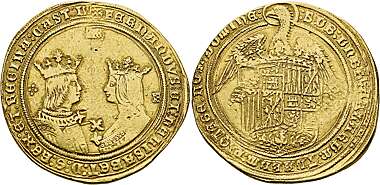
Los 1709. Spain, Fernando and Isabel, 1474-1504. AV 10 Excelentes, Segovia, assayer F, im. cross potent. Struck after 1497. FERNANDUS[three dots vertical] ET[three dots vertical] HELISABET: D: G: REX: ET: REGINA: CAST: L: crowned and draped busts vis-à-vis, value X between, cross of five pellets behind king, F behind queen, aqueduct above, rev. :SVB: VNBRA: ALARVM: TVARVM: PROTEGE: NOM: DOMINE: crowned shield of arms over eagle. Annulet stops. 35.15 g. Museo Arqueológico Nacional 104732 – same dies; HAS 8512 – this coin; A.C. type 197, no. 779 – this coin illustrated. Some double striking on reverse. Minor marks. Otherwise richly toned and better than VF. Excellent detail to portraits. A most impressive multiple of the highest rarity and great numismatic importance. Ex Selección de Monedas del Colleción Archer M. Huntington (J. Vico, 26 June 2012), lot 438. Hispanic Society of America collection. The 10 excelente belongs to one of the most transformative periods in Spanish history. Following the conquest of Granada in 1492 and the arrival of Columbus in the New World, the power and international ambitions of the Catholic Monarchs were expanding rapidly. The monetary reform promulgated at Medina del Campo in 1497 sought to modernise Castilian coinage, establishing the excelente de la Granada on the weight and fineness of the Venetian ducat, then the principal gold coin of international commerce. The type of this new coin, bearing the facing busts of the king and queen on the obverse and the quartered shield of Castile-Leon and the territories of the Crown of Catalonia-Aragon above the emblem of the Kingdom of Granada on the reverse, provided a potent visual affirmation of the unity of the Spanish realms. The reform also provided for multiples of the excelente, including the exceptional 10, 20 and 50 excelente pieces. Large gold multiples had been issued by earlier Spanish monarchs, but the production of these extraordinary pieces represents an Iberian genesis of what would become a wider European development towards increasingly substantial gold denominations, exemplified by Manuel I’s 10-cruzado português of Portugal, issued at about the same time. The largest Spanish multiples appear to have been confined to the mints of Segovia and Seville, with the 10-excelente represented only at Segovia. The possible presence of such multiples within the royal treasury is documented by an inventory of the Cámara of Ferdinand at Madrid in 1510, which records ‘un excelente de diez excelentes’. On these massive multiples, as well as on the more commonly encountered 2 and 4 excelente pieces, an outspread eagle representing St John the Evangelist stands behind the royal shield, a personal emblem of Isabella reflecting her particular devotion to the saint. Its wings, together with the legend SVB VMBRA ALARVM TVARVM PROTEGE NOS (‘Protect us under the shadow of your wings’), reinforce the theme of divine guardianship. A very small number 10 excelente pieces have survived. In addition to the present specimen, ex Huntington and illustrated as Calicó 779, we are aware of only three further examples: the specimen in the Museo Arqueológico Nacional, ex Ferrán Rosa collection and struck from the same dies; the specimen from the Calicó Collection illustrated in MEC 6, The Iberian Peninsula, p. 414, fig. 69; and the example offered in Elsen 161, lot 1165, bearing assayer mark P. Of the three in private hands, the coin offered here is the finest.
Startpreis:
200'000 CHF
218'516 EUR
182'161 GBP
245'603 USD
Nur ungefähre, gerundete WerteDatum:
05.11.2026
 consentmanager.net