Catherine the Great dominates the auction
They appear in every auction; they’re called “sleepers”—coins whose true rarity isn’t reflected in the estimate. The fact that they eventually fetch their true value is due to their exposure in media read by the right customers. An excellent example is a 10-ruble coin offered by the Heidelberger Münzhandlung on May 12, 2026.
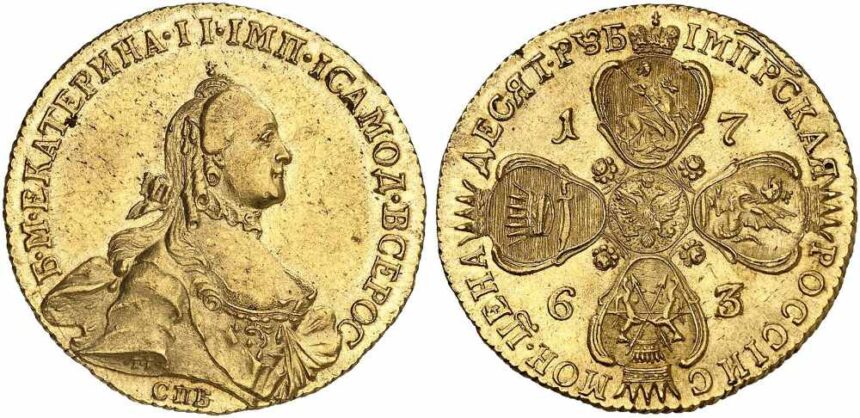
What is depicted on the 10-ruble coin from 1763?
Those not specifically interested in Russian Imperials would likely have noticed nothing amiss, as the design deviates in no way from the usual type. The obverse depicts a portrait of the young, crowned Tsarina wearing an ermine mantle. A light veil falls over her hair and neck. The inscription reads (in translation): By the Grace of God, Catherine II, Empress and Autocrat of all Russians. The three letters below the bust indicate the St. Petersburg mint. A closer look reveals two further letters on the sleeve, the signature of the medalist Timofei Ivanovich Ivanov (1729-1803).
The reverse depicts the crowned coats of arms of the four kingdoms surrounding the Russian double-headed eagle: at the top, Moscow with St. George on horseback slaying the dragon; to the right, Kazan with the crowned, winged dragon; at the bottom, Siberia with two sables, two arrows, and a bow, above which is the crown; and to the left, Astrakhan with a crown above an oriental saber. The inscription reads (in translation): Imperial Russian coin, value ten rubles.
The year 1763 and the overthrow of Peter III.
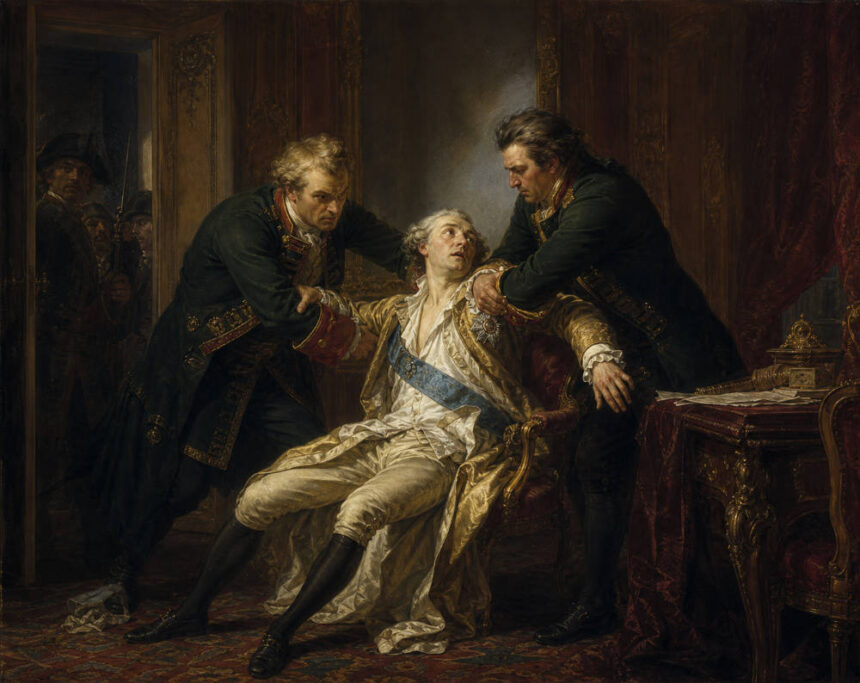
The story of this coin is closely intertwined with one of the most gripping episodes in Russia’s history, a history certainly not lacking in violence. At its heart is Peter III, the adopted heir to the throne from Schleswig-Holstein, who was deeply inspired by the ideals of the Enlightenment. He assumed power in Russia on January 5, 1762. Within 186 days, he enacted 220 new laws. Then this flurry of legislation came to an abrupt end, for his wife Catherine, also German, exploited the Russian nobility’s lack of willingness to reform to initiate a palace coup. No wonder, since the vivacious woman feared divorce after the Tsar wasn’t even certain whether the heir to the throne was his own child. With the support of her lover, Grigory Orlov, and his brothers, she imprisoned her husband, perhaps even ensuring his death, and ascended the throne herself.
The fact that Peter III is still sometimes portrayed as incompetent, even childish, is due to the excellent propaganda of his wife, who was a master at falsifying history. For example, she paid Voltaire, the most important opinion leader in Europe, to spread her version of events.
Catherine’s policies were reflected in her coinage. And here we come back to the Imperial from 1763.
Why are Imperials dated 1763 so rare?
For Catherine not only immediately had new coins minted with her portrait; wherever possible, she also had the imperial coins bearing the portrait of her deposed husband used as blanks. His image was to disappear from public view. Well, overstrikes are technically more challenging than strikes on new blanks, which is why the coins of this year are not always perfectly struck.
That is, if one can find them at all, because on December 18, 1763, Catherine issued an imperial rescript changing the standard for Imperials. From then on, they were to be minted with 20% less gold. Heavy Imperials, which had entered the state treasury through taxes or other payments, were immediately melted down and minted into new Imperials. This yielded a considerable profit per Imperial.
Many gold coins from Catherine’s first reign were therefore melted down. Very few survived, and even fewer in such fabulous condition as the one offered by the Heidelberger Münzhandlung. Several specialists recognized the rarity of the piece and bid high among themselves. Thus, this historically significant rarity of Russian numismatics climbed to €325,000.
It only takes two specialists…
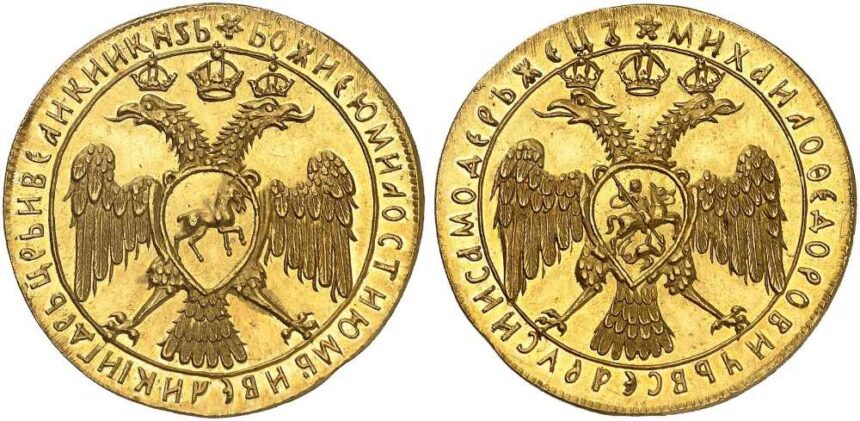
The same thing happened with the Novodel from the 4-ducat piece, which we featured in our article “What is a Novodel?”. It climbed to €30,500, three times its estimate. And so we can now answer the question with which our article concluded: Would the Novodel or the contemporary coin rise higher? The contemporary coin, being extremely rare, fetched roughly ten times the price of the equally rare Novodel. This was also due to effective media coverage that drew public attention to both pieces.
Text and images: Ursula Kampmann