The Short-Whiskered Dragon
Heritage has valued a proof coin from the Chinese mint in Tianjin, dated 1911, at US$2 million. The proof coin is extremely rare; only three examples are known to be in private hands. More importantly, however, is its historical significance, as the coin symbolises the changing times in China.
On 17 June 2026, Heritage will hold an auction in Hong Kong. It features a number of highlights from the world of Chinese numismatics. The undisputed highlight is a proof coin that numismatists refer to as the ‘Short-Whiskered Dragon’ dollar. Here, we explain why this dragon with the short whiskers could be worth US$2 million – and perhaps considerably more.
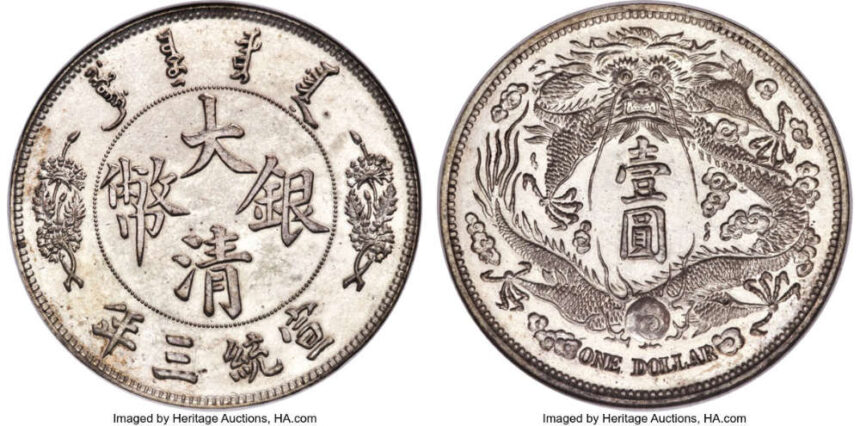
What can be seen on the Short-Whiskered Dragon Dollar?
First of all, one thing: strictly speaking, the side of the dollar featuring only text should be described as the obverse. However, auction catalogues tend to depict the side with the dragon as the obverse, presumably because the image is far more striking.
So let us refer to it as the text side. In the centre, we read – naturally all in Chinese characters – ‘Silver coin of the Great Qing’.
At the top and bottom of the rim is the identical date: the 3rd year of the Xuantong era. The name given to Puyi’s reign could be roughly translated as ‘committed to tradition’.
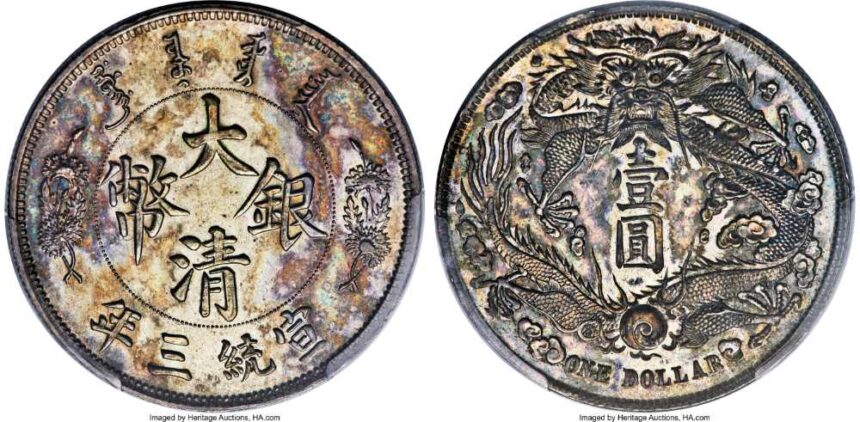
This refers to the third year of Puyi’s reign, 1911. Whilst the date at the bottom is rendered in Chinese characters, the characters at the top are in Manchu, the language of Manchuria. The inscription thus alludes to the original origins of the Qing dynasty.
The reverse side depicts a mighty Chinese dragon, whose body encircles the characters for the unit “One Yuan”. Beneath this, the words “ONE DOLLAR” are written in Latin letters. Of particular note are the whiskers, which extend only as far as the first character of the inscription.
Why is the Short-Whiskered Dragon such a special coin?
There are many rare coins in numismatics. Most of them can be bought for sums in the thousands or tens of thousands. For a coin to be worth $2 million, there has to be something more to it. It must evoke emotions; it must hold significance for those who wish to own it. To understand why this coin evokes such strong feelings, we need to take a brief look back at the history of Chinese currency.
The Chinese Coinage Reform
Well into the 19th century, China had a monetary system that was completely different from that of the West. People who bought small everyday items paid with coins made of base metal. These were produced throughout the empire and served purely as a medium of exchange. Those wishing to save invested in silver. This was not acquired in the form of state-issued coins, but as privately produced ingots. The state, however, set the weights and ensured compliance. Gold played no role in this system.
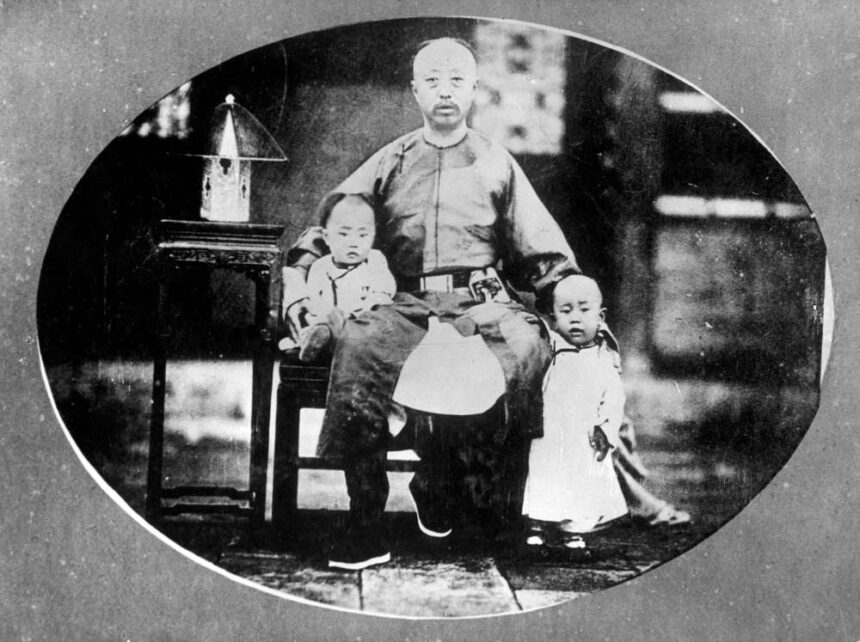
By the end of the 19th century, all countries whose currency was based on silver were grappling with a problem: the price of silver had fallen dramatically. This also plunged China into crisis. On top of this, foreign economic partners were pressing for the introduction of a monetary system based on the Western model. Several provincial governors did so, others did not. The result was financial chaos, which was under constant strain due to the depreciation of Chinese currencies.
Then came a change of government: on 13 November 1908, the influential Empress Dowager Cixi made the two-year-old Puyi heir to the throne; on 14 November 1908, Emperor Guangxu died – rumoured to have been poisoned; on 15 November, the power-broker Cixi died.
This delayed the long-overdue currency reform that Guangxu had indeed begun. His decision to have a tael minted with a fineness of 980/1000 was overturned. Puyi’s father established the Currency Reform Investigation Bureau, which proposed creating the yuan with a fineness of 900/1000, thereby bringing it into line with Western currencies. This decision was confirmed at a conference to which representatives from banks in Britain, the USA, France and Germany were invited. These banks were to provide China with the enormous loan – said to be around 50 million US dollars – with which the country’s infrastructure could be modernised.
Luigi Giorgi
The mint in Tientsin, now Tianjin, was commissioned to produce the proofs. Giorgi Luigi (1880–1954) was responsible for the dies. This Giorgi Luigi should not be confused with the chief engraver of the Italian mint of the same name.
Our Giorgi Luigi was born in Milan in 1880 and trained at the Scuola di Disegno of the Accademia di Belle Arti di Brera in Milan. From 1904 to 1910, he worked for Stefano Johnson, a renowned Italian private mint.
In 1910, Luigi moved to China with his entire family to work as chief engraver in Tientsin and to oversee the training of future die-cutters. The post had been arranged by the Italian ambassador in Beijing. Giorgi’s appointment was initially limited to three years, but was extended twice. His first major commission was the design of the new, pan-Chinese currency, the yuan.
Before we look into this, let’s first consider what happened to Giorgi next: in 1919, the Chinese Ministry of Finance decided not to renew his contract. The reason for his ‘dismissal’ may have been a cultural misunderstanding, which a dishonest translator exploited for his own ends: whilst the Chinese Ministry of Finance assumed that Giorgi’s salary covered all the stamps, Giorgi expected a bonus for each stamp, as was customary in Europe.
In 1920, Giorgi returned to Varese in Italy. There he initially worked as an independent engraver before founding a photography and optics business in Varese with his sons, where he died in 1954.
The designs for the new yuan
Luigi Giorgi developed three different types of imperial dragon for the central government’s new yuan:
· Long-Whiskered Dragon – with long whiskers extending down to the denomination
· Short-Whiskered Dragon – with short whiskers and a prominent dragon’s head
· Curved-Whiskered Dragon – with curved whiskers
Eduard Kann, author of the standard work on Chinese numismatics, corresponded with Giorgi. Kann’s reconstruction of the motif’s development is therefore likely to be accurate. He reports on several phases of revision following the creation of the Long-Whiskered Dragon. This was followed by a revision of the calligraphy and the floral elements.
Giorgi then shortened the whiskers. There are even said to have been transitional designs featuring a medium-length moustache. It was only towards the end that the Curved-Whiskered Dragon was developed, the direct model for the ‘Flying Dragon’ on the dollars that were actually minted.
This was minted at the mints in Tientsin and Wuchang and put into circulation without much fanfare in 1911 to pay the soldiers of the government forces. The revolution had begun. Puyi was defeated. The Republic triumphed. The coin design remained. It was not replaced until 1914 with one that seemed better suited to the new Republic.
Thus, the trial issues of the new yuan stand at the crossroads between old and new China. They are a symbol of transition, and can be interpreted both as the last coins of the Chinese emperors and as the first coins of the young Republic.
What is a Short-Whiskered Dragon Dollar worth?
A ‘Long-Whiskered Dragon’ fetched one million dollars without a premium at Heritage in December 2021. This is the highest price recorded by CoinArchive for this type. Hammer prices vary greatly depending on quality and auction house. One thing is clear, however. Whilst a “Long-Whiskered Dragon” is offered somewhere almost every year, not a single “Short-Whiskered Dragon” – apart from the one currently on offer at Heritage – is listed on CoinArchive.
We will, of course, report back to you on what the coin fetches on 17 June 2026.
Update from July 1, 2026:
As early as June 18, 2026, Heritage issued a press release proudly announcing that the “Short-Whiskered Dragon” pattern coin had sold for 4.88 million USD. The hammer price was $4 million, equivalent to 3.51 million euros. This is an impressive result, as it makes the “Short-Whiskered Dragon” the most expensive “World Coin” ever sold by Heritage. Kyle Johnson, Managing Director of World & Ancient Coins, commented: “We are very pleased to set another record at the HKINF. The Peh family collection continues to yield some of the most outstanding coins ever to enter the collector’s market, and we look forward to offering additional pieces at the next HKINF, December 5–7, 2026.”
In total, the two auctions conducted by Heritage during the Hong Kong International Numismatic Fair (HKINF) achieved an impressive total of approximately 27 million USD—including the buyer’s premium.
We have commented on this price and put it into context based on other auction results from June 2026.
Text and images: Ursula Kampmann