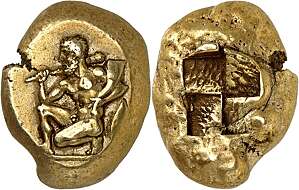
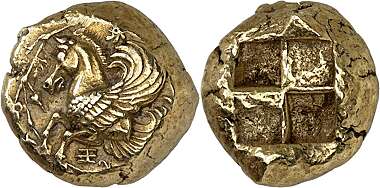
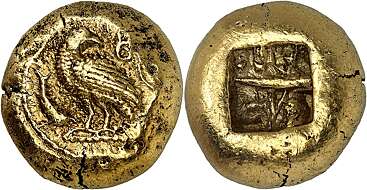
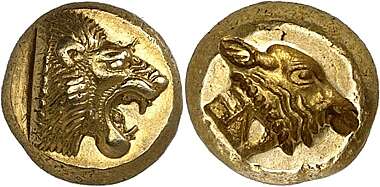
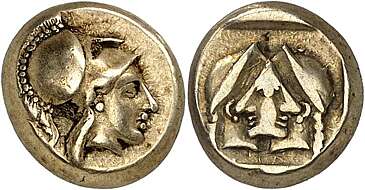
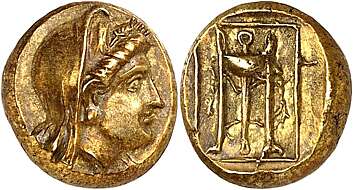
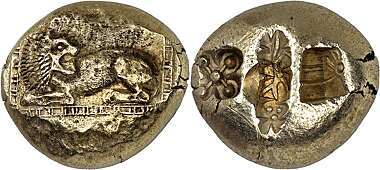
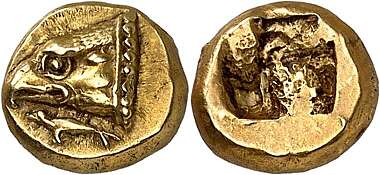
Register for Live-Bidding
Numismatica Genevensis SA Logo
Lot
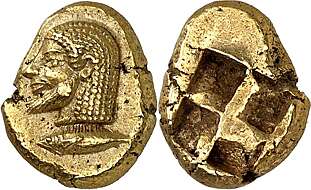
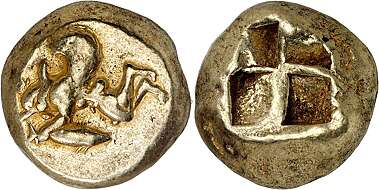
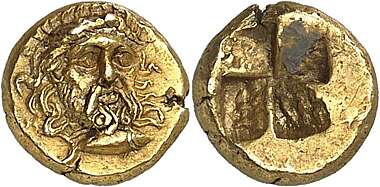
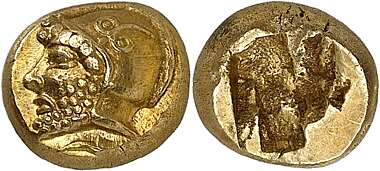
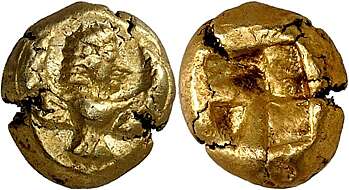
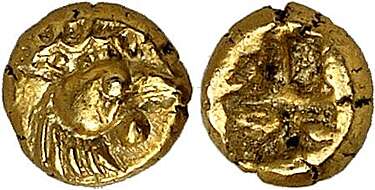
Lot 1. Mysia Kyzikos. Electrum Hekte circa 550-500 BC. Bearded archaic male head left; tuna fish left below / Quadripartite incuse square. 2,66g. Greenwell 78; Jameson 2170; SNG France 194; cf. von Fritze 66 (unlisted denomination). Of great archaic style. Good extremely fine. Provenance: Nomos 20 (10 July 2020), 179. This remarkable hekte offers a superb example of the Greek Archaic style. The male portrait depicted on the coin is distinguished by a hieratic treatment of the face, stylized hair, and a solemn expression, all characteristic features of Archaic aesthetics. The famous Archaic smile can even be discerned. Rather than pursuing realism, the engraver emphasized the symbolic power of the image, giving the figure an enduring and timeless presence. Ce remarquable hekte offre un superbe exemple du style archaïque grec. Le portrait masculin représenté se distingue par un traitement hiératique du visage, des cheveux stylisés et une expression empreinte de solennité, caractéristiques de l'esthétique archaïque. On distingue même le fameux sourire archaïque. Loin de rechercher le réalisme, le graveur a privilégié la puissance symbolique de l'image donnant au personnage une présence intemporelle.
  • Starting price:
    2'000 CHF
    2'182 EUR
    1'821 GBP
    2'449 USD

    Rounded approximations onlyDate: 11/05/2026

Please note that bids can only be placed in the bidding steps specified by the auction house.

  • 0 CHF - 200 CHF : 10 CHF Steps
  • 200 CHF - 500 CHF : 20 CHF Steps
  • 500 CHF - 1'000 CHF : 50 CHF Steps
  • 1'000 CHF - 2'000 CHF : 100 CHF Steps
  • 2'000 CHF - 5'000 CHF : 200 CHF Steps
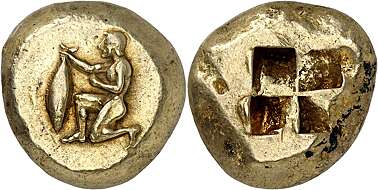
  • 5'000 CHF - 10'000 CHF : 250 CHF Steps
  • 10'000 CHF - 20'000 CHF : 500 CHF Steps
  • 20'000 CHF - 50'000 CHF : 2'000 CHF Steps
  • 50'000 CHF - 100'000 CHF : 5'000 CHF Steps
  • 100'000 CHF - 200'000 CHF : 10'000 CHF Steps
  • 200'000 CHF - 500'000 CHF : 20'000 CHF Steps
  • 500'000 CHF - 1'000'000 CHF : 50'000 CHF Steps
  • > 1'000'000 CHF    : 100'000 CHF Steps
Lot
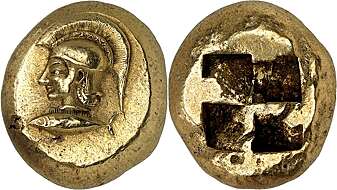
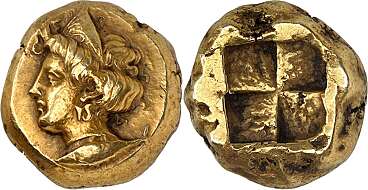
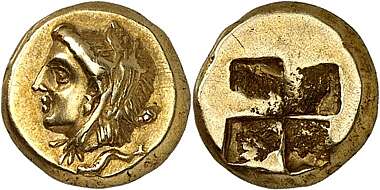
Lot 2. Mysia Kyzikos. Electrum Stater circa 550-475 BC. Head of Athena left wearing crested Attic helmet, tuna fish left below / Quadripartite incuse square. 16,05g. Gillet 1053; Greenwell 25; Jameson 2171; Kraay-Hirmer 701; Traité pl. VI, 28; von Fritze 67, pl. II, 20; Weber 4791 (all from the same obverse die). Very rare. A splendid portrait in exceptional quality. Good extremely fine. Provenance: From the A.F. Collection (formed in Germany), Roma XIX (26 March 2020), 488. According to the Palatine Anthology, Kyzikos housed the oldest sanctuary of Athena in Asia. The presence of Athena’s portrait on the city’s staters confirms the predominant role of the Goddess and her cult in local religious life. Brett noted similarities between this portrait of Athena and the one appearing on Athenian coins of the 6th and 5th centuries BC, particularly in the rendering of the helmet. These parallels reveal reciprocal influences between Kyzikos and Athens, reflecting sustained exchanges between the city and mainland Greece, both culturally and commercially. Selon l’Anthologie Palatine, Cyzique abritait le plus ancien sanctuaire d’Athéna en Asie. La présence du portrait d'Athéna sur les statères de la cité confirme le rôle prépondérant de la déesse et de son culte dans la vie religieuse locale. Brett a relevé des similitudes entre ce portrait d’Athéna et celui figurant sur les monnaies athéniennes des VIᵉ et Vᵉ siècle av. J.‑C. Ces similitudes révèlent des influences réciproques entre Cyzique et Athènes, reflet d’échanges soutenus entre la cité et la Grèce continentale, tant sur les plans culturels que commerciaux.
  • Starting price:
    25'000 CHF
    27'287 EUR
    22'763 GBP
    30'624 USD

    Rounded approximations onlyDate: 11/05/2026

Please note that bids can only be placed in the bidding steps specified by the auction house.

  • 0 CHF - 200 CHF : 10 CHF Steps
  • 200 CHF - 500 CHF : 20 CHF Steps
  • 500 CHF - 1'000 CHF : 50 CHF Steps
  • 1'000 CHF - 2'000 CHF : 100 CHF Steps
  • 2'000 CHF - 5'000 CHF : 200 CHF Steps
  • 5'000 CHF - 10'000 CHF : 250 CHF Steps
  • 10'000 CHF - 20'000 CHF : 500 CHF Steps
  • 20'000 CHF - 50'000 CHF : 2'000 CHF Steps
  • 50'000 CHF - 100'000 CHF : 5'000 CHF Steps
  • 100'000 CHF - 200'000 CHF : 10'000 CHF Steps
  • 200'000 CHF - 500'000 CHF : 20'000 CHF Steps
  • 500'000 CHF - 1'000'000 CHF : 50'000 CHF Steps
  • > 1'000'000 CHF    : 100'000 CHF Steps
Lot
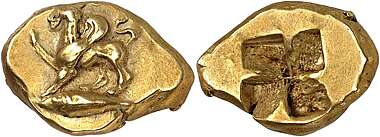
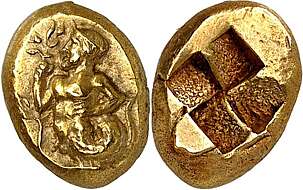
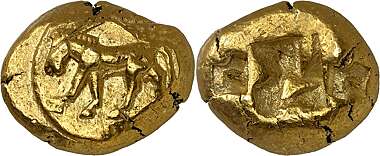
Lot 3. Mysia Kyzikos. Electrum Hekte circa 550-475 BC. Sphinx, front paw right lifted, standing left on tuna fish / Quadripartite incuse square. 2,62g. Greenwell 99; SNG Lockett 2690; Traité I, 297; von Fritze 127. Good very fine. Provenance: Leu 71 (24 October 1997), 189. NGSA 5 (3 December 2008), 105. Baron Lorne Thyssen-Bornemisza Collection. The sphinx depicted on the obverse of this hekte is traditionally associated with Dionysus. This association is hardly surprising given that the city of Cyzicus was surrounded by vineyards and that a statue of Dionysus stood at the heart of the city. However, Mikhail G. Abramzon and Nina A. Frolova, who have extensively studied electrum coinage, suggest that the engravers of Cyzicus simply adopted the iconography of the staters and hektes of Chios, on which the sphinx is a recurring motif. According to this interpretation, this hekte would represent an appropriation of the monetary iconography of another city. Le sphinx représenté à l'avers de cette hekte est traditionnellement associé à Dionysos. Cette association n'a rien de surprenant lorsque l'on sait que la cité de Cyzique était entourée de vignobles et qu'une statue de Dionysos se dressait au cœur de la ville. Toutefois, les chercheurs Mikhail G. Abramzon et Nina A. Frolova, qui ont longuement étudié les monnayages d'électrum, suggèrent que les graveurs de Cyzique auraient tout simplement repris l'iconographie des statères et hekte de Chios, sur lesquels le sphinx constitue un motif récurrent. Il s'agirait donc d'une appropriation de l'iconographie monétaire d'une autre cité.
  • Starting price:
    4'000 CHF
    4'365 EUR
    3'642 GBP
    4'899 USD

    Rounded approximations onlyDate: 11/05/2026

Please note that bids can only be placed in the bidding steps specified by the auction house.

  • 0 CHF - 200 CHF : 10 CHF Steps
  • 200 CHF - 500 CHF : 20 CHF Steps
  • 500 CHF - 1'000 CHF : 50 CHF Steps
  • 1'000 CHF - 2'000 CHF : 100 CHF Steps
  • 2'000 CHF - 5'000 CHF : 200 CHF Steps
  • 5'000 CHF - 10'000 CHF : 250 CHF Steps
  • 10'000 CHF - 20'000 CHF : 500 CHF Steps
  • 20'000 CHF - 50'000 CHF : 2'000 CHF Steps
  • 50'000 CHF - 100'000 CHF : 5'000 CHF Steps
  • 100'000 CHF - 200'000 CHF : 10'000 CHF Steps
  • 200'000 CHF - 500'000 CHF : 20'000 CHF Steps
  • 500'000 CHF - 1'000'000 CHF : 50'000 CHF Steps
  • > 1'000'000 CHF    : 100'000 CHF Steps
Lot
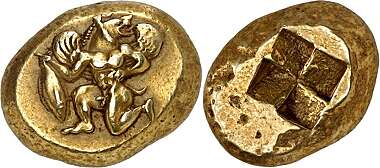
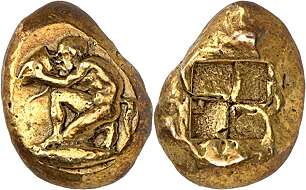
Lot 4. Mysia Kyzikos. Electrum Stater circa 550-450 BC. Winged creature with the head and torso of a horned dolphin, the abdomen, arms, and legs of a nude human, swimming or flying left, holding in right hand the tail of a tuna fish right / Quadripartite incuse square. 16,02g. BMC –; BMFA –; Gillet –; Gulbenkian –; Greenwell –; Jameson –; Kraay & Hirmer 699 = Prinkipo 57; SNG BN –; cf. von Fritze I 79 (unlisted denomination); Weber –; cf. Triton XX, lot 226 and Roma XI, lot 407. Extremely rare, apparently the fifth specimen known. Very fine. Provenance: CNG 114 (13 May 2020), 226. The figure depicted on the obverse of this stater raises several questions, as no hybrid being, half-man and half-dolphin, is attested in Greek mythology. In Archaic Greek iconography, wings nevertheless constituted a conventional attribute used to identify the divine nature of an individual. Their presence on this figure therefore suggests that it is indeed a deity. Some scholars have proposed that it may refer to an episode from the mythological cycle of Apollo. After his birth on the island of Delos, the God reached adulthood in only four days before embarking on a journey in search of a place where he could establish his sanctuary. His travels eventually led him to Mount Parnassus, where the site of Pytho was located, then occupied by the oracle of Gaia and protected by the serpent Python, son of the Earth. Apollo slew the monster with an arrow and took possession of the sanctuary. However, this act of killing required purification: the God had to atone for his deed by serving for nine years in the household of Admetus, king of Pherae in Thessaly. Upon his return to Pytho, Apollo is said to have arrived in the form of a dolphin. The sanctuary then took the name Delphi, derived from the Greek term delphis, meaning “dolphin”. It is therefore possible that the engraver intended to represent Apollo by emphasizing his connection with Delphi. This hypothesis finds a particular resonance in the mythical traditions of Cyzicus, which establish a close link between the city and the God Apollo. Some sources indeed attribute to the eponymous founder of Cyzicus a divine ancestry connected with Apollo, while Aristides goes so far as to present the God himself as the founder of the city. La figure représentée à l'avers de ce statère soulève plusieurs interrogations, aucun être hybride mi-homme, mi-dauphin n'étant attesté dans la mythologie grecque. Dans l'iconographie grecque archaïque, les ailes constituaient toutefois un attribut conventionnel permettant d'identifier la nature divine d'un individu. Leur présence sur cette figure suggère donc qu'il s'agit bien d'une divinité. Certains spécialistes ont proposé d'y reconnaître une référence à un épisode du cycle mythologique d'Apollon. Après sa naissance sur l'île de Délos, le dieu atteignit l'âge adulte en seulement quatre jours avant d'entreprendre un voyage à la recherche d'un lieu destiné à accueillir son sanctuaire. Son périple le mena jusqu'au mont Parnasse, où se trouvait le site de Pythô, alors occupé par l'oracle de Gaïa et protégé par le serpent Python, fils de la Terre. Apollon tua le monstre d'une flèche et prit possession du sanctuaire. Toutefois, ce meurtre exigeait une purification : le dieu dut expier sa faute en servant pendant neuf années auprès d'Admète, roi de Phères en Thessalie. À son retour à Pythô, Apollon serait arrivé sous la forme d'un dauphin. Le sanctuaire prit alors le nom de Delphes, issu du terme grec delphis, signifiant « dauphin ». Il est donc possible que le graveur ait cherché à représenter Apollon en insistant sur son lien avec Delphes. Cette hypothèse trouve un écho particulier dans les traditions mythiques de Cyzique qui établissent un lien étroit entre la cité et le dieu Apollon. Certaines sources attribuent, en effet, au fondateur éponyme de Cyzique une ascendance divine liée à Apollon, tandis qu'Aristide va jusqu'à présenter le dieu lui-même comme le fondateur de la cité.
  • Starting price:
    10'000 CHF
    10'914 EUR
    9'105 GBP
    12'249 USD

    Rounded approximations onlyDate: 11/05/2026

Please note that bids can only be placed in the bidding steps specified by the auction house.

  • 0 CHF - 200 CHF : 10 CHF Steps
  • 200 CHF - 500 CHF : 20 CHF Steps
  • 500 CHF - 1'000 CHF : 50 CHF Steps
  • 1'000 CHF - 2'000 CHF : 100 CHF Steps
  • 2'000 CHF - 5'000 CHF : 200 CHF Steps
  • 5'000 CHF - 10'000 CHF : 250 CHF Steps
  • 10'000 CHF - 20'000 CHF : 500 CHF Steps
  • 20'000 CHF - 50'000 CHF : 2'000 CHF Steps
  • 50'000 CHF - 100'000 CHF : 5'000 CHF Steps
  • 100'000 CHF - 200'000 CHF : 10'000 CHF Steps
  • 200'000 CHF - 500'000 CHF : 20'000 CHF Steps
  • 500'000 CHF - 1'000'000 CHF : 50'000 CHF Steps
  • > 1'000'000 CHF    : 100'000 CHF Steps
Lot
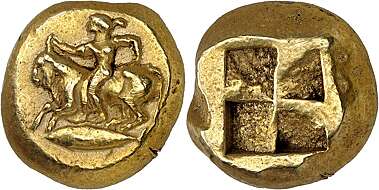
Lot 5. Mysia Kyzikos. Electrum Stater circa 550-450 BC. Europa riding bull left, holding its horns with her right hand, left hand resting on its hindquarters; below, tuna fish left / Quadripartite incuse square. 15,99g. BMFA 1477 = Warren 1426; Greenwell –; SNG France 250; von Fritze 108, pl. III, 27; cf. Jameson 1411 (Hekte). A pleasant specimen. Good very fine. Provenance: CNG 111 (29 May 2019), 212. In Greek mythology, Europa, daughter of Agenor, king of Tyre in Phoenicia, was at the center of a famous episode involving Zeus’s amorous deception. While she was near Sidon, the God took the form of a magnificent white bull in order to approach her without arousing her suspicion while also avoiding the anger of his wife Hera. Captivated by the animal, Europa climbed onto its back and was carried away by Zeus to Crete, where some traditions place her arrival at Gortyn, while others locate the event further north, near the Bosporus. In Crete, Zeus abandoned his animal form and united with Europa in his divine guise. Their union produced three famous sons: Minos, the legendary future king of Crete; Rhadamanthus, associated with justice in the afterlife; and Sarpedon, who later left Crete and settled in Cilicia. Europa subsequently married Asterion, king of Crete, who raised her children. This magnificent stater therefore depicts the abduction of Europa by Zeus, transformed into a bull: one of the most celebrated episodes of Greek mythology. Dans la mythologie grecque, Europe, fille d'Agénor, roi de Tyr en Phénicie, fut au centre d'un épisode célèbre mettant en scène la ruse amoureuse de Zeus. Alors qu'elle se trouvait près de Sidon, le dieu prit l'apparence d'un magnifique taureau blanc afin de l'approcher sans éveiller sa méfiance tout en évitant la colère de son épouse Héra. Séduite par l'animal, Europe monta sur son dos et fut alors emportée par Zeus jusqu'en Crète où certaines traditions situent son arrivée à Gortyne, tandis que d'autres évoquent une localisation plus septentrionale, près du Bosphore. En Crète, Zeus abandonna son apparence animale et s'unit à Europe sous sa forme divine. De cette union naquirent trois fils célèbres : Minos, futur roi légendaire de Crète, Rhadamanthe, associé à la justice dans l'au-delà, et Sarpédon, qui quitta ensuite la Crète pour s'établir en Cilicie. Par la suite, Europe épousa Astérion, roi de Crète, qui éleva ses enfants. Ce magnifique statère représente donc l'enlèvement d'Europe par Zeus métamorphosé en taureau : un des épisodes les plus connus de la mythologie grecque.
  • Starting price:
    10'000 CHF
    10'914 EUR
    9'105 GBP
    12'249 USD

    Rounded approximations onlyDate: 11/05/2026

Please note that bids can only be placed in the bidding steps specified by the auction house.

  • 0 CHF - 200 CHF : 10 CHF Steps
  • 200 CHF - 500 CHF : 20 CHF Steps
  • 500 CHF - 1'000 CHF : 50 CHF Steps
  • 1'000 CHF - 2'000 CHF : 100 CHF Steps
  • 2'000 CHF - 5'000 CHF : 200 CHF Steps
  • 5'000 CHF - 10'000 CHF : 250 CHF Steps
  • 10'000 CHF - 20'000 CHF : 500 CHF Steps
  • 20'000 CHF - 50'000 CHF : 2'000 CHF Steps
  • 50'000 CHF - 100'000 CHF : 5'000 CHF Steps
  • 100'000 CHF - 200'000 CHF : 10'000 CHF Steps
  • 200'000 CHF - 500'000 CHF : 20'000 CHF Steps
  • 500'000 CHF - 1'000'000 CHF : 50'000 CHF Steps
  • > 1'000'000 CHF    : 100'000 CHF Steps
Lot
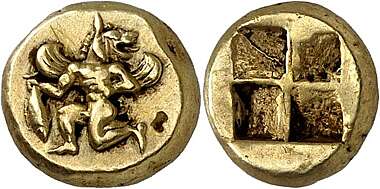
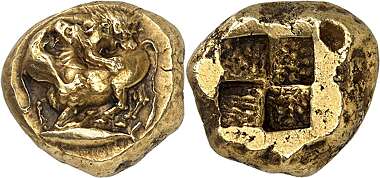
Lot 6. Mysia Kyzikos. Electrum Stater circa 500-475 BC. Winged creature with a human body and lion's face, running left, head turned back and holding a tuna in its right hand / Quadripartite incuse square. 16,06g. Jameson 2560; Traité II, 2712, pl. 175, 37; SNG von Aulock 1198 = Franke-Hirmer pl. 198, 704 = Mildenberg Vestigia pl. 7, 62 (this coin); von Fritze 123, pl. IV, 9; Warren 1471. An outstanding creation, somewhere between the monstrous and the harmonious. A superb specimen and the finest known. Provenance: H. von Aulock Collection (1906-1980), 7300, published between 1957-1968. Leu 45 (26 May 1988), 196. NGSA 5 (3 December 2008), 100. Displayed at the White Gold exhibition in 2012. Baron Lorne Thyssen-Bornemisza Collection. The fantastical creature depicted on the reverse has intrigued generations of numismatists. As early as 1887, Greenwell noted in his work on the coinage of Kyzikos that it was a “type perhaps impossible to explain with entire satisfaction” (William Greenwell, The Electrum Coinage of Cyzicus, Rollin & Feuardent, London, 1887, p. 79). Nevertheless, he believed that the motif must be of Eastern origin, probably Persian, a true reflection of the multiple influences that permeated the commercial city of Kyzikos. A few years earlier, in 1881, Dr. Imhoof Blumer had likewise emphasized the oriental origin of the creature. He noted a similar figure on a frieze from Pergamon and, based on this comparison, identified the creature as Phobos, son of Ares and Aphrodite and the personification of fear—especially the fear inspired by war—in Greek mythology. On the obverse of this stater, Phobos displays a frightening head reminiscent of a vulture, intended to evoke the horror of death on the battlefield, when funerary rites are impossible and bodies are left to the appetite of scavenging birds. His wings would symbolize the speed with which fear or death can strike. More recently, some scholars have proposed an even more Eastern provenance. Bivar argues that the figure corresponds to Areimanios in the Mithraic tradition (Ahriman), a deity associated with darkness and chaos. Other numismatists interpret it as Anubis, the Egyptian God of necropolises and mummification, or as a humanized form of Chrysaor, the winged boar, brother of Pegasus and son of Poseidon and Medusa. In sum, it appears to be a creature of Eastern inspiration, comparable to those found on temple friezes or contemporary ceramics. This exceptional stater highlights the richness and complexity of ancient belief system, in which Greek and Oriental influences intermingled. La créature fantastique représentée au revers a intrigué des générations de numismates. Dès 1887, Greenwell avertissait dans son ouvrage consacré au monnayage de Cyzique qu’il s’agissait d’un « type perhaps impossible to explain with entire satisfaction » (William Greenwell, The Electrum Coinage of Cyzicus, Rollin & Feuardent, London, 1887, p. 79). Il estimait néanmoins que ce motif devait être d’origine orientale, probablement perse, véritable reflet des influences multiples qui traversaient la cité commerciale de Cyzique. Quelques années plus tôt, en 1881, le Dr Imhoof-Blumer avait lui aussi souligné l’origine orientale de la créature. Il signalait une figure similaire sur une frise de Pergame et, à partir de cette comparaison, identifiait la créature comme Phobos, fils d’Arès et d’Aphrodite et personnification de la peur – surtout celle inspirée par la guerre – dans la mythologie grecque. Sur l’avers de ce statère, Phobos arbore une tête effrayante rappelant celle d’un vautour afin d’évoquer l’horreur de la mort sur le champ de bataille, lorsque les funérailles sont impossibles et que les dépouilles sont abandonnées aux rapaces. Ses ailes symboliseraient la rapidité avec laquelle la peur ou la mort peut frapper. Plus récemment, certains chercheurs ont proposé une provenance encore plus orientale. Bivar soutient que la figure correspondrait au Areimanios mithriaque (Ahriman), divinité associée aux ténèbres et au chaos. D’autres numismates y voient Anubis, dieu égyptien des nécropoles et de la momificaiton, ou une forme humanisée de Chrysaor, le sanglier ailé, frère de Pégase et fils de Poséidon et de Méduse. En somme, il s’agirait d’une créature d’inspiration orientale, comparable à celles que l’on rencontre sur les frises de certains temples ou sur la céramique de cette époque. Cet exceptionnel statère met en lumière la richesse et la complexité du système de croyances antiques où se mêlaient influences grecques et orientales.
  • Starting price:
    80'000 CHF
    87'319 EUR
    72'842 GBP
    97'998 USD

    Rounded approximations onlyDate: 11/05/2026

Please note that bids can only be placed in the bidding steps specified by the auction house.

  • 0 CHF - 200 CHF : 10 CHF Steps
  • 200 CHF - 500 CHF : 20 CHF Steps
  • 500 CHF - 1'000 CHF : 50 CHF Steps
  • 1'000 CHF - 2'000 CHF : 100 CHF Steps
  • 2'000 CHF - 5'000 CHF : 200 CHF Steps
  • 5'000 CHF - 10'000 CHF : 250 CHF Steps
  • 10'000 CHF - 20'000 CHF : 500 CHF Steps
  • 20'000 CHF - 50'000 CHF : 2'000 CHF Steps
  • 50'000 CHF - 100'000 CHF : 5'000 CHF Steps
  • 100'000 CHF - 200'000 CHF : 10'000 CHF Steps
  • 200'000 CHF - 500'000 CHF : 20'000 CHF Steps
  • 500'000 CHF - 1'000'000 CHF : 50'000 CHF Steps
  • > 1'000'000 CHF    : 100'000 CHF Steps
Lot
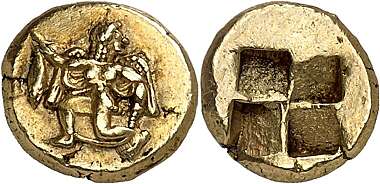
Lot 7. Mysia Kyzikos. Electrum Stater circa 500-460 BC. Winged female figure running left, head turned right, holding tuna fish in right hand and her chiton belt in left hand / Quadripartite incuse square. 16,08g. BMC Mysia 21, 25; De Luynes 2430; Greenwell 58, pl. III, 8; Kraay-Hirmer 705 (same obverse die); Kunstwerk der Antike F3 (this coin); Traité II, 281, pl. VII, 1 (same obverse die); von Fritze 121, pl. IV, 7. An exceptional specimen. Good extremely fine. Provenance: Robert Käppeli Collection (1900-2000), F3, published in 1963. Displayed at the White Gold exhibition in 2012. Baron Lorne Thyssen-Bornemisza Collection. The identity of the female figure holding a tuna on the obverse of this stater remains uncertain. Several specialists have suggested that she may represent Aphrodite‑Astarte, a divinity whose cult is attested at this period, notably in Syria. Waddington instead proposed Isis, the great Egyptian Goddess, or Nike, an interpretation now regarded as the most convincing. Indeed, Nike, the personification of victory, is frequently depicted in Greek art in the form of a winged woman. L’identité de la figure féminine tenant un thon à l’avers de ce statère demeure incertaine. Plusieurs spécialistes ont proposé d’y voir Aphrodite‑Astarté, une divinité dont le culte est attesté à cette époque, notamment en Syrie. Waddington suggérait plutôt Isis, la grande déesse égyptienne, ou Niké, hypothèse aujourd’hui considérée comme la plus convaincante. En effet, Niké, personnification de la victoire, est fréquemment représentée dans l’art grec sous les traits d’une femme ailée.
  • Starting price:
    50'000 CHF
    54'574 EUR
    45'526 GBP
    61'249 USD

    Rounded approximations onlyDate: 11/05/2026

Please note that bids can only be placed in the bidding steps specified by the auction house.

  • 0 CHF - 200 CHF : 10 CHF Steps
  • 200 CHF - 500 CHF : 20 CHF Steps
  • 500 CHF - 1'000 CHF : 50 CHF Steps
  • 1'000 CHF - 2'000 CHF : 100 CHF Steps
  • 2'000 CHF - 5'000 CHF : 200 CHF Steps
  • 5'000 CHF - 10'000 CHF : 250 CHF Steps
  • 10'000 CHF - 20'000 CHF : 500 CHF Steps
  • 20'000 CHF - 50'000 CHF : 2'000 CHF Steps
  • 50'000 CHF - 100'000 CHF : 5'000 CHF Steps
  • 100'000 CHF - 200'000 CHF : 10'000 CHF Steps
  • 200'000 CHF - 500'000 CHF : 20'000 CHF Steps
  • 500'000 CHF - 1'000'000 CHF : 50'000 CHF Steps
  • > 1'000'000 CHF    : 100'000 CHF Steps
Lot
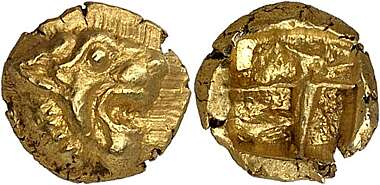
Lot 8. Mysia Kyzikos. Electrum Hekte circa 500-475 BC. Winged creature with a human body and lion's face, running left, head turned back and holding a tuna in its right hand / Quadripartite incuse square. 2,60g. Apollo to Apollo, p. 201, 36.5 (this coin); BMFA 1459; Master of Miniatures Art, p. 50 (this coin); cf. von Fritze 123 (Stater); Warren 1472. Extremely fine. Provenance: Privately purchased from Athena Gallery Munich in November 2008. From the Apollo to Apollo Collection, 36.5, p. 201.
  • Starting price:
    4'000 CHF
    4'365 EUR
    3'642 GBP
    4'899 USD

    Rounded approximations onlyDate: 11/05/2026

Please note that bids can only be placed in the bidding steps specified by the auction house.

  • 0 CHF - 200 CHF : 10 CHF Steps
  • 200 CHF - 500 CHF : 20 CHF Steps
  • 500 CHF - 1'000 CHF : 50 CHF Steps
  • 1'000 CHF - 2'000 CHF : 100 CHF Steps
  • 2'000 CHF - 5'000 CHF : 200 CHF Steps
  • 5'000 CHF - 10'000 CHF : 250 CHF Steps
  • 10'000 CHF - 20'000 CHF : 500 CHF Steps
  • 20'000 CHF - 50'000 CHF : 2'000 CHF Steps
  • 50'000 CHF - 100'000 CHF : 5'000 CHF Steps
  • 100'000 CHF - 200'000 CHF : 10'000 CHF Steps
  • 200'000 CHF - 500'000 CHF : 20'000 CHF Steps
  • 500'000 CHF - 1'000'000 CHF : 50'000 CHF Steps
  • > 1'000'000 CHF    : 100'000 CHF Steps
Lot
Lot 9. Mysia Kyzikos. Electrum Hekte circa 500-460 BC. Winged female figure running left, head turned right, holding tuna fish in right hand and her chiton belt in left hand / Quadripartite incuse square. 2,69g. BMC Mysia 21, 26; Konuk & Lorber p.58 (this coin); Traité I, 282, pl. VII, 2; cf. von Fritze 121, pl. IV, 7 (Stater). Small cracks. Good very fine. Provenance: Tkalec (24 October 2003), 101. Displayed at the White Gold exhibition in 2012. Baron Lorne Thyssen-Bornemisza Collection.
  • Starting price:
    2'000 CHF
    2'182 EUR
    1'821 GBP
    2'449 USD

    Rounded approximations onlyDate: 11/05/2026

Please note that bids can only be placed in the bidding steps specified by the auction house.

  • 0 CHF - 200 CHF : 10 CHF Steps
  • 200 CHF - 500 CHF : 20 CHF Steps
  • 500 CHF - 1'000 CHF : 50 CHF Steps
  • 1'000 CHF - 2'000 CHF : 100 CHF Steps
  • 2'000 CHF - 5'000 CHF : 200 CHF Steps
  • 5'000 CHF - 10'000 CHF : 250 CHF Steps
  • 10'000 CHF - 20'000 CHF : 500 CHF Steps
  • 20'000 CHF - 50'000 CHF : 2'000 CHF Steps
  • 50'000 CHF - 100'000 CHF : 5'000 CHF Steps
  • 100'000 CHF - 200'000 CHF : 10'000 CHF Steps
  • 200'000 CHF - 500'000 CHF : 20'000 CHF Steps
  • 500'000 CHF - 1'000'000 CHF : 50'000 CHF Steps
  • > 1'000'000 CHF    : 100'000 CHF Steps
Lot
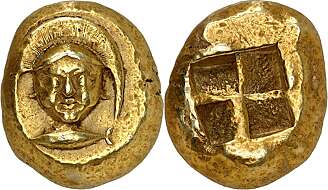
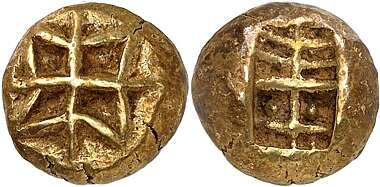
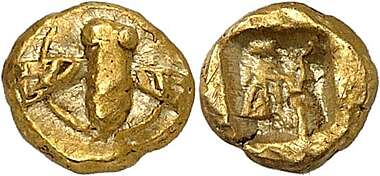
Lot 10. Mysia Kyzikos. Electrum Stater circa 500-450 BC. Facing head of Athena wearing crested helmet; below, tuna fish left / Quadripartite incuse square. 16,03g. Greenwell 30 and pl. II, 7 (possibly this coin); Traité 2611 = von Fritze 68 and pl. II, 21 (same dies); SNG France 196 (same dies). Extremely rare. Beautiful representation of Athena. Extremely fine. Provenance: Possibly Sotheby, Wilkson & Hodge (10 July 1884), 744. NAC 132 (30 May 2022), 292. This electrum stater stands out for its unusual style: the helmeted head of Athena is shown facing forward rather than in profile, as was customary. Facing portraits remain relatively rare in Greek coinage during the first half of the 5th century BC. The main contemporary parallels are the gorgoneion portraits, struck in Mysia, Thrace, and southern Italy alike. These issues likely served as models for the engravers of Kyzikos, and it is possible that this type likewise fulfilled an apotropaic function. Ce statère d’électrum se distingue par son style inhabituel : la tête casquée d’Athéna étant représentée de face et non de profil comme le veut l’usage. Les portraits de face demeurent relativement rares dans la numismatique grecque de la première moitié du Ve siècle av. J.‑C. Les principaux parallèles contemporains sont les portraits de Gorgoneion, frappés aussi bien en Mysie qu’en Thrace ou dans le sud de l’Italie. Ces émissions ont probablement servi de modèles aux graveurs de Cyzique et il est possible que ce type ait, lui aussi, rempli une fonction apotropaïque.
  • Starting price:
    50'000 CHF
    54'574 EUR
    45'526 GBP
    61'249 USD

    Rounded approximations onlyDate: 11/05/2026

Please note that bids can only be placed in the bidding steps specified by the auction house.

  • 0 CHF - 200 CHF : 10 CHF Steps
  • 200 CHF - 500 CHF : 20 CHF Steps
  • 500 CHF - 1'000 CHF : 50 CHF Steps
  • 1'000 CHF - 2'000 CHF : 100 CHF Steps
  • 2'000 CHF - 5'000 CHF : 200 CHF Steps
  • 5'000 CHF - 10'000 CHF : 250 CHF Steps
  • 10'000 CHF - 20'000 CHF : 500 CHF Steps
  • 20'000 CHF - 50'000 CHF : 2'000 CHF Steps
  • 50'000 CHF - 100'000 CHF : 5'000 CHF Steps
  • 100'000 CHF - 200'000 CHF : 10'000 CHF Steps
  • 200'000 CHF - 500'000 CHF : 20'000 CHF Steps
  • 500'000 CHF - 1'000'000 CHF : 50'000 CHF Steps
  • > 1'000'000 CHF    : 100'000 CHF Steps
Lot
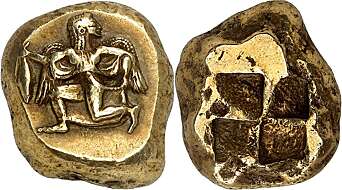
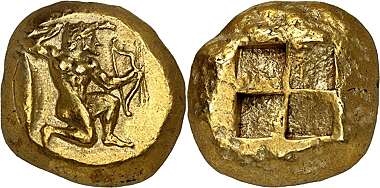
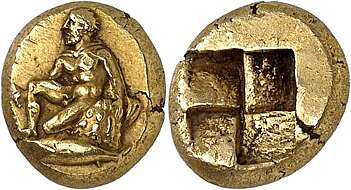
Lot 11. Mysia Kyzikos. Electrum Stater circa 500-450 BC. Herakles nude in kneeling-running stance to right, holding club overhead and bow; behind, tuna fish upward / Quadripartite incuse square. 16,00g. BMFA 1462; Greenwell 65; von Fritze 107 = Traité I 283 = BMC 27; cf. SNG France 249 (Hekte). Extremely rare and of superb archaic style. Extremely fine. Provenance: Roma XXI (24 March 2021), 212. This archaic-style stater depicts Herakles, a figure closely linked to the mythical history of the city. According to legend, driven by the Thracian winds, the Argonauts, accompanied by HeraKles, landed at Kyzikos, where they were warmly welcomed by the young king Kyzikos during his wedding celebrations. The next morning, the Argonauts climbed Mount Dindymus to determine the route to follow, leaving Herakles in charge of guarding the Argo. At that moment, giants appeared and attacked the ship, hurling huge blocks of stone into the harbour to block it and prevent the expedition from departing. A fierce battle ensued between the giants and Herakles, soon joined by his companions. The attackers were defeated one by one after a brutal struggle. The Argonauts then resumed their journey at sea, but a contrary wind drove them back once more to the shores of Kyzikos. In the darkness, the king, believing he was under attack by the Pelasgians, mobilised his men. A clash followed: the Argonauts prevailed, and in the confusion Kyzikos was killed, struck by an arrow shot either by Jason or by Herakles. At dawn, the Argonauts realised the magnitude of their mistake. Overwhelmed with remorse, they organised lavish funeral rites for the king, then purified themselves by offering a sacrifice to Rhea on the heights of Mount Dindymus. Ce statère de style archaïque représente Hercule, figure liée à l’histoire mythique de la cité. Selon la légende, poussés par les vents de Thrace, les Argonautes, accompagnés d’Hercule, débarquèrent à Cyzique où ils furent chaleureusement accueillis par le jeune roi Cyzicos, alors en pleines noces. Le lendemain matin, les Argonautes gravirent le mont Dindyme pour repérer l'itinéraire à suivre laissant à Hercule la garde de l’Argo. C’est à ce moment que des géants surgirent pour attaquer le navire lançant d’énormes blocs de pierre dans le port afin de l’obstruer et d’empêcher le départ de l’expédition. S’ensuivit un combat acharné entre les géants et Hercule, bientôt rejoint par ses compagnons. Les assaillants furent vaincus un à un au terme d’une lutte féroce. Les Argonautes reprirent ensuite leur périple en mer, mais un vent contraire les ramena de nouveau sur les côtes de Cyzique. Dans l’obscurité, le roi, croyant à une attaque des Pélasges, mobilisa ses hommes. Un affrontement éclata : les Argonautes l’emportèrent et, dans la confusion, Cyzicos fut tué, atteint d’une flèche tirée par Jason ou par Hercule. À l’aube, les Argonautes découvrirent l’ampleur de leur méprise. Accablés, ils organisèrent pour le roi des funérailles somptueuses, puis procédèrent à leur purification en sacrifiant à Rhéa sur les hauteurs du mont Dindyme.
  • Starting price:
    40'000 CHF
    43'659 EUR
    36'421 GBP
    48'999 USD

    Rounded approximations onlyDate: 11/05/2026

Please note that bids can only be placed in the bidding steps specified by the auction house.

  • 0 CHF - 200 CHF : 10 CHF Steps
  • 200 CHF - 500 CHF : 20 CHF Steps
  • 500 CHF - 1'000 CHF : 50 CHF Steps
  • 1'000 CHF - 2'000 CHF : 100 CHF Steps
  • 2'000 CHF - 5'000 CHF : 200 CHF Steps
  • 5'000 CHF - 10'000 CHF : 250 CHF Steps
  • 10'000 CHF - 20'000 CHF : 500 CHF Steps
  • 20'000 CHF - 50'000 CHF : 2'000 CHF Steps
  • 50'000 CHF - 100'000 CHF : 5'000 CHF Steps
  • 100'000 CHF - 200'000 CHF : 10'000 CHF Steps
  • 200'000 CHF - 500'000 CHF : 20'000 CHF Steps
  • 500'000 CHF - 1'000'000 CHF : 50'000 CHF Steps
  • > 1'000'000 CHF    : 100'000 CHF Steps
Lot
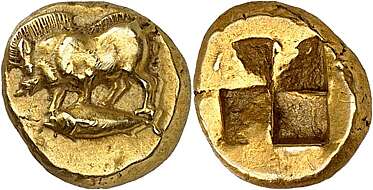
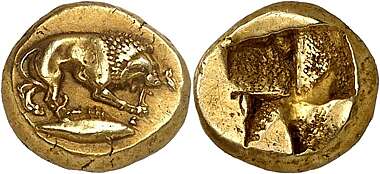
Lot 12. Mysia Kyzikos. Electrum Hekte circa 500-450 BC. Wild boar standing left on tuna fish / Quadripartite incuse square. 2,65g. BMC Mysia 31, 90; BMFA 1465; Greenwell 135; SNG von Aulock 7285 (this coin); von Fritze 90; Warren 1561. Nice extremely fine. Provenance: H. von Aulock Collection (1906-1980), 7285, published between 1957-1968. Tradart (18 November 1993), 90. Displayed at the White Gold exhibition in 2012. Baron Lorne Thyssen-Bornemisza Collection. In the Greek World, the boar was a symbol of strength and courage in the Greek imagination. The representation of the boar on this hekte may evoke one of the twelve labors of Herakles: the capture of the Erymanthian boar. Ordered by Eurystheus to bring back alive this formidable creature that was ravaging the region of Mount Erymanthus, Herakles pursued it until he exhausted it in the snow, before capturing it and carrying it back on his shoulders. This feat once again demonstrates the hero’s mastery over the wild forces of nature. References to Herakles and the myths associated with him are recurrent in coinage of Kyzikos. They reflect the importance of the hero within the religious and mythological imagination of the city, particularly due to his role in traditions connected with the Argonauts and the mythical origins of Kyzikos. De tout temps, le sanglier a été un symbole de force, de puissance et de courage dans l'imaginaire grec. La représentation du sanglier sur cet hekte pourrait évoquer l'un des douze travaux d'Hercule : la capture du sanglier d'Érymanthe. Chargé par Eurysthée de ramener vivant cette redoutable créature qui ravageait la région d'Érymanthe, Hercule parvint à la traquer jusqu'à l'épuiser dans la neige avant de la capturer et de la ramener sur ses épaules. Cet exploit illustre une nouvelle fois la maîtrise du héros sur les forces sauvages de la nature. Les références à Hercule et aux mythes qui lui sont associés sont récurrentes dans le monnayage de Cyzique. Elles témoignent de l'importance du héros dans l'imaginaire religieux et mythologique de la cité, notamment en raison de son rôle dans les traditions liées aux Argonautes et aux origines mythiques de Cyzique.
  • Starting price:
    6'000 CHF
    6'548 EUR
    5'463 GBP
    7'349 USD

    Rounded approximations onlyDate: 11/05/2026

Please note that bids can only be placed in the bidding steps specified by the auction house.

  • 0 CHF - 200 CHF : 10 CHF Steps
  • 200 CHF - 500 CHF : 20 CHF Steps
  • 500 CHF - 1'000 CHF : 50 CHF Steps
  • 1'000 CHF - 2'000 CHF : 100 CHF Steps
  • 2'000 CHF - 5'000 CHF : 200 CHF Steps
  • 5'000 CHF - 10'000 CHF : 250 CHF Steps
  • 10'000 CHF - 20'000 CHF : 500 CHF Steps
  • 20'000 CHF - 50'000 CHF : 2'000 CHF Steps
  • 50'000 CHF - 100'000 CHF : 5'000 CHF Steps
  • 100'000 CHF - 200'000 CHF : 10'000 CHF Steps
  • 200'000 CHF - 500'000 CHF : 20'000 CHF Steps
  • 500'000 CHF - 1'000'000 CHF : 50'000 CHF Steps
  • > 1'000'000 CHF    : 100'000 CHF Steps
Lot
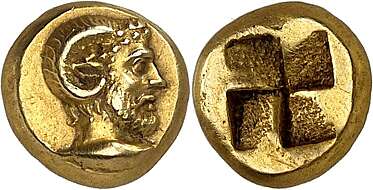
Lot 13. Mysia Kyzikos. Electrum Hekte circa 500-450 BC. Head of Ammon right with horn and ear of a ram, tuna fish below / Quadripartite incuse square. 2,68g. Cf. Greenwell 3 (Stater); cf. Gulbenkian 640; cf. Jameson 1419; cf. SNG France 281; von Fritze 130; cf. Weber 4987. Of remarkable style. Extremely fine. Provenance: Privately acquired in January 2013. Displayed at the White Gold exhibition in 2012. Baron Lorne Thyssen-Bornemisza Collection. The ram's horns identify the deity depicted as Zeus Ammon, the patron God of Cyrene, renowned for his oracular sanctuary at Siwa. This figure is the result of a religious syncretism between a local Libyan deity, assimilated to the Egyptian God Amun—traditionally represented with ram's horns—and Zeus, the supreme deity of the Greek pantheon. The depiction of Zeus Ammon on this Kyzikos' stater is nevertheless distinguished by a somewhat unusual iconographic treatment. Traditionally, the God is portrayed in an entirely human form, with the ram's horns serving as his sole distinguishing attribute. Here, however, the engraver also endowed him with a ram's ear. This iconographic feature appears on all Kyzikos' coins depicting Zeus Ammon and thus constitutes a characteristic trait of the Kyzikos' issues dedicated to this deity. Les cornes de bélier permettent d'identifier la divinité représentée comme Zeus Ammon, dieu tutélaire de Cyrène, célèbre pour son sanctuaire oraculaire de Siwa. Cette figure résulte d'un syncrétisme religieux entre une divinité libyenne locale, assimilée au dieu égyptien Amon — traditionnellement représenté avec des cornes de bélier — et Zeus, le dieu suprême du panthéon grec. La représentation de Zeus Ammon sur ce statère de Cyzique se distingue toutefois par un traitement iconographique quelque peu inhabituel. Traditionnellement, le dieu est figuré sous une apparence entièrement humaine, les cornes de bélier constituant son unique attribut distinctif. Ici, cependant, le graveur lui a également donné une oreille de bélier. Cette particularité iconographique se retrouve sur l'ensemble des monnaies de Cyzique représentant Zeus Ammon et constitue ainsi un trait caractéristique des émissions cyzicéniennes consacrées à cette divinité.
  • Starting price:
    5'000 CHF
    5'457 EUR
    4'552 GBP
    6'124 USD

    Rounded approximations onlyDate: 11/05/2026

Please note that bids can only be placed in the bidding steps specified by the auction house.

  • 0 CHF - 200 CHF : 10 CHF Steps
  • 200 CHF - 500 CHF : 20 CHF Steps
  • 500 CHF - 1'000 CHF : 50 CHF Steps
  • 1'000 CHF - 2'000 CHF : 100 CHF Steps
  • 2'000 CHF - 5'000 CHF : 200 CHF Steps
  • 5'000 CHF - 10'000 CHF : 250 CHF Steps
  • 10'000 CHF - 20'000 CHF : 500 CHF Steps
  • 20'000 CHF - 50'000 CHF : 2'000 CHF Steps
  • 50'000 CHF - 100'000 CHF : 5'000 CHF Steps
  • 100'000 CHF - 200'000 CHF : 10'000 CHF Steps
  • 200'000 CHF - 500'000 CHF : 20'000 CHF Steps
  • 500'000 CHF - 1'000'000 CHF : 50'000 CHF Steps
  • > 1'000'000 CHF    : 100'000 CHF Steps
Lot
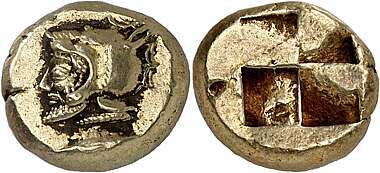
Lot 14. Mysia Kyzikos. Electrum Hekte circa 500-400 BC. Bearded male head left wearing Ketos helmet representing a sea monster, a griffin or a lion; tuna fish left below / Quadripartite mill-sail incuse square. 2,68g. Liewald I 17a; SNG von Aulock 7291. Extremely fine. Provenance: Privately purchased from NGSA in April 2012. Baron Lorne Thyssen-Bornemisza Collection. The identity of the figure depicted on the obverse of this issue remains a matter of debate. One initial hypothesis identifies him as Perseus. This identification, however, appears unlikely, as the hero is generally represented beardless in Greek iconography, whereas the figure on this coin displays a clearly defined beard. Furthermore, the headdress, long interpreted as a griffin skin, in fact displays a crest resembling a fin as well as pointed ears. These features rather suggest that it should be understood as a ketos skin, referring to the well-known sea monster of Greek mythology. Some scholars have therefore proposed an identification with Herakles. The hero is indeed associated with the ketos in the episode of the rescue of Hesione, daughter of Laomedon, who was destined to be devoured by the monster. According to legend, Herakles allowed himself to be swallowed before killing the creature from inside. This interpretation would explain the presence of a ketos skin worn as a headdress, replacing the traditional lion skin, which normally constitutes his principal attribute. Nevertheless, this mythological interpretation is not universally accepted. The portrait may also represent Poseidon. Although the God is most commonly identified by his trident, a headdress in the form of a ketos skin is also consistent with his dominion over the sea. This hypothesis finds an interesting parallel in Etruscan iconography: F. Catalli studied a Volterra vase depicting a divine head wearing a ketos headdress, initially identified as Hades but now more commonly regarded as Poseidon due to the marine attributes surrounding the figure. This interpretation is further supported by certain Etruscan coins depicting Nethuns, the Etruscan equivalent of Poseidon, with very similar features and associated with a hippocamp. L'identité du personnage figuré à l'avers de cette émission demeure sujette à débat. Une première hypothèse y voit Persée. Cette identification paraît toutefois peu convaincante, car le héros est généralement représenté imberbe dans l'iconographie grecque, alors que le personnage de cette monnaie arbore une barbe bien marquée. De plus, le couvre-chef, longtemps interprété comme une dépouille de griffon, présente en réalité une crête évoquant une nageoire ainsi que des oreilles pointues. Ces caractéristiques invitent plutôt à y reconnaître une dépouille de kétos, le monstre marin bien connu de la mythologie grecque. Certains chercheurs ont alors suggéré qu'il pourrait s'agir d'Hercule. Le héros est en effet associé au kétos dans l'épisode du sauvetage d'Hésione, fille de Laomédon, que le monstre devait dévorer. Selon la légende, Hercule se serait laissé engloutir avant de mettre la créature à mort de l'intérieur. Cette interprétation permettrait d'expliquer le port d'une dépouille de kétos en guise de couvre-chef, en remplacement de la traditionnelle léonté qui constitue habituellement son principal attribut. Néanmoins, cette lecture mythologique ne fait pas l'unanimité. Le portrait pourrait aussi être celui de Poséidon. Si le dieu est le plus souvent identifiable à son trident, une coiffure formée d'une dépouille de kétos s'accorde également avec sa souveraineté sur le monde marin. Cette hypothèse trouve un parallèle intéressant dans l'iconographie étrusque : F. Catalli a notamment étudié un vase de Volterra figurant une tête divine coiffée d'un kétos, initialement identifiée comme Hadès mais désormais plus volontiers reconnue comme Poséidon en raison des attributs marins qui l'entourent. Cette interprétation est également confortée par certaines monnaies étrusques représentant Nethuns, l'équivalent étrusque de Poséidon, sous des traits très proches et associé à un hippocampe.
  • Starting price:
    6'000 CHF
    6'548 EUR
    5'463 GBP
    7'349 USD

    Rounded approximations onlyDate: 11/05/2026

Please note that bids can only be placed in the bidding steps specified by the auction house.

  • 0 CHF - 200 CHF : 10 CHF Steps
  • 200 CHF - 500 CHF : 20 CHF Steps
  • 500 CHF - 1'000 CHF : 50 CHF Steps
  • 1'000 CHF - 2'000 CHF : 100 CHF Steps
  • 2'000 CHF - 5'000 CHF : 200 CHF Steps
  • 5'000 CHF - 10'000 CHF : 250 CHF Steps
  • 10'000 CHF - 20'000 CHF : 500 CHF Steps
  • 20'000 CHF - 50'000 CHF : 2'000 CHF Steps
  • 50'000 CHF - 100'000 CHF : 5'000 CHF Steps
  • 100'000 CHF - 200'000 CHF : 10'000 CHF Steps
  • 200'000 CHF - 500'000 CHF : 20'000 CHF Steps
  • 500'000 CHF - 1'000'000 CHF : 50'000 CHF Steps
  • > 1'000'000 CHF    : 100'000 CHF Steps
Lot
Lot 15. Mysia Kyzikos. Electrum Hekte circa 460-450 BC. Kerberos with two heads, walking left, with collars on each neck and with both jaws open, tuna fish below / Quadripartite incuse square. 2,75g. Jameson 2183; Pozzi 2191 (this coin) = SNG Lockett 2691 (this coin); SNG France 244; SNG von Aulock 7300 (this coin); von Fritze 103. Extremely fine. Provenance: S. Pozzi Collection (1846-1918), Naville I (4 April 1921), 2191. R. C. Lockett Collection (1873-1950). H. von Aulock Collection (1906-1980), 7300, published between 1957-1968. Star Collection, Leu 48 (10 May 1989), 215. LHS Numismatik 102 (29 April 2008), 258. Displayed at the White Gold exhibition in 2012. Baron Lorne Thyssen-Bornemisza Collection. The famous monstrous multi-headed dog Cerberus was tasked with guarding the entrance to the Underworld, preventing the dead from leaving. Son of Typhon and Echidna, he symbolized the impassable boundary between the world of the living and that of the dead. Nevertheless, his capture by Herakles represents one of the climactic moments of the legend of the twelve labors of Herakles. After obtaining Hades’ permission, the hero confronted Cerberus and succeeded in subduing him through his own physical strength before bringing him back to the world of the living and presenting him to Eurystheus. The representation of mythological figures associated with Herakles on Kyzikos' coins can be explained by the hero’s role in the mythological history of the city: according to tradition, he accidentally killed the legendary founder of Kyzikos. Célèbre chien monstrueux à plusieurs têtes, Cerbère était chargé de garder l'entrée des Enfers et empêche les morts d'en sortir. Fils de Typhon et d'Échidna, il symbolisait la frontière infranchissable entre le monde des vivants et celui des morts. Pourtant, sa capture par Hercule est l'un des points culminants de la légende des douze travaux d'Hercule. En effet, après avoir obtenu l'autorisation d'Hadès, le héros affronte Cerbère et parvient à le maîtriser grâce à sa seule force physique avant de l'emmener dans le monde des vivants auprès d'Eurysthée. La représentation de figures mythologiques liées à Hercule sur les monnaies de Cyzique s'explique par le fait que le héros a joué un rôle dans l'histoire mythologique de la cité : il aurait accidentellement tué le fondateur de Cyzique.
  • Starting price:
    6'000 CHF
    6'548 EUR
    5'463 GBP
    7'349 USD

    Rounded approximations onlyDate: 11/05/2026

Please note that bids can only be placed in the bidding steps specified by the auction house.

  • 0 CHF - 200 CHF : 10 CHF Steps
  • 200 CHF - 500 CHF : 20 CHF Steps
  • 500 CHF - 1'000 CHF : 50 CHF Steps
  • 1'000 CHF - 2'000 CHF : 100 CHF Steps
  • 2'000 CHF - 5'000 CHF : 200 CHF Steps
  • 5'000 CHF - 10'000 CHF : 250 CHF Steps
  • 10'000 CHF - 20'000 CHF : 500 CHF Steps
  • 20'000 CHF - 50'000 CHF : 2'000 CHF Steps
  • 50'000 CHF - 100'000 CHF : 5'000 CHF Steps
  • 100'000 CHF - 200'000 CHF : 10'000 CHF Steps
  • 200'000 CHF - 500'000 CHF : 20'000 CHF Steps
  • 500'000 CHF - 1'000'000 CHF : 50'000 CHF Steps
  • > 1'000'000 CHF    : 100'000 CHF Steps
Lot
Lot 16. Mysia Kyzikos. Electrum Stater circa 450 BC. Nude youth kneeling left, holding in his right hand a tuna fish by the tail / Quadripartite incuse square. 16,53g. BMFA 1487; SNG France 253; von Fritze 112, pl. III, 31; Warren 1502. A beautiful specimen struck on a broad flan. Good extremely fine. Provenance: Heritage 3033 (8 August 2014), 23031. Baron Lorne Thyssen-Bornemisza Collection. The quadripartite incuse square on the reverse constitutes one of the most emblematic features of Kyzikos' coinage. This reverse design also served an essential practical purpose: it allowed users of the currency to examine the interior of the flan and ensure that it was indeed composed of precious metal. At a time when the use of coinage was gradually developing, establishing confidence among users was essential to ensure the acceptance of this new instrument of exchange. Le carré quadriparti incus au revers constitue l'un des aspects les plus emblématiques du monnayage de Cyzique. Ce revers jouait également un rôle pratique essentiel : il permettait aux utilisateurs de la monnaie d'observer l'intérieur du flan et de s'assurer que celui-ci était bien constitué de métal précieux. À une époque où l'usage de la monnaie se développait progressivement, il était indispensable d'établir un climat de confiance auprès des utilisateurs afin de garantir l'acceptation de ce nouvel instrument d'échange.
  • Starting price:
    25'000 CHF
    27'287 EUR
    22'763 GBP
    30'624 USD

    Rounded approximations onlyDate: 11/05/2026

Please note that bids can only be placed in the bidding steps specified by the auction house.

  • 0 CHF - 200 CHF : 10 CHF Steps
  • 200 CHF - 500 CHF : 20 CHF Steps
  • 500 CHF - 1'000 CHF : 50 CHF Steps
  • 1'000 CHF - 2'000 CHF : 100 CHF Steps
  • 2'000 CHF - 5'000 CHF : 200 CHF Steps
  • 5'000 CHF - 10'000 CHF : 250 CHF Steps
  • 10'000 CHF - 20'000 CHF : 500 CHF Steps
  • 20'000 CHF - 50'000 CHF : 2'000 CHF Steps
  • 50'000 CHF - 100'000 CHF : 5'000 CHF Steps
  • 100'000 CHF - 200'000 CHF : 10'000 CHF Steps
  • 200'000 CHF - 500'000 CHF : 20'000 CHF Steps
  • 500'000 CHF - 1'000'000 CHF : 50'000 CHF Steps
  • > 1'000'000 CHF    : 100'000 CHF Steps
Lot
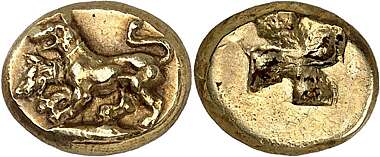
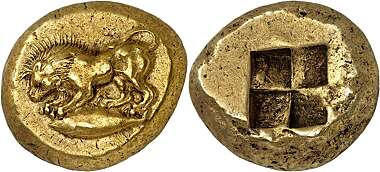
Lot 17. Mysia Kyzikos. Electrum Stater circa 450-400 BC. Lion crouching left, tuna fish left below / Quadripartite incuse square. 15,90g. SNG France –; von Fritze 83, pl. III, 2; Warren 1530. Rare. Perfectly sruck and centred on a large flan. Extremely fine. Provenance: NGSA 6 (30 November 2010), 80. NAC 116 (1 October 2019), 163. Lion representations are recurrent in coinage of Kyzikos, as this animal constituted a powerful symbol associated with strength, courage, and prestige. The presence of the lion on this stater probably reflects the influence of religious traditions originating from Anatolia and perhaps beyond, where the feline was closely connected with cosmic forces. Associated with the sun, light, and the renewal of the day, the lion gradually became a symbol of both divine and earthly power. This symbolic dimension explains, in particular, its connection with royalty in Lydia. On this remarkable stater, the lion may also allude to Aphrodite-Astarte, a deity associated with Cybele. The depiction of this animal on this coin thus illustrates the richness of the cultural influences that shaped the religious and symbolic identity of the city, situated at the crossroads of the Greek, Anatolian, and Oriental worlds. Les représentations de lion sont récurrentes dans le monnayage de Cyzique, car cet animal constituait un symbole puissant associé à la force, au courage et au prestige. La présence du lion sur ce remarquable statère témoigne probablement de l'influence de traditions religieuses venues d'Anatolie, voire d'au-delà, où le félin était étroitement lié aux forces cosmiques. Associé au soleil, à la lumière et au renouveau du jour, le lion devint progressivement un symbole de puissance divine et terrestre. Cette dimension explique notamment son lien avec la royauté en Lydie. Sur ce remarquable statère, le lion pourrait aussi évoquer Aphrodite-Astarté, divinité associée à la Cybèle. La présence de cet animal sur le monnayage de Cyzique illustre donc la richesse des influences culturelles qui façonnèrent l'identité religieuse et symbolique de la cité, au carrefour des mondes grec, anatolien et oriental.
  • Starting price:
    15'000 CHF
    16'372 EUR
    13'657 GBP
    18'374 USD

    Rounded approximations onlyDate: 11/05/2026

Please note that bids can only be placed in the bidding steps specified by the auction house.

  • 0 CHF - 200 CHF : 10 CHF Steps
  • 200 CHF - 500 CHF : 20 CHF Steps
  • 500 CHF - 1'000 CHF : 50 CHF Steps
  • 1'000 CHF - 2'000 CHF : 100 CHF Steps
  • 2'000 CHF - 5'000 CHF : 200 CHF Steps
  • 5'000 CHF - 10'000 CHF : 250 CHF Steps
  • 10'000 CHF - 20'000 CHF : 500 CHF Steps
  • 20'000 CHF - 50'000 CHF : 2'000 CHF Steps
  • 50'000 CHF - 100'000 CHF : 5'000 CHF Steps
  • 100'000 CHF - 200'000 CHF : 10'000 CHF Steps
  • 200'000 CHF - 500'000 CHF : 20'000 CHF Steps
  • 500'000 CHF - 1'000'000 CHF : 50'000 CHF Steps
  • > 1'000'000 CHF    : 100'000 CHF Steps
Lot
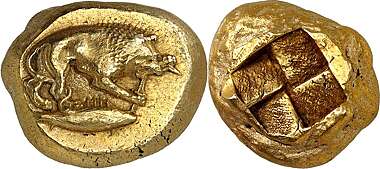
Lot 18. Mysia Kyzikos. Electrum Stater circa 420 BC. Lion right, gnawing on a curved sword or the leg of a prey, tuna fish below, swimming left / Quadripartite incuse square. 15,99g. BMFA 1502; De Callataÿ p. 658, F177 (gnawing on a curved sword); Gulbenkian 621; Jameson 2204; von Fritze 177. Good very fine. Provenance: CNG Triton XXI (9 January 2018), 446. The identification of the object held in the lion’s mouth has given rise to lively debate. Traditionally, numismatists have regarded it as a weapon — a sword or a harpa — and have assumed that the lion was bravely attacking the instrument with which one had attempted to bring him down. In 1981, the Sternberg cataloguer proposed a different interpretation: it would be the leg of an animal that the lion had hunted and killed. Whatever interpretation one adopts, this stater highlights the power and courage of the lion, a symbol of warrior strength. L’identification de l’objet que le lion tient dans sa gueule a suscité de vifs débats parmi les spécialistes. Traditionnellement, les numismates y ont vu une arme — une épée ou une harpé — et ont supposé que le lion s’attaquait courageusement à l’instrument avec lequel on avait tenté de l’abattre. En 1981, le catalogueur de Sternberg a proposé une interprétation différente : il s’agirait de la jambe d’un animal que le lion aurait chassé et tué. Quelle que soit l’interprétation retenue, ce statère met en avant la puissance et le courage du lion, symbole de force guerrière.
  • Starting price:
    10'000 CHF
    10'914 EUR
    9'105 GBP
    12'249 USD

    Rounded approximations onlyDate: 11/05/2026

Please note that bids can only be placed in the bidding steps specified by the auction house.

  • 0 CHF - 200 CHF : 10 CHF Steps
  • 200 CHF - 500 CHF : 20 CHF Steps
  • 500 CHF - 1'000 CHF : 50 CHF Steps
  • 1'000 CHF - 2'000 CHF : 100 CHF Steps
  • 2'000 CHF - 5'000 CHF : 200 CHF Steps
  • 5'000 CHF - 10'000 CHF : 250 CHF Steps
  • 10'000 CHF - 20'000 CHF : 500 CHF Steps
  • 20'000 CHF - 50'000 CHF : 2'000 CHF Steps
  • 50'000 CHF - 100'000 CHF : 5'000 CHF Steps
  • 100'000 CHF - 200'000 CHF : 10'000 CHF Steps
  • 200'000 CHF - 500'000 CHF : 20'000 CHF Steps
  • 500'000 CHF - 1'000'000 CHF : 50'000 CHF Steps
  • > 1'000'000 CHF    : 100'000 CHF Steps
Lot
Lot 19. Mysia Kyzikos. Electrum Hekte circa 420 BC. Lion right gnawing on a curved sword or the leg of a prey, tuna fish below, swimming left / Quadripartite incuse square. 2,59g. Cf. BMFA 1502 (stater); De Callataÿ, p. 658, F177 (gnawing on a curved sword); Liewald II 177 (this coin cited); cf. von Fritze 177 (Stater). A beautiful representation. Extremely fine. Provenance: Sternberg XI (20 November 1981), 106. Star Collection, The Numismatic Auction 3 (1 December 1985), 118. LHS Numismatik (29 April 2008), 259. Displayed at the White Gold exhibition in 2012. Baron Lorne Thyssen-Bornemisza Collection.
  • Starting price:
    15'000 CHF
    16'372 EUR
    13'657 GBP
    18'374 USD

    Rounded approximations onlyDate: 11/05/2026

Please note that bids can only be placed in the bidding steps specified by the auction house.

  • 0 CHF - 200 CHF : 10 CHF Steps
  • 200 CHF - 500 CHF : 20 CHF Steps
  • 500 CHF - 1'000 CHF : 50 CHF Steps
  • 1'000 CHF - 2'000 CHF : 100 CHF Steps
  • 2'000 CHF - 5'000 CHF : 200 CHF Steps
  • 5'000 CHF - 10'000 CHF : 250 CHF Steps
  • 10'000 CHF - 20'000 CHF : 500 CHF Steps
  • 20'000 CHF - 50'000 CHF : 2'000 CHF Steps
  • 50'000 CHF - 100'000 CHF : 5'000 CHF Steps
  • 100'000 CHF - 200'000 CHF : 10'000 CHF Steps
  • 200'000 CHF - 500'000 CHF : 20'000 CHF Steps
  • 500'000 CHF - 1'000'000 CHF : 50'000 CHF Steps
  • > 1'000'000 CHF    : 100'000 CHF Steps
Lot
Lot 20. Mysia Kyzikos. Electrum Stater circa 400 BC. Silenus kneeling left on tuna fish and taking a kantharos to his lips / Quadripartite incuse square. 16,06g. BMFA 1507; Gillet 1066 (this coin); Jameson 2567 (this coin); SNG France 318; Traité II, 2704, pl. CLXXV, 28; von Fritze 173, pl. V, 21; Waren 1464. Good very fine. Provenance: Robert Jameson Collection (1861-1942), 2567. Charles Gillet Collection (1879-1972), 1066. Leu 20 (25-26 April 1978), 116. Leu 59 (17 May 1994), 123. Baron Lorne Thyssen-Bornemisza Collection. The city of Kyzikos was surrounded by vast vineyards that produced a renowned wine exported throughout the Mediterranean. In this context, it is hardly surprising that figures associated with the Dionysian world appear on its staters. Silenus, shown here on the obverse raising a kantharos to his lips, perfectly embodies this universe: a satyr, tutor and inseparable — and almost always drunken — companion of Dionysos, God of wine and festivity. His presence on the coinage of Kyzikos thus reflects the essential role of viticulture in the local economy. Silenus also appears on other Greek coinages, notably in Sicily: the tetradrachm of Aetna is the most famous example. La cité de Cyzique était entourée de vastes vignobles produisant un vin réputé et exporté dans toute la Méditerranée. Dans ce contexte, il n’est guère surprenant que des figures liées au monde dionysiaque apparaissent sur les statères de la cité. Silène, représenté ici à l’avers portant un canthare à ses lèvres, incarne parfaitement cet univers : satyre, précepteur et compagnon inséparable — et presque toujours ivre — de Dionysos, dieu du vin et des réjouissances. Sa présence sur les monnaies de Cyzique reflète ainsi la place essentielle de la viticulture dans l’économie locale. On retrouve Silène sur d’autres monnayages grecs, notamment en Sicile : le tétradrachme d’Aetna en est le plus célèbre exemple.
  • Starting price:
    30'000 CHF
    32'744 EUR
    27'315 GBP
    36'749 USD

    Rounded approximations onlyDate: 11/05/2026

Please note that bids can only be placed in the bidding steps specified by the auction house.

  • 0 CHF - 200 CHF : 10 CHF Steps
  • 200 CHF - 500 CHF : 20 CHF Steps
  • 500 CHF - 1'000 CHF : 50 CHF Steps
  • 1'000 CHF - 2'000 CHF : 100 CHF Steps
  • 2'000 CHF - 5'000 CHF : 200 CHF Steps
  • 5'000 CHF - 10'000 CHF : 250 CHF Steps
  • 10'000 CHF - 20'000 CHF : 500 CHF Steps
  • 20'000 CHF - 50'000 CHF : 2'000 CHF Steps
  • 50'000 CHF - 100'000 CHF : 5'000 CHF Steps
  • 100'000 CHF - 200'000 CHF : 10'000 CHF Steps
  • 200'000 CHF - 500'000 CHF : 20'000 CHF Steps
  • 500'000 CHF - 1'000'000 CHF : 50'000 CHF Steps
  • > 1'000'000 CHF    : 100'000 CHF Steps
Lot
Lot 21. Mysia Kyzikos. Electrum Stater circa 400 BC. Head of Aphrodite left, wearing stephane, tuna fish below / Quadripartite incuse square. 16,01g. Gulbenkian 643; SNG France 287; SNG von Aulock 7316; von Fritze 135, pl. IV, 21; Waren 1451. A splendid coin of great style. Provenance: Christie’s London (7 October 1986), 117. Leu 81 (16 May 2001), 248. NGSA 7 (27 November 2012), 211. Baron Lorne Thyssen-Bornemisza Collection. Kyzikos maintained a close connection with Aphrodite, whose cult was attested there in several forms. The city notably honored Aphrodite Agoraia, protector of the marketplace and guarantor of the commercial transactions that ensured the prosperity of the city. Epigraphic documents also mention Aphrodite Pontia, invoked to ensure the safety of sea journeys—an essential protection for a city oriented toward navigation and trade. Aphrodite therefore occupied a significant place in the religious and civic identity of Kyzikos, and it is entirely logical that her portrait should appear on the staters issued by the city. Cyzique entretenait un lien étroit avec Aphrodite et plusieurs formes de son culte y sont attestées. La cité honorait notamment Aphrodite Agoraia, protectrice de la place du marché et garante des transactions commerciales qui faisaient la prospérité de la ville. Des documents épigraphiques mentionnent aussi Aphrodite Pontia, invoquée pour assurer la sécurité des voyages en mer, protection essentielle pour une cité tournée vers la navigation et les échanges. Aphrodite occupait donc une place significative dans l’identité religieuse et civique de Cyzique, et il est donc parfaitement logique de retrouver son portrait sur les statères émis par la cité.
  • Starting price:
    40'000 CHF
    43'659 EUR
    36'421 GBP
    48'999 USD

    Rounded approximations onlyDate: 11/05/2026

Please note that bids can only be placed in the bidding steps specified by the auction house.

  • 0 CHF - 200 CHF : 10 CHF Steps
  • 200 CHF - 500 CHF : 20 CHF Steps
  • 500 CHF - 1'000 CHF : 50 CHF Steps
  • 1'000 CHF - 2'000 CHF : 100 CHF Steps
  • 2'000 CHF - 5'000 CHF : 200 CHF Steps
  • 5'000 CHF - 10'000 CHF : 250 CHF Steps
  • 10'000 CHF - 20'000 CHF : 500 CHF Steps
  • 20'000 CHF - 50'000 CHF : 2'000 CHF Steps
  • 50'000 CHF - 100'000 CHF : 5'000 CHF Steps
  • 100'000 CHF - 200'000 CHF : 10'000 CHF Steps
  • 200'000 CHF - 500'000 CHF : 20'000 CHF Steps
  • 500'000 CHF - 1'000'000 CHF : 50'000 CHF Steps
  • > 1'000'000 CHF    : 100'000 CHF Steps
Lot
Lot 22. Mysia Kyzikos. Electrum Hekte circa 400-375 BC. Bearded Cecrops left with human head and torso and a snake's tail replacing his lower body, riding on tuna left and holding sapling in right hand / Quadripartite incuse square. 2,70g. Konuk & Lorber, p. 70 (this coin); Linzalone 1165 (this coin); SNG France 306; von Fritze 158, pl. V, 6. A splendid specimen. Provenance: Numismatic Fine Arts XXVII (4 December 1991), 57. Displayed at the White Gold exhibition in 2012. Baron Lorne Thyssen-Bornemisza Collection Cecrops, regarded in Greek tradition as the first king of Athens, was considered the first autochthon of Attica, a term literally meaning “born from the earth itself”. Mythology describes him as a hybrid being with a body combining human and serpentine features, and some traditions even present him as a son of Gaia. He is said to have founded the city of Athens, whose fortified hill was named Cecropia in his honor, and to have organized the territory of Attica into twelve tribes. His reign is especially marked by the famous contest between Athena and Poseidon for the possession of Attica: the sea God struck the ground with his trident, causing a saltwater spring to emerge, while Athena offered the city an olive tree. Cecrops ultimately chose the Goddess’s gift, considered more beneficial for the future of the community, thereby making Athena the protector of Athens. The presence of this myth on Kyzikos' coinage should be understood within a historical context in which the two cities maintained close relations. Athens and Kyzikos were long connected through shared interests and political alliances, particularly during the Classical period, when Kyzikos was a member of the Delian League, the maritime alliance dominated by Athens until its dissolution in 404 BC. This proximity facilitated the circulation of religious and artistic influences between the two cities, helping to explain the adoption of Athenian mythological references within the coin iconography of Kyzicos. Cécrops, considéré par la tradition grecque comme le premier roi d’Athènes, serait le premier autochtone de l’Attique, terme signifiant littéralement « né de la terre elle-même ». La mythologie le décrit comme un être primordial doté d’une nature hybride, avec un corps mêlant traits humains et serpents, et certaines traditions en font même un fils de Gaïa. Il aurait fondé la cité d’Athènes, dont la colline fortifiée prit le nom de Cécropia en son honneur, et aurait organisé le territoire attique en douze tribus. Son règne est surtout marqué par la célèbre dispute entre Athéna et Poséidon pour la possession de l’Attique : le dieu de la mer fit jaillir une source d’eau salée en frappant le sol de son trident, tandis qu’Athéna offrit à la cité un olivier. Cécrops choisit finalement le présent de la déesse, jugé plus utile pour l’avenir de la communauté, faisant d’Athéna la protectrice d’Athènes. La présence de ce mythe sur le monnayage de Cyzique s’inscrit dans un contexte historique où les deux cités entretenaient des relations étroites. Athènes et Cyzique furent longtemps liées par des intérêts communs et des alliances politiques, notamment durant la période classique, lorsque Cyzique appartint à la Ligue de Délos, l’alliance maritime dominée par Athènes jusqu’à sa dissolution en 404 av. J.-C. Cette proximité explique la circulation des influences religieuses et artistiques entre les deux cités, et permet de mieux comprendre l’adoption de références mythologiques athéniennes dans l’iconographie monétaire de Cyzique.
  • Starting price:
    10'000 CHF
    10'914 EUR
    9'105 GBP
    12'249 USD

    Rounded approximations onlyDate: 11/05/2026

Please note that bids can only be placed in the bidding steps specified by the auction house.

  • 0 CHF - 200 CHF : 10 CHF Steps
  • 200 CHF - 500 CHF : 20 CHF Steps
  • 500 CHF - 1'000 CHF : 50 CHF Steps
  • 1'000 CHF - 2'000 CHF : 100 CHF Steps
  • 2'000 CHF - 5'000 CHF : 200 CHF Steps
  • 5'000 CHF - 10'000 CHF : 250 CHF Steps
  • 10'000 CHF - 20'000 CHF : 500 CHF Steps
  • 20'000 CHF - 50'000 CHF : 2'000 CHF Steps
  • 50'000 CHF - 100'000 CHF : 5'000 CHF Steps
  • 100'000 CHF - 200'000 CHF : 10'000 CHF Steps
  • 200'000 CHF - 500'000 CHF : 20'000 CHF Steps
  • 500'000 CHF - 1'000'000 CHF : 50'000 CHF Steps
  • > 1'000'000 CHF    : 100'000 CHF Steps
Lot
Lot 23. Mysia Kyzikos. Electrum Hemihekte circa 400-360 BC. Laureate head of Zeus facing three-quarters right; tuna-fish right below / Quadripartite incuse square with mill-sail pattern. 1,31g. Liewald II 182 (this coin); cf. von Fritze 182 (Stater). A lovely specimen of beautiful style. Provenance: Leu 57 (25 May 1993), 100, Rendering a three-quarter portrait on a coin was a technical feat that only the greatest engravers of the Greek world were capable of achieving. Accomplishing such a result on a hekte weighing little more than one gram represents a true artistic tour de force. This magnificent coin bears witness to the exceptional talent of the engravers of Kyzikos, who succeeded in giving the face of Zeus remarkable depth and striking expressiveness. At a time when Kimon was captivating the Greek world with his celebrated Syracusan tetradrachms featuring the facing head of Arethusa, the engravers of Kyzikos demonstrated that they too were capable of innovation, pushing the boundaries of the art of coin engraving. Réaliser un portrait de trois quarts sur une monnaie constituait une prouesse technique dont seuls les plus grands graveurs du monde grec étaient capables. Parvenir à un tel résultat sur une hekte d'à peine plus d'un gramme relève du véritable exploit artistique. Cette magnifique pièce témoigne du talent exceptionnel des graveurs de Cyzique qui sont parvenus à conférer au visage de Zeus une profondeur et une expressivité saisissantes. À l'époque où Kimon fascinait le monde grec avec ses célèbres tétradrachmes de Syracuse au portrait d'Aréthuse de face, les graveurs de Cyzique montraient qu'eux aussi étaient capables d'innover et de repousser les limites de l'art monétaire.
  • Starting price:
    6'000 CHF
    6'548 EUR
    5'463 GBP
    7'349 USD

    Rounded approximations onlyDate: 11/05/2026

Please note that bids can only be placed in the bidding steps specified by the auction house.

  • 0 CHF - 200 CHF : 10 CHF Steps
  • 200 CHF - 500 CHF : 20 CHF Steps
  • 500 CHF - 1'000 CHF : 50 CHF Steps
  • 1'000 CHF - 2'000 CHF : 100 CHF Steps
  • 2'000 CHF - 5'000 CHF : 200 CHF Steps
  • 5'000 CHF - 10'000 CHF : 250 CHF Steps
  • 10'000 CHF - 20'000 CHF : 500 CHF Steps
  • 20'000 CHF - 50'000 CHF : 2'000 CHF Steps
  • 50'000 CHF - 100'000 CHF : 5'000 CHF Steps
  • 100'000 CHF - 200'000 CHF : 10'000 CHF Steps
  • 200'000 CHF - 500'000 CHF : 20'000 CHF Steps
  • 500'000 CHF - 1'000'000 CHF : 50'000 CHF Steps
  • > 1'000'000 CHF    : 100'000 CHF Steps
Lot
Lot 24. Mysia Kyzikos. Electrum Stater circa 375-350 BC. Zeus draped below the waist, half kneeling right on tuna fish, right hand holding scepter, left hand supporting eagle with spread wings above his knee / Quadripartite incuse square. 15,95g. De Luynes 2449; Greenwell, 2, pl. I, 2; SNG France 296; von Fritze 145, pl. IV, 32; Warren 1422. An exceptional specimen. Provenance: NGSA 5 (2 December 2008), 102. Displayed at the White Gold exhibition in 2012. Baron Lorne Thyssen-Bornemisza Collection.. Kyzikos, a major commercial city of the Propontis, owed its prosperity to its exports: fruit, renowned wine, and grain. The Mysian plain was indeed an extremely fertile territory, cultivated all the way to the shores of Lake Aphnitis. This agricultural wealth was accompanied by cults intended to protect the harvests, livestock, and those who worked them. Among these, Zeus Olbios held a central place: as God of the sky, rain, winds, and lightning, Zeus Olbios watched over the fields, animals, and farmers, as attested by several dedications discovered near Kyzikos. Zeus Chalzios was also invoked to protect the crops from hail, a sign of the importance accorded to divine protection in a city whose prosperity depended closely on the land. The obverse of this stater, depicting the king of the Gods, echoes these various cults practiced at Kyzikos. Cyzicus, grande cité marchande de la Propontide, devait sa prospérité à ses exportations : fruits, vins et céréales. La plaine mysienne était en effet un territoire extrêmement fertile, cultivé jusqu’aux rives du lac Aphnitis. Cette richesse agricole s’accompagnait de cultes destinés à protéger les récoltes, le bétail et ceux qui les travaillaient. Parmi eux, Zeus Olbios occupait une place centrale. Dieu du ciel, de la pluie, des vents et de la foudre, Zeus Olbios veillait sur les champs, les animaux et les paysans, comme l’attestent plusieurs dédicaces découvertes près de Cyzicus. Zeus Chalzios était également invoqué pour protéger les moissons de la grêle, signe de l’importance accordée à la protection divine dans une cité dont la prospérité dépendait étroitement de la terre et du climat. L’avers de ce statère, représentant le roi des dieux, fait écho à ces différents cultes pratiqués à Cyzique.
  • Starting price:
    100'000 CHF
    109'148 EUR
    91'053 GBP
    122'498 USD

    Rounded approximations onlyDate: 11/05/2026

Please note that bids can only be placed in the bidding steps specified by the auction house.

  • 0 CHF - 200 CHF : 10 CHF Steps
  • 200 CHF - 500 CHF : 20 CHF Steps
  • 500 CHF - 1'000 CHF : 50 CHF Steps
  • 1'000 CHF - 2'000 CHF : 100 CHF Steps
  • 2'000 CHF - 5'000 CHF : 200 CHF Steps
  • 5'000 CHF - 10'000 CHF : 250 CHF Steps
  • 10'000 CHF - 20'000 CHF : 500 CHF Steps
  • 20'000 CHF - 50'000 CHF : 2'000 CHF Steps
  • 50'000 CHF - 100'000 CHF : 5'000 CHF Steps
  • 100'000 CHF - 200'000 CHF : 10'000 CHF Steps
  • 200'000 CHF - 500'000 CHF : 20'000 CHF Steps
  • 500'000 CHF - 1'000'000 CHF : 50'000 CHF Steps
  • > 1'000'000 CHF    : 100'000 CHF Steps
Lot
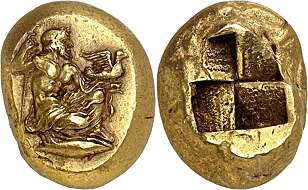
Lot 25. Mysia Kyzikos. Electrum Hekte circa 375-350 BC. Bearded Orestes, naked except for chlamys around neck, halfkneeling left, his right knee raised before him, his left knee resting on tuna left, his right hand holding sword with tip upward, his left hand resting on filleted omphalos beside him / Quadripartite incuse square. 2,65g. BMC Mysia 22, 34; Traité I, 288bis, pl. VII, 7; cf. von Fritze 165, pl. V, 13 (Stater). Good extremely fine. Provenance: Privately purchased from Tradart in November 2009. Displayed at the White Gold exhibition in 2012. Baron Lorne Thyssen-Bornemisza Collection. Orestes is one of the most emblematic figures of the mythological cycle of the Atreids, the illustrious royal lineage of Mycenae marked by family tragedies and bloodshed. Son of Agamemnon, leader of the Greeks during the Trojan War, and Clytemnestra, he is compelled to avenge the murder of his father, who was killed by his wife and Aegisthus upon his return from the conflict. On Apollo’s command, Orestes commits the terrible act of murdering his own mother, provoking the wrath of the Erinyes, the vengeful deities responsible for punishing crimes committed against family bonds. Orestes finds refuge at Delphi in the sanctuary of Apollo, where he kneels beside the Omphalos (the sacred stone) in order to be purified by the God. It is precisely this moment that is represented on the obverse of this hekte. Unable to fully atone for his crime at Delphi, Orestes travels to Athens, where he is tried before the Areopagus, the sacred court of Athens, under the protection of Athena. The Goddess intervenes in the trial and grants him purification, bringing an end to the cycle of vengeance that had devastated his family. The reference to a hero so deeply associated with Athenian mythological identity on Kyzikos' coins provides further evidence of the intensity of cultural and religious exchanges between the two cities and illustrates the influence exerted by Athens on the symbolic imagination of Kyzikos. Oreste est l’une des figures les plus emblématiques du cycle mythologique des Atrides, cette illustre lignée royale de Mycènes marquée par les drames familiaux et les conflits de sang. Fils d’Agamemnon, chef des Grecs lors de la guerre de Troie, et de Clytemnestre, il est contraint de venger le meurtre de son père, assassiné par son épouse et Égisthe à son retour du conflit. Sur l’ordre d’Apollon, Oreste accomplit alors l’acte terrible de tuer sa propre mère, déclenchant la colère des Érinyes, divinités vengeresses chargées de punir les crimes contre les liens familiaux. Oreste trouve refuge à Delphes dans le sanctuaire d'Apollon où il s'agenouille près de l'Omphalos (la pierre sacrée) afin de se faire purifier par le dieu. C'est précisément ce moment qui est représenté sur l'avers de cette hekte. Ne pouvant totalement expier sa faute à Delphes, Oreste se rend à Athènes, où il est jugé devant l’Aréopage, le tribunal sacré d’Athènes, sous la protection d’Athéna. La déesse intervient dans le procès et permet sa purification, mettant ainsi fin au cycle de vengeance qui ensanglantait sa famille. La référence à un héros profondément associé à l’identité mythologique athénienne sur des monnaies de Cyzique constitue un témoignage supplémentaire de l'intensité des échanges culturels et religieux entre les deux cités, et illustre l’influence exercée par Athènes sur l’imaginaire symbolique de Cyzique.
  • Starting price:
    10'000 CHF
    10'914 EUR
    9'105 GBP
    12'249 USD

    Rounded approximations onlyDate: 11/05/2026

Please note that bids can only be placed in the bidding steps specified by the auction house.

  • 0 CHF - 200 CHF : 10 CHF Steps
  • 200 CHF - 500 CHF : 20 CHF Steps
  • 500 CHF - 1'000 CHF : 50 CHF Steps
  • 1'000 CHF - 2'000 CHF : 100 CHF Steps
  • 2'000 CHF - 5'000 CHF : 200 CHF Steps
  • 5'000 CHF - 10'000 CHF : 250 CHF Steps
  • 10'000 CHF - 20'000 CHF : 500 CHF Steps
  • 20'000 CHF - 50'000 CHF : 2'000 CHF Steps
  • 50'000 CHF - 100'000 CHF : 5'000 CHF Steps
  • 100'000 CHF - 200'000 CHF : 10'000 CHF Steps
  • 200'000 CHF - 500'000 CHF : 20'000 CHF Steps
  • 500'000 CHF - 1'000'000 CHF : 50'000 CHF Steps
  • > 1'000'000 CHF    : 100'000 CHF Steps
Lot
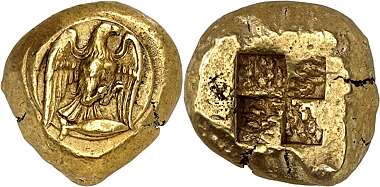
Lot 26. Mysia Kyzikos. Electrum Stater circa 360-350 BC. Eagle, wings spread, flying right, tuna fish below. All within circle / Quadripartite incuse square. 16,06g. BMC Mysia -; Greenwell 152; SNG France 349; Traité II 2791, pl. CLXXVII, 27 (same reverse die); von Fritze 221, pl. 6, 33 (same reverse die); Warren 1577. Extremely fine. Provenance: Leu 48 (10 May 1989), 217. Displayed at the White Gold exhibition in 2012. Baron Lorne Thyssen-Bornemisza Collection. According to Greenwell, the disc shown behind the eagle represents the sun and thus refers to Helios, the solar deity. This interpretation is all the more plausible given that the prosperity of Kyzikos depended closely on its harvests, and therefore on favorable weather conditions. In the same vein, the eagle would evoke Zeus, king of the Gods but above all master of the sky: he unleashes lightning, regulates rainfall, causes droughts or floods, and commands the winds. The obverse of this coin may therefore be understood as a tribute to the divine powers responsible for the climate, guarantors of good harvests and, consequently, of the city’s economic growth. Selon Greenwell, le disque figurant derrière l’aigle représenterait le soleil et renverrait ainsi à Hélios, divinité solaire. Cette interprétation est d’autant plus plausible que la prospérité de Cyzique dépendait étroitement de ses récoltes, et donc de conditions climatiques favorables. Dans la même logique, l’aigle évoquerait Zeus, roi des dieux mais surtout maître du ciel. C’est lui qui déchaîne la foudre, régule les pluies, provoque sécheresses ou inondations et commande les vents. L'avers de cette pièce pourrait ainsi être compris comme un hommage aux puissances divines responsables du climat, garantes des bonnes récoltes et, par conséquent, de l’essor économique de la cité.
  • Starting price:
    40'000 CHF
    43'659 EUR
    36'421 GBP
    48'999 USD

    Rounded approximations onlyDate: 11/05/2026

Please note that bids can only be placed in the bidding steps specified by the auction house.

  • 0 CHF - 200 CHF : 10 CHF Steps
  • 200 CHF - 500 CHF : 20 CHF Steps
  • 500 CHF - 1'000 CHF : 50 CHF Steps
  • 1'000 CHF - 2'000 CHF : 100 CHF Steps
  • 2'000 CHF - 5'000 CHF : 200 CHF Steps
  • 5'000 CHF - 10'000 CHF : 250 CHF Steps
  • 10'000 CHF - 20'000 CHF : 500 CHF Steps
  • 20'000 CHF - 50'000 CHF : 2'000 CHF Steps
  • 50'000 CHF - 100'000 CHF : 5'000 CHF Steps
  • 100'000 CHF - 200'000 CHF : 10'000 CHF Steps
  • 200'000 CHF - 500'000 CHF : 20'000 CHF Steps
  • 500'000 CHF - 1'000'000 CHF : 50'000 CHF Steps
  • > 1'000'000 CHF    : 100'000 CHF Steps
Lot
Lot 27. Mysia Kyzikos. Electrum Stater circa 360-340 BC. Bull kneeling left and attacked by a lion, tuna fish below / Quadripartite incuse square. 15,98g. Desneux pl. XXXVII, a (same dies); Liewald I 38a (this coin); Prinkipo 138, pl. III, 138 (same dies); SNG France 352 (same dies). The finest specimen known. An extraordinary piece. Provenance: Guermantes Collection, Leu 86 (5-6 May 2003), 392 (illustrated on front cover). NGSA 6 (30 November 2010), 81. Displayed at the White Gold exhibition in 2012. Baron Lorne Thyssen-Bornemisza Collection. The confrontation between the lion and the bull is a very ancient theme in numismatics, as it already appears on the coinage of Croesus (560–546 BC), the famous and immensely wealthy king of Lydia. The exact meaning of this iconography remains uncertain, but the lion was generally associated with the sun and royalty, whereas the bull represented wild strength and earthly powers. The direct prototype of this coin is undoubtedly the tetradrachm of Acanthus. The engraver of our specimen surpassed his model in both finesse and expressiveness. The high relief and the complexity of the design likely explain the rarity of this issue. Subjected to excessive pressure, the obverse die shows a slight crack, which probably led to its premature breakage. L’affrontement du lion et du taureau est un thème très ancien dans la numismatique, puisqu’il apparaît déjà sur le monnayage de Crésus (560–546 av. J.-C.), le célèbre et richissime roi de Lydie. La signification exacte de cette iconographie demeure un mystère, mais le lion était généralement associé au soleil et à la royauté, tandis que le taureau représentait la force sauvage et les puissances terrestres. Le prototype direct de cette monnaie est sans nul doute le tétradrachme d’Acanthe. Le graveur de notre exemplaire a, toutefois, surpassé son modèle en finesse et en expressivité. Le haut relief et la complexité du motif expliquent probablement la rareté de cette émission. Soumis à une pression excessive, le coin d’avers présente une légère fissure qui a vraisemblablement conduit à sa rupture précoce.
  • Starting price:
    250'000 CHF
    272'872 EUR
    227'633 GBP
    306'246 USD

    Rounded approximations onlyDate: 11/05/2026

Please note that bids can only be placed in the bidding steps specified by the auction house.

  • 0 CHF - 200 CHF : 10 CHF Steps
  • 200 CHF - 500 CHF : 20 CHF Steps
  • 500 CHF - 1'000 CHF : 50 CHF Steps
  • 1'000 CHF - 2'000 CHF : 100 CHF Steps
  • 2'000 CHF - 5'000 CHF : 200 CHF Steps
  • 5'000 CHF - 10'000 CHF : 250 CHF Steps
  • 10'000 CHF - 20'000 CHF : 500 CHF Steps
  • 20'000 CHF - 50'000 CHF : 2'000 CHF Steps
  • 50'000 CHF - 100'000 CHF : 5'000 CHF Steps
  • 100'000 CHF - 200'000 CHF : 10'000 CHF Steps
  • 200'000 CHF - 500'000 CHF : 20'000 CHF Steps
  • 500'000 CHF - 1'000'000 CHF : 50'000 CHF Steps
  • > 1'000'000 CHF    : 100'000 CHF Steps
Lot
Lot 28. Mysia Kyzikos. Electrum Stater circa 350-300 BC. Bearded Herakles crouching left on ground line, left knee lowered, right knee raised before him, right hand holding club over shoulder, left hand holding cornucopia, tuna fish placed vertically behind him (head upward) / Quadripartite incuse square. 15,99g. BMFA 1528; Gulbenkian 631; Jameson 2209; SNG France 342; von Fritze 209, pl. VI, 21; Warren 1482; Weber 4997. Very rare. Of excellent style. Extremely fine. Provenance: NAC 52 (7 October 2009), 161. Displayed at the White Gold exhibition in 2012. Baron Lorne Thyssen-Bornemisza Collection. The attributes most commonly associated with Herakles are the skin of the Nemean lion, the club, and the bow, symbols of his strength and heroic exploits. The hero is also linked to the myth of the cornucopia, a symbol of prosperity and inexhaustible abundance. According to tradition, Herakles broke off one of the horns of the goat Amalthea, who had nourished Zeus during his childhood while the God was hidden from his father Kronos. Endowed with the animal’s extraordinary properties, this horn became an inexhaustible source of fruits and blessings. Another version of the myth relates that Herakles tore off one of the horns of the river God Achelous during their confrontation, and that this horn was later transformed into the horn of plenty. The decision to represent Herakles with this less common attribute was probably intended to evoke the prosperity of Kyzikos. Les attributs les plus couramment associés à Hercule sont la peau du lion de Némée, la massue et l’arc, symboles de sa force et de ses exploits héroïques. Le héros est également lié au mythe de la corne d’abondance, symbole de prospérité et de richesse inépuisable. Selon la tradition, Hercule aurait brisé une corne de la chèvre Amalthée, celle qui avait nourri Zeus durant son enfance alors que le dieu se cachait de son père Cronos. Dotée des propriétés extraordinaires de l’animal, cette corne serait devenue une source inépuisable de fruits et de bienfaits. Une autre version du mythe rapporte qu’Hercule aurait arraché une corne au dieu-fleuve Achélôos lors de leur affrontement, transformant ensuite celle-ci en corne d’abondance. Le choix de représenter Hercule avec cet attribut moins courant est probablement une volonté de rappeler la prospérité de Cyzique.
  • Starting price:
    20'000 CHF
    21'829 EUR
    18'210 GBP
    24'499 USD

    Rounded approximations onlyDate: 11/05/2026

Please note that bids can only be placed in the bidding steps specified by the auction house.

  • 0 CHF - 200 CHF : 10 CHF Steps
  • 200 CHF - 500 CHF : 20 CHF Steps
  • 500 CHF - 1'000 CHF : 50 CHF Steps
  • 1'000 CHF - 2'000 CHF : 100 CHF Steps
  • 2'000 CHF - 5'000 CHF : 200 CHF Steps
  • 5'000 CHF - 10'000 CHF : 250 CHF Steps
  • 10'000 CHF - 20'000 CHF : 500 CHF Steps
  • 20'000 CHF - 50'000 CHF : 2'000 CHF Steps
  • 50'000 CHF - 100'000 CHF : 5'000 CHF Steps
  • 100'000 CHF - 200'000 CHF : 10'000 CHF Steps
  • 200'000 CHF - 500'000 CHF : 20'000 CHF Steps
  • 500'000 CHF - 1'000'000 CHF : 50'000 CHF Steps
  • > 1'000'000 CHF    : 100'000 CHF Steps
Lot
Lot 29. Mysia Lampsakos. Electrum Stater circa 411 BC. Forepart of Pegasus left, all within vine wreath / Quadripartite incuse square. 15,15g. Baldwin pl. I, 12; BMFA 1585; Gulbekian 679; Jameson 1432; SNG von Aulock 1292 (this coin). A splendid specimen with an important pedigree. Provenance: H. von Aulock Collection (1906-1980), 1292, published between 1957-1968. Leu 50 (25 April 1990), 154. Leu 81 (16 May 2001), 252. LHS Numismatik 102 (29 April 2008), 262. Displayed at the White Gold exhibition in 2012. Baron Lorne Thyssen-Bornemisza Collection. Pegasus, the famous winged horse of Greek mythology, is the son of Poseidon and Medusa. Associated with the hero Bellerophon, who succeeded in taming him with the help of Athena before using him to defeat the Chimera, he embodies divine power, speed, and elevation toward the celestial realm. Pegasus occupies an important place in Greek coin iconography, particularly on the coinage of Corinth, where he appears as a recurring emblem of the city. These Corinthian issues may have served as a model for the engravers of Lampsakos in the creation of this stater, thus illustrating the circulation of iconographic motifs between Greek cities. Pégase, le célèbre cheval ailé de la mythologie grecque, est le fils de Poséidon et de Méduse. Associé au héros Bellérophon qui parvint à le dompter grâce à l’aide d’Athéna avant de l’utiliser pour vaincre la Chimère, il incarne la puissance divine, la rapidité et l’élévation vers le monde céleste. Pégase occupe une place importante dans l’iconographie monétaire grecque, notamment sur les monnaies de Corinthe où il apparaît comme un emblème récurrent de la cité. Ces émissions corinthiennes ont pu servir de modèle aux graveurs de Lampsaque pour la création de ce statère, témoignant ainsi de la circulation des motifs iconographiques entre les cités grecques.
  • Starting price:
    50'000 CHF
    54'574 EUR
    45'526 GBP
    61'249 USD

    Rounded approximations onlyDate: 11/05/2026

Please note that bids can only be placed in the bidding steps specified by the auction house.

  • 0 CHF - 200 CHF : 10 CHF Steps
  • 200 CHF - 500 CHF : 20 CHF Steps
  • 500 CHF - 1'000 CHF : 50 CHF Steps
  • 1'000 CHF - 2'000 CHF : 100 CHF Steps
  • 2'000 CHF - 5'000 CHF : 200 CHF Steps
  • 5'000 CHF - 10'000 CHF : 250 CHF Steps
  • 10'000 CHF - 20'000 CHF : 500 CHF Steps
  • 20'000 CHF - 50'000 CHF : 2'000 CHF Steps
  • 50'000 CHF - 100'000 CHF : 5'000 CHF Steps
  • 100'000 CHF - 200'000 CHF : 10'000 CHF Steps
  • 200'000 CHF - 500'000 CHF : 20'000 CHF Steps
  • 500'000 CHF - 1'000'000 CHF : 50'000 CHF Steps
  • > 1'000'000 CHF    : 100'000 CHF Steps
Lot
Lot 30. Troas Abydos. Electrum Stater, Lydo-Milesian standard, cica 520-480 BC. Eagle standing left, head right, on dotted ground line; to left, dolphin downward; floral symbol to right / Incuse square, roughly bisected by a thick line, with each section containing irregular marks. 14,13g. Marchand A5 = SNG München 1 = Baldwin pl. II, 4 = Traité I 350 = Head, HN, p. 538 = Head NC, p. 265, pl. VII, 7 (same obv. die); otherwise unpublished. Extremely rare. Two pieces known. The only one in private hands. Minor die rust. Near extremely fine. Provenance: Jonathan P. Rosen Collection, Roma XII (29 September 2016), 233. CNG Triton XXIII (14 January 2020), 323. Many numismatists, including Marchand and Kraay, have attributed this issue to the period of the Ionian Revolt (499–493 BC), in which Abydos took part. Nevertheless, the overall style appears more archaic: the dolphin shows a primitive form, the eagle is rendered in an archaic manner, and a curious symbol appears to the right of the bird. The reverse also resembles the staters of Chios and other uncertain mints dated to around 525–500 BC. Taken together, these stylistic and technical features suggest that this type may predate the Ionian Revolt. It would therefore represent the earliest known coinage of Abydos. De nombreux numismates, dont Marchand et Kraay, ont attribué cette émission à la période de la Révolte ionienne (499‑493 av. J.-C.), à laquelle Abydos prit part. L’ensemble du style apparaît néanmoins plus archaïque : forme primitive du dauphin, style archaïque de l’aigle, curieux symbole à droite de l’aigle, etc. Le revers se rapproche davantage des statères de Chios et d’autres ateliers incertains datés vers 525‑500 av. J.-C. L’ensemble de ces éléments stylistiques et techniques suggère que ce type pourrait être antérieur à la Révolte ionienne. Il s'agirait donc de la plus ancienne émission monétaire connue d’Abydos.
  • Starting price:
    25'000 CHF
    27'287 EUR
    22'763 GBP
    30'624 USD

    Rounded approximations onlyDate: 11/05/2026

Please note that bids can only be placed in the bidding steps specified by the auction house.

  • 0 CHF - 200 CHF : 10 CHF Steps
  • 200 CHF - 500 CHF : 20 CHF Steps
  • 500 CHF - 1'000 CHF : 50 CHF Steps
  • 1'000 CHF - 2'000 CHF : 100 CHF Steps
  • 2'000 CHF - 5'000 CHF : 200 CHF Steps
  • 5'000 CHF - 10'000 CHF : 250 CHF Steps
  • 10'000 CHF - 20'000 CHF : 500 CHF Steps
  • 20'000 CHF - 50'000 CHF : 2'000 CHF Steps
  • 50'000 CHF - 100'000 CHF : 5'000 CHF Steps
  • 100'000 CHF - 200'000 CHF : 10'000 CHF Steps
  • 200'000 CHF - 500'000 CHF : 20'000 CHF Steps
  • 500'000 CHF - 1'000'000 CHF : 50'000 CHF Steps
  • > 1'000'000 CHF    : 100'000 CHF Steps
Lot
Lot 31. Lesbos Mytilene. Electrum Hekte circa 520-478 BC. Head of roaring lion right / Incuse head of calf right, rectangular punch behind. 2,55g. BMFA 1679-81; Bodenstedt 13 (unlisted dies); Gulbenkian 874-5; Pozzi 2315-6; SNG Copenhagen 301; SNG von Aulock 1685. A perfect specimen. Provenance: CNG Triton XI (8 January 2008), 220. Displayed at the White Gold exhibition in 2012. Baron Lorne Thyssen-Bornemisza Collection. The calf represented in incuse on the reverse was the civic emblem of Mytilene. The lion was associated with several deities, such as Apollo, the principal God of Mytilene. The lion on the observe can be understood as a substitute for Apollo—especially given that Apollo’s bust later replaced the lion’s head on following issues. Le veau représenté en incus au revers était l’emblème civique de Mytilène. Quant au lion, il était associé à plusieurs divinités, notamment à Apollon, le dieu principal de Mytilène. Le lion à l’avers peut donc être compris comme un substitut d’Apollon — d’autant plus que le buste d’Apollon a ensuite remplacé la tête de lion sur les émissions suivantes.
  • Starting price:
    3'000 CHF
    3'274 EUR
    2'731 GBP
    3'674 USD

    Rounded approximations onlyDate: 11/05/2026

Please note that bids can only be placed in the bidding steps specified by the auction house.

  • 0 CHF - 200 CHF : 10 CHF Steps
  • 200 CHF - 500 CHF : 20 CHF Steps
  • 500 CHF - 1'000 CHF : 50 CHF Steps
  • 1'000 CHF - 2'000 CHF : 100 CHF Steps
  • 2'000 CHF - 5'000 CHF : 200 CHF Steps
  • 5'000 CHF - 10'000 CHF : 250 CHF Steps
  • 10'000 CHF - 20'000 CHF : 500 CHF Steps
  • 20'000 CHF - 50'000 CHF : 2'000 CHF Steps
  • 50'000 CHF - 100'000 CHF : 5'000 CHF Steps
  • 100'000 CHF - 200'000 CHF : 10'000 CHF Steps
  • 200'000 CHF - 500'000 CHF : 20'000 CHF Steps
  • 500'000 CHF - 1'000'000 CHF : 50'000 CHF Steps
  • > 1'000'000 CHF    : 100'000 CHF Steps
Lot
Lot 32. Lesbos Mytilene. Electrum Hekte circa 454-427 BC. Head of Athena right, wearing crested Corinthian helmet / Two confronted female heads, their faces overlapping, within incuse square. 2,56g. Bodenstedt 55; HGC 6, 981. Very rare. Good very fine. Provenance: Daniel Koppersmith Collection, privately purchased from Ed Waddell (inv. no. 17318). CNG 115 (16 September 2020), 210. The overlapping faces on the reverse create a striking visual effect, producing an optical illusion that immediately catches the eye. Such experimentation is highly unusual in Greek coinage. This innovative composition reveals that Mytilene employed talented engravers who were not only technically skilled but also open to artistic experimentation. Les visages superposés au revers produisent un effet visuel saisissant créant une véritable illusion d’optique qui attire immédiatement le regard. Ce type de motif est extrêmement inhabituel dans le monnayage grec. Cette composition audacieuse montre que Mytilène employait des graveurs talentueux, ouverts à l’innovation.
  • Starting price:
    5'000 CHF
    5'457 EUR
    4'552 GBP
    6'124 USD

    Rounded approximations onlyDate: 11/05/2026

Please note that bids can only be placed in the bidding steps specified by the auction house.

  • 0 CHF - 200 CHF : 10 CHF Steps
  • 200 CHF - 500 CHF : 20 CHF Steps
  • 500 CHF - 1'000 CHF : 50 CHF Steps
  • 1'000 CHF - 2'000 CHF : 100 CHF Steps
  • 2'000 CHF - 5'000 CHF : 200 CHF Steps
  • 5'000 CHF - 10'000 CHF : 250 CHF Steps
  • 10'000 CHF - 20'000 CHF : 500 CHF Steps
  • 20'000 CHF - 50'000 CHF : 2'000 CHF Steps
  • 50'000 CHF - 100'000 CHF : 5'000 CHF Steps
  • 100'000 CHF - 200'000 CHF : 10'000 CHF Steps
  • 200'000 CHF - 500'000 CHF : 20'000 CHF Steps
  • 500'000 CHF - 1'000'000 CHF : 50'000 CHF Steps
  • > 1'000'000 CHF    : 100'000 CHF Steps
Lot
Lot 33. Lesbos Mytilene. Electrum Hekte circa 450-330 BC. Veiled head of Demeter right / Tripod within square. 2,53g. Bodenstedt 91; HGC 6, 1017. Splendid. Provenance: Privately purchased from NGSA in May 2008. Displayed at the White Gold exhibition in 2012. Baron Lorne Thyssen-Bornemisza Collection. Demeter was the Goddess of grain and agricultural fertility, the mother figure par excellence in Greek religion. She embodied the life‑giving power of the earth and presided over the cycles of growth and harvest. Archaeological investigations on Lesbos have uncovered traces of a sanctuary dedicated to Demeter, indicating that she held an important place in the island’s religious life. Déméter était la déesse du grain et de la fertilité agricole, la figure maternelle par excellence dans la religion grecque. Elle incarnait la puissance vitale de la terre et présidait aux cycles de croissance et de récolte. Des fouilles archéologiques menées à Lesbos ont révélé les traces d’un sanctuaire dédié à Déméter, ce qui montre qu’elle occupait une place importante dans la vie religieuse de l’île .
  • Starting price:
    4'000 CHF
    4'365 EUR
    3'642 GBP
    4'899 USD

    Rounded approximations onlyDate: 11/05/2026

Please note that bids can only be placed in the bidding steps specified by the auction house.

  • 0 CHF - 200 CHF : 10 CHF Steps
  • 200 CHF - 500 CHF : 20 CHF Steps
  • 500 CHF - 1'000 CHF : 50 CHF Steps
  • 1'000 CHF - 2'000 CHF : 100 CHF Steps
  • 2'000 CHF - 5'000 CHF : 200 CHF Steps
  • 5'000 CHF - 10'000 CHF : 250 CHF Steps
  • 10'000 CHF - 20'000 CHF : 500 CHF Steps
  • 20'000 CHF - 50'000 CHF : 2'000 CHF Steps
  • 50'000 CHF - 100'000 CHF : 5'000 CHF Steps
  • 100'000 CHF - 200'000 CHF : 10'000 CHF Steps
  • 200'000 CHF - 500'000 CHF : 20'000 CHF Steps
  • 500'000 CHF - 1'000'000 CHF : 50'000 CHF Steps
  • > 1'000'000 CHF    : 100'000 CHF Steps
Lot
Lot 34. Western Asia Minor Uncertain mint. Electrum Trite circa 600 BC. Geometrical form in the shape of a star with four arms divided in four part by a cross / Incuse rectangle with geometrical decorations dividing the surface in ten parts; within two parts, a globule. 4,64g. Konuk & Lorber fig. 14 (this coin); SNG Copenhagen 318; SNG Kayhan 697. Extremely fine. Provenance: Privately purchased from NGSA in April 2008. Baron Lorne Thyssen-Bornemisza Collection. This is one of the earliest struck monetary types : a witness to the birth of coinage. The first coins bore no motifs, but geometric designs soon appeared, as on this trite, marking an intermediate stage before the introduction of figurative representations. This coin therefore perfectly illustrates that pivotal moment when engravers began to embellish coins, paving the way for the complex iconography that would soon characterize Greek coinage. Il s’agit de l’un des premiers types monétaires frappés: un véritable témoin de la naissance de la monnaie. Après l’apparition de flans lisses, furent rapidement introduits des motifs géométriques, comme ceux visibles sur ce trité, marquant une étape intermédiaire avant l’introduction des représentations figuratives. Cette monnaie illustre donc parfaitement ce moment charnière où les graveurs commencèrent à embellir les pièces, ouvrant la voie à l’iconographie complexe qui caractérisera bientôt le monnayage grec.
  • Starting price:
    5'000 CHF
    5'457 EUR
    4'552 GBP
    6'124 USD

    Rounded approximations onlyDate: 11/05/2026

Please note that bids can only be placed in the bidding steps specified by the auction house.

  • 0 CHF - 200 CHF : 10 CHF Steps
  • 200 CHF - 500 CHF : 20 CHF Steps
  • 500 CHF - 1'000 CHF : 50 CHF Steps
  • 1'000 CHF - 2'000 CHF : 100 CHF Steps
  • 2'000 CHF - 5'000 CHF : 200 CHF Steps
  • 5'000 CHF - 10'000 CHF : 250 CHF Steps
  • 10'000 CHF - 20'000 CHF : 500 CHF Steps
  • 20'000 CHF - 50'000 CHF : 2'000 CHF Steps
  • 50'000 CHF - 100'000 CHF : 5'000 CHF Steps
  • 100'000 CHF - 200'000 CHF : 10'000 CHF Steps
  • 200'000 CHF - 500'000 CHF : 20'000 CHF Steps
  • 500'000 CHF - 1'000'000 CHF : 50'000 CHF Steps
  • > 1'000'000 CHF    : 100'000 CHF Steps
Lot
Lot 35. Ionia Ephesos. Electrum 1/24 of Stater circa 600-550 BC. Bee seen from above within linear circle overlapped by its wings / Incuse square. 0,70g. BMC -; Rosen -; SNG Kayhan II -, cf. 1221 (an 1/48 Stater of differing style and without the linear circle); SNG von Aulock -. Very rare. Good very fine. Provenance: Egon Beckenbauer Collection (1913-1999), privately purchased in the 1990s. Leu Numismatik 5 (27 October 2019), 132. Like the stag, the bee was an animal closely associated with Artemis, the Goddess of the hunt, wild nature, and fertility, as well as the protectress of the city of Ephesos. In antiquity, the bee embodied both fertility and nourishing power: honey was regarded as a divine gift, and the insect as one of the most perfect symbols of nature’s generosity. Another element reinforced this symbolic link between the bee and Artemis: since the Greeks did not understand how bees reproduced, they associated the insect with chastity. Artemis, for her part, was a virgin Goddess, fiercely attached to her independence and purity. The Ephesians, who devoted an important cult to Artemis, frequently depicted bees on the Goddess’s statues as well as on their coinage. À l’instar du cerf, l’abeille était un animal étroitement associé à Artémis, déesse de la chasse, de la nature sauvage et de la fertilité, mais aussi protectrice de la cité d’Éphèse. Dans l’Antiquité, l’abeille incarnait la fécondité et la puissance nourricière : le miel était perçu comme un don divin, et l’insecte comme l’un des symboles les plus parfaits de la générosité de la nature. Un autre élément renforçait ce lien symbolique entre l'abeille et Artémis : ne comprenant pas le mode de reproduction des abeilles, les Grecs associaient l’insecte à la chasteté. Or Artémis était une déesse vierge, farouchement attachée à son indépendance et à sa pureté. Les Éphésiens, qui vouaient un culte majeur à Artémis, représentaient fréquemment des abeilles sur les statues de la déesse ainsi que sur leurs monnaies.
  • Starting price:
    1'000 CHF
    1'091 EUR
    910 GBP
    1'224 USD

    Rounded approximations onlyDate: 11/05/2026

Please note that bids can only be placed in the bidding steps specified by the auction house.

  • 0 CHF - 200 CHF : 10 CHF Steps
  • 200 CHF - 500 CHF : 20 CHF Steps
  • 500 CHF - 1'000 CHF : 50 CHF Steps
  • 1'000 CHF - 2'000 CHF : 100 CHF Steps
  • 2'000 CHF - 5'000 CHF : 200 CHF Steps
  • 5'000 CHF - 10'000 CHF : 250 CHF Steps
  • 10'000 CHF - 20'000 CHF : 500 CHF Steps
  • 20'000 CHF - 50'000 CHF : 2'000 CHF Steps
  • 50'000 CHF - 100'000 CHF : 5'000 CHF Steps
  • 100'000 CHF - 200'000 CHF : 10'000 CHF Steps
  • 200'000 CHF - 500'000 CHF : 20'000 CHF Steps
  • 500'000 CHF - 1'000'000 CHF : 50'000 CHF Steps
  • > 1'000'000 CHF    : 100'000 CHF Steps
Lot
Lot 36. Ionia Miletos. Electrum Stater circa 560-545 BC. Lion seated left, head turned back right; all within ornamental rectangular frame / Three ornamental incuses: the left square punch containing a star of five pellets connected by lines; at the center, a rectangular punch containing a fox running left and an ornament of three pellets; to right, a square punch, containing a stag's head left. 13,92g. BMFA 1882; Konuk & Lorber fig. 18; Kraay & Hirmer 591; SNG Kayhan 440; Weidauer 126. Rare. A few minor marks, otherwise good very fine. Provenance: CNG 26 (11 June 1993), 97. CNG 103 (14 September 2016), 255. Nomos 17 (26 October 2018), 174. The lion was the emblem of the city of Miletos because of its close association with Apollo. The most important sanctuary in the Milesian territory was the temple of Apollo at Didyma, located about ten kilometers from the city, that counted among the largest sacred edifices of the Greek world. The entrance to the temple was flanked by several archaic-style lion statues, and even the harbor of Miletus was guarded by two imposing stone lions. It is therefore no surprise that the city’s engravers adopted this civic symbol on electrum coinage, asserting Miletos’ religious and political identity through its numismatic imagery. Le lion était l’emblème de la cité de Milet en raison de son association étroite avec Apollon. Rappelons que le sanctuaire le plus important du territoire milésien était le temple d’Apollon à Didymes, situé à une dizaine de kilomètres de la ville, constituant l’un des plus vastes édifices sacrés du monde grec. L’entrée du temple était flanquée de plusieurs statues de lions de style archaïque, et même le port de Milet était protégé par deux imposants lions de pierre. Les graveurs monétaires ont naturellement repris ce symbole civique sur les monnaies d’électrum affirmant ainsi l’identité religieuse et politique de la cité.
  • Starting price:
    10'000 CHF
    10'914 EUR
    9'105 GBP
    12'249 USD

    Rounded approximations onlyDate: 11/05/2026

Please note that bids can only be placed in the bidding steps specified by the auction house.

  • 0 CHF - 200 CHF : 10 CHF Steps
  • 200 CHF - 500 CHF : 20 CHF Steps
  • 500 CHF - 1'000 CHF : 50 CHF Steps
  • 1'000 CHF - 2'000 CHF : 100 CHF Steps
  • 2'000 CHF - 5'000 CHF : 200 CHF Steps
  • 5'000 CHF - 10'000 CHF : 250 CHF Steps
  • 10'000 CHF - 20'000 CHF : 500 CHF Steps
  • 20'000 CHF - 50'000 CHF : 2'000 CHF Steps
  • 50'000 CHF - 100'000 CHF : 5'000 CHF Steps
  • 100'000 CHF - 200'000 CHF : 10'000 CHF Steps
  • 200'000 CHF - 500'000 CHF : 20'000 CHF Steps
  • 500'000 CHF - 1'000'000 CHF : 50'000 CHF Steps
  • > 1'000'000 CHF    : 100'000 CHF Steps
Lot
Lot 37. Ionia Phocaea. Electrum Hekte circa 525 BC. Head of eagle left with double truncation of solid and dotted lines, small seal left below / Irregular incuse square. 2,57g. Bodenstedt -; Konuk & Lorber fig. 26 (this coin). A splendid specimen. Provenance: Privately purchased from Freeman & Sear in January 2009. Displayed at the White Gold exhibition in 2012. Baron Lorne Thyssen-Bornemisza Collection. Beneath the eagle’s head appears a small seal. This animal was the traditional emblem of Phocaea, whose name derives from phókē, which means ‘seal’ in Greek. The Phocaeans, renowned navigators and founders of colonies throughout the western Mediterranean, saw in this marine mammal a symbol of their close relationship with the sea. By adopting the seal as a monetary motif, they affirmed their origins, their maritime culture, and their civic identity, while also playing on the etymological root of their city’s name. Sous la tête de l’aigle apparaît un petit phoque. Cet animal était l’emblème traditionnel de Phocée, dont le nom dérive de phốkê qui singifie phoque en grec. Les Phocéens, grands navigateurs et fondateurs de colonies en Méditerranée occidentale, voyaient dans ce mammifère marin un symbole de leur rapport étroit à la mer. En adoptant le phoque comme motif monétaire, ils affirmaient ainsi leur origine, leur culture maritime et leur identité civique tout en jouant sur la racine étymologique de leur nom.
  • Starting price:
    8'000 CHF
    8'731 EUR
    7'284 GBP
    9'799 USD

    Rounded approximations onlyDate: 11/05/2026

Please note that bids can only be placed in the bidding steps specified by the auction house.

  • 0 CHF - 200 CHF : 10 CHF Steps
  • 200 CHF - 500 CHF : 20 CHF Steps
  • 500 CHF - 1'000 CHF : 50 CHF Steps
  • 1'000 CHF - 2'000 CHF : 100 CHF Steps
  • 2'000 CHF - 5'000 CHF : 200 CHF Steps
  • 5'000 CHF - 10'000 CHF : 250 CHF Steps
  • 10'000 CHF - 20'000 CHF : 500 CHF Steps
  • 20'000 CHF - 50'000 CHF : 2'000 CHF Steps
  • 50'000 CHF - 100'000 CHF : 5'000 CHF Steps
  • 100'000 CHF - 200'000 CHF : 10'000 CHF Steps
  • 200'000 CHF - 500'000 CHF : 20'000 CHF Steps
  • 500'000 CHF - 1'000'000 CHF : 50'000 CHF Steps
  • > 1'000'000 CHF    : 100'000 CHF Steps
Lot
Lot 38. Ionia Phocaea. Electrum Hekte circa 500-480 BC. Bearded head of Ares left with helmet ornamented with bud and two tendrils on long stem, small seal left under neck truncation / Irregular incuse square. 2,57g. Bodenstedt 44 (unlisted dies); De Luynes 2643; Pozzi 2505; SNG von Aulock 2643. An exceptional coin. Provenance: CNG Triton XI (8 January 2008), 239. Displayed at the White Gold exhibition in 2012. Baron Lorne Thyssen-Bornemisza Collection.. Ares, the Greek God of war, embodies the violence of battle, impetuosity, and warrior fury. In mythology, he often appears as a figure both feared and respected, accompanying heroes and intervening directly in the most decisive clashes. In this context, depicting his portrait on coinage may have offered a city like Phocaea a way to assert its military strength, its ability to defend itself, and its warrior prestige. By associating their civic identity with Ares, the Phocaeans projected across the Mediterranean an image of power and determination, reinforcing their reputation as bold navigators and founders of colonies. Arès, dieu grec de la guerre, incarne la violence du combat, l’impétuosité et la fureur guerrière. Dans la mythologie, il apparaît souvent comme une figure redoutée mais néanmoins respectée accompagnant les héros et intervenant directement dans les affrontements les plus décisifs. Dans ce contexte, représenter son portrait sur les monnaies pouvait offrir à une cité comme Phocée un moyen d’affirmer sa force militaire, sa capacité à se défendre et son prestige guerrier. En associant leur identité civique à Arès, les Phocéens projetaient dans toute la Méditerranée une image de puissance et de détermination renforçant ainsi leur réputation de navigateurs audacieux et de fondateurs de colonies.
  • Starting price:
    8'000 CHF
    8'731 EUR
    7'284 GBP
    9'799 USD

    Rounded approximations onlyDate: 11/05/2026

Please note that bids can only be placed in the bidding steps specified by the auction house.

  • 0 CHF - 200 CHF : 10 CHF Steps
  • 200 CHF - 500 CHF : 20 CHF Steps
  • 500 CHF - 1'000 CHF : 50 CHF Steps
  • 1'000 CHF - 2'000 CHF : 100 CHF Steps
  • 2'000 CHF - 5'000 CHF : 200 CHF Steps
  • 5'000 CHF - 10'000 CHF : 250 CHF Steps
  • 10'000 CHF - 20'000 CHF : 500 CHF Steps
  • 20'000 CHF - 50'000 CHF : 2'000 CHF Steps
  • 50'000 CHF - 100'000 CHF : 5'000 CHF Steps
  • 100'000 CHF - 200'000 CHF : 10'000 CHF Steps
  • 200'000 CHF - 500'000 CHF : 20'000 CHF Steps
  • 500'000 CHF - 1'000'000 CHF : 50'000 CHF Steps
  • > 1'000'000 CHF    : 100'000 CHF Steps
Lot
Lot 39. Ionia Phocaea. Electrum Hekte circa 387-326 BC. Head of Omphale left, wearing lion skin; club behind neck; below, small seal left / Quadripartite incuse square. 2,52g. Bodenstedt Em. 107; SNG Copenhagen 1028; SNG von Aulock 2133. Extremely fine. Provenance: Albert Hofer Collection (formed from the 1970s onward), Tradart (18 December 2014), 154. Baron Lorne Thyssen-Bornemisza Collection. The obverse of this hekte depicts a key figure from the myth of Herakles: Omphale, the Lydian queen to whom the hero had to submit in order to atone for the murder of Iphitus. According to the myth, Hercules was forced to wear women’s clothing and spin wool, while Omphale donned his lion skin and carried his club, thus reversing their roles. This is why the mythical queen is shown with the attributes of Herakles on this coin. A widow of King Tmolus, she was connected to the mountain of the same name in Lydia, which was the principal natural source of electrum in the kingdom. L'avers de cet hekte représente un personnage essentiel du mythe d'Hercule : Omphale, la reine lydienne à laquelle le héros dut se soumettre pour expier le meurtre d’Iphitos. Selon le mythe, Hercule fut contraint de porter des vêtements féminins et de filer la laine, tandis qu’Omphale arborait sa peau de lion et sa massue, inversant ainsi leurs rôles. C'est pourquoi la reine mythique est représenté avec les attributs d'Hercule sur cette monnaie. Veuve du roi Tmolos, elle était liée à la montagne du même nom en Lydie, qui était la principale source naturelle d’électrum dans le royaume.
  • Starting price:
    2'000 CHF
    2'182 EUR
    1'821 GBP
    2'449 USD

    Rounded approximations onlyDate: 11/05/2026

Please note that bids can only be placed in the bidding steps specified by the auction house.

  • 0 CHF - 200 CHF : 10 CHF Steps
  • 200 CHF - 500 CHF : 20 CHF Steps
  • 500 CHF - 1'000 CHF : 50 CHF Steps
  • 1'000 CHF - 2'000 CHF : 100 CHF Steps
  • 2'000 CHF - 5'000 CHF : 200 CHF Steps
  • 5'000 CHF - 10'000 CHF : 250 CHF Steps
  • 10'000 CHF - 20'000 CHF : 500 CHF Steps
  • 20'000 CHF - 50'000 CHF : 2'000 CHF Steps
  • 50'000 CHF - 100'000 CHF : 5'000 CHF Steps
  • 100'000 CHF - 200'000 CHF : 10'000 CHF Steps
  • 200'000 CHF - 500'000 CHF : 20'000 CHF Steps
  • 500'000 CHF - 1'000'000 CHF : 50'000 CHF Steps
  • > 1'000'000 CHF    : 100'000 CHF Steps
Lot
Lot 40. Ionia Uncertain mint. Electrum Hemistater, Lydo-Milesian standard, circa 650-600 BC. Flattened striated surface / Two incuse squares flanking central rectangular incuse. 7,17g. Linzalone LN1027 (this coin); Linzalone LN1028 (same incuse); Weidauer Group II (unlisted denomination). Extremely rare. Good very fine. Provenance: CNG 70 (21 September 2005), 271. Jonathan P. Rosen Collection, CNG Triton XXIII (14 January 2020), 384. The earliest coins had a globular shape and were devoid of any design. Gradually, simple motifs appeared, consisting of striations and incuse squares, as illustrated by this extremely rare stater. It stands as a valuable witness to this decisive phase in the history of coinage. It follows the Lydo‑Milesian standard, based on a stater of about 14 ,15g, then in use in Lydia and Ionia. Les premières monnaies présentaient une forme globulaire et étaient dépourvues de tout motif. Peu à peu apparurent des motifs simples, composés de stries et de carrés incus, comme le montre ce statère extrêmement rare. Celui-ci constitue un témoignage précieux de cette phase décisive de l’histoire de la monnaie. Il relève du standard lydo‑milésien, fondé sur un statère d’environ 14,15g., alors en usage en Lydie et en Ionie.
  • Starting price:
    30'000 CHF
    32'744 EUR
    27'315 GBP
    36'749 USD

    Rounded approximations onlyDate: 11/05/2026

Please note that bids can only be placed in the bidding steps specified by the auction house.

  • 0 CHF - 200 CHF : 10 CHF Steps
  • 200 CHF - 500 CHF : 20 CHF Steps
  • 500 CHF - 1'000 CHF : 50 CHF Steps
  • 1'000 CHF - 2'000 CHF : 100 CHF Steps
  • 2'000 CHF - 5'000 CHF : 200 CHF Steps
  • 5'000 CHF - 10'000 CHF : 250 CHF Steps
  • 10'000 CHF - 20'000 CHF : 500 CHF Steps
  • 20'000 CHF - 50'000 CHF : 2'000 CHF Steps
  • 50'000 CHF - 100'000 CHF : 5'000 CHF Steps
  • 100'000 CHF - 200'000 CHF : 10'000 CHF Steps
  • 200'000 CHF - 500'000 CHF : 20'000 CHF Steps
  • 500'000 CHF - 1'000'000 CHF : 50'000 CHF Steps
  • > 1'000'000 CHF    : 100'000 CHF Steps
Lot
Lot 41. Ionia Uncertain mint. Electrum Hekte circa 600 BC. Head of calf left, ornaments below (remains of writing ?) / Irregular incuse square. 2,37g. BMC Ionia -; SNG von Aulock -. Superb. Provenance: Privately purchased from NGSA in April 2008. Baron Lorne Thyssen-Bornemisza Collection. The depiction of a calf on the obverse of this hekte might suggest a minting at Mytilene because the calf was the civic emblem of the city. However, the irregularly shaped incuse square bears no resemblance to the coinage of that city. The calf should therefore be understood in its symbolic dimension: as an animal frequently sacrificed to the Gods, it evokes the notion of pure offering, an idea central to Greek religious practice. La représentation du veau sur l’avers de cette hekte pourrait laisser penser à une émission de Mytilène, le veau étant l'emblème de la cité. Toutefois, le carré incus aux contours irréguliers ne correspond en rien à la production monétaire de cette cité. Le veau doit donc être interprété dans sa dimension symbolique : animal souvent sacrifié aux dieux, il évoque le sacrifice pur, une idée importante dans la religion grecque.
  • Starting price:
    10'000 CHF
    10'914 EUR
    9'105 GBP
    12'249 USD

    Rounded approximations onlyDate: 11/05/2026

Please note that bids can only be placed in the bidding steps specified by the auction house.

  • 0 CHF - 200 CHF : 10 CHF Steps
  • 200 CHF - 500 CHF : 20 CHF Steps
  • 500 CHF - 1'000 CHF : 50 CHF Steps
  • 1'000 CHF - 2'000 CHF : 100 CHF Steps
  • 2'000 CHF - 5'000 CHF : 200 CHF Steps
  • 5'000 CHF - 10'000 CHF : 250 CHF Steps
  • 10'000 CHF - 20'000 CHF : 500 CHF Steps
  • 20'000 CHF - 50'000 CHF : 2'000 CHF Steps
  • 50'000 CHF - 100'000 CHF : 5'000 CHF Steps
  • 100'000 CHF - 200'000 CHF : 10'000 CHF Steps
  • 200'000 CHF - 500'000 CHF : 20'000 CHF Steps
  • 500'000 CHF - 1'000'000 CHF : 50'000 CHF Steps
  • > 1'000'000 CHF    : 100'000 CHF Steps
Lot
Lot 42. Ionia Uncertain mint. Electrum Stater, Phokaic standard, circa 600-550 BC. Ithyphallic donkey walking left on a raised circular disc (shield?) / One large irregular incuse square flanked by two smaller ones. 16,67g. SNG Kayhan-. Traité-. Weidauer-. Of exceptional rarity, apparently unique. Small marks. About extremely fine. Provenance: NAC 92 (23 May 2016), 199. CNG Triton XXI (9 January 2018), 486. The depiction of a donkey on an electrum coin is exceptionally rare: it is probably the first appearance of this animal in the history of numismatics. The donkey was likely the symbol of the issuing authority, but it may also have referred to Dionysos, God of wine, drunkenness, and festivity. This association is far from incidental: several cities of Asia Minor were renowned for their wine production and devoted a cult to Dionysos. All the more so as the ithyphallic depiction of the donkey explicitly reinforces its association with the idea of fertility. This remarkable stater was struck according to the Phokaic standard, based on a stater of about 16,60g. and in use in Mysia as well as in several Ionian cities. The reverse stands out for its unusual configuration: instead of the two incuse squares of unequal size placed side by side — the typical arrangement on coins issued according to the Phokaic standard — we find here a large central incuse square flanked by two smaller incuse squares, a layout reminiscent of the reverse of coins struck according to the Lydo‑Milesian standard. By adopting the Phokaic standard while borrowing the incuse‑square arrangement characteristic of the Lydo‑Milesian standard, the issuer was likely influenced by the coins circulating in Mysia and in certain Ionian cities, revealing a monetary environment in which practices moved and blended across regions. La représentation d’un âne sur une monnaie d’électrum est d’une rareté exceptionnelle : il s’agit probablement de la première apparition de cet animal dans l’histoire de la numismatique. L’âne était sans doute le symbole de l’autorité émettrice, mais il pouvait également renvoyer à Dionysos, dieu du vin, de l’ivresse et des réjouissances. Cette association n’est pas anodine : plusieurs cités d’Asie Mineure étaient réputées pour leur production viticole et vouaient un culte à Dionysos. D’autant plus que la représentation ithyphallique de l’âne renforce explicitement son association avec l’idée de fertilité. Ce remarquable statère a été frappé selon le standard phocéen fondé sur un statère d’environ 16,60g. et alors en usage en Mysie ainsi que dans plusieurs cités ioniennes. Le revers se distingue par une configuration inhabituelle : au lieu des deux carrés incus de taille inégale placés côte à côte — disposition typique des monnaies émises selon le standard phocéen — on observe ici un grand carré incus central, encadré par deux carrés incus plus petits, ce qui rappelle le revers des monnaies frappées selon le standard lydo‑milésien. En adoptant le standard phocéen tout en reprenant la disposition des carrés incus propre au standard lydo‑milésien, l’émetteur a probablement été influencé par les monnaies circulant en Mysie et dans certaines cités ioniennes révélant un contexte monétaire où les pratiques circulaient et se mêlaient.
  • Starting price:
    20'000 CHF
    21'829 EUR
    18'210 GBP
    24'499 USD

    Rounded approximations onlyDate: 11/05/2026

Please note that bids can only be placed in the bidding steps specified by the auction house.

  • 0 CHF - 200 CHF : 10 CHF Steps
  • 200 CHF - 500 CHF : 20 CHF Steps
  • 500 CHF - 1'000 CHF : 50 CHF Steps
  • 1'000 CHF - 2'000 CHF : 100 CHF Steps
  • 2'000 CHF - 5'000 CHF : 200 CHF Steps
  • 5'000 CHF - 10'000 CHF : 250 CHF Steps
  • 10'000 CHF - 20'000 CHF : 500 CHF Steps
  • 20'000 CHF - 50'000 CHF : 2'000 CHF Steps
  • 50'000 CHF - 100'000 CHF : 5'000 CHF Steps
  • 100'000 CHF - 200'000 CHF : 10'000 CHF Steps
  • 200'000 CHF - 500'000 CHF : 20'000 CHF Steps
  • 500'000 CHF - 1'000'000 CHF : 50'000 CHF Steps
  • > 1'000'000 CHF    : 100'000 CHF Steps
Lot
Lot 43. Ionia Uncertain mint. Electrum Hemihekte circa 600-550 BC. Head of roaring lion right / Incuse quadripartite square punch with rough surfaces. 1,31g. Linzalone 1123 (Smyrna); cf. Rosen 313 (Uncertain Ionia, Hekte) and 348 (same, 1/24 stater); cf. SNG Kayhan 708-710 (Uncertain Ionia, 1/24 staters). Rare and exceptionally well struck. As struck. Provenance: Heritage 3076 (5 September 2019), 30130. From the very beginnings of coinage in Asia Minor, issuing authorities quickly understood the need to strike small denominations suited to everyday exchanges. This hemihekte of the 6th century BC — weighing just over one gram and equivalent to 1/12 of a stater — illustrates this development perfectly: it served for ordinary payments, whereas staters, too heavy and too valuable, were reserved for major transactions, particularly in maritime trade. The appearance of these fractional denominations reveals the growing sophistication of archaic monetary systems and the ability of the mints of Asia Minor to adapt rapidly to the real economic needs of the cities. Working with such tiny denominations forced engravers to display extraordinary skill, achieving remarkably delicate designs in precious metal. Dès les débuts de la monnaie en Asie Mineure, les autorités émettrices comprirent rapidement la nécessité de frapper des petites dénominations adaptées aux échanges quotidiens. Cet hemihekte du VIᵉ siècle av. J.-C. — pesant à peine plus d’un gramme et équivalant à 1/12 de statère — illustre parfaitement cette évolution : il servait aux paiements courants, tandis que les statères, trop lourds et trop précieux, étaient réservés aux transactions importantes, notamment pour le commerce maritime. L’apparition de ces fractions révèle la sophistication croissante des systèmes monétaires archaïques et la capacité des ateliers d’Asie Mineure à s’adapter rapidement aux besoins économiques réels des cités. Face à des dénominations de très petite taille, les graveurs durent faire preuve d’une virtuosité exceptionnelle pour graver dans le métal précieux des motifs d’une finesse remarquable.
  • Starting price:
    2'000 CHF
    2'182 EUR
    1'821 GBP
    2'449 USD

    Rounded approximations onlyDate: 11/05/2026

Please note that bids can only be placed in the bidding steps specified by the auction house.

  • 0 CHF - 200 CHF : 10 CHF Steps
  • 200 CHF - 500 CHF : 20 CHF Steps
  • 500 CHF - 1'000 CHF : 50 CHF Steps
  • 1'000 CHF - 2'000 CHF : 100 CHF Steps
  • 2'000 CHF - 5'000 CHF : 200 CHF Steps
  • 5'000 CHF - 10'000 CHF : 250 CHF Steps
  • 10'000 CHF - 20'000 CHF : 500 CHF Steps
  • 20'000 CHF - 50'000 CHF : 2'000 CHF Steps
  • 50'000 CHF - 100'000 CHF : 5'000 CHF Steps
  • 100'000 CHF - 200'000 CHF : 10'000 CHF Steps
  • 200'000 CHF - 500'000 CHF : 20'000 CHF Steps
  • 500'000 CHF - 1'000'000 CHF : 50'000 CHF Steps
  • > 1'000'000 CHF    : 100'000 CHF Steps
Lot
Lot 44. Ionia Uncertain mint. Electrum Hekte circa 600-550 BC. Half-length bust of siren facing, head turned right, wings spread / Quadripartite incuse square. 2,69g. cf. Weidauer 175-7; CNG 79, lot 361; CNG Triton XXIX , lot 249. Otherwise unpublished in standard references. Only three specimens known. Extremely fine. Provenance: Roma XIX (26 March 2020), 414. The obverse of this hekte most likely depicts a siren, a fantastical creature occupying a singular place in the Greek imagination. Far from the half‑woman, half‑fish figure popularized much later, the ancient siren was a hybrid being with the body of a bird and the head of a woman. Associated with the world of the dead and endowed with the powers of music, they enchanted men with their mesmerizing song, capable of diverting sailors from their course and driving them to madness. Their most famous appearance occurs in the Odyssey, where Odysseus, warned of their danger, has himself tied to the mast so he may hear their voices without succumbing. Since most Greek cities minting electrum coinage were oriented toward maritime activity, it is unsurprising to find mythological creatures linked to the sea on their issues. The figure on the obverse could, however, also represent a harpy. Like sirens, harpies were hybrid beings with the body of a bird and the head of a woman, but their role in Greek mythology is far darker. Embodiments of divine vengeance, they are best known for tormenting numerous mythological figures, including King Phineus, whom they relentlessly harassed by stealing his food. L’avers de cet hekte représente vraisemblablement une sirène, créature fantastique occupant une place singulière dans l’imaginaire grec. Loin de la figure mi‑femme mi‑poisson popularisée bien plus tard, la sirène antique était un être hybride au corps d’oiseau et à la tête de femme. Associées au monde des morts et aux pouvoirs de la musique, elles charmaient les hommes par leur chant envoûtant, capable de détourner les marins de leur route et de leur faire perdre la raison. Leur rôle le plus célèbre apparaît dans l’Odyssée, où Ulysse, averti de leur danger, se fait attacher au mât pour écouter leur voix sans succomber. Etant donné que la plupart des cités grecques frappant l’électrum étaient tournées vers la navigation, il n'est pas étonnant de retrouver sur leurs monnaies des créatures mythologiques liées au monde marin. La figure représentée sur l’avers pourrait toutefois aussi être une harpie. Les harpies, tout comme les sirènes, étaient des créatures hybrides au corps d’oiseau et à la tête de femme, mais leur rôle dans l’imaginaire grec est plus sombre encore. Incarnations de la vengeance divine, elles sont notamment célèbres pour avoir persécuté de nombreux personnages mythologiques dont le roi Phinée qu’elles harcelaient sans relâche en lui volant sa nourriture.
  • Starting price:
    2'000 CHF
    2'182 EUR
    1'821 GBP
    2'449 USD

    Rounded approximations onlyDate: 11/05/2026

Please note that bids can only be placed in the bidding steps specified by the auction house.

  • 0 CHF - 200 CHF : 10 CHF Steps
  • 200 CHF - 500 CHF : 20 CHF Steps
  • 500 CHF - 1'000 CHF : 50 CHF Steps
  • 1'000 CHF - 2'000 CHF : 100 CHF Steps
  • 2'000 CHF - 5'000 CHF : 200 CHF Steps
  • 5'000 CHF - 10'000 CHF : 250 CHF Steps
  • 10'000 CHF - 20'000 CHF : 500 CHF Steps
  • 20'000 CHF - 50'000 CHF : 2'000 CHF Steps
  • 50'000 CHF - 100'000 CHF : 5'000 CHF Steps
  • 100'000 CHF - 200'000 CHF : 10'000 CHF Steps
  • 200'000 CHF - 500'000 CHF : 20'000 CHF Steps
  • 500'000 CHF - 1'000'000 CHF : 50'000 CHF Steps
  • > 1'000'000 CHF    : 100'000 CHF Steps
Lot
Lot 45. Ionia Uncertain mint. Electrum 1/24 Stater circa 600-550 BC. Head of rooster right / Irregular incuse square. 0,62g. Traité I 111, pl. III, 12. Extremely rare. Good extremely fine. Provenance: CNG Triton XIV (4 January 2011), 310. Displayed at the White Gold exhibition in 2012. Baron Lorne Thyssen-Bornemisza Collection. The domestic rooster only truly became established in the Greek world during the first half of the first millennium BC, having been introduced from Asia. Upon its arrival, it was mainly valued for cockfighting, a practice widespread in Greek cities. In Greek culture, the rooster was above all the creature that heralded the rising sun. Mythology offers an amusing explanation for this characteristic trait: one night, while Aphrodite was deceiving Hephaistos with Ares, the latter entrusted a young ephebe named Alectryon with keeping watch and warning him of daybreak. Alectryon fell asleep, allowing Helios to surprise the lovers. As punishment, Ares transformed him into a rooster, condemned to announce the return of daylight every morning. In ancient Greece, the rooster was therefore associated with the sun and with the cult of Apollo. Le coq domestique ne s'imposa véritablement dans le monde grec qu’au cours de la première moitié du Ier millénaire av. J.-C., introduit depuis l’Asie. À son arrivée, il était surtout apprécié pour les combats de coqs, pratique répandue dans les cités grecques. Dans la culture grecque, le coq était avant tout celui qui annonce le lever du soleil. La mythologie livre une amusante explication de ce trait caractéristique des coqs : une nuit où Aphrodite trompait Héphaïstos avec Arès, ce dernier confia à un jeune éphèbe nommé Alectryon la tâche de veiller et de l’avertir de l’arrivée du jour. Alectryon s’endormit laissant Hélios surprendre les amants. Pour le punir, Arès le transforma en coq condamné à annoncer chaque matin le retour de la lumière. Dans la Grèce antique, le coq était donc associé au soleil et au culte d'Apollon.
  • Starting price:
    4'000 CHF
    4'365 EUR
    3'642 GBP
    4'899 USD

    Rounded approximations onlyDate: 11/05/2026

Please note that bids can only be placed in the bidding steps specified by the auction house.

  • 0 CHF - 200 CHF : 10 CHF Steps
  • 200 CHF - 500 CHF : 20 CHF Steps
  • 500 CHF - 1'000 CHF : 50 CHF Steps
  • 1'000 CHF - 2'000 CHF : 100 CHF Steps
  • 2'000 CHF - 5'000 CHF : 200 CHF Steps
  • 5'000 CHF - 10'000 CHF : 250 CHF Steps
  • 10'000 CHF - 20'000 CHF : 500 CHF Steps
  • 20'000 CHF - 50'000 CHF : 2'000 CHF Steps
  • 50'000 CHF - 100'000 CHF : 5'000 CHF Steps
  • 100'000 CHF - 200'000 CHF : 10'000 CHF Steps
  • 200'000 CHF - 500'000 CHF : 20'000 CHF Steps
  • 500'000 CHF - 1'000'000 CHF : 50'000 CHF Steps
  • > 1'000'000 CHF    : 100'000 CHF Steps
Lot
Lot 46. Ionia Uncertain mint. Electrum Stater, Milesian standard, circa 500-480 BC. Forepart of lion right, dotted body truncation / Rectangular incuse punch with irregular surfaces. 14,03g. Hurter, Essays Hersh, 39 (same dies); cf. Leu 57 (25 May 1993), 105 (same dies); cf. Tkalec (23 October 1992), 112 (same reverse die). Of the highest rarity. Apparently only the third and by far the finest specimen known. Extremely fine. Provenance: Privately purchased from Tkalec in 1993. NAC 92 (23 May 2016), 197. NAC 114 (6 May 2019), 245. The lion is a recurring figure in the electrum coinage of Asia Minor. The archaic Greek depiction of the lion is characterized by a powerful, stylized, and deliberately expressive aesthetic. Engravers favored massive forms, manes rendered in geometric strands, and exaggerated features — oversized eyes, wide‑open jaws, tense muscles — to convey the animal’s strength. In archaic art, the lion was never represented realistically: it functioned as a symbol of power and courage, often associated with royalty or with deities such as Apollo, which explains its frequent appearance on coins, temple pediments, and votive objects. Le lion est une figure récurrente dans les monnayages en électrum d’Asie Mineure. La représentation archaïque du lion grec se caractérise par une esthétique puissante, stylisée et volontairement expressive. Les graveurs privilégiaient des formes massives, des crinières en mèches géométriques, et des traits exagérés — yeux disproportionnés, gueule largement ouverte, muscles tendus — pour traduire la force de l’animal. Dans l’art archaïque, le lion n'était jamais représenté de manière réaliste : il était un symbole de puissance et de courage, souvent associé à la royauté ou à des divinités telles qu'Apollon, ce qui explique sa présence récurrente sur les monnaies, les frontons des temples et les objets votifs.
  • Starting price:
    80'000 CHF
    87'319 EUR
    72'842 GBP
    97'998 USD

    Rounded approximations onlyDate: 11/05/2026

Please note that bids can only be placed in the bidding steps specified by the auction house.

  • 0 CHF - 200 CHF : 10 CHF Steps
  • 200 CHF - 500 CHF : 20 CHF Steps
  • 500 CHF - 1'000 CHF : 50 CHF Steps
  • 1'000 CHF - 2'000 CHF : 100 CHF Steps
  • 2'000 CHF - 5'000 CHF : 200 CHF Steps
  • 5'000 CHF - 10'000 CHF : 250 CHF Steps
  • 10'000 CHF - 20'000 CHF : 500 CHF Steps
  • 20'000 CHF - 50'000 CHF : 2'000 CHF Steps
  • 50'000 CHF - 100'000 CHF : 5'000 CHF Steps
  • 100'000 CHF - 200'000 CHF : 10'000 CHF Steps
  • 200'000 CHF - 500'000 CHF : 20'000 CHF Steps
  • 500'000 CHF - 1'000'000 CHF : 50'000 CHF Steps
  • > 1'000'000 CHF    : 100'000 CHF Steps
Lot
Lot 47. Ionia Uncertain mint. Electrum Hemihekte circa 500-480 BC. Head of bull right, line of seven pearls on his neck / Incuse square. 1,15g. Tradart Institut, 2008, p.127, 22 (this coin); SNG Kayhan 733; cf. Waggoner, “Early Greek Coins from the Collection of Jonathan P. Rosen”, ACNAC 5, New York, 1983, 266 (Hekte). Superb. Provenance: Sternberg VIII (16-17 November 1978), 108. Tradart (17 November 1994), 78. Baron Lorne Thyssen-Bornemisza Collection. On this hemihekte, equivalent to 1/12 of a stater and weighing just over one gram, appears the head of a bull, a symbol of vitality, strength, and fertility. The bull was one of the most frequently represented animals in Antiquity. While it often refers to Dionysos or Poseidon, it also evokes, among many other examples, the Golden Calf of the Bible, Zeus transformed into a white bull to seduce Europa in Greek mythology, or the famous bulls adorning the Ishtar Gate in Babylon. An animal omnipresent in the imagination of the Near East and the Mediterranean, the bull appears in numerous coinages: at Gela, Thurioi, Gortyna, Eretria, and even in imperial Rome. The level of detail in the engraving demonstrates the remarkable skill of the engravers of Asia Minor at the turn of the 5th century BC, capable of giving striking expressiveness to miniature designs. Sur cette hemihekte équivalant à 1/12 de statère et pesant à peine plus d'un gramme, figure la tête d’un taureau, symbole de vitalité, de puissance et de fécondité. Le taureau fut l’un des animaux les plus représentés dans l’Antiquité. S’il renvoie souvent à Dionysos ou à Poséidon, il évoque aussi, parmi bien d’autres exemples, le veau d’or de la Bible, le Zeus métamorphosé en taureau blanc pour séduire Europe dans la mythologie grecque, ou encore les célèbres taureaux ornant la porte d’Ishtar à Babylone. Animal omniprésent dans l’imaginaire du Proche‑Orient et de la Méditerranée, le taureau apparaît dans de nombreux monnayages : à Gela, à Thourioi, à Gortyne, à Érétrie, et même dans la Rome impériale. Le niveau de détail de la gravure témoigne du talent remarquable des graveurs d’Asie Mineure au tournant du Vᵉ siècle av. J.‑C., capables de conférer une expressivité saisissante à des motifs miniatures.
  • Starting price:
    5'000 CHF
    5'457 EUR
    4'552 GBP
    6'124 USD

    Rounded approximations onlyDate: 11/05/2026

Please note that bids can only be placed in the bidding steps specified by the auction house.

  • 0 CHF - 200 CHF : 10 CHF Steps
  • 200 CHF - 500 CHF : 20 CHF Steps
  • 500 CHF - 1'000 CHF : 50 CHF Steps
  • 1'000 CHF - 2'000 CHF : 100 CHF Steps
  • 2'000 CHF - 5'000 CHF : 200 CHF Steps
  • 5'000 CHF - 10'000 CHF : 250 CHF Steps
  • 10'000 CHF - 20'000 CHF : 500 CHF Steps
  • 20'000 CHF - 50'000 CHF : 2'000 CHF Steps
  • 50'000 CHF - 100'000 CHF : 5'000 CHF Steps
  • 100'000 CHF - 200'000 CHF : 10'000 CHF Steps
  • 200'000 CHF - 500'000 CHF : 20'000 CHF Steps
  • 500'000 CHF - 1'000'000 CHF : 50'000 CHF Steps
  • > 1'000'000 CHF    : 100'000 CHF Steps
Lot
Lot 48. Islands off Ionia Samos. Electrum Hekte circa 650-600 BC. Facing head of panther on lumpy background / Incuse square with irregular surface. 2,86g. Greenwell 28, pl. III, 18; HGC 6, 1168; Konuk & Lorber fig. 5 (this coin, illustrated in front cover); Traité I 379, pl. X, 20; Weidauer 199. Superb specimen. Provenance: Vinchon (27 October 2000), 203. Displayed at the White Gold exhibition in 2012 (cover coin of the catalogue). Baron Lorne Thyssen-Bornemisza Collection. The earliest issues of Samos are distinguished by an irregular, not entirely smooth surface. Later, figurative representations appear, still set against this same background. The most famous type shows a panther’s head, an animal closely associated with Dionysos, the God of wine and drunkenness. This iconographic choice is all the more meaningful given that Samos was a wine‑producing island, renowned since antiquity for the quality of its vineyards. Les premières émissions de Samos se distinguent par une surface irrégulière et pas totalement lisse. Par la suite apparaissent des représentations figuratives toujours sur ce même arrière‑plan. Le type le plus célèbre montre une tête de panthère, animal étroitement associé à Dionysos, dieu du vin et de l’ivresse. Ce choix iconographique prend tout son sens lorsque l’on rappelle que Samos était une île productrice de vin, renommée dès l’Antiquité pour la qualité de ses vignobles.
  • Starting price:
    15'000 CHF
    16'372 EUR
    13'657 GBP
    18'374 USD

    Rounded approximations onlyDate: 11/05/2026

Please note that bids can only be placed in the bidding steps specified by the auction house.

  • 0 CHF - 200 CHF : 10 CHF Steps
  • 200 CHF - 500 CHF : 20 CHF Steps
  • 500 CHF - 1'000 CHF : 50 CHF Steps
  • 1'000 CHF - 2'000 CHF : 100 CHF Steps
  • 2'000 CHF - 5'000 CHF : 200 CHF Steps
  • 5'000 CHF - 10'000 CHF : 250 CHF Steps
  • 10'000 CHF - 20'000 CHF : 500 CHF Steps
  • 20'000 CHF - 50'000 CHF : 2'000 CHF Steps
  • 50'000 CHF - 100'000 CHF : 5'000 CHF Steps
  • 100'000 CHF - 200'000 CHF : 10'000 CHF Steps
  • 200'000 CHF - 500'000 CHF : 20'000 CHF Steps
  • 500'000 CHF - 1'000'000 CHF : 50'000 CHF Steps
  • > 1'000'000 CHF    : 100'000 CHF Steps
Lot
Lot 49. Lydian Kingdom Alyattes II, 610-561 BC. Electrum Trite circa 610-575 BC, Sardes. Lion's head right / Incuse punch. 4,73g. Rosen 656; SNG von Aulock 2868; Weidauer 86. Extremely fine. Provenance: Sternberg XXIV (19-20 November 1990), 111. Künker 312 (8 October 2018), 2450. This lion‑headed type is among the earliest issues firmly attributed to the Lydian kingdom. This trite dates to the reign of Alyattes II between 610 and 561 BC. Alyattes II is one of the most prominent rulers of the Mermnad dynasty: he strengthened royal authority and laid the foundations of Lydian power, which his son Croesus would later bring to its height. A formidable war leader, Alyattes II extended his control over much of western Anatolia, notably at the expense of the Ionian cities. His long war against Miletus — marked by repeated incursions, the destruction of crops, and intermittent truces — defined much of his reign. His campaigns also helped spread the use of coinage throughout Ionia. The lion depicted on the obverse was the emblem of the kings of Lydia. A symbol of power, nobility, and courage, it embodied the sovereign authority and military strength of the kingdom. Ce type monétaire à la tête de lion figure parmi les premières émissions fermement attribuées au royaume de Lydie. Ce trité remonte au règne d’Alyattes II entre 610 et 561 av. J.-C. Alyattes est l’un des souverains les plus marquants de la dynastie des Mermnades : il consolida l’autorité royale et posa les fondations de la puissance lydienne que son fils Crésus portera à son apogée. Redoutable chef de guerre, Alyattes étendit son contrôle sur une large partie de l’Anatolie occidentale, notamment aux dépens des cités ioniennes. Sa longue guerre contre Milet — faite d’incursions répétées, de destructions de récoltes et de trêves ponctuelles — marqua son règne. Ses campagnes contribuèrent également à diffuser l’usage de la monnaie dans toute l’Ionie. Le lion représenté à l’avers était l’emblème des rois de Lydie. Symbole de puissance, de noblesse et de courage, il incarnait l’autorité souveraine et la force militaire du royaume.
  • Starting price:
    3'000 CHF
    3'274 EUR
    2'731 GBP
    3'674 USD

    Rounded approximations onlyDate: 11/05/2026

Please note that bids can only be placed in the bidding steps specified by the auction house.

  • 0 CHF - 200 CHF : 10 CHF Steps
  • 200 CHF - 500 CHF : 20 CHF Steps
  • 500 CHF - 1'000 CHF : 50 CHF Steps
  • 1'000 CHF - 2'000 CHF : 100 CHF Steps
  • 2'000 CHF - 5'000 CHF : 200 CHF Steps
  • 5'000 CHF - 10'000 CHF : 250 CHF Steps
  • 10'000 CHF - 20'000 CHF : 500 CHF Steps
  • 20'000 CHF - 50'000 CHF : 2'000 CHF Steps
  • 50'000 CHF - 100'000 CHF : 5'000 CHF Steps
  • 100'000 CHF - 200'000 CHF : 10'000 CHF Steps
  • 200'000 CHF - 500'000 CHF : 20'000 CHF Steps
  • 500'000 CHF - 1'000'000 CHF : 50'000 CHF Steps
  • > 1'000'000 CHF    : 100'000 CHF Steps
Privacy settingsPrivacy settings