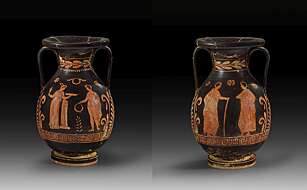
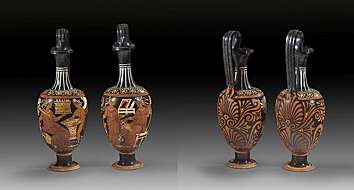
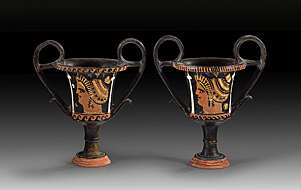
Gorny & Mosch Logo
Lote
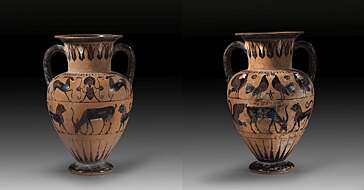
Lote 1. Chalkidische schwarzfigurige Halsamphora des Phineus-Malers. 530 v. Chr. H 28,1cm, B 18,4cm ø 17,3cm. Auf dem Körper zwei Tierfriese. Oben auf einer Seite zwei Hähne zwischen Sirenen, auf der anderen Palmetten-Lotus-Motiv zwischen zwei Hirschkühen und einer Eule, in den Zwischenräumen Rosetten und unter den Henkeln je eine Swastika. Auf dem unteren Abschnitt drei Panther, zwei Ziegenböcke, ein Schwan und eine Eule. Auf dem Hals Lotusknospen und über dem Fuß Strahlenkranz. Rot und Weiß für zahlreiche Details. Mit Kopie der Rechnung! Kleine Absplitterung an der Mündung, sonst intakt und mit sehr gut erhaltenen Farben. Provenienz: Ex Sammlung A. M., Ascona / Amsterdam, erworben 1987 bei Robin Symes Limited, London. Eine Amphora im fast gleichen Dekorschema in Oxford, Ashmolean Museum 1950.6 (Beazley Archive Pottery Database 900004). Die Produktionsstätte dieser Vasen, die nach Inschriften in chalkidischer Schrift benannt sind, ist nicht sicher. Im Gespräch sind Rhegion und Caere, das heutige Cerveteri. Die Maler arbeiten in hervorragender Qualität und nehmen Anregungen attischer, korinthischer und ionischer Vasen auf. Siehe dazu Th. Mannack, Griechische Vasenmalerei - Eine Einführung (2002) S. 129-131; zum Phineus-Maler weiterhin Der Neue Pauly 9 (2000) 903 s.v. Phineus-Maler [M. Steinhardt]. Chalcidian black-figure neck-amphora by the Phineus Painter. 530 BC. H 28.1cm, W 18.4cm, ø 17.3cm. Two animal friezes on the corpus. Above, on one side, two roosters between sirens, on the other, a palmette-lotus motif between two hinds and an owl. Rosettes fill the intervening spaces, and there is a swastika beneath each handle. On the lower section three panthers, two goats, a swan, and an owl. Lotus buds on the neck and ray pattern above the foot. Red and white used for numerous details. With copy of the invoice! Small chip at the rim, otherwise intact, with very well-preserved colors.
  • Precio de salida:
    12'000 EUR
    10'005 GBP
    10'973 CHF
    13'398 USD

    Importes redondeados, solo aproximadosFecha: 06/11/2026
Lote
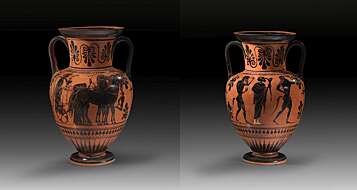
Lote 2. Attische schwarzfigurige Halsamphora des Rote-Linien-Malers. 510 - 490 v. Chr. H 28,3cm, ø 17,7cm. Auf der Vorderseite die Fahrt des Dionysos in den Olymp. Der Gott steht mit Kantharos als Lenker im Wagen der Quadriga, dahinter eine Mänade und davor eine kleine schwebende Gestalt. Rückwärtig wird die Szene durch einen Thiasos bestehend aus zwei tanzenden Satyrn und einer Mänade mit Rhyton ergänzt. Weiß und Rot für zahlreiche Details. Zusammengesetzt, dabei kleine Fehlstellen ergänzt, aber nicht retuschiert. Provenienz: Ex Sammlung Dr. H.-J. V., München, erworben vor 1990 auf einer Münchner Messe. Zum Maler siehe J. D. Beazley, Attic Black-figure Vase-painters (1956) S. 600-605. Attic black-figure neck-amphora by the Red-Line Painter. 510 - 490 BC. H 28.3cm, ø 17.7cm. The front depicts the journey of Dionysus to Olympus. The god with kantharos stands as charioteer on a quadriga, behind the horses a maenad, and in front of the quadriga, a small, hovering figure. On the reverse, the scene is complemented by a thiasos consisting of two dancing satyrs and maenad holding a rhyton. White and red are used for numerous details. Reassembled, small missing areas filled in, but not retouched.
  • Precio de salida:
    4'000 EUR
    3'335 GBP
    3'657 CHF
    4'466 USD

    Importes redondeados, solo aproximadosFecha: 06/11/2026
Lote
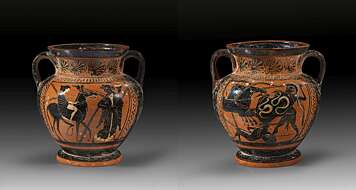
Lote 3. Kleine attische schwarzfigurige Amphora aus der Werkstatt des Sappho- und des Diosphos-Malers. 500 - 490 v. Chr. H 15,6cm, B 15,1cm, ø 14,6cm. Beidseitig rechteckiges Bildfeld gerahmt von Zungenstab und doppelten Efeuranken. Auf der einen Seite kämpft ein Krieger über seinem gefallenen Gefährten gegen einen Streitwagen, dessen beide Pferde zur Hälfte links zu sehen sind. Als Besonderheit des Kriegers ist sein Schild zu nennen, bei dem es sich um eine Pelte handelt, die als Zeichen zwei Schlangen trägt. Auf der anderen Seite ein Thiasos mit einer Mänade reitend auf einem Maulesel und davor Dionysos mit Rhyton. Mit Kopie der Rechnung! Ein Mündungsfragment sowie ein Henkel fehlen und sind retuschiert, der andere Henkel gebrochen und wieder angesetzt. Provenienz: Ex Sammlung A. M., Ascona / Amsterdam, erworben 1987 bei Robin Symes Limited, London. Small Attic black-figure amphora from the workshop of the Sappho and Diosphos Painter. H 15.6cm, W 15.1cm, ø 14.6cm. Rectangular picture panels on both sides, framed by tongue pattern and double ivy tendrils. On one side, a warrior fights a chariot over his fallen comrade, the two horses of the chariot are partially visible on the left. Distinctive feature of the warrior is his shield, a pelta which bears an emblem of two snakes. The other side depicts a thiasos scene featuring a maenad riding a mule, preceded by Dionysus holding a rhyton. With copy of the invoice! Fragment of the rim and one handle are missing and have been restored, the other handle is broken and reattached.
  • Precio de salida:
    8'000 EUR
    6'670 GBP
    7'315 CHF
    8'932 USD

    Importes redondeados, solo aproximadosFecha: 06/11/2026
Lote
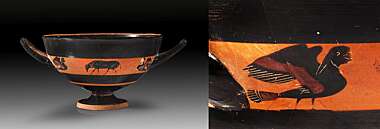
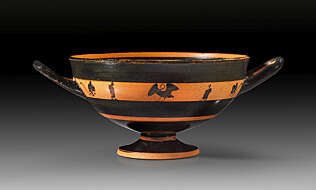
Lote 4. Attischer schwarzfiguriger Bandskyphos aus der Werkstatt des Hermogenes in der Art des Elbows-Out-Malers. 530 - 520 v. Chr. H 11,4cm, B 26,6cm, ø 19,3cm. Tiefe Schale, die dem Dekorschema der Bandschalen folgt, auf einem niedrigen Fuß mit Wulst der Form A. Beidseitig auf der Frieszone ein äsender Widder zwischen zwei Sirenen. Einsatz von Weiß und Rot für Details. Mit schönem Infofaltblatt des Vorbesitzers! Zusammengesetzt, kleine Fehlstelle und Absplitterungen an den Bruchkanten retuschiert. Provenienz: Ex Sammlung G. B., Schweiz, erworben am 3. Oktober 1983 bei Ariadne Galleries, New York. Attic black-figure band skyphos from the workshop of Hermogenes and in the manner of the Elbows-Out Painter. 530 - 520 BC. H 11.4cm, W 26.6cm, ø 19.3cm. Deep cup following the decorative scheme of Band Cup , resting on low foot with torus moulding of typus A. On both sides, the frieze zone features a grazing ram flanked by two sirens. White and red are used for details. Includes a nice information leaflet from the previous owner! Reassembled, one small loss and chips along the break edges retouched. ● Ware in Vorübergehender Verwendung / Subject to temporary admission
  • Precio de salida:
    3'600 EUR
    3'001 GBP
    3'292 CHF
    4'019 USD

    Importes redondeados, solo aproximadosFecha: 06/11/2026
Lote
Lote 5. Attischer schwarzfiguriger Bandskyphos eines Kleinmeisters. 540 - 530 v. Chr. H 10,8cm, B 27,5cm, ø 19,8cm. Tiefe Schale, die dem Dekorschema der Bandschalen folgt, auf einem niedrigem Fuß mit Wulst der Form A. Beidseitig auf der Frieszone ein Schwan mit ausgebreiteten Flügeln zwischen zwei Manteljünglingen, an den Henkelenden Palmetten. Einsatz von Weiß und Rot für Details. Drei kleine Randfragmente gebrochen und wieder eingesetzt, sonst intakt. Provenienz: Aus der Schweizer Privatsammlung Y. v. d. W., erworben in den 1960er Jahren; in Deutschland seit 2010. Attic black-figure band skyphos by a Little Master. 540 - 530 BC. H 10.8cm, W 27.5cm, ø 19.8cm. Deep cup following the decorative scheme of Band Cup , resting on low foot with torus moulding of typus A. On both sides, within the frieze zone, swan with spread wings is depicted between two draped youths, palmettes appear at the handle terminals. White and red are used for details. Three small rim fragments broken and reattached, otherwise intact.
  • Precio de salida:
    2'240 EUR
    1'867 GBP
    2'048 CHF
    2'500 USD

    Importes redondeados, solo aproximadosFecha: 06/11/2026
Lote
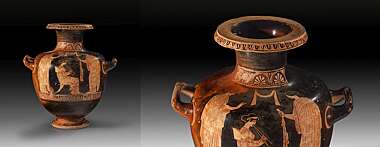
Lote 6. Attische rotfigurige Kalpis der Polygnotos-Gruppe. 440 - 430 v. Chr. H 30,3cm, B 26,9cm, 22,2cm. Sonderform einer Hydria mit abgerundeter Schulter. Zwischen Palmetten auf der Schulter und einem Mäander als Standlinie eine Szene aus dem Frauengemach. Dabei spielt die auf einem Klismos genannten Möbel Sitzende in der Mitte die Doppelaulos. Seitlich von ihr zwei weitere Frauen - eine davon mit dem Futteral für das Instrument -, die ihrem Spiel lauschen. Mit Kopien aller Kataloge! Kleine oberflächige Bestoßungen und kleine Absplitterungen an der Mündung, sonst intakt, dabei ca. ein Drittel durch nicht ausreichende Hitzeeinwirkung beim Brand rotbraun gefärbt. Provenienz: Ex Privatsammlung B. F., München; ex Galerie W. Schmidt, München; ex Privatsammlung v. d. G., Würzburg; ex Sotheby´s New York 14. Dezember 1994, Los 60 mit der Zuweisung an die Polygnot-Gruppe; aus der Sammlung des US-Schauspielers Bronson Pinchot; ex Sotheby´s London 3. Dezember 1991, Los 150; ex Galerie Günter Puhze, Freiburg im Breisgau Katalog 8 (1989) S. 22 Nr. 216 mit Abb. Auf dem Höhepunkt der Macht Athens und nach der Vollendung der Demokratie 457 v. Chr. durch die Einführung der Diäten für Volksvertreter ändert sich das Bildrepertoire auf Vasen der sog. Parthenonzeit dahingehend, dass nun bürgerliche Tugenden wie Pflichterfüllung und politisches Engagement dominierend sind. Auf Bildern der Frauenwelt steht nun die Rolle der Mutter und Ehefrau im Vordergrund. Wie unsere Kalpis zeigt, gehörte zu einer attischen Bürgerin aber auch Bildung einschließlich der Fähigkeit musischer Betätigung. Der ehemalige Besitzer der Vase, Bronson Alcott Pinchot (* 1959), spielte neben den Größen Hollywoods in namhaften Filmen wie zum Beispiel der Beverly Hills Cop Triologie oder Der Club der Teufelinnen mit. Außerdem war er der Star in der Serie Ein Grieche erobert Chicago . Pinchot, der ursprünglich Kunstgeschichte studieren wollte, trat später als Stifter des Metropolitan Museum of Art, New York in Erscheinung. Attic red-figure kalpis of the Polygnotos Group. 440 - 430 BC. H 30.3cm, W 26.9cm, 22.2cm. Hydria of special shape featuring rounded shoulder. Scene set in the women's quarters appears between palmettes on the shoulder and meander pattern serving as the ground line. In the center, a woman seated on a klismos chair plays the double aulos. Flanking her are two other women - one holding the instrument's case - listening to her play. With copies of all catalogs! Minor surface nicks and small chips at the rim, otherwise intact, with approximately one-third colored reddish-brown due to insufficient heat during firing.
  • Precio de salida:
    16'000 EUR
    13'341 GBP
    14'631 CHF
    17'864 USD

    Importes redondeados, solo aproximadosFecha: 06/11/2026
Lote
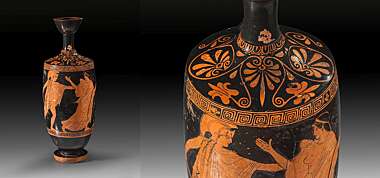
Lote 7. Große attische rotfigurige Lekythos eines Manieristen nahe dem Pan-Maler. 480 - 460 v. Chr. H 40,3cm, ø 15,1cm. Auf dem Fries ist eine mythologische Verfolgungsszene dargestellt, bei der ein Krieger mit gezücktem Schwert eine fliehende junge Frau mit Diadem verfolgt. In Analogie zu anderen Vasenbildern kann man hier eine Szene aus der Iliupersis - den Untergang Trojas - erkennen, in der Menelaos voller Wut seine untreue Ehefrau Helena zu dem Haus ihres neuen Gatten Deiphobos verfolgt. Der Mythos weiß, dass Menelaos diesen töten wird, aber beim Anblick seiner wunderschönen Frau seinen Groll vergisst, sich mit ihr versöhnt und mit ihr nach Hause nach Sparta geht. Zwischen den Köpfen und rechts von Helena verläuft eine in Rot verfasste Inschrift, deren erster Teil zwischen den Figuren allerdings modern ist. Der Teil rechts vom Kopf der Helena ist aber original und stellt eine neutrale Kalosinschrift dar: ΗΟ ΠΑΙΣ ΚΑΛΟΣ. Mit der originalen Rechnung von Kricheldorf! In der Mitte gebrochen und wieder mit kleinen retuschierten Fehlstellen zusammengesetzt, auf der Vorderseite ist der Glanzton weitgehend modern, auch bei den Figuren sind Partien modern übermalt, dazu gehören die Vorderseite des Helmes sowie die Nase des Menelaos, weiterhin kleine Partien am Gewand und die Konturen an Armen und Beinen, sein linker Arm ist ebenso wie der rechte der Helena übermalt, bei der Helena ist vom Kopf nur das Gesicht original, größere Teile am unteren und rechten Gewand sind ebenfalls übermalt, auch der vordere Teil der Inschrift ist ergänzt, während der hintere sich erhalten hat, original sind auch die Schulterpalmetten sowie der Glanzton auf der Rückseite, der Schulter, dem Hals und der Mündung, nur im Inneren der Mündung ist der Glanzton modern überdeckt. Provenienz: Aus der westdeutschen Privatsammlung S. M.; ehemals in der Sammlung Dr. Horst Haertel, erworben 1962 bei H. H. Kricheldorf, Stuttgart. Die Versöhnung von Menelaos und Helena, mit der dem höchsten Wert der griechischen Kultur, nämlich dem Erhalt der Familie, genüge getan wird, beginnt ein Prozess der Versöhnung, an dessen Ende die Entsühnung des Orestes vom Muttermord steht. Damit findet die größte aller Tragödien - der Fluch der Tantaliden - nach Generationen unglaublicher Exzesse mit Inzest und Brudermord sein Ende. Large Attic red-figure lekythos by a Mannerist close to the Pan Painter. 480 - 460 BC. H 40.3cm, ø 15.1cm. The frieze depicts a mythological pursuit scene in which a warrior with drawn sword chases a fleeing young woman wearing a diadem. By analogy with other vase paintings, this scene can be identified as part of the Iliupersis - the Fall of Troy - showing Menelaus furiously pursuing his unfaithful wife, Helen, to the house of her new husband, Deiphobus. According to the myth, Menelaus kills Deiphobus but, upon seeing his beautiful wife, forgets his anger, reconciles with her, and returns home to Sparta with her. An inscription in red runs between the heads and to the right of Helen. However, the first part situated between the figures is modern. The section to the right of Helen's head is original, and constitutes a neutral kalos inscription: ΗΟ ΠΑΙΣ ΚΑΛΟΣ. Includes the original Kricheldorf invoice! Broken across the middle and reassembled with small retouched losses, the glaze on the obverse is largely modern, and parts of the figures have also been overpainted - specifically the front of the helmet, the nose of Menelaus, small sections of the drapery, and the outlines of the arms and legs. His left arm has been overpainted, as has Helen's right arm. Regarding Helen, only the face remains from the original head, and larger areas of the lower and right-hand drapery have also been overpainted. The front part of the inscription is a restoration, whereas the rear section is preserved. The shoulder palmettes are original, as is the glaze on the reverse, shoulder, neck, and rim - only the glaze inside the rim has been covered over with modern paint.
  • Precio de salida:
    6'000 EUR
    5'002 GBP
    5'486 CHF
    6'699 USD

    Importes redondeados, solo aproximadosFecha: 06/11/2026
Lote
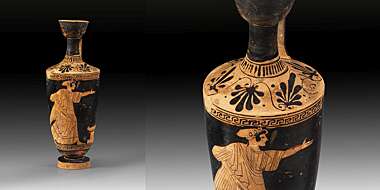
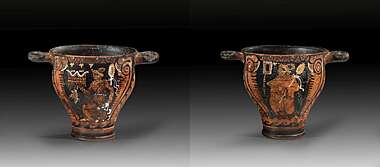
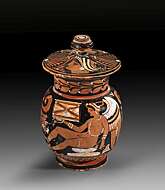
Lote 8. Attische rotfigurige Zylinderlekythos des Bowdoin-Malers. 470 - 460 v. Chr. H 26,2cm, ø 9,4cm. Nach rechts zu einem Altar eilende Frau mit Phiale in der Hand und bekleidet mit Kranz, Sakkos, Chiton und Schrägmäntelchen. Mit Kopie der Rechnung und französischem Antikenpass! Fuß und Henkel gebrochen und wieder angesetzt, winzige Absplitterungen an Mündung und Fuß. Provenienz: Ex Sammlung M. C., Frankreich, erworben am 6. Juni 1986 bei Patrice LaPorte, Paris. Attic red-figure cylindrical lekythos by the Bowdoin Painter. 470 - 460 BC. H 26.2cm, ø 9.4cm. Woman hurrying to the right towards an altar, holding phiale and wearing wreath, sakkos, chiton, and small diagonal mantle. Includes a copy of the invoice and French antiquities passport! Foot and handle broken and reattached, tiny chips on the rim and foot.
  • Precio de salida:
    6'000 EUR
    5'002 GBP
    5'486 CHF
    6'699 USD

    Importes redondeados, solo aproximadosFecha: 06/11/2026
Lote
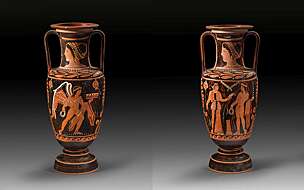
Lote 9. Große paestanische rotfigurige Amphora des Asteas. 340 - 330 v. Chr. H 45,9cm, B 18,9cm, ø 18,3cm. Auf der einen Seite stehen seitlich eines Altars eine junge Frau mit Spendenschale und ein Jüngling mit Kranz und Früchteband. Auf der anderen eilt ein Eros mit Schachtel und Kranz nach rechts. Auf dem Hals beidseitig je ein Frauenkopf mit Sakkos. Reichliche Verwendung von Weiß und Gelb für die Details. Mit TL-Analyse! Intakt. Provenienz: Ex Privatsammlung Dr. M. C., Genf, erworben in den 1960er Jahren; publiziert von Arthur D. Trendall 1987. Zugewiesen und publiziert von A. D. Trendall, The Red-Figured Vases of Paestum. Band 2 (1987) S. 127 N.184. Large Paestan red-figure amphora by Asteas. 340 - 330 BC. H 45.9cm, W 18.9cm, ø 18.3cm. On one side, a young woman holding libation bowl and a youth with wreath and garland of fruit stand on either side of an altar. On the other side, an Eros carrying box and wreath hurries to the right. The neck features female head wearing sakkos on each side. Generous use of white and yellow for the details. With TL analysis! Intact. Attributed and published by Arthur D. Trendall. ● Ware in Vorübergehender Verwendung / Subject to temporary admission
  • Precio de salida:
    9'600 EUR
    8'004 GBP
    8'778 CHF
    10'718 USD

    Importes redondeados, solo aproximadosFecha: 06/11/2026
Lote
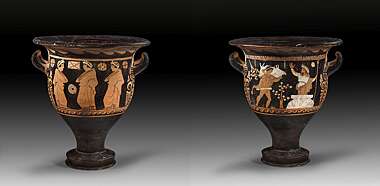
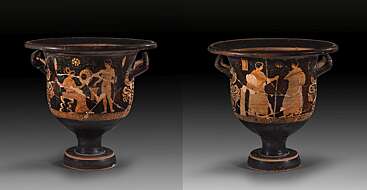
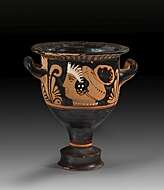
Lote 10. Kampanischer rotfiguriger Glockenkrater des Malers von New York GR 1000. Cumae, um 340 v. Chr. H 41,8cm, ø 38,2cm. Auf der Vorderseite die vierte Heraklesarbeit, bei der der Held nach vollbrachter Tat den Erymanthischen Eber zu König Eurystheus bringt, der sich vor Angst in einen großen Pithos geflüchtet hat. Rückwärtig drei Manteljünglinge. Reicher Gebrauch von weißer und gelber Farbe für Details. Mit TL-Analyse! Zwei Randfragmente und der Fuß gebrochen und wieder angesetzt, sonst in hervorragendem Zustand. Provenienz: Ex Slg. F.R.; ex Schweizer Privatsammlung, erworben 1993; davor in der Sammlung von Madame A., Genf, erworben Mitte der 1980er Jahre; davor in einer deutschen Privatsammlung. Zuweisung durch Michael Padgett. Vergleiche zum Beispiel A. D. Trendall, Rofigurige Vasen aus Unteritalien und Sizilien - Ein Handbuch (1990) Abb. 319-320. Campanian red-figure bell-krater by the New York GR 1000 Painter. Cumae, around 340 BC. H 41.8cm, ø 38.2cm. The front depicts the fourth labor of Heracles. Having completed the task, the hero brings the Erymanthian Boar to King Eurystheus, who is hiding in a large pithos out of sheer terror. The reverse shows three draped youths. Rich use of white and yellow paint for details. Includes a TL analysis! Two rim fragments and the foot broken and reattached, otherwise in excellent condition. ● Ware in Vorübergehender Verwendung / Subject to temporary admission
  • Precio de salida:
    28'000 EUR
    23'347 GBP
    25'604 CHF
    31'262 USD

    Importes redondeados, solo aproximadosFecha: 06/11/2026
Lote
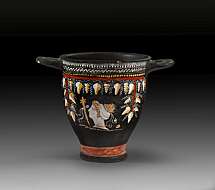
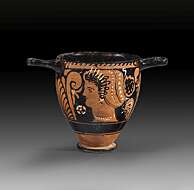
Lote 11. Monumentaler apulischer Skyphos der Gnathia-Ware aus der Darius-Unterwelt-Werkstatt. 330 - 320 v. Chr. H 29,5cm, B 38,9cm, ø 26,1cm. Glanztonware mit weißer, gelber und roter Bemalung. Vorne in einer Laube mit Weinranke ein Frauenkopf mit Sakkos neben einer Fackel. Rückwärtig eine Laube mit Efeuranke, darin ein kleiner Kreis. Der Stiel des Fußes ist mit roter Farbe gedeckt. Aus zwei großen Fragmenten zusammengesetzt, Bruchkanten etwas retuschiert. Provenienz: Ex Sammlung F.R.; ex Privatsammlung England, erworben vor 2000. Monumental Apulian Gnathia-ware skyphos from the Darius-Underworld Workshop. 330 - 320 BC. H 29.5cm, W 38.9cm, ø 26.1cm. Black glazed ware with white, yellow, and red painting. On the front, within an arbor featuring grapevine, is a female head wearing sakkos, positioned next to a torch. On the back is an arbor with ivy tendril enclosing a small circle. The stem of the foot is covered in red paint. Assembled from two large fragments, break edges slightly retouched.
  • Precio de salida:
    3'680 EUR
    3'068 GBP
    3'365 CHF
    4'108 USD

    Importes redondeados, solo aproximadosFecha: 06/11/2026
Lote
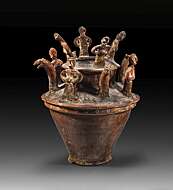
Lote 12. Picenische Urne mit figürlichem Dekor. Östliches Mittelitalien, 600 - 575 v. Chr. H 31,7cm, ø 23,2cm. Braunes bis schwarzes Impasto. Konisches Gefäß mit Pseudo-Deckel, darauf niedriger Hals und kreisrunde Mündung. Auf Deckel und Mündung zwei Kreise von Figuren bestehend aus je vier Adoranten und unten vier Greifenprotomen. Unter dem Deckel Fries aus gestempelten Kreismotiven. Mit Kopie der Rechnung! Absplitterungen an Deckelrand und Fußring, mehrere Figuren gebrochen und wieder angesetzt, die Köpfe von drei Adoranten fehlen und sind modern ergänzt. Provenienz: Ex Privatbesitz D. M., Bayern, erworben am 31. Mai 1980 bei der Kunsthandlung Aloys Faust, Köln. Zu der Kultur der Picener siehe L. F. Dell´Orto (Hrsg.), Die Picener - Ein Volk Europas. Ausstellung Frankfurt (1999) insbesondere S. 97 Abb. 70 = S. 215 Nr. 204 (Greifenprotome); S. 90 Abb. 64 = S. 250 Nr. 433 (Deckel mit Figuren). Picenian urn with figurative decoration. Eastern Central Italy, 600 - 575 BC. H 31.7cm, ø 23.2cm. Brown to black impasto. Conical vessel with pseudo-lid, featuring low neck and circular mouth. On the lid and mouth are two rows of figures, each consisting of four adorants, with four griffin protomes below. Beneath the lid runs a frieze of stamped circular motifs. With a copy of the invoice! Chipping to the rim of the lid and the foot ring, several figures broken and reattached, the heads of three adorants are missing and have been replaced with modern additions.
  • Precio de salida:
    4'000 EUR
    3'335 GBP
    3'657 CHF
    4'466 USD

    Importes redondeados, solo aproximadosFecha: 06/11/2026
Lote
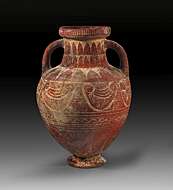
Lote 13. Etruskische Amphora mit phönizischen Palmetten. Cerveteri, 650 - 625 Jh. v. Chr. H 40,1cm, ø 27,6cm. Weingefäß aus braunem Impasto mit kräftigem rotbraunem Überzug und weißer Deckfarbe. In mehreren Friesen zeigt diese unten über einem Strahlenkranz ein Flechtband zwischen Linien, darüber aufwendige hängende Palmetten phönizischer Art und darüber drei Reihen von hängenden Dreiecken. Intakt. Provenienz: Ex Sammlung A. M., Ascona / Amsterdam, erworben 1985. Etruscan amphora with Phoenician palmettes. Cerveteri, 650 - 625 century BC. H 40.1cm, ø 27.6cm. Wine vessel made of brown impasto with strong reddish-brown slip and white painted decoration. Arranged in several friezes, the design features from the bottom up, above a radiating band, a braided pattern between lines, followed by elaborate Phoenician-style hanging palmettes, and finally three rows of hanging triangles. Intact.
  • Precio de salida:
    2'400 EUR
    2'001 GBP
    2'194 CHF
    2'679 USD

    Importes redondeados, solo aproximadosFecha: 06/11/2026
Lote
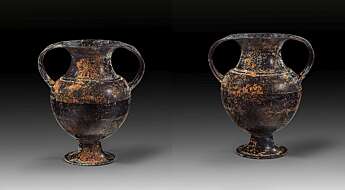
Lote 14. Etruskische Bucchero-Amphora der Nikosthenischen Form mit Tierfries. 600 - 550 v. Chr. H 33,5cm, B 29,4cm, ø 23,1cm. Großes Weingefäß mit globularem Körper, konkav eingeschnittenem Hals, breiten, durchbrochenen Bandhenkeln und einem profilierten Trompetenfuß. Zwischen zwei Reihen vertikaler Ritzungen ein Tierfries mit drei geflügelten Wesen je Seite inkl. Sphinx, Hirschkuh und Greif. Mit Kopie der Rechnung! Hals zusammen mit den beiden Henkeln gebrochen und wieder angesetzt, Fuß teilweise zusammengesetzt, Gefäß vollständig mit ungebrochenem Körper. Provenienz: Ex Sammlung A. M., Ascona / Amsterdam, erworben 1987 bei Robin Symes Limited, London. Diese typische etruskische Amphorenform mit breiten Bandhenkeln entsteht im 7. Jh. v. Chr. in der Impasto-Technik. Später ist ihre Beliebtheit als Bucchero-Variante so groß, dass der attische Töpfer und Werkstattbesitzer Nikosthenes ab 530 v. Chr. eine schwarzfigurige Nachahmung herstellt, obwohl in Etrurien die Produktion bereits eingestellt wurde. Wohl als Exportware gedacht, wird sie in der rotfigurigen Technik noch bis zum Beginn der Perserkriege hergestellt. Etruscan Bucchero amphora of the Nikosthenic shape with an animal frieze. 600 - 550 BC. H 33.5cm, W 29.4cm, ø 23.1cm. Large wine vessel with globular body, concave neck, broad openwork strap handle, and profiled trumpet-shaped foot. Between two rows of vertical incised lines an animal frieze featuring three winged creatures on each side, including sphinx, hind, and griffin.With copy of the invoice! Neck broken off along with both handles and reattached, foot partially reassembled, vase complete with intact corpus.
  • Precio de salida:
    6'400 EUR
    5'336 GBP
    5'852 CHF
    7'145 USD

    Importes redondeados, solo aproximadosFecha: 06/11/2026
Lote
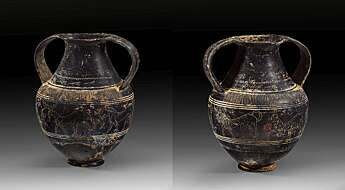
Lote 15. Etruskische Amphora aus Bucchero mit Tierfries. 625 - 600 v. Chr. H 28,4cm, B 23,1cm, ø 21,6cm. Transportgefäß für Wein mit breiten Bandhenkeln, sog. Nikosthenische Form. Auf dem Bauch zwischen zwei Dreiergruppen abgedrehter Rillen geritzter Tierfries beginnend mit einem Panther, nach rechts folgend Hirsch, Löwe, Stier, Widder und am Schluss ein Hase. Der weitere Dekor beinhaltet einen Strahlenkranz über dem Fuß und einen gestichelten Fächerfries auf der Schulter. Kleine Absplitterungen an Mündung und Fuß, sonst intakt. Provenienz: Ex Sammlung A. M., Ascona / Amsterdam, erworben 1985. Etruscan bucchero amphora with animal frieze. 625 - 600 BC. H. 28.4cm, W. 23.1cm, ø 21.6cm. Wine transport vessel with broad strap handles, of the so-called Nikosthenic shape. On the body, between two sets of three grooves, is an incised animal frieze beginning with panther, followed to the right by stag, lion, bull, ram, and finally a hare. Additional decoration includes ray pattern above the foot and stippled fan frieze on the shoulder. Small chips on the rim and base, otherwise intact.
  • Precio de salida:
    3'200 EUR
    2'668 GBP
    2'926 CHF
    3'572 USD

    Importes redondeados, solo aproximadosFecha: 06/11/2026
Lote
Lote 16. Kleine minoische Amphora. Nachpalastzeit SM IIIA, 14. Jh. v. Chr. H 15,1cm, ø 12,6cm. Liniendekor in Dunkelbraun, auf der Schulter Fries von Schrägstrichen. Zahlreiche oberflächige Absplitterungen und Risse, an der Lippe Abplatzungen. Provenienz: Ex Sammlung R. W., Rheinland-Pfalz, seit vor 1980. Small Minoan amphora. Post-palace period SM IIIA, 14th century BC. H 15.1cm, ø 12.6cm. Linear decoration in dark brown, frieze of diagonal strokes on the shoulder. Numerous superficial chips and cracks, flaking on the lip.
  • Precio de salida:
    640 EUR
    533 GBP
    585 CHF
    714 USD

    Importes redondeados, solo aproximadosFecha: 06/11/2026
Lote
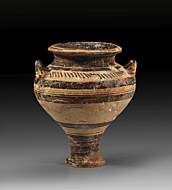
Lote 17. Kleine mykenische Bügelkanne. Späthelladisch III B, 13. Jh. v. Chr. H 8,8cm, ø 11,5cm. Hellbrauner Ton mit brauner bis dunkelbrauner Bemalung. Neben breitem und dünnem Liniendekor befinden sich auf der Schulter fächerartige konzentrische Viertelkreise. Mit Kopie des Kataloges und dem Originalzertifikat! Zahlreiche kleine oberflächige Absplitterungen, ein Wandungsloch auf der Unterseite. Provenienz: Ex Sammlung H. S., Norddeutschland, erworben 1983 bei der Galerie Günter Puhze in Freiburg im Breisgau. Publiziert in Kunst der Antike - Galerie Günter Puhze Katalog 5 (1983) S. 16 Nr. 143 mit Abb. Small Mycenaean stirrup jug. Late Helladic III B, 13th century BC. H 8.8cm, ø 11.5cm. Light brown terracotta with brown to dark brown painting. In addition to broad and fine line decoration, fan-like concentric quarter-circles appear on the shoulder. Includes a copy of the catalogue and the original certificate! Numerous small, superficial chips, hole in the wall on the underside.
  • Precio de salida:
    640 EUR
    533 GBP
    585 CHF
    714 USD

    Importes redondeados, solo aproximadosFecha: 06/11/2026
Lote
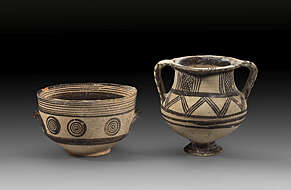
Lote 18. Zwei Vasen der White Painted IV-Ware. Archaisch I, 750 - 600 v. Chr. Beige Terrakotta mit dunkelbrauner Bemalung. a) Kleine Amphora mit schraffierten Metopen und Zickzack-Muster. H 12,1cm, B 13,2cm. Kleine Absplitterung am Rand. b) Tiefe Henkelschale mit Liniendekor und konzentrischen Kreisen sowohl außen wie auch im Inneren. H 7,9cm, ø 12,7cm. Kleine Absplitterungen am Rand und an einem Henkel. 2 Stück! Mit Kopie des Kataloges und den Originalzertifikaten! Provenienz: Ex Sammlung H. S., Norddeutschland, erworben 1993 bei der Galerie Günter Puhze in Freiburg im Breisgau. Publiziert in Kunst der Antike - Galerie Günter Puhze Katalog 10 (1993) S. 14 Nr. 149 und 151 mit Abb. Two vases of White Painted IV ware. Archaic I, 750 - 600 BC. Beige terracotta with dark brown painted decoration. a) Small amphora with hatched metopes and zigzag patterns. H 12.1cm, W 13.2cm. Small chip on the rim. b) Deep cup with handles, featuring linear decoration and concentric circles on both the exterior and interior. H 7.9cm, ø 12.7cm. Small chips on the rim and on one handle. 2 pieces! Includes a copy of the catalogue and the original certificates!
  • Precio de salida:
    1'200 EUR
    1'000 GBP
    1'097 CHF
    1'339 USD

    Importes redondeados, solo aproximadosFecha: 06/11/2026
Lote
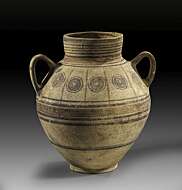
Lote 18a. Amphora der Bichrome IV-Ware. Archaisch I, 750 - 600 v. Chr. H 30,7cm, B 18,2cm, ø 26,6cm. Beige Terrakotta mit rot- und dunkelbrauner Bemalung. Neben Liniendekor auf Bauch und Hals findet sich auf der Schulter ein Metopenfries mit eingestellten konzentrischen Kreisen. Intakt. Provenienz: Ex Sammlung E. K., München / Salzburg, erworben in den 1980er bis 1990er Jahren in Deutschland . Amphora of Bichrome IV ware. Archaic I, 750 - 600 BC. Beige terracotta with reddish and dark brown painted decoration. H 30.7cm, W 18.2cm, ø 26.6cm. Beige terracotta with reddish and dark brown painting. In addition to linear decoration on the corpus and neck, the shoulder features a metope frieze with set-in concentric circles. Intact.
  • Precio de salida:
    800 EUR
    667 GBP
    731 CHF
    893 USD

    Importes redondeados, solo aproximadosFecha: 06/11/2026
Lote
Lote 19. Karische Olpe des orientalisierenden Stils. Wohl Milet, 630 - 610 v. Chr. H 21,4cm, ø 23,1cm. Lentoide Kanne mit Trompetenmündung und Bandhenkel. Die schwarze bis braune Bemalung in Silhouettentechnik. Neben Bündeln von Linien auf Bauch und Hals weiterhin über dem Fuß Strahlenkranz und auf der Schulter Wasservögel zwischen zwei mit Rauten gefüllten Dreiecken. Zusammengesetzt, Absplitterungen an den Bruchkanten und eine Fehlstelle im Boden retuschiert, Malerei an kleinen Stellen berieben. Provenienz: Ehemals Sammlung D. T., Bayern, seit mindestens 2000. Carian olpe in the Orientalizing style. Likely Miletus, 630 - 610 BC. H 21.4cm, ø 23.1cm. Lentoid jug with a trumpet-shaped mouth and strap handle. Decoration in black to brown paint using the silhouette technique. In addition to bands of lines on the body and neck, there is a ray pattern above the base and, on the shoulder, a waterfowl flanked by two triangles filled with lozenge pattern. Reassembled, chips along the break edges and a missing area on the base have been retouched, paint rubbed in small areas.
  • Precio de salida:
    1'200 EUR
    1'000 GBP
    1'097 CHF
    1'339 USD

    Importes redondeados, solo aproximadosFecha: 06/11/2026
Lote
Lote 20. Sehr schöne peuketische Amphora. Geometrischer Stil, 575 - 525 v. Chr. H 29,6cm, B 25,1cm, ø 24,1cm. Hellbrauner Ton mit dunkelbrauner Bemalung. Auf der Schulter zwischen Linien zwei Reihen schraffierter Rauten, auf dem Bauch Metopenfries mit je einer großen Swastika zwischen Gitterfeldern, auf der Mündung Bogenelemente mit Zickzack. Mit TL-Analyse von 2024! Winzige Absplitterungen an Mündung, Henkel und Fuß, Bemalung minimal berieben, sonst intakt. Provenienz: Aus der alten Privatsammlung von Dr. und Madame M. J., Antwerpen, erworben vor mehr als 50 Jahren. Vergleiche S. Cassani (Hrsg.), The Art of the Italic Peoples from 3000 to 30 BC. Ausstellung Genf - Paris (1993) S. 304 Nr. 197. Very beautiful Peucetian amphora. Geometric style, 575 - 525 BC. H 29.6cm, W 25.1cm, ø 24.1cm. Light brown terracotta with dark brown painting. On the shoulder, between lines, two rows of hatched diamonds, on the body, metope frieze featuring large swastika alternating with hatched panels, on the mouth, arched elements with zigzag patterns. Includes a 2024 TL analysis! Tiny chips on the rim, handle, and foot, painting minimally rubbed, otherwise intact.
  • Precio de salida:
    960 EUR
    800 GBP
    877 CHF
    1'071 USD

    Importes redondeados, solo aproximadosFecha: 06/11/2026
Lote
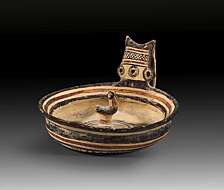
Lote 21. Sehr schöner bichromer daunischer Kyathos mit Vogel. Subgeometrisch II, 525 - 475 v. Chr. H 10,6cm, B 17,8cm, ø 16,9cm. Niedrige Randschale mit hohem gehörnten Schlaufenhenkel, der mit drei "Augen" verziert ist, im Inneren ein plastischer Vogel. Bemalung in Rot- und Dunkelbraun zumeist bestehend aus Linien oder Ringen, auf dem Henkel ein Gitter und auf der Unterseite Raute im Kreis umgeben von Bogensegmenten. Intakt. Provenienz: Ex Sammlung F.R.; aus der Sammlung von Madame D., Genf, erworben in den 1960er bis frühen 1970er Jahren. Very beautiful bichrome Daunian kyathos with bird. Subgeometric II, 525 - 475 BC. H 10.6cm, W 17.8cm, ø 16.9cm. Shallow bowl with high, horned loop handle decorated with three eyes , sculpted bird figure sits inside. Painted in red and dark brown, predominantly with lines or rings, the handle features grid pattern, while the underside displays diamond shape within a circle, surrounded by arc segments. Intact. ● Ware in Vorübergehender Verwendung / Subject to temporary admission
  • Precio de salida:
    800 EUR
    667 GBP
    731 CHF
    893 USD

    Importes redondeados, solo aproximadosFecha: 06/11/2026
Lote
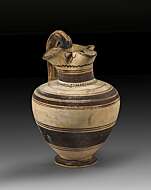
Lote 22. Korinthische Kleeblattoinochoe. Mittelkorinthisch, 600 - 575 v. Chr. H 29,4cm, ø 19,1cm. Beiger Ton mit dunkel- bis rotbrauner Bemalung in Gestalt von breiten und schmalen Linien. Auf der Schulter zusätzlich eine Schlangenlinie und ein Efeufries, und in den Mündungstälern Lotusblüten. Mit Originalexpertise von Gackstätter! Henkel und einige Mündungsfragmente gebrochen und wieder angesetzt. Provenienz: Ex Sammlung H. S., Norddeutschland, erworben 1993 bis 2010 beim Antiken-Kabinett - Bernd Gackstätter, Frankfurt am Main. Corinthian trefoil oinochoe. Middle Corinthian, 600 - 575 BC. H 29.4cm, ø 19.1cm. Beige terracotta with dark to reddish-brown painted decoration in the form of broad and narrow lines. Additionally, a wavy line and an ivy frieze on the shoulder, and lotus blossoms in the valleys of the mouth. Includes an original certificate of authenticity from Gackstätter! Handle and several rim fragments broken and reattached.
  • Precio de salida:
    600 EUR
    500 GBP
    548 CHF
    669 USD

    Importes redondeados, solo aproximadosFecha: 06/11/2026
Lote
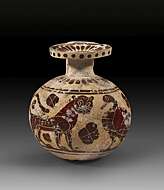
Lote 23. Korinthischer schwarzfiguriger Kugelaryballos. Frühkorinthisch, 600 - 590 v. Chr. H 8,7cm, ø 7,7cm. Auf dem Körper Tierfries mit Löwe, Panther und Schwan, dazwischen Palmetten. Intakt mit kleinen Sinterresten. Provenienz: Ex Sammlung A. M., Ascona / Amsterdam, erworben 1985. Corinthian black-figure globular aryballos. Early Corinthian, 600 - 590 BC. H 8.7cm, ø 7.7cm. Animal frieze on the body featuring lion, panther, and swan, with palmettes interspersed. Intact, with small traces of sinter.
  • Precio de salida:
    800 EUR
    667 GBP
    731 CHF
    893 USD

    Importes redondeados, solo aproximadosFecha: 06/11/2026
Lote
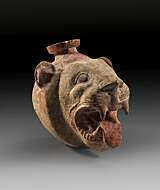
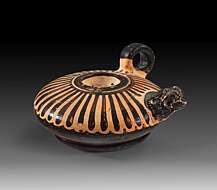
Lote 24. Figürlicher Aryballos in Form eines Löwenkopfes. Ostgriechisch, 560 - 550 v. Chr. H 11,5cm, L liegend 11,7cm, B 9,2cm. Als Kopf eines männlichen Löwen mit offenem Maul sowie heraushängender Zunge gestaltetes Salbgefäß. Die Rückseite ist abgeflacht und dient als Standfläche, oben ein runder Mündungsteller mit kleinem Einfüllloch. Polychrome Bemalung mit rot- und dunkelbrauner sowie gelber Farbe. Mit Kopie des Christie´s-Kataloges! Seltenes, wunderschönes Stück! Winzige Bestoßungen an Mündungsteller und rechtem Ohr, sonst intakt mit gut erhaltener Farbe. Provenienz: Ex Sammlung J. M., Deutschland, seit 2003; ex Christie´s London Auktion 29. Oktober 2003; 1982 bei der Galerie Heidi Vollmoeller in Zürich; davor seit 1973 in der Vollmoeller Galerie. Publiziert: Christie´s London Auktion 29. Oktober 2003, Los 488; Galerie Heidi Vollmoeller Zürich, Terracotta (1983) Nr. 60. Vgl. zum Beispiel einen ganz ähnlichen Löwenkopfaryballos im Antikenmuseum und Sammlung Ludwig, Basel Inv. BS312.1966: Beazley Archive Pottery Database 1008832 (samisch?). Figural aryballos in the shape of a lion's head. Eastern Greek, 560 - 550 BC. H 11.5cm, L 11.7cm, W 9.2cm. Cosmetic vessel shaped as the head of a male lion with open mouth and protruding tongue. The back is flattened to serve as a base and at the top is a disk-shaped mouth with small filling hole. Polychrome decoration in red, dark brown, and yellow. Includes a copy of the Christie's catalogue! Rare, special and marvelous piece! Tiny chips on the mouth and right ear, otherwise intact, with well-preserved paint.
  • Precio de salida:
    2'800 EUR
    2'334 GBP
    2'560 CHF
    3'126 USD

    Importes redondeados, solo aproximadosFecha: 06/11/2026
Lote
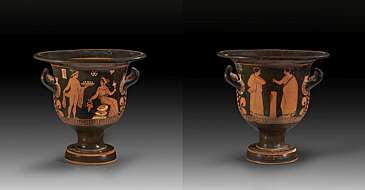
Lote 25. Großer Apulischer rotfiguriger Glockenkrater des Stupsnasen-Malers. 360 - 350 v. Chr. H 41,5cm, ø 42,4cm. Auf der einen Seite junge sitzende Frau als Mänade mit Thyrsos und Tympanon, vor ihr ein Satyr mit Kalathos und Thyrsos. Rückwärtig zwei Manteljünglinge rechts neben einem Pfeiler. Für Details Verwendung von Weiß und Gelb. Aus Fragmenten zusammengesetzt, kleinere Fehlstellen unretuschiert ergänzt. Provenienz: Ex Sammlung A. M., Ascona / Amsterdam, erworben 1985. Zum Maler siehe A. D. Trendall, The red-figured vases of Apulia Band 1 - Early and Middle Apulian (1978) S. 317-334. Large Apulian red-figure bell-krater by the Snub-Nose Painter. 360 - 350 BC. H 41.5cm, ø 42.4cm. On one side, a young seated woman depicted as maenad with thyrsus and tympanum, before her, satyr with kalathos and thyrsus. On the reverse, two draped youths, positioned to the right of a pillar. White and yellow were used for details. Reassembled from fragments, minor missing areas filled in without retouching.
  • Precio de salida:
    2'000 EUR
    1'667 GBP
    1'828 CHF
    2'233 USD

    Importes redondeados, solo aproximadosFecha: 06/11/2026
Lote
Lote 26. Apulischer rotfiguriger Glockenkrater des Malers von Genf 2754. Um 360 v. Chr. H 29,6cm, ø 30,6cm. Auf der Vorderseite ein junges Paar in den dionysischen Gefilden. Die junge Frau ist dabei sitzend als Muse mit Federkrone dargestellt und hält Weintrauben und einen Spiegel. Hinter ihr steht ein Jüngling ihr eine Spendenschale offerierend. Rückwärtig zwei Manteljünglinge seitlich eines Pfeilers. Gebrauch von Weiß und Gelb für Details. Mit schönem Infofaltblatt des Vorbesitzers! Intakt und in exzellenter Erhaltung. Provenienz: Ex Sammlung G. B., Schweiz, erworben am 3. Oktober 1983 bei Ariadne Galleries, New York. Apulian red-figure bell-krater by the Painter of Geneva 2754. Around 360 BC. H 29.6cm, ø 30.6cm. The front depicts a young couple in Dionysian setting. The young woman is shown seated as Muse, wearing feather crown and holding grapes and mirror, behind her stands a youth offering her an offering bowl. The reverse shows two draped youths, positioned on either side of a pillar. Use of white and yellow for details. Includes a nice information leaflet from the previous owner! Intact and in excellent condition. ● Ware in Vorübergehender Verwendung / Subject to temporary admission
  • Precio de salida:
    2'400 EUR
    2'001 GBP
    2'194 CHF
    2'679 USD

    Importes redondeados, solo aproximadosFecha: 06/11/2026
Lote
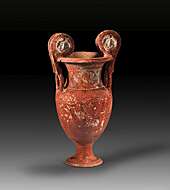
Lote 27. Apulischer polychrom bemalter Volutenkrater. Canosa, 300 - 280 v. Chr. H 41,8cm, B 22,6cm. Rötlicher Ton mit kräftigem rotbraunem Überzug. Darauf polychrome Malerei, von der sich Spuren weißer Farbe erhalten haben. Auf der Vorderseite Naiskos, rückwärtig Akanthuspflanzen, unter den Henkeln Palmetten und auf dem Hals vorne geflügelter Frauenkopf und hinten Lorbeer. Auf den Voluten plastische Gorgoneia. Mit datierter Karteikarte des Sammlers! Zusammengesetzt aus großen Fragmenten mit deutlichen Klebstoffresten, kleine Absplitterungen an Mündung und an den Bruchkanten. Provenienz: Ex Sammlung H. S., Norddeutschland, erworben im März 1996. Apulian polychrome painted volute-krater. Canosa, 300 - 280 BC. H 41.8cm, W 22.6cm. Reddish terracotta with strong reddish-brown slip. Decorated with polychrome painting, of which traces of white pigment remain. On the front appears a naiskos and acanthus plants on the back, palmettes are located beneath the handles, while the neck features a winged female head on the front and laurel wreath on the back. Relief gorgoneia adorn the volutes. Includes the collector's dated index card! Assembled from large fragments with visible traces of adhesive, small chips at the rim and along the fracture edges.
  • Precio de salida:
    960 EUR
    800 GBP
    877 CHF
    1'071 USD

    Importes redondeados, solo aproximadosFecha: 06/11/2026
Lote
Lote 28. Apulische rotfigurige Kalpis des Malers vom Ständer Macinagrossa. 320 - 310 v. Chr. H 35,8cm, B 24,8cm. Die Vorderseite zeigt im Reichen Stil einen sitzenden Eros mit großer Schachtel, Kranz und reichem Schmuck bestehend aus Perlenketten, Arm- und Fußreifen sowie Tänien. Reicher Gebrauch von Weiß und Gelb für Details. Mit Kopie des Kataloges und dem Originalzertifikat! Zusammengesetzt, geringfügige Retuschen an den Bruchkanten, im Boden ein Loch. Provenienz: Ex Sammlung H. S., Norddeutschland, erworben 1987 bei der Galerie Günter Puhze in Freiburg im Breisgau. Publiziert in Kunst der Antike - Galerie Günter Puhze Katalog 7 (1987) S. 22 Nr. 216 mit Abb. Zugewiesen von Arthur D. Trendall. Zum Maler siehe A. D. Trendall - A. Cambitoglou, The red-figured vases of Apulia Band 2 - Late Apulian (1982) S. 904-905. Apulian red-figure kalpis by the Painter of the Macinagrossa Stand (attibuted by Arthur D. Trendall). 320 - 310 BC. H 35.8cm, W 24.8cm. The obverse depicts, in the Rich Style, a seated Eros with large box and wreath, wearing elaborate jewelry consisting of strings of pearls, armlets, anklets, and ribbons. Generous use of white and yellow for details. Includes copy of the catalogue and the original certificate! Reassembled, minor retouching along the break edges, hole in bottom.
  • Precio de salida:
    2'000 EUR
    1'667 GBP
    1'828 CHF
    2'233 USD

    Importes redondeados, solo aproximadosFecha: 06/11/2026
Lote
Lote 29. Apulische rotfigurige Pelike des Varrese-Malers. Um 350 v. Chr. H 31,8cm, ø 20,6cm. Auf der Vorderseite lehnt eine junge Frau an einem perspektivisch gezeigten Pfeiler und hält Spiegel und Opferschale, ihr gegenüber ein Jüngling mit Kranz. Rückwärtig zwei Manteljünglinge. Gebrauch von Weiß und Gelb für Details. Mit schönem Infofaltblatt des Vorbesitzers! Mündung mehrfach gebrochen und etwas grob zusammengesetzt, im unteren Teil intakt. Provenienz: Ex Sammlung G. B., Schweiz, erworben zwischen 1970 und 1984 bei der Schweizer Kreditanstalt Bern. Apulian red-figure pelike by the Varrese Painter. Around 350 BC. H 31.8cm, ø 20.6cm. On the obverse, young woman leans against pillar depicted in perspective, holding mirror and an offering bowl, facing her is youth holding a wreath. On the reverse, two draped youths. White and yellow used for details. Includes a nice information leaflet from the previous owner! Rim broken and reassembled somewhat roughly, intact in the lower section. ● Ware in Vorübergehender Verwendung / Subject to temporary admission
  • Precio de salida:
    4'000 EUR
    3'335 GBP
    3'657 CHF
    4'466 USD

    Importes redondeados, solo aproximadosFecha: 06/11/2026
Lote
Lote 30. Paar großer apulischer rotfiguriger Oinochoen des Malers der Weißen Hauben. 320 - 310 v. Chr. H 35,8cm und 36,5cm. Weinkannen der Form 1 mit Kleeblattmündung und hohem Bügelhenkel, an dessen unterem Ende sich eine plastische Protome in Gestalt eines Frauenkopfes befindet. Die Bildfelder zeigen jeweils eine sitzende Frau mit Attributen des Reichtums und der dionysischen Sphäre. Der einen Frau reicht ein Eros einen großen Kalathos, der anderen eine Schachtel, in der sich ein Alabastron befindet. Üppiger Gebrauch von Weiß und Gelb. 2 Stück mit sehr detailreicher Malerei! Bei der kleineren Mündung und Henkel sowie bei der größeren der Fuß gebrochen und wieder angesetzt, kleine Absplitterungen an beiden Fußkanten. Provenienz: Ex Slg. F.R.; ex Privatsammlung England, erworben vor 2000. Pair of large Apulian red-figure oinochoai by the White Sakkos Painter. 320 - 310 BC. H 35.8cm and 36.5cm. Wine jugs of type 1, featuring trefoil mouth and stirrup handle, at the lower end of the handle is a relief protome in the shape of a female head. The pictorial panels each depict a seated woman with attributes signifying wealth and the Dionysian realm. In one instance, Eros hands a large kalathos to the woman, in the other, a female companion hands her a box containing an alabastron. Lavish use of white and yellow. 2 pieces with highly detailed painting! On the smaller vessel, the rim and handle are broken and reattached, on the larger one, the foot is broken and reattached, there are small chips on the edges of both feet.
  • Precio de salida:
    6'000 EUR
    5'002 GBP
    5'486 CHF
    6'699 USD

    Importes redondeados, solo aproximadosFecha: 06/11/2026
Lote
Lote 31. Apulische rotfigurige Oinochoe des Malers der Weißen Hauben. 320 - 310 v. Chr. H 27cm. Weinkanne der Form 1 mit Kleeblattmündung und hohem Bügelhenkel. Auf der Vorderseite ein sitzender Eros mit gleich zwei Spendenschalen und einem Kalathos. Reichhaltiger Gebrauch von Weiß, Gelb und Rot. Intakt. Provenienz: Ex Sammlung F.R.; ex Privatsammlung England, erworben vor 2000. Apulian red-figure oinochoe by the White Sakkos Painter. 320 - 310 BC. H 27cm. Wine jug of type 1, featuring trefoil mouth and stirrup handle. The front features a seated Eros holding two libation bowls and kalathos. Rich use of white, yellow, and red. Intact.
  • Precio de salida:
    1'600 EUR
    1'334 GBP
    1'463 CHF
    1'786 USD

    Importes redondeados, solo aproximadosFecha: 06/11/2026
Lote
Lote 32. Paar apulischer rotfiguriger Kantharoi des Malers von Brunswick 307-8. 320 - 310 v. Chr. H 20,4cm und 21,2cm, B beide 17,7cm. Beide fast identischen Stücke zeigen beidseitig Frauenköpfe mit Sakkos, Federkrone und reichem Schmuck zwischen Thyrsoi. Reicher Gebrauch von Weiß und Gelb. 2 Stück! Intakt. Provenienz: Ex Sammlung H. S., Norddeutschland, erworben 1970er Jahre bis 2010. Pair of Apulian red-figure kantharoi by the Painter of Brunswick 307-8 of the Kantharos Group. 320 - 310 BC. H 20.4cm and 21.2cm, W 17.7cm for both. Both nearly identical pieces feature female heads on both sides, wearing jackets, feather crowns, and elaborate jewelry, and positioned between thyrsoi. Generous use of white and yellow. 2 pieces! Intact.
  • Precio de salida:
    1'120 EUR
    933 GBP
    1'024 CHF
    1'250 USD

    Importes redondeados, solo aproximadosFecha: 06/11/2026
Lote
Lote 33. Kampanischer rotfiguriger Skyphos aus der späteren CA-Werkstatt. Cumae, 340 - 330 v. Chr. H 15,8cm, B mit Henkeln 23,2cm, ø 16,2cm. Zwischen reichem Ranken- und Palmettenschmuck auf der einen Seite eine sitzende Dame mit Schachtel, Tympanon und Thyrsos, auf der anderen Seite eine stehende Frau eng umschlungen von ihrem Mantel und mit Thyrsos. Reicher Gebrauch von Weiß und Gelb für Details. Intakt. Provenienz: Ex Privatsammlung W. F., München, seit vor 2000. Campanian red-figure skyphos from the later CA Workshop. Cumae, 340 - 330 BC. H 15.8cm, W with handles 23.2cm, ø 16.2cm. Amidst elaborate tendril and palmette ornamentation, one side depicts a seated lady with box, tympanum, and thyrsus, the other side shows a standing woman, closely wrapped in her mantle and holding a thyrsus. Generous use of white and yellow for details. Intact.
  • Precio de salida:
    960 EUR
    800 GBP
    877 CHF
    1'071 USD

    Importes redondeados, solo aproximadosFecha: 06/11/2026
Lote
Lote 34. Apulischer rotfiguriger Kothon der Menzies-Gruppe plus Deckel. 330 - 320 v. Chr. a) H 15,9cm, ø 12,6cm. Becher mit geknotetem Henkel. Vorne ein sitzender Eros mit Schachtel. b) Dazu ein nicht zugehöriger Deckel aus der Werkstatt des Baltimore-Malers mit Frauenköpfen. ø 11,1cm. Bei Kothon und Deckel für die Details Verwendung von Weiß und Gelb. Beim Kothon Absplitterung am Fußring, sonst intakt. Provenienz: Ex Sammlung H. S., Norddeutschland, erworben 1970er Jahre bis 2010. Apulian red-figure kothon of the Menzies Group, with lid. 330 - 320 BC. a) H 15.9cm, ø 12.6cm. Cup with knotted handle. Seated Eros with box on the front. b) Accompanied by a non-matching lid from the workshop of the Baltimore Painter, featuring female heads. ø 11.1cm. White and yellow are used for details on both kothon and lid. Chipping on the foot ring of the kothon, otherwise intact.
  • Precio de salida:
    800 EUR
    667 GBP
    731 CHF
    893 USD

    Importes redondeados, solo aproximadosFecha: 06/11/2026
Lote
Lote 35. Kleiner kampanischer rotfiguriger Glockenkrater des Malers von New York GR 1000. Cumae, 340 - 330 v. Chr. H 17,1cm, B 15,4cm, ø 13,2cm. Beidseitig ein Frauenkopf mit Federkrone und Sakkos. Gebrauch von Weiß für Details. Mit schönem Infofaltblatt des Vorbesitzers! Winzige Absplitterung am Fuß, sonst in sehr gutem intakten Zustand. Provenienz: Ex Sammlung G. B., Schweiz, erworben am 3. Oktober 1983 bei Ariadne Galleries, New York. Vergleiche A. D. Trendall, Rotfigurige Vasen aus Unteritalien und Sizilien - Ein Handbuch (1990) Abb. 317,3; zum Maler ebenda S. 195 mit Abb. 319. Small Campanian red-figure bell-krater by the New York GR 1000 Painter. Cumae, 340 - 330 BC. H 17.1cm, W 15.4cm, ø 13.2cm. Female head with feather headdress and sakkos on both sides. Use of white for details. Includes a nice information leaflet from the previous owner! Tiny chip on the foot, otherwise in very good, intact condition. ● Ware in Vorübergehender Verwendung / Subject to temporary admission
  • Precio de salida:
    800 EUR
    667 GBP
    731 CHF
    893 USD

    Importes redondeados, solo aproximadosFecha: 06/11/2026
Lote
Lote 36. Apulischer rotfiguriger Skyphos aus der Darius-Unterwelt-Werkstatt. 340 - 330 v. Chr. H 11cm, B 16,9cm. Beidseitig unter Wellenbändern Frauenköpfe mit Sakkos und reichem Schmuck zwischen Palmetten und Ranken. Weiß und Gelb für Details. Mit Originalexpertise von Gackstätter! Beide Henkel und einige Randfragmente gebrochen und wieder angesetzt. Provenienz: Ex Sammlung H. S., Norddeutschland, erworben bis 1993 bei dem Antiken-Kabinett - Bernd Gackstätter, Frankfurt am Main. Apulian red-figure skyphos from the Darius-Underworld Workshop. 340 - 330 BC. H 11cm, W 16.9cm. On both sides, beneath bands of wave patterns, female heads wearing sakkos and elaborate jewelry are depicted between palmettes and tendrils. White and yellow are used for details. Includes an original certificate of authenticity from Gackstätter! Both handles and several rim fragments broken and reattached.
  • Precio de salida:
    640 EUR
    533 GBP
    585 CHF
    714 USD

    Importes redondeados, solo aproximadosFecha: 06/11/2026
Lote
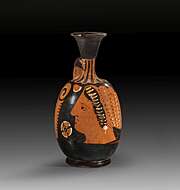
Lote 37. Kampanische rotfigurige Bauchlekythos aus der Werkstatt des APZ-Malers. Cumae, 330 - 320 v. Chr. H 25,7cm, ø 13,3cm. Auf der Vorderseite der große Kopf einer Frau mit Federkranz und Sakkos. Reiche Verwendung von Weiß für Details. Mit Kopie der Rechnung! Mündung gebrochen und wieder angesetzt, dabei kleine Absplitterung an der Bruchkante. Provenienz: Ex Sammlung A. M., Ascona / Amsterdam, erworben 1979 in Genf bei Marie LaForet. Campanian red-figure squat lekythos from the workshop of the APZ Painter. Cumae, 330-320 BC. H 25.7cm, ø 13.3cm. On the front, the large head of a woman wearing wreath of feathers and sakkos. Extensive use of white for details. With copy of the invoice! Spout broken off and reattached, small chip at the break edge.
  • Precio de salida:
    600 EUR
    500 GBP
    548 CHF
    669 USD

    Importes redondeados, solo aproximadosFecha: 06/11/2026
Lote
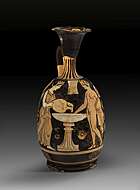
Lote 38. Sizilische rotfigurige Bauchlekythos in der Nachfolge der Lentini-Gruppe. 340 - 330 v. Chr. H 24,7cm, ø 12,1cm. Seitlich eines marmornen Perirrhanterion, das auf einer kannelierten Basis ruht, stehen links eine junge Frau, die aus einer Hydria Wasser in das Becken gießt, und rechts ein junger Mann, der bereits seine Rechte zum Waschen in das Becken gestreckt hat. Reiche Verwendung von Weiß und Gelb. Mit Kopie des Kataloges und dem Originalzertifikat! Aus großen Fragmenten zusammengesetzt ohne Fehlstellen. Provenienz: Ex Sammlung H. S., Norddeutschland, erworben 1987 bei der Galerie Günter Puhze in Freiburg im Breisgau. Publiziert in Kunst der Antike - Galerie Günter Puhze Katalog 7 (1987) S. 21 Nr. 208 mit Abb. In einem ebenfalls als Kopie beiliegenden Schreiben vergleicht der Käufer, der das Stück als etruskisch gekauft hatte, die Bauchlekythos korrekt mit Vasen, die er 1990 auf einer Reise auf Sizilien beobachtet hatte. Sicilian red-figure squat lekythos in the tradition of the Lentini Group. 340 - 330 BC. H 24.7cm, ø 12.1cm. Flanking a marble perirrhanterion resting on fluted base, a young woman stands on the left, pouring water from a hydria into the basin, while a young man stands on the right, having already extended his right hand into the basin to wash. Generous use of white and yellow. Includes a copy of the catalogue and the original certificate! Assembled from large fragments, with no missing parts.
  • Precio de salida:
    1'200 EUR
    1'000 GBP
    1'097 CHF
    1'339 USD

    Importes redondeados, solo aproximadosFecha: 06/11/2026
Lote
Lote 39. Apulischer rotfiguriger Chous der BM Kentauren-Gruppe. 340 - 330 v. Chr. H 21,3cm, ø 13cm. Ovoide Weinkanne mit Kleeblattmündung. Vorne in einem hochrechteckigen Bildfeld eine nach rechts schreitende Frau mit Cista und Kranz. Gebrauch von Weiß und Gelb für Details. Mit Originalexpertise von Gackstätter! Oben auf dem Henkelrücken eine Absplitterung, sonst intakt. Provenienz: Ex Sammlung H. S., Norddeutschland, erworben bis 1993 bei dem Antiken-Kabinett - Bernd Gackstätter, Frankfurt am Main. Die Zuweisung ist von Bernd Gackstätter vermerkt worden. Zu der Gruppe, die zum Umkreis des Dareios-Malers gehört, siehe A. D. Trendall - A. Cambitoglou, The red-figured vases of Apulia Band 2 - Late Apulian (1982) S. 622. Apulian red-figure Chous of the BM Centaur group. 340 - 330 BC. H 21.3cm, ø 13cm. Ovoid wine jug with trefoil spout. On the front, within a tall rectangular panel, a woman strides to the right, carrying cista and wreath. White and yellow are used for details. Includes original certificate of authenticity from Gackstätter! Chip on the back of the handle at the top, otherwise intact.
  • Precio de salida:
    960 EUR
    800 GBP
    877 CHF
    1'071 USD

    Importes redondeados, solo aproximadosFecha: 06/11/2026
Lote
Lote 40. Kampanischer rotfiguriger Chous der Dreipunkt-Gruppe. Capua, um 340 v. Chr. H 14,7cm, ø 10,7cm. Kanne der Form 3 mit Kleeblattmündung und niedrigem Bügelhenkel. Gerahmt durch Wellenband und Winkelfriese eine nach links eilende Mänade mit Tympanon und einer gelochten Scheibe. Als Besonderheit ist die Unterseite korrespondierend zum Bildfeld teilweise mit roter Farbe, teilweise mit Glanzton gedeckt. Mit schönem Infofaltblatt des Vorbesitzers! Intakt. Provenienz: Ex Sammlung G. B., Schweiz, erworben am 3. Oktober 1983 bei Ariadne Galleries, New York. Campanian red-figure chous by the Three-Dot Group. Capua, around 340 BC. H 14.7cm, ø 10.7cm. Jug of Form 3 with trefoil mouth and low loop handle. Framed by wave pattern and angular friezes a maenad hurrying to the left, holding tympanum and perforated disc. A distinctive feature is the underside, which, corresponding to the picture field, is covered partly with red paint and partly with black glaze. Includes a nice information leaflet from the previous owner! Intact. ● Ware in Vorübergehender Verwendung / Subject to temporary admission
  • Precio de salida:
    640 EUR
    533 GBP
    585 CHF
    714 USD

    Importes redondeados, solo aproximadosFecha: 06/11/2026
Lote
Lote 41. Attische rotfigurige Oinochoe nahe der Fat Boy-Gruppe. 370 - 350 v. Chr. H 16,7cm, ø 9,9cm. Kanne der Form 2 mit Kleeblattmündung und Bügelhenkel. Auf der Vorderseite zwei antithetische Frauenköpfe mit Sakkos. Mit schönem Infofaltblatt des Vorbesitzers! Kleine Fehlstelle an der Mündung ergänzt und retuschiert, sonst intakt. Provenienz: Ex Sammlung G. B., Schweiz, erworben am 3. Oktober 1983 bei Ariadne Galleries, New York. Attic red-figure oinochoe close to the Fat Boy Group. 370 - 350 BC. H 16.7cm, ø 9.9cm. Jug of type 2 with trefoil mouth and loop handle. On the front, two antithetical female heads wearing sakkoi. Includes a nice information leaflet from the previous owner! Small loss at the rim filled and retouched, otherwise intact. ● Ware in Vorübergehender Verwendung / Subject to temporary admission
  • Precio de salida:
    1'200 EUR
    1'000 GBP
    1'097 CHF
    1'339 USD

    Importes redondeados, solo aproximadosFecha: 06/11/2026
Lote
Lote 42. Apulisches rotfiguriges Bombylos aus der Werkstatt des Baltimore-Malers. 320 - 310 v. Chr. H 17,8cm, ø 9,9cm. Ovoides Salbölfläschchen benannt nach griechisch Bombylios = Hummel, deren Geräusch dem des Ausgießens wohl nahekam. Vorne zwischen Wellenband und Zungenstab ein sitzender Eros mit Spendenschale und Spiegel. Intensiver Gebrauch von gelber und weißer Farbe. Mit Karteikarte des Sammlers mit Preis in DM! Oberes Drittel gebrochen und wieder angesetzt. Provenienz: Ex Sammlung H. S., Norddeutschland, erworben ab den 1970er Jahren und vor 2002. Apulian red-figure bombylos from the workshop of the Baltimore Painter. 320 - 310 BC. H 17.8cm, ø 9.9cm. Ovoid cosmetic flask named after the Greek bombylios = bumblebee, the sound of which presumably resembled the noise made while pouring the contents. On the front, between wave and tongue pattern, a seated Eros is depicted holding offering bowl and mirror. Extensive use of yellow and white paint. Includes the collector's index card with the price in DM! Upper third broken and reattached.
  • Precio de salida:
    640 EUR
    533 GBP
    585 CHF
    714 USD

    Importes redondeados, solo aproximadosFecha: 06/11/2026
Lote
Lote 43. Apulische rotfigurige Pyxis-Epichysis nahe dem Maler der Weißen Hauben. 320 - 310 v. Chr. H 20,9cm, ø 11,7cm. Salbgefäß mit Schnabelausguss, seitlich daran plastische Löwenköpfe. Auf dem Pseudodeckel Frauenkopf zwischen Ranken. Verwendung von Weiß und Gelb. Mit Kopie des Kataloges und dem Originalzertifikat! Kleine Absplitterung am Ausguss, sonst intakt. Provenienz: Ex Sammlung H. S., Norddeutschland, erworben 1983 bei der Galerie Günter Puhze in Freiburg im Breisgau. Publiziert in Kunst der Antike - Galerie Günter Puhze Katalog 5 (1983) S. 23 Nr. 208 mit Abb. Apulian red-figure pyxis-epichysis, close to the White Sakkos Painter. 320 - 310 BC. H 20.9cm, ø 11.7cm. Cosmetic vessel with beaked spout, featuring applied lion heads on the sides. Female head set amidst tendrils appears on the pseudo-lid. White and yellow colors are used. Includes the copy of the catalogue and the original certificate! Small chip on the spout, otherwise intact.
  • Precio de salida:
    800 EUR
    667 GBP
    731 CHF
    893 USD

    Importes redondeados, solo aproximadosFecha: 06/11/2026
Lote
Lote 44. Zwei attische weißgrundige Lekythen mit Frauenszenen. a) Werkstatt des Bowdoin-Malers. 470 - 460 v. Chr. H 20,6cm. Sitzende Frau, vor ihr eine weitere Person eine Oinochoe haltend. Auf der Schulter Palmetten. Mündung und Henkel gebrochen und wieder angesetzt, Bemalung stark berieben, Gesicht der Frau nachgemalt. b) ATL-Klasse. Um 460 v. Chr. H erhalten 12,9cm. Stehende Frau wickelt Faden auf eine Spindel auf. Auf der Schulter Strahlen. Hals, Mündung und Henkel fehlen, rückwärtig ist die Oberfläche gänzlich abgeplatzt, der Bereich der Figur gut erhalten. 2 Stück! Provenienz: Aus der Privatsammlung von Madame J. Z., seit ungefähr 50 Jahren in Familienbesitz. Two Attic white-ground lekythoi with scenes featuring women. a) Workshop of the Bowdoin Painter. 470 - 460 BC. H 20.6cm. Seated woman, before her, another person holding an oinochoe. Palmettes on the shoulder. Rim and handle broken and reattached, painting heavily abraded, woman's face repainted. b) ATL Class. Circa 460 BC. Preserved H 12.9cm. Standing woman winding thread onto spindle. Rays on the shoulder. Neck, rim, and handle missing. Surface completely flaked off at the back, the area with the figure is well preserved. 2 pieces!
  • Precio de salida:
    1'600 EUR
    1'334 GBP
    1'463 CHF
    1'786 USD

    Importes redondeados, solo aproximadosFecha: 06/11/2026
Lote
Lote 45. Attisches weißgrundiges und schwarzfiguriges Alabastron. 500 - 490 v. Chr. H 15,7cm, ø 4,8cm. Auf dem Körper zwei Reihen liegender Palmetten. Mit interessanter Sammlerkarte! Im Körper großer Sprung, unten etwas berieben, am Mündungsteller kleine Absplitterungen, mit Holzständer. Provenienz: Ex Privatsammlung W. F., München, seit vor 2000. Attic white-ground and black-figure alabastron. 500 - 490 BC. H 15.7cm, ø 4.8cm. Two rows of recumbent palmettes on the corpus. Includes an interesting collector's card! Large crack in the body, some rubbing at the base, small chips on the rim, includes wooden stand.
  • Precio de salida:
    640 EUR
    533 GBP
    585 CHF
    714 USD

    Importes redondeados, solo aproximadosFecha: 06/11/2026
Lote
Lote 46. Etruskischer schwarzfiguriger Kyathos aus der Werkstatt des Micali-Malers. Um 500 v. Chr. H 12cm, ø 10,8cm, L mit Henkel 16,2cm. Kleine konische Tasse mit Schlaufenhenkel, letzterer bekrönt von einem plastischen Pinienzapfen. Der Fries zeigt zwischen zwei Augen eine weibliche Sphinx, in den Feldern dicht gedrängt Efeublätter. Details in Weiß. Henkel und kleine Randfragmente gebrochen und wieder angesetzt, Oberfläche etwas berieben, winzige Absplitterungen, eine sehr kleine Fehlstelle am Rand ergänzt. Provenienz: Ex Sammlung A. M., Ascona / Amsterdam, erworben 1985. Zahlreiche Indizien wie der Stil der Sphinx, die dicht gedrängten Efeublätter, die Fußform sowie der nicht perfekte Brand lassen darauf schließen, dass es sich hier nicht um ein attisches, sondern um ein hinsichtlich dieser Gefäßform seltenes etruskisches Produkt handelt. Der Stil der Sphinx lässt weiterhin eine deutliche Nähe zu dem Werk des berühmten Micali-Malers erkennen, so dass eine Entstehung in dessen Werkstatt als wahrscheinlich gelten darf. Vergleiche zum Beispiel die Sphingen auf einer Hydria in den Staatlichen Antikensammlungen, München aus der Sammlung SH 895 = Beazley Archive Pottery Database 9034640. Etruscan black-figure kyathos from the workshop of the Micali Painter. Around 500 BC. H 12cm, ø 10.8cm, L with handle 16.2cm. Small conical cup with loop handle, the latter topped by a modeled pine cone. The frieze depicts a female sphinx between two eyes, with ivy leaves densely packed in the intervening spaces. Details in white. Handle and small rim fragments broken and reattached, surface slightly abraded, tiny chips, very small area of the rim is lost and retouched.
  • Precio de salida:
    800 EUR
    667 GBP
    731 CHF
    893 USD

    Importes redondeados, solo aproximadosFecha: 06/11/2026
Lote
Lote 47. Kampanischer Guttus mit Löwenkopf. 350 - 320 v. Chr. H 6,2cm, L mit Ausguss 13,8cm, ø 11,6cm. Flaches lentoides Salbgefäß mit Ringhenkel und Ausguss in Löwenkopfform, Mähne gestichelt. Auf der Schulter Zungenstab. Mit schönem Infofaltblatt des Vorbesitzers! Intakt. Provenienz: Ex Sammlung G. B., Schweiz, erworben am 3. Oktober 1983 bei Ariadne Galleries, New York. Apulian red-figure pelike by the Varrese Painter. Around 350 BC. H 31.8cm, ø 20.6cm. On the obverse, young woman leans against pillar depicted in perspective, holding mirror and an offering bowl, facing her is youth holding a wreath. On the reverse, two draped youths. White and yellow used for details. Includes a nice information leaflet from the previous owner! Mouth broken in several places and reassembled somewhat rough, intact in the lower section. ● Ware in Vorübergehender Verwendung / Subject to temporary admission
  • Precio de salida:
    600 EUR
    500 GBP
    548 CHF
    669 USD

    Importes redondeados, solo aproximadosFecha: 06/11/2026
Lote
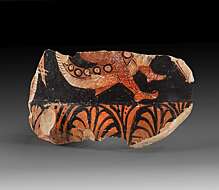
Lote 48. Fragment eines etruskischen rotfigurigen Kelchkraters. Orvieto, um 350 v. Chr. H 10,1cm, B 15,7cm. Fragment mit Ansatz eines Henkels. Über einer Reihe von Palmetten ein figürlicher Fries. Erhalten hat sich der untere Teil einer nackten Figur, die auf einem Meereswesen mit Schlangenkörper reitet, davor ein Rest eines Gegenstandes, vielleicht ein Ruder, ganz links noch ein kleiner Teil eines weiteren Meereswesens. Details in Weiß, der Körper der Figur mit einer dünnen rötlichen Farbe überzogen. Provenienz: Ex Sammlung G. S., München, seit vor 1980. Fragment of an Etruscan red-figure calyx-krater. Orvieto, around 350 BC. H 10.1cm, W 15.7cm. Fragment with the base of a handle. Figurative frieze sits above a row of palmettes. Preserved is the lower part of a nude figure riding a sea creature with serpentine body, in front is the remnant of an object - perhaps a rudder - and at the far left, a small part of another sea creature. Details are rendered in white, and the figure's body is covered with a thin reddish wash.
  • Precio de salida:
    400 EUR
    333 GBP
    365 CHF
    446 USD

    Importes redondeados, solo aproximadosFecha: 06/11/2026
Lote
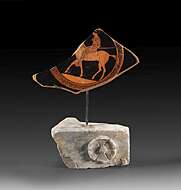
Lote 49. Fragment einer attischen rotfigurigen Schale, Werkstatt des Aison. 430 - 410 v. Chr. 12,6 x 16,1cm. Im Tondo mit Mäanderrahmung die Amazonenkönigin Hippolyte mit Diadem und Lanzen zu Pferde nach links. Auf der Außenseite Reste einer Amazonomachie, links Beine einer Amazone, dann die Hinterhufe eines Pferdes, davor ein griechischer Recke. Das Stück ist auf ein Architekturteil aus grauem Marmor montiert, das vorne mit einer Rosette geschmückt ist und vielleicht von einem hellenistischen Grabmonument stammt. Mit Kopie der Rechnung! Provenienz: Ex Sammlung A. M., Ascona / Amsterdam, erworben 1970 in Locarno bei der Galerie Fasciani-Escher. Fragment of an Attic red-figure cup, workshop of Aison. 430 - 410 BC. 12.6 x 16.1cm. Within a tondo framed by meander pattern, the Amazon queen Hippolyta is depicted on horseback, facing left, wearing diadem and holding spears. The exterior features remnants of an Amazonomachy. The legs of an Amazon on the left, followed by the hind hooves of a horse, and a Greek warrior in the foreground. With copy of the invoice! The piece is mounted on a grey marble architectural element adorned with rosette on the front and perhaps originates from a Hellenistic funerary monument.
  • Precio de salida:
    800 EUR
    667 GBP
    731 CHF
    893 USD

    Importes redondeados, solo aproximadosFecha: 06/11/2026
Lote
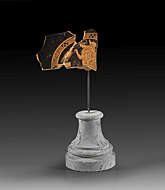
Lote 50. Fragment einer attischen rotfigurigen Schale. 400 - 390 v. Chr. 11,1 x 14,4cm. Das mäandergeschmückte Innenbild zeigt einen wohl selten dargestellten Mythos, in dem ein junger Mann - durch Petasos und Chlamys als Reisender charakterisiert - mit einem Vogel spricht. Der Rest des Außenbildes zeigt einen Jüngling, der auf einem Felsen sitzt, und dahinter den unteren Teil einer Frau. Interessant ist auch das Henkelornament, dass als seitliches Element ein in dieser Funktion eher seltenes Akanthusblatt zeigt. Mit Kopie der Rechnung! Aus zwei Fragmenten zusammengesetzt, auf einen profilierten Sockel aus grauem Marmor montiert. Provenienz: Ex Sammlung A. M., Ascona / Amsterdam, erworben 1970 in Locarno bei der Galerie Fasciani-Escher. Vielleicht handelt es sich bei der Darstellung um die bisher einzige, die den Lapithen Mopsos in seiner Funktion als Seher auf dem Zug der Argonauten zeigt. Seine Fähigkeiten erlernte er bei Apoll und er soll die Sprache der Vögel verstanden haben. Weiterhin findet er Erwähnung als Kämpfer gegen die Kentauren und als Teilnehmer der Kalydonischen Eberjagd. Fragment of an Attic red-figure cup. 400 - 390 BC. 11.1 x 14.4cm. The interior image, framed by a meander pattern, depicts a myth that is rarely illustrated. A young man - identified as traveler by petasos and chlamys - conversing with a bird. The depiction may well be the only one to date that shows the Lapith Mopsus, who is said to have understood the language of birds, in his role as seer during the Argonauts' expedition. The exterior scene shows a youth seated on a rock, with the lower part of a woman visible behind him. Also of interest is the handle ornament, which features an acanthus leaf as a lateral element - a motif rarely used in this specific function. With copy of the invoice! Reassembled from two fragments, mounted on a profiled grey marble base.
  • Precio de salida:
    800 EUR
    667 GBP
    731 CHF
    893 USD

    Importes redondeados, solo aproximadosFecha: 06/11/2026
Lote
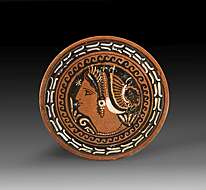
Lote 51. Apulischer rotfiguriger Teller aus des Stoke-on-Trent-Malers. 330 - 320 v. Chr. H 5,6cm, ø 23,3cm. Auf der Oberseite mit Lorbeer und Wellenband gerahmter Tondo, darin Frauenkopf mit Sakkos und reichem Schmuck sowie Federkrone. Weiß und Gelb für Details. Unter dem Fuß rotes Kreuz. Mit Originalexpertise von Gackstätter! Intakt. Provenienz: Ex Sammlung H. S., Norddeutschland, erworben bis 1993 bei dem Antiken-Kabinett - Bernd Gackstätter, Frankfurt am Main. Apulian red-figure plate by the Stoke-on-Trent Painter. 330 - 330 BC. H 5.6cm, ø 23.3cm. The upper surface features a tondo framed by laurel wreath and wave pattern, enclosing the head of a woman wearing sakkos, elaborate jewelry, and a feather headdress. White and yellow are used for details. Beneath the foot appears a red cross. Includes an original certificate of authenticity from Gackstätter! Intact.
  • Precio de salida:
    800 EUR
    667 GBP
    731 CHF
    893 USD

    Importes redondeados, solo aproximadosFecha: 06/11/2026
Lote
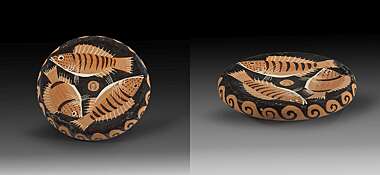
Lote 52. Kampanischer rotfiguriger Fischteller des Helgoland-Malers. 350 - 325 v. Chr. H 3,1cm, ø 18cm. Auf der Oberseite gegen den Uhrzeigersinn drei Meeresbrassen. Reichlich Einsatz von Weiß für die Details. Auf dem Rand Wellenband. Mit schönem Infofaltblatt des Vorbesitzers! Winzige Bestoßung am Rand, sonst intakt. Provenienz: Ex Sammlung G. B., Schweiz, erworben am 3. Oktober 1983 bei Ariadne Galleries, New York. Vergleiche Chr. Zindel, Meeresleben und Jenseitsfahrt. Die Fischteller der Sammlung Florence Gottet (²2008) S. 40-41 Nr. 10. Campanian red-figure fish-plate of the Helgoland Painter. 350 - 325 BC. H 3.1cm, ø 18cm. Three sea bream arranged counter-clockwise on the upper surface. Generous use of white for the details. Band of waves on the rim. Includes a nice information leaflet from the previous owner! Tiny bump on the edge, otherwise intact. ● Ware in Vorübergehender Verwendung / Subject to temporary admission
  • Precio de salida:
    3'200 EUR
    2'668 GBP
    2'926 CHF
    3'572 USD

    Importes redondeados, solo aproximadosFecha: 06/11/2026
Lote
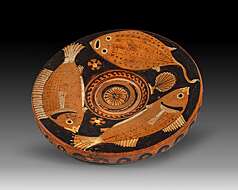
Lote 53. Kampanischer rotfiguriger Fischteller. 350 - 325 v. Chr. H 4,3cm, ø 18,3cm. Auf der Oberseite gegen den Uhrzeigersinn drei Meeresbrassen. Reichlich Einsatz von Weiß für die Details. Auf dem Rand Strichgruppen alternierend mit großen schwarzen Punkten. Mit schönem Infofaltblatt des Vorbesitzers! Aus zwei Teilen zusammengesetzt. Provenienz: Ex Sammlung G. B., Schweiz, erworben am 3. Oktober 1983 bei Ariadne Galleries, New York. Aus der selben Hand wie der Teller Chur, Museum K 55 (Beazley Archive Pottery Database 1009037). Campanian red-figure fish-plate. 350 - 325 BC. H 4.3cm, ø 18.3cm. Three sea bream arranged counter-clockwise on the upper surface. Generous use of white for the details. Groups of lines alternating with large black dots on the rim. Includes a nice information leaflet from the previous owner! Assembled from two parts. ● Ware in Vorübergehender Verwendung / Subject to temporary admission
  • Precio de salida:
    3'200 EUR
    2'668 GBP
    2'926 CHF
    3'572 USD

    Importes redondeados, solo aproximadosFecha: 06/11/2026
Lote
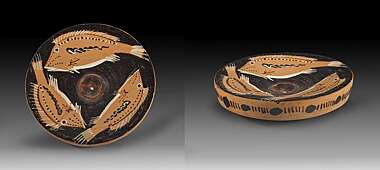
Lote 54. Apulischer rotfiguriger Fischteller nahe der Gruppe von Karlsruhe 66/140. Tarent, 340 - 320 v. Chr. ø 19,9cm. Auf der Oberseite gegen den Uhrzeigersinn eine Zweibindenbrasse, eine Meerbarbe und ein gefleckter Zitterrochen und auf dem Rand ein Wellenband. Reichlich Einsatz von Weiß für die Details. Das fehlende Mittelstück ist ersetzt durch den Knauf mit Strahlenkranz eines Lekanisdeckels, dem wiederum auf der Unterseite eine kleine unverzierte Fußschale als Gegenstück dient. Mittelteil als Pasticcio ergänzt, Tellerfläche ansonsten intakt. Provenienz: Ex Sammlung Helmut Gernsheim (1913-1995), Schweiz; in Deutschland seit vor 2000. Bei dem ehemaligen Besitzer handelt es sich um Helmut Gernsheim (geb. 1913 in München, gest. 1995 in Lugano), der als Fotograf, Fotografienhistoriker und Sammler in Erscheinung getreten ist. In seiner Eigenschaft als Fotografenhistoriker entdeckte er 1952 die bisher älteste Fotografie, die Joseph Nicéphore Niépce 1826 hergestellt hat. Apulian red-figure fish-plate, close to the Group of Karlsruhe 66/140. Tarentum, 340 - 320 BC. ø 19.9cm. The upper surface features a counter-clockwise arrangement of a two-banded seabream, a red mullet, and a spotted torpedo ray, with a wave pattern along the rim. Generous use of white for details. The missing central section has been replaced by the knob featuring a radiating pattern from a lekanis lid, a small, undecorated footed bowl serves as a corresponding support on the underside. Central section supplemented as a pasticcio, otherwise, the surface of the plate is intact. Ex collection Helmut Gernsheim (1913-1995), Switzerland, the discoverer of what is to date the oldest photograph.
  • Precio de salida:
    800 EUR
    667 GBP
    731 CHF
    893 USD

    Importes redondeados, solo aproximadosFecha: 06/11/2026
Lote
Lote 55. Attischer Fischteller der Glanztonware. 375 - 350 v. Chr. H 4,2cm, ø 24,3cm. Oben mittig eine runde Vertiefung, auf der Unterseite im Fußinneren gemalte konzentrische Kreise. Seltener attischer Fischteller! Intakt. Provenienz: Ex Sammlung G. S., München, seit vor 1980. Vergleiche zum Beispiel das ähnliche Exemplar Bochum, Ruhr-Universität S 434 (Beazley Archive Pottery Database 9031751). Attic fish-plate of black glazed ware. 375 - 350 BC. H 4.2cm, ø 24.3cm. Round depression at the top center, painted concentric circles on the underside, inside the foot. Rare Attic fish plate! Intact.
  • Precio de salida:
    1'200 EUR
    1'000 GBP
    1'097 CHF
    1'339 USD

    Importes redondeados, solo aproximadosFecha: 06/11/2026
Lote
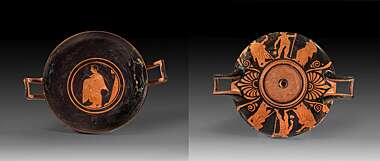
Lote 56. Attische rotfigurige Schale aus der Werkstatt des Jena-Malers. 400 - 380 v. Chr. H 7,1cm, B 24,1cm, ø 17,9cm. Form B. Innen ein Manteljüngling neben einem Pfeiler. Außen jeweils ein Athlet zwischen zwei begleitenden Manteljünglingen. Mit Kopie der Rechnung! Ein Henkel gebrochen und wieder angesetzt, winzige Absplitterung am Fuß. Provenienz: Ex Sammlung A. M., Ascona / Amsterdam, erworben 1980 bei Nina Borowski, Paris; davor 1968 bis 1975 Sammlung James Bomford. Attic red-figure cup from the workshop of the Jena Painter. 400 - 380 BC. H 7.1cm, W 24.1cm, ø 17.9cm. Type B. Interior a draped youth a pillar. Exterior each an athlete between two accompanying draped youths. With copy of the invoice! One handle broken and reattached, tiny chip on the foot.
  • Precio de salida:
    800 EUR
    667 GBP
    731 CHF
    893 USD

    Importes redondeados, solo aproximadosFecha: 06/11/2026
Lote
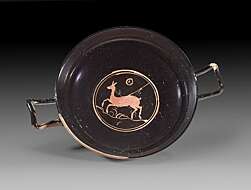
Lote 57. Herrliche Schale der apulischen Red Swan-Gruppe. 350 - 300 v. Chr. H 5,4cm, B 26,1cm, ø 19,1cm. Niedrige Glanztonschale mit innen abgesetztem Rand. Zentral ein Vierpass mit vier gestempelten Palmetten, darüber mit rötlichem Schlicker aufgemalt ein Tondo, darin eine Hirschkuh, in deren Rücken eine Lanze steckt. Kleine Fehlstelle am Fußring ergänzt und retuschiert, leichter Abrieb an einem Henkel, sonst intakt und in hervorragendem Zustand. Provenienz: Aus der alten Privatsammlung von Dr. und Madame M. J., Antwerpen, erworben vor mehr als 50 Jahren. Magnificent cup of the Apulian Red Swan Group. 350 - 300 BC. H 5.4cm, W 26.1cm, ø 19.1cm. Stemless black glazed cup with an offset inner rim. Centrally located a quatrefoil design featuring four stamped palmettes, over it, a tondo is painted in reddish slip, depicting a doe with spear embedded in its back. Small loss on the foot ring filled and retouched, slight abrasion on one handle, otherwise intact and in excellent condition.
  • Precio de salida:
    960 EUR
    800 GBP
    877 CHF
    1'071 USD

    Importes redondeados, solo aproximadosFecha: 06/11/2026
Lote
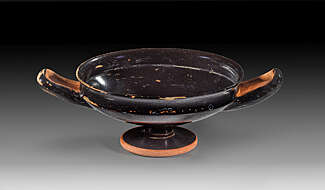
Lote 58. Spätarchaische attische Glanztonschale. 520 - 500 v. Chr. H 8,8cm, B 26,4cm, ø 17,9cm. Randschale mit Fuß der Form C. Mit Kopien der Rechnung und Echtheitsbestätigung! Winzige Kratzer, Glanzton an wenigen kleinen Stellen berieben, sonst intakt. Provenienz: Ehemals deutsche Privatsammlung K. P. (gest. 2014), erworben 1986 bei der Galerie Günter Puhze, Freiburg im Breisgau. Late Archaic Attic black glazed cup. 520 - 500 BC. H 8.8cm, W 26.4cm, ø 17.9cm. Cup with offset rim and foot type C. Includes the copies of the invoice and the certificate of authenticity! Tiny scratches, black glaze rubbed in few small spots, otherwise intact.
  • Precio de salida:
    960 EUR
    800 GBP
    877 CHF
    1'071 USD

    Importes redondeados, solo aproximadosFecha: 06/11/2026
Lote
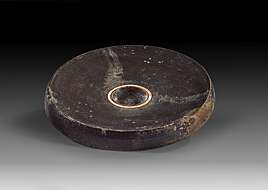
Lote 59. Attische Glanztonschale mit Inschrift. 425 - 400 v. Chr. H 4,5cm, ø 15,9cm. Niedrige Schale ohne Henkel und mit konvexem Rand. Auf der Unterseite vor dem Glanzton angebrachtes Graffito bestehend aus einer Doppelvolute, dann / H / I / X / (= 618). Mit Kopie der Rechnung! Kleiner Sprung am Rand, sonst intakt. Provenienz: Ex Sammlung A. M., Ascona / Amsterdam, erworben 1980 bei Nina Borowski, Paris. Attic black glazed bowl with inscription. 425 - 400 BC. H 4.5cm, ø 15.9cm. Stemless bowl without handles and with convex rim. Graffito on the underside, applied before the black glaze, consisting of a double volute followed by / H / I / X / (= 618). With a copy of the invoice! Small crack on the rim, otherwise intact.
  • Precio de salida:
    640 EUR
    533 GBP
    585 CHF
    714 USD

    Importes redondeados, solo aproximadosFecha: 06/11/2026
Lote
Lote 60. Großer kampanischer Skyphos der Gnathia-Ware. 300 - 275 v. Chr. H 10,6cm, B mit Henkeln 28,6cm, ø 19,4cm. Konische Schale mit innen abgesetztem Rand und niedrigem Fuß. Innen und außen jeweils eine Efeu-Korymbenranke aus geritzten Ranken und Blättern und Blüten in Weiß. Innen am Boden gestempeltes Ornament mit Palmetten und Doppelvoluten, auf der Unterseite konzentrische Kreise in Schwarz. Mit Kopie der Rechnung! Aus zwei großen und wenigen kleinen Fragmenten zusammengesetzt, kleine Fehlstelle retuschiert. Provenienz: Ex Sammlung A. M., Ascona / Amsterdam, erworben 1979 in Genf bei Marie LaForet. Large Campanian skyphos in Gnathia technique. 300 - 275 BC. H 10.6cm, W incl. handles 28.6cm, ø 19.4cm. Stemless conical bowl with offset inner rim. Both the interior and exterior feature an ivy-and-corymb motif composed of incised tendrils, leaves and blossoms rendered in white. The interior base bears a stamped ornament featuring palmettes and double volutes, while the underside displays the concentric black circles. With a copy of the invoice! Reassembled from two large and few small fragments, small area of loss retouched.
  • Precio de salida:
    600 EUR
    500 GBP
    548 CHF
    669 USD

    Importes redondeados, solo aproximadosFecha: 06/11/2026
Lote
Lote 61. Kleiner kampanischer Volutenkrater der Gnathia-Ware. 325 - 300 v. Chr. H 23,2cm, B 13,6cm, ø 12,1cm. Glanztonware mit weißer Bemalung, die eine doppelte Weinranke darstellt. Der tongrundige Reif über dem Fuß ist mit dünner roter Farbe gedeckt. Herrliches Kleinod! Minimaler Abrieb des Glanztons und der weißen Deckfarbe, sonst intakt mit Sinterresten. Provenienz: Aus der Privatsammlung von Madame J. Z., seit ungefähr 50 Jahren in Familienbesitz. Vergleiche zum Beispiel den Krater New York Sammlung Gallatin (Beazley Archive Pottery Database 9038306). Campanian volute-krater of Gnathia ware en miniature. 325 - 300 BC. H 23.2cm, W 13.6cm, ø 12.1cm. Black glazed ware with white painting depicting a double grapevine. The band above the foot, left in the natural bright terracotta color, is covered with a thin layer of red paint. Magnificent gem! Minimal abrasion of the black glaze and the white paint, otherwise intact, with traces of sintering.
  • Precio de salida:
    1'200 EUR
    1'000 GBP
    1'097 CHF
    1'339 USD

    Importes redondeados, solo aproximadosFecha: 06/11/2026
Lote
Lote 62. Attischer Kantharos der Glanztonware. 350 - 300 v. Chr. H 10,3cm, B 17,2cm, ø 11,4cm. Kantharos mit Sporenhenkeln und geripptem Körper. Mit schönem Infofaltblatt des Vorbesitzers! Intakt mit Sinterresten. Provenienz: Ex Sammlung G. B., Schweiz, erworben am 3. Oktober 1983 bei Ariadne Galleries, New York. Attic black glazed kantheros. 350 - 300 BC. H 10.3cm, W 17.2cm, ø 11.4cm. Drinking vessel with spur handles and ribbed corpus. Includes a nice information leaflet from the previous owner! Intact, with traces of sinter. ● Ware in Vorübergehender Verwendung / Subject to temporary admission
  • Precio de salida:
    640 EUR
    533 GBP
    585 CHF
    714 USD

    Importes redondeados, solo aproximadosFecha: 06/11/2026
Lote
Lote 63. Große bikonische Urne der Villanova-Kultur mit Schalendeckel. 9. - 1. Hälfte 8. Jh. v. Chr. H 33,6cm, ø 27,9cm, ø Deckel 22,7cm. Schwarz- bis dunkelbraunes Impasto (dark polished ware). Auf dem Hals Hakenmäander und auf dem Bauch alternierende Pfeilspitzen, als Besonderheit formt sich die Linie zwischen Bauch und Schulter über dem Henkel zu einem breitem Gesicht. Bei der Schale ist unter dem Henkel eine Swastika mit Schnurtechnik eingedrückt. Mit Kopie des Kataloges und dem Originalzertifikat! Urne bis auf eine winzige Bestoßung am Rand intakt, Deckel mit kleinem Riss, sonst ebenfalls intakt. Provenienz: Ex Sammlung H. S., Norddeutschland, erworben 1984 bei der Galerie Günter Puhze in Freiburg im Breisgau. Publiziert in Kunst der Antike - Galerie Günter Puhze Katalog 6 (1984) S. 18 Nr. 187 mit Abb. Large biconical urn of the Villanova culture with a bowl-shaped lid. 9th - first half of the 8th century BC. H 33.6cm, ø 27.9cm, lid ø 22.7cm. Black to dark brown impasto (dark polished ware). The neck features a hooked meander pattern, while the body displays alternating arrowhead motifs, a distinctive feature is that the line separating the body and shoulder transforms into a broad face where it crosses the handle. On the bowl, beneath the handle, a swastika has been impressed using a cord-impression technique. Includes a copy of the catalogue and the original certificate! Urn intact except for tiny chip on the rim, lid has small crack but is otherwise intact.
  • Precio de salida:
    1'200 EUR
    1'000 GBP
    1'097 CHF
    1'339 USD

    Importes redondeados, solo aproximadosFecha: 06/11/2026
Lote
Lote 64. Kleine bikonische Urne der Villanova-Kultur. 9. - 1. Hälfte 8. Jh. v. Chr. H 27,2cm, ø 25,3cm. Dunkelbraunes Impasto (dark polished ware). Auf dem Körper vier geritzte Metopen bestehend aus vierfach geschachtelten Rechtecken, dazwischen spitze Noppen, auf dem Hals Hakenmäander im Schnurdekor. Mit Kopie der Rechnung! Zusammengesetzt, größere Fehlstellen ergänzt und farblich retuschiert. Provenienz: Ex Sammlung A. M., Ascona / Amsterdam, erworben 1980 bei Nina Borowski, Paris; davor 1968 bis 1975 Sammlung James Bomford. Small biconical urn of the Villanova culture. 9th - first half of the 8th century BC. H 27.2cm, ø 25.3cm. Dark brown impasto (dark polished ware). On the body, four incised metopes consisting of four nested rectangles with pointed knobs between them, on the neck, a hooked meander pattern executed in cord-impressed technique. With a copy of the invoice! Reassembled, larger losses filled in, and color-retouched.
  • Precio de salida:
    800 EUR
    667 GBP
    731 CHF
    893 USD

    Importes redondeados, solo aproximadosFecha: 06/11/2026
Lote
Lote 65. Etruskische Olla mit Deckel. 2. Hälfte 7. Jh. v. Chr. H ohne Deckel 38,1cm und mit Deckel 45,8cm, ø 37,4cm und B mit Henkeln 45,5cm. Ockerfarbenes Impasto mit kräftigem rotbraunem Überzug. Kugeliges Gefäß mit passendem Deckel, Dekor mit plastischen Rippen. Mit Kopie der Rechnung! Fragmente der Mündung gebrochen und wieder angesetzt, kleine Farbretuschen, bei der Olla kleiner Riss im Körper, auf der Deckelunterseite oberflächige Absplitterungen. Provenienz: Ex Sammlung A. M., Ascona / Amsterdam, erworben 1980 bei Nina Borowski, Paris. Etruscan olla with lid. Second half of the 7th century BC. H 38.1cm without lid and 45.8cm with lid, ø 37.4cm and W including handles 45.5cm. Ocher-colored impasto with strong reddish-brown slip. Globular vessel with matching lid, both featuring raised ribs. With a copy of the invoice! Fragments of the rim broken and reattached, minor paint retouching, small crack in the body of the olla, superficial chips on the underside of the lid.
  • Precio de salida:
    1'600 EUR
    1'334 GBP
    1'463 CHF
    1'786 USD

    Importes redondeados, solo aproximadosFecha: 06/11/2026
Lote
Lote 66. Farbige etruskische Olla. 700 - 650 v. Chr. H 35,9cm. Rotbraune Terrakotta. Kugeliger Topf mit auskragender Mündung und Reliefdekor in Gestalt von Reihen gegeneinander verschobener Quadrate, die abwechselnd tongrundig belassen oder weiß gedeckt sind. Kleiner restaurierter Sprung, sonst intakt, Farbe teilweise erhalten. Provenienz: Aus einer Berliner Privatsammlung; ex Gorny & Mosch Auktion 179, 2009, Los 385; ex Sammlung Tollmann; 1979 für die Sammlung W. H. erworben. Polychrome Etruscan olla. 700 - 650 BC. H 35.9cm. Reddish-brown terracotta. Globular pot with everted mouth and relief decoration consisting of rows of staggered squares, alternately left in the natural clay color or covered in white. Small restored crack, otherwise intact, paint partially preserved.
  • Precio de salida:
    2'400 EUR
    2'001 GBP
    2'194 CHF
    2'679 USD

    Importes redondeados, solo aproximadosFecha: 06/11/2026
Lote
Lote 67. Etruskischer Karyatidenkelch aus Bucchero. 620 - 580 v. Chr. H 16,7cm, ø 16,2cm. Bucchero Pesante. Konischer Kelch mit Omphalos und Strahlenkranz im Inneren auf vier Stützen bestehend jeweils aus zwei weiblichen Figuren, unten flacher Standring. Zusammengesetzt, zwei kleine Absplitterungen am Mündungsrand. Provenienz: Ex Sammlung A. M., Ascona / Amsterdam, erworben 1985. Etruscan caryatid calice from Bucchero. 620 - 580 BC. H 16.7cm, ø 16.2cm. Bucchero pesante. Conical calice with omphalos and radiant halo inside, resting on four supports each consisting of two female figures, below flat base ring. Reassembled, two small chips on the rim.
  • Precio de salida:
    640 EUR
    533 GBP
    585 CHF
    714 USD

    Importes redondeados, solo aproximadosFecha: 06/11/2026
Lote
Lote 68. Paar ungewöhnliche etruskische Bucchero-Kelche. 600 - 550 v. Chr. H 14,9cm bis 15,9cm, ø 16,8cm und 17,3cm. Beide Kelche bestehen aus getrenntem Ober- und Unterteil, die zusammengesteckt werden. Die Schalen sind außen mit Rillen und einem Zackenband versehen, ihr Boden ist plastisch mit Rippen und in der Mitte mit konzentrischen Kreisen dekoriert. Bei den Fußteilen weisen die Oberseiten der Standplatten einen gestichelten Fächerfries auf. 2 Stück! Aus Fragmenten zusammengesetzt, kleine Fehlstellen retuschiert. Provenienz: Ex Sammlung A. M., Ascona / Amsterdam, erworben vor 2000. Pair of unusual Etruscan Bucchero chalices. 600 - 550 BC. H 14.9cm to 15.9cm, ø 16.8cm and 17.3cm. Both chalices consist of separate upper and lower sections that fit together. The exteriors of the bowls feature grooves and a zigzag band, while the undersides are decorated with relief ribbing and concentric circles in the center. On the foots, the upper surfaces of the footplates display a stippled fan frieze. 2 pieces! Reassembled from fragments, small areas of loss retouched.
  • Precio de salida:
    2'400 EUR
    2'001 GBP
    2'194 CHF
    2'679 USD

    Importes redondeados, solo aproximadosFecha: 06/11/2026
Lote
Lote 69. Römischer figürlich verzierter Lagynos aus Terra Sigillata. Nordafrika, 3. Jh. n. Chr. H 18,8cm, ø 16,5cm. Formgetöpfert. Einhenkelige lentoide Flasche, der Hals gebildet als Kopf einer alten Frau mit Modefrisur. Auf der Schulter Relieffries mit einem Silen, der mittels eines Sichelmessers Weintrauben erntet. Intakt. Provenienz: Ex Collection Y. D., Frankreich, erworben zwischen 1930 und 1950, seitdem in Familienbesitz. Roman terra sigillata lagynos with figurative decoration. North Africa, 3rd century AD. H 18.8cm, ø 16.5cm. Mold-made. Single-handled lentoid flask, the neck shaped as the head of an elderly woman with fashionable hairstyle. Relief frieze on the shoulder depicts Silenus harvesting grapes with a sickle-shaped knife. Intact.
  • Precio de salida:
    1'440 EUR
    1'200 GBP
    1'316 CHF
    1'607 USD

    Importes redondeados, solo aproximadosFecha: 06/11/2026
Lote
Lote 70. Römische figürliche Flasche aus Terra Sigillata der Navigius-Ware. Nordafrika, 270 - 320 Jh. n. Chr. H 22,9cm, B 11,9cm. Formgetöpfert. Flasche in Form eines afrikanischen Knaben mit Buckellocken. Auf dem konischem Hals als plastisch hervorgehobene Inschrift NABICIVS PINCIT (Navigius pingit = gemacht von Navigius). Intakt. Provenienz: Ex Collection Y. D., Frankreich, erworben zwischen 1930 und 1950, seitdem in Familienbesitz. Roman terra sigillata figurative flask from the workshop of Navigius. North Africa, 270 - 320 AD. H 22.9cm, W 11.9cm. Mold-made. Flask in the shape of an African boy with tight, curly hair. On the conical neck, a relief inscription reads NABICIVS PINCIT (Navigius pingit = made by Navigius). Intact.
  • Precio de salida:
    1'120 EUR
    933 GBP
    1'024 CHF
    1'250 USD

    Importes redondeados, solo aproximadosFecha: 06/11/2026
Lote
Lote 71. Große griechische Amphora für Wein. Chios, 6. Jh. v. Chr. H 70cm, ø 36cm. Hellbrauner Ton, beiger Überzug, Bemalung in dunkel- bis rotbraun. Auf dem Körper und Hals Linien, auf der Schulter Schlangenlinien in Form einer liegenden Acht und um den Henkelansatz ein Kreis mit einer nach unten laufenden langen Linie. Sehr selten und von großer Schönheit! Mit Kopie der Rechnung! Intakt, teilweise bedeckt mit Sinter. Provenienz: Ex Sammlung A. M., Ascona / Amsterdam, erworben 1970 in Locarno bei der Galerie Fasciani-Escher. Der beige Überzug und die schöne Bemalung machen einen Gebrauch als Transportamphora eher unwahrscheinlich. Eher dürfte es sich wie bei den bemalten korinthischen und attischen Vasen um eine repräsentative Amphorenversion für den Symposiongebrauch handeln. Large Greek amphora for wine. Chios, 6th century BC. H 70cm, ø 36cm. Light brown terracotta, beige slip, painting in dark to reddish-brown. Lines on the body and neck, wavy lines in the shape of horizontal figure-eight on the shoulder, and a circle with long line extending downwards around the base of the handle. Very rare and of great beauty! With copy of the invoice! Intact, partially covered with sinter.
  • Precio de salida:
    4'800 EUR
    4'002 GBP
    4'389 CHF
    5'359 USD

    Importes redondeados, solo aproximadosFecha: 06/11/2026
Lote
Lote 72. Große griechische Amphora für Wein. Chios, 6. Jh. v. Chr. H 71cm, ø 36cm. Hellbrauner Ton, beiger Überzug, Bemalung in dunkel- bis rotbraun. Auf dem Körper und Hals Linien, auf der Schulter Schlangenlinien in Form einer liegenden Acht und um den Henkelansatz ein Kreis mit einer nach unten laufenden langen Linie. Hinter einem Henkel ein Graffito mit XXXX II. Sehr selten und von großer Schönheit! Mit Kopie der Rechnung! Teile der Schulter, des Halses und der Mündung sowie eine Henkel fehlen und sind ergänzt. Provenienz: Ex Sammlung A. M., Ascona / Amsterdam, erworben 1970 in Locarno bei der Galerie Fasciani-Escher. Der beige Überzug und die schöne Bemalung machen einen Gebrauch als Transportamphora eher unwahrscheinlich. Eher dürfte es sich wie bei den bemalten korinthischen und attischen Vasen um eine repräsentative Amphorenversion für den Symposiongebrauch handeln. Large Greek amphora for wine. Chios, 6th century BC. H 71cm, ø 36cm. Light brown terracotta, beige slip, painting in dark to reddish-brown. Lines on the body and neck, wavy lines in the shape of horizontal figure-eight on the shoulder, and a circle with long line extending downwards around the base of the handle. Behind one handle, a graffito reading XXXX II.Very rare and of great beauty! With copy of the invoice! Parts of the shoulder, neck, and rim, as well as one handle, are missing and have been restored.
  • Precio de salida:
    3'200 EUR
    2'668 GBP
    2'926 CHF
    3'572 USD

    Importes redondeados, solo aproximadosFecha: 06/11/2026
Lote
Lote 73. Griechische Transportamphora für Wein. Chios, 5. Jh. v. Chr. H 74cm und mit Ständer 98,5cm. Hellbrauner Ton. Obere Hälfte zusammengesetzt, ein Henkel fehlt, mit Ständer. Provenienz: Ex Privatsammlung J. P., NRW, erworben 1969 bei Adolf Buch, NRW, von diesem 1967 in Sucuraj, Kroatien gekauft und mit einer offiziellen Genehmigung ausgeführt. Greek transport amphora for wine. Chios, 5th century BC. H 74cm, and 98.5cm with stand. Light brown terracotta. Upper half reassembled, one handle missing, with stand.
  • Precio de salida:
    640 EUR
    533 GBP
    585 CHF
    714 USD

    Importes redondeados, solo aproximadosFecha: 06/11/2026
Lote
Lote 74. Griechische Amphora für Wein. Rhodos, 4. Jh. v. Chr. H 72cm. Rotbrauner Ton. Zusammengesetzt mit ergänzten Fehlstellen, teilweise mit Meeresbewuchs. Provenienz: Ex Sammlung J. C., Bayern, seit den 1970er Jahren. Greek amphora for wine. Rhodes, 4th century BC. H 72cm. Reddish-brown clay. Reassembled with filled-in losses, partially covered with marine encrustation.
  • Precio de salida:
    800 EUR
    667 GBP
    731 CHF
    893 USD

    Importes redondeados, solo aproximadosFecha: 06/11/2026
Lote
Lote 75. Römische Transportamphora Dressel 1C für Wein. Tyrrhenische Küste Italiens, 2. - 1. Jh. v. Chr. H 108cm. Brauner Ton. Gebrochener Henkel liegt in zwei Teilen bei, sonst intakt mit Meeresbewuchs. Provenienz: Ex Privatsammlung, NRW, erworben 1969 bei Adolf Buch, NRW, von diesem 1967 in Sucuraj, Kroatien gekauft und mit einer offiziellen Genehmigung ausgeführt. Roman transport amphora Dressel 1C for wine. Tyrrhenian coast of Italy, 2nd - 1st century BC. H 108cm. Brown terracotta. Broken handle included in two pieces, otherwise intact, with marine encrustation.
  • Precio de salida:
    800 EUR
    667 GBP
    731 CHF
    893 USD

    Importes redondeados, solo aproximadosFecha: 06/11/2026
Lote
Lote 76. Römische Transportamphora Dressel 8 für Garum. Baetica, spätes 1. Jh. v. Chr. - 1. Jh. n. Chr. H 85,5cm und mit Ständer 94cm. Brauner Ton. Mündung und ein Henkel gebrochen und wieder angesetzt, ein Henkel sowie ein Fragment der Mündung fehlen, Reste von Meeresbewuchs, mit Ständer. Provenienz: Ex Privatsammlung J. P., NRW, erworben 1969 bei Adolf Buch, NRW, von diesem 1967 in Sucuraj, Kroatien gekauft und mit einer offiziellen Genehmigung ausgeführt. Roman Dressel 8 transport amphora for garum. Baetica, late 1st century BC - 1st century AD. H 85.5cm and 94cm with stand. Brown terracotta. Rim and one handle broken and reattached, one handle and fragment of the rim are missing, traces of marine encrustation, includes stand.
  • Precio de salida:
    640 EUR
    533 GBP
    585 CHF
    714 USD

    Importes redondeados, solo aproximadosFecha: 06/11/2026
Lote
Lote 77. Römische Transportamphora Agora M54 für Wein. Kilikien, 3. Jh. n. Chr. H 68cm und mit Ständer 83cm. Hellbrauner Ton. Ein Henkel gebrochen und wieder angesetzt, mit schönem Meeresbewuchs, mit Ständer. Provenienz: Ex Privatsammlung, Nordrhein-Westfalen, erworben 1969 bei Adolf Buch, Nordrhein-Westfalen. Roman transport amphora Agora M54 for wine. Cilicia, 3rd century AD. H 68cm, and 83cm with the stand. Light brown terracotta. One handle broken and reattached, with beautiful marine encrustation, includes stand.
  • Precio de salida:
    600 EUR
    500 GBP
    548 CHF
    669 USD

    Importes redondeados, solo aproximadosFecha: 06/11/2026
Lote
Lote 78. Spätrömische Transportamphora der Form 3 für Wein. Östlicher Mittelmeerraum, 5. - 6. Jh. n. Chr. H 72cm. Brauner Ton. Aus großen Teilen zusammengesetzt mit teilweise dickem Meeresbewuchs, in der Mündung ist eine moderne Kordel zum Aufhängen montiert. Provenienz: Ex Privatsammlung J. P., NRW, erworben 1969 bei Adolf Buch, NRW, von diesem 1967 in Sucuraj, Kroatien gekauft und mit einer offiziellen Genehmigung ausgeführt. Late Roman transport amphora of Form 3 for wine. Eastern Mediterranean, 5th - 6th century AD. H 72cm. Brown terracotta. Reassembled from large fragments with patches of thick marine encrustation, modern cord for hanging is attached at the opening.
  • Precio de salida:
    600 EUR
    500 GBP
    548 CHF
    669 USD

    Importes redondeados, solo aproximadosFecha: 06/11/2026
Lote
Lote 79. Kleine Transportamphora für Wein. Östlicher Mittelmeerraum, 1. v. Chr. - 1. Jh. n. Chr. H 61cm. Braune Terrakotta. Intakt. Provenienz: Ex Sammlung J.R & V.P., Niederlande; ex Sammlung Schapfeld, erworben in den 1980er Jahren. Small transport amphora for wine. Eastern Mediterranean, 1st century BC - 1st century AD. H 61cm. Brown terracotta. Intact.
  • Precio de salida:
    600 EUR
    500 GBP
    548 CHF
    669 USD

    Importes redondeados, solo aproximadosFecha: 06/11/2026
Lote
Lote 80. Griechische Transportamphora MGS 3 für Wein. Sizilien, 5. - 4. Jh. v. Chr. H 61,5cm und mit Ständer 92,5cm. Hellbrauner Ton. MGS steht für Magna Graecia Sicily. In Höhe der Schulter gebrochen und wieder angesetzt, dabei kleines Loch, mit Meeresbewuchs, mit schönem Ständer. Provenienz: Aus belgischem Kunsthandel, erworben 2007. Greek transport amphora MGS 3 for wine. Sicily, 5th - 4th century BC. H 61.5cm and 92.5cm with stand. Light brown terracotta. MGS means Magna Graecia Sicily . Broken at shoulder level and reattached, small hole present, with marine encrustation, includes nice stand.
  • Precio de salida:
    800 EUR
    667 GBP
    731 CHF
    893 USD

    Importes redondeados, solo aproximadosFecha: 06/11/2026
Lote
Lote 81. Griechische Transportamphora MGS 6 für Wein. Sizilien, 4. - 2. Jh. v. Chr. Kleinformatige Version mit H 36,2cm. Beiger Ton. MGS steht für Magna Graecia Sicily. Mit Karteikarte des Sammlers! Intakt. Provenienz: Ex Sammlung H. S., Norddeutschland, erworben 1970er Jahre bis 2010. Greek transport amphora MGS 6 for wine. Sicily, 4th - 2nd century BC. Small-format version, H 36.2cm. Beige terracotta. MGS means Magna Graecia Sicily . Includes the collector's index card! Intact.
  • Precio de salida:
    480 EUR
    400 GBP
    438 CHF
    535 USD

    Importes redondeados, solo aproximadosFecha: 06/11/2026
Lote
Lote 82. Meeresgott. Phönizien, ca. Ende 6. - 1. Hälfte 5. Jh. v. Chr. Rotbraune Terrakotta, H 44cm, L 53cm. Männliche Gottheit (Triton) mit einem nackten menschlichen Oberkörper und einem langen, diagonal abstehenden Fischschwanz. Beide Hände sind erhoben. Der Gott hat einen langen Bart und lange Haare. Seine Augen stehen eng beieinander, der Mund mit geschwollen wirkenden Lippen ist leicht geöffnet. Die Figur sitzt auf einer rechteckigen Basis mit auskragender Plinthe. Mit TL-Analyse! Rechte Hand gebrochen, Meeresinkrustationen, fachmännisch restauriert. Provenienz: Ex Ifergan collection (Malaga). In der E.U. mind. seit 2020. Ex Aphrodite Ancient Art Gallery, New York, vor 1983. Davor in der Marwan Shehab Sammlung, erworben bei Asfar & Sarkis, 1964. Mit spanischer Exportlizenz! Publiziert in: S. Garcia Alfonso (Hrsg.), Shipwrecked Gods (2023) S. 168f. Kat.-Nr. 130. Phoenician terracotta figure of Triton. Late 6th - early 5th century BC. Reddish-brown terracotta, H 44cm, L 53cm. The maritime god has a bearded male head and upper body and a long straight fish tail. Both hands are raised. The figure sits on a rectangular base. Right hand broken, sea encrustations, expertly restored. With TL-analysis!
  • Precio de salida:
    22'400 EUR
    18'677 GBP
    20'483 CHF
    25'009 USD

    Importes redondeados, solo aproximadosFecha: 06/11/2026
Lote
Lote 83. Schiff. Phönizien, ca. Ende 6. - 1. Hälfte 5. Jh. v. Chr. Rotbraune Terrakotta, L 47cm, H 12cm. Darstellung eines Schiffes mit vier Bänken: Auf denen vorderen saßen in zwei Reihen rudernde Besatzungsmitglieder, auf der räumlich abgesetzten hinteren Bank befand sich ein unklares Objekt. Ein weiterer Mann, der Steuermann, saß den Ruderern zugewandt am Bug. Die obere Außenwand des Schiffes ist mehrfach gelocht. Reste von Meeresbewuchs, fehlende Fragmente, Besatzung nur fragmentarisch erhalten, fachmännisch restauriert. Provenienz: Ex Ifergan collection (Malaga). Ex Aphrodite Ancient Art Gallery, New York, vor 1983. Davor in der Marwan Shehab Sammlung, erworben bei Asfar & Sarkis, 1964. Mit spanischer Exportlizenz! Publiziert in: S. Garcia Alfonso (Hrsg.), Shipwrecked Gods (2023) S. 158 Kat.-Nr. 122. Die Phöniker waren eine der fortschrittlichsten Seefahrtsnationen der antiken Welt. Die vorliegende Terrakotta zeigt ein Flachwasserschiff. Dieser Schiffstyp wurde meist zum Be- und Entladen größerer Schiffe oder für Ankermanöver verwendet. Da ihre Bordwände sehr niedrig waren, hatten viele antike Schiffe relativ hohe Bugpartien, um Besatzung und Ladung vor dem Seegang zu schützen. Phoenician terracotta model of a medium-size ship. Late 6th - early 5th century BC. Reddish-brown terracotta, L 47cm, H 12cm. Traces of crewmen sitting in two rows on the thwarts, possibly rowing. Another man, the helmsman, sitting at the bow. Traces of sea encrustation, missing fragments, crewman only fragmentarily preserved, expertly restored.
  • Precio de salida:
    11'200 EUR
    9'338 GBP
    10'241 CHF
    12'504 USD

    Importes redondeados, solo aproximadosFecha: 06/11/2026
Lote
Lote 84. Adorant mit Blütenkrone. Phönizien, ca. Mitte 5. Jh. v. Chr. Rotbraune Terrakotta, H 76cm. Stehender Jüngling in einem bodenlangen, glatten Gewand. Er hat spitz zulaufende Locken und trägt eine aus mehreren Blumen gefertigte Krone. Die Figur steht auf einer altarähnlichen Basis mit auskragender Plinthe. Reste von Meeresbewuchs, Arme gebrochen, fachmännisch restauriert. Provenienz: Ex Ifergan collection (Malaga). In der E.U. mind. seit 2020. Ex Aphrodite Ancient Art Gallery, New York, vor 1983. Davor in der Marwan Shehab Sammlung, erworben bei Asfar & Sarkis, 1964. Mit spanischer Exportlizenz! Publiziert in: S. Garcia Alfonso (Hrsg.), Shipwrecked Gods (2023) S. 136f. Kat.-Nr. 104. Phoenician terracotta figure of worshipper. Mid-5th century BC. Reddish-brown terracotta, H 76cm. Standing, slightly obese youth in a floor-length robe, both arms raised. He wears a crown made of several flowers. The figure stands on an altar-like base. Traces of sea encrustation, arms broken off, expertly restored.
  • Precio de salida:
    9'600 EUR
    8'004 GBP
    8'778 CHF
    10'718 USD

    Importes redondeados, solo aproximadosFecha: 06/11/2026
Lote
Lote 85. Adorant mit Blütenkrone. Phönizien, ca. Mitte 5. Jh. v. Chr. Rotbraune Terrakotta, H 88cm. Stehender Jüngling in einem bodenlangen, gefältelten Gewand. Er trägt eine Blattkrone, die vorne mit einer Blume geschmückt ist. Der heute fehlende rechte Arm war wohl einst erhoben, der linke ist vorgestreckt, die geschlossene Hand hielt ein Objekt, vielleicht einen Stab. Die Figur steht auf einer altarähnlichen Basis mit auskragender Plinthe. Reste von Meeresbewuchs, rechter Arm gebrochen, fachmännisch restauriert, auf Holzsockel. Provenienz: Ex Ifergan collection (Malaga). In der E.U. mind. seit 2020. Ex Aphrodite Ancient Art Gallery, New York, vor 1983. Davor in der Marwan Shehab Sammlung, erworben bei Asfar & Sarkis, 1964. Mit spanischer Exportlizenz! Publiziert in: S. Garcia Alfonso (Hrsg.), Shipwrecked Gods (2023) S. 144f. Kat.-Nr. 111. Phoenician terracotta figure of worshipper. Mid-5th century BC. Reddish-brown terracotta, H 88cm. Standing youth in a floor-length robe, wearing a leaf crown adorned with a flower. Originally, he might have been holding a staff in the closed left hand. The figure stands on an altar-like base with a projecting plinth. Traces of sea encrustation, right arm broken off, expertly restored, on wooden stand.
  • Precio de salida:
    8'000 EUR
    6'670 GBP
    7'315 CHF
    8'932 USD

    Importes redondeados, solo aproximadosFecha: 06/11/2026
Lote
Lote 86. Adorant mit Blattkrone. Phönizien, ca. Mitte 5. Jh. v. Chr. Rotbraune Terrakotta, H 62cm. Stehender, etwas korpulenter Jüngling in einem knöchellangen Gewand. Er hat Buckellocken und trägt eine aus Lorbeer- oder Olivenzweigen gefertigte Krone mit einer Blume im Zentrum. Die Figur steht auf einer altarähnlichen Basis mit auskragender Plinthe. Mit TL-Analyse! Reste von Meeresbewuchs, Arme gebrochen, fachmännisch restauriert. Provenienz: Ex Ifergan collection (Malaga). In der E.U. mind. seit 2020. Ex Aphrodite Ancient Art Gallery, New York, vor 1983. Davor in der Marwan Shehab Sammlung, erworben bei Asfar & Sarkis, 1964. Mit spanischer Exportlizenz! Publiziert in: S. Garcia Alfonso (Hrsg.), Shipwrecked Gods (2023) S. 128 Kat.-Nr. 96. Die Figur könnte in Zusammenhang mit dem im Februar begangenen Fest der Auferstehung (egersis) des Melqart stehen, bei dem die Teilnehmer Kränze aus Blättern und Blumen trugen. Phoenician terracotta figure of worshipper. Mid-5th century BC. Reddish-brown terracotta, H 62cm. Standing, slightly obese youth in an ankle-length robe, both arms raised. He wears a crown of laurel or olive leaves with a flower at the front. The figure stands on an altar-like base. Traces of sea encrustation, arms broken off, expertly restored. With TL-analysis!
  • Precio de salida:
    7'200 EUR
    6'003 GBP
    6'584 CHF
    8'038 USD

    Importes redondeados, solo aproximadosFecha: 06/11/2026
Lote
Lote 87. Adorant mit erhobenen Händen. Phönizien, ca. 1. Hälfte 5. Jh. v. Chr. Rotbraune Terrakotta, H 64cm. Stehender Jüngling mit kurzer Lockenfrisur in einem knielangen, glatten Gewand. Beide Arme waren in einem Adorationsgestus angehoben. Die Figur steht auf einer altarähnlichen Basis mit auskragender Plinthe. Reste von Meeresbewuchs, Arme gebrochen, fehlendes Fragment an der Basis, fachmännisch restauriert. Provenienz: Ex Ifergan collection (Malaga). In der E.U. mind. seit 2020. Ex Aphrodite Ancient Art Gallery, New York, vor 1983. Davor in der Marwan Shehab Sammlung, erworben bei Asfar & Sarkis, 1964. Mit spanischer Exportlizenz! Publiziert in: S. Garcia Alfonso (Hrsg.), Shipwrecked Gods (2023) S. 86 Kat.-Nr. 49. Phoenician terracotta figure of worshipper. Early 5th century BC. Reddish-brown terracotta, H 64cm. Standing youth with curly hair in a knee-length robe, both arms raised. The figure stands on an altar-like base. Traces of sea encrustation, arms broken off, expertly restored.
  • Precio de salida:
    3'600 EUR
    3'001 GBP
    3'292 CHF
    4'019 USD

    Importes redondeados, solo aproximadosFecha: 06/11/2026
Lote
Lote 88. Flötenspielerin. Phönizien, ca. Ende 6. - 1. Hälfte 5. Jh. v. Chr. Rotbraune Terrakotta, H 40cm. Stehende, schwangere Frau mit Schleier, bodenlangem Gewand und Gürtel, die in eine Doppelflöte bläst. Die Figur steht auf einer altarähnlichen Basis mit auskragendem Rand. Mit TL-Analyse! Reste von Meeresbewuchs, fachmännisch restauriert. Provenienz: Ex Ifergan collection (Malaga). Ex Aphrodite Ancient Art Gallery, New York, vor 1983. Davor in der Marwan Shehab Sammlung, erworben bei Asfar & Sarkis, 1964. Mit spanischer Exportlizenz! Publiziert in: S. Garcia Alfonso (Hrsg.), Shipwrecked Gods (2023) S. 230f. Kat.-Nr. 191. Die Doppelflöte ist erstmals im Neuen Reich in Ägypten bezeugt, von wo aus sie sich über Ugarit (15. - 13. Jh. v. Chr.) nach Zypern und Griechenland verbreitete. Die vorliegende Terrakotte einer Flötenspielerin könnte mit religiösen Zeremonien zu Ehren der Astarte oder der Tanit in Zusammenhang stehen. Phoenician terracotta figure of a flute player. Late 6th - early 5th century BC. Reddish-brown terracotta, H 40cm. Standing pregnant woman playing the double flute, on an altar-like base. Traces of sea encrustation, expertly restored. With TL-analysis!
  • Precio de salida:
    4'400 EUR
    3'668 GBP
    4'023 CHF
    4'912 USD

    Importes redondeados, solo aproximadosFecha: 06/11/2026
Lote
Lote 89. Stillende. Phönizien. ca. Ende 6. - 1. Hälfte 5. Jh. v. Chr. Rotbraune Terrakotta, H 38cm. Stehende Frau mit Frisur und Schleier im griechischen Stil. Am Gürtel trägt sie das Zeichen der Tanit. Die Rechte ist angehoben, im linken Arm hält sie ihr neugeborenes Baby. Die Figur steht auf einer altarähnlichen Basis mit überhängender Kante, zwischen ihren Füßen befindet sich eine Schale, in die einst bei Zeremonien Flüssigkeit gefüllt wurde. Mit TL-Analyse! Reste von Meeresbewuchs, fachmännisch restauriert. Provenienz: Ex Ifergan collection (Malaga). Ex Aphrodite Ancient Art Gallery, New York, vor 1983. Davor in der Marwan Shehab Sammlung, erworben bei Asfar & Sarkis, 1964. Mit spanischer Exportlizenz! Publiziert in: S. Garcia Alfonso (Hrsg.), Shipwrecked Gods (2023) S. 219 Kat.-Nr. 184. Dieser Figurentypus könnte mit Bitten an die Göttinnen der Geburt und des Stillens - Tanit und, in geringerem Maße, Astarte -, die eine reichliche Versorgung des Neugeborenen mit Muttermilch sicherstellen sollten, verbunden sein. Phoenician terracotta figure of woman in posture of supplication. Late 6th - early 5th century BC. Reddish-brown terracotta, H 33cm. Standing woman with a Greek-style hairstyle and veil, wearing the symbol of Tanit on her belt. Her right hand is raised, in her left arm she holds her newborn baby. The figure stands on an altar-like base with a receptacle for ritual use between her feet. Traces of sea encrustation, expertly restored. With TL-analysis!
  • Precio de salida:
    3'600 EUR
    3'001 GBP
    3'292 CHF
    4'019 USD

    Importes redondeados, solo aproximadosFecha: 06/11/2026
Lote
Lote 90. Verschleierte Frau. Phönizien, ca. Ende 6. - 1. Hälfte 5. Jh. v. Chr. Rotbraune Terrakotta, H 54cm. Stehende, lächelnde Frau, die offenbar schwanger ist. Sie trägt ihre Haare im gräco-ägyptischen Stil mit Schneckenlocken sowie einen großen Schleier, eine bodenlange, gefältelte Tunika und eine bis zu den Schenkeln reichende Stola. Die rechte Hand ist erhoben, die linke an die Kehle gelegt. Die Figur steht auf einem würfelförmigen Basis, die auf einer altarähnlichen Basis mit auskragender Plinthe sitzt. Reste von Meeresbewuchs, fachmännisch restauriert. Provenienz: Ex Ifergan collection (Malaga). Ex Aphrodite Ancient Art Gallery, New York, vor 1983. Davor in der Marwan Shehab Sammlung, erworben bei Asfar & Sarkis, 1964. Mit spanischer Exportlizenz! Publiziert in: S. Garcia Alfonso (Hrsg.), Shipwrecked Gods (2023) S. 204f. Kat.-Nr. 162. Das Gewand der Figur deutet an, dass eine Frau von hohem sozialen Status dargestellt ist, vielleicht eine Priesterin. Die an den Hals gelegte Hand könnte mit Zaubersprüchen zu tun haben, die auf korrekte Weise rezitiert werden mussten. Phoenician terracotta figure of a smiling woman. Late 6th - early 5th century BC. Reddish-brown terracotta, H 54cm. Standing, presumably pregnant woman with Greco-Egyptian hairstyles, a large veil, floor-length tunic and stole. Her right hand is raised, her left placed at her throat. The figure stands on a cube atop an altar-like base. Sea encrustations, expertly restored.
  • Precio de salida:
    7'200 EUR
    6'003 GBP
    6'584 CHF
    8'038 USD

    Importes redondeados, solo aproximadosFecha: 06/11/2026
Lote
Lote 91. Adorant mit erhobenen Händen. Phönizien, ca. 1. Hälfte 5. Jh. v. Chr. Rotbraune Terrakotta, H 56cm. Stehender Jüngling in einem bodenlangen, gefältelten Gewand. Beide Arme sind vorgestreckt. Er trägt eine Kurzhaarfrisur, deren einzeln angefertigte Locken die Kalotte bedecken. Die Figur steht auf einer runden Basis. Reste von Meeresbewuchs, vor allem im Kopf- und Schulterbereich, fachmännisch restauriert. Provenienz: Ex Ifergan collection (Malaga). In der E.U. mind. seit 2020. Ex Aphrodite Ancient Art Gallery, New York, vor 1983. Davor in der Marwan Shehab Sammlung, erworben bei Asfar & Sarkis, 1964. Mit spanischer Exportlizenz! Publiziert in: S. Garcia Alfonso (Hrsg.), Shipwrecked Gods (2023) S. 134 Kat.-Nr. 101. Phoenician terracotta figure of worshipper. Early 5th century BC. Reddish-brown terracotta, H 56cm. Standing youth in a floor-length robe, both arms are outstretched. He has short hair with individually crafted curls. The figure stands on a round base. Traces of sea encrustation, expertly restored.
  • Precio de salida:
    3'200 EUR
    2'668 GBP
    2'926 CHF
    3'572 USD

    Importes redondeados, solo aproximadosFecha: 06/11/2026
Lote
Lote 92. Adorant. Phönizien, ca. Ende 6. - 1. Hälfte 5. Jh. v. Chr. Rotbraune Terrakotta, H 50cm. Stehender, glatzköpfiger Adorant in einem knielangen, glatten Gewand. Einst waren beide Arme in einem Anbetungsgestus erhoben. Die Figur steht auf einer altarähnlichen Basis mit auskragender Plinthe. Arme fehlen, Reste von Meeresbewuchs mit großer Anhaftung an der Basis, fachmännisch restauriert, mit Holzsockel. Provenienz: Ex Ifergan collection (Malaga). Ex Aphrodite Ancient Art Gallery, New York, vor 1983. Davor in der Marwan Shehab Sammlung, erworben bei Asfar & Sarkis, 1964. Mit spanischer Exportlizenz! Publiziert in: S. Garcia Alfonso (Hrsg.), Shipwrecked Gods (2023) S. 63 Kat.-Nr. 14. Phoenician terracotta figure of a worshipper. Late 6th - early 5th century BC. Reddish-brown terracotta, H 50cm. Standing bald man in a knee-length tunic, his arms were originally raised in a gesture of adoration. The figure stands on an altar-like base. Arms missing, traces of sea encrustation with big adhesion on the base, expertly restored, with wooden stand.
  • Precio de salida:
    3'200 EUR
    2'668 GBP
    2'926 CHF
    3'572 USD

    Importes redondeados, solo aproximadosFecha: 06/11/2026
Lote
Lote 93. Adorant mit Opfergabe. Phönizien, ca. Ende 6. - 1. Hälfte 5. Jh. v. Chr. Rotbraune Terrakotta, H 46cm. Stehender Jüngling in einem bodenlangen, glatten Gewand. Der rechte Arm ist angehoben, in der vor die Brust gelegten Linken hält er eine Opfergabe. Reste von Meeresbewuchs, fachmännisch restauriert. Provenienz: Ex Ifergan collection (Malaga). Ex Aphrodite Ancient Art Gallery, New York, vor 1983. Davor in der Marwan Shehab Sammlung, erworben bei Asfar & Sarkis, 1964. Mit spanischer Exportlizenz! Publiziert in: S. Garcia Alfonso (Hrsg.), Shipwrecked Gods (2023) S. 83 Kat.-Nr. 46. Phoenician terracotta figure of a worshipper. Late 6th - early 5th century BC. Reddish-brown terracotta, H 46cm. Standing youth in a full-length tunic, his right arm raised, carrying an offering in his left close to his chest. Traces of sea encrustation, expertly restored.
  • Precio de salida:
    2'240 EUR
    1'867 GBP
    2'048 CHF
    2'500 USD

    Importes redondeados, solo aproximadosFecha: 06/11/2026
Lote
Lote 94. Adorant mit Opfergabe. Phönizien, ca. Ende 6. - 1. Hälfte 5. Jh. v. Chr. Rotbraune Terrakotta, H 44cm. Stehender Jüngling in einem bodenlangen, gefälteltem Gewand. Der rechte Arm ist angehoben, in der vor den Bauch gelegten Linken hält er eine Opfergabe. Das linke Bein ist leicht vorgeschoben. Die Figur steht auf einer altarähnlichen Basis mit auskragender Plinthe. Mit TL-Analyse! Reste von Meeresbewuchs, fachmännisch restauriert. Provenienz: Ex Ifergan collection (Malaga). Ex Aphrodite Ancient Art Gallery, New York, vor 1983. Davor in der Marwan Shehab Sammlung, erworben bei Asfar & Sarkis, 1964. Mit spanischer Exportlizenz! Publiziert in: S. Garcia Alfonso (Hrsg.), Shipwrecked Gods (2023) S. 80 Kat.-Nr. 40. Phoenician terracotta figure of a worshipper. Late 6th - early 5th century BC. Reddish-brown terracotta, H 44cm. Standing youth in a full-length tunic, his right arm raised, carrying an offering in his left below his chest, his left leg is slightly protruding. The figure stands on an altar-like base. Traces of sea encrustation, expertly restored. With TL-analysis!
  • Precio de salida:
    2'800 EUR
    2'334 GBP
    2'560 CHF
    3'126 USD

    Importes redondeados, solo aproximadosFecha: 06/11/2026
Lote
Lote 95. Adorant mit Opferschale. Phönizien, ca. Ende 6. - 1. Hälfte 5. Jh. v. Chr. Rotbraune Terrakotta, H 39cm. Stehender Jüngling in einem bodenlangen, gefälteltem Gewand. Der rechte Arm ist angehoben, in der vor den Bauch gelegten Linken hält er eine Opfergabe. Die Figur steht auf einer altarähnlichen Basis mit auskragender Plinthe, vor den Beinen befindet sich eine Schale, in die einst bei Zeremonien Flüssigkeit gefüllt wurde. Reste von Meeresbewuchs, fachmännisch restauriert. Provenienz: Ex Ifergan collection (Malaga). Ex Aphrodite Ancient Art Gallery, New York, vor 1983. Davor in der Marwan Shehab Sammlung, erworben bei Asfar & Sarkis, 1964. Mit spanischer Exportlizenz! Publiziert in: S. Garcia Alfonso (Hrsg.), Shipwrecked Gods (2023) S. 85 Kat.-Nr. 69. Phoenician terracotta figure of a worshipper. Late 6th - early 5th century BC. Reddish-brown terracotta, H 39cm. Standing youth in a full-length tunic, his right arm raised, carrying an offering in his left below his chest. The figure stands on an altar-like base, a receptacle, related to the libation of liquid during a ceremony, is placed infront of his feet. Traces of sea encrustation, expertly restored.
  • Precio de salida:
    3'200 EUR
    2'668 GBP
    2'926 CHF
    3'572 USD

    Importes redondeados, solo aproximadosFecha: 06/11/2026
Lote
Lote 96. Geburtsszene. Phönizien, ca. Ende 6. - 1. Hälfte 5. Jh. v. Chr. Rotbraune Terrakotta, H 18,5cm, L cm. Eine schwangere junge Frau ist beim Geburtsvorgang umgeben von zwei älteren Hebammen: Eine sitzt hinter ihr und hält sie an den Schultern, die andere sitzt vor ihr auf einem niedrigen Schemel, auf ihrem Schoß liegt ein Neugeborenes. Reste von Meeresbewuchs, fachmännisch restauriert. Provenienz: Ex Ifergan collection (Malaga). Ex Aphrodite Ancient Art Gallery, New York, vor 1983. Davor in der Marwan Shehab Sammlung, erworben bei Asfar & Sarkis, 1964. Mit spanischer Exportlizenz! Publiziert in: S. Garcia Alfonso (Hrsg.), Shipwrecked Gods (2023) S. 227 Kat.-Nr. 190. Terrakotten, die den Geburtsvorgang zeigen, gehören zu den großen Seltenheiten der Ifergan Collection. Diese wurden als Dankesgabe für eine glückliche Geburt angefertigt, gerichtet an die Kotharat (Töchter der Venus) oder an Chousarthis, der phönikischen Entsprechung der Toeris (Taweret). Phoenician terracotta depicting a birth scene. Late 6th - early 5th century BC. Reddish-brown terracotta, H 19cm, L 18cm. A pregnant woman is giving birth, surrounded by two midwives: One sits behind her and holds shoulders, the other sits in front of her on a low stool, a newborn lies in her lap. Traces of sea encrustation, expertly restored.
  • Precio de salida:
    5'200 EUR
    4'335 GBP
    4'755 CHF
    5'805 USD

    Importes redondeados, solo aproximadosFecha: 06/11/2026
Lote
Lote 97. Kore. Etrurien, Ende 6. Jh. v. Chr. H 77,5cm. B 27cm. Hellroter Ton. Akroterfigur eines Mädchens im archaischen Stil bekleidet in Chiton und Himation. In der Art griechisch-archaischer Mädchendarstellungen greift sie mit der Linken in ihren Chiton und rafft das Kleid seitlich in einem Keuschheitsgestus herauf. Den Oberkörper bedeckt ein gepunktetes, feingefälteltes Himation mit verzierten Säumen. Auf dem Haupt ruht ein Diadem. Das Mädchen ist nur von den Knien an aufwärts dargestellt. Auf der Rückseite Rest des Dachaufbaus. Mit TL-Analyse! Gut erhaltene Farbreste, rechte Hand gebrochen, rückseitig Reste des Dachziegels mit Bruchkanten. Kleinere Beschädigungen am Gesicht und Diadem. Provenienz: Ex Sammlung A.M., Ascona/Amsterdam, vor 2000. An Etruscan acroterion figure in the form of a Kore in Greek attire. Terracotta, Late 6th century BC. In the manner of Greek-archaic koré she gathers her lavishly decorated chiton to the side in a gesture of modesty. Her upper body is covered by a dotted, finely pleated himation with decorated hems. A diadem rests on her head. The girl is shown only from the knees up. On the back, remnants of the roof tile. Well-preserved paint remnants, right hand broken, minor damage on the face and diadem. With TL-analysis!
  • Precio de salida:
    8'000 EUR
    6'670 GBP
    7'315 CHF
    8'932 USD

    Importes redondeados, solo aproximadosFecha: 06/11/2026
Lote
Lote 98. Votiv-Stier aus Terrakotta. 4. Jh. v. Chr. H mit Plinthe 48cm, L 38cm. Plinthe 38 x 23,5cm. Hellrote Terrakotta. Ein auf einer rechteckigen Plinthe stehender Stier, der den Kopf leicht zur rechten Seite gewandt hat. Der Schwanz ist aufgeringelt. Mit Kopie der Rechnung und TL-Analyse! Füße und Hörner gebrochen und wiederzusammengesetzt. Provenienz: Ex Sammlung A. M., Ascona / Amsterdam, erworben 1987 bei Robin Symes Limited, London. Votive terracotta bull. H with plinth 48cm, W 38cm, plinth 38 x 23.5cm. Light red clay. Standing bull with his head turned slightly to the right. 4th century BC. Includes a copy of the invoice! With TL-analysis! Feet and horns broken and reassembled.
  • Precio de salida:
    12'000 EUR
    10'005 GBP
    10'973 CHF
    13'398 USD

    Importes redondeados, solo aproximadosFecha: 06/11/2026
Lote
Lote 99. Bärtiger Reliefkopf eines Silens. Etruskisch, 4. - 3. Jh. v. Chr. H 34cm, B 29cm, T 11cm. Beige Terrakotta. Kopf eines bärtigen Mannes in fortgeschrittenem Alter mit üppigem, wild wucherndem Haar, in dem ein Efeu-Korymben-Kranz liegt. Um den Hals sind Reste eines umgebundenen Tierfells zu sehen. Seine Natur als Mischwesen zeigen die seitlich vorragenden Tierohren. An den Rändern gebrochen, horizontaler Bruch restauriert. Provenienz: Ex Sammlung A.M., Ascona/Amsterdam. Erworben 1970 bei Galerie Fasciani-Escher, Locarno (mit Rechnungskopie als testa di Dioniso ). A large terracotta relief head of a bearded, elderly Silenos. Light red clay. Etruscan, 3rd - 2nd century BC. Head of an elderly bearded man with lush, wildly growing hair, in which an ivy-corymb wreath rests. Around his neck, remnants of a draped animal pelt can be seen. His nature as a hybrid creature is shown by the animal ears protruding from the sides. Cracks at the sides, horizontal restored crack.
  • Precio de salida:
    12'000 EUR
    10'005 GBP
    10'973 CHF
    13'398 USD

    Importes redondeados, solo aproximadosFecha: 06/11/2026
La configuración de privacidadLa configuración de privacidad