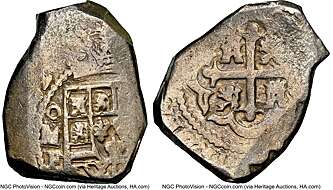
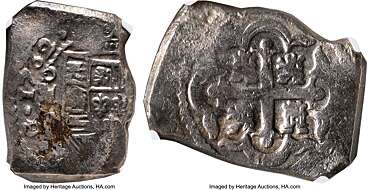
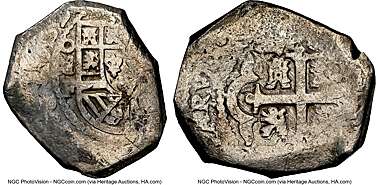
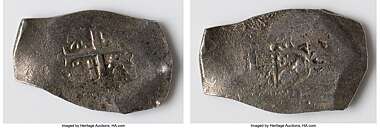
Heritage Auctions, Inc. Logo
Lote
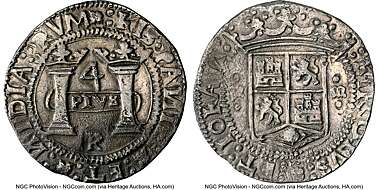
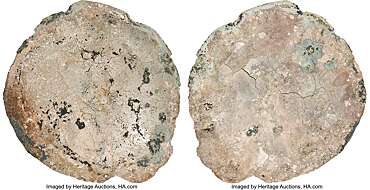
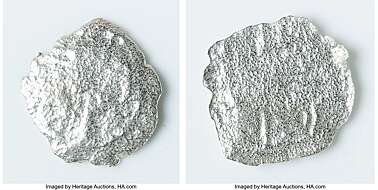
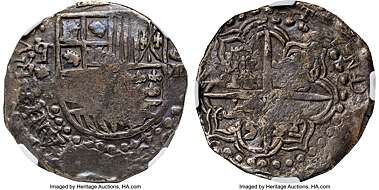
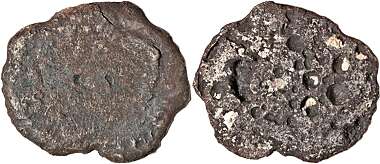
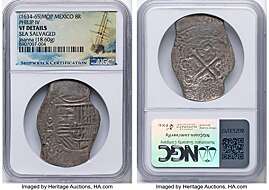
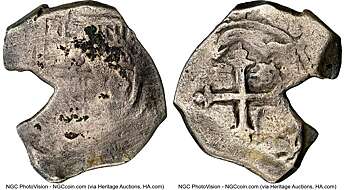
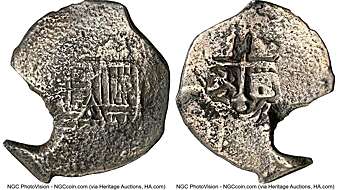
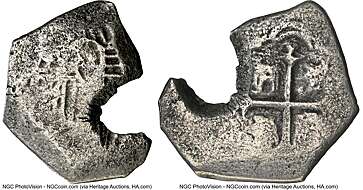
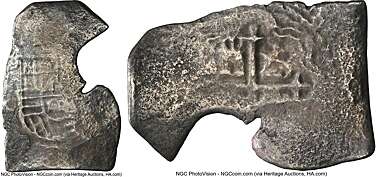
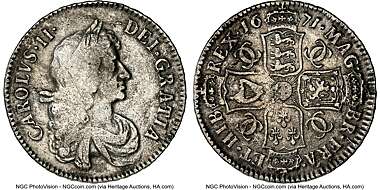
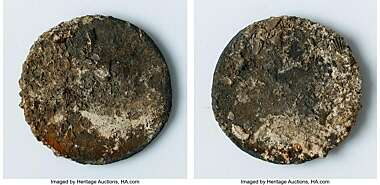
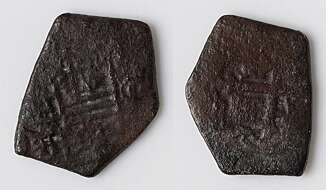
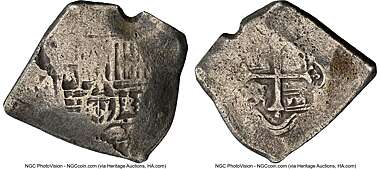
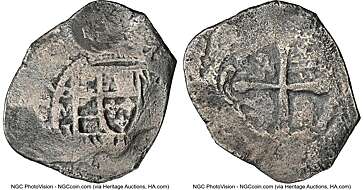
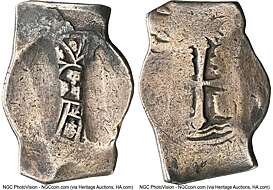
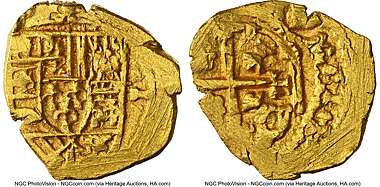
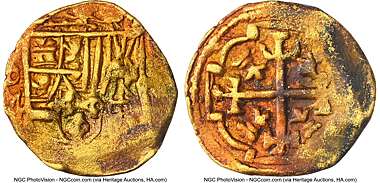
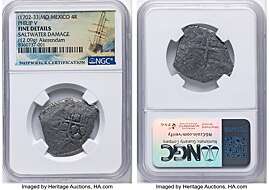
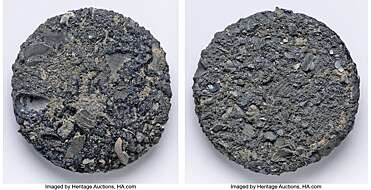
Lote 25001. Mexico Charles & Johanna "Golden Fleece" 4 Reales ND (1536-1538) Mo-R XF Details (Sea Salvaged) NGC, Mexico City mint, Cal-115. 12.50gm. Early series. Latin "R". Oval panel. Salvaged from the "Golden Fleece" shipwreck (sunk ca. 1550 in the northern Caribbean). An AU piece, attractive at hand. The Golden Fleece shipwreck is a vessel in the northern Caribbean nicknamed for a royal stamping, known as Golden Fleece, that was found on several of the gold 'finger' ingots and coins. A few dozen of these gold and silver ingots were salvaged with varying purities, reminiscent of the famous "tumbaga" bars. Significantly, it is believed that the Golden Fleece ingots are the only known examples made in the colonies between the "tumbaga" era of the 1520s and the ones found on the 1554 Padre Island Fleet. Almost all the recovered coins are Mexican Carlos-Juana silver pieces (all assayers prior to S) apart from some extremely rare Santo Domingo pieces. Notably, three examples of the very first 8 Reales ever struck in the New World were found - the Rincón "Early Series" 8 Reales of 1538. HID05401242017 © 2026 Heritage Auctions | All Rights Reserved www.HA.com/TexasAuctioneerLicenseNotice
  • Precio de salida:
    1 USD
    0 EUR
    0 GBP
    0 CHF

    Importes redondeados, solo aproximadosFecha: 05/11/2026
Lote
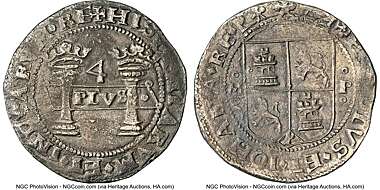
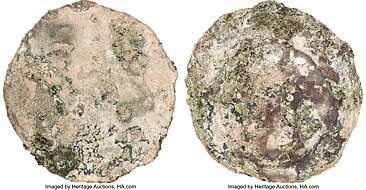
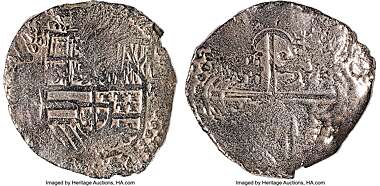
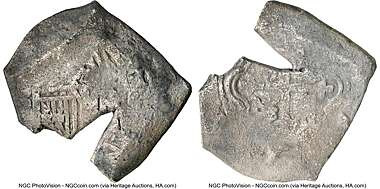
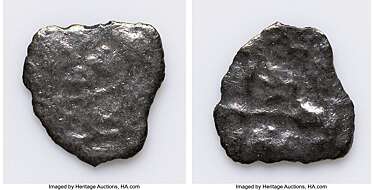
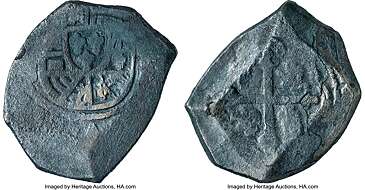
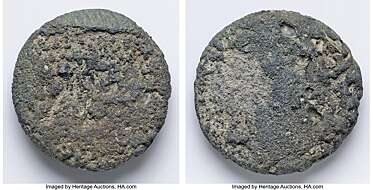
Lote 25002. Mexico Charles & Johanna "Golden Fleece" 4 Reales ND (1541-1542) M-P XF Details (Sea Salvaged) NGC, Mexico City mint, Cal-123. Early Series. 12.96gm. Salvaged from the "Golden Fleece" shipwreck (sunk ca. 1550 in the northern Caribbean). The Golden Fleece shipwreck is a vessel in the northern Caribbean nicknamed for a royal stamping, known as Golden Fleece, that was found on several of the gold 'finger' ingots and coins. A few dozen of these gold and silver ingots were salvaged with varying purities, reminiscent of the famous "tumbaga" bars. Significantly, it is believed that the Golden Fleece ingots are the only known examples made in the colonies between the "tumbaga" era of the 1520s and the ones found on the 1554 Padre Island Fleet. Almost all the recovered coins are Mexican Carlos-Juana silver pieces (all assayers prior to S) apart from some extremely rare Santo Domingo pieces. Notably, three examples of the very first 8 Reales ever struck in the New World were found - the Rincón "Early Series" 8 Reales of 1538. HID05401242017 © 2026 Heritage Auctions | All Rights Reserved www.HA.com/TexasAuctioneerLicenseNotice
  • Precio de salida:
    1 USD
    0 EUR
    0 GBP
    0 CHF

    Importes redondeados, solo aproximadosFecha: 05/11/2026
Lote
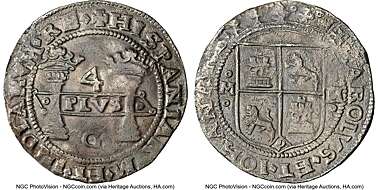
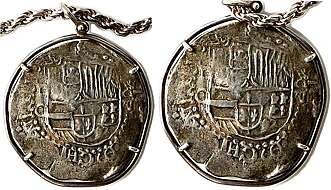
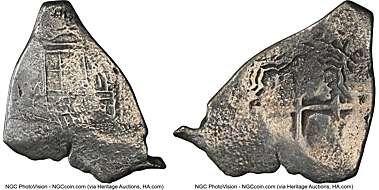
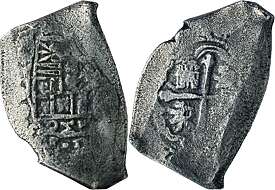
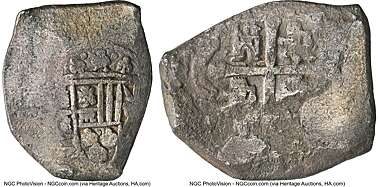
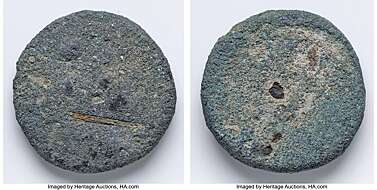
Lote 25003. Mexico Charles & Johanna "Golden Fleece" 4 Reales ND (1538-1542) M-G VF Details (Sea Salvaged) NGC, Mexico City mint, cf. Cal-119 (For Type), cf. Nesmith-11 (For Type). Early series. 12.35gm. Salvaged from the "Golden Fleece" shipwreck (sunk ca. 1550 in the northern Caribbean). With M-M/F Mint Mark. Rhomboid paneling. Lozenges for stops. The Golden Fleece shipwreck is a vessel in the northern Caribbean nicknamed for a royal stamping, known as Golden Fleece, that was found on several of the gold 'finger' ingots and coins. A few dozen of these gold and silver ingots were salvaged with varying purities, reminiscent of the famous "tumbaga" bars. Significantly, it is believed that the Golden Fleece ingots are the only known examples made in the colonies between the "tumbaga" era of the 1520s and the ones found on the 1554 Padre Island Fleet. Almost all the recovered coins are Mexican Carlos-Juana silver pieces (all assayers prior to S) apart from some extremely rare Santo Domingo pieces. Notably, three examples of the very first 8 Reales ever struck in the New World were found - the Rincón "Early Series" 8 Reales of 1538. HID05401242017 © 2026 Heritage Auctions | All Rights Reserved www.HA.com/TexasAuctioneerLicenseNotice
  • Precio de salida:
    1 USD
    0 EUR
    0 GBP
    0 CHF

    Importes redondeados, solo aproximadosFecha: 05/11/2026
Lote
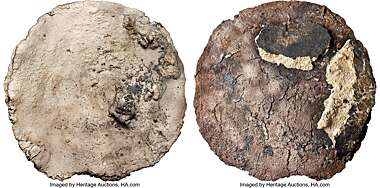
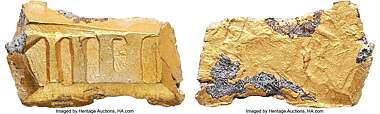
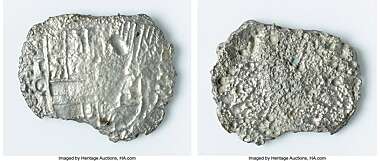
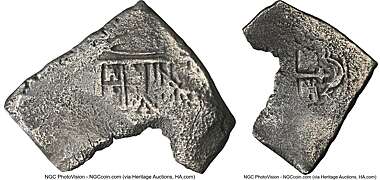
Lote 25004. Mexico Charles & Johanna "Golden Fleece Shipwreck" silver Ingot of 1610gm ND (c. 1550), 150x150mm. 1610gm. XRF scan: 99%. Salvaged from the "Golden Fleece" shipwreck (sunk ca. 1550 in the northern Caribbean). Showing faint tax stamps (one a crown) and some coral encrustation. The crude splash ingots were made by pouring the molten silver directly to a depression made in sand. Often, on one side, these bars show protrusions due to the silver cooling down by the end of the pour. The Golden Fleece shipwreck is a vessel in the northern Caribbean nicknamed for a royal stamping, known as Golden Fleece, that was found on several of the gold 'finger' ingots and coins. A few dozen of these gold and silver ingots were salvaged with varying purities, reminiscent of the famous "tumbaga" bars. Significantly, it is believed that the Golden Fleece ingots are the only known examples made in the colonies between the "tumbaga" era of the 1520s and the ones found on the 1554 Padre Island Fleet. Almost all the recovered coins are Mexican Carlos-Juana silver pieces (all assayers prior to S) apart from some extremely rare Santo Domingo pieces. Notably, three examples of the very first 8 Reales ever struck in the New World were found - the Rincón "Early Series" 8 Reales of 1538. Due to the crudeness of these ingots, the XRF analysis is an average result from the several scans done in different areas of the item HID05401242017 © 2026 Heritage Auctions | All Rights Reserved www.HA.com/TexasAuctioneerLicenseNotice
  • Precio de salida:
    1 USD
    0 EUR
    0 GBP
    0 CHF

    Importes redondeados, solo aproximadosFecha: 05/11/2026
Lote
Lote 25005. Mexico Charles & Johanna "Golden Fleece Shipwreck" silver Cut Ingot of 890gm ND (c. 1550), 185x75mm. 890gm. XRF scan: 98%. Salvaged from the "Golden Fleece" shipwreck (sunk ca. 1550 in the northern Caribbean). Showing faint tax stamps (one a crown over a C) and some coral encrustation. The crude splash ingots were made by pouring the molten silver directly to a depression made in sand. Often, on one side, these bars show protrusions due to the silver cooling down by the end of the pour. The Golden Fleece shipwreck is a vessel in the northern Caribbean nicknamed for a royal stamping, known as Golden Fleece, that was found on several of the gold 'finger' ingots and coins. A few dozen of these gold and silver ingots were salvaged with varying purities, reminiscent of the famous "tumbaga" bars. Significantly, it is believed that the Golden Fleece ingots are the only known examples made in the colonies between the "tumbaga" era of the 1520s and the ones found on the 1554 Padre Island Fleet. Almost all the recovered coins are Mexican Carlos-Juana silver pieces (all assayers prior to S) apart from some extremely rare Santo Domingo pieces. Notably, three examples of the very first 8 Reales ever struck in the New World were found - the Rincón "Early Series" 8 Reales of 1538. Due to the crudeness of these ingots, the XRF analysis is an average result from the several scans done in different areas of the item HID05401242017 © 2026 Heritage Auctions | All Rights Reserved www.HA.com/TexasAuctioneerLicenseNotice
  • Precio de salida:
    1 USD
    0 EUR
    0 GBP
    0 CHF

    Importes redondeados, solo aproximadosFecha: 05/11/2026
Lote
Lote 25006. Mexico Charles & Johanna "Golden Fleece Shipwreck" silver Ingot of 1106gm ND (c. 1550), 210x190mm. 1106gm. XRF scan: 93%. Salvaged from the "Golden Fleece" shipwreck (sunk ca. 1550 in the northern Caribbean). Still coral encrusted. The crude splash ingots were made by pouring the molten silver directly to a depression made in sand. Often, on one side, these bars show protrusions due to the silver cooling down by the end of the pour. The Golden Fleece shipwreck is a vessel in the northern Caribbean nicknamed for a royal stamping, known as Golden Fleece, that was found on several of the gold 'finger' ingots and coins. A few dozen of these gold and silver ingots were salvaged with varying purities, reminiscent of the famous "tumbaga" bars. Significantly, it is believed that the Golden Fleece ingots are the only known examples made in the colonies between the "tumbaga" era of the 1520s and the ones found on the 1554 Padre Island Fleet. Almost all the recovered coins are Mexican Carlos-Juana silver pieces (all assayers prior to S) apart from some extremely rare Santo Domingo pieces. Notably, three examples of the very first 8 Reales ever struck in the New World were found - the Rincón "Early Series" 8 Reales of 1538. Due to the crudeness of these ingots, the XRF analysis is an average result from the several scans done in different areas of the item HID05401242017 © 2026 Heritage Auctions | All Rights Reserved www.HA.com/TexasAuctioneerLicenseNotice
  • Precio de salida:
    1 USD
    0 EUR
    0 GBP
    0 CHF

    Importes redondeados, solo aproximadosFecha: 05/11/2026
Lote
Lote 25007. Mexico Charles & Johanna "Golden Fleece Shipwreck" silver Ingot of 3154gm ND (c. 1550), 190x185mm. 3154gm. XRF scan: 99%. Salvaged from the "Golden Fleece" shipwreck (sunk ca. 1550 in the northern Caribbean). A large ingot with faint quinto stamps; resembling the older Tumbaga "cow pies". The crude splash ingots were made by pouring the molten silver directly to a depression made in sand. Often, on one side, these bars show protrusions due to the silver cooling down by the end of the pour. The Golden Fleece shipwreck is a vessel in the northern Caribbean nicknamed for a royal stamping, known as Golden Fleece, that was found on several of the gold 'finger' ingots and coins. A few dozen of these gold and silver ingots were salvaged with varying purities, reminiscent of the famous "tumbaga" bars. Significantly, it is believed that the Golden Fleece ingots are the only known examples made in the colonies between the "tumbaga" era of the 1520s and the ones found on the 1554 Padre Island Fleet. Almost all the recovered coins are Mexican Carlos-Juana silver pieces (all assayers prior to S) apart from some extremely rare Santo Domingo pieces. Notably, three examples of the very first 8 Reales ever struck in the New World were found - the Rincón "Early Series" 8 Reales of 1538. Due to the crudeness of these ingots, the XRF analysis is an average result from the several scans done in different areas of the item HID05401242017 © 2026 Heritage Auctions | All Rights Reserved www.HA.com/TexasAuctioneerLicenseNotice
  • Precio de salida:
    1 USD
    0 EUR
    0 GBP
    0 CHF

    Importes redondeados, solo aproximadosFecha: 05/11/2026
Lote
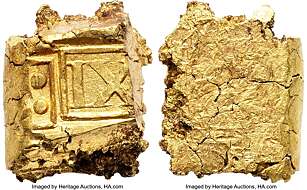
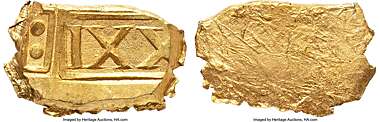
Lote 25008. Mexico Charles & Johanna gold "Golden Fleece Shipwreck" cut Ingot of 17.03gm ND (c. 1550), 19x15mm. 17.03gm. Marked with fineness XXI-1/2 (21.5K). XRF scan: 21.6K. Salvaged from the "Golden Fleece" shipwreck (sunk ca. 1550 in the northern Caribbean). A hefty cut piece. The Golden Fleece shipwreck is a vessel in the northern Caribbean nicknamed for a royal stamping, known as Golden Fleece, that was found on several of the gold 'finger' ingots and coins. A few dozen of these gold and silver ingots were salvaged with varying purities, reminiscent of the famous "tumbaga" bars. Significantly, it is believed that the Golden Fleece ingots are the only known examples made in the colonies between the "tumbaga" era of the 1520s and the ones found on the 1554 Padre Island Fleet. Almost all the recovered coins are Mexican Carlos-Juana silver pieces (all assayers prior to S) apart from some extremely rare Santo Domingo pieces. Notably, three examples of the very first 8 Reales ever struck in the New World were found - the Rincón "Early Series" 8 Reales of 1538. HID05401242017 © 2026 Heritage Auctions | All Rights Reserved www.HA.com/TexasAuctioneerLicenseNotice
  • Precio de salida:
    1 USD
    0 EUR
    0 GBP
    0 CHF

    Importes redondeados, solo aproximadosFecha: 05/11/2026
Lote
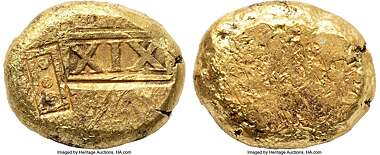
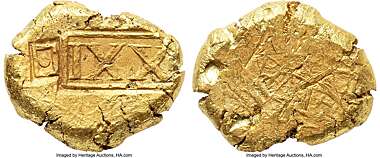
Lote 25009. Mexico Charles & Johanna gold "Golden Fleece Shipwreck" Ingot of 25.39gm ND (c. 1550), 24x19mm. 25.39gm. Marked with fineness XIX-3/4 (19.75K). XRF scan: 20K. Salvaged from the "Golden Fleece" shipwreck (sunk ca. 1550 in the northern Caribbean). Neatly round and stamped. The Golden Fleece shipwreck is a vessel in the northern Caribbean nicknamed for a royal stamping, known as Golden Fleece, that was found on several of the gold 'finger' ingots and coins. A few dozen of these gold and silver ingots were salvaged with varying purities, reminiscent of the famous "tumbaga" bars. Significantly, it is believed that the Golden Fleece ingots are the only known examples made in the colonies between the "tumbaga" era of the 1520s and the ones found on the 1554 Padre Island Fleet. Almost all the recovered coins are Mexican Carlos-Juana silver pieces (all assayers prior to S) apart from some extremely rare Santo Domingo pieces. Notably, three examples of the very first 8 Reales ever struck in the New World were found - the Rincón "Early Series" 8 Reales of 1538. HID05401242017 © 2026 Heritage Auctions | All Rights Reserved www.HA.com/TexasAuctioneerLicenseNotice
  • Precio de salida:
    1 USD
    0 EUR
    0 GBP
    0 CHF

    Importes redondeados, solo aproximadosFecha: 05/11/2026
Lote
Lote 25010. Mexico Charles & Johanna gold "Golden Fleece Shipwreck" cut Ingot of 1.30gm ND (c. 1550), 13x8mm. 1.30gm. Marked with fineness XVIIII (14K). XRF scan: 14K. Salvaged from the "Golden Fleece" shipwreck (sunk ca. 1550 in the northern Caribbean). A minute and still coral encrusted ingot. The Golden Fleece shipwreck is a vessel in the northern Caribbean nicknamed for a royal stamping, known as Golden Fleece, that was found on several of the gold 'finger' ingots and coins. A few dozen of these gold and silver ingots were salvaged with varying purities, reminiscent of the famous "tumbaga" bars. Significantly, it is believed that the Golden Fleece ingots are the only known examples made in the colonies between the "tumbaga" era of the 1520s and the ones found on the 1554 Padre Island Fleet. Almost all the recovered coins are Mexican Carlos-Juana silver pieces (all assayers prior to S) apart from some extremely rare Santo Domingo pieces. Notably, three examples of the very first 8 Reales ever struck in the New World were found - the Rincón "Early Series" 8 Reales of 1538. HID05401242017 © 2026 Heritage Auctions | All Rights Reserved www.HA.com/TexasAuctioneerLicenseNotice
  • Precio de salida:
    1 USD
    0 EUR
    0 GBP
    0 CHF

    Importes redondeados, solo aproximadosFecha: 05/11/2026
Lote
Lote 25011. Mexico Charles & Johanna gold "Golden Fleece Shipwreck" cut Ingot of 4.23gm ND (c. 1550), 20x13mm. 4.23gm. Marked with fineness XXI-dot-dot (21-1/2K). XRF scan: 21.5K. Salvaged from the "Golden Fleece" shipwreck (sunk ca. 1550 in the northern Caribbean). Displaying bright, golden crevices. The Golden Fleece shipwreck is a vessel in the northern Caribbean nicknamed for a royal stamping, known as Golden Fleece, that was found on several of the gold 'finger' ingots and coins. A few dozen of these gold and silver ingots were salvaged with varying purities, reminiscent of the famous "tumbaga" bars. Significantly, it is believed that the Golden Fleece ingots are the only known examples made in the colonies between the "tumbaga" era of the 1520s and the ones found on the 1554 Padre Island Fleet. Almost all the recovered coins are Mexican Carlos-Juana silver pieces (all assayers prior to S) apart from some extremely rare Santo Domingo pieces. Notably, three examples of the very first 8 Reales ever struck in the New World were found - the Rincón "Early Series" 8 Reales of 1538. HID05401242017 © 2026 Heritage Auctions | All Rights Reserved www.HA.com/TexasAuctioneerLicenseNotice
  • Precio de salida:
    1 USD
    0 EUR
    0 GBP
    0 CHF

    Importes redondeados, solo aproximadosFecha: 05/11/2026
Lote
Lote 25012. Mexico Charles & Johanna gold "Golden Fleece Shipwreck" Ingot of 16.52gm ND (c. 1550), 23x20mm. 16.52gm. Marked with fineness XXI-dot (21.25K). XRF scan: 21.3K. Salvaged from the "Golden Fleece" shipwreck (sunk ca. 1550 in the northern Caribbean). The Golden Fleece shipwreck is a vessel in the northern Caribbean nicknamed for a royal stamping, known as Golden Fleece, that was found on several of the gold 'finger' ingots and coins. A few dozen of these gold and silver ingots were salvaged with varying purities, reminiscent of the famous "tumbaga" bars. Significantly, it is believed that the Golden Fleece ingots are the only known examples made in the colonies between the "tumbaga" era of the 1520s and the ones found on the 1554 Padre Island Fleet. Almost all the recovered coins are Mexican Carlos-Juana silver pieces (all assayers prior to S) apart from some extremely rare Santo Domingo pieces. Notably, three examples of the very first 8 Reales ever struck in the New World were found - the Rincón "Early Series" 8 Reales of 1538. HID05401242017 © 2026 Heritage Auctions | All Rights Reserved www.HA.com/TexasAuctioneerLicenseNotice
  • Precio de salida:
    1 USD
    0 EUR
    0 GBP
    0 CHF

    Importes redondeados, solo aproximadosFecha: 05/11/2026
Lote
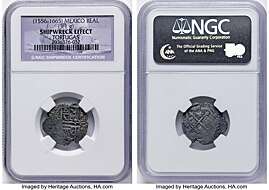
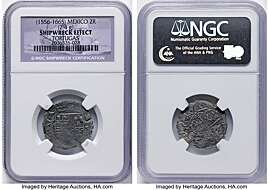
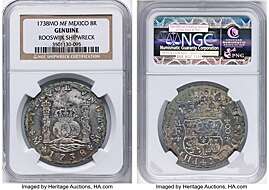
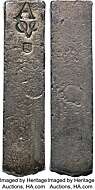
Lote 25013. Bolivia Philip II - Philip III "Atocha" Cob 8 Reales ND (1578-1621)-P VG Details (Saltwater Damage) PCGS, Potosi mint. 23.46gm. Grad: Uncleaned. Salvaged from the "Nuestra Señora de Atocha" (sunk in 1622 off Key West, Florida). A seldom-seen only partially cleaned Atocha coin. Sold with original tag and Treasure Salvors photo-certificate U-298. The Nuestra Señora de Atocha was the Admiral Galleon of the Tierra Firme Fleet, a twenty-eight-ship fleet carrying an unprecedented amount of treasure from the Americas. Sailing from Havana bound to Spain on the 4th of September 1622, the armada was hit by a massive hurricane in the Florida Keys, most of the fleet being decimated and the treasure sinking to the Atlantic seabed. The Spanish efforts to retrieve the precious cargo weren't fruitful, which led to the scattering of the vast amount of treasure across the Florida coast with subsequent hurricanes. The original manifesto of the Atocha was impressive: 24 tons of silver in 1038 ingots, 180,000 Pesos in silver coins, 582 copper ingots, 125 gold bars and discs, 1,200 pounds of worked silverware and other goods; and that's only what was officially transported, since smuggling treasure to avoid taxes was very common in the period, with some estimating that a large percentage of the total cargo was in contraband. In 1969, treasure hunter Mel Fisher began a long-lasting, 16-year quest to locate the treasure. Over the years, isolated coins and artifacts were found scattered across Florida's "treasure coast", many given to investors who funded the operation. In 1973 three silver bars were found and matched to the original 17th century manifesto, leading the crew closer to the main wreck site. By 1980 a significant part of the Santa Margarita had been located, counting with gold bars, silver coins and jewelry. On July 20th, 1985, the motherlode was located, when divers found a "reef of bars". The main pile of the Atocha provided countless artifacts which quickly became immersed in Florida's pop culture and would later become perhaps the world's most famous shipwreck treasure in history. HID05401242017 © 2026 Heritage Auctions | All Rights Reserved www.HA.com/TexasAuctioneerLicenseNotice
  • Precio de salida:
    1 USD
    0 EUR
    0 GBP
    0 CHF

    Importes redondeados, solo aproximadosFecha: 05/11/2026
Lote
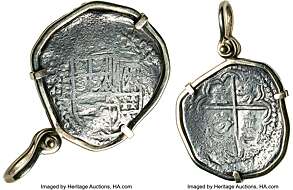
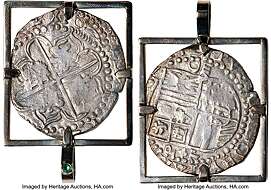
Lote 25014. Bolivia Philip III "Atocha" Cob 2 Reales ND (1605-1613) P-R XF (Shipwreck Effect, Mounted), Potosi mint, KM8, Cal-626. Total weight: 11.14gm. Grade 1. Salvaged from the "Nuestra Señora de Atocha" (sunk in 1622 off Key West, Florida). Mounted in 14K gold. Sold with original tag and Treasure Salvors photo-certificate. The Nuestra Señora de Atocha was the Admiral Galleon of the Tierra Firme Fleet, a twenty-eight-ship fleet carrying an unprecedented amount of treasure from the Americas. Sailing from Havana bound to Spain on the 4th of September 1622, the armada was hit by a massive hurricane in the Florida Keys, most of the fleet being decimated and the treasure sinking to the Atlantic seabed. The Spanish efforts to retrieve the precious cargo weren't fruitful, which led to the scattering of the vast amount of treasure across the Florida coast with subsequent hurricanes. The original manifesto of the Atocha was impressive: 24 tons of silver in 1038 ingots, 180,000 Pesos in silver coins, 582 copper ingots, 125 gold bars and discs, 1,200 pounds of worked silverware and other goods; and that's only what was officially transported, since smuggling treasure to avoid taxes was very common in the period, with some estimating that a large percentage of the total cargo was in contraband. In 1969, treasure hunter Mel Fisher began a long-lasting, 16-year quest to locate the treasure. Over the years, isolated coins and artifacts were found scattered across Florida's "treasure coast", many given to investors who funded the operation. In 1973 three silver bars were found and matched to the original 17th century manifesto, leading the crew closer to the main wreck site. By 1980 a significant part of the Santa Margarita had been located, counting with gold bars, silver coins and jewelry. On July 20th, 1985, the motherlode was located, when divers found a "reef of bars". The main pile of the Atocha provided countless artifacts which quickly became immersed in Florida's pop culture and would later become perhaps the world's most famous shipwreck treasure in history. HID05401242017 © 2026 Heritage Auctions | All Rights Reserved www.HA.com/TexasAuctioneerLicenseNotice
  • Precio de salida:
    1 USD
    0 EUR
    0 GBP
    0 CHF

    Importes redondeados, solo aproximadosFecha: 05/11/2026
Lote
Lote 25015. Bolivia Philip III "Atocha" Cob 2 Reales (1616-1617) P-M XF (Shipwreck Effect), Potosi mint, KM8, Calico-628. Total weight: 17.24gm. Grade 1. Salvaged from the "Nuestra Señora de Atocha" (sunk in 1622 off Key West, Florida). A mesmerizing pendant with a grade one 2 Reales, minimally corroded and with assayer visible, combined with not only two two Atocha emeralds, but also five Santa Margarita Pearls, all encased in a tasteful 18K frame with 0.6 carats of accents Colombian emeralds. An exciting, truly historic jewelry piece, ready to be worn by a modern-day pirate. Sold with Eight Treasure Salvors photo-certificates (2 for the emeralds at bale, 5 for the pearls and one for the coin). This piece is accompanied by a photo-copied letter from consignors where they explain their adventures with Mel Fisher himself. The letter reads: "We stumbled across Mel Fisher by accident when we went to Key West. We took a tour and at the end of that we learned we could be investors. We became investors, and with that you are able to obtain treasure two ways: you can go out and hunt for emeralds, and the other way, you receive your percentage of what they find that year. We were able to find three emeralds with the time being with Mel Fisher; as well as received coins, pearls and other artifacts. A few years after we went back to Key West and went into Emeralds International and had Manuel Marcial de Gomar, who is a worldwide known expert in emeralds, design these two beautiful pieces of jewelry from our division through Mel Fisher's. The Nuestra Señora de Atocha was the Admiral Galleon of the Tierra Firme Fleet, a twenty-eight-ship fleet carrying an unprecedented amount of treasure from the Americas. Sailing from Havana bound to Spain on the 4th of September 1622, the armada was hit by a massive hurricane in the Florida Keys, most of the fleet being decimated and the treasure sinking to the Atlantic seabed. The Spanish efforts to retrieve the precious cargo weren't fruitful, which led to the scattering of the vast amount of treasure across the Florida coast with subsequent hurricanes. The original manifesto of the Atocha was impressive: 24 tons of silver in 1038 ingots, 180,000 Pesos in silver coins, 582 copper ingots, 125 gold bars and discs, 1,200 pounds of worked silverware and other goods; and that's only what was officially transported, since smuggling treasure to avoid taxes was very common in the period, with some estimating that a large percentage of the total cargo was in contraband. In 1969, treasure hunter Mel Fisher began a long-lasting, 16-year quest to locate the treasure. Over the years, isolated coins and artifacts were found scattered across Florida's "treasure coast", many given to investors who funded the operation. In 1973 three silver bars were found and matched to the original 17th century manifesto, leading the crew closer to the main wreck site. By 1980 a significant part of the Santa Margarita had been located, counting with gold bars, silver coins and jewelry. On July 20th, 1985, the motherlode was located, when divers found a "reef of bars". The main pile of the Atocha provided countless artifacts which quickly became immersed in Florida's pop culture and would later become perhaps the world's most famous shipwreck treasure in history. From the Gary Nixon Collection Of Atocha Artifacts HID05401242017 © 2026 Heritage Auctions | All Rights Reserved www.HA.com/TexasAuctioneerLicenseNotice
  • Precio de salida:
    1 USD
    0 EUR
    0 GBP
    0 CHF

    Importes redondeados, solo aproximadosFecha: 05/11/2026
Lote
Lote 25016. Bolivia Philip III "Atocha" Cob 4 Reales ND (1598-1622)-P XF (Shipwreck Effect), 5.9gm. Salvaged from the "Nuestra Señora de Atocha" (sunk in 1622 off Key West, Florida). Sold with original tag and Treasure Salvors photo-certificate 90M-15049. This piece is accompanied by a photo-copied letter from consignors where they explain their adventures with Mel Fisher himself. The letter reads: "We stumbled across Mel Fisher by accident when we went to Key West. We took a tour and at the end of that we learned we could be investors. We became investors, and with that you are able to obtain treasure two ways: you can go out and hunt for emeralds, and the other way, you receive your percentage of what they find that year. We were able to find three emeralds with the time being with Mel Fisher; as well as received coins, pearls and other artifacts. A few years after we went back to Key West and went into Emeralds International and had Manuel Marcial de Gomar, who is a worldwide known expert in emeralds, design these two beautiful pieces of jewelry from our division through Mel Fisher's. The Nuestra Señora de Atocha was the Admiral Galleon of the Tierra Firme Fleet, a twenty-eight-ship fleet carrying an unprecedented amount of treasure from the Americas. Sailing from Havana bound to Spain on the 4th of September 1622, the armada was hit by a massive hurricane in the Florida Keys, most of the fleet being decimated and the treasure sinking to the Atlantic seabed. The Spanish efforts to retrieve the precious cargo weren't fruitful, which led to the scattering of the vast amount of treasure across the Florida coast with subsequent hurricanes. The original manifesto of the Atocha was impressive: 24 tons of silver in 1038 ingots, 180,000 Pesos in silver coins, 582 copper ingots, 125 gold bars and discs, 1,200 pounds of worked silverware and other goods; and that's only what was officially transported, since smuggling treasure to avoid taxes was very common in the period, with some estimating that a large percentage of the total cargo was in contraband. In 1969, treasure hunter Mel Fisher began a long-lasting, 16-year quest to locate the treasure. Over the years, isolated coins and artifacts were found scattered across Florida's "treasure coast", many given to investors who funded the operation. In 1973 three silver bars were found and matched to the original 17th century manifesto, leading the crew closer to the main wreck site. By 1980 a significant part of the Santa Margarita had been located, counting with gold bars, silver coins and jewelry. On July 20th, 1985, the motherlode was located, when divers found a "reef of bars". The main pile of the Atocha provided countless artifacts which quickly became immersed in Florida's pop culture and would later become perhaps the world's most famous shipwreck treasure in history. From the Gary Nixon Collection Of Atocha Artifacts HID05401242017 © 2026 Heritage Auctions | All Rights Reserved www.HA.com/TexasAuctioneerLicenseNotice
  • Precio de salida:
    1 USD
    0 EUR
    0 GBP
    0 CHF

    Importes redondeados, solo aproximadosFecha: 05/11/2026
Lote
Lote 25017. Bolivia Philip III "Atocha" Cob 8 Reales ND (1603-1612) P-R XF (Shipwreck Effect), Potosi mint, KM10, Cal-912. 21.6gm. Grade 1. Salvaged from the "Nuestra Señora de Atocha" (sunk in 1622 off Key West, Florida). Sold with original tag and Treasure Salvors photo-certificate 85A-262728. This piece is accompanied by a photo-copied letter from consignors where they explain their adventures with Mel Fisher himself. The letter reads: "We stumbled across Mel Fisher by accident when we went to Key West. We took a tour and at the end of that we learned we could be investors. We became investors, and with that you are able to obtain treasure two ways: you can go out and hunt for emeralds, and the other way, you receive your percentage of what they find that year. We were able to find three emeralds with the time being with Mel Fisher; as well as received coins, pearls and other artifacts. A few years after we went back to Key West and went into Emeralds International and had Manuel Marcial de Gomar, who is a worldwide known expert in emeralds, design these two beautiful pieces of jewelry from our division through Mel Fisher's. The Nuestra Señora de Atocha was the Admiral Galleon of the Tierra Firme Fleet, a twenty-eight-ship fleet carrying an unprecedented amount of treasure from the Americas. Sailing from Havana bound to Spain on the 4th of September 1622, the armada was hit by a massive hurricane in the Florida Keys, most of the fleet being decimated and the treasure sinking to the Atlantic seabed. The Spanish efforts to retrieve the precious cargo weren't fruitful, which led to the scattering of the vast amount of treasure across the Florida coast with subsequent hurricanes. The original manifesto of the Atocha was impressive: 24 tons of silver in 1038 ingots, 180,000 Pesos in silver coins, 582 copper ingots, 125 gold bars and discs, 1,200 pounds of worked silverware and other goods; and that's only what was officially transported, since smuggling treasure to avoid taxes was very common in the period, with some estimating that a large percentage of the total cargo was in contraband. In 1969, treasure hunter Mel Fisher began a long-lasting, 16-year quest to locate the treasure. Over the years, isolated coins and artifacts were found scattered across Florida's "treasure coast", many given to investors who funded the operation. In 1973 three silver bars were found and matched to the original 17th century manifesto, leading the crew closer to the main wreck site. By 1980 a significant part of the Santa Margarita had been located, counting with gold bars, silver coins and jewelry. On July 20th, 1985, the motherlode was located, when divers found a "reef of bars". The main pile of the Atocha provided countless artifacts which quickly became immersed in Florida's pop culture and would later become perhaps the world's most famous shipwreck treasure in history. From the Gary Nixon Collection Of Atocha Artifacts HID05401242017 © 2026 Heritage Auctions | All Rights Reserved www.HA.com/TexasAuctioneerLicenseNotice
  • Precio de salida:
    1 USD
    0 EUR
    0 GBP
    0 CHF

    Importes redondeados, solo aproximadosFecha: 05/11/2026
Lote
Lote 25018. Bolivia Philip III "Atocha" Cob 8 Reales ND (1612-1616) P-Q XF (Shipwreck Effect, Mounted), Potosi mint, KM10, Cal-916. Coin weight: 26.30gm. Total weight: 65.32gm (with chain). Accompanied by tag, COA, promotional papers and Atocha book. Grade 1. Salvaged from the "Nuestra Señora de Atocha" (sunk in 1622 off Key West, Florida). Sold with Treasure Salvors photo-certificate 85A-162307. The Nuestra Señora de Atocha was the Admiral Galleon of the Tierra Firme Fleet, a twenty-eight-ship fleet carrying an unprecedented amount of treasure from the Americas. Sailing from Havana bound to Spain on the 4th of September 1622, the armada was hit by a massive hurricane in the Florida Keys, most of the fleet being decimated and the treasure sinking to the Atlantic seabed. The Spanish efforts to retrieve the precious cargo weren't fruitful, which led to the scattering of the vast amount of treasure across the Florida coast with subsequent hurricanes. The original manifesto of the Atocha was impressive: 24 tons of silver in 1038 ingots, 180,000 Pesos in silver coins, 582 copper ingots, 125 gold bars and discs, 1,200 pounds of worked silverware and other goods; and that's only what was officially transported, since smuggling treasure to avoid taxes was very common in the period, with some estimating that a large percentage of the total cargo was in contraband. In 1969, treasure hunter Mel Fisher began a long-lasting, 16-year quest to locate the treasure. Over the years, isolated coins and artifacts were found scattered across Florida's "treasure coast", many given to investors who funded the operation. In 1973 three silver bars were found and matched to the original 17th century manifesto, leading the crew closer to the main wreck site. By 1980 a significant part of the Santa Margarita had been located, counting with gold bars, silver coins and jewelry. On July 20th, 1985, the motherlode was located, when divers found a "reef of bars". The main pile of the Atocha provided countless artifacts which quickly became immersed in Florida's pop culture and would later become perhaps the world's most famous shipwreck treasure in history. HID05401242017 © 2026 Heritage Auctions | All Rights Reserved www.HA.com/TexasAuctioneerLicenseNotice
  • Precio de salida:
    1 USD
    0 EUR
    0 GBP
    0 CHF

    Importes redondeados, solo aproximadosFecha: 05/11/2026
Lote
Lote 25019. Bolivia Philip III "Atocha" Cob 8 Reales ND (1612-1622) P-Q XF (Shipwreck Effect), Potosi mint, KM10, Cal-917. 13.9gm. Grade 4. Salvaged from the "Nuestra Señora de Atocha" (sunk in 1622 off Key West, Florida). Sold with Treasure Salvors photo-certificate 96A-270845. This piece is accompanied by a photo-copied letter from consignors where they explain their adventures with Mel Fisher himself. The letter reads: "We stumbled across Mel Fisher by accident when we went to Key West. We took a tour and at the end of that we learned we could be investors. We became investors, and with that you are able to obtain treasure two ways: you can go out and hunt for emeralds, and the other way, you receive your percentage of what they find that year. We were able to find three emeralds with the time being with Mel Fisher; as well as received coins, pearls and other artifacts. A few years after we went back to Key West and went into Emeralds International and had Manuel Marcial de Gomar, who is a worldwide known expert in emeralds, design these two beautiful pieces of jewelry from our division through Mel Fisher's. The Nuestra Señora de Atocha was the Admiral Galleon of the Tierra Firme Fleet, a twenty-eight-ship fleet carrying an unprecedented amount of treasure from the Americas. Sailing from Havana bound to Spain on the 4th of September 1622, the armada was hit by a massive hurricane in the Florida Keys, most of the fleet being decimated and the treasure sinking to the Atlantic seabed. The Spanish efforts to retrieve the precious cargo weren't fruitful, which led to the scattering of the vast amount of treasure across the Florida coast with subsequent hurricanes. The original manifesto of the Atocha was impressive: 24 tons of silver in 1038 ingots, 180,000 Pesos in silver coins, 582 copper ingots, 125 gold bars and discs, 1,200 pounds of worked silverware and other goods; and that's only what was officially transported, since smuggling treasure to avoid taxes was very common in the period, with some estimating that a large percentage of the total cargo was in contraband. In 1969, treasure hunter Mel Fisher began a long-lasting, 16-year quest to locate the treasure. Over the years, isolated coins and artifacts were found scattered across Florida's "treasure coast", many given to investors who funded the operation. In 1973 three silver bars were found and matched to the original 17th century manifesto, leading the crew closer to the main wreck site. By 1980 a significant part of the Santa Margarita had been located, counting with gold bars, silver coins and jewelry. On July 20th, 1985, the motherlode was located, when divers found a "reef of bars". The main pile of the Atocha provided countless artifacts which quickly became immersed in Florida's pop culture and would later become perhaps the world's most famous shipwreck treasure in history. From the Gary Nixon Collection Of Atocha Artifacts HID05401242017 © 2026 Heritage Auctions | All Rights Reserved www.HA.com/TexasAuctioneerLicenseNotice
  • Precio de salida:
    1 USD
    0 EUR
    0 GBP
    0 CHF

    Importes redondeados, solo aproximadosFecha: 05/11/2026
Lote
Lote 25020. Bolivia Philip IV "Atocha" Cob 8 Reales 1622 P-T AU (Shipwreck Effect, Mounted), Potosi mint, KM10, Cal-1436. Total weight: 37.42gm. Grade 1. Salvaged from the "Nuestra Señora de Atocha" (sunk in 1622 off Key West, Florida). Mounted in a 14K frame with a 0.05 carat Colombian emerald on bale. A highly-impressive Atocha survivor displaying little to no corrosion and a full date, assayer and mintmark. Sold with Treasure Salvors photo-certificate 96A-20281. This piece is accompanied by a photo-copied letter from consignors where they explain their adventures with Mel Fisher himself. The letter reads: "We stumbled across Mel Fisher by accident when we went to Key West. We took a tour and at the end of that we learned we could be investors. We became investors, and with that you are able to obtain treasure two ways: you can go out and hunt for emeralds, and the other way, you receive your percentage of what they find that year. We were able to find three emeralds with the time being with Mel Fisher; as well as received coins, pearls and other artifacts. A few years after we went back to Key West and went into Emeralds International and had Manuel Marcial de Gomar, who is a worldwide known expert in emeralds, design these two beautiful pieces of jewelry from our division through Mel Fisher's. The Nuestra Señora de Atocha was the Admiral Galleon of the Tierra Firme Fleet, a twenty-eight-ship fleet carrying an unprecedented amount of treasure from the Americas. Sailing from Havana bound to Spain on the 4th of September 1622, the armada was hit by a massive hurricane in the Florida Keys, most of the fleet being decimated and the treasure sinking to the Atlantic seabed. The Spanish efforts to retrieve the precious cargo weren't fruitful, which led to the scattering of the vast amount of treasure across the Florida coast with subsequent hurricanes. The original manifesto of the Atocha was impressive: 24 tons of silver in 1038 ingots, 180,000 Pesos in silver coins, 582 copper ingots, 125 gold bars and discs, 1,200 pounds of worked silverware and other goods; and that's only what was officially transported, since smuggling treasure to avoid taxes was very common in the period, with some estimating that a large percentage of the total cargo was in contraband. In 1969, treasure hunter Mel Fisher began a long-lasting, 16-year quest to locate the treasure. Over the years, isolated coins and artifacts were found scattered across Florida's "treasure coast", many given to investors who funded the operation. In 1973 three silver bars were found and matched to the original 17th century manifesto, leading the crew closer to the main wreck site. By 1980 a significant part of the Santa Margarita had been located, counting with gold bars, silver coins and jewelry. On July 20th, 1985, the motherlode was located, when divers found a "reef of bars". The main pile of the Atocha provided countless artifacts which quickly became immersed in Florida's pop culture and would later become perhaps the world's most famous shipwreck treasure in history. From the Gary Nixon Collection Of Atocha Artifacts HID05401242017 © 2026 Heritage Auctions | All Rights Reserved www.HA.com/TexasAuctioneerLicenseNotice
  • Precio de salida:
    1 USD
    0 EUR
    0 GBP
    0 CHF

    Importes redondeados, solo aproximadosFecha: 05/11/2026
Lote
Lote 25021. Bolivia Philip IV "Atocha" Cob 8 Reales 1622 P-T VF Details (Environmental Damage) NGC, Potosi mint, KM10, Cal-1436. 26.34gm. Grade 1. Accompanied by an 8 oz silver Medal and 2 oz gilt-silver plaque made with Atocha recovered silver. Salvaged from the "Nuestra Señora de Atocha" (sunk in 1622 off Key West, Florida). A full-weight survivor displaying crisp peripheries and a whimsical retrograde P for the mintmark. The shipwreck origin added to having been struck under assayer Tapia can undeniably date this piece to the first year of Philip IV, also the wreckage of the Atocha: 1622. The grade and quality of this piece is likely the reason why it was chosen to integrate the celebration of the 375th anniversary of the 1622 Terra Firme Fleet, reason why this coin is accompanied by a hefty 8 oz Medal, 2 oz plaque (#59 of 375) and a full presentation box. Sold with 1997 Promotional Box, plaque, Medal and Treasure Salvors photo-certificate 85A-TM1463. The Nuestra Señora de Atocha was the Admiral Galleon of the Tierra Firme Fleet, a twenty-eight-ship fleet carrying an unprecedented amount of treasure from the Americas. Sailing from Havana bound to Spain on the 4th of September 1622, the armada was hit by a massive hurricane in the Florida Keys, most of the fleet being decimated and the treasure sinking to the Atlantic seabed. The Spanish efforts to retrieve the precious cargo weren't fruitful, which led to the scattering of the vast amount of treasure across the Florida coast with subsequent hurricanes. The original manifesto of the Atocha was impressive: 24 tons of silver in 1038 ingots, 180,000 Pesos in silver coins, 582 copper ingots, 125 gold bars and discs, 1,200 pounds of worked silverware and other goods; and that's only what was officially transported, since smuggling treasure to avoid taxes was very common in the period, with some estimating that a large percentage of the total cargo was in contraband. In 1969, treasure hunter Mel Fisher began a long-lasting, 16-year quest to locate the treasure. Over the years, isolated coins and artifacts were found scattered across Florida's "treasure coast", many given to investors who funded the operation. In 1973 three silver bars were found and matched to the original 17th century manifesto, leading the crew closer to the main wreck site. By 1980 a significant part of the Santa Margarita had been located, counting with gold bars, silver coins and jewelry. On July 20th, 1985, the motherlode was located, when divers found a "reef of bars". The main pile of the Atocha provided countless artifacts which quickly became immersed in Florida's pop culture and would later become perhaps the world's most famous shipwreck treasure in history. HID05401242017 © 2026 Heritage Auctions | All Rights Reserved www.HA.com/TexasAuctioneerLicenseNotice
  • Precio de salida:
    1 USD
    0 EUR
    0 GBP
    0 CHF

    Importes redondeados, solo aproximadosFecha: 05/11/2026
Lote
Lote 25022. Bolivia "Atocha" Cob 4 Reales Shipwreck Effect, 5.1gm. Grade 5. Salvaged from the "Nuestra Señora de Atocha" (sunk in 1622 off Key West, Florida). Sold with Treasure Salvors photo-certificate 88A-11062. This piece is accompanied by a photo-copied letter from consignors where they explain their adventures with Mel Fisher himself. The letter reads: "We stumbled across Mel Fisher by accident when we went to Key West. We took a tour and at the end of that we learned we could be investors. We became investors, and with that you are able to obtain treasure two ways: you can go out and hunt for emeralds, and the other way, you receive your percentage of what they find that year. We were able to find three emeralds with the time being with Mel Fisher; as well as received coins, pearls and other artifacts. A few years after we went back to Key West and went into Emeralds International and had Manuel Marcial de Gomar, who is a worldwide known expert in emeralds, design these two beautiful pieces of jewelry from our division through Mel Fisher's. The Nuestra Señora de Atocha was the Admiral Galleon of the Tierra Firme Fleet, a twenty-eight-ship fleet carrying an unprecedented amount of treasure from the Americas. Sailing from Havana bound to Spain on the 4th of September 1622, the armada was hit by a massive hurricane in the Florida Keys, most of the fleet being decimated and the treasure sinking to the Atlantic seabed. The Spanish efforts to retrieve the precious cargo weren't fruitful, which led to the scattering of the vast amount of treasure across the Florida coast with subsequent hurricanes. The original manifesto of the Atocha was impressive: 24 tons of silver in 1038 ingots, 180,000 Pesos in silver coins, 582 copper ingots, 125 gold bars and discs, 1,200 pounds of worked silverware and other goods; and that's only what was officially transported, since smuggling treasure to avoid taxes was very common in the period, with some estimating that a large percentage of the total cargo was in contraband. In 1969, treasure hunter Mel Fisher began a long-lasting, 16-year quest to locate the treasure. Over the years, isolated coins and artifacts were found scattered across Florida's "treasure coast", many given to investors who funded the operation. In 1973 three silver bars were found and matched to the original 17th century manifesto, leading the crew closer to the main wreck site. By 1980 a significant part of the Santa Margarita had been located, counting with gold bars, silver coins and jewelry. On July 20th, 1985, the motherlode was located, when divers found a "reef of bars". The main pile of the Atocha provided countless artifacts which quickly became immersed in Florida's pop culture and would later become perhaps the world's most famous shipwreck treasure in history. From the Gary Nixon Collection Of Atocha Artifacts HID05401242017 © 2026 Heritage Auctions | All Rights Reserved www.HA.com/TexasAuctioneerLicenseNotice
  • Precio de salida:
    1 USD
    0 EUR
    0 GBP
    0 CHF

    Importes redondeados, solo aproximadosFecha: 05/11/2026
Lote
Lote 25023. Bolivia Philip IV silver "Atocha" Ingot of 77 lb (1122.92 troy oz) ND (1622), 342.90x127x45mm. 77 pounds. Accompanied by COA. Salvaged from the "Nuestra Señora de Atocha" (sunk in 1622 off Key West, Florida). Sold with Mel Fishers Treasures LLC photo-certificate 85A-S49. The Nuestra Señora de Atocha was the Admiral Galleon of the Tierra Firme Fleet, a twenty-eight-ship fleet carrying an unprecedented amount of treasure from the Americas. Sailing from Havana bound to Spain on the 4th of September 1622, the armada was hit by a massive hurricane in the Florida Keys, most of the fleet being decimated and the treasure sinking to the Atlantic seabed. The Spanish efforts to retrieve the precious cargo weren't fruitful, which led to the scattering of the vast amount of treasure across the Florida coast with subsequent hurricanes. The original manifesto of the Atocha was impressive: 24 tons of silver in 1038 ingots, 180,000 Pesos in silver coins, 582 copper ingots, 125 gold bars and discs, 1,200 pounds of worked silverware and other goods; and that's only what was officially transported, since smuggling treasure to avoid taxes was very common in the period, with some estimating that a large percentage of the total cargo was in contraband. In 1969, treasure hunter Mel Fisher began a long-lasting, 16-year quest to locate the treasure. Over the years, isolated coins and artifacts were found scattered across Florida's "treasure coast", many given to investors who funded the operation. In 1973 three silver bars were found and matched to the original 17th century manifesto, leading the crew closer to the main wreck site. By 1980 a significant part of the Santa Margarita had been located, counting with gold bars, silver coins and jewelry. On July 20th, 1985, the motherlode was located, when divers found a "reef of bars". The main pile of the Atocha provided countless artifacts which quickly became immersed in Florida's pop culture and would later become perhaps the world's most famous shipwreck treasure in history. From the Randy & Nancy Best Collection HID05401242017 © 2026 Heritage Auctions | All Rights Reserved www.HA.com/TexasAuctioneerLicenseNotice
  • Precio de salida:
    1 USD
    0 EUR
    0 GBP
    0 CHF

    Importes redondeados, solo aproximadosFecha: 05/11/2026
Lote
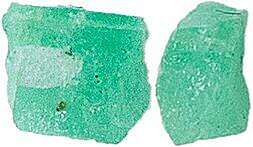
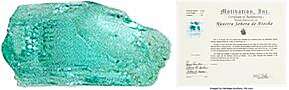
Lote 25024. Colombia "Atocha" Shipwreck Emerald (0.36 carat), 0.1gm. Salvaged from the "Nuestra Señora de Atocha" (sunk in 1622 off Key West, Florida). A bright green specimen. Sold with Treasure Salvors photo-certificate 15A-91406. This piece is accompanied by a photo-copied letter from consignors where they explain their adventures with Mel Fisher himself. The letter reads: "We stumbled across Mel Fisher by accident when we went to Key West. We took a tour and at the end of that we learned we could be investors. We became investors, and with that you are able to obtain treasure two ways: you can go out and hunt for emeralds, and the other way, you receive your percentage of what they find that year. We were able to find three emeralds with the time being with Mel Fisher; as well as received coins, pearls and other artifacts. A few years after we went back to Key West and went into Emeralds International and had Manuel Marcial de Gomar, who is a worldwide known expert in emeralds, design these two beautiful pieces of jewelry from our division through Mel Fisher's. Colombian emeralds, renowned for their unmatched quality, were central to the treasure cargo of Spanish galleons, laden with treasures and precious stones, which navigated treacherous routes from the New World to Spain. These often succumbed to the perils of piracy, storms, and battles, sending vast fortunes, including these prized emeralds, to the ocean's depths. The Nuestra Señora de Atocha was the Admiral Galleon of the Tierra Firme Fleet, a twenty-eight-ship fleet carrying an unprecedented amount of treasure from the Americas. Sailing from Havana bound to Spain on the 4th of September 1622, the armada was hit by a massive hurricane in the Florida Keys, most of the fleet being decimated and the treasure sinking to the Atlantic seabed. The Spanish efforts to retrieve the precious cargo weren't fruitful, which led to the scattering of the vast amount of treasure across the Florida coast with subsequent hurricanes. The original manifesto of the Atocha was impressive: 24 tons of silver in 1038 ingots, 180,000 Pesos in silver coins, 582 copper ingots, 125 gold bars and discs, 1,200 pounds of worked silverware and other goods; and that's only what was officially transported, since smuggling treasure to avoid taxes was very common in the period, with some estimating that a large percentage of the total cargo was in contraband. In 1969, treasure hunter Mel Fisher began a long-lasting, 16-year quest to locate the treasure. Over the years, isolated coins and artifacts were found scattered across Florida's "treasure coast", many given to investors who funded the operation. In 1973 three silver bars were found and matched to the original 17th century manifesto, leading the crew closer to the main wreck site. By 1980 a significant part of the Santa Margarita had been located, counting with gold bars, silver coins and jewelry. On July 20th, 1985, the motherlode was located, when divers found a "reef of bars". The main pile of the Atocha provided countless artifacts which quickly became immersed in Florida's pop culture and would later become perhaps the world's most famous shipwreck treasure in history. From the Gary Nixon Collection Of Atocha Artifacts HID05401242017 © 2026 Heritage Auctions | All Rights Reserved www.HA.com/TexasAuctioneerLicenseNotice
  • Precio de salida:
    1 USD
    0 EUR
    0 GBP
    0 CHF

    Importes redondeados, solo aproximadosFecha: 05/11/2026
Lote
Lote 25025. Colombia "Atocha" Shipwreck Emerald (0.3 carat), Accompanied by COA. Salvaged from the "Nuestra Señora de Atocha" (sunk in 1622 off Key West, Florida). Colombian emeralds, renowned for their unmatched quality, were central to the treasure cargo of Spanish galleons, laden with treasures and precious stones, which navigated treacherous routes from the New World to Spain. These often succumbed to the perils of piracy, storms, and battles, sending vast fortunes, including these prized emeralds, to the ocean's depths. The Nuestra Señora de Atocha was the Admiral Galleon of the Tierra Firme Fleet, a twenty-eight-ship fleet carrying an unprecedented amount of treasure from the Americas. Sailing from Havana bound to Spain on the 4th of September 1622, the armada was hit by a massive hurricane in the Florida Keys, most of the fleet being decimated and the treasure sinking to the Atlantic seabed. The Spanish efforts to retrieve the precious cargo weren't fruitful, which led to the scattering of the vast amount of treasure across the Florida coast with subsequent hurricanes. The original manifesto of the Atocha was impressive: 24 tons of silver in 1038 ingots, 180,000 Pesos in silver coins, 582 copper ingots, 125 gold bars and discs, 1,200 pounds of worked silverware and other goods; and that's only what was officially transported, since smuggling treasure to avoid taxes was very common in the period, with some estimating that a large percentage of the total cargo was in contraband. In 1969, treasure hunter Mel Fisher began a long-lasting, 16-year quest to locate the treasure. Over the years, isolated coins and artifacts were found scattered across Florida's "treasure coast", many given to investors who funded the operation. In 1973 three silver bars were found and matched to the original 17th century manifesto, leading the crew closer to the main wreck site. By 1980 a significant part of the Santa Margarita had been located, counting with gold bars, silver coins and jewelry. On July 20th, 1985, the motherlode was located, when divers found a "reef of bars". The main pile of the Atocha provided countless artifacts which quickly became immersed in Florida's pop culture and would later become perhaps the world's most famous shipwreck treasure in history. HID05401242017 © 2026 Heritage Auctions | All Rights Reserved www.HA.com/TexasAuctioneerLicenseNotice
  • Precio de salida:
    1 USD
    0 EUR
    0 GBP
    0 CHF

    Importes redondeados, solo aproximadosFecha: 05/11/2026
Lote
Lote 25026. Colombia "Atocha" Shipwreck Emerald (0.26 carat), Accompanied by COA. Salvaged from the "Nuestra Señora de Atocha" (sunk in 1622 off Key West, Florida). Colombian emeralds, renowned for their unmatched quality, were central to the treasure cargo of Spanish galleons, laden with treasures and precious stones, which navigated treacherous routes from the New World to Spain. These often succumbed to the perils of piracy, storms, and battles, sending vast fortunes, including these prized emeralds, to the ocean's depths. The Nuestra Señora de Atocha was the Admiral Galleon of the Tierra Firme Fleet, a twenty-eight-ship fleet carrying an unprecedented amount of treasure from the Americas. Sailing from Havana bound to Spain on the 4th of September 1622, the armada was hit by a massive hurricane in the Florida Keys, most of the fleet being decimated and the treasure sinking to the Atlantic seabed. The Spanish efforts to retrieve the precious cargo weren't fruitful, which led to the scattering of the vast amount of treasure across the Florida coast with subsequent hurricanes. The original manifesto of the Atocha was impressive: 24 tons of silver in 1038 ingots, 180,000 Pesos in silver coins, 582 copper ingots, 125 gold bars and discs, 1,200 pounds of worked silverware and other goods; and that's only what was officially transported, since smuggling treasure to avoid taxes was very common in the period, with some estimating that a large percentage of the total cargo was in contraband. In 1969, treasure hunter Mel Fisher began a long-lasting, 16-year quest to locate the treasure. Over the years, isolated coins and artifacts were found scattered across Florida's "treasure coast", many given to investors who funded the operation. In 1973 three silver bars were found and matched to the original 17th century manifesto, leading the crew closer to the main wreck site. By 1980 a significant part of the Santa Margarita had been located, counting with gold bars, silver coins and jewelry. On July 20th, 1985, the motherlode was located, when divers found a "reef of bars". The main pile of the Atocha provided countless artifacts which quickly became immersed in Florida's pop culture and would later become perhaps the world's most famous shipwreck treasure in history. HID05401242017 © 2026 Heritage Auctions | All Rights Reserved www.HA.com/TexasAuctioneerLicenseNotice
  • Precio de salida:
    1 USD
    0 EUR
    0 GBP
    0 CHF

    Importes redondeados, solo aproximadosFecha: 05/11/2026
Lote
Lote 25027. Colombia "Atocha" Shipwreck Emerald (0.13 carat), Salvaged from the "Nuestra Señora de Atocha" (sunk in 1622 off Key West, Florida). Sold with Treasure Salvors certificate. Colombian emeralds, renowned for their unmatched quality, were central to the treasure cargo of Spanish galleons, laden with treasures and precious stones, which navigated treacherous routes from the New World to Spain. These often succumbed to the perils of piracy, storms, and battles, sending vast fortunes, including these prized emeralds, to the ocean's depths. The Nuestra Señora de Atocha was the Admiral Galleon of the Tierra Firme Fleet, a twenty-eight-ship fleet carrying an unprecedented amount of treasure from the Americas. Sailing from Havana bound to Spain on the 4th of September 1622, the armada was hit by a massive hurricane in the Florida Keys, most of the fleet being decimated and the treasure sinking to the Atlantic seabed. The Spanish efforts to retrieve the precious cargo weren't fruitful, which led to the scattering of the vast amount of treasure across the Florida coast with subsequent hurricanes. The original manifesto of the Atocha was impressive: 24 tons of silver in 1038 ingots, 180,000 Pesos in silver coins, 582 copper ingots, 125 gold bars and discs, 1,200 pounds of worked silverware and other goods; and that's only what was officially transported, since smuggling treasure to avoid taxes was very common in the period, with some estimating that a large percentage of the total cargo was in contraband. In 1969, treasure hunter Mel Fisher began a long-lasting, 16-year quest to locate the treasure. Over the years, isolated coins and artifacts were found scattered across Florida's "treasure coast", many given to investors who funded the operation. In 1973 three silver bars were found and matched to the original 17th century manifesto, leading the crew closer to the main wreck site. By 1980 a significant part of the Santa Margarita had been located, counting with gold bars, silver coins and jewelry. On July 20th, 1985, the motherlode was located, when divers found a "reef of bars". The main pile of the Atocha provided countless artifacts which quickly became immersed in Florida's pop culture and would later become perhaps the world's most famous shipwreck treasure in history. HID05401242017 © 2026 Heritage Auctions | All Rights Reserved www.HA.com/TexasAuctioneerLicenseNotice
  • Precio de salida:
    1 USD
    0 EUR
    0 GBP
    0 CHF

    Importes redondeados, solo aproximadosFecha: 05/11/2026
Lote
Lote 25028. Colombia "Atocha" Shipwreck Emerald (0.96 carat), 0.23gm. Salvaged from the "Nuestra Señora de Atocha" (sunk in 1622 off Key West, Florida). Sold with Treasure Salvors certificate LE1838. Colombian emeralds, renowned for their unmatched quality, were central to the treasure cargo of Spanish galleons, laden with treasures and precious stones, which navigated treacherous routes from the New World to Spain. These often succumbed to the perils of piracy, storms, and battles, sending vast fortunes, including these prized emeralds, to the ocean's depths. The Nuestra Señora de Atocha was the Admiral Galleon of the Tierra Firme Fleet, a twenty-eight-ship fleet carrying an unprecedented amount of treasure from the Americas. Sailing from Havana bound to Spain on the 4th of September 1622, the armada was hit by a massive hurricane in the Florida Keys, most of the fleet being decimated and the treasure sinking to the Atlantic seabed. The Spanish efforts to retrieve the precious cargo weren't fruitful, which led to the scattering of the vast amount of treasure across the Florida coast with subsequent hurricanes. The original manifesto of the Atocha was impressive: 24 tons of silver in 1038 ingots, 180,000 Pesos in silver coins, 582 copper ingots, 125 gold bars and discs, 1,200 pounds of worked silverware and other goods; and that's only what was officially transported, since smuggling treasure to avoid taxes was very common in the period, with some estimating that a large percentage of the total cargo was in contraband. In 1969, treasure hunter Mel Fisher began a long-lasting, 16-year quest to locate the treasure. Over the years, isolated coins and artifacts were found scattered across Florida's "treasure coast", many given to investors who funded the operation. In 1973 three silver bars were found and matched to the original 17th century manifesto, leading the crew closer to the main wreck site. By 1980 a significant part of the Santa Margarita had been located, counting with gold bars, silver coins and jewelry. On July 20th, 1985, the motherlode was located, when divers found a "reef of bars". The main pile of the Atocha provided countless artifacts which quickly became immersed in Florida's pop culture and would later become perhaps the world's most famous shipwreck treasure in history. HID05401242017 © 2026 Heritage Auctions | All Rights Reserved www.HA.com/TexasAuctioneerLicenseNotice
  • Precio de salida:
    1 USD
    0 EUR
    0 GBP
    0 CHF

    Importes redondeados, solo aproximadosFecha: 05/11/2026
Lote
Lote 25029. World Lots Fisher Space Pen with Atocha gold, Sold with original box. Central rim stamped: "Contains Atocha gold From Mel Fisher". Hand Engraved: "Today's the day! Mel Fisher" A curious piece joining Space and shipwreck history. HID05401242017 © 2026 Heritage Auctions | All Rights Reserved www.HA.com/TexasAuctioneerLicenseNotice
  • Precio de salida:
    1 USD
    0 EUR
    0 GBP
    0 CHF

    Importes redondeados, solo aproximadosFecha: 05/11/2026
Lote
Lote 25030. World Lots temp. Philip III "Santa Margarita" gold "Money Chain" of 41.67gm ND (early 1600's), 200mm. Total weight: 41.67gm (with later added clasp). XRF Scan: 21k. Accompanied By COA and booklet. Salvaged from the Santa Margarita (sunk in 1622 off Key West, Florida). A shorter piece of a longer money chain, now turned into a historic bracelet with the added clasp. To avoid the Spanish Quinto tax-which claimed 20% of all precious metals sourced in the Americas-colonists in the often smuggled gold disguised as jewelry. One remarkable form was the "money chain", a simple-form chain, often very long, which allowed individuals to transport untaxed wealth back to Europe in plain sight. Unlike the few auction records of claimed-to-be money chains--which were intricate chains, still used as contraband--this true money chain has open links, which are easy to open and allow the owner to detach links to use as actual currency through one's voyage to Spain. A true opportunity to acquire and wear a piece of history. Sold with original Treasure Salvors photo-certificate M81 203. The Santa Margarita, part of the ill-fated Spanish treasure fleet of 1622, sailed alongside its sister ship, the famous Nuestra Señora de Atocha, carrying immense riches from the Americas back to Spain. Departing Havana on September 4, 1622, the fleet encountered a devastating hurricane in the Florida Keys. Many ships, including the Santa Margarita, succumbed to the storm, scattering their treasures across the seabed and along Florida's coast. The Santa Margarita's cargo manifest included a staggering collection of wealth: silver coins, gold ingots, and exquisite jewelry. However, as was common for the period, much of its true value went undocumented due to rampant smuggling to avoid royal taxes. Alongside these treasures, the ship carried personal belongings of its passengers, including ornate religious artifacts and luxury goods destined for European markets. Efforts by the Spanish to recover the wreck's treasure in the years following the disaster were largely unsuccessful, despite deploying indigenous and African divers to salvage what they could from the wreckage. The location of the Santa Margarita remained a mystery for centuries until modern treasure hunters, led by Mel Fisher, began a methodical search for the 1622 fleet in the 1970s. By the early 1980s, significant portions of the Santa Margarita's treasure were recovered, including gold bars, silver coins, and intricate jewelry, showcasing the ship's opulence and historical significance. The discoveries revealed stunning examples of 17th-century craftsmanship, including emerald-studded gold crosses and delicate chains. Unlike the Atocha, whose main "motherlode" was found in 1985, the Santa Margarita's treasures were more dispersed, making recovery efforts challenging and time-consuming. Today, the artifacts from the Santa Margarita provide valuable insight into Spain's colonial trade and the global movement of wealth during the 17th century. These treasures, now showcased in museums and private collections, highlight the enduring legacy of the 1622 fleet and the perilous journeys of Spain's maritime empire. The Santa Margarita, while overshadowed by the Atocha's fame, remains a vital piece of this historic maritime tragedy. HID05401242017 © 2026 Heritage Auctions | All Rights Reserved www.HA.com/TexasAuctioneerLicenseNotice
  • Precio de salida:
    1 USD
    0 EUR
    0 GBP
    0 CHF

    Importes redondeados, solo aproximadosFecha: 05/11/2026
Lote
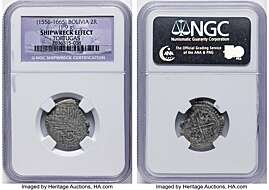
Lote 25031. Bolivia Philip III "Dry Tortugas/Nuestra Señora del Rosario" Cob 2 Reales ND (1598-1603) P-B Shipwreck Effect NGC, Potosi mint, Cal-625. 1.9gm. Salvaged from the "Nuestra Señora del Rosario" (sunk in 1622 off Dry Tortugas, Florida). The Nuestra Señora del Rosario, part of the ill-fated Spanish treasure fleet of 1622, sailed alongside its sister ship, the famous Nuestra Señora de Atocha, carrying immense riches from the Americas back to Spain. Departing Havana on September 4, 1622, the fleet encountered a devastating hurricane in the Florida Keys. The Rosario struck a rock, and survivors clung to it for safety. Spanish salvage operations soon recovered significant portions of the ship's armament and cargo. In 1971, the wreck was rediscovered near Loggerhead Reef, yielding artifacts such as cannons, swivel guns, and silver coins. From "SHIPWRECKED": The Odyssey Marine Collection of Shipwreck Artifacts HID05401242017 © 2026 Heritage Auctions | All Rights Reserved www.HA.com/TexasAuctioneerLicenseNotice
  • Precio de salida:
    1 USD
    0 EUR
    0 GBP
    0 CHF

    Importes redondeados, solo aproximadosFecha: 05/11/2026
Lote
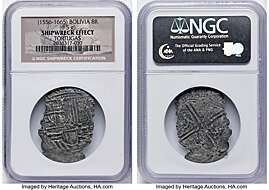
Lote 25032. Bolivia Philip III "Dry Tortugas/Nuestra Señora del Rosario" Cob 8 Reales ND (1598-1618) Mo-F XF (Shipwreck Effect) NGC, Mexico City mint, KM44.3, Cal-Type 162. 6.5gm. Salvaged from the "Nuestra Señora del Rosario" (sunk in 1622 off Dry Tortugas, Florida). The Nuestra Señora del Rosario, part of the ill-fated Spanish treasure fleet of 1622, sailed alongside its sister ship, the famous Nuestra Señora de Atocha, carrying immense riches from the Americas back to Spain. Departing Havana on September 4, 1622, the fleet encountered a devastating hurricane in the Florida Keys. The Rosario struck a rock, and survivors clung to it for safety. Spanish salvage operations soon recovered significant portions of the ship's armament and cargo. In 1971, the wreck was rediscovered near Loggerhead Reef, yielding artifacts such as cannons, swivel guns, and silver coins. From "SHIPWRECKED": The Odyssey Marine Collection of Shipwreck Artifacts HID05401242017 © 2026 Heritage Auctions | All Rights Reserved www.HA.com/TexasAuctioneerLicenseNotice
  • Precio de salida:
    1 USD
    0 EUR
    0 GBP
    0 CHF

    Importes redondeados, solo aproximadosFecha: 05/11/2026
Lote
Lote 25033. Bolivia Philip III "Dry Tortugas/Nuestra Señora del Rosario" Cob 8 Reales ND (1598-1618)-P XF (Shipwreck Effect) NGC, Potosi mint, KM10. 5.7gm. Salvaged from the "Nuestra Señora del Rosario" (sunk in 1622 off Dry Tortugas, Florida). The Nuestra Señora del Rosario, part of the ill-fated Spanish treasure fleet of 1622, sailed alongside its sister ship, the famous Nuestra Señora de Atocha, carrying immense riches from the Americas back to Spain. Departing Havana on September 4, 1622, the fleet encountered a devastating hurricane in the Florida Keys. The Rosario struck a rock, and survivors clung to it for safety. Spanish salvage operations soon recovered significant portions of the ship's armament and cargo. In 1971, the wreck was rediscovered near Loggerhead Reef, yielding artifacts such as cannons, swivel guns, and silver coins. From "SHIPWRECKED": The Odyssey Marine Collection of Shipwreck Artifacts HID05401242017 © 2026 Heritage Auctions | All Rights Reserved www.HA.com/TexasAuctioneerLicenseNotice
  • Precio de salida:
    1 USD
    0 EUR
    0 GBP
    0 CHF

    Importes redondeados, solo aproximadosFecha: 05/11/2026
Lote
Lote 25034. Mexico Philip II "Dry Tortugas/Nuestra Señora del Rosario" Cob Real (1572-1589) Mo-O Shipwreck Effect NGC, Mexico City mint, Cal-224. 1.3gm. Salvaged from the "Nuestra Señora del Rosario" (sunk in 1622 off Dry Tortugas, Florida). The Nuestra Señora del Rosario, part of the ill-fated Spanish treasure fleet of 1622, sailed alongside its sister ship, the famous Nuestra Señora de Atocha, carrying immense riches from the Americas back to Spain. Departing Havana on September 4, 1622, the fleet encountered a devastating hurricane in the Florida Keys. The Rosario struck a rock, and survivors clung to it for safety. Spanish salvage operations soon recovered significant portions of the ship's armament and cargo. In 1971, the wreck was rediscovered near Loggerhead Reef, yielding artifacts such as cannons, swivel guns, and silver coins. From "SHIPWRECKED": The Odyssey Marine Collection of Shipwreck Artifacts HID05401242017 © 2026 Heritage Auctions | All Rights Reserved www.HA.com/TexasAuctioneerLicenseNotice
  • Precio de salida:
    1 USD
    0 EUR
    0 GBP
    0 CHF

    Importes redondeados, solo aproximadosFecha: 05/11/2026
Lote
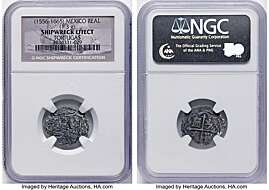
Lote 25035. Mexico Philip III "Dry Tortugas/Nuestra Señora del Rosario" Cob Real ND (1598-1696) Mo-F Shipwreck Effect NGC, Mexico City mint, KM27.2, Cal-Type 102. 3.1gm. Salvaged from the "Nuestra Señora del Rosario" (sunk in 1622 off Dry Tortugas, Florida). GRATIA in legend, undated type. The Nuestra Señora del Rosario, part of the ill-fated Spanish treasure fleet of 1622, sailed alongside its sister ship, the famous Nuestra Señora de Atocha, carrying immense riches from the Americas back to Spain. Departing Havana on September 4, 1622, the fleet encountered a devastating hurricane in the Florida Keys. The Rosario struck a rock, and survivors clung to it for safety. Spanish salvage operations soon recovered significant portions of the ship's armament and cargo. In 1971, the wreck was rediscovered near Loggerhead Reef, yielding artifacts such as cannons, swivel guns, and silver coins. From "SHIPWRECKED": The Odyssey Marine Collection of Shipwreck Artifacts HID05401242017 © 2026 Heritage Auctions | All Rights Reserved www.HA.com/TexasAuctioneerLicenseNotice
  • Precio de salida:
    1 USD
    0 EUR
    0 GBP
    0 CHF

    Importes redondeados, solo aproximadosFecha: 05/11/2026
Lote
Lote 25036. Mexico Philip III "Dry Tortugas/Nuestra Señora del Rosario" Cob 2 Reales ND (1598-1606) Shipwreck Effect NGC, Mexico City mint, KM32.2, Cal-Type 125. 2.4gm. Salvaged from the "Nuestra Señora del Rosario" (sunk in 1622 off Dry Tortugas, Florida). GRATIA in legend, undated type. The Nuestra Señora del Rosario, part of the ill-fated Spanish treasure fleet of 1622, sailed alongside its sister ship, the famous Nuestra Señora de Atocha, carrying immense riches from the Americas back to Spain. Departing Havana on September 4, 1622, the fleet encountered a devastating hurricane in the Florida Keys. The Rosario struck a rock, and survivors clung to it for safety. Spanish salvage operations soon recovered significant portions of the ship's armament and cargo. In 1971, the wreck was rediscovered near Loggerhead Reef, yielding artifacts such as cannons, swivel guns, and silver coins. From "SHIPWRECKED": The Odyssey Marine Collection of Shipwreck Artifacts HID05401242017 © 2026 Heritage Auctions | All Rights Reserved www.HA.com/TexasAuctioneerLicenseNotice
  • Precio de salida:
    1 USD
    0 EUR
    0 GBP
    0 CHF

    Importes redondeados, solo aproximadosFecha: 05/11/2026
Lote
Lote 25037. World Lots Philip II "Dry Tortugas/Nuestra Señora del Rosario" Pair of Clay Pipes ND (1600's), Salvaged from the "Nuestra Señora del Rosario" (sunk in 1622 off Dry Tortugas, Florida). The Nuestra Señora del Rosario, part of the ill-fated Spanish treasure fleet of 1622, sailed alongside its sister ship, the famous Nuestra Señora de Atocha, carrying immense riches from the Americas back to Spain. Departing Havana on September 4, 1622, the fleet encountered a devastating hurricane in the Florida Keys. The Rosario struck a rock, and survivors clung to it for safety. Spanish salvage operations soon recovered significant portions of the ship's armament and cargo. In 1971, the wreck was rediscovered near Loggerhead Reef, yielding artifacts such as cannons, swivel guns, and silver coins. From "SHIPWRECKED": The Odyssey Marine Collection of Shipwreck Artifacts HID05401242017 © 2026 Heritage Auctions | All Rights Reserved www.HA.com/TexasAuctioneerLicenseNotice
  • Precio de salida:
    1 USD
    0 EUR
    0 GBP
    0 CHF

    Importes redondeados, solo aproximadosFecha: 05/11/2026
Lote
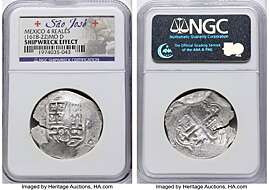
Lote 25038. Mexico Philip III "São José" Cob 4 Reales ND (1618-1621) Mo-D Shipwreck Effect NGC, Mexico City mint, KM37.2. Accompanied by COA. Salvaged from the "São José" (sunk in 1622 off Mozambique, Africa). In 1622, the galleon São José hushed to Goa, India, due to reports that the British were planning on taking the strategic Hormuz island. Francisco da Gama, the great-grandson of explorer Vasco da Gama (the first European to reach India by sea) was in charge of the precious cargo which counted with thousands of silver Reales. When sailing the Mozambique channel, the fleet was attacked by Dutch and British East India Company ships, cutting the Sao Jose off and "firing more shots than in any other battle ever fought in the Indian Ocean". With many of the crew ill or deceased, the São José tried to escape--something highly unusual for the feared Portuguese naval vessels--but ended ripping its rudder on a reef. The enemy reportedly managed to pillage 66,000 Spanish Reales from the cargo, with the rest of cargo and crew sinking to the bottom of the seas. Located in 2005 by the Portuguese marine archeology company "Arqueonautas", the São José has since provided over 24,000 Silver Reales. HID05401242017 © 2026 Heritage Auctions | All Rights Reserved www.HA.com/TexasAuctioneerLicenseNotice
  • Precio de salida:
    1 USD
    0 EUR
    0 GBP
    0 CHF

    Importes redondeados, solo aproximadosFecha: 05/11/2026
Lote
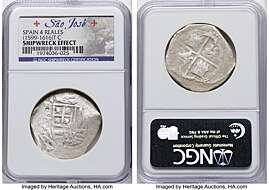
Lote 25039. Spain Philip III "São José" Cob 4 Reales ND (1599-1616) To-C Shipwreck Effect NGC, Toledo mint. Accompanied by COA. Salvaged from the "São José" (sunk in 1622 off Mozambique, Africa). In 1622, the galleon São José hushed to Goa, India, due to reports that the British were planning on taking the strategic Hormuz island. Francisco da Gama, the great-grandson of explorer Vasco da Gama (the first European to reach India by sea) was in charge of the precious cargo which counted with thousands of silver Reales. When sailing the Mozambique channel, the fleet was attacked by Dutch and British East India Company ships, cutting the Sao Jose off and "firing more shots than in any other battle ever fought in the Indian Ocean". With many of the crew ill or deceased, the São José tried to escape--something highly unusual for the feared Portuguese naval vessels--but ended ripping its rudder on a reef. The enemy reportedly managed to pillage 66,000 Spanish Reales from the cargo, with the rest of cargo and crew sinking to the bottom of the seas. Located in 2005 by the Portuguese marine archeology company "Arqueonautas", the São José has since provided over 24,000 Silver Reales. HID05401242017 © 2026 Heritage Auctions | All Rights Reserved www.HA.com/TexasAuctioneerLicenseNotice
  • Precio de salida:
    1 USD
    0 EUR
    0 GBP
    0 CHF

    Importes redondeados, solo aproximadosFecha: 05/11/2026
Lote
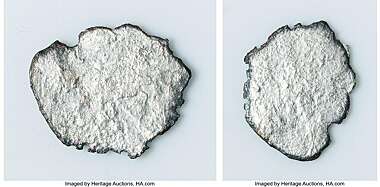
Lote 25040. World Lots "San Jose" Cob Real Fragment ND (Shipwreck Effect), 1.2gm. Accompanied by COA. Savaged from the "San Jose" (sunk in 1631 off Panama). The San José was a part of a fleet of ships that was loaded down with silver bars and coins from Potosi to bring back to Spain in 1631. The usual route was to sail from Callao, Peru, to the isthmus at Panama, take the cargo overland, and reload the ship before setting off again. On its 2-3 week journey from Peru to Panama with some 51 tons of silver in its holds, the San José struck a rock outcropping thanks to high tides and strong currents. While initial recovery efforts may have yielded some of the cargo, the vast majority of the treasure was lost somewhere along the forty miles from where it initially crashed and where the other ships in the fleet led its upper decks for salvaging. It was found and salvaged in 2013. HID05401242017 © 2026 Heritage Auctions | All Rights Reserved www.HA.com/TexasAuctioneerLicenseNotice
  • Precio de salida:
    1 USD
    0 EUR
    0 GBP
    0 CHF

    Importes redondeados, solo aproximadosFecha: 05/11/2026
Lote
Lote 25041. Mexico Philip IV "Concepción" Cob 4 Reales ND (1622-1640) Mo-D XF (Shipwreck Effect), Mexico City mint, KM37.2, Cal-Type 275. 11.16gm. Accompanied by tag. Salvaged from the "Concepción" (sunk in 1641 off Puerto Plata, Dominican Republic). The Nuestra Señora de La Pura y Limpia Concepción, part of a Spanish treasure fleet, sank in 1641 after two attempts of transporting immense treasure back to Spain. The ship was already in poor condition when it departed from Havana, Cuba, after a failed attempt the week before where it encountered storms that left the ship badly damaged. Loaded with both New World silver and treasures from the Orient, such as indigo, silks, spices, porcelain, and jade that had been sent on Manila galleons to Acapulco on the Pacific side of New Spain (present day Mexico), the Concepcion set sail once again bound to Spain. After encountering a powerful hurricane, the ship drifted for weeks, until running on the reefs of Hispañola, the present day Dominican Republic. Rumors of a vast Spanish treasure lost on a remote reef circulated throughout the Caribbean and made its way to the English colonies in the Americas. In 1687, Captain William Phipps, who would later become the governor of Massachusetts, discovered and salvaged part of Concepcion's treasure. The shipwreck was re-discovered in 1978, with thousands of coins recovered and incredible artifacts that made their way to the Dominican Republic National Museums Casas Reales and Faro Colon in Santo Domingo. HID05401242017 © 2026 Heritage Auctions | All Rights Reserved www.HA.com/TexasAuctioneerLicenseNotice
  • Precio de salida:
    1 USD
    0 EUR
    0 GBP
    0 CHF

    Importes redondeados, solo aproximadosFecha: 05/11/2026
Lote
Lote 25042. World Lots "Concepción" silver Splash of 119gm ND (c. 1600's), 119.5gm. Salvaged from the "Concepción" (sunk in 1641 off Puerto Plata, Dominican Republic). Also known as "silver splash", Plata Corriente translates to "Running Silver", which was quite literally the precious metal in circulation in the early days of Colonization. These bits vary in size and form, some consisting of pieces chopped from large ingots/bars, while other are bits of smelter splatter which would be picked up in the assaying process. The piece in question shows no stamps, which can indicate being contraband smuggled in the ship. The Nuestra Señora de La Pura y Limpia Concepción, part of a Spanish treasure fleet, sank in 1641 after two attempts of transporting immense treasure back to Spain. The ship was already in poor condition when it departed from Havana, Cuba, after a failed attempt the week before where it encountered storms that left the ship badly damaged. Loaded with both New World silver and treasures from the Orient, such as indigo, silks, spices, porcelain, and jade that had been sent on Manila galleons to Acapulco on the Pacific side of New Spain (present day Mexico), the Concepcion set sail once again bound to Spain. After encountering a powerful hurricane, the ship drifted for weeks, until running on the reefs of Hispañola, the present day Dominican Republic. Rumors of a vast Spanish treasure lost on a remote reef circulated throughout the Caribbean and made its way to the English colonies in the Americas. In 1687, Captain William Phipps, who would later become the governor of Massachusetts, discovered and salvaged part of Concepcion's treasure. The shipwreck was re-discovered in 1978, with thousands of coins recovered and incredible artifacts that made their way to the Dominican Republic National Museums Casas Reales and Faro Colon in Santo Domingo. HID05401242017 © 2026 Heritage Auctions | All Rights Reserved www.HA.com/TexasAuctioneerLicenseNotice
  • Precio de salida:
    1 USD
    0 EUR
    0 GBP
    0 CHF

    Importes redondeados, solo aproximadosFecha: 05/11/2026
Lote
Lote 25043. Mexico Philip IV "Joanna" Cob 8 Reales ND (1634-1666) Mo-P VF Details (Sea Salvaged) NGC, Mexico City mint, KM45, Cal-Type 319. 18.60gm. Salvaged from the "Joanna" (sunk in 1682 off South Africa). The East Indiaman ship "Joanna" was on its way to Surat, India, when got separated from the convoy and sunk off South Africa in 1682. It carried 70 chests of silver, of which only the equivalent of about 28,000 Guilders could be contemporaneously recovered. Rediscovered in the 1980's, the wreck has produced thousands of Mexican Cobs, usually with surface corrosion but some with rare dates from the reign of Charles II. HID05401242017 © 2026 Heritage Auctions | All Rights Reserved www.HA.com/TexasAuctioneerLicenseNotice
  • Precio de salida:
    1 USD
    0 EUR
    0 GBP
    0 CHF

    Importes redondeados, solo aproximadosFecha: 05/11/2026
Lote
Lote 25044. Mexico Charles II "Joanna" Cob 4 Reales ND (1665-1682)-Mo Sea Salvaged NGC, Mexico City mint, KM39. Salvaged from the "Joanna" (sunk in 1682 off South Africa). The East Indiaman ship "Joanna" was on its way to Surat, India, when got separated from the convoy and sunk off South Africa in 1682. It carried 70 chests of silver, of which only the equivalent of about 28,000 Guilders could be contemporaneously recovered. Rediscovered in the 1980's, the wreck has produced thousands of Mexican Cobs, usually with surface corrosion but some with rare dates from the reign of Charles II. HID05401242017 © 2026 Heritage Auctions | All Rights Reserved www.HA.com/TexasAuctioneerLicenseNotice
  • Precio de salida:
    1 USD
    0 EUR
    0 GBP
    0 CHF

    Importes redondeados, solo aproximadosFecha: 05/11/2026
Lote
Lote 25045. Mexico Charles II "Joanna" Cob 4 Reales ND (1665-1682)-Mo Sea Salvaged NGC, Mexico City mint, KM39. Salvaged from the "Joanna" (sunk in 1682 off South Africa). Presenting a very interesting shape, as made. The East Indiaman ship "Joanna" was on its way to Surat, India, when got separated from the convoy and sunk off South Africa in 1682. It carried 70 chests of silver, of which only the equivalent of about 28,000 Guilders could be contemporaneously recovered. Rediscovered in the 1980's, the wreck has produced thousands of Mexican Cobs, usually with surface corrosion but some with rare dates from the reign of Charles II. HID05401242017 © 2026 Heritage Auctions | All Rights Reserved www.HA.com/TexasAuctioneerLicenseNotice
  • Precio de salida:
    1 USD
    0 EUR
    0 GBP
    0 CHF

    Importes redondeados, solo aproximadosFecha: 05/11/2026
Lote
Lote 25046. Mexico Charles II "Joanna" Cob 4 Reales ND (1665-1682)-Mo Sea Salvaged NGC, Mexico City mint, KM39. Salvaged from the "Joanna" (sunk in 1682 off South Africa). The East Indiaman ship "Joanna" was on its way to Surat, India, when got separated from the convoy and sunk off South Africa in 1682. It carried 70 chests of silver, of which only the equivalent of about 28,000 Guilders could be contemporaneously recovered. Rediscovered in the 1980's, the wreck has produced thousands of Mexican Cobs, usually with surface corrosion but some with rare dates from the reign of Charles II. HID05401242017 © 2026 Heritage Auctions | All Rights Reserved www.HA.com/TexasAuctioneerLicenseNotice
  • Precio de salida:
    1 USD
    0 EUR
    0 GBP
    0 CHF

    Importes redondeados, solo aproximadosFecha: 05/11/2026
Lote
Lote 25047. Mexico Charles II "Joanna" Cob 8 Reales ND (1668-1682)-Mo Sea Salvaged NGC, Mexico City mint, KM46. Salvaged from the "Joanna" (sunk in 1682 off South Africa). Presenting a very interesting shape, as made. The East Indiaman ship "Joanna" was on its way to Surat, India, when got separated from the convoy and sunk off South Africa in 1682. It carried 70 chests of silver, of which only the equivalent of about 28,000 Guilders could be contemporaneously recovered. Rediscovered in the 1980's, the wreck has produced thousands of Mexican Cobs, usually with surface corrosion but some with rare dates from the reign of Charles II. HID05401242017 © 2026 Heritage Auctions | All Rights Reserved www.HA.com/TexasAuctioneerLicenseNotice
  • Precio de salida:
    1 USD
    0 EUR
    0 GBP
    0 CHF

    Importes redondeados, solo aproximadosFecha: 05/11/2026
Lote
Lote 25048. Mexico Charles II "Joanna" Cob 8 Reales ND (1668-1682)-Mo Sea Salvaged NGC, Mexico City mint, KM46. 17.36gm. Salvaged from the "Joanna" (sunk in 1682 off South Africa). The East Indiaman ship "Joanna" was on its way to Surat, India, when got separated from the convoy and sunk off South Africa in 1682. It carried 70 chests of silver, of which only the equivalent of about 28,000 Guilders could be contemporaneously recovered. Rediscovered in the 1980's, the wreck has produced thousands of Mexican Cobs, usually with surface corrosion but some with rare dates from the reign of Charles II. HID05401242017 © 2026 Heritage Auctions | All Rights Reserved www.HA.com/TexasAuctioneerLicenseNotice
  • Precio de salida:
    1 USD
    0 EUR
    0 GBP
    0 CHF

    Importes redondeados, solo aproximadosFecha: 05/11/2026
Lote
Lote 25049. Mexico Charles II "Joanna" Cob 8 Reales ND (1668-1682)-Mo Sea Salvaged NGC, Mexico City mint, KM46. 17.23gm. Salvaged from the "Joanna" (sunk in 1682 off South Africa). Neat shape, as made. The East Indiaman ship "Joanna" was on its way to Surat, India, when got separated from the convoy and sunk off South Africa in 1682. It carried 70 chests of silver, of which only the equivalent of about 28,000 Guilders could be contemporaneously recovered. Rediscovered in the 1980's, the wreck has produced thousands of Mexican Cobs, usually with surface corrosion but some with rare dates from the reign of Charles II. HID05401242017 © 2026 Heritage Auctions | All Rights Reserved www.HA.com/TexasAuctioneerLicenseNotice
  • Precio de salida:
    1 USD
    0 EUR
    0 GBP
    0 CHF

    Importes redondeados, solo aproximadosFecha: 05/11/2026
Lote
Lote 25050. Mexico Charles II "Joanna" Cob 8 Reales ND (1668-1682)-Mo Sea Salvaged NGC, Mexico City mint, KM46. 13.55gm. Salvaged from the "Joanna" (sunk in 1682 off South Africa). The East Indiaman ship "Joanna" was on its way to Surat, India, when got separated from the convoy and sunk off South Africa in 1682. It carried 70 chests of silver, of which only the equivalent of about 28,000 Guilders could be contemporaneously recovered. Rediscovered in the 1980's, the wreck has produced thousands of Mexican Cobs, usually with surface corrosion but some with rare dates from the reign of Charles II. HID05401242017 © 2026 Heritage Auctions | All Rights Reserved www.HA.com/TexasAuctioneerLicenseNotice
  • Precio de salida:
    1 USD
    0 EUR
    0 GBP
    0 CHF

    Importes redondeados, solo aproximadosFecha: 05/11/2026
Lote
Lote 25051. Great Britain Charles II "Association" 1/2 Crown 1671 VF Details (Saltwater Damage) NGC, KM428.5, S-3366. Salvaged from the Association (sunk in 1707 off the isles of Scilly, England). The H.M.S. Association was a British warship that met its demise in the Scilly naval disaster of October 1707. Upon returning from the Mediterranean after its participation in the Toulon campaign, amidst the war of the Spanish Succession, severe weather sunk 4 out of the 21-ship Royal Navy fleet off the Isles of Scilly. This claimed the lives of approximately 1,400-2,000 sailors, making this incident one of the worst maritime disasters in British naval history. Salvaging began in the 1960's, recovering a plethora of artifacts and over 2,000 gold and silver coins. The quantity of salvaged historical artifacts led to the passing of government legislation, specifically the Protection of Wrecks Act 1973, to preserve British historical wrecks as a part of maritime heritage. HID05401242017 © 2026 Heritage Auctions | All Rights Reserved www.HA.com/TexasAuctioneerLicenseNotice
  • Precio de salida:
    1 USD
    0 EUR
    0 GBP
    0 CHF

    Importes redondeados, solo aproximadosFecha: 05/11/2026
Lote
Lote 25052. Great Britain "Association" 1/2 Crown Encrusted, 13.29gm. Accompanied by COA. Salvaged from the Association (sunk in 1707 off the isles of Scilly, England). The H.M.S. Association was a British warship that met its demise in the Scilly naval disaster of October 1707. Upon returning from the Mediterranean after its participation in the Toulon campaign, amidst the war of the Spanish Succession, severe weather sunk 4 out of the 21-ship Royal Navy fleet off the Isles of Scilly. This claimed the lives of approximately 1,400-2,000 sailors, making this incident one of the worst maritime disasters in British naval history. Salvaging began in the 1960's, recovering a plethora of artifacts and over 2,000 gold and silver coins. The quantity of salvaged historical artifacts led to the passing of government legislation, specifically the Protection of Wrecks Act 1973, to preserve British historical wrecks as a part of maritime heritage. HID05401242017 © 2026 Heritage Auctions | All Rights Reserved www.HA.com/TexasAuctioneerLicenseNotice
  • Precio de salida:
    1 USD
    0 EUR
    0 GBP
    0 CHF

    Importes redondeados, solo aproximadosFecha: 05/11/2026
Lote
Lote 25053. Mexico Charles II "H.M.S. Association" Cob 4 Reales ND (1665-1700) VF (Shipwreck Effect), Mexico City mint, KM39. 7.55gm. Salvaged from the "Association" (sunk in 1707 off the isles of Scilly, England). Ex. Sedwick Auction 33 (May 2023, Lot 293); Sotheby's Auction (January 1970, Lot 161 (part of) The H.M.S. Association was a British warship that met its demise in the Scilly naval disaster of October 1707. Upon returning from the Mediterranean after its participation in the Toulon campaign, amidst the war of the Spanish Succession, severe weather sunk 4 out of the 21-ship Royal Navy fleet off the Isles of Scilly. This claimed the lives of approximately 1,400-2,000 sailors, making this incident one of the worst maritime disasters in British naval history. Salvaging began in the 1960's, recovering a plethora of artifacts and over 2,000 gold and silver coins. The quantity of salvaged historical artifacts led to the passing of government legislation, specifically the Protection of Wrecks Act 1973, to preserve British historical wrecks as a part of maritime heritage. HID05401242017 © 2026 Heritage Auctions | All Rights Reserved www.HA.com/TexasAuctioneerLicenseNotice
  • Precio de salida:
    1 USD
    0 EUR
    0 GBP
    0 CHF

    Importes redondeados, solo aproximadosFecha: 05/11/2026
Lote
Lote 25054. World Lots Multi-Coin "Association" Shipwreck Clump, Total weight: 153gm. Accompanied by photo-certificate #7209. Salvaged from the Association (sunk in 1707 off the isles of Scilly, England). A charming and hefty clump counting with a Mexican 1/2 Real Cob and two English Shillings, plus 3 visible musket balls. The H.M.S. Association was a British warship that met its demise in the Scilly naval disaster of October 1707. Upon returning from the Mediterranean after its participation in the Toulon campaign, amidst the war of the Spanish Succession, severe weather sunk 4 out of the 21-ship Royal Navy fleet off the Isles of Scilly. This claimed the lives of approximately 1,400-2,000 sailors, making this incident one of the worst maritime disasters in British naval history. Salvaging began in the 1960's, recovering a plethora of artifacts and over 2,000 gold and silver coins. The quantity of salvaged historical artifacts led to the passing of government legislation, specifically the Protection of Wrecks Act 1973, to preserve British historical wrecks as a part of maritime heritage. HID05401242017 © 2026 Heritage Auctions | All Rights Reserved www.HA.com/TexasAuctioneerLicenseNotice
  • Precio de salida:
    1 USD
    0 EUR
    0 GBP
    0 CHF

    Importes redondeados, solo aproximadosFecha: 05/11/2026
Lote
Lote 25055. Netherlands Gelderland. Provincial "Merestein" Ducaton (Silver Rider) ND (1670-1679) Genuine NGC, KM41.1 (Dog), Dav-4923. Salvaged from the "Merestein" (sunk in 1702 off Jutten Island, South Africa). The Dutch East Indiaman Merestein was loaded with several chests of silver coins for trade in the East Indies when a reef off Jutten Island torn the ship into pieces. Contemporary salvaging wasn't fruitful, the wreck later re-discovered and salvaged in the 1970's when thousands of Dutch silver coins were retrieved, with much of the treasure yet to be found. HID05401242017 © 2026 Heritage Auctions | All Rights Reserved www.HA.com/TexasAuctioneerLicenseNotice
  • Precio de salida:
    1 USD
    0 EUR
    0 GBP
    0 CHF

    Importes redondeados, solo aproximadosFecha: 05/11/2026
Lote
Lote 25056. Netherlands Utrecht. "Merestein" Provincial Ducaton 1679 VF Details (Saltwater Damage) NGC, KM63, Dav-4938. Salvaged from the "Merestein" (sunk in 1702 off Jutten Island, South Africa). The Dutch East Indiaman Merestein was loaded with several chests of silver coins for trade in the East Indies when a reef off Jutten Island torn the ship into pieces. Contemporary salvaging wasn't fruitful, the wreck later re-discovered and salvaged in the 1970's when thousands of Dutch silver coins were retrieved, with much of the treasure yet to be found. HID05401242017 © 2026 Heritage Auctions | All Rights Reserved www.HA.com/TexasAuctioneerLicenseNotice
  • Precio de salida:
    1 USD
    0 EUR
    0 GBP
    0 CHF

    Importes redondeados, solo aproximadosFecha: 05/11/2026
Lote
Lote 25057. Netherlands Zwolle. Matthias I "Merestein" 6 Stuivers (Arendschelling) ND (1613-1618) XF (Shipwreck Effect), Zwolle mint, KM16. 4.03gm. Salvaged from the "Merestein" (sunk in 1702 off Jutten Island, South Africa). The Dutch East Indiaman Merestein was loaded with several chests of silver coins for trade in the East Indies when a reef off Jutten Island torn the ship into pieces. Contemporary salvaging wasn't fruitful, the wreck later re-discovered and salvaged in the 1970's when thousands of Dutch silver coins were retrieved, with much of the treasure yet to be found. HID05401242017 © 2026 Heritage Auctions | All Rights Reserved www.HA.com/TexasAuctioneerLicenseNotice
  • Precio de salida:
    1 USD
    0 EUR
    0 GBP
    0 CHF

    Importes redondeados, solo aproximadosFecha: 05/11/2026
Lote
Lote 25058. Mexico Charles II "1715 Fleet" Cob 8 Reales ND (1678-1701)-Mo VG10 NGC, Mexico City mint, KM46, Cal-Type 108. 26.81gm. Accompanied by COA. Salvaged from the "1715 Fleet" (Sunk off Florida's Treasure Coast). On July 30th, 1715, a Spanish treasure fleet, which would later be famously known as the 1715 Fleet, encountered a hurricane that claimed a sizable portion of its galleons and crew. A reported 1,000 lives and 14 million pesos were lost, including an equal amount of treasure in contraband. It's hard to estimate the value lost when measured in today's currency, but one can imagine the extensive caliber of cargo when considering the convoy was a combination of two different fleets: the Nueva España Fleet, which got stuck in Veracruz for two years before it could join the Tierra Firme Fleet. After more delays in Havana, a 12-13 ship convoy left with an enormous amount of accumulated cargo, never to reach Spain. The Spaniards salvaged the wreck for a few years afterwards, recovering nearly half of the official cargo from shallow-water wreck sites. Modern salvaging began when Florida resident Kip Wagner found a "piece of eight" at a beach after a hurricane and was intrigued by its origins. With old maps, metal detectors, a small plane, and a permit from the state of Florida, Wagner located wreck sites and artifacts, ultimately putting together a team of archeologists, divers, and investors. This was the beginning of the Real Eight Company. As the Real Eight team combed the seabed with suction machines, they found jewels, emeralds, Chinese porcelain, silverware, and gold & silver ingots. Furthermore, they found as many as 10,000 gold Cobs and over 100,000 silver Cobs. These huge discoveries uncovered yet-unknown numismatic pieces and ultimately made rare gold Cobs "common" (though still very high-end for collectors). The salvaged coins were mainly from Mexico, Colombia, Peru, and Bolivia, minted primarily between 1711 and 1715, although numerous earlier pieces from the 1600's were also recovered. As modern salvaging continues in these underwater sites, we expect many more exciting discoveries to be made, including the recovery of the last five or six ships that have yet to be found. HID05401242017 © 2026 Heritage Auctions | All Rights Reserved www.HA.com/TexasAuctioneerLicenseNotice
  • Precio de salida:
    1 USD
    0 EUR
    0 GBP
    0 CHF

    Importes redondeados, solo aproximadosFecha: 05/11/2026
Lote
Lote 25059. Mexico Philip V "1715 Fleet" Cob Real ND (1701-1715) VF (Shipwreck Effect), Mexico City mint, KM30. 0.78gm. Accompanied by Sedwick tag. Salvaged from the "1715 Fleet" (Sunk off Florida's Treasure Coast). On July 30th, 1715, a Spanish treasure fleet, which would later be famously known as the 1715 Fleet, encountered a hurricane that claimed a sizable portion of its galleons and crew. A reported 1,000 lives and 14 million pesos were lost, including an equal amount of treasure in contraband. It's hard to estimate the value lost when measured in today's currency, but one can imagine the extensive caliber of cargo when considering the convoy was a combination of two different fleets: the Nueva España Fleet, which got stuck in Veracruz for two years before it could join the Tierra Firme Fleet. After more delays in Havana, a 12-13 ship convoy left with an enormous amount of accumulated cargo, never to reach Spain. The Spaniards salvaged the wreck for a few years afterwards, recovering nearly half of the official cargo from shallow-water wreck sites. Modern salvaging began when Florida resident Kip Wagner found a "piece of eight" at a beach after a hurricane and was intrigued by its origins. With old maps, metal detectors, a small plane, and a permit from the state of Florida, Wagner located wreck sites and artifacts, ultimately putting together a team of archeologists, divers, and investors. This was the beginning of the Real Eight Company. As the Real Eight team combed the seabed with suction machines, they found jewels, emeralds, Chinese porcelain, silverware, and gold & silver ingots. Furthermore, they found as many as 10,000 gold Cobs and over 100,000 silver Cobs. These huge discoveries uncovered yet-unknown numismatic pieces and ultimately made rare gold Cobs "common" (though still very high-end for collectors). The salvaged coins were mainly from Mexico, Colombia, Peru, and Bolivia, minted primarily between 1711 and 1715, although numerous earlier pieces from the 1600's were also recovered. As modern salvaging continues in these underwater sites, we expect many more exciting discoveries to be made, including the recovery of the last five or six ships that have yet to be found. HID05401242017 © 2026 Heritage Auctions | All Rights Reserved www.HA.com/TexasAuctioneerLicenseNotice
  • Precio de salida:
    1 USD
    0 EUR
    0 GBP
    0 CHF

    Importes redondeados, solo aproximadosFecha: 05/11/2026
Lote
Lote 25060. Mexico Philip V "1715 Fleet" Cob 8 Reales 1713 Mo-J XF (Shipwreck Effect), Mexico City mint, KM47, Cal-1400. 24.90gm. Mexico City mint, KM47, Cal-Type 170. 26.13gm. Accompanied by COA. Salvaged from the "1715 Fleet" (Sunk off Florida's Treasure Coast). A seldom-seen date. On July 30th, 1715, a Spanish treasure fleet, which would later be famously known as the 1715 Fleet, encountered a hurricane that claimed a sizable portion of its galleons and crew. A reported 1,000 lives and 14 million pesos were lost, including an equal amount of treasure in contraband. It's hard to estimate the value lost when measured in today's currency, but one can imagine the extensive caliber of cargo when considering the convoy was a combination of two different fleets: the Nueva España Fleet, which got stuck in Veracruz for two years before it could join the Tierra Firme Fleet. After more delays in Havana, a 12-13 ship convoy left with an enormous amount of accumulated cargo, never to reach Spain. The Spaniards salvaged the wreck for a few years afterwards, recovering nearly half of the official cargo from shallow-water wreck sites. Modern salvaging began when Florida resident Kip Wagner found a "piece of eight" at a beach after a hurricane and was intrigued by its origins. With old maps, metal detectors, a small plane, and a permit from the state of Florida, Wagner located wreck sites and artifacts, ultimately putting together a team of archeologists, divers, and investors. This was the beginning of the Real Eight Company. As the Real Eight team combed the seabed with suction machines, they found jewels, emeralds, Chinese porcelain, silverware, and gold & silver ingots. Furthermore, they found as many as 10,000 gold Cobs and over 100,000 silver Cobs. These huge discoveries uncovered yet-unknown numismatic pieces and ultimately made rare gold Cobs "common" (though still very high-end for collectors). The salvaged coins were mainly from Mexico, Colombia, Peru, and Bolivia, minted primarily between 1711 and 1715, although numerous earlier pieces from the 1600's were also recovered. As modern salvaging continues in these underwater sites, we expect many more exciting discoveries to be made, including the recovery of the last five or six ships that have yet to be found. HID05401242017 © 2026 Heritage Auctions | All Rights Reserved www.HA.com/TexasAuctioneerLicenseNotice
  • Precio de salida:
    1 USD
    0 EUR
    0 GBP
    0 CHF

    Importes redondeados, solo aproximadosFecha: 05/11/2026
Lote
Lote 25061. Mexico Philip V "1715 Fleet" Cob 8 Reales 1714 Mo-J VG Details (Saltwater Damage) NGC, Mexico City mint, KM47, Cal-1401. 20.42gm. Salvaged from the "1715 Fleet" (Sunk off Florida's Treasure Coast). With a faint but discernible date. On July 30th, 1715, a Spanish treasure fleet, which would later be famously known as the 1715 Fleet, encountered a hurricane that claimed a sizable portion of its galleons and crew. A reported 1,000 lives and 14 million pesos were lost, including an equal amount of treasure in contraband. It's hard to estimate the value lost when measured in today's currency, but one can imagine the extensive caliber of cargo when considering the convoy was a combination of two different fleets: the Nueva España Fleet, which got stuck in Veracruz for two years before it could join the Tierra Firme Fleet. After more delays in Havana, a 12-13 ship convoy left with an enormous amount of accumulated cargo, never to reach Spain. The Spaniards salvaged the wreck for a few years afterwards, recovering nearly half of the official cargo from shallow-water wreck sites. Modern salvaging began when Florida resident Kip Wagner found a "piece of eight" at a beach after a hurricane and was intrigued by its origins. With old maps, metal detectors, a small plane, and a permit from the state of Florida, Wagner located wreck sites and artifacts, ultimately putting together a team of archeologists, divers, and investors. This was the beginning of the Real Eight Company. As the Real Eight team combed the seabed with suction machines, they found jewels, emeralds, Chinese porcelain, silverware, and gold & silver ingots. Furthermore, they found as many as 10,000 gold Cobs and over 100,000 silver Cobs. These huge discoveries uncovered yet-unknown numismatic pieces and ultimately made rare gold Cobs "common" (though still very high-end for collectors). The salvaged coins were mainly from Mexico, Colombia, Peru, and Bolivia, minted primarily between 1711 and 1715, although numerous earlier pieces from the 1600's were also recovered. As modern salvaging continues in these underwater sites, we expect many more exciting discoveries to be made, including the recovery of the last five or six ships that have yet to be found. HID05401242017 © 2026 Heritage Auctions | All Rights Reserved www.HA.com/TexasAuctioneerLicenseNotice
  • Precio de salida:
    1 USD
    0 EUR
    0 GBP
    0 CHF

    Importes redondeados, solo aproximadosFecha: 05/11/2026
Lote
Lote 25062. Mexico Philip V "1715 Fleet" Cob 8 Reales 1714 Mo-J Fine Details (Saltwater Damage) NGC, Mexico City mint, KM47, Cal-1401. 25.29gm. Salvaged from the "1715 Fleet" (Sunk off Florida's Treasure Coast). A coveted dated Fleet Cob. On July 30th, 1715, a Spanish treasure fleet, which would later be famously known as the 1715 Fleet, encountered a hurricane that claimed a sizable portion of its galleons and crew. A reported 1,000 lives and 14 million pesos were lost, including an equal amount of treasure in contraband. It's hard to estimate the value lost when measured in today's currency, but one can imagine the extensive caliber of cargo when considering the convoy was a combination of two different fleets: the Nueva España Fleet, which got stuck in Veracruz for two years before it could join the Tierra Firme Fleet. After more delays in Havana, a 12-13 ship convoy left with an enormous amount of accumulated cargo, never to reach Spain. The Spaniards salvaged the wreck for a few years afterwards, recovering nearly half of the official cargo from shallow-water wreck sites. Modern salvaging began when Florida resident Kip Wagner found a "piece of eight" at a beach after a hurricane and was intrigued by its origins. With old maps, metal detectors, a small plane, and a permit from the state of Florida, Wagner located wreck sites and artifacts, ultimately putting together a team of archeologists, divers, and investors. This was the beginning of the Real Eight Company. As the Real Eight team combed the seabed with suction machines, they found jewels, emeralds, Chinese porcelain, silverware, and gold & silver ingots. Furthermore, they found as many as 10,000 gold Cobs and over 100,000 silver Cobs. These huge discoveries uncovered yet-unknown numismatic pieces and ultimately made rare gold Cobs "common" (though still very high-end for collectors). The salvaged coins were mainly from Mexico, Colombia, Peru, and Bolivia, minted primarily between 1711 and 1715, although numerous earlier pieces from the 1600's were also recovered. As modern salvaging continues in these underwater sites, we expect many more exciting discoveries to be made, including the recovery of the last five or six ships that have yet to be found. HID05401242017 © 2026 Heritage Auctions | All Rights Reserved www.HA.com/TexasAuctioneerLicenseNotice
  • Precio de salida:
    1 USD
    0 EUR
    0 GBP
    0 CHF

    Importes redondeados, solo aproximadosFecha: 05/11/2026
Lote
Lote 25063. Mexico Philip V "1715 Fleet" Cob 8 Reales ND (1706-1715) Mo-J XF (Shipwreck Effect), Mexico City mint, KM47, Cal-Type 170. 27.13gm. Accompanied by COA. Salvaged from the "1715 Fleet" (Sunk off Florida's Treasure Coast). A full-weight piece with a desirable Real Eight Co. COA. On July 30th, 1715, a Spanish treasure fleet, which would later be famously known as the 1715 Fleet, encountered a hurricane that claimed a sizable portion of its galleons and crew. A reported 1,000 lives and 14 million pesos were lost, including an equal amount of treasure in contraband. It's hard to estimate the value lost when measured in today's currency, but one can imagine the extensive caliber of cargo when considering the convoy was a combination of two different fleets: the Nueva España Fleet, which got stuck in Veracruz for two years before it could join the Tierra Firme Fleet. After more delays in Havana, a 12-13 ship convoy left with an enormous amount of accumulated cargo, never to reach Spain. The Spaniards salvaged the wreck for a few years afterwards, recovering nearly half of the official cargo from shallow-water wreck sites. Modern salvaging began when Florida resident Kip Wagner found a "piece of eight" at a beach after a hurricane and was intrigued by its origins. With old maps, metal detectors, a small plane, and a permit from the state of Florida, Wagner located wreck sites and artifacts, ultimately putting together a team of archeologists, divers, and investors. This was the beginning of the Real Eight Company. As the Real Eight team combed the seabed with suction machines, they found jewels, emeralds, Chinese porcelain, silverware, and gold & silver ingots. Furthermore, they found as many as 10,000 gold Cobs and over 100,000 silver Cobs. These huge discoveries uncovered yet-unknown numismatic pieces and ultimately made rare gold Cobs "common" (though still very high-end for collectors). The salvaged coins were mainly from Mexico, Colombia, Peru, and Bolivia, minted primarily between 1711 and 1715, although numerous earlier pieces from the 1600's were also recovered. As modern salvaging continues in these underwater sites, we expect many more exciting discoveries to be made, including the recovery of the last five or six ships that have yet to be found. HID05401242017 © 2026 Heritage Auctions | All Rights Reserved www.HA.com/TexasAuctioneerLicenseNotice
  • Precio de salida:
    1 USD
    0 EUR
    0 GBP
    0 CHF

    Importes redondeados, solo aproximadosFecha: 05/11/2026
Lote
Lote 25064. Mexico Philip V "1715 Fleet" Cob 8 Reales ND (1700-1715) Fine Details (Environmental Damage) NGC, Mexico City mint, KM47, Cal-Type 170. 24.40gm. Accompanied by COA. Salvaged from the "1715 Fleet" (Sunk off Florida's Treasure Coast). On July 30th, 1715, a Spanish treasure fleet, which would later be famously known as the 1715 Fleet, encountered a hurricane that claimed a sizable portion of its galleons and crew. A reported 1,000 lives and 14 million pesos were lost, including an equal amount of treasure in contraband. It's hard to estimate the value lost when measured in today's currency, but one can imagine the extensive caliber of cargo when considering the convoy was a combination of two different fleets: the Nueva España Fleet, which got stuck in Veracruz for two years before it could join the Tierra Firme Fleet. After more delays in Havana, a 12-13 ship convoy left with an enormous amount of accumulated cargo, never to reach Spain. The Spaniards salvaged the wreck for a few years afterwards, recovering nearly half of the official cargo from shallow-water wreck sites. Modern salvaging began when Florida resident Kip Wagner found a "piece of eight" at a beach after a hurricane and was intrigued by its origins. With old maps, metal detectors, a small plane, and a permit from the state of Florida, Wagner located wreck sites and artifacts, ultimately putting together a team of archeologists, divers, and investors. This was the beginning of the Real Eight Company. As the Real Eight team combed the seabed with suction machines, they found jewels, emeralds, Chinese porcelain, silverware, and gold & silver ingots. Furthermore, they found as many as 10,000 gold Cobs and over 100,000 silver Cobs. These huge discoveries uncovered yet-unknown numismatic pieces and ultimately made rare gold Cobs "common" (though still very high-end for collectors). The salvaged coins were mainly from Mexico, Colombia, Peru, and Bolivia, minted primarily between 1711 and 1715, although numerous earlier pieces from the 1600's were also recovered. As modern salvaging continues in these underwater sites, we expect many more exciting discoveries to be made, including the recovery of the last five or six ships that have yet to be found. HID05401242017 © 2026 Heritage Auctions | All Rights Reserved www.HA.com/TexasAuctioneerLicenseNotice
  • Precio de salida:
    1 USD
    0 EUR
    0 GBP
    0 CHF

    Importes redondeados, solo aproximadosFecha: 05/11/2026
Lote
Lote 25065. Mexico Philip V "1715 Fleet" Cob 8 Reales ND (1700-1715)-Mo VG Details (Saltwater Damage) NGC, Mexico City mint, KM47, Cal-Type 170. 24.42gm. Accompanied by COA. Salvaged from the "1715 Fleet" (Sunk off Florida's Treasure Coast). On July 30th, 1715, a Spanish treasure fleet, which would later be famously known as the 1715 Fleet, encountered a hurricane that claimed a sizable portion of its galleons and crew. A reported 1,000 lives and 14 million pesos were lost, including an equal amount of treasure in contraband. It's hard to estimate the value lost when measured in today's currency, but one can imagine the extensive caliber of cargo when considering the convoy was a combination of two different fleets: the Nueva España Fleet, which got stuck in Veracruz for two years before it could join the Tierra Firme Fleet. After more delays in Havana, a 12-13 ship convoy left with an enormous amount of accumulated cargo, never to reach Spain. The Spaniards salvaged the wreck for a few years afterwards, recovering nearly half of the official cargo from shallow-water wreck sites. Modern salvaging began when Florida resident Kip Wagner found a "piece of eight" at a beach after a hurricane and was intrigued by its origins. With old maps, metal detectors, a small plane, and a permit from the state of Florida, Wagner located wreck sites and artifacts, ultimately putting together a team of archeologists, divers, and investors. This was the beginning of the Real Eight Company. As the Real Eight team combed the seabed with suction machines, they found jewels, emeralds, Chinese porcelain, silverware, and gold & silver ingots. Furthermore, they found as many as 10,000 gold Cobs and over 100,000 silver Cobs. These huge discoveries uncovered yet-unknown numismatic pieces and ultimately made rare gold Cobs "common" (though still very high-end for collectors). The salvaged coins were mainly from Mexico, Colombia, Peru, and Bolivia, minted primarily between 1711 and 1715, although numerous earlier pieces from the 1600's were also recovered. As modern salvaging continues in these underwater sites, we expect many more exciting discoveries to be made, including the recovery of the last five or six ships that have yet to be found. HID05401242017 © 2026 Heritage Auctions | All Rights Reserved www.HA.com/TexasAuctioneerLicenseNotice
  • Precio de salida:
    1 USD
    0 EUR
    0 GBP
    0 CHF

    Importes redondeados, solo aproximadosFecha: 05/11/2026
Lote
Lote 25066. Mexico Philip V "1715 Fleet" Cob 8 Reales ND (1700-1715) Sea Salvaged NGC, Mexico City mint, KM47, Cal-Type 170. 25.81gm. Accompanied by COA. Salvaged from the "1715 Fleet" (Sunk off Florida's Treasure Coast). On July 30th, 1715, a Spanish treasure fleet, which would later be famously known as the 1715 Fleet, encountered a hurricane that claimed a sizable portion of its galleons and crew. A reported 1,000 lives and 14 million pesos were lost, including an equal amount of treasure in contraband. It's hard to estimate the value lost when measured in today's currency, but one can imagine the extensive caliber of cargo when considering the convoy was a combination of two different fleets: the Nueva España Fleet, which got stuck in Veracruz for two years before it could join the Tierra Firme Fleet. After more delays in Havana, a 12-13 ship convoy left with an enormous amount of accumulated cargo, never to reach Spain. The Spaniards salvaged the wreck for a few years afterwards, recovering nearly half of the official cargo from shallow-water wreck sites. Modern salvaging began when Florida resident Kip Wagner found a "piece of eight" at a beach after a hurricane and was intrigued by its origins. With old maps, metal detectors, a small plane, and a permit from the state of Florida, Wagner located wreck sites and artifacts, ultimately putting together a team of archeologists, divers, and investors. This was the beginning of the Real Eight Company. As the Real Eight team combed the seabed with suction machines, they found jewels, emeralds, Chinese porcelain, silverware, and gold & silver ingots. Furthermore, they found as many as 10,000 gold Cobs and over 100,000 silver Cobs. These huge discoveries uncovered yet-unknown numismatic pieces and ultimately made rare gold Cobs "common" (though still very high-end for collectors). The salvaged coins were mainly from Mexico, Colombia, Peru, and Bolivia, minted primarily between 1711 and 1715, although numerous earlier pieces from the 1600's were also recovered. As modern salvaging continues in these underwater sites, we expect many more exciting discoveries to be made, including the recovery of the last five or six ships that have yet to be found. HID05401242017 © 2026 Heritage Auctions | All Rights Reserved www.HA.com/TexasAuctioneerLicenseNotice
  • Precio de salida:
    1 USD
    0 EUR
    0 GBP
    0 CHF

    Importes redondeados, solo aproximadosFecha: 05/11/2026
Lote
Lote 25067. Mexico Philip V gold "1715 Fleet" Cob Escudo ND (1712-1713) Mo-J MS62 NGC, Mexico City mint, KM51.1, Cal-Type 206. Crosslet at ends of cross variety. 3.41gm. Salvaged from the "1715 Fleet" (Sunk off Florida's Treasure Coast). On July 30th, 1715, a Spanish treasure fleet, which would later be famously known as the 1715 Fleet, encountered a hurricane that claimed a sizable portion of its galleons and crew. A reported 1,000 lives and 14 million pesos were lost, including an equal amount of treasure in contraband. It's hard to estimate the value lost when measured in today's currency, but one can imagine the extensive caliber of cargo when considering the convoy was a combination of two different fleets: the Nueva España Fleet, which got stuck in Veracruz for two years before it could join the Tierra Firme Fleet. After more delays in Havana, a 12-13 ship convoy left with an enormous amount of accumulated cargo, never to reach Spain. The Spaniards salvaged the wreck for a few years afterwards, recovering nearly half of the official cargo from shallow-water wreck sites. Modern salvaging began when Florida resident Kip Wagner found a "piece of eight" at a beach after a hurricane and was intrigued by its origins. With old maps, metal detectors, a small plane, and a permit from the state of Florida, Wagner located wreck sites and artifacts, ultimately putting together a team of archeologists, divers, and investors. This was the beginning of the Real Eight Company. As the Real Eight team combed the seabed with suction machines, they found jewels, emeralds, Chinese porcelain, silverware, and gold & silver ingots. Furthermore, they found as many as 10,000 gold Cobs and over 100,000 silver Cobs. These huge discoveries uncovered yet-unknown numismatic pieces and ultimately made rare gold Cobs "common" (though still very high-end for collectors). The salvaged coins were mainly from Mexico, Colombia, Peru, and Bolivia, minted primarily between 1711 and 1715, although numerous earlier pieces from the 1600's were also recovered. As modern salvaging continues in these underwater sites, we expect many more exciting discoveries to be made, including the recovery of the last five or six ships that have yet to be found. HID05401242017 © 2026 Heritage Auctions | All Rights Reserved www.HA.com/TexasAuctioneerLicenseNotice
  • Precio de salida:
    1 USD
    0 EUR
    0 GBP
    0 CHF

    Importes redondeados, solo aproximadosFecha: 05/11/2026
Lote
Lote 25068. Mexico Philip V gold "1715 Fleet" Cob Escudo ND (1712-1713) XF Details (Sea Salvaged) NGC, Mexico City mint, KM51.1, Cal-Type 206. Crosslet at ends of cross variety. 3.42gm. Salvaged from the "1715 Fleet" (Sunk off Florida's Treasure Coast). A toned Fleet Escudo. On July 30th, 1715, a Spanish treasure fleet, which would later be famously known as the 1715 Fleet, encountered a hurricane that claimed a sizable portion of its galleons and crew. A reported 1,000 lives and 14 million pesos were lost, including an equal amount of treasure in contraband. It's hard to estimate the value lost when measured in today's currency, but one can imagine the extensive caliber of cargo when considering the convoy was a combination of two different fleets: the Nueva España Fleet, which got stuck in Veracruz for two years before it could join the Tierra Firme Fleet. After more delays in Havana, a 12-13 ship convoy left with an enormous amount of accumulated cargo, never to reach Spain. The Spaniards salvaged the wreck for a few years afterwards, recovering nearly half of the official cargo from shallow-water wreck sites. Modern salvaging began when Florida resident Kip Wagner found a "piece of eight" at a beach after a hurricane and was intrigued by its origins. With old maps, metal detectors, a small plane, and a permit from the state of Florida, Wagner located wreck sites and artifacts, ultimately putting together a team of archeologists, divers, and investors. This was the beginning of the Real Eight Company. As the Real Eight team combed the seabed with suction machines, they found jewels, emeralds, Chinese porcelain, silverware, and gold & silver ingots. Furthermore, they found as many as 10,000 gold Cobs and over 100,000 silver Cobs. These huge discoveries uncovered yet-unknown numismatic pieces and ultimately made rare gold Cobs "common" (though still very high-end for collectors). The salvaged coins were mainly from Mexico, Colombia, Peru, and Bolivia, minted primarily between 1711 and 1715, although numerous earlier pieces from the 1600's were also recovered. As modern salvaging continues in these underwater sites, we expect many more exciting discoveries to be made, including the recovery of the last five or six ships that have yet to be found. HID05401242017 © 2026 Heritage Auctions | All Rights Reserved www.HA.com/TexasAuctioneerLicenseNotice
  • Precio de salida:
    1 USD
    0 EUR
    0 GBP
    0 CHF

    Importes redondeados, solo aproximadosFecha: 05/11/2026
Lote
Lote 25069. Mexico Philip V "Akerendam" Cob 4 Reales ND (1702-1723) Mo-J Fine Details (Saltwater Damage) NGC, Mexico City mint, KM40, Cal-Type 139. 12.09gm. Salvaged from the "Akerendam" (sunk in 1725 off Runde Island, Norway). On January 19th, 1725, the VOC ship Akerendam headed to Batavia with 19 chests of gold and silver coins when it got hit by a snow storm and sunk off the Norwegian coast. Five of the chests were recovered, but the wreck was only further salvaged upon its rediscover in the 1970's. Of over 50,000 of the retrieved coins, the main type found within the 6,600 gold specimens was the 1724 Utrecht Ducat - a once extremely rare type. Also known as the "Runde Treasure", it's the largest coin treasure ever found in Norway. HID05401242017 © 2026 Heritage Auctions | All Rights Reserved www.HA.com/TexasAuctioneerLicenseNotice
  • Precio de salida:
    1 USD
    0 EUR
    0 GBP
    0 CHF

    Importes redondeados, solo aproximadosFecha: 05/11/2026
Lote
Lote 25070. Mexico Philip V "Akerendam" Cob 4 Reales ND (1702-1725) VG Details (Saltwater Damage) NGC, Mexico City mint, KM40, Cal-Type 139. 13.09gm. Salvaged from the "Akerendam" (sunk in 1725 off Runde Island, Norway). On January 19th, 1725, the VOC ship Akerendam headed to Batavia with 19 chests of gold and silver coins when it got hit by a snow storm and sunk off the Norwegian coast. Five of the chests were recovered, but the wreck was only further salvaged upon its rediscover in the 1970's. Of over 50,000 of the retrieved coins, the main type found within the 6,600 gold specimens was the 1724 Utrecht Ducat - a once extremely rare type. Also known as the "Runde Treasure", it's the largest coin treasure ever found in Norway. HID05401242017 © 2026 Heritage Auctions | All Rights Reserved www.HA.com/TexasAuctioneerLicenseNotice
  • Precio de salida:
    1 USD
    0 EUR
    0 GBP
    0 CHF

    Importes redondeados, solo aproximadosFecha: 05/11/2026
Lote
Lote 25071. Mexico Philip V "Akerendam" Cob 8 Reales ND (1701-1725)-Mo VF Details (Saltwater Damage) NGC, Mexico City mint, KM47. 26.18gm. Salvaged from the "Akerendam" (sunk in 1725 off Runde Island, Norway). On January 19th, 1725, the VOC ship Akerendam headed to Batavia with 19 chests of gold and silver coins when it got hit by a snow storm and sunk off the Norwegian coast. Five of the chests were recovered, but the wreck was only further salvaged upon its rediscover in the 1970's. Of over 50,000 of the retrieved coins, the main type found within the 6,600 gold specimens was the 1724 Utrecht Ducat - a once extremely rare type. Also known as the "Runde Treasure", it's the largest coin treasure ever found in Norway. HID05401242017 © 2026 Heritage Auctions | All Rights Reserved www.HA.com/TexasAuctioneerLicenseNotice
  • Precio de salida:
    1 USD
    0 EUR
    0 GBP
    0 CHF

    Importes redondeados, solo aproximadosFecha: 05/11/2026
Lote
Lote 25072. Mexico Philip V "Akerendam" Cob 8 Reales ND (1701-1725) Fine Details (Sea Salvaged) NGC, Mexico City mint, KM47. 24.52gm. Salvaged from the "Akerendam" (sunk in 1725 off Runde Island, Norway). On January 19th, 1725, the VOC ship Akerendam headed to Batavia with 19 chests of gold and silver coins when it got hit by a snow storm and sunk off the Norwegian coast. Five of the chests were recovered, but the wreck was only further salvaged upon its rediscover in the 1970's. Of over 50,000 of the retrieved coins, the main type found within the 6,600 gold specimens was the 1724 Utrecht Ducat - a once extremely rare type. Also known as the "Runde Treasure", it's the largest coin treasure ever found in Norway. HID05401242017 © 2026 Heritage Auctions | All Rights Reserved www.HA.com/TexasAuctioneerLicenseNotice
  • Precio de salida:
    1 USD
    0 EUR
    0 GBP
    0 CHF

    Importes redondeados, solo aproximadosFecha: 05/11/2026
Lote
Lote 25073. Mexico Philip V "Akerendam" Cob 8 Reales ND (1701-1723) Mo-J Fine Details (Saltwater Damage) NGC, Mexico City mint, KM47. 25.32gm. Salvaged from the "Akerendam" (sunk in 1725 off Runde Island, Norway). On January 19th, 1725, the VOC ship Akerendam headed to Batavia with 19 chests of gold and silver coins when it got hit by a snow storm and sunk off the Norwegian coast. Five of the chests were recovered, but the wreck was only further salvaged upon its rediscover in the 1970's. Of over 50,000 of the retrieved coins, the main type found within the 6,600 gold specimens was the 1724 Utrecht Ducat - a once extremely rare type. Also known as the "Runde Treasure", it's the largest coin treasure ever found in Norway. HID05401242017 © 2026 Heritage Auctions | All Rights Reserved www.HA.com/TexasAuctioneerLicenseNotice
  • Precio de salida:
    1 USD
    0 EUR
    0 GBP
    0 CHF

    Importes redondeados, solo aproximadosFecha: 05/11/2026
Lote
Lote 25074. Netherlands Gelderland. Provincial "Akerendam" Ducaton (Silver Rider) 1681 Sea Salvaged NGC, Dav-4924. Salvaged from the "Akerendam" (sunk in 1725 off Runde Island, Norway). On January 19th, 1725, the VOC ship Akerendam headed to Batavia with 19 chests of gold and silver coins when it got hit by a snow storm and sunk off the Norwegian coast. Five of the chests were recovered, but the wreck was only further salvaged upon its rediscover in the 1970's. Of over 50,000 of the retrieved coins, the main type found within the 6,600 gold specimens was the 1724 Utrecht Ducat - a once extremely rare type. Also known as the "Runde Treasure", it's the largest coin treasure ever found in Norway. HID05401242017 © 2026 Heritage Auctions | All Rights Reserved www.HA.com/TexasAuctioneerLicenseNotice
  • Precio de salida:
    1 USD
    0 EUR
    0 GBP
    0 CHF

    Importes redondeados, solo aproximadosFecha: 05/11/2026
Lote
Lote 25075. Netherlands Holland. Provincial "Akerendam" 2 Stuivers 1724 AU Details (Saltwater Damage) NGC, Dordrecht mint, KM48. Salvaged from the "Akerendam" (sunk in 1725 off Runde Island, Norway). On January 19th, 1725, the VOC ship Akerendam headed to Batavia with 19 chests of gold and silver coins when it got hit by a snow storm and sunk off the Norwegian coast. Five of the chests were recovered, but the wreck was only further salvaged upon its rediscover in the 1970's. Of over 50,000 of the retrieved coins, the main type found within the 6,600 gold specimens was the 1724 Utrecht Ducat - a once extremely rare type. Also known as the "Runde Treasure", it's the largest coin treasure ever found in Norway. HID05401242017 © 2026 Heritage Auctions | All Rights Reserved www.HA.com/TexasAuctioneerLicenseNotice
  • Precio de salida:
    1 USD
    0 EUR
    0 GBP
    0 CHF

    Importes redondeados, solo aproximadosFecha: 05/11/2026
Lote
Lote 25076. Netherlands Holland. Provincial "Akerendam" 2 Stuivers 1724 AU Details (Saltwater Damage) NGC, Dordrecht mint, KM48. Salvaged from the "Akerendam" (sunk in 1725 off Runde Island, Norway). On January 19th, 1725, the VOC ship Akerendam headed to Batavia with 19 chests of gold and silver coins when it got hit by a snow storm and sunk off the Norwegian coast. Five of the chests were recovered, but the wreck was only further salvaged upon its rediscover in the 1970's. Of over 50,000 of the retrieved coins, the main type found within the 6,600 gold specimens was the 1724 Utrecht Ducat - a once extremely rare type. Also known as the "Runde Treasure", it's the largest coin treasure ever found in Norway. HID05401242017 © 2026 Heritage Auctions | All Rights Reserved www.HA.com/TexasAuctioneerLicenseNotice
  • Precio de salida:
    1 USD
    0 EUR
    0 GBP
    0 CHF

    Importes redondeados, solo aproximadosFecha: 05/11/2026
Lote
Lote 25077. Netherlands Overyssel. "Akerendam" Provincial Ducaton (Silver Rider) ND (159-1682) Sea Salvaged NGC, Dav-4936. Salvaged from the "Akerendam" (sunk in 1725 off Runde Island, Norway). On January 19th, 1725, the VOC ship Akerendam headed to Batavia with 19 chests of gold and silver coins when it got hit by a snow storm and sunk off the Norwegian coast. Five of the chests were recovered, but the wreck was only further salvaged upon its rediscover in the 1970's. Of over 50,000 of the retrieved coins, the main type found within the 6,600 gold specimens was the 1724 Utrecht Ducat - a once extremely rare type. Also known as the "Runde Treasure", it's the largest coin treasure ever found in Norway. HID05401242017 © 2026 Heritage Auctions | All Rights Reserved www.HA.com/TexasAuctioneerLicenseNotice
  • Precio de salida:
    1 USD
    0 EUR
    0 GBP
    0 CHF

    Importes redondeados, solo aproximadosFecha: 05/11/2026
Lote
Lote 25078. Spanish Netherlands Brabant. Philip IV of Spain "Akerendam" 1/2 Ducaton 1639 XF Details (Saltwater Damage) NGC, Antwerp mint, KM73.1. Salvaged from the "Akerendam" (sunk in 1725 off Runde Island, Norway). On January 19th, 1725, the VOC ship Akerendam headed to Batavia with 19 chests of gold and silver coins when it got hit by a snow storm and sunk off the Norwegian coast. Five of the chests were recovered, but the wreck was only further salvaged upon its rediscover in the 1970's. Of over 50,000 of the retrieved coins, the main type found within the 6,600 gold specimens was the 1724 Utrecht Ducat - a once extremely rare type. Also known as the "Runde Treasure", it's the largest coin treasure ever found in Norway. HID05401242017 © 2026 Heritage Auctions | All Rights Reserved www.HA.com/TexasAuctioneerLicenseNotice
  • Precio de salida:
    1 USD
    0 EUR
    0 GBP
    0 CHF

    Importes redondeados, solo aproximadosFecha: 05/11/2026
Lote
Lote 25079. Spanish Netherlands Brabant. Philip IV of Spain "Akerendam" Ducaton 1644 AU Details (Saltwater Damage) NGC, Antwerp mint, KM72.1. Salvaged from the "Akerendam" (sunk in 1725 off Runde Island, Norway). On January 19th, 1725, the VOC ship Akerendam headed to Batavia with 19 chests of gold and silver coins when it got hit by a snow storm and sunk off the Norwegian coast. Five of the chests were recovered, but the wreck was only further salvaged upon its rediscover in the 1970's. Of over 50,000 of the retrieved coins, the main type found within the 6,600 gold specimens was the 1724 Utrecht Ducat - a once extremely rare type. Also known as the "Runde Treasure", it's the largest coin treasure ever found in Norway. HID05401242017 © 2026 Heritage Auctions | All Rights Reserved www.HA.com/TexasAuctioneerLicenseNotice
  • Precio de salida:
    1 USD
    0 EUR
    0 GBP
    0 CHF

    Importes redondeados, solo aproximadosFecha: 05/11/2026
Lote
Lote 25080. Mexico Philip IV "Vliegenhart" Cob Real ND (1637-1662) Mo-P VF Details (Obverse Tooled) NGC, Mexico City mint, KM28. 3.21gm. Salvaged from the Vliegenthart (sunk in 1735 off Zeeland, the Netherlands). The Vliegenhart (Flying Hart) was an East Indiaman ship which, upon hit by bad weather, sunk with it's crew off Rammekens. Contemporary efforts by the Dutch East India Company to salvage the cargo weren't fruitful, but provided a treasure map which was rediscovered in the 1970's. An intact chest with Mexican silver and Dutch gold was recovered in 1983, with other 2 smashed chests and smaller boxes (likely contraband) of "Ducatoons" discovered later. HID05401242017 © 2026 Heritage Auctions | All Rights Reserved www.HA.com/TexasAuctioneerLicenseNotice
  • Precio de salida:
    1 USD
    0 EUR
    0 GBP
    0 CHF

    Importes redondeados, solo aproximadosFecha: 05/11/2026
Lote
Lote 25081. Mexico Philip V "Vliegenthart" Cob 8 Reales 1729 Mo-R Genuine NGC, Mexico City mint, KM47a, Cal-1415. 26.74gm. Salvaged from the Vliegenthart (sunk in 1735 off Zeeland, the Netherlands). The Vliegenhart (Flying Hart) was an East Indiaman ship which, upon hit by bad weather, sunk with it's crew off Rammekens. Contemporary efforts by the Dutch East India Company to salvage the cargo weren't fruitful, but provided a treasure map which was rediscovered in the 1970's. An intact chest with Mexican silver and Dutch gold was recovered in 1983, with other 2 smashed chests and smaller boxes (likely contraband) of "Ducatoons" discovered later. HID05401242017 © 2026 Heritage Auctions | All Rights Reserved www.HA.com/TexasAuctioneerLicenseNotice
  • Precio de salida:
    1 USD
    0 EUR
    0 GBP
    0 CHF

    Importes redondeados, solo aproximadosFecha: 05/11/2026
Lote
Lote 25082. Mexico Philip V "Vliegenthart" Cob 8 Reales 1732 Mo-F XF Details (Sea Salvaged) NGC, Mexico City mint, KM47a, Cal-1427. 26.59gm. Salvaged from the Vliegenthart (sunk in 1735 off Zeeland, the Netherlands). The Vliegenhart (Flying Hart) was an East Indiaman ship which, upon hit by bad weather, sunk with it's crew off Rammekens. Contemporary efforts by the Dutch East India Company to salvage the cargo weren't fruitful, but provided a treasure map which was rediscovered in the 1970's. An intact chest with Mexican silver and Dutch gold was recovered in 1983, with other 2 smashed chests and smaller boxes (likely contraband) of "Ducatoons" discovered later. HID05401242017 © 2026 Heritage Auctions | All Rights Reserved www.HA.com/TexasAuctioneerLicenseNotice
  • Precio de salida:
    1 USD
    0 EUR
    0 GBP
    0 CHF

    Importes redondeados, solo aproximadosFecha: 05/11/2026
Lote
Lote 25083. Mexico Philip V "Vliegenthart" Cob 8 Reales 1732 Mo-F XF Details (Cleaned) NGC, Mexico City mint, KM47a, Cal-1427. 26.59gm. Salvaged from the Vliegenthart (sunk in 1735 off Zeeland, the Netherlands). Well-struck, minimally saltwater affected and displaying a full date. The Vliegenhart (Flying Hart) was an East Indiaman ship which, upon hit by bad weather, sunk with it's crew off Rammekens. Contemporary efforts by the Dutch East India Company to salvage the cargo weren't fruitful, but provided a treasure map which was rediscovered in the 1970's. An intact chest with Mexican silver and Dutch gold was recovered in 1983, with other 2 smashed chests and smaller boxes (likely contraband) of "Ducatoons" discovered later. HID05401242017 © 2026 Heritage Auctions | All Rights Reserved www.HA.com/TexasAuctioneerLicenseNotice
  • Precio de salida:
    1 USD
    0 EUR
    0 GBP
    0 CHF

    Importes redondeados, solo aproximadosFecha: 05/11/2026
Lote
Lote 25084. Mexico Philip V "Vliegenthart" Cob 8 Reales 1732 Mo-F VF Details (Sea Salvaged) NGC, Mexico City mint, KM47a, Cal-1427. 26.59gm. Salvaged from the Vliegenthart (sunk in 1735 off Zeeland, the Netherlands). The Vliegenhart (Flying Hart) was an East Indiaman ship which, upon hit by bad weather, sunk with it's crew off Rammekens. Contemporary efforts by the Dutch East India Company to salvage the cargo weren't fruitful, but provided a treasure map which was rediscovered in the 1970's. An intact chest with Mexican silver and Dutch gold was recovered in 1983, with other 2 smashed chests and smaller boxes (likely contraband) of "Ducatoons" discovered later. HID05401242017 © 2026 Heritage Auctions | All Rights Reserved www.HA.com/TexasAuctioneerLicenseNotice
  • Precio de salida:
    1 USD
    0 EUR
    0 GBP
    0 CHF

    Importes redondeados, solo aproximadosFecha: 05/11/2026
Lote
Lote 25085. Mexico Philip V "Vliegenhart" Cob 8 Reales ND (1700-1733)-Mo XF (Shipwreck Effect), Mexico City mint, KM47. 26.98gm. Accompanied by COA. Salvaged from the Vliegenthart (sunk in 1735 off Zeeland, the Netherlands). Full weight. The Vliegenhart (Flying Hart) was an East Indiaman ship which, upon hit by bad weather, sunk with it's crew off Rammekens. Contemporary efforts by the Dutch East India Company to salvage the cargo weren't fruitful, but provided a treasure map which was rediscovered in the 1970's. An intact chest with Mexican silver and Dutch gold was recovered in 1983, with other 2 smashed chests and smaller boxes (likely contraband) of "Ducatoons" discovered later. HID05401242017 © 2026 Heritage Auctions | All Rights Reserved www.HA.com/TexasAuctioneerLicenseNotice
  • Precio de salida:
    1 USD
    0 EUR
    0 GBP
    0 CHF

    Importes redondeados, solo aproximadosFecha: 05/11/2026
Lote
Lote 25086. Netherlands Overyssel. Provincial "Vliegenthart" Ducaton (Silver Rider) 1733 AU Details (Saltwater Damage) NGC, KM80, Dav-1829. Salvaged from the Vliegenthart (sunk in 1735 off Zeeland, the Netherlands). The Vliegenhart (Flying Hart) was an East Indiaman ship which, upon hit by bad weather, sunk with it's crew off Rammekens. Contemporary efforts by the Dutch East India Company to salvage the cargo weren't fruitful, but provided a treasure map which was rediscovered in the 1970's. An intact chest with Mexican silver and Dutch gold was recovered in 1983, with other 2 smashed chests and smaller boxes (likely contraband) of "Ducatoons" discovered later. HID05401242017 © 2026 Heritage Auctions | All Rights Reserved www.HA.com/TexasAuctioneerLicenseNotice
  • Precio de salida:
    1 USD
    0 EUR
    0 GBP
    0 CHF

    Importes redondeados, solo aproximadosFecha: 05/11/2026
Lote
Lote 25087. Netherlands Overyssel. Provincial "Vliegenthart" Ducaton (Silver Rider) 1733 AU (Shipwreck Effect), KM80, Dav-1829. 13.96gm. Salvaged from the Vliegenthart (sunk in 1735 off Zeeland, the Netherlands). The Vliegenhart (Flying Hart) was an East Indiaman ship which, upon hit by bad weather, sunk with it's crew off Rammekens. Contemporary efforts by the Dutch East India Company to salvage the cargo weren't fruitful, but provided a treasure map which was rediscovered in the 1970's. An intact chest with Mexican silver and Dutch gold was recovered in 1983, with other 2 smashed chests and smaller boxes (likely contraband) of "Ducatoons" discovered later. HID05401242017 © 2026 Heritage Auctions | All Rights Reserved www.HA.com/TexasAuctioneerLicenseNotice
  • Precio de salida:
    1 USD
    0 EUR
    0 GBP
    0 CHF

    Importes redondeados, solo aproximadosFecha: 05/11/2026
Lote
Lote 25088. Netherlands Overyssel. Provincial "Vliegenthart" Ducaton (Silver Rider) 1734 AU Details (Saltwater Damage) NGC, KM80, Dav-1829. Salvaged from the Vliegenthart (sunk in 1735 off Zeeland, the Netherlands). The Vliegenhart (Flying Hart) was an East Indiaman ship which, upon hit by bad weather, sunk with it's crew off Rammekens. Contemporary efforts by the Dutch East India Company to salvage the cargo weren't fruitful, but provided a treasure map which was rediscovered in the 1970's. An intact chest with Mexican silver and Dutch gold was recovered in 1983, with other 2 smashed chests and smaller boxes (likely contraband) of "Ducatoons" discovered later. HID05401242017 © 2026 Heritage Auctions | All Rights Reserved www.HA.com/TexasAuctioneerLicenseNotice
  • Precio de salida:
    1 USD
    0 EUR
    0 GBP
    0 CHF

    Importes redondeados, solo aproximadosFecha: 05/11/2026
Lote
Lote 25089. Netherlands Multi-Coin "Vliegenthart" Shipwreck Clump, Total Weight 171.64gm. Accompanied by COA #1152. Salvaged from the Vliegenthart (sunk in 1735 off Zeeland, the Netherlands). A larger clump with some rust iron streaks and bits of dark shells. The Vliegenhart (Flying Hart) was an East Indiaman ship which, upon hit by bad weather, sunk with it's crew off Rammekens. Contemporary efforts by the Dutch East India Company to salvage the cargo weren't fruitful, but provided a treasure map which was rediscovered in the 1970's. An intact chest with Mexican silver and Dutch gold was recovered in 1983, with other 2 smashed chests and smaller boxes (likely contraband) of "Ducatoons" discovered later. HID05401242017 © 2026 Heritage Auctions | All Rights Reserved www.HA.com/TexasAuctioneerLicenseNotice
  • Precio de salida:
    1 USD
    0 EUR
    0 GBP
    0 CHF

    Importes redondeados, solo aproximadosFecha: 05/11/2026
Lote
Lote 25090. World Lots "Vliegenthart" 8 Reales or Ducaton Saltwater Encrusted, 68.89gm. Salvaged from the Vliegenthart (sunk in 1735 off Zeeland, the Netherlands). Accompanied by a COA. The Vliegenhart (Flying Hart) was an East Indiaman ship which, upon hit by bad weather, sunk with it's crew off Rammekens. Contemporary efforts by the Dutch East India Company to salvage the cargo weren't fruitful, but provided a treasure map which was rediscovered in the 1970's. An intact chest with Mexican silver and Dutch gold was recovered in 1983, with other 2 smashed chests and smaller boxes (likely contraband) of "Ducatoons" discovered later. HID05401242017 © 2026 Heritage Auctions | All Rights Reserved www.HA.com/TexasAuctioneerLicenseNotice
  • Precio de salida:
    1 USD
    0 EUR
    0 GBP
    0 CHF

    Importes redondeados, solo aproximadosFecha: 05/11/2026
Lote
Lote 25091. World Lots "Vliegenthart" 8 Reales or Ducaton Saltwater Encrusted, 50.68gm. Salvaged from the Vliegenthart (sunk in 1735 off Zeeland, the Netherlands). Accompanied by a COA. The Vliegenhart (Flying Hart) was an East Indiaman ship which, upon hit by bad weather, sunk with it's crew off Rammekens. Contemporary efforts by the Dutch East India Company to salvage the cargo weren't fruitful, but provided a treasure map which was rediscovered in the 1970's. An intact chest with Mexican silver and Dutch gold was recovered in 1983, with other 2 smashed chests and smaller boxes (likely contraband) of "Ducatoons" discovered later. HID05401242017 © 2026 Heritage Auctions | All Rights Reserved www.HA.com/TexasAuctioneerLicenseNotice
  • Precio de salida:
    1 USD
    0 EUR
    0 GBP
    0 CHF

    Importes redondeados, solo aproximadosFecha: 05/11/2026
Lote
Lote 25092. World Lots "Vliegenthart" 8 Reales or Ducaton Saltwater Encrusted, 49.94gm. Salvaged from the Vliegenthart (sunk in 1735 off Zeeland, the Netherlands). Accompanied by a COA. The Vliegenhart (Flying Hart) was an East Indiaman ship which, upon hit by bad weather, sunk with it's crew off Rammekens. Contemporary efforts by the Dutch East India Company to salvage the cargo weren't fruitful, but provided a treasure map which was rediscovered in the 1970's. An intact chest with Mexican silver and Dutch gold was recovered in 1983, with other 2 smashed chests and smaller boxes (likely contraband) of "Ducatoons" discovered later. HID05401242017 © 2026 Heritage Auctions | All Rights Reserved www.HA.com/TexasAuctioneerLicenseNotice
  • Precio de salida:
    1 USD
    0 EUR
    0 GBP
    0 CHF

    Importes redondeados, solo aproximadosFecha: 05/11/2026
Lote
Lote 25093. World Lots "Vliegenthart" 8 Reales or Ducaton Saltwater Encrusted, 50.33gm. Salvaged from the Vliegenthart (sunk in 1735 off Zeeland, the Netherlands). Accompanied by a COA. The Vliegenhart (Flying Hart) was an East Indiaman ship which, upon hit by bad weather, sunk with it's crew off Rammekens. Contemporary efforts by the Dutch East India Company to salvage the cargo weren't fruitful, but provided a treasure map which was rediscovered in the 1970's. An intact chest with Mexican silver and Dutch gold was recovered in 1983, with other 2 smashed chests and smaller boxes (likely contraband) of "Ducatoons" discovered later. HID05401242017 © 2026 Heritage Auctions | All Rights Reserved www.HA.com/TexasAuctioneerLicenseNotice
  • Precio de salida:
    1 USD
    0 EUR
    0 GBP
    0 CHF

    Importes redondeados, solo aproximadosFecha: 05/11/2026
Lote
Lote 25094. Mexico Philip V "Rooswijk" 8 Reales 1734 Mo-MF AU Details (Saltwater Damage) NGC, Mexico City mint, KM103. Salvaged from the "Rooswijk" (sunk in 1739 off the Goodwin Sands, Southeast England). The Rooswijk was an 850-ton cargo ship that set sail from Holland with the Dutch East India Company's Christmas Fleet on January 8, 1739. This was supposed to be its second voyage to the Dutch Indies under Captain Dan Ronzieres, but it was caught by a storm only one day into its voyage. The Rooswijk was hammered into a shallow sand bar and thus lost by the Dutch for over 265 years. In 2004, a Cambridgeshire carpenter was diving on Goodwin Sands and spotted an old wooden wreck complete with intact crates. In the crates, he proceeded to uncover Mexican silver coins, V.O.C ingots, and other historical artifacts. Throughout the next year, an archeological salvage team recovered and identified the lost treasure of the Rooswijk. An estimated 20,000 silver and gold coins, rare Pillar Dollars of Mexico City (1720s-1730s), Cob "Pieces of Eight" (8 Reales), Klippes (1733-1734), silver bars, and other artifacts were successfully salvaged from the site. Today, the Rooswijk is now a protected historical wreck site under United Kingdom, Netherlands, and Dutch legislation that has prevented further salvaging from occurring. HID05401242017 © 2026 Heritage Auctions | All Rights Reserved www.HA.com/TexasAuctioneerLicenseNotice
  • Precio de salida:
    1 USD
    0 EUR
    0 GBP
    0 CHF

    Importes redondeados, solo aproximadosFecha: 05/11/2026
Lote
Lote 25095. Mexico Philip V "Rooswijk" 8 Reales 1738 Mo-MF Genuine NGC, Mexico City mint, KM103. Salvaged from the "Rooswijk" (sunk in 1739 off the Goodwin Sands, Southeast England). The Rooswijk was an 850-ton cargo ship that set sail from Holland with the Dutch East India Company's Christmas Fleet on January 8, 1739. This was supposed to be its second voyage to the Dutch Indies under Captain Dan Ronzieres, but it was caught by a storm only one day into its voyage. The Rooswijk was hammered into a shallow sand bar and thus lost by the Dutch for over 265 years. In 2004, a Cambridgeshire carpenter was diving on Goodwin Sands and spotted an old wooden wreck complete with intact crates. In the crates, he proceeded to uncover Mexican silver coins, V.O.C ingots, and other historical artifacts. Throughout the next year, an archeological salvage team recovered and identified the lost treasure of the Rooswijk. An estimated 20,000 silver and gold coins, rare Pillar Dollars of Mexico City (1720s-1730s), Cob "Pieces of Eight" (8 Reales), Klippes (1733-1734), silver bars, and other artifacts were successfully salvaged from the site. Today, the Rooswijk is now a protected historical wreck site under United Kingdom, Netherlands, and Dutch legislation that has prevented further salvaging from occurring. HID05401242017 © 2026 Heritage Auctions | All Rights Reserved www.HA.com/TexasAuctioneerLicenseNotice
  • Precio de salida:
    1 USD
    0 EUR
    0 GBP
    0 CHF

    Importes redondeados, solo aproximadosFecha: 05/11/2026
Lote
Lote 25096. Netherlands Dutch Colony. United East India Company "Rooswijk" silver bar of 1960gm ND (1700's), 163x38x31mm. 1960gm. XRF scan: 95%. Salvaged from the "Rooswijk" (sunk in 1739 off the Goodwin Sands, Southeast England). With three stamps, the VOC monogram with A (Chamber of Amsterdam) above, and billy goat (assayer/foundry mark) below, assayer's bite on corner. A well-preserved silver ingot, displaying bold, clear stamps that make this piece a fascinating artifact of maritime history. These silver bars originate from a fascinating era of global commerce when Dutch demand for Asian goods was exceptionally strong. However, the Dutch had relatively few products that Asian markets desired in return. What was consistently in demand, however, was precious metal-particularly gold and silver. Throughout the 18th century, the VOC (Dutch East India Company) conducted regular voyages between Europe and Asia, transporting silver eastward to facilitate trade and returning to Amsterdam with valuable commodities acquired across the region for sale in European markets. The Rooswijk was an 850-ton cargo ship that set sail from Holland with the Dutch East India Company's Christmas Fleet on January 8, 1739. This was supposed to be its second voyage to the Dutch Indies under Captain Dan Ronzieres, but it was caught by a storm only one day into its voyage. The Rooswijk was hammered into a shallow sand bar and thus lost by the Dutch for over 265 years. In 2004, a Cambridgeshire carpenter was diving on Goodwin Sands and spotted an old wooden wreck complete with intact crates. In the crates, he proceeded to uncover Mexican silver coins, V.O.C ingots, and other historical artifacts. Throughout the next year, an archeological salvage team recovered and identified the lost treasure of the Rooswijk. An estimated 20,000 silver and gold coins, rare Pillar Dollars of Mexico City (1720s-1730s), Cob "Pieces of Eight" (8 Reales), Klippes (1733-1734), silver bars, and other artifacts were successfully salvaged from the site. Today, the Rooswijk is now a protected historical wreck site under United Kingdom, Netherlands, and Dutch legislation that has prevented further salvaging from occurring. From the Randy & Nancy Best Collection HID05401242017 © 2026 Heritage Auctions | All Rights Reserved www.HA.com/TexasAuctioneerLicenseNotice
  • Precio de salida:
    1 USD
    0 EUR
    0 GBP
    0 CHF

    Importes redondeados, solo aproximadosFecha: 05/11/2026
Lote
Lote 25097. Mexico Philip V "Hollandia" Cob 8 Reales ND (1701-1733)-Mo (Sea Salvaged) NGC, Mexico City mint, KM47, Calico Type-168. 25.53gm. Salvaged from the "Hollandia" (sunk in 1743 off the isles of Scilly, England). Belonging to the Dutch East India Company, the Hollandia met her demise during its inaugural voyage in July of 1743. Leaving the port of Texel with a convoy bound for Batavia in the Dutch East Indies, the Hollandia became lost in dense fog around the Scilly Islands. It struck rocks a few kilometers outside the island of Annet, but after firing cannons and unsuccessfully alerting locals, the entirety of the 276-member crew and its treasure perished. The cargo it carried contained several barrels filled with silver coins worth approximately 129,000 florins. Many were Spanish issues of four and eight Reales that were minted in Mexico and Bolivia, hardly having time to circulate before the tragedy. Some of the rarer issues included Mexican "Klippes" (1733-1734), Cobs from Guatemala, and Ducatons from the Netherlands. These coins, and many more artifacts, were found and recovered over 200 years later in 1971 by London explorer Rex Cowan. Cowan, and a team of divers, archeologists, and specialists, began an archeological excavation that covered 180 meters by 100 meters. In two years, over 35,000 silver coins and bronze artifacts were recovered, with most coins being Mexican eight Reales "columnarios" (silver coins that feature the column motif, minted in Spain from 1732-1773). HID05401242017 © 2026 Heritage Auctions | All Rights Reserved www.HA.com/TexasAuctioneerLicenseNotice
  • Precio de salida:
    1 USD
    0 EUR
    0 GBP
    0 CHF

    Importes redondeados, solo aproximadosFecha: 05/11/2026
Lote
Lote 25098. Mexico Philip V "Hollandia" Cob 8 Reales ND (1701-1733)-Mo (Sea Salvaged) NGC, Mexico City mint, KM47, Calico Type-168. 24.93gm. Salvaged from the "Hollandia" (sunk in 1743 off the isles of Scilly, England). Belonging to the Dutch East India Company, the Hollandia met her demise during its inaugural voyage in July of 1743. Leaving the port of Texel with a convoy bound for Batavia in the Dutch East Indies, the Hollandia became lost in dense fog around the Scilly Islands. It struck rocks a few kilometers outside the island of Annet, but after firing cannons and unsuccessfully alerting locals, the entirety of the 276-member crew and its treasure perished. The cargo it carried contained several barrels filled with silver coins worth approximately 129,000 florins. Many were Spanish issues of four and eight Reales that were minted in Mexico and Bolivia, hardly having time to circulate before the tragedy. Some of the rarer issues included Mexican "Klippes" (1733-1734), Cobs from Guatemala, and Ducatons from the Netherlands. These coins, and many more artifacts, were found and recovered over 200 years later in 1971 by London explorer Rex Cowan. Cowan, and a team of divers, archeologists, and specialists, began an archeological excavation that covered 180 meters by 100 meters. In two years, over 35,000 silver coins and bronze artifacts were recovered, with most coins being Mexican eight Reales "columnarios" (silver coins that feature the column motif, minted in Spain from 1732-1773). HID05401242017 © 2026 Heritage Auctions | All Rights Reserved www.HA.com/TexasAuctioneerLicenseNotice
  • Precio de salida:
    1 USD
    0 EUR
    0 GBP
    0 CHF

    Importes redondeados, solo aproximadosFecha: 05/11/2026
Lote
Lote 25099. Mexico Philip V "Hollandia" 8 Reales 1736 Mo-MF XF (Mounted, Saltwater Effect), Mexico City mint, KM103. Total weight: 43.69gm. Salvaged from the "Hollandia" (sunk in 1743 off the isles of Scilly, England). Mounted in an ornate bezel with edge engraved "TREASURE FROM "HOLLANDIA" SUNK 1743 sterling silver" Belonging to the Dutch East India Company, the Hollandia met her demise during its inaugural voyage in July of 1743. Leaving the port of Texel with a convoy bound for Batavia in the Dutch East Indies, the Hollandia became lost in dense fog around the Scilly Islands. It struck rocks a few kilometers outside the island of Annet, but after firing cannons and unsuccessfully alerting locals, the entirety of the 276-member crew and its treasure perished. The cargo it carried contained several barrels filled with silver coins worth approximately 129,000 florins. Many were Spanish issues of four and eight Reales that were minted in Mexico and Bolivia, hardly having time to circulate before the tragedy. Some of the rarer issues included Mexican "Klippes" (1733-1734), Cobs from Guatemala, and Ducatons from the Netherlands. These coins, and many more artifacts, were found and recovered over 200 years later in 1971 by London explorer Rex Cowan. Cowan, and a team of divers, archeologists, and specialists, began an archeological excavation that covered 180 meters by 100 meters. In two years, over 35,000 silver coins and bronze artifacts were recovered, with most coins being Mexican eight Reales "columnarios" (silver coins that feature the column motif, minted in Spain from 1732-1773). HID05401242017 © 2026 Heritage Auctions | All Rights Reserved www.HA.com/TexasAuctioneerLicenseNotice
  • Precio de salida:
    1 USD
    0 EUR
    0 GBP
    0 CHF

    Importes redondeados, solo aproximadosFecha: 05/11/2026
Lote
Lote 25100. Mexico Philip V "Hollandia" 8 Reales 1740/30 Mo-MF VF Details (Saltwater Damage) NGC, Mexico City mint, KM103. Salvaged from the "Hollandia" (sunk in 1743 off the isles of Scilly, England). Belonging to the Dutch East India Company, the Hollandia met her demise during its inaugural voyage in July of 1743. Leaving the port of Texel with a convoy bound for Batavia in the Dutch East Indies, the Hollandia became lost in dense fog around the Scilly Islands. It struck rocks a few kilometers outside the island of Annet, but after firing cannons and unsuccessfully alerting locals, the entirety of the 276-member crew and its treasure perished. The cargo it carried contained several barrels filled with silver coins worth approximately 129,000 florins. Many were Spanish issues of four and eight Reales that were minted in Mexico and Bolivia, hardly having time to circulate before the tragedy. Some of the rarer issues included Mexican "Klippes" (1733-1734), Cobs from Guatemala, and Ducatons from the Netherlands. These coins, and many more artifacts, were found and recovered over 200 years later in 1971 by London explorer Rex Cowan. Cowan, and a team of divers, archeologists, and specialists, began an archeological excavation that covered 180 meters by 100 meters. In two years, over 35,000 silver coins and bronze artifacts were recovered, with most coins being Mexican eight Reales "columnarios" (silver coins that feature the column motif, minted in Spain from 1732-1773). HID05401242017 © 2026 Heritage Auctions | All Rights Reserved www.HA.com/TexasAuctioneerLicenseNotice
  • Precio de salida:
    1 USD
    0 EUR
    0 GBP
    0 CHF

    Importes redondeados, solo aproximadosFecha: 05/11/2026
La configuración de privacidadLa configuración de privacidad