Registrarse para pujas en directo
Heritage Auctions, Inc. Logo
Lote
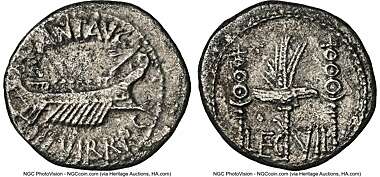
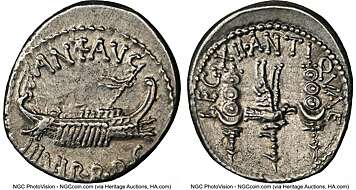
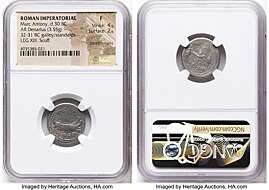
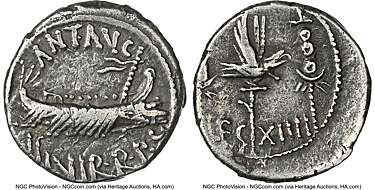
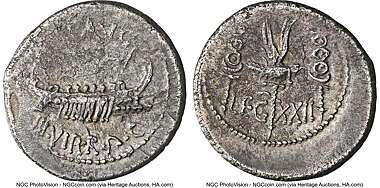
Lote 25201. Marc Antony (43-30 BC). AR denarius (18mm, 3.37 gm, 5h). NGC Choice VF 5/5 - 2/5, brushed. Legionary issue, mint traveling with Antony in Greece (Aegae or Patrae), 32-31 BC. ANT•AVG• / III•VIR•R•P•C, war galley under oar right with triple ram prow and scepter tied with fillet / LEG-VII, aquila between two signa. Crawford 544/20. Ex London Ancient Coins, VCoins (June 2023), private sale with dealer's tag included. Legio VII usually refers to Caesar’s Seventh, later VII Claudia, but Antony’s LEG VII requires separate treatment. Antony’s Seventh is generally regarded as a different formation from Caesar’s legion, which supported Octavian. VII Claudia was already serving under Caesar when he invaded Gaul in 58 BC. It fought against the Nervii, participated in his expeditions to Britain, and subsequently served against Pompey at Ilerda, Dyrrhachium, and Pharsalus. After its veterans were discharged, Octavian reconstituted the legion in 44 BC, employing it at Mutina, Philippi, and Perusia. Under the emperors, the Seventh garrisoned Tilurium in Dalmatia, in modern Croatia. In AD 42, it joined XI Claudia in rejecting Scribonianus’s rebellion against Claudius, earning the title Claudia Pia Fidelis—"Claudian, dutiful and faithful." Transferred to Moesia around AD 58, it eventually established its headquarters at Viminacium, near modern Kostolac in Serbia. It supported Vespasian in AD 69, fought in the Dacian Wars, and remained a Danubian garrison into late antiquity. Its emblems included a bull and a lion. Antony’s Seventh, named on his denarii of 32–31 BC as LEG VII, has almost no securely documented history beyond the coins. It was probably raised by Antony and disbanded after his defeat at Actium. HID05401242017 © 2026 Heritage Auctions | All Rights Reserved www.HA.com/TexasAuctioneerLicenseNotice
  • Precio de salida:
    1 USD
    0 EUR
    0 GBP
    0 CHF

    Importes redondeados, solo aproximadosFecha: 16/11/2026
Lote
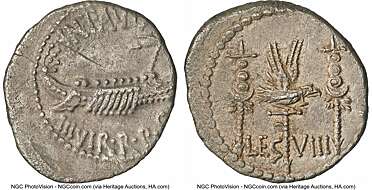
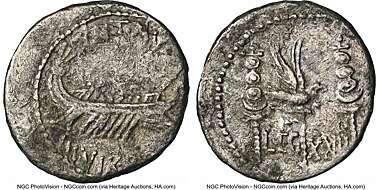
Lote 25202. Marc Antony (43-30 BC). AR denarius (19mm, 3.38 gm, 7h). NGC Choice AU 4/5 - 3/5, marks. Legionary issue, mint moving with Antony in Greece (Aegae or Patrae), ca. 32-31 BC. ANT•AVG / III•VIR•R•P•C, war galley under oar right with triple ram prow and scepter tied with fillet / LEG-VIII, aquila flanked by standard on either side. Crawford 544/21. Sydenham 1225. Antonia 114. Ex Marcantica, VCoins (23 June 2023), SKU ALAN039. Legio VIII is best known as VIII Augusta, one of Caesar’s veteran legions. However, the LEG VIII on Marc Antony’s denarii is generally regarded as a separate formation, since Caesar’s Eighth had joined Octavian. Caesar’s Eighth was already in service when he began the Gallic Wars in 58 BC. It fought against the Nervii in 57 BC and at Gergovia in 52 BC. During the civil war against Pompey, it suffered heavily at Dyrrhachium, then fought alongside the Ninth at Pharsalus in 48 BC. Veterans subsequently returned for Caesar’s African campaign before receiving land in Italy. Octavian reconstituted the legion in 44 BC. It fought against Antony at Mutina in 43 BC, against Caesar’s assassins at Philippi in 42 BC, and during the siege of Perusia. Under Augustus, it acquired the title Augusta and served in the Balkans. By the mid-first century AD, it was stationed at Novae, in modern Bulgaria. After supporting Vespasian during the civil wars of AD 69, VIII Augusta transferred west. It occupied Mirebeau-sur-Bèze before establishing its enduring headquarters at Argentoratum—modern Strasbourg—by around AD 90. There it guarded the Rhine frontier for centuries, remaining associated with Strasbourg into late antiquity. Antony’s Eighth, commemorated on denarii of 32–31 BC inscribed LEG VIII, is much less securely documented. It was probably an Antonian creation and apparently disappeared during the army reorganizations following Actium. Its coinage should therefore not automatically be assigned the campaign history of VIII Augusta. HID05401242017 © 2026 Heritage Auctions | All Rights Reserved www.HA.com/TexasAuctioneerLicenseNotice
  • Precio de salida:
    1 USD
    0 EUR
    0 GBP
    0 CHF

    Importes redondeados, solo aproximadosFecha: 16/11/2026
Lote
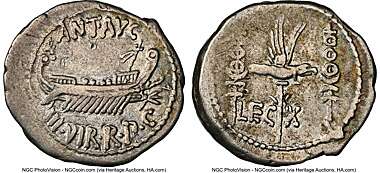
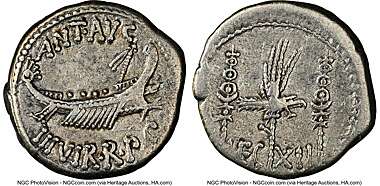
Lote 25203. Marc Antony (43-30 BC). AR denarius (19mm, 3.72 gm, 5h). NGC VF 5/5 - 2/5, bankers marks. Legionary issue, mint moving with Antony in Greece (Aegae or Patrae), 32-31 BC. ANT•AVG / III•VIR•R•P•C, war galley under oar right with triple ram prow and scepter tied with fillet / LEG-X, aquila right between two standards. Crawford 544/24. Ex Germania Inferior Numismatics, VCoins (May 2018), private sale with dealer's tag included. Legio X Equestris, later Gemina, was already serving when Caesar began his conquest of Gaul in 58 BC, and became his most trusted legion. It distinguished itself against the Nervii in 57 BC and participated in the invasion of Britain in 55 BC. Its title Equestris, meaning "mounted," is traditionally connected with Caesar temporarily mounting its infantry to escort him during negotiations with Ariovistus. Livius During the civil wars, it fought for Caesar at Pharsalus in 48 BC, in Africa, and at Munda in 45 BC. After discharge and reconstitution, it served the triumvirs at Philippi in 42 BC, then accompanied Marc Antony on his eastern campaigns. Following the Battle of Actium, it passed into Octavian’s army. Reorganized with soldiers from other formations, it became X Gemina, the "Twin Tenth." Under the emperors, X Gemina served in Spain, helped suppress the Batavian Revolt in AD 70, and garrisoned Nijmegen. It later moved to the Danube, eventually establishing itself at Vindobona—modern Vienna. It survived into the fifth century. Its emblem was a bull, prominently displayed on Gallienus’s legionary coins. The "twin" Legio X is Fretensis—the Tenth "of the Straits". Octavian raised this separate legion around 41–40 BC. Its title probably commemorated service around the Straits of Messina during the war against Sextus Pompeius. It subsequently served in Syria and became especially prominent in the Jewish War, participating in the capture of Jerusalem in AD 70 and the siege of Masada. Jerusalem remained its headquarters for generations. Later transferred to Aela, modern Aqaba, it was still recorded there around AD 400. Its emblems included a boar, dolphin, and warship. HID05401242017 © 2026 Heritage Auctions | All Rights Reserved www.HA.com/TexasAuctioneerLicenseNotice
  • Precio de salida:
    1 USD
    0 EUR
    0 GBP
    0 CHF

    Importes redondeados, solo aproximadosFecha: 16/11/2026
Lote
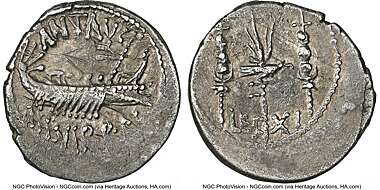
Lote 25204. Marc Antony (43-30 BC). AR denarius (18mm, 3.38 gm, 1h). NGC Choice VF 4/5 - 2/5, graffito, brushed. Legionary issue, mint moving with Antony in Greece (Aegae or Patrae), 32-31 BC. ANT•AVG / III•VIR•R•P•C, war galley under oar right with triple ram prow and scepter tied with fillet / LEG-XI, aquila flanked by standards. Crawford 544/25. Sydenham 1229. Ex Bertolami Fine Arts, E-Auction 105 (21 October 2021), lot 1840. Legio XI, later known as XI Claudia Pia Fidelis, was raised by Julius Caesar in 58 BC and survived into the early fifth century AD. Like XII Fulminata, it began in Caesar’s army, but its later history centered on the Balkans, the Rhine, and the lower Danube. The Eleventh fought in the Gallic Wars, including the battle against the Nervii in 57 BC. During Caesar’s civil war against Pompey, it served at Dyrrhachium and Pharsalus in 48 BC. Disbanded in 45 BC, its veterans received land around Bovianum in Italy. Octavian reconstituted the legion in 42 BC; it fought at Philippi, participated in the Perusine War, and later served on his side in the Actium campaign of 31 BC. Under the emperors, the legion settled at Burnum in Dalmatia, in modern Croatia. Its defining honor came in AD 42, when it refused to support the governor Scribonianus’s rebellion against Claudius. Together with the Seventh Legion, it received the title Claudia Pia Fidelis, meaning "Claudian, dutiful and faithful." During the Year of the Four Emperors, AD 69, XI Claudia initially supported Otho, then joined Vespasian and fought on the victorious side at the second battle of Bedriacum. After helping suppress the Batavian Revolt in AD 70, it moved to Vindonissa, modern Windisch in Switzerland, and served on the Rhine frontier. Under Trajan, it transferred to the Danubian theater and participated in the Dacian Wars. By AD 114, it was established at Durostorum, modern Silistra in Bulgaria, its headquarters for centuries. Detachments served as far afield as Judaea and the Crimea. It supported Septimius Severus in the civil wars and later received renewed honors for loyalty under Gallienus. The legion was still recorded guarding the lower Danube in the early fifth century; its ultimate fate is unknown. HID05401242017 © 2026 Heritage Auctions | All Rights Reserved www.HA.com/TexasAuctioneerLicenseNotice
  • Precio de salida:
    1 USD
    0 EUR
    0 GBP
    0 CHF

    Importes redondeados, solo aproximadosFecha: 16/11/2026
Lote
Lote 25205. Marc Antony (43-30 BC). AR denarius (18mm, 3.87 gm, 10h). NGC AU 5/5 - 4/5, brushed. Legionary issue, mint moving with Antony in Greece (Aegae or Patrae), ca. 32-31 BC. ANT•AVG / III•VIR•R•P•C, war galley under oar right with triple ram prow and scepter tied with fillet / LEG•XII•ANTIQVAE, aquila flanked by standard on either side. Crawford 544/9. Sydenham 1231. Ex Classical Numismatic Review, Volume XLVII, No 2 (Summer 2023), page 41, SKU 5644657; Classical Numismatic Group, Auction 123 (23 May 2023), lot 551. The identity of Legio XII Antiquae remains uncertain. It is often associated with Legio XII Fulminata, originally raised by Julius Caesar, with Antiqua perhaps emphasizing its veteran status or Caesarian origins. However, the designation is known only from the coinage, and that identification is unproven. Antony also issued denarii inscribed simply LEG XII, further complicating the relationship. HID05401242017 © 2026 Heritage Auctions | All Rights Reserved www.HA.com/TexasAuctioneerLicenseNotice
  • Precio de salida:
    1 USD
    0 EUR
    0 GBP
    0 CHF

    Importes redondeados, solo aproximadosFecha: 16/11/2026
Lote
Lote 25206. Marc Antony (43-30 BC). AR denarius (18mm, 3.36 gm, 9h). NGC Choice VF 4/5 - 3/5, marks. Legionary issue, mint traveling with Antony in Greece (Aegae or Patrae), 32-31 BC. ANT•AVG-III•VIR•R•P•C, war galley under oar right with triple ram prow and scepter tied with fillet / LEG-XXIII, aquila right between two standards. Crawford 544/39. Sydenham 1246. CRI 383. Ex Roma Numismatics, E-Sale 113 (28 September 2023), lot 750. Legio XXIII is known principally from Marc Antony's legionary denarii of 32–31 BC. It is the highest legionary number securely accepted in the series. Its foundation date, commanders, recruiting grounds, and individual campaigns are unknown. The legion was probably among the formations Antony raised for his struggle against Octavian. Its appearance on the coinage places it within his military establishment during preparations for the Actium campaign, but does not establish its precise role in the fighting. This legion appears to have been disbanded after Actium, since Augustus reorganized and consolidated the Roman army, with Legions XXII Deiotariana and XXII Primigenia afterwards holding the highest numbered legion, until XXX Ulpia Victrix was formed under Trajan in AD 105. HID05401242017 © 2026 Heritage Auctions | All Rights Reserved www.HA.com/TexasAuctioneerLicenseNotice
  • Precio de salida:
    1 USD
    0 EUR
    0 GBP
    0 CHF

    Importes redondeados, solo aproximadosFecha: 16/11/2026
Lote
Lote 25207. Marc Antony (43-30 BC). AR denarius (19mm, 3.71 gm, 6h). NGC VF 5/5 - 4/5. Legionary issue, mint moving with Antony in Greece (Aegae or Patrae), 32-31 BC. ANT•AVG / III•VIR•R•P•C, war galley under oar right with triple ram prow and scepter tied with fillet / LEG-XII, aquila flanked by standard on either side. Crawford 544/26. Sydenham 1230. Ex Germania Inferior Numismatics, VCoins (May 2018), private sale with dealer's tag included. Legio XII Fulminata—the "Thunderbolt Twelfth"—was raised by Julius Caesar in 58 BC and remained in service into the early fifth century AD. Its history spans the conquest of Gaul, Rome’s civil wars, and centuries of warfare on the eastern frontier. Its distinctive emblem was a thunderbolt. The Twelfth fought against the Nervii in 57 BC and supported Caesar against Pompey, including at Pharsalus in 48 BC. After its veterans were discharged, the legion was reconstituted and entered Marc Antony’s army, serving in his eastern campaigns. It is commonly identified with the XII Antiqua named on Antony’s legionary denarii, although that identification remains uncertain. After Antony’s defeat, it passed into Augustus’s army and eventually garrisoned Raphanaea in Syria. Its worst setbacks came under Nero. In AD 62, it surrendered alongside IV Scythica at Rhandeia, during the struggle with Parthia over Armenia. In AD 66, it accompanied Cestius Gallus’s unsuccessful expedition against Jerusalem. During the retreat, Roman forces suffered a crushing defeat at Beth Horon, where the Twelfth lost its eagle standard—a particularly serious disgrace. The legion subsequently participated in the later stages of the Jewish War. Around AD 70–71, it moved to Melitene, near modern Malatya in Turkey, guarding the Euphrates frontier. It served in campaigns involving Armenia and the Caucasus; an inscription in modern Azerbaijan records one of its centurions under Domitian. In AD 175, its loyalty during Avidius Cassius’s rebellion earned it the title Certa Constans, meaning approximately "steadfast and dependable." It remained associated with Melitene into late antiquity; its eventual disappearance is poorly documented. The legion also became famous in Christian tradition through the "rain miracle" during Marcus Aurelius’s wars, usually dated to AD 172 or 174. Christian writers credited soldiers’ prayers with bringing a storm that relieved a thirsty Roman army. The Twelfth’s precise involvement is uncertain, and its name Fulminata predates the episode—it was not awarded because of the miracle. HID05401242017 © 2026 Heritage Auctions | All Rights Reserved www.HA.com/TexasAuctioneerLicenseNotice
  • Precio de salida:
    1 USD
    0 EUR
    0 GBP
    0 CHF

    Importes redondeados, solo aproximadosFecha: 16/11/2026
Lote
Lote 25208. Marc Antony (43-30 BC). AR denarius (19mm, 3.55 gm, 7h). NGC Fine 4/5 - 2/5, bankers marks, scuff. Legionary issue, mint traveling with Antony in Greece (Aegae or Patrae), 32-31 BC. ANT•AVG• / III•VIR•R•P•C, war galley under oar right with triple ram prow and scepter tied with fillet / LEG-XIII, aquila between two signa. Crawford 544/27. Ex APMEX (September 2023), private sale, SKU 281792. Legio XIII is best known as Caesar’s Thirteenth, later XIII Gemina—the legion associated with his crossing of the Rubicon in 49 BC. Antony also issued coins naming LEG XIII, but that unit should not automatically be identified with Caesar’s legion, which subsequently served Octavian. Caesar raised the Thirteenth in 57 BC during the Gallic Wars. It served at Gergovia and probably Alesia, then accompanied him into Italy when civil war began. It fought at Dyrrhachium and Pharsalus in 48 BC and participated in his African campaign. After its discharge, veterans received land at Spello in Italy. Octavian reconstituted a Thirteenth around 41 BC for his struggle against Sextus Pompeius. Following Actium, it absorbed soldiers from other formations and became XIII Gemina, the "Twin Thirteenth." Under the emperors it served on the Rhine and Danube, supported Vespasian in AD 69, and eventually established its headquarters at Apulum—modern Alba Iulia in Romania—after Trajan’s conquest of Dacia. After Rome evacuated Dacia in the AD 270s, the legion moved to Ratiaria, in modern Bulgaria, where it remained attested into the early fifth century. Its distinctive emblem was a lion. Antony’s LEG XIII inscription securely identifies a Thirteenth in Antony’s army; but it does not establish continuity with XIII Gemina or justify assigning that legion’s campaigns to it. HID05401242017 © 2026 Heritage Auctions | All Rights Reserved www.HA.com/TexasAuctioneerLicenseNotice
  • Precio de salida:
    1 USD
    0 EUR
    0 GBP
    0 CHF

    Importes redondeados, solo aproximadosFecha: 16/11/2026
Lote
Lote 25209. Marc Antony (43-30 BC). AR denarius (16mm, 3.78 gm, 4h). NGC Choice VF 4/5 - 3/5, brushed. Legionary issue, mint traveling with Antony in Greece (Aegae or Patrae), 32-31 BC. ANT•AVG• / III•VIR•R•P•C, war galley under oar right with triple ram prow and scepter tied with fillet / LEG-XIIII, aquila between two signa. Crawford 544/28. Ex Roma Numismatics, E-Sale 110 (3 August 2023), lot 1149. The LEG XIIII on Antony’s denarii should be distinguished from Octavian’s Fourteenth, later XIV Gemina. Antony’s unit is poorly documented and apparently disappeared after Actium, either through disbandment or incorporation into other legions. The better-known XIV Gemina is traditionally connected with Caesar’s Fourteenth, raised around 57 BC. That earlier formation was destroyed by Ambiorix and the Eburones in the winter of 54–53 BC, then reconstituted. The precise continuity between Caesar’s legion and the Fourteenth subsequently serving Octavian remains uncertain. The title Gemina, meaning "twin," indicates a formation created by combining troops. Under the emperors, XIV Gemina served at Mainz before joining Claudius’s invasion of Britain in AD 43. Its most celebrated victory came during Boudicca’s revolt in AD 60–61, when it formed the core of Suetonius Paulinus’s victorious army. It earned the title Martia Victrix, approximately "warlike and victorious," and enjoyed an exceptional reputation under Nero. After further service on the Rhine, it transferred to the Danube and eventually established its headquarters at Carnuntum, east of modern Vienna. It strongly supported Septimius Severus in AD 193, contributing troops to his struggle for the throne. The legion remained associated with Carnuntum into the early fifth century. Its best-known emblem was Capricorn. HID05401242017 © 2026 Heritage Auctions | All Rights Reserved www.HA.com/TexasAuctioneerLicenseNotice
  • Precio de salida:
    1 USD
    0 EUR
    0 GBP
    0 CHF

    Importes redondeados, solo aproximadosFecha: 16/11/2026
Lote
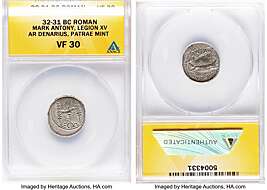
Lote 25210. Marc Antony, as Triumvir and Imperator (43-30 BC). AR denarius (19mm, 5h). ANACS VF30. Legionary issue, mint traveling with Antony in Greece (Aegae or Patrae), 32-31 BC. ANT•AVG• / III•VIR•R•P•C, war galley under oar right with triple ram prow and scepter tied with fillet / LEG-XV, aquila between two signa. Crawford 544/30. Ex Celeste Jones Mining, VCoins (May 2018), SKU 5004331. Legion XV Apollinaris, named for Octavian's protecting deity, was likely formed by Octavian prior to the Battle at Actium in 31 BC. It was under the command of Titus in Alexandria Egypt in AD 66, from where it was summoned to Judaea to restore order there in the Jewish uprising. It is this legion that captured the city of Jotopata after a 48 day siege, taking captive Yosef Ben Mattityahu, known as Josephus, Vespasian's famed historian. LEG XV remained in Judaea during the rebellion and was involved along with three other legions in the siege and destruction of Jerusalem and the Temple in AD 70. After the fall of Jerusalem, the legion participated in the Triumph Parade in Rome where the plundered treasures from the Jerusalem temple were displayed. It was then quickly reassigned to its home frontier along the Danube River. HID05401242017 © 2026 Heritage Auctions | All Rights Reserved www.HA.com/TexasAuctioneerLicenseNotice
  • Precio de salida:
    1 USD
    0 EUR
    0 GBP
    0 CHF

    Importes redondeados, solo aproximadosFecha: 16/11/2026
Lote
Lote 25211. Marc Antony (43-30 BC). AR denarius (17mm, 3.65 gm, 5h). NGC Choice XF 5/5 - 3/5, brushed. Legionary issue, mint traveling with Antony in Greece (Aegae or Patrae), 32-31 BC. ANT•AVG• / III•VIR•R•P•C, war galley under oar right with triple ram prow and scepter tied with fillet / LEG-XVI, aquila right between two signa. Crawford 544/31. Sydenham 1236. Ex Roma Numismatics, E-Sale 103 (24 November 2022), lot 926. The LEG XVI on Marc Antony’s denarii is generally regarded as a separate legion from the better-known XVI Gallica. Antony’s Sixteenth is otherwise poorly documented: its foundation, commanders, and individual campaigns are unknown. It may have been disbanded after Actium, but its fate is uncertain. XVI Gallica, by contrast, was probably raised by Octavian around 41–40 BC, during his struggle against Sextus Pompeius. Under Augustus, it transferred to the Rhine frontier, serving at Mainz and later moving to Novaesium—modern Neuss—around AD 43. Its title Gallica means "Gallic" or "of Gaul." During the Year of the Four Emperors, AD 69, XVI Gallica supported Vitellius. The subsequent Batavian Revolt overwhelmed Roman positions on the lower Rhine, and the legion surrendered in AD 70. Vespasian then abolished its old identity and reconstituted it as XVI Flavia Firma, meaning approximately "the steadfast Flavian Sixteenth." The reconstituted legion transferred east, initially serving at Satala and later at Samosata on the Euphrates. It participated in Rome’s wars against Parthia, including those of Trajan and Lucius Verus. Its soldiers also undertook major engineering projects, including the surviving Cendere Bridge under the Severan dynasty. By the fourth century, it was stationed at Sura in Syria, still guarding the Euphrates. Its emblem was a lion. HID05401242017 © 2026 Heritage Auctions | All Rights Reserved www.HA.com/TexasAuctioneerLicenseNotice
  • Precio de salida:
    1 USD
    0 EUR
    0 GBP
    0 CHF

    Importes redondeados, solo aproximadosFecha: 16/11/2026
Lote
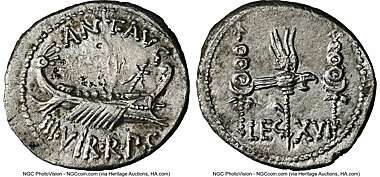
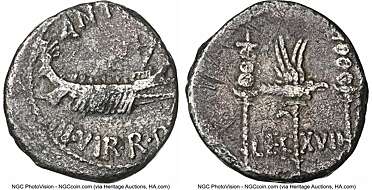
Lote 25212. Marc Antony (43-30 BC). AR denarius (19mm, 2.99 gm, 4h). NGC Choice VF 4/5 - 3/5, bankers mark. Legionary issue, mint moving with Antony in Greece (Aegae or Patrae), 32-31 BC. ANT•AVG• / III•VIR•R•P•C, war galley under oar right with triple ram prow and scepter tied with fillet / LEG-XVII, aquila right between two signa. Crawford 544/32. Sydenham 1237. Ex Künker, private sale with dealer's tag included; CGB Numismatique, VCoins, private sale with dealer's tag included. Legio XVII has two distinct histories: Antony’s Seventeenth, known from his legionary coins, and the imperial Seventeenth destroyed in Germany in AD 9. They are generally treated as separate formations, although their precise origins remain uncertain. www.livius.org Antony’s Legio XVII appears on denarii of 32–31 BC with the inscriptions LEG XVII and LEG XVII CLASSICAE. The title Classica means "naval" or "associated with the fleet," suggesting troops assigned to shipboard service, possibly comparable to marines. Beyond the coinage, its history is poorly documented. It apparently ceased to exist after Actium in 31 BC, when Octavian disbanded or absorbed many Antonian formations. The plain LEG XVII denarius is Crawford 544/32; the named CLASSICAE variety is 544/10. The imperial Legio XVII was probably raised by Octavian around 41–40 BC, during his struggle against Sextus Pompeius. It subsequently served on the Rhine and probably participated in the German campaigns of Drusus and Tiberius. Its honorary title, emblem, and exact sequence of bases are unknown. In September AD 9, it accompanied Publius Quinctilius Varus, together with XVIII and XIX, into the ambush organized by Arminius in the Teutoburg Forest region. All three legions were destroyed as effective military formations, and their eagle standards were captured. The standards were eventually recovered, but the legions were never reconstituted and their numbers were not reused. HID05401242017 © 2026 Heritage Auctions | All Rights Reserved www.HA.com/TexasAuctioneerLicenseNotice
  • Precio de salida:
    1 USD
    0 EUR
    0 GBP
    0 CHF

    Importes redondeados, solo aproximadosFecha: 16/11/2026
Lote
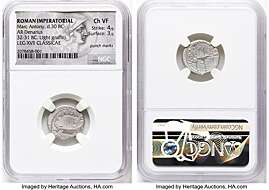
Lote 25213. Marc Antony (43-30 BC). AR denarius (17mm, 5h). NGC Choice VF 4/5 - 3/5, punch marks, light graffito. Legionary issue, mint traveling with Antony in Greece (Aegae or Patrae), 32-31 BC. ANT•AVG• / III•VIR•R•P•C, war galley under oar right with triple ram prow and scepter tied with fillet / LEG•XVII•CLASSICAE, aquila between two signa. Crawford 544/10. Ex APMEX (June 2018), private sale, SKU 1675757. Legio XVII Classicae was likely raised by Marc Antony during the final civil war of the Roman Republic ca. 32-31 BC to fight at sea. It was likely disbanded by Octavian and no legion with the name Classicae is known from the Imperial period. The term Classicae in this instance refers to regular army legions that were temporarily or permanently assigned to serve as marines aboard warships. HID05401242017 © 2026 Heritage Auctions | All Rights Reserved www.HA.com/TexasAuctioneerLicenseNotice
  • Precio de salida:
    1 USD
    0 EUR
    0 GBP
    0 CHF

    Importes redondeados, solo aproximadosFecha: 16/11/2026
Lote
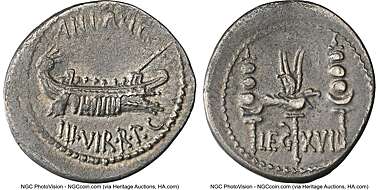
Lote 25214. Marc Antony (43-30 BC). AR denarius (17mm, 3.66 gm, 7h). NGC Choice Fine 4/5 - 3/5, marks. Legionary issue, mint moving with Antony in Greece (Aegae or Patrae), 32-31 BC. ANT•AVG• / III•VIR•R•P•C, war galley under oar right with triple ram prow and scepter tied with fillet / LEG-XVII, aquila right between two signa. Crawford 544/32. Sydenham 1237. Ex Mercantica, VCoins (January 2022), SKU ANPOI028. The imperial Seventeenth was probably raised by Octavian around 41–40 BC, when he needed troops against Sextus Pompeius, whose control of Sicily threatened Rome's grain supply. Its subsequent movements are largely reconstructed: it may have served in Gaul before transferring to the Rhine and participating in the German campaigns of Drusus and Tiberius. Its precise bases are uncertain. In September AD 9, the legion accompanied Publius Quinctilius Varus, together with XVIII and XIX, through Germania. A tribal coalition led by Arminius, a Cheruscan leader who had served Rome, ambushed the army and destroyed the three legions as effective fighting formations. Their eagle standards were captured and eventually recovered in later Roman campaigns. The legions were never reconstituted, and their numbers were not reused. HID05401242017 © 2026 Heritage Auctions | All Rights Reserved www.HA.com/TexasAuctioneerLicenseNotice
  • Precio de salida:
    1 USD
    0 EUR
    0 GBP
    0 CHF

    Importes redondeados, solo aproximadosFecha: 16/11/2026
Lote
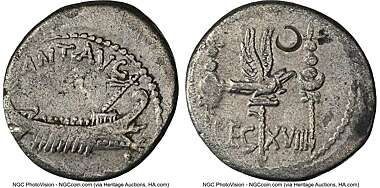
Lote 25215. Marc Antony (43-30 BC). AR denarius (18mm, 3.50 gm, 8h). NGC Choice Fine 4/5 - 2/5, bankers mark, brushed. Legionary issue, mint moving with Antony in Greece (Aegae or Patrae), 32-31 BC. ANT•AVG / III•VIR•R•P•C, war galley under oar right with triple ram prow and scepter tied with fillet / LEG-XVIII, aquila flanked by standard on either side. Crawford 544/33. Sydenham 1239. Ex Ancient Artifacts and Treasures, VCoins (8 August 2023), SKU JA0541. Legio XVIII has two histories to distinguish: Antony’s Eighteenth, including the unit titled Lybica, and the imperial Eighteenth destroyed with Varus in AD 9. They are generally treated as separate formations, although a connection cannot be entirely excluded. Antony’s Legio XVIII appears on his legionary denarii of 32–31 BC, both as LEG XVIII and LEG XVIII LYBICAE. The title Lybica indicates a North African association, probably reflecting recruitment there. Its foundation, commanders, and individual campaigns remain obscure. It apparently lost its separate identity after Actium in 31 BC, through disbandment or absorption into Octavian’s army. No imperial legion retained the title Lybica. The imperial Legio XVIII was probably raised by Octavian around 41–40 BC, during his struggle against Sextus Pompeius. It later transferred to the Rhine frontier and served in the German campaigns of Drusus and Tiberius. Its precise sequence of bases, honorary title, and emblem are unknown. In September AD 9, it was destroyed alongside XVII and XIX in the ambush organized by Arminius against Publius Quinctilius Varus. One especially poignant witness is the surviving cenotaph of Marcus Caelius, a centurion of XVIII whose inscription records that he "fell in the Varian War." His remains were never recovered. The legion was not reconstituted. HID05401242017 © 2026 Heritage Auctions | All Rights Reserved www.HA.com/TexasAuctioneerLicenseNotice
  • Precio de salida:
    1 USD
    0 EUR
    0 GBP
    0 CHF

    Importes redondeados, solo aproximadosFecha: 16/11/2026
Lote
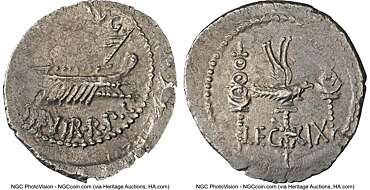
Lote 25216. Marc Antony (43-30 BC). AR denarius (20mm, 3.40 gm, 1h). NGC XF 3/5 - 4/5. Legionary issue, mint moving with Antony in Greece (Aegae or Patrae), 32-31 BC. ANT•AVG / III•VIR•R•P•C, war galley under oar right with triple ram prow and scepter tied with fillet / LEG-XIX, aquila flanked by standard on either side. Crawford 544/35. Sydenham 1242. Ex London Ancient Coins, VCoins (June 2023), private sale with dealer's tag included. Legio XIX has two histories to distinguish: Antony’s Nineteenth, commemorated on his coins, and the imperial Nineteenth destroyed in the Teutoburg Forest in AD 9. They are generally treated as separate formations, although their precise relationship remains uncertain. Antony’s Legio XIX appears on legionary denarii struck in 32–31 BC, during preparations for the Actium campaign. Its foundation, commanders, and individual campaigns are unknown. It probably lost its separate identity after Antony’s defeat, through disbandment or absorption into other formations. The imperial Legio XIX was probably raised by Octavian around 41–40 BC, when he needed troops against Sextus Pompeius. Some veterans were settled near Pisa in 30 BC. Archaeological evidence subsequently places the legion at Dangstetten on the Upper Rhine, around 15–8 BC, and at Haltern in Germania. It served in the northern campaigns associated with Rome’s attempted expansion beyond the Rhine. Its honorary title and emblem are unknown. In September AD 9, XIX accompanied Publius Quinctilius Varus, together with XVII and XVIII, into the ambush organized by Arminius. The three legions were destroyed as effective fighting formations. In AD 15, during Germanicus’s retaliatory campaigns, Lucius Stertinius recovered the Nineteenth’s eagle from the Bructeri. The legion was never reconstituted, and its number was not reused. HID05401242017 © 2026 Heritage Auctions | All Rights Reserved www.HA.com/TexasAuctioneerLicenseNotice
  • Precio de salida:
    1 USD
    0 EUR
    0 GBP
    0 CHF

    Importes redondeados, solo aproximadosFecha: 16/11/2026
Lote
Lote 25217. Marc Antony (43-30 BC). AR denarius (18mm, 3.44 gm, 5h). NGC VF 4/5 - 2/5, edge smoothing. Legionary issue, mint moving with Antony in Greece (Aegae or Patrae), 32-31 BC. ANT•AVG / III•VIR•R•P•C, war galley under oar right with triple ram prow and scepter tied with fillet / LEG-XX, aquila flanked by standard on either side. Crawford 544/36. Sydenham 1243. Ex Münzhandlung Ritter, VCoins (May 2023), private sale with dealer's tag included. Legio XX requires a distinction between Antony’s Twentieth, known from his coins, and the later imperial XX Valeria Victrix, famous for its service in Britain. A connection between them is possible, but unproven. Almost nothing is securely known about Antony's Legio XX foundation, commanders, or campaigns. It has been suggested that surviving soldiers entered Octavian’s Twentieth after Actium, but this remains a reconstruction. XX Valeria Victrix emerged during the Augustan period, although its precise origins are uncertain. It served in the Cantabrian Wars in Spain, then transferred to the Balkans, distinguishing itself during the Pannonian revolt of AD 6–9. Following the destruction of Varus’s army, it moved to the Rhine frontier and participated in Germanicus’s campaigns. In AD 43, the Twentieth joined Claudius’s invasion of Britain. It helped defeat Boudicca’s revolt in AD 60–61, later participated in Agricola’s northern campaigns, and eventually established its enduring headquarters at Deva—modern Chester. Its soldiers contributed to both Hadrian’s Wall and the Antonine Wall. Its best-known emblem was a charging boar. The legion remained active in Britain during the late third century, including the period of Carausius and Allectus. Its subsequent fate is uncertain; its disappearance from the evidence does not establish when or how it was disbanded. HID05401242017 © 2026 Heritage Auctions | All Rights Reserved www.HA.com/TexasAuctioneerLicenseNotice
  • Precio de salida:
    1 USD
    0 EUR
    0 GBP
    0 CHF

    Importes redondeados, solo aproximadosFecha: 16/11/2026
Lote
Lote 25218. Marc Antony (43-30 BC). AR denarius (20mm, 3.54 gm, 1h). NGC Choice VF 4/5 - 3/5. Legionary issue, mint moving with Antony in Greece (Aegae or Patrae), 32-31 BC. ANT•AVG / III•VIR•R•P•C, war galley under oar right with triple ram prow and scepter tied with fillet / LEG-XXII, aquila flanked by standard on either side. Crawford 544/38. Sydenham 1245. Ex Den of Antiquity, VCoins (May 2023), private sale with dealer's tag included. The LEG XXII on Marc Antony’s denarii is generally treated as an obscure Antonian legion, distinct from the later XXII Deiotariana and XXII Primigenia. Its foundation, commanders, and individual campaigns are unknown. It apparently ceased to exist after Actium, with surviving soldiers discharged or incorporated into other formations. Although some auction descriptions identify it with Deiotariana, that connection is unproven and should not be assumed. The two better-documented imperial Twenty-Second Legions had separate histories: - XXII Deiotariana originated in the Roman-trained army of King Deiotarus of Galatia. Its predecessors fought alongside Caesar at Zela in 47 BC. Following Rome’s annexation of Galatia in 25 BC, the formation entered the imperial army and eventually garrisoned Alexandria in Egypt. Detachments served in the Jewish War, and the legion supported Vespasian in AD 69. It disappears from the record during the second century; destruction during the Bar Kokhba revolt is one proposed explanation, rather than an established fact. - XXII Primigenia was raised by Caligula in AD 39 for service in Germania. Its title honored Fortuna Primigenia. Closely associated with Mainz, it supported Vitellius in AD 69, survived the Batavian Revolt, and continued serving on the Rhine into the fourth century. It therefore could not have been the legion named on Antony’s coins. HID05401242017 © 2026 Heritage Auctions | All Rights Reserved www.HA.com/TexasAuctioneerLicenseNotice
  • Precio de salida:
    1 USD
    0 EUR
    0 GBP
    0 CHF

    Importes redondeados, solo aproximadosFecha: 16/11/2026
Lote
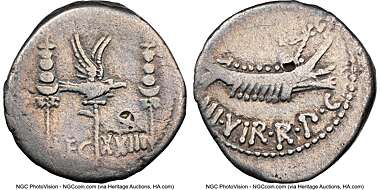
Lote 25219. Marc Antony (43-30 BC). AR denarius (17mm, 3.60 gm, 6h). NGC Choice Fine 3/5 - 2/5, bankers marks, brushed, light scratches. Legionary issue, mint traveling with Antony in Greece (Aegae or Patrae), 32-31 BC. ANT•AVG-III•VIR•R•P•C, war galley under oar right with triple ram prow and scepter tied with fillet / LEG-XXIII, aquila right between two standards. Crawford 544/39. Sydenham 1246. CRI 383. Ex Art of Money, private sale with dealer's tag included. XXIII was the highest number securely known to have been given to a legion within Marc Antony's order of battle. This legion appears to have been disbanded after Actium, since Augustus reorganized and consolidated the Roman army, with Legions XXII Deiotariana and XXII Primigenia afterwards holding the highest numbered legion, until XXX Ulpia Victrix was formed under Trajan in AD 105. HID05401242017 © 2026 Heritage Auctions | All Rights Reserved www.HA.com/TexasAuctioneerLicenseNotice
  • Precio de salida:
    1 USD
    0 EUR
    0 GBP
    0 CHF

    Importes redondeados, solo aproximadosFecha: 16/11/2026
Lote
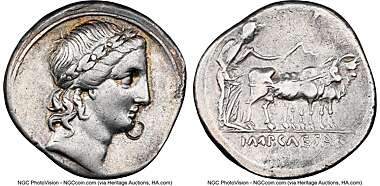
Lote 25220. Octavian, as Imperator (ca. 33-30 BC). AR denarius (19mm, 7h). NGC VF 5/5 - 3/5, bankers mark, brushed. Italian mint, ca. 30-29 BC. Laureate head of Apollo right, linear border / IMP CAESAR, Octavian driving team of yoked oxen right. RIC I 272. From the WCN Collection. Ex Palladium Numismatics, private sale with dealer's tag included. Born on 23 September 63 BC into a wealthy plebeian family, Augustus, originally Gaius Octavius, was the grandnephew and posthumously adopted son of Julius Caesar. This inheritance set him on a collision course with Rome's political elite, leading to the formation of the Second Triumvirate with Marc Antony and Marcus Aemilius Lepidus. Their initial unity against Caesar's assassins eventually gave way to conflict, from which Augustus emerged as Rome's first true emperor after victories in key battles like Philippi and Actium. In 27 BC, he was honored with the title "Augustus" by the Senate, signaling the start of his reign and the Pax Romana, a golden era of peace, prosperity, and cultural flourishing that lasted over two centuries. HID05401242017 © 2026 Heritage Auctions | All Rights Reserved www.HA.com/TexasAuctioneerLicenseNotice
  • Precio de salida:
    1 USD
    0 EUR
    0 GBP
    0 CHF

    Importes redondeados, solo aproximadosFecha: 16/11/2026
Lote
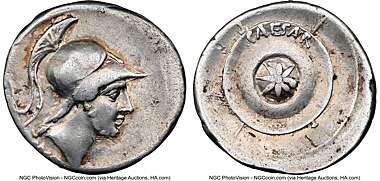
Lote 25221. Octavian, as Imperator (ca. 33-30 BC). AR denarius (19mm, 3.63 gm, 7h). NGC Choice Fine 4/5 - 2/5, scratches. Uncertain Italian mint (Rome or Brundisium?), ca. 30-29 BC. IMP, helmeted head of Mars right / CAESAR, legend around shield decorated with eight-pointed star in center, lying on crossed spear and sword. RIC I 274 (ca. 29-27 BC). From the WCN Collection. Ex Munz Zentrum, private sale with dealer's tag included. Born on 23 September 63 BC into a wealthy plebeian family, Augustus, originally Gaius Octavius, was the grandnephew and posthumously adopted son of Julius Caesar. This inheritance set him on a collision course with Rome's political elite, leading to the formation of the Second Triumvirate with Marc Antony and Marcus Aemilius Lepidus. Their initial unity against Caesar's assassins eventually gave way to conflict, from which Augustus emerged as Rome's first true emperor after victories in key battles like Philippi and Actium. In 27 BC, he was honored with the title "Augustus" by the Senate, signaling the start of his reign and the Pax Romana, a golden era of peace, prosperity, and cultural flourishing that lasted over two centuries. HID05401242017 © 2026 Heritage Auctions | All Rights Reserved www.HA.com/TexasAuctioneerLicenseNotice
  • Precio de salida:
    1 USD
    0 EUR
    0 GBP
    0 CHF

    Importes redondeados, solo aproximadosFecha: 16/11/2026
Lote
Lote 25222. GAUL. Lugdunum (Copia). Octavian, as Imperator and Triumvir (43-33 BC), with Divus Julius Caesar. AE dupondius (32mm, 16.12 gm, 11h). NGC VF 4/5 - 4/5, edge chips. Ca. 36 BC(?). IMP•CAESAR•DIVI•F•DIVI•IVLI•, adduced heads of laureate Divus Julius Caesar left, and bare head of Octavian right; upright palm between / COPIA, prow of ship right, decorated with eye and dolphin right; globe and meta above. RPC 515. HID05401242017 © 2026 Heritage Auctions | All Rights Reserved www.HA.com/TexasAuctioneerLicenseNotice
  • Precio de salida:
    1 USD
    0 EUR
    0 GBP
    0 CHF

    Importes redondeados, solo aproximadosFecha: 16/11/2026
Lote
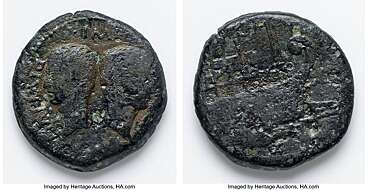
Lote 25223. GAUL. Vienne. Octavian, as Imperator (43-27 BC), with Divus Julius Caesar. AE dupondius (30mm, 18.24 gm, 1h). Fine. Ca. 36 BC. •IMP• / •CAESAR• / DIVI•IVLI / DIVI•F, back-to-back bare heads of Julius Caesar left (on right) and Octavian right (on left) / C•I•V, prow of quinquereme right. RPC I 517. Ex Joel Malter Galleries (7 December 1964), private sale. Collectors envelope included. Born on 23 September 63 BC into a wealthy plebeian family, Augustus, originally Gaius Octavius, was the grandnephew and posthumously adopted son of Julius Caesar. This inheritance set him on a collision course with Rome's political elite, leading to the formation of the Second Triumvirate with Marc Antony and Marcus Aemilius Lepidus. Their initial unity against Caesar's assassins eventually gave way to conflict, from which Augustus emerged as Rome's first true emperor after victories in key battles like Philippi and Actium. In 27 BC, he was honored with the title "Augustus" by the Senate, signaling the start of his reign and the Pax Romana, a golden era of peace, prosperity, and cultural flourishing that lasted over two centuries. HID05401242017 © 2026 Heritage Auctions | All Rights Reserved www.HA.com/TexasAuctioneerLicenseNotice
  • Precio de salida:
    1 USD
    0 EUR
    0 GBP
    0 CHF

    Importes redondeados, solo aproximadosFecha: 16/11/2026
Lote
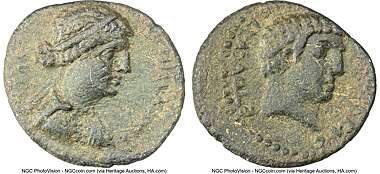
Lote 25224. PTOLEMAIC EGYPT. Cleopatra VII and Marc Antony, rulers of the East (37-31 BC). AE (21mm, 5.37 gm, 11h). NGC XF 4/5 - 3/5. Coele Syria, Chalcis, 32/31 BC. BACIΛICCHC KΛEOΠATPAC, diademed, draped bust of Cleopatra right / ΕΤΟΥC ΚΑ ΤΟΥ ΚΑΙ Ϛ ΘΕΑC ΝΕΩΤΕΡΑC, bare head of Mark Antony right. RPC I 4771. This type reflects an important period in the history between Rome and Egypt. Marc Antony was overseeing the eastern territories of Rome before Octavian (Augustus) deemed himself sole emperor. In response, Antony joined allies with Cleopatra to challenge the encroaching imperial power of Rome. The two would rule Egypt together, portrayed as equals in coins such as this. The portraits share physical characteristics: a portraiture type with Hellenistic influence that demonstrated shared power, often between male and female rulers. This would solidify Antony's position as an eastern ruler and Cleopatra's position as a powerful ruler in contradiction to Rome's patriarchal political space. HID05401242017 © 2026 Heritage Auctions | All Rights Reserved www.HA.com/TexasAuctioneerLicenseNotice
  • Precio de salida:
    1 USD
    0 EUR
    0 GBP
    0 CHF

    Importes redondeados, solo aproximadosFecha: 16/11/2026
La configuración de privacidadLa configuración de privacidad